REVIEW 3 major objections 3 minor 45 references
Quantum-Circuit-Based Visual Fractal Image Generation in Qiskit and Analytics
T0 review · 3 major / 3 minor · reviewed 2026-08-05 · deepseek-v4-flash
Pith's one-line read Measurement probabilities from a four-qubit circuit seed Julia-set parameters, generating 1000 fractal images that cluster into three visual families.
desk verdict A visually nice pipeline whose central claim—quantum randomness driving the fractals—is unverifiable as written, because the mapping from circuit outputs to Julia parameters is never given. read the letter →
The pith
A machine-rendered reading of the paper's core claim, the machinery that carries it, and where it could break.
The reading
What carries the argument
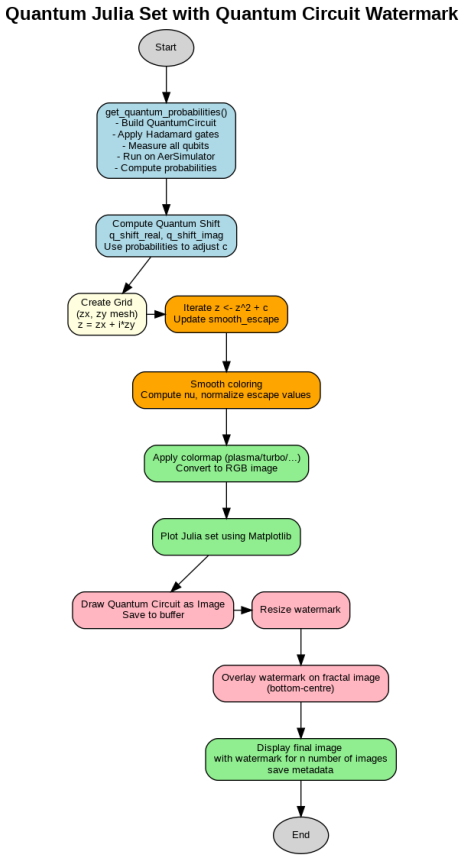
The load-bearing object is the randomized four-qubit measurement circuit: its shot statistics supply quantum randomness that is fed into the Julia-set parameters. The paper uses a superposition-and-entanglement circuit over four qubits, measured with 2048 simulator shots; the resulting probability distribution is the seed that perturbs the complex constant c in the Julia iteration z_{n+1}=z_n^2+c. Escape-time iteration with smoothing (via 'nu' and normalization) turns each parameter choice into a smoothly colored fractal image, and the same pipeline is extended to GHZ-, Grover-like, and Shor-like circuits on 10 qubits.
What would settle it
A concrete test: take the exact four-qubit circuit, replace its measured probabilities with draws from a classical pseudorandom generator matched to the same marginal distributions, and regenerate the 1000 images; if the resulting dataset and its three clusters are statistically indistinguishable from the quantum-seeded one, then quantum randomness is not load-bearing. Alternatively, locating the missing mapping in the code: if the shot-to-parameter function is not defined, the pipeline cannot be reproduced and there is no quantum-specific content to test.
Extended reading notes
Core claim
The paper's central claim is that a randomized four-qubit quantum circuit, built from Hadamard, rotation, and CNOT gates, can drive Julia-set image generation: the 2048-shot measurement probabilities from the circuit are taken to 'gently disturb' the complex constant c (and related parameters) that controls the Julia iteration zn+1 = zn^2 + c. From 1000 such images, with escape-time rendering and smooth gradients, the pipeline extracts two fractal features—fractal dimension and lacunarity—and, after PCA, applies K-means clustering. The result is a three-cluster structure: dense, low-lacunarity images dominate; sparse dendritic images are rare; intermediate structures are rarest. The analysis
Load-bearing premise
Load-bearing premise: the mapping from circuit measurement probabilities to the Julia parameters (c_real, c_imag, power, depth) exists and is what makes the generated images 'quantum'; if that mapping is arbitrary, undisclosed, or equivalent to a classical random seed, the paper's central novelty collapses.
Editorial extensions
If this is right
- A quantum circuit can act as a practical generator for a large synthetic image dataset, complete with metadata, without requiring a physical quantum device.
- Unsupervised analytics on such datasets is viable: K-means on PCA-reduced fractal features recovers three interpretable clusters, so quantum-seeded fractals are not noise-like but have latent structure.
- Because fractal dimension is nearly constant across clusters while lacunarity and power separate them, the visual diversity of the quantum-generated images is carried by texture, gaps, and rendering intensity rather than by overall space-filling dimension.
- The extension to GHZ-, Grover-like, and Shor-like circuits indicates that different circuit families imprint different visual landscapes—periodic, stable-basin, and chaotic-like—suggesting circuit design itself is a tunable artistic parameter.
- The approach positions simulation-shot randomness as a candidate ingredient for quantum generative art and for synthetic data pipelines in image-oriented machine-learning tasks.
Reading between the lines
- The paper never specifies the function that maps shot counts or probabilities to c_real, c_imag, power, and depth; until that mapping is published, the 'quantum' step is not distinguishable from a classical pseudorandom seed. My inference: a control experiment rerunning the pipeline with a classical RNG is the direct test of the novelty claim.
- The reported perfect anti-correlation between c_real and c_imag and the near-constant fractal dimension suggest the generative pipeline actually samples a low-dimensional slice of parameter space; the '1000 images' may therefore represent a smaller family of distinct fractals than the count suggests.
- Since clustering separates on lacunarity and power, a natural next step is to check whether raw-pixel classifiers or multifractal spectra recover the same three classes, or whether the cluster structure is an artifact of the rendering process rather than the quantum parameters.
Editorial analysis
A structured set of objections, weighed in public.
Referee Report
Summary. The paper claims a novel pipeline: Qiskit quantum circuits (four qubits, 2048 simulator shots) are used to produce 'quantum randomness' that seeds parameters of Julia-set fractal generation (c_real, c_imag, power, depth). One thousand images and a metadata CSV are generated; fractal dimension and lacunarity are extracted, followed by PCA and K-means clustering, yielding three clusters. The stated contribution is quantum-circuit-based generation of a synthetic fractal image dataset with classifiable structure. The manuscript contains a workflow diagram, sample circuit/density-matrix/Bloch-sphere visualizations, example images, and descriptive analytics, but it does not ship code, data, or a precise generative mapping.
Significance. If the missing mapping were supplied and validated, the pipeline would be a modest but legitimate demonstration of quantum measurement randomness seeding a synthetic image dataset, with potential interest for quantum generative art. The paper deserves credit for presenting an end-to-end visual pipeline (Figs. 1-16) and for using standard Julia iteration (Eq. 1) with PCA/K-means analytics. However, the quantum component is currently indistinguishable from a classical random seed, no reproducibility artifacts are provided, and the reported parameter relationships contain unexplained artifacts. The significance is therefore prospective, not established.
major comments (3)
- [Section III, Figs. 2-3] The central generation step is never specified. The text states only that 2048-shot quantum probabilities 'gently disturb' the Julia shape determined by c, but no equation or algorithm maps the 16 measurement-count outcomes (or the seed/probs_sha1 columns shown in Table I) to c_real, c_imag, power, and depth. Without this mapping, the paper cannot support the central claim that circuit randomness rather than a classical pseudo-random generator produced the images, and the work is not reproducible from the manuscript. This gap is load-bearing: every image and every downstream cluster depends on the unspecified function.
- [Fig. 8 and Table I] The reported exactly -1 correlation between c_real and c_imag is unexplained and is a red flag for the 'quantum randomness' claim. A measure-zero coincidence for 1000 independent draws would require exact linear dependence; the authors' parenthetical 'perhaps as a result of standardization or dataset design' admits as much, but no standardization or construction is described. Table I adds further confusion: power_x values are ~10^10 while power_y is always 2; the PCA columns (PC1/PC2 vs pca1/pca2) are duplicated; and the row 'Cluster' (2,1,2) contradicts the row 'cluster_label' (2,1,0). These inconsistencies make the parameter semantics unclear.
- [Section III.A, Figs. 14-16] The K-means clustering is purely descriptive: there is no silhouette/gap/validity measure, no statement of preprocessing/standardization, and no connection of cluster membership back to the quantum circuit parameters. The claim that 'dense, low-lacunarity structures are favored' and that 'the parameter space for intermediate structures is small' is an interpretation of the same data used to build the clusters, not an independent finding. The cluster labels in Table I/II also do not align with the reported visual characterizations (e.g., Cluster 0 and Cluster 2 have nearly identical fractal dimension).
minor comments (3)
- [Table I] Formatting and column semantics need cleanup: duplicate pca columns, inconsistent cluster labels, and illegible large exponents should be resolved. A caption should define every column, especially power_x vs power_y and probs_sha1.
- [Section V, Fig. 17] The GHZ/Grover-like/Shor-like extension is presented without any methodology, circuit definitions, or quantitative analysis; the Conclusion itself uses 'prima facie.' Either remove or substantiate with actual experiments and metrics.
- [Throughout] The manuscript has numerous grammar and typographical issues (e.g., 'the root where lies to the using', 'C_real and C_imag indicates', 'The' alone on a line). Reference [17] appears to be mis-cited for the Penrose impossible-figures work. A careful language and reference pass is needed regardless of the technical revisions.
Circularity Check
No significant circularity found; the main gap is an unspecified parameter mapping, a reproducibility/novelty issue rather than a circular derivation.
full rationale
The paper's derivation chain is descriptive rather than inferential. The only mathematical equation is the standard Julia iteration Zn+1 = Zn^2 + c (Eq. 1), and no parameter is fitted to a target or used to predict a held-out quantity. The claimed novelty is that Qiskit circuit measurement probabilities and shots influence the Julia parameters (c_real, c_imag, power, depth), but the exact mapping from the 2048-shot outcome distribution to these parameters is never specified. This is an under-specified, unreproducible generative scheme, not a circular reduction: the generated images are outputs of the procedure, not inputs used to define the procedure. Similarly, the K-means/PCA clustering is applied to features extracted from the already-generated images, and the resulting clusters are descriptive summaries of the same dataset; the paper does not claim that these clusters validate the quantum generation method against an external benchmark. There are no load-bearing self-citations, no imported uniqueness theorems, and no fitted parameter renamed as a prediction. The observed exact c_real/c_imag correlation of -1 and the unusual power values suggest possible construction constraints, but that concerns data-generation validity rather than circularity. Overall, the central claim may be weak or incomplete, but it does not reduce to its own inputs by construction.
Assumptions & free parameters
free parameters (3)
- Julia constant c ranges =
c_real ~ -0.73 to -0.67, c_imag ~ 0.24 to 0.30 (from Table I sample)
- Qiskit shots =
2048
- power and depth =
power ~1e10, depth 2-4
assumptions (3)
- standard math The Julia set iteration Z_{n+1}=Z_n^2+c with escape-time criterion generates valid fractals.
- domain assumption Qiskit simulator measurement outcomes are treated as a source of quantum randomness.
- ad hoc to paper Entanglement visible in the density matrix (Fig. 5) materially influences the generated fractal patterns.
Cite this review
Pith. "Pith review of Quantum-Circuit-Based Visual Fractal Image Generation in Qiskit and Analytics." pith.science (2026). https://pith.science/paper/4V6LJYTI
@misc{pith2026250818835,
  author       = {Pith},
  title        = {Pith review of: Quantum-Circuit-Based Visual Fractal Image Generation in Qiskit and Analytics},
  year         = {2026},
  howpublished = {\url{https://pith.science/paper/4V6LJYTI}},
  note         = {Machine review of arXiv:2508.18835}
}
read the original abstract
As nature is ascribed as quantum, the fractals also pose some intriguing appearance which is found in many micro and macro observable entities or phenomena. Fractals show self-similarity across sizes; structures that resemble the entire are revealed when zoomed in. In Quantum systems, the probability density or wavefunction may exhibit recurring interference patterns at various energy or length scales. Fractals are produced by basic iterative rules (such as Mandelbrot or Julia sets), and they provide limitless complexity. Despite its simplicity, the Schr\"odinger equation in quantum mechanics produces incredibly intricate patterns of interference and entanglement, particularly in chaotic quantum systems. Quantum computing, the root where lies to the using the principles of quantum-mechanical phenomenon, when applied in fractal image generation, what outcomes are expected? The paper outlines the generation of a Julia set dataset using an approach coupled with building quantum circuit, highlighting the concepts of superposition, randomness, and entanglement as foundational elements to manipulate the generated dataset patterns. As Quantum computing is finding many application areas, the possibility of using quantum circuits for fractal Julia image generation posits a unique direction of future research where it can be applied to quantum generative arts across various ecosystems with a customised approach, such as producing an exciting landscape based on a quantum art theme.
Figures


Figures from the paper (14 more)


Reference graph
Works this paper leans on
-
[1]
Quantum Randomness for Julia Parameters This step ensures that every fractal created is distinct and impacted by quantum randomness, transforming the image from a deterministic Julia set into a work of art inspired by quantum mechanics. Here, we use quantum probabilities to gently disturb the Julia fractal's shape, which is determined by the constant c. T...
-
[2]
Fractal Computation (Julia Set) It uses the escape -time algorithm, a well -known method for creating fractals. use smoothing (via nu and normalization) instead of blocky iterations to create a high-quality, gradient-colored fractal. Fractal art galleries frequently employ this to provide visual smoothness. Fig. 3. Four-qubit system quantum circuit with d...
work page 2011
-
[3]
Schrödinger, Physique quantique et représentation du monde
E. Schrödinger, Physique quantique et représentation du monde . Éditions du Seuil, 1992
work page 1992
-
[4]
Entangled? Frieder Nake’s Probabilities Versus Quantum Computing Artistic Research
G. Robillard and A. Lioret, “Entangled? Frieder Nake’s Probabilities Versus Quantum Computing Artistic Research”
-
[5]
Simulating Physics with Computers,
R. P. Feynman, “Simulating Physics with Computers,” vol. 21, pp. 467–488, 1982
work page 1982
-
[6]
Quantum music, quantum arts and their perception,
V. Putz and K. Svozil, “Quantum music, quantum arts and their perception,” in Quantum Computing in the Arts and Humanities: An Introduction to Core Concepts, Theory and Applications , Springer, 2022, pp. 179–191
work page 2022
-
[7]
A. Lioret, “Quantum art,” Expressive 2016; Proc. Jt. Symp. Comput. Aesthet. Sketch Based Interfaces Model. Non - Photorealistic Animat. Render. , pp. 135 –139, 2016, doi: 10.2312/exp.20161072
-
[8]
Z. JIE, S. Dalal, M. S. Bin Abu Bakar, and W. A. Wan Yahaya, “Artistic Creation of Cultural Sustainability and Interactive Creativity through Three-Dimensional Animation,” J. Creat. Arts, vol. 1, no. 1, pp. 130–144, 2024, doi: 10.24191/jca.v1i1.1475
Show all 45 references
-
[9]
20, 2025
IBM Qiskit, “UGate.” Accessed: Apr. 20, 2025. [Online]. Available: https://docs.quantum.ibm.com/api/qiskit/qiskit.circuit.library.UG ate
2025
-
[10]
Metaphors for Abstract Concepts: Visual Art and Quantum Mechanics,
L. Stone, “Metaphors for Abstract Concepts: Visual Art and Quantum Mechanics,” Stud. Res., vol. 1, no. 2, pp. 14–29, 2014
2014
-
[11]
Re-Visioning Reality: Quantum Superposition in Visual Art,
L. Stone, “Re-Visioning Reality: Quantum Superposition in Visual Art,” vol. 51, no. 2, pp. 111–117, 2018, doi: 10.1162/LEON
2018 doi
-
[12]
Art by Quantum Entanglement
Russell Huffman, “Art by Quantum Entanglement.” [Online]. Available: https://medium.com/@jrussellhuffman/art -by- quantum-entanglement-5c3bbafb2400
-
[13]
Quantum computing inspired paintings: reinterpreting classical masterpieces,
A. Crippa, Y. Chai, O. C. Hamido, P. Itaborai, and K. Jansen, “Quantum computing inspired paintings: reinterpreting classical masterpieces,” pp. 1 –10, 2024, [Online]. Available: http://arxiv.org/abs/2411.09549
2024 arXiv
-
[14]
REFIK ANADOL Quantum Memories
“REFIK ANADOL Quantum Memories.” [Online]. Available: https://www.ngv.vic.gov.au/refik-anadol-quantum- memories/#:~:text=PROJECT Commissioned by the NGV%2C,work uses the data to
-
[15]
a new set of affordances
that the fundamental characteristics of QC (superposition, entanglement, and interference) provide "a new set of affordances" for art, making quantum media as different from traditional digital art as photography is from painting. Quantum physicist-turned-artist Libby Heaney u...
1980
-
[16]
Quantum image processing and its application to edge detection: Theory and experiment,
X. W. Yao et al., “Quantum image processing and its application to edge detection: Theory and experiment,” Phys. Rev. X, vol. 7, no. 3, pp. 1–14, 2017, doi: 10.1103/PhysRevX.7.031041
2017 doi
-
[17]
Quantum Generative Art
Dongyang Li, “Quantum Generative Art.” [Online]. Available: https://iqparc.northwestern.edu/quantum-generative- art/#:~:text=Utilizing a quantum computer and,Blender and Unreal Engine 5
-
[18]
There’s A Burgeoning Quantum Art Scene
Russell Huffman, “There’s A Burgeoning Quantum Art Scene.” [Online]. Available: https://medium.com/qiskit/theres -a- burgeoning-quantum-art-scene-76119cca7144
-
[19]
The Interview | Libby Heaney,
L. Heaney, “The Interview | Libby Heaney,” 2025. [Online]. Available: https://www.rightclicksave.com/article/the -interview- libby-heaney#:~:text=In 2021%2C I used one,augmented
2025
-
[20]
On the cohomology of Impossible Figures,
R. Penrose, “On the cohomology of Impossible Figures,” Adv. Math. (N. Y). , vol. 454, pp. 11 –16, 2024, doi: 10.1016/j.aim.2024.109868
2024
-
[21]
Impossible object - Wikipedia
“Impossible object - Wikipedia.” Accessed: Jul. 20, 2025. [Online]. Available: https://en.wikipedia.org/wiki/Impossible_object
2025
-
[22]
Art makes quantum intuitive,
G. Cattan, K. Duś, S. Kusmia, and T. Stopa, “Art makes quantum intuitive,” Front. Quantum Sci. Technol., vol. 3, no. May, pp. 1–4, 2024, doi: 10.3389/frqst.2024.1397130
2024
-
[23]
E. R. Miranda, Quantum Computing in the Arts and Humanities: An Introduction to Core Concepts, Theory and Applications. 2022. doi: 10.1007/978-3-030-95538-0
2022 doi
-
[24]
Jie; and E
Z. Jie; and E. Al, Interaction & Interference: Meditation on Interactive Animation and Media Spectacle in Digital Being , vol
-
[25]
doi: 10.1007/978-3-031-84636-6
-
[26]
Fractal Beings,
P. A. Lioret and J. Bouizem, “Fractal Beings,” XX Gener. Art Conf. GA2017, 2017, [Online]. Available: http://www.stochastic.fr/
2017
-
[27]
Reimagining reality through decolonial and quantum lenses in abstract animation,
M. Chavez and I. Conradi, “Reimagining reality through decolonial and quantum lenses in abstract animation,” Animat. Pract. Process & Prod. , vol. 12, no. Decolonizing Animation, pp. 137 –160, 2023, doi: https://doi.org/10.1386/ap3_00047_1
2023 doi
-
[28]
B. B. Mandelbrot, The fractal geometry of nature /Revised and enlarged edition/ . AA(IBM New York), 1983. [Online]. Available: https://ui.adsabs.harvard.edu/abs/1983whf..book.....M
1983
-
[29]
B. B. Mandelbrot, C. J. G. Evertsz, and M. C. Gutzwiller, Fractals and chaos: the Mandelbrot set and beyond, vol. 3. Springer, 2004
2004
-
[30]
ULIA Mémoire sur l’itération des fonctions rationnelles,
GASTON JULIA, “ULIA Mémoire sur l’itération des fonctions rationnelles,” vol. 1, pp. 47–245, 1918
1918
-
[31]
Étude dynamique des polynômes complexes,
J. H. Hubbard and A. Douady, “Étude dynamique des polynômes complexes,” p. 180, 2007
2007
-
[32]
Universal quantum computation using fractal symmetry -protected cluster phases,
T. Devakul and D. J. Williamson, “Universal quantum computation using fractal symmetry -protected cluster phases,” Phys. Rev. A , vol. 98, no. 2, 2018, doi: 10.1103/PhysRevA.98.022332
2018 doi
-
[33]
Learning Image Fractals Using Chaotic Differentiable Point Splatting,
A. Djeacoumar, F. Mujkanovic, H. P. Seidel, and T. Leimkühler, “Learning Image Fractals Using Chaotic Differentiable Point Splatting,” Comput. Graph. Forum , vol. 44, no. 2, 2025, doi: 10.1111/cgf.70084
2025 doi
-
[34]
Quantum fractals. Geometric modeling of quantum jumps with conformal maps,
A. Jadczyk, “Quantum fractals. Geometric modeling of quantum jumps with conformal maps,” Adv. Appl. Clifford Algebr., vol. 18, no. 3–4, pp. 737–754, 2008, doi: 10.1007/s00006-008-0099-2
2008 doi
-
[35]
Quantum -accelerated fractal image compression: An interdisciplinary approach,
S. Du, Y. Yan, and Y. Ma, “Quantum -accelerated fractal image compression: An interdisciplinary approach,” IEEE Signal Process. Lett. , vol. 22, no. 4, pp. 499 –503, 2015, doi: 10.1109/LSP.2014.2363689
2015
-
[36]
Top 5 applications of fractals | Mathematics | University of Waterloo
“Top 5 applications of fractals | Mathematics | University of Waterloo.” Accessed: Aug. 24, 2025. [Online]. Available: https://uwaterloo.ca/math/news/top-5-applications-fractals
2025
-
[37]
Quantum Computational Networks,
D. . . Deutsch, “Quantum Computational Networks,” Proc. R. Soc. London . Ser. A , Math. Phys. Publ. by R. Soc. Stable , vol. 425, no. 1868, pp. 73–90, 1989
1989
-
[38]
Quantum computation,
D. Aharonov, “Quantum computation,” pp. 1–78, 2024
2024
-
[39]
A fast quantum mechanical algorithm for database search,
L. K. Grover, “A fast quantum mechanical algorithm for database search,” Proc. Annu. ACM Symp. Theory Comput. , vol. Part F1294, pp. 212–219, 1996, doi: 10.1145/237814.237866
1996
-
[40]
Polynomial-Time Algorithms for Prime Factorization and Discrete Logarithms on a Quantum Computer,
P. W. Shor, “Polynomial-Time Algorithms for Prime Factorization and Discrete Logarithms on a Quantum Computer,” vol. 41, no. 2, pp. 303–332, 1999
1999
-
[41]
Rapid solution of problems by quantum computation,
D. Deutsch and R. Jozsa, “Rapid solution of problems by quantum computation,” Proc. R. Soc. London. Ser. A Math. Phys. Sci., vol. 439, no. 1907, pp. 553–558, 1992
1907
-
[42]
Quantum Complexity general,
U. Bernstein, Ethan;, Vazirani, “Quantum Complexity general,” 1993, doi: 10.1145/167088.167097
1993
-
[43]
M. A. Nielsen and I. H. . Chuang, Quantum Computation and Quantum Information, 2010th ed. Cambridge University Press
-
[44]
O. C. Hamido and P. V. Itabora, OSC-Qasm: Interfacing Music Software with Quantum Computing . 2023. doi: 10.1007/978 -3- 031-29956-8
2023 doi
-
[45]
Extending the Visual Arts Experience: Sonifying Paintings with AI BT - Artificial Intelligence in Music, Sound, Art and Design,
T. Fink and A. A. Akdag Salah, “Extending the Visual Arts Experience: Sonifying Paintings with AI BT - Artificial Intelligence in Music, Sound, Art and Design,” C. Johnson, N. Rodríguez-Fernández, and S. M. Rebelo, Eds., Cham: Springer Nature Switzerland, 2023, pp. 100–116
2023
Reviewed August 5, 2026 · model on record in the stance chip above.
Discussion (0). Continue with ORCID to comment.