REVIEW 3 major objections 6 minor 1 cited by
HiPlan: Hierarchical Planning for LLM-Based Agents with Adaptive Global-Local Guidance
T0 review · 3 major / 6 minor · reviewed 2026-08-05 · deepseek-v4-flash
Pith's one-line read Pairing a global milestone roadmap with per-step hints carries LLM agents through long-horizon tasks.
desk verdict HiPlan's two-level retrieval is a genuinely new recipe, and the WebShop gains are real, but the headline 'consistently outperforms' is contradicted by their own Table 1. read the letter →
The pith
A machine-rendered reading of the paper's core claim, the machinery that carries it, and where it could break.
The reading
What carries the argument
The load-bearing object is the milestone library: a set of tuples each holding a task embedding, a milestone embedding, a natural-language subgoal description, and the trajectory segment that accomplishes it. The library is built offline from successful demonstrations and is queried twice during execution—once at task level to generate the global Milestone Action Guide (two similar tasks) and once at milestone level to generate the Step-Wise Hint (two similar milestones, with deduplication across trajectories). The key design choice is mid-granularity: action-level trajectories carry too much context-specific noise, while task-level trajectories carry too much task-specific detail; milestone
What would settle it
Take the full HiPlan pipeline and replace the milestone-level retrieval with random trajectory fragments of the same size while keeping every prompt identical. If success rates stay near the reported 82/94 percent on ALFWorld and 36/40 percent on WebShop, the milestone library is not doing the causal work claimed; if they drop sharply, retrieval is load-bearing. A complementary check is human annotation of a sample of extracted milestones to see whether the assigned action segments actually accomplish the stated subgoal.
Extended reading notes
Core claim
The paper's central discovery is that global and local guidance are complementary and should be generated together: a dynamically built sequence of milestones keeps the agent oriented, while a retrieved step-wise hint, refreshed at every action, turns the current observation into a concrete next move and names the gap to the current milestone. HiPlan builds a milestone library offline by having an LLM split each expert trajectory into contiguous subgoal segments and label them, then embedding both tasks and milestones into a dense space. At execution, the task embedding retrieves similar tasks to draft the milestone guide, and the current milestone's embedding retrieves similar milestone-tra
Load-bearing premise
The argument leans on the offline segmentation and retrieval: an LLM must cut demonstration trajectories into the right subgoals, and the embedding similarity must pull back genuinely relevant milestones; if either step is noisy, both the global guide and the local hints can mislead the agent.
Editorial extensions
If this is right
- On the paper's numbers, HiPlan reaches 82% and 94% overall success on ALFWorld (Mixtral and LLaMA) and 36% and 40% on WebShop, topping all baselines on both benchmarks.
- The step-efficiency results say HiPlan completes tasks in about 28% fewer steps on ALFWorld and 37% fewer on WebShop on average, so hierarchical guidance changes path quality, not just final success.
- Ablations show that removing either level hurts: step-wise hints contribute large absolute gains (11-32 points on ALFWorld), and removing milestone-level demonstrations also degrades both benchmarks.
- The largest ALFWorld gains appear on the multi-object PutTwo task, suggesting dual-level guidance becomes more valuable as task length and object count grow.
- The gains hold across two different model architectures (a sparse mixture-of-experts and a dense model), which the paper reads as evidence the recipe generalizes beyond one backbone.
Reading between the lines
- A testable extension the paper does not run: scramble the retrieved milestones while preserving the prompt structure; if success stays high, the gains come from the hierarchy itself, whereas if it collapses, retrieval quality is the real driver.
- Because the library stores milestones independently of their original tasks, the same storage could serve novel task families that share subgoals, such as search-then-configure-then-purchase in shopping; the paper only evaluates within two fixed task collections.
- The error analysis describes milestone-completion misjudgments, such as moving a tomato without cooling it first, which suggests a natural next component: a separate verification step that checks state changes before advancing to the next milestone.
- In principle the same two-level loop applies to non-text environments, such as robotic or GUI agents, since the hints are generated in natural language and attached to whatever observation stream the agent has; this is an extrapolation, not a claim in the paper.
Editorial analysis
A structured set of objections, weighed in public.
Referee Report
Summary. The paper proposes HiPlan, a hierarchical planning framework for LLM-based agents. An offline phase constructs a milestone library from successful demonstrations, segmenting trajectories with GPT-4o and embedding task/milestone descriptions. At execution time, the framework retrieves similar tasks to generate a global milestone action guide and similar milestones to generate step-wise hints, then uses both to select actions. Experiments on ALFWorld and WebShop with Mixtral-8x22B and LLaMA-3.3-70B report higher aggregate success rates than ReAct, Reflexion, and TRAD, with ablations and a step-efficiency analysis. The contribution is a retrieval-augmented, dual-level planning recipe that combines macroscopic guidance with local corrective hints.
Significance. If the empirical results hold, HiPlan is a practical and generally applicable planning mechanism for LLM agents: the global guide and local hints are complementary, and milestone-level retrieval offers a sensible middle ground between task-level and action-level demonstrations. Strengths include evaluation on two open benchmarks with two distinct open-weight backbones, detailed prompts in the appendix, ablation studies, error-mode analysis, and step-efficiency comparisons. The paper does not ship code, but the prompt-level detail supports reproducibility. The central comparative claim, however, is stronger than the data support: Table 1 contradicts the 'highest success rates across all task categories' statement, and no statistical testing is reported. The M and P retrieval counts are empirical hyperparameters, not evidence of circularity, but sensitivity to them is not assessed. With appropriately qualified claims and additional statistical evidence, this would be a useful contribution.
major comments (3)
- [Abstract; Section 5.2; Table 1] The claim of 'consistently outperforms strong baselines with higher success rates and greater robustness' and the statement that 'HIPLAN achieves the highest success rates across all task categories' are not supported by the paper's own data. In Table 1, with Mixtral, TRAD succeeds on Cool & Place at 0.95 versus HiPlan's 0.71, and the two tie on Clean & Place at 0.84. Overall ALFWorld success for Mixtral is 0.82 versus 0.78 for TRAD, a difference of about 5 tasks out of 134, with no confidence intervals, error bars, or significance tests anywhere in the paper. Please qualify the claims to 'aggregate improvements in most settings' and provide per-category results plus a significance test (e.g., bootstrap or McNemar) and confidence intervals or error bars for the aggregate numbers.
- [Appendix E.3; Table 2] The WebShop results for TRAD come from a new implementation by the authors, since the original TRAD paper did not provide WebShop experiments. This makes the WebShop comparison load-bearing: if the re-implementation is not faithful, the large margins (e.g., 0.36 vs. 0.04 for Mixtral, 0.40 vs. 0.14 for LLaMA) may be inflated. The paper should describe how the re-implementation was validated (e.g., comparing against any other reported TRAD-like numbers, or releasing the code) and discuss why TRAD's WebShop success rate is dramatically below the other baselines.
- [Section 4.2; Appendix B; Appendix C] The core mechanism of HiPlan is the milestone library and milestone-level retrieval, but the paper reports no validation of either the GPT-4o trajectory segmentation or the embedding-based retrieval quality. Section 4.2 states that an LLM segments trajectories into 'semantically meaningful subgoals,' and Appendix C sets M=2 and P=2 based on 'empirical observations,' yet no segmentation agreement, retrieval hit-rate, precision, or sensitivity to M and P is reported. Given that the ablations show a drop when milestone-level demonstrations are removed, the paper should provide evidence that the extracted milestones and retrieved segments are semantically appropriate, e.g., human evaluation on a sample of milestones, retrieval accuracy metrics, or a small sensitivity study over M and P.
minor comments (6)
- [Section 3] The POMDP definition is incomplete: it lists (S, A, O, T) but defines T : S × A → S only, omitting an observation function and reward/goal structure. This is not central to the method but should be corrected for formal accuracy.
- [Section 4.2; throughout] There are text-formatting artifacts in several mathematical expressions, e.g., 'ξ(⟩)' on page 4 and inconsistent spacing in 'H IPLAN'. Please proofread the LaTeX/source rendering.
- [Figure 3] The ablation figure reports no numeric labels on the bars, so the exact gains discussed in Section 5.3 (e.g., '11-32 points') cannot be verified from the figure. Add a table with the underlying values.
- [Appendix A; Figure 5] The step-efficiency claims ('28% on ALFWorld and 37% on WebShop', 'up to 55%') are presented without raw step counts or any measure of variance. Please report the actual averages and, ideally, confidence intervals.
- [Appendix C] The statement that M=2 and P=2 'align with established practices' is vague. A small sensitivity analysis or a citation to a systematic study would be much stronger.
- [General] The paper does not state whether code will be released. Given that a new TRAD WebShop implementation is introduced, code release would substantially improve reproducibility.
Circularity Check
No significant circularity: the paper's central claim is an empirical benchmark comparison, and no load-bearing step reduces to its own inputs.
full rationale
HiPlan's contribution is an empirical planning framework evaluated on ALFWorld and WebShop against external baselines. The claimed improvements (Tables 1 and 2) are measured outcomes, not derived from the method's definitions. The retrieval and prompting equations ((1)-(5)) specify a pipeline for generating guidance and actions; they do not encode the success rates or force a particular benchmark result. The milestone library is built from separate expert demonstrations, and hyperparameters M=2 and P=2 are explicitly described as empirical choices, not as fitted quantities that determine the reported predictions. Self-citations (Li, Chang, and Le 2024; Chang et al. 2025) appear only as background related work and are not load-bearing. The paper even includes an error-mode analysis (Appendix D) acknowledging failure cases, which is inconsistent with a circularly guaranteed result. Concerns about overclaiming 'consistently outperforms' despite one category reversal and the absence of significance tests are evidentiary/correctness issues, not circularity. Thus no circular step can be identified under the required standard.
Assumptions & free parameters
free parameters (2)
- M (number of retrieved tasks for global guide) =
2
- P (number of retrieved milestones for step-wise hints) =
2
assumptions (3)
- domain assumption Access to a set of successful expert demonstrations D = {(tau_i, xi_i)}
- domain assumption GPT-4o can accurately segment trajectories into semantically coherent milestones and all-mpnet-base-v2 embeddings capture task/milestone similarity
- domain assumption The LLM follows the generated milestone guide and hints to produce better actions than without them
Cite this review
Pith. "Pith review of HiPlan: Hierarchical Planning for LLM-Based Agents with Adaptive Global-Local Guidance." pith.science (2026). https://pith.science/paper/ZY53KM2R
@misc{pith2026250819076,
  author       = {Pith},
  title        = {Pith review of: HiPlan: Hierarchical Planning for LLM-Based Agents with Adaptive Global-Local Guidance},
  year         = {2026},
  howpublished = {\url{https://pith.science/paper/ZY53KM2R}},
  note         = {Machine review of arXiv:2508.19076}
}
read the original abstract
Large language model (LLM)-based agents have demonstrated remarkable capabilities in decision-making tasks, but struggle significantly with complex, long-horizon planning scenarios. This arises from their lack of macroscopic guidance, causing disorientation and failures in complex tasks, as well as insufficient continuous oversight during execution, rendering them unresponsive to environmental changes and prone to deviations. To tackle these challenges, we introduce HiPlan, a hierarchical planning framework that provides adaptive global-local guidance to boost LLM-based agents'decision-making. HiPlan decomposes complex tasks into milestone action guides for general direction and step-wise hints for detailed actions. During the offline phase, we construct a milestone library from expert demonstrations, enabling structured experience reuse by retrieving semantically similar tasks and milestones. In the execution phase, trajectory segments from past milestones are dynamically adapted to generate step-wise hints that align current observations with the milestone objectives, bridging gaps and correcting deviations. Extensive experiments across two challenging benchmarks demonstrate that HiPlan substantially outperforms strong baselines, and ablation studies validate the complementary benefits of its hierarchical components.
Figures


Figures from the paper (12 more)


Forward citations
Cited by 1 Pith paper
-
A Taxonomy of Cognitive Capability Gaps in Generative and Agentic AI
The paper organizes persistent AI limitations into a five-part taxonomy of cognitive capability gaps and proposes a conceptual ACIA architecture and cognition-centric metrics, none of which are validated.
Reference graph
Works this paper leans on
-
[1]
Go to [target]: Move to the target; observe its contents or state (opened/closed)
-
[2]
apple,” the agent may eventually pick up a “tomato
ChatGLM-Math: Improving Math Problem-Solving in Large Language Models with a Self-Critique Pipeline. In Al-Onaizan, Y .; Bansal, M.; and Chen, Y .-N., eds.,Findings of the Association for Computational Linguistics: EMNLP 2024, 9733–9760. Miami, Florida, USA: Association for Computational Linguistics. Yao, S.; Chen, H.; Yang, J.; and Narasimhan, K. 2022. W...
work page 2024
-
[3]
You can only take one object at the same time
Take [object] from [target]: Pick up one object from the target. You can only take one object at the same time
-
[4]
Open [target]: Open closable targets. Observe contents. Only cabinets, drawers, fridges, safes, and microwaves can be opened
-
[5]
Other items in/on the sinkbasin don’t affect cleaning
Clean [object] with [target]: Clean an object at the sinkbasin after moving there. Other items in/on the sinkbasin don’t affect cleaning
-
[6]
Put [object] in/on [target]: Place held object on/in target (must be at target)
-
[7]
Cool [object] with [target]: Cool an object in the fridge after moving there, regardless of other items inside
-
[8]
Other items inside don’t affect heating
Heat [object] with [target]: Heat an object in the microwave after moving there. Other items inside don’t affect heating
Show all 16 references
-
[10]
Use the desklamp where it is
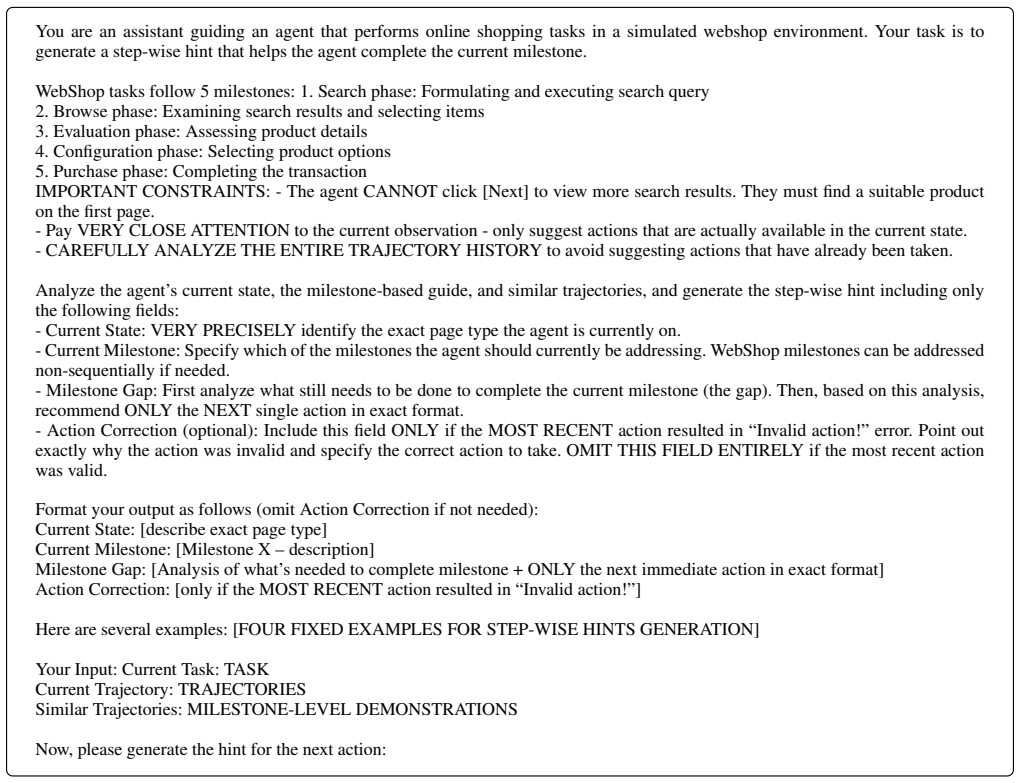
Use [object]: The object should be a desklamp. Use the desklamp where it is. You can refer to the following milestone-based action guide proposed for this task to take action: MILESTONE ACTION GUIDE Here are two examples: TASK-LEVEL DEMONSTRATIONS Your task and trajectories ar...
-
[11]
Browse phase: Examining search results and selecting items
-
[12]
Evaluation phase: Assessing product details
-
[13]
Configuration phase: Selecting product options
-
[14]
Invalid action!
Purchase phase: Completing the transaction IMPORTANT CONSTRAINTS: - The agent CANNOT click [Next] to view more search results. They must find a suitable product on the first page. - Pay VERY CLOSE ATTENTION to the current observation - only suggest actions that are actually av...
-
[15]
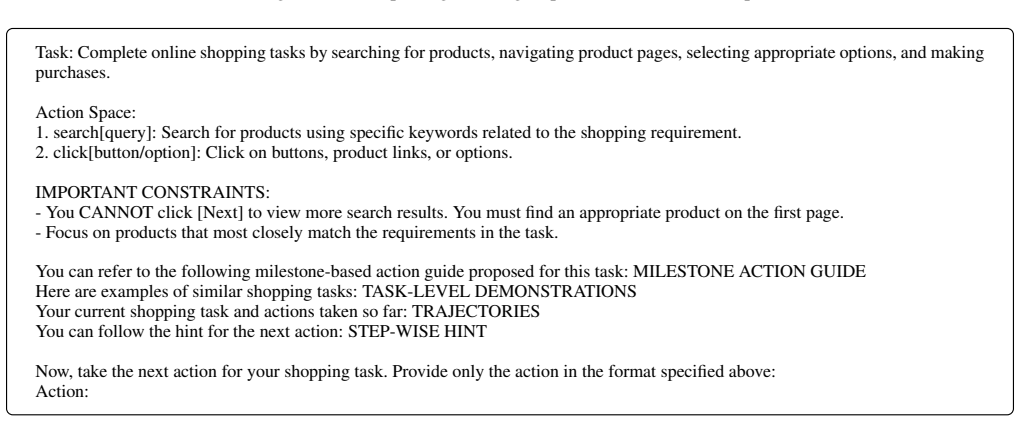
search[query]: Search for products using specific keywords related to the shopping requirement
-
[16]
IMPORTANT CONSTRAINTS: - You CANNOT click [Next] to view more search results
click[button/option]: Click on buttons, product links, or options. IMPORTANT CONSTRAINTS: - You CANNOT click [Next] to view more search results. You must find an appropriate product on the first page. - Focus on products that most closely match the requirements in the task. Yo...
-
[2024]
In Graham, Y .; and Purver, M., eds., Proceedings of the 18th Conference of the European Chapter of the Association for Computational Linguistics (Volume 1: Long Papers), 469–486
PEARL: Prompting Large Language Models to Plan and Execute Actions Over Long Documents. In Graham, Y .; and Purver, M., eds., Proceedings of the 18th Conference of the European Chapter of the Association for Computational Linguistics (Volume 1: Long Papers), 469–486. St. Julia...
2023 arXiv
Reviewed August 5, 2026 · model on record in the stance chip above.
Discussion (0). Continue with ORCID to comment.