Tracing Signatures of Modified Gravity in Redshift-Space Galaxy Bispectrum Multipoles: Prospects for Euclid
Pith reviewed 2026-05-18 21:22 UTC · model grok-4.3
The pith
Galaxy bispectrum multipoles reveal signatures of modified gravity detectable by Euclid.
A machine-rendered reading of the paper's core claim, the machinery that carries it, and where it could break.
Core claim
In the Hu-Sawicki f(R) gravity model the redshift-space galaxy bispectrum multipoles, especially the monopole and quadrupole, exhibit relative deviations of 2 percent to 8 percent from the general relativity case at z equals 0.7 and k1 approximately 0.3 h Mpc inverse 1 for f_R0 equals 10 to the minus 5; these deviations remain measurable in an Euclid-like survey with signal-to-noise ratios of roughly 30 and 15 respectively even after accounting for bias, velocity dispersion, Finger-of-God damping, and shot noise, thereby providing a probe capable of breaking degeneracies with bias and velocity effects and strengthening constraints on deviations from Lambda CDM.
What carries the argument
The full scale- and time-dependent second-order kernels computed via perturbation theory for the redshift-space bispectrum, incorporating corrections from the scale-dependent growth rate and nonlinear screening.
If this is right
- The bispectrum multipoles break degeneracies between modified gravity, galaxy bias, and velocity effects.
- They strengthen constraints on the parameter f_R0 that controls the strength of deviations from Lambda CDM.
- Higher multipoles supply weaker but complementary signals on the modified gravity signatures.
- The calculation method can be used to forecast constraints from other upcoming large-scale structure surveys.
Where Pith is reading between the lines
- Non-detection would tighten upper bounds on the allowed strength of the fifth force below current limits.
- Combining the bispectrum multipoles with power spectrum measurements could yield even stronger tests of gravity.
- The same multipole approach may help distinguish between different modified gravity models that include screening.
Load-bearing premise
The full scale- and time-dependent second-order kernels computed via perturbation theory together with the nonlinear screening corrections accurately capture the redshift-space bispectrum in the Hu-Sawicki model on the scales and redshifts relevant for Euclid.
What would settle it
A measurement of the redshift-space bispectrum monopole and quadrupole in Euclid data that shows deviations from Lambda CDM predictions outside the 2 to 8 percent range for f_R0 near 10 to the minus 5, or a complete lack of such deviations after accounting for the modeled effects.
Figures




read the original abstract
We study the galaxy bispectrum multipoles in the Hu-Sawicki $f(R)$ gravity model, where a scalar degree of freedom mediates a fifth force that is screened in high-density environments. The model is specified by $f_{R0}$, the present-day background value of the scalar field, which controls the strength of deviations from General Relativity (GR). Using perturbation theory, we compute the redshift-space galaxy bispectrum with the full scale- and time-dependent second-order kernels, incorporating corrections from the scale-dependent growth rate and nonlinear screening. Expanding the bispectrum in spherical harmonics, we analyze the sensitivity of the multipoles to modified gravity and forecast their detectability in a \textit{Euclid}-like survey. The monopole ($B_0^0$) and quadrupole ($B_2^0$) show the strongest signatures, with relative deviations of $2\%$--$8\%$ at $z=0.7$ and $k_1\simeq0.3\,h\,{\rm Mpc}^{-1}$ (largest side of the triangle) for $f_{R0}=10^{-5}$. Higher multipoles provide weaker but complementary signals. For \textit{Euclid}, we forecast signal-to-noise ratios up to $\sim30$ for the monopole and $\sim15$ for the quadrupole including the Finger-of-God damping and shot noise effect. These results demonstrate that bispectrum multipoles are a powerful probe of gravity, capable of breaking degeneracies with bias and velocity effects and strengthening constraints on deviations from $\Lambda$CDM.
Editorial analysis
A structured set of objections, weighed in public.
Referee Report
Summary. The manuscript studies galaxy bispectrum multipoles in the Hu-Sawicki f(R) gravity model with parameter f_R0. It computes the redshift-space bispectrum using full scale- and time-dependent second-order perturbation theory kernels that incorporate scale-dependent growth and nonlinear screening corrections, expands the result in spherical harmonics, quantifies relative deviations from GR (2-8% at z=0.7, k1≃0.3 h Mpc^{-1} for f_R0=10^{-5}), and forecasts signal-to-noise ratios (up to ~30 for the monopole and ~15 for the quadrupole) for an Euclid-like survey including FoG damping and shot noise.
Significance. If the modeling is accurate, the work shows that bispectrum multipoles can break degeneracies between modified gravity, bias, and velocity effects, providing a complementary probe that strengthens constraints on deviations from ΛCDM with Euclid data. The use of scale- and time-dependent kernels is a methodological strength.
major comments (2)
- [Perturbation theory kernels and screening implementation] The headline SNR forecasts and 2-8% deviation claims rest on the assertion that second-order PT kernels plus the specific nonlinear screening implementation remain accurate at k1≃0.3 h Mpc^{-1}. The manuscript should include a direct validation (e.g., against N-body simulations or higher-order PT) for the Hu-Sawicki model on these scales and redshifts; without it the reported detectability may be optimistic.
- [Forecast and degeneracy discussion] The degeneracy-breaking argument with bias and velocity effects is central but would be strengthened by an explicit Fisher-matrix or MCMC forecast that marginalizes over bias parameters and FoG; the current SNR estimates appear to fix these rather than jointly constrain them.
minor comments (2)
- [Notation and definitions] Define the exact spherical-harmonic expansion and multipole notation B_l^m with an explicit equation early in the methods section for clarity.
- [Results presentation] Add a brief discussion of the triangle configurations used (e.g., equilateral vs. squeezed) when quoting deviations at k1≃0.3 h Mpc^{-1}.
Simulated Author's Rebuttal
We thank the referee for their careful reading of the manuscript and for the constructive comments, which have helped us improve the presentation and robustness of our results. We address each major comment below.
read point-by-point responses
-
Referee: [Perturbation theory kernels and screening implementation] The headline SNR forecasts and 2-8% deviation claims rest on the assertion that second-order PT kernels plus the specific nonlinear screening implementation remain accurate at k1≃0.3 h Mpc^{-1}. The manuscript should include a direct validation (e.g., against N-body simulations or higher-order PT) for the Hu-Sawicki model on these scales and redshifts; without it the reported detectability may be optimistic.
Authors: We agree that explicit validation strengthens confidence in the modeling. Our second-order kernels are obtained from the scale- and time-dependent perturbation equations in Hu-Sawicki f(R) gravity, including the nonlinear screening term calibrated to the quasi-static limit. Existing N-body studies in the literature have validated comparable second-order PT implementations for f(R) models at k ≲ 0.3 h Mpc^{-1} and z ≈ 0.7 for |f_R0| = 10^{-5}, with typical accuracy at the 5–10 % level for the bispectrum. We have added a new paragraph in Section 3.2 that summarizes these literature validations, quantifies the expected modeling uncertainty, and states the regime where our forecasts remain reliable. A dedicated new simulation campaign lies beyond the scope of the present theoretical forecast paper; the revised text now includes an explicit caveat on this point. revision: partial
-
Referee: [Forecast and degeneracy discussion] The degeneracy-breaking argument with bias and velocity effects is central but would be strengthened by an explicit Fisher-matrix or MCMC forecast that marginalizes over bias parameters and FoG; the current SNR estimates appear to fix these rather than jointly constrain them.
Authors: We concur that a joint forecast is the most convincing demonstration of degeneracy breaking. The original SNR values were computed with bias parameters fixed at fiducial values and with the FoG damping term included at its fiducial velocity dispersion, in order to isolate the raw information content of the multipoles. In the revised manuscript we have added a Fisher-matrix analysis (new subsection 5.2) that marginalizes over the linear and quadratic galaxy bias parameters together with the FoG velocity dispersion σ_v. The updated results show that the monopole retains an SNR ≳ 20 and the quadrupole an SNR ≳ 10 after marginalization, confirming that the multipoles continue to provide useful constraints on f_R0 even when bias and velocity nuisance parameters are varied. The revised discussion now explicitly links this marginalised forecast to the degeneracy-breaking argument. revision: yes
Circularity Check
No circularity in derivation chain; forward computation from model parameter and external survey specs
full rationale
The paper computes redshift-space galaxy bispectrum multipoles in Hu-Sawicki f(R) gravity by applying standard perturbation theory with full scale- and time-dependent second-order kernels plus nonlinear screening corrections directly to the input parameter f_R0. Relative deviations (2-8%) and Euclid SNR forecasts (~30 for monopole, ~15 for quadrupole) are generated from these forward-modelled signals combined with independent survey specifications (volume, shot noise, FoG damping). No quoted step reduces a claimed prediction to a fitted input by construction, nor does any load-bearing premise rest on self-citation or imported uniqueness. The chain is self-contained against external benchmarks.
Axiom & Free-Parameter Ledger
free parameters (1)
- f_R0
axioms (1)
- domain assumption Second-order perturbation theory remains valid on the scales k ≲ 0.3 h Mpc^{-1} at z=0.7 even with modified growth and screening
Forward citations
Cited by 1 Pith paper
-
FolpsD: combining EFT and phenomenological approaches for joint power spectrum and bispectrum analyses
FolpsD combines EFT power spectrum and tree-level bispectrum with damping to enable joint analyses that improve cosmological constraints from DESI-like galaxy mocks by up to 30% on As and omega_cdm while extending the...
Reference graph
Works this paper leans on
-
[1]
Here ¯ρand R0 incorporates background density and cur- vature respectively
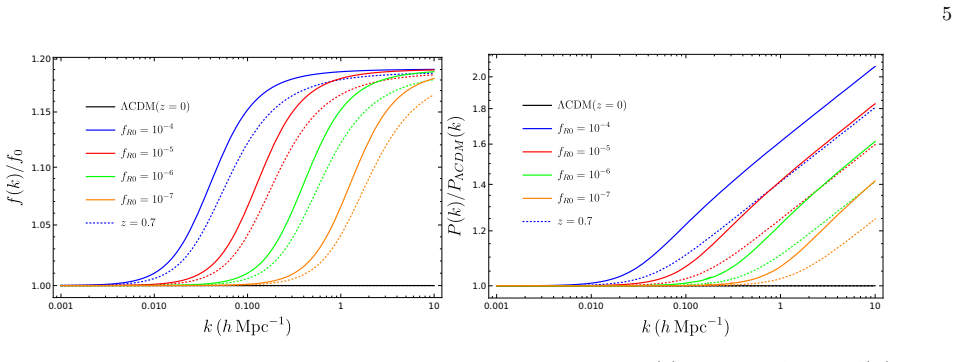
Perturbative Framework The perturbative dynamics of this model can be cap- tured by a scalar–tensor formulation in the Newtonian gauge with an associated scalar perturbation δfR = fR −f R0, sourced by matter density fluctuations δρ = ¯ρ δ. Here ¯ρand R0 incorporates background density and cur- vature respectively. The modified Poisson equation in Fourier ...
-
[2]
Finger of God Effect On small scales, galaxy redshift measurements are af- fected by random line-of-sight motion, which produce elongated structure in redshift space — an effect com- monly referred to as theFinger-of-God(FoG) phenom- ena [102]. This leads to a suppression of both the power spectrum [103, 104] and bispectrum, with the magnitude of the effe...
-
[3]
Kernel Analysis In an EdS universe, where Ω m = f2, the second-order perturbation theory kernels F2 and G2 have well-known analytical, time-independent solutions [ 83]. However, in a ΛCDM universe, the kernels become both scale- and time-dependent, necessitating a numerical approach [ 84]. The situation is further complicated in the HS- f(R) grav- ity mod...
-
[4]
The contours qualitatively look similar for both. Along the linear triangles ( µ≈ 1), starting from stretched to the squeezed limit ( µ≈ 1, t≈ 1), the differ- ence gradually decreases, and the difference is minimum for the equilateral triangles ( µ≈ 0.5, t≈ 1). Considering FoG, we see that the Q0 2 contours look similar to the one without FoG, only the di...
-
[5]
The patterns of ∆ Qm 2 for these two multipoles are also non-degenerate with the effects of massive neutrinos as found out in our previous study [ 88]. In summary, within the quadrupole family, m = 0 and m = 2 offer the strongest signatures off(R) gravity. We have also examined the difference for the hexade- capole ( L = 4) with m = 0 and 1. We do not sho...
-
[6]
Results are plotted against redshift z and the nuisance parameters b1 (left), γ2 = b2/b1 (middle), and σp (right), for fixed fR0 = 10−5 and a stretched triangle configuration with ( µ, t) = (0.975, 0.525). In the b1–z plane, ∆Q0 0 is positive for b1 ≃ 1 and peaks near z≃ 1.4, but becomes negative for large b1, indicating suppressed monopole amplitude in H...
-
[7]
When combined, however, they can boost total SNR
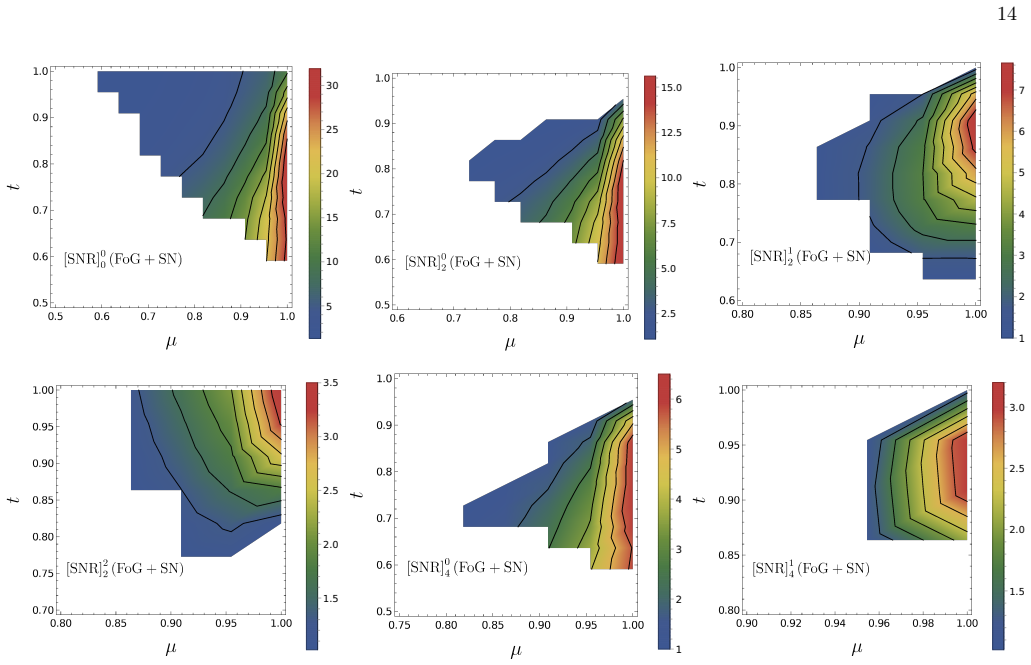
Including B1 2, B2 2, B0 4, B1 4 adds some complementarity, but each is at most a ∼few sigma effect. When combined, however, they can boost total SNR. Across all multipoles ranges, we observe a consistent pattern. The signal-to-noise is high for the linear triangles ( µ≈ 1), for some multipoles it peaks in the squeezed limit ( µ≈ 1, t≈ 1). These configura...
-
[8]
We also present forecasts of signal-to-noise ratios
This shows that realistic analyses must fit for fR0 jointly with nuisance parameters, rather than treating them independently, to avoid biased constraints. We also present forecasts of signal-to-noise ratios. For a Euclid-like survey, the monopole B0 0 achieves the highest SNR, reaching values of around 30 for stretched and linear triangles when fR0 = 10−...
work page 2020
-
[9]
Discovery of a Supernova Explosion at Half the Age of the Universe and its Cosmological Implications
S. Perlmutteret al.(Supernova Cosmology Project), Nature391, 51 (1998), arXiv:astro-ph/9712212
work page internal anchor Pith review Pith/arXiv arXiv 1998
-
[10]
Measurements of Omega and Lambda from 42 High-Redshift Supernovae
S. Perlmutteret al.(Supernova Cosmology Project), Astrophys. J.517, 565 (1999), arXiv:astro-ph/9812133
work page internal anchor Pith review Pith/arXiv arXiv 1999
-
[11]
S. M. Carroll, W. H. Press, and E. L. Turner, Ann. Rev. Astron. Astrophys.30, 499 (1992)
work page 1992
-
[12]
G. Efstathiou, W. J. Sutherland, and S. J. Maddox, Nature348, 705 (1990)
work page 1990
-
[13]
L. M. Krauss and M. S. Turner, Gen. Rel. Grav.27, 1137 (1995), arXiv:astro-ph/9504003
work page internal anchor Pith review Pith/arXiv arXiv 1995
-
[14]
B. P. Schmidt, Rev. Mod. Phys.84, 1151 (2012)
work page 2012
- [15]
-
[16]
Quintessence, Cosmic Coincidence, and the Cosmological Constant
I. Zlatev, L.-M. Wang, and P. J. Steinhardt, Phys. Rev. Lett.82, 896 (1999), arXiv:astro-ph/9807002
work page internal anchor Pith review Pith/arXiv arXiv 1999
-
[17]
The Cosmological Constant Problem and Quintessence
V. Sahni, Class. Quant. Grav.19, 3435 (2002), arXiv:astro-ph/0202076
work page internal anchor Pith review Pith/arXiv arXiv 2002
-
[18]
H. E. S. Velten, R. F. vom Marttens, and W. Zimdahl, Eur. Phys. J. C74, 3160 (2014), arXiv:1410.2509 [astro- ph.CO]
work page internal anchor Pith review Pith/arXiv arXiv 2014
-
[19]
J. Sola Peracaula, Phil. Trans. Roy. Soc. Lond. A380, 20210182 (2022), arXiv:2203.13757 [gr-qc]
-
[20]
Cosmological Tests of Modified Gravity
K. Koyama, Rept. Prog. Phys.79, 046902 (2016), arXiv:1504.04623 [astro-ph.CO]
work page internal anchor Pith review Pith/arXiv arXiv 2016
-
[21]
Testing General Relativity with Present and Future Astrophysical Observations
E. Bertiet al., Class. Quant. Grav.32, 243001 (2015), arXiv:1501.07274 [gr-qc]
work page internal anchor Pith review Pith/arXiv arXiv 2015
-
[22]
C. de Rham and A. J. Tolley, The Encyclopedia of Cosmology: Volume 1: Modified Gravity, inThe En- cyclopedia of Cosmology, edited by G. G. Fazi (World Scientific, 2023)
work page 2023
-
[23]
J. K. Bloomfield, ´E. ´E. Flanagan, M. Park, and S. Wat- son, JCAP08, 010, arXiv:1211.7054 [astro-ph.CO]
work page internal anchor Pith review Pith/arXiv arXiv
-
[24]
The Effective Field Theory of Dark Energy
G. Gubitosi, F. Piazza, and F. Vernizzi, JCAP02, 032, arXiv:1210.0201 [hep-th]
work page internal anchor Pith review Pith/arXiv arXiv
-
[25]
G. W. Horndeski, Int. J. Theor. Phys.10, 363 (1974)
work page 1974
-
[26]
Horndeski: beyond, or not beyond?
M. Crisostomi, M. Hull, K. Koyama, and G. Tasinato, JCAP03, 038, arXiv:1601.04658 [hep-th]
work page internal anchor Pith review Pith/arXiv arXiv
-
[27]
Hamiltonian analysis of higher derivative scalar-tensor theories
D. Langlois and K. Noui, JCAP07, 016, arXiv:1512.06820 [gr-qc]
work page internal anchor Pith review Pith/arXiv arXiv
-
[28]
Extended Scalar-Tensor Theories of Gravity
M. Crisostomi, K. Koyama, and G. Tasinato, JCAP04, 044, arXiv:1602.03119 [hep-th]
work page internal anchor Pith review Pith/arXiv arXiv
-
[29]
T. P. Sotiriou and V. Faraoni, Rev. Mod. Phys.82, 451 (2010), arXiv:0805.1726 [gr-qc]
work page internal anchor Pith review Pith/arXiv arXiv 2010
-
[30]
F. S. N. Lobo, J. Phys. Conf. Ser.600, 012006 (2015), arXiv:1412.0867 [gr-qc]
work page internal anchor Pith review Pith/arXiv arXiv 2015
-
[31]
E. V. Linder, Phys. Rev. D81, 127301 (2010), [Erratum: Phys.Rev.D 82, 109902 (2010)], arXiv:1005.3039 [astro- ph.CO]
work page internal anchor Pith review Pith/arXiv arXiv 2010
-
[32]
M. S. Turner and D. Huterer, J. Phys. Soc. Jap.76, 111015 (2007), arXiv:0706.2186 [astro-ph]
work page internal anchor Pith review Pith/arXiv arXiv 2007
-
[33]
Linking Tests of Gravity On All Scales: from the Strong-Field Regime to Cosmology
T. Baker, D. Psaltis, and C. Skordis, Astrophys. J.802, 63 (2015), arXiv:1412.3455 [astro-ph.CO]
work page internal anchor Pith review Pith/arXiv arXiv 2015
-
[34]
Beyond the Cosmological Standard Model
A. Joyce, B. Jain, J. Khoury, and M. Trodden, Phys. Rept.568, 1 (2015), arXiv:1407.0059 [astro-ph.CO]
work page internal anchor Pith review Pith/arXiv arXiv 2015
-
[35]
C. P. L. Berry and J. R. Gair, Phys. Rev. D83, 104022 (2011), [Erratum: Phys.Rev.D 85, 089906 (2012)], arXiv:1104.0819 [gr-qc]
work page internal anchor Pith review Pith/arXiv arXiv 2011
-
[36]
P. J. Peebles,The Large-Scale Structure of the Universe (Princeton University Press, 1980)
work page 1980
-
[37]
Testing $\Lambda$CDM at the lowest redshifts with SN Ia and galaxy velocities
D. Huterer, D. Shafer, D. Scolnic, and F. Schmidt, JCAP 05, 015, arXiv:1611.09862 [astro-ph.CO]
work page internal anchor Pith review Pith/arXiv arXiv
-
[38]
L. Kazantzidis and L. Perivolaropoulos, Phys. Rev. D 97, 103503 (2018), arXiv:1803.01337 [astro-ph.CO]
work page internal anchor Pith review Pith/arXiv arXiv 2018
-
[39]
S. Alam, H. Miyatake, S. More, S. Ho, and R. Mandel- baum, Mon. Not. Roy. Astron. Soc.465, 4853 (2017), arXiv:1610.09410 [astro-ph.CO]
work page internal anchor Pith review Pith/arXiv arXiv 2017
-
[40]
C. Blakeet al., Astron. Astrophys.642, A158 (2020), arXiv:2005.14351 [astro-ph.CO]
-
[41]
A. Aviles, Phys. Rev. D111, L021301 (2025), arXiv:2409.15640 [astro-ph.CO]
-
[42]
S. Li and J.-Q. Xia, Astrophys. J. Suppl.276, 71 (2025), arXiv:2501.02852 [astro-ph.CO]
-
[43]
C. Viglione, P. Fosalba, I. Tutusaus, L. Blot, J. Carretero, P. Tallada, and F. Castander, (2025), arXiv:2504.04961 [astro-ph.CO]
-
[44]
The Bispectrum as a Signature of Gravitational Instability in Redshift-Space
R. Scoccimarro, H. M. P. Couchman, and J. A. Frieman, Astrophys. J.517, 531 (1999), arXiv:astro-ph/9808305
work page internal anchor Pith review Pith/arXiv arXiv 1999
- [45]
-
[46]
The power spectrum and bispectrum of SDSS DR11 BOSS galaxies I: bias and gravity
H. Gil-Mar´ ın, J. Nore˜ na, L. Verde, W. J. Percival, C. Wagner, M. Manera, and D. P. Schneider, Mon. Not. Roy. Astron. Soc.451, 539 (2015), arXiv:1407.5668 [astro-ph.CO]
work page internal anchor Pith review Pith/arXiv arXiv 2015
-
[47]
H. Gil-Mar´ ın, W. J. Percival, L. Verde, J. R. Brownstein, C.-H. Chuang, F.-S. Kitaura, S. A. Rodr´ ıguez-Torres, and M. D. Olmstead, Mon. Not. Roy. Astron. Soc.465, 1757 (2017), arXiv:1606.00439 [astro-ph.CO]
work page internal anchor Pith review Pith/arXiv arXiv 2017
- [48]
- [49]
-
[50]
E. Hawkinset al., Mon. Not. Roy. Astron. Soc.346, 78 (2003), arXiv:astro-ph/0212375
work page internal anchor Pith review Pith/arXiv arXiv 2003
-
[51]
A test of the nature of cosmic acceleration using galaxy redshift distortions
L. Guzzoet al., Nature451, 541 (2008), arXiv:0802.1944 [astro-ph]
work page internal anchor Pith review Pith/arXiv arXiv 2008
-
[52]
Systematic Effects on Determination of the Growth Factor from Redshift-space Distortions
T. Okumura and Y. P. Jing, ApJ726, 5 (2011), arXiv:1004.3548 [astro-ph.CO]
work page internal anchor Pith review Pith/arXiv arXiv 2011
-
[53]
T. Okumura and A. Taruya, Astrophys. J. Lett.945, L30 (2023), arXiv:2301.06273 [astro-ph.CO]
-
[54]
I. Hashimoto, Y. Rasera, and A. Taruya, Phys. Rev. D 96, 043526 (2017), arXiv:1705.02574 [astro-ph.CO]
work page internal anchor Pith review Pith/arXiv arXiv 2017
-
[55]
Y. Nan, K. Yamamoto, and C. Hikage, JCAP07, 038, arXiv:1706.03515 [astro-ph.CO]
work page internal anchor Pith review Pith/arXiv arXiv
-
[56]
Neutrino mass and dark energy constraints from redshift-space distortions
A. Upadhye, JCAP05, 041, arXiv:1707.09354 [astro- ph.CO]
work page internal anchor Pith review Pith/arXiv arXiv
-
[57]
Constraints on Neutrino Physics from DESI DR2 BAO and DR1 Full Shape
W. Elberset al., arXiv e-prints , arXiv:2503.14744 (2025), arXiv:2503.14744 [astro-ph.CO]
work page internal anchor Pith review Pith/arXiv arXiv 2025
-
[58]
F. Verdiani, E. Bellini, C. Moretti, E. Sefusatti, C. Car- bone, and M. Viel, arXiv e-prints , arXiv:2503.06655 (2025), arXiv:2503.06655 [astro-ph.CO]
-
[59]
Cosmological information in the redshift-space bispectrum
V. Yankelevich and C. Porciani, Mon. Not. Roy. Astron. Soc.483, 2078 (2019), arXiv:1807.07076 [astro-ph.CO]
work page internal anchor Pith review Pith/arXiv arXiv 2078
- [60]
-
[61]
O. H. E. Philcox,Probing Fundamental Cosmology with Galaxy Surveys, Ph.D. thesis, Princeton U. (2022)
work page 2022
- [62]
-
[63]
Enhancing BOSS bispectrum cosmological constraints with maximal compression
D. Gualdi, H. Gil-Mar´ ın, R. L. Schuhmann, M. Manera, B. Joachimi, and O. Lahav, Mon. Not. Roy. Astron. Soc. 484, 3713 (2019), arXiv:1806.02853 [astro-ph.CO]
work page internal anchor Pith review Pith/arXiv arXiv 2019
-
[64]
D. Gualdi and L. Verde, JCAP06, 041, arXiv:2003.12075 [astro-ph.CO]
-
[65]
Z. Slepian, F. Kamalinejad, and A. Greco, (2025), arXiv:2508.06762 [astro-ph.CO]
-
[66]
E. V. Linder, Astropart. Phys.29, 336 (2008), arXiv:0709.1113 [astro-ph]
work page internal anchor Pith review Pith/arXiv arXiv 2008
-
[67]
S. de la Torreet al., Astron. Astrophys.608, A44 (2017), arXiv:1612.05647 [astro-ph.CO]
work page internal anchor Pith review Pith/arXiv arXiv 2017
- [68]
-
[69]
G. Valogiannis, R. Bean, and A. Aviles, (2019), arXiv:1909.05261 [astro-ph.CO]
-
[70]
Models of f(R) Cosmic Acceleration that Evade Solar-System Tests
W. Hu and I. Sawicki, Phys. Rev. D76, 064004 (2007), arXiv:0705.1158 [astro-ph]
work page internal anchor Pith review Pith/arXiv arXiv 2007
-
[71]
A. De Felice and S. Tsujikawa, Living Rev. Rel.13, 3 (2010), arXiv:1002.4928 [gr-qc]
work page internal anchor Pith review Pith/arXiv arXiv 2010
-
[72]
Non-linear Evolution of Matter Power Spectrum in Modified Theory of Gravity
K. Koyama, A. Taruya, and T. Hiramatsu, Phys. Rev. D79, 123512 (2009), arXiv:0902.0618 [astro-ph.CO]
work page internal anchor Pith review Pith/arXiv arXiv 2009
-
[73]
Chameleon Fields: Awaiting Surprises for Tests of Gravity in Space
J. Khoury and A. Weltman, Phys. Rev. Lett.93, 171104 (2004), arXiv:astro-ph/0309300 [astro-ph]
work page internal anchor Pith review Pith/arXiv arXiv 2004
-
[74]
An Extended Excursion Set Approach to Structure Formation in Chameleon Models
B. Li and G. Efstathiou, Mon. Not. Roy. Astron. Soc. 421, 1431 (2012), arXiv:1110.6440 [astro-ph.CO]
work page internal anchor Pith review Pith/arXiv arXiv 2012
-
[75]
ECOSMOG: An Efficient Code for Simulating Modified Gravity
B. Li, G.-B. Zhao, R. Teyssier, and K. Koyama, JCAP 1201, 051, arXiv:1110.1379 [astro-ph.CO]
work page internal anchor Pith review Pith/arXiv arXiv
-
[76]
S. Bharadwaj, A. Mazumdar, and D. Sarkar, Mon. Not. Roy. Astron. Soc.493, 594 (2020), arXiv:2001.10243 [astro-ph.CO]
-
[77]
A. Mazumdar, S. Bharadwaj, and D. Sarkar, Mon. Not. Roy. Astron. Soc.498, 3975 (2020), arXiv:2005.07066 [astro-ph.CO]
-
[78]
A. Mazumdar, D. Sarkar, and S. Bharadwaj, Mon. Not. Roy. Astron. Soc.520, 2534 (2023), arXiv:2209.03233 [astro-ph.CO]
-
[79]
L. Amendolaet al., Living Rev. Rel.21, 2 (2018), arXiv:1606.00180 [astro-ph.CO]
-
[80]
Scaramellaet al.(Euclid), Astron
R. Scaramellaet al.(Euclid), Astron. Astrophys.662, A112 (2022), arXiv:2108.01201 [astro-ph.CO]
discussion (0)
Sign in with ORCID, Apple, or X to comment. Anyone can read and Pith papers without signing in.