REVIEW 3 major objections 4 minor 29 references
On the Dynamics of Extended Bodies and the GravoThermo Memory Effect
T0 review · 3 major / 4 minor · reviewed 2026-08-15 · deepseek-v4-flash
Pith's one-line read This paper claims that a gravitational wave pulse permanently shifts the azimuthal orientation of an extended body's spin and writes its polarization into the body's thermodynamic state.
desk verdict The claimed permanent spin memory vanishes on the paper's own equations: G(v) in Eq. (36) is odd, so Δφ and the thermodynamic results don't follow as printed. read the letter →
The pith
A machine-rendered reading of the paper's core claim, the machinery that carries it, and where it could break.
The reading
What carries the argument
The load-bearing object is the spin orientation in the plane transverse to the wave, specifically the azimuthal angle $\varphi$ of the spin vector. The argument is carried by an order-by-order perturbation of the pole-dipole equations of motion for an extended body around a flat background, with zeroth-order momentum fixed to $P^\mu_{(0)}=(1,0,0,0)$ and the zeroth-order spin confined to the $XZ$ plane; the gravitational wave enters as a small metric perturbation with plus and cross polarizations, chosen as Gaussian pulses $h_+(t,z) = H_+ e^{-(z-ct)^2/2\sigma^2} e^{ik(z-ct)}$ and similarly for $h_\times$. The pulse determines forcing functions $F(v)$ and $G(v)$, and integrating the perturbed spin equations $dS_x/dt = g_2$ and $dS_y/dt = g_1$ plus the position equations numerically produces the permanent $\varphi$ shift. The same perturbed trajectory feeds the quadrupole formula for the re-radiated field, yielding the nonlinear wave memory.
What would settle it
Repeat the first-order calculation with quadrupole-moment terms included (the next order in the multipole expansion) for the same Gaussian pulse: if the permanent $\Delta\varphi$ vanishes or becomes initial-velocity dependent instead of initial-spin dependent, the reported memory is an artifact of pole-dipole truncation. A second check is to measure the final azimuth of a spinning test mass after a calibrated pulse in a tabletop experiment, where the predicted shifts for the plotted parameters with $\epsilon=0.1$ are around $10^{-6}$ degrees; a null result at that level would rule the claim out.
Extended reading notes
Core claim
On the paper's terms, the central discovery is that the dynamics of an extended rotating body at pole-dipole (spin-only) order contains a gravitational memory: integrating the first-order perturbed equations of motion in the field of a Gaussian gravitational wave pulse yields a net change $\Delta\varphi$ in the azimuthal spin orientation while the polar angle $\theta$ returns to its initial value, and the sign and magnitude of $\Delta\varphi$ oscillate with the initial spin angle $\alpha$ and grow with the polarization ratio $\varsigma = H_+/H_\times$. The same integration gives a permanent longitudinal jump and a spiral transverse motion of the body's reference point, so the memory appears in both rotational and linear degrees of freedom. For an ensemble of randomly oriented bodies in a magnetic field, the paper argues that the wave-induced reorientation changes the partition function, producing a polarization-dependent entropy change and, for strongly plus-polarized waves, a resonance in internal energy near the characteristic temperature; this is presented as a gravo-thermo memory that encodes information about the wave and its source.
Load-bearing premise
The result assumes that during the pulse each body is adequately described as a spinning object with no quadrupole or higher internal structure, with its momentum locked to the rest frame $P^\mu_{(0)}=(1,0,0,0)$, and that in the ensemble intermolecular forces exactly cancel the wave-induced linear motion; if any of these fail, the permanent azimuthal shift and thermodynamic memory could be artifacts of the truncation.
Editorial extensions
If this is right
- Every extended rotating body that encounters a gravitational wave pulse should retain a small, permanent azimuthal spin shift while its polar alignment is restored; the shift oscillates with initial orientation and increases with the plus-to-cross polarization ratio.
- An ensemble of such bodies will have a permanent redistribution of spin orientations, so thermodynamic state variables after the pulse differ from their initial values even after the wave has gone.
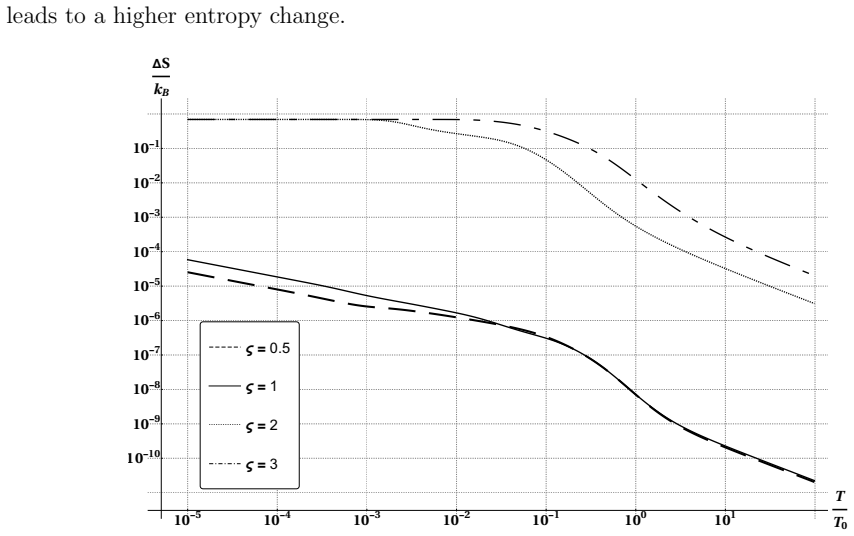
- The entropy change grows as the wave becomes more plus-polarized, and for strongly plus-polarized waves the internal energy exhibits a temperature resonance near the system's characteristic temperature.
- A body on the wave's path re-radiates a small transverse-traceless field, so the wave itself acquires nonlinear memory; for the Earth and a 10 kHz merger signal the extra amplitude is about $2.7 \times 10^{-3}/r$.
- Although a single body's $\Delta\varphi$ is a rapidly oscillating function of initial orientation, averaging over an ensemble gives smooth thermodynamic curves, making the effect statistically observable.
Reading between the lines
- If the pole-dipole truncation is reliable, the same mechanism should appear in any geometric theory with a nonlinear tensor field that couples to spin; the memory is a fingerprint of nonlinearity rather than of a specific metric theory.
- One testable extension the paper does not pursue: replace the assumption of exactly balanced intermolecular forces with a dilute gas or suspension so translational and rotational memory compete; the resulting partition-function shift could be larger or partially randomized, a difference that can be checked by simulation.
- The oscillatory $\Delta\varphi(\alpha)$ curve suggests that a sufficiently large ensemble could act as a polarimeter: the statistics of final spin orientations encode the polarization ratio $\varsigma$, so thermodynamic measurements might infer source properties of a past gravitational wave.
- The paper's point-particle comparison implies that taking the body size to zero should recover the earlier memory result, so comparing the extended-body and point-particle curves would isolate the role of tidal coupling in the memory.
Signed reviews
Editorial analysis
A structured set of objections, weighed in public.
Referee Report
Summary. The paper studies the motion of an extended spinning body described by the Mathisson-Papapetrou equations in a linearly polarized gravitational-wave pulse, working to first order in the wave amplitude. It claims that after the pulse the body retains a permanent change in the azimuthal orientation of its spin, that this change is imprinted on the gravitational wave through reradiation, and that an ensemble of such bodies acquires a permanent change in its partition function, entropy, and internal energy. The central quantitative results are a purported finite spin memory, shown in Figures 2 and 6, and the thermodynamic memory derived from it in Section V.
Significance. If the claims were correct, the paper would extend gravitational memory from point particles to extended bodies and would connect memory to thermodynamics of an ensemble, which is an interesting and potentially useful direction. The paper is self-contained in the sense that no free parameter is fitted to the thermodynamic output, and the mathematical framework is standard. However, the central spin-memory result does not follow from the equations as written: the forcing function G(v) in Eq. (36) is odd in v, so its integral over the pulse vanishes. Consequently, the claimed permanent azimuthal spin shift and all thermodynamic consequences derived from it are not supported by the presented calculation. The paper also relies on a set of first-order equations, Eqs. (17)-(21), that are asserted without derivation, and the numerical plots are presented without error estimates or convergence checks. The underlying idea is salvageable, but the manuscript in its current form does not establish its main claim.
major comments (3)
- [Section III, Eqs. (36) and (38)] The permanent spin-memory result is contradicted by the written equations. Equations (38) give dS_x/dt = g_2 and dS_y/dt = g_1, with g_1 and g_2 proportional to G(v) from Eq. (36). Since G(v) = exp(-v^2/2σ^2)(σ^2 sin v + v cos v) is an odd function of v, the integral over the pulse at fixed z vanishes: ∫_{-∞}^{∞} G(v) dv = 0. The S_12 component in Eq. (27) is zero, so S_z is unchanged at first order as well. Therefore the spin returns to its initial orientation, and the permanent Δφ shown in Figures 2 and 6 does not follow from the printed equations. Please correct the expression for G(v) (or the real-part convention used to define h_+ and h_×) and derive the resulting Δφ analytically, or explain explicitly why the first-order spin shift is nonzero despite the vanishing integral.
- [Section III, Eqs. (17)-(21)] The first-order equations that drive the entire analysis are stated as 'straightforward to show' but are not derived. These equations determine P_μ^{(1)}, S_{μν}^{(1)}, and U_μ^{(1)}, and any sign or factor error in them propagates into the forcing functions in Eqs. (31)-(36). For example, Eq. (27) sets S_{31}^{(1)} = -ϵ g_1, while Eq. (38) gives dS_y/dt = g_1; if S_y is identified with S_{31}, the sign is inconsistent, and if S_y is instead identified with S_{13}, the identification should be stated. Please provide the derivation of Eqs. (17)-(21) or a supplementary calculation so that the forcing terms can be checked.
- [Section V, Eqs. (53)-(59)] The thermodynamic memory is built entirely on the numerical values of Δφ_i(θ_i). Since the first-order calculation gives Δφ = 0 when Eq. (36) is used, the entropy and energy changes plotted in Figures 11-13 have no basis unless the spin-memory calculation is corrected. Additionally, the paper does not state how Δφ_i(θ_i) was extracted from the numerical solutions or how the averaging over θ_i was implemented; please specify the discretization, the number of samples, and the numerical accuracy. Without this information, the claimed smooth thermodynamic behavior cannot be reproduced.
minor comments (4)
- [Section IV, Eq. (50)] The estimate H_{rad}/H_{in} ~ 2.7 × 10^{-3}/r is dimensionally ambiguous. The paper states 'per unit distance from earth' but r is a length; please specify the units of r and the values of ς, ν, and the Earth mass and size used to obtain this number.
- [Section IV, Eq. (46)] The term 'nonlinear memory' for the reradiated field is misleading: the body motion is linear in the incoming wave amplitude, and the quadrupole formula used here is also linear in the source's second moment. Calling this 'nonlinear memory' conflates it with the standard Christodoulou memory, which is a nonlinear effect in the gravitational field itself. Please clarify the terminology.
- [Figures 2, 6, 9] The numerical plots are presented without error bars, convergence checks, or a description of the numerical integrator. Given that the central claim depends on tiny residual values (about 10^{-6} degrees), the absence of such checks makes it impossible to assess whether the plotted memory is numerical noise.
- [Section III, Eq. (27)] The notation for the spin components is not defined consistently. Please state explicitly which components of S^{μν} correspond to S_x, S_y, and S_z in both Eqs. (24) and (27).
Circularity Check
No significant circularity: the spin and thermodynamic memory results are derived from the Mathisson-Papapetrou equations with no fitted parameters; the authors' prior work appears only as motivation and comparison.
full rationale
The claimed chain is self-contained. Section III expands the Mathisson-Papapetrou equations to first order in the wave amplitude and solves Eqs. (37)-(39) with explicitly written pulse functions; the unperturbed momentum and spin are chosen as initial data, not as outputs. The permanent spin change is obtained by integrating the displayed differential equations, and the Section V partition function is constructed by inserting the numerically obtained Delta-phi_i(Theta_i) into Eq. (56), so the thermodynamic quantities are consequences of the preceding dynamics rather than inputs to it. No parameter is fitted to the entropy or energy curves. References [19] and [20] are the authors' previous papers, but they are cited as a toy-model motivation and as a comparison, not as a premise of the extended-body calculation; the load-bearing equations (17)-(21) and (31)-(38) are derived here. The explicit Section V limitation that inter-molecular forces balance the wave-induced linear motion is a modeling assumption, not a circular step. A separate numerical-consistency concern about the zero integral of the G(v) in Eq. (36) is a correctness issue rather than circularity and is therefore not counted in this score.
Assumptions & free parameters
free parameters (4)
- perturbation amplitude epsilon =
0.1
- normalized pulse width k sigma =
10
- initial spin angle alpha =
35 degrees
- polarization ratio ς = H+/H× =
Values 0.3, 0.5, 1, 2, 3, 10
assumptions (5)
- domain assumption The Mathisson-Papapetrou-Dixon pole-dipole truncation, with the spin supplementary condition PμSμν=0 and conserved charges m² and s², governs the extended body.
- domain assumption The gravitational wave is a weak linearized perturbation hμν of Minkowski spacetime with Gaussian pulse profiles h+(t,z) and h×(t,z).
- ad hoc to paper The reference point has initial four-momentum P(0)μ=(1,0,0,0) and spin confined to the XZ-plane.
- ad hoc to paper For the ensemble, intermolecular interactions balance the wave-induced linear motion so that only spin reorientation contributes to the thermodynamic changes.
- standard math The standard quadrupole formula (40) estimates the radiation emitted by the body.
Cite this review
Pith. "Pith review of On the Dynamics of Extended Bodies and the GravoThermo Memory Effect." pith.science (2026). https://pith.science/paper/EQNYYHR5
@misc{pith2026250819231,
  author       = {Pith},
  title        = {Pith review of: On the Dynamics of Extended Bodies and the GravoThermo Memory Effect},
  year         = {2026},
  howpublished = {\url{https://pith.science/paper/EQNYYHR5}},
  note         = {Machine review of arXiv:2508.19231}
}
read the original abstract
The non-linearity of the theory of gravity induces a hysteresis effect in both the systems interacting with gravity and in the gravitational field. The effect is usually referred to as the memory effect. In this paper, we explore this phenomenon in the context of the dynamics of extended rotating objects in the presence of a gravitational wave pulse. Then, we consider an ensemble of such objects and show that a redistribution of spin orientations takes place as a gravitational wave passes through. We examine how this redistribution, changes the partition function and the thermodynamic quantities including entropy and energy of the system. The result shows that some information about the source of the gravitation wave is encoded in the thermodynamics of the system.
Figures


Figures from the paper (10 more)




Reference graph
Works this paper leans on
-
[19]
On the Gravitational Precession Memory Effect for an Ensemble of Gyroscopes
R. Moti and A. Shojai, On the gravitational precession memory effect for an ensemble of gyroscopes, Class. Quant. Grav. 41 (2024) 025011 [arXiv:2307.04151]
work page Pith review arXiv 2024
-
[1]
Y.B. Zel’dovich and A.G. Polnarev, Radiation of gravitational waves by a cluster of super- dense stars, Sov. Astron. 18 (1974) 17
work page 1974
-
[2]
Braginsky and K.S
V.B. Braginsky and K.S. Thorne, Gravitational-wave bursts with memory and experimental prospects, Nature 327 (1987) 123
1987
-
[3]
Christodoulou, Nonlinear nature of gravitation and gravitational wave experiments , Phys
D. Christodoulou, Nonlinear nature of gravitation and gravitational wave experiments , Phys. Rev. Lett. 67 (1991) 1486
1991
-
[4]
L. Blanchet and T. Damour, Hereditary effects in gravitational radiation, Phys. Rev. D 46 (1992) 4304. 25
work page 1992
-
[5]
K. S. Thorne, Gravitational-wave bursts with memory: The Christodoulou effect , Phys. Rev. D 45 (1992) 520
work page 1992
-
[6]
The First-Order Velocity Memory Effect from Compact Binary Coalescing Sources
A.K. Divakarla and B.F. Whiting, First-order velocity memory effect from compact binary coalescing sources, Phys. Rev. D 104 (2021) 064001 [arXiv:2106.05163]
work page Pith review arXiv 2021
-
[7]
L.P. Grishchuk and A.G. Polnarev, Gravitational wave pulses with ‘velocity coded memory’, Sov. Phys. JETP 69 (1989) 653
work page 1989
Show all 29 references
-
[8]
Favata, Nonlinear gravitational-wave memory from binary black hole mergers , Astro- phys
M. Favata, Nonlinear gravitational-wave memory from binary black hole mergers , Astro- phys. J. Lett. 696 (2009) [arXiv:0902.3660]
2009 arXiv
-
[9]
Favata, Gravitational-wave memory revisited: Memory from the merger and recoil of binary black holes , J
M. Favata, Gravitational-wave memory revisited: Memory from the merger and recoil of binary black holes , J. Phys. Conf. Ser. 154 (2009) 012043 [arXiv:0811.3451]
2009 arXiv
-
[10]
Favata, Post-Newtonian corrections to the gravitational-wave memory for quasi- circular, inspiralling compact binaries , Phys
M. Favata, Post-Newtonian corrections to the gravitational-wave memory for quasi- circular, inspiralling compact binaries , Phys. Rev. D 80 (2009) 024002 [arXiv:0812.0069]
2009 arXiv
-
[11]
Favata, The gravitational-wave memory effect , Class
M. Favata, The gravitational-wave memory effect , Class. Quant. Grav. 27 (2010) 084036 [arXiv:1003.3486]
2010 arXiv
-
[12]
Nichols, Spin memory effect for compact binaries in the post-Newtonian approxima- tion, Phys
D.A. Nichols, Spin memory effect for compact binaries in the post-Newtonian approxima- tion, Phys. Rev. D 95 (2017) 084048 [arXiv:1702.03300]
2017 arXiv
-
[13]
Strominger and A
A. Strominger and A. Zhiboedov, Gravitational memory, BMS supertranslations and soft theorems, JHEP 01 (2014) 08 [arXiv:1411.5745]
2014 arXiv
-
[14]
Pasterski, A
S. Pasterski, A. Strominger, and A. Zhiboedov, New gravitational memories , JHEP 12 (2016) 053 [arXiv:1502.06120]
2016 arXiv
-
[15]
Zhang, C.Duval, G.W
P.M. Zhang, C.Duval, G.W. Gibbons, and P.A. Horvathy, Soft gravitons and the memory effect for plane gravitational waves , Phys. Rev. D 96 (2017) 064013 [arXiv:1705.01378]
2017 arXiv
-
[16]
Pate, A Raclariu, and A
M. Pate, A Raclariu, and A. Strominger, Color memory: A Yang-Mills analog of gravita- tional wave memory , Phys. Rev. Lett. 119 (2017) 261602 [arXiv:1707.08016]. 26
2017 arXiv
-
[17]
V.D. Luca, J. Khoury, and S.S.C. Wong, Gravitational memory and soft theorems: The local perspective, Phys. Rev. D 112 (2025) 2 [arXiv:2412.01910]
2025 arXiv
-
[18]
Caldwell, The persistence of nonlinear gravitational wave memory , [arXiv:2506.20751]
R.R. Caldwell, The persistence of nonlinear gravitational wave memory , [arXiv:2506.20751]
-
[20]
Moti and A
R. Moti and A. Shojai, On the gravitational hysteresis in the kinetic theory , JCAP 12 (2024) 002 [arXiv:2410.04537]
2024 arXiv
-
[21]
Mathisson, Republication of: New mechanics of material systems , Gen
M. Mathisson, Republication of: New mechanics of material systems , Gen. Rel. Grav. 42 (2010) 1011
2010
-
[22]
Papapetrou, Spinning test-particles in general relativity I , Proc
A. Papapetrou, Spinning test-particles in general relativity I , Proc. R. Soc. Lond. A 209 (1951) 248
1951
-
[23]
Corinaldesi and A
E. Corinaldesi and A. Papapetrou, Spinning test-particles in general relativity II , Proc. R. Soc. Lond. A 209 (1951) 259
1951
-
[24]
Dixon, Dynamics of extended bodies in general relativity
W.G. Dixon, Dynamics of extended bodies in general relativity. I. Momentum and angular momentum, Proc. R. Soc. Lond. A 314 (1970) 499
1970
-
[25]
K.P. Tod, F. De Felice, and M. Calvani, Spinning test particles in the field of a black hole , Nuovo Cim. B 34 (1976) 365
1976
-
[26]
Mashhoon and D
B. Mashhoon and D. Singh, Dynamics of extended spinning masses in a gravitational field , Phys. Rev. D 74 (2006) 124006 [arXiv:astro-ph/0608278]
2006 arXiv
-
[27]
Singh, An analytic perturbation approach for classical spinning particle dynamics , Gen
D. Singh, An analytic perturbation approach for classical spinning particle dynamics , Gen. Rel. Grav. 40 (2008) 1179 [arXiv:0706.0928]
2008 arXiv
-
[28]
Mohseni, and H.R
M. Mohseni, and H.R. Sepangi, Gravitational waves and spinning test particles , Class. Quant. Grav. 17 (2000) 4615 [arXiv:gr-qc/0009070]. 27
2000 arXiv
-
[29]
Maggiore, Gravitational Waves
M. Maggiore, Gravitational Waves. Vol. 1: Theory and Experiments , Oxford University Press (2007) [DOI: 10.1093/acprof:oso/9780198570745.001.0001]. 28
2007
Reviewed August 15, 2026 · model on record in the stance chip above.
Discussion (0). Continue with ORCID to comment.