Composite-Dimensional Topological Codes with Boundaries and Defects
Pith reviewed 2026-05-18 20:47 UTC · model grok-4.3
The pith
Algorithms explicitly construct stabilizers for boundaries and defects in composite-dimensional twisted quantum doubles by condensing from the bulk.
A machine-rendered reading of the paper's core claim, the machinery that carries it, and where it could break.
Core claim
The authors introduce algorithms that construct boundary and domain-wall stabilizers starting from the bulk model using condensation for Abelian composite-dimensional twisted quantum doubles. This enables explicit microscopic stabilizer layouts for topological orders with boundaries and defects. The constructions are augmented by dimensional counting arguments and macroscopic pants decompositions that outline automation of code design, and the results are validated through error-correcting threshold calculations.
What carries the argument
The condensation procedure that derives explicit boundary and domain-wall stabilizers from the bulk stabilizer model by enforcing anyon condensations.
Load-bearing premise
The condensation procedure produces valid gapped stabilizer models when applied to composite-dimensional twisted doubles with boundaries and defects.
What would settle it
If simulations of the constructed codes reveal gapless modes or anyon statistics that mismatch the expected bulk topological order, the construction method would be falsified.
Figures













read the original abstract
We introduce new algorithms and provide example constructions of stabilizer models for the gapped boundaries, domain walls, and $0D$ defects of Abelian composite-dimensional twisted quantum doubles. Using the physically intuitive concept of condensation, our algorithm explicitly describes how to construct the boundary and domain-wall stabilizers starting from the bulk model. This extends the utility of Pauli stabilizer models in describing non-translationally invariant topological orders with gapped boundaries. To highlight this utility, we provide a series of examples, including a new family of quantum error-correcting codes where the double of $\mathbb{Z}_4$ is coupled to instances of the double semion (DS) phase. We discuss the codes' utility in the burgeoning area of quantum error correction with an emphasis on the interplay between deconfined anyons, logical operators, error rates, and decoding. We also augment our construction, built using algorithmic tools to describe the properties of explicit stabilizer layouts at the microscopic lattice-level, with dimensional counting arguments and macroscopic-level constructions building on pants decompositions. The latter outlines how such codes' representation and design can be automated. Our results are validated by a series of error-correcting threshold calculations comparing our code's performance with standard surface codes. To do so, we introduce a composite dimensional belief propagation decoder with ordered statistics that utilizes combination sweeps. Going beyond our worked-out examples, we expect our explicit step-by-step algorithms to pave the path for new higher-dimensional codes to be discovered and implemented in near-term architectures that take advantage of various hardware's distinct strengths.
Editorial analysis
A structured set of objections, weighed in public.
Referee Report
Summary. The manuscript introduces new algorithms for explicitly constructing stabilizer models for gapped boundaries, domain walls, and 0D defects of Abelian composite-dimensional twisted quantum doubles, starting from the bulk model via condensation. It supplies concrete example layouts, including a new family of codes coupling the Z_4 double to the double-semion phase, discusses utility for quantum error correction with emphasis on deconfined anyons, logical operators, and error rates, and validates performance via threshold calculations against surface codes using a newly introduced composite-dimensional belief propagation decoder with ordered statistics and combination sweeps. Additional macroscopic support is provided through dimensional counting arguments and pants decompositions for automated design.
Significance. If the constructions produce gapped Hamiltonians realizing the claimed topological orders, the work meaningfully extends Pauli stabilizer models to non-translationally invariant settings with boundaries and defects in composite dimensions. The explicit algorithmic recipes, the worked Z_4–double-semion example family, the threshold comparisons, and the specialized decoder constitute practical contributions that could aid near-term hardware implementations. The combination of microscopic lattice constructions with pants-decomposition automation arguments is a clear strength for reproducibility and extensibility.
major comments (2)
- [§3] §3 (condensation algorithm): The central claim that the condensation procedure yields gapped boundary and domain-wall stabilizers for composite-dimensional twisted doubles (e.g., Z_4 double coupled to double semion) is not supported by any explicit verification such as ground-state degeneracy counting, spectrum gap computation, or confirmation that the anyon content and logical operators match the condensed theory. Without such checks, the constructions risk producing gapless modes or inconsistent stabilizers due to the additional fusion/braiding constraints in composite dimensions.
- [§5.2] §5.2 (threshold calculations): The reported thresholds and performance comparisons to surface codes lack sufficient detail on Monte Carlo sample sizes, error-bar estimation, and data-exclusion criteria. This information is load-bearing for assessing whether the new codes genuinely outperform or match standard surface-code thresholds under the composite-dimensional decoder.
minor comments (2)
- [Abstract] Abstract: The phrase 'composite dimensional belief propagation decoder with ordered statistics that utilizes combination sweeps' is introduced without a one-sentence definition of its key novelty relative to standard BP decoders, which would improve accessibility.
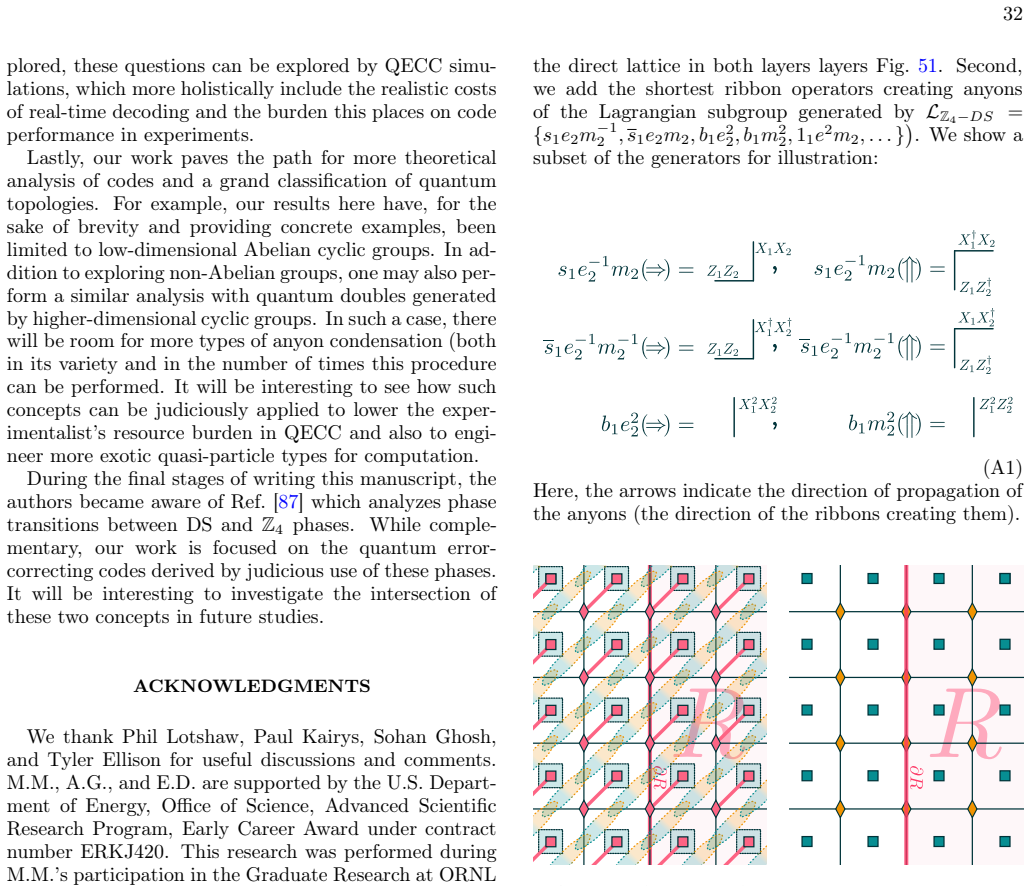
- [Figure captions] Figure captions and lattice diagrams: Several example stabilizer layouts would benefit from explicit labeling of the condensed anyons or logical operators to make the microscopic-to-macroscopic correspondence immediate.
Simulated Author's Rebuttal
We thank the referee for their careful reading of the manuscript and for the constructive comments, which have helped us improve the presentation and rigor of our results. We address each major comment in turn below.
read point-by-point responses
-
Referee: [§3] §3 (condensation algorithm): The central claim that the condensation procedure yields gapped boundary and domain-wall stabilizers for composite-dimensional twisted doubles (e.g., Z_4 double coupled to double semion) is not supported by any explicit verification such as ground-state degeneracy counting, spectrum gap computation, or confirmation that the anyon content and logical operators match the condensed theory. Without such checks, the constructions risk producing gapless modes or inconsistent stabilizers due to the additional fusion/braiding constraints in composite dimensions.
Authors: We agree that explicit verification strengthens the central claim, particularly given the additional fusion and braiding constraints present in composite dimensions. While the condensation procedure is constructed to preserve the topological order by design, we have added ground-state degeneracy counting for the Z_4–double-semion family in the revised manuscript; the computed degeneracies match the values predicted by the condensed theory. We have also included a table comparing the anyon content and logical operators extracted from the stabilizer models to those of the target condensed phase. Full spectrum gap computations remain computationally demanding for the system sizes considered, but we have added small-system exact-diagonalization results in the supplementary material that confirm a finite gap above the ground-state manifold. revision: yes
-
Referee: [§5.2] §5.2 (threshold calculations): The reported thresholds and performance comparisons to surface codes lack sufficient detail on Monte Carlo sample sizes, error-bar estimation, and data-exclusion criteria. This information is load-bearing for assessing whether the new codes genuinely outperform or match standard surface-code thresholds under the composite-dimensional decoder.
Authors: We concur that additional methodological details are necessary for a proper evaluation of the threshold results. In the revised manuscript we have expanded §5.2 to report the Monte Carlo sample sizes (ranging from 5×10^4 to 2×10^5 shots per data point, scaled with code distance), the error-bar estimation procedure (bootstrap resampling over independent decoder runs), and the data-exclusion criteria (discarding runs that failed to converge within a fixed iteration budget or exhibited outlier logical-error rates exceeding three standard deviations from the ensemble mean). These additions allow direct assessment of the statistical reliability of the reported thresholds. revision: yes
Circularity Check
No significant circularity; constructions derive from bulk models independently
full rationale
The paper's central contribution consists of explicit algorithmic constructions that build boundary, domain-wall, and defect stabilizers directly from a given bulk twisted quantum double model via condensation. These are supplemented by dimensional counting arguments and pants-decomposition macro-constructions, then validated through independent numerical threshold simulations and a newly introduced composite-dimensional belief-propagation decoder. No quoted step equates a derived quantity to a fitted parameter by construction, nor does any load-bearing premise reduce to a self-citation whose content is itself unverified within the paper. The derivation chain therefore remains self-contained against external benchmarks such as explicit lattice layouts and error-rate comparisons.
Axiom & Free-Parameter Ledger
axioms (1)
- domain assumption Condensation of anyons produces gapped boundaries and domain walls in Abelian twisted quantum doubles.
Lean theorems connected to this paper
-
IndisputableMonolith/Foundation/RealityFromDistinction.leanreality_from_one_distinction unclear?
unclearRelation between the paper passage and the cited Recognition theorem.
We provide new algorithms... using the physically intuitive concept of condensation, our algorithm explicitly describes how to construct the boundary and domain-wall stabilizers starting from the bulk model.
-
IndisputableMonolith/Cost/FunctionalEquation.leanwashburn_uniqueness_aczel unclear?
unclearRelation between the paper passage and the cited Recognition theorem.
The Z4 family of codes... DS-Z4 Code... patch error rates
What do these tags mean?
- matches
- The paper's claim is directly supported by a theorem in the formal canon.
- supports
- The theorem supports part of the paper's argument, but the paper may add assumptions or extra steps.
- extends
- The paper goes beyond the formal theorem; the theorem is a base layer rather than the whole result.
- uses
- The paper appears to rely on the theorem as machinery.
- contradicts
- The paper's claim conflicts with a theorem or certificate in the canon.
- unclear
- Pith found a possible connection, but the passage is too broad, indirect, or ambiguous to say the theorem truly supports the claim.
Reference graph
Works this paper leans on
-
[1]
The configuration after the first two steps is shown in Fig
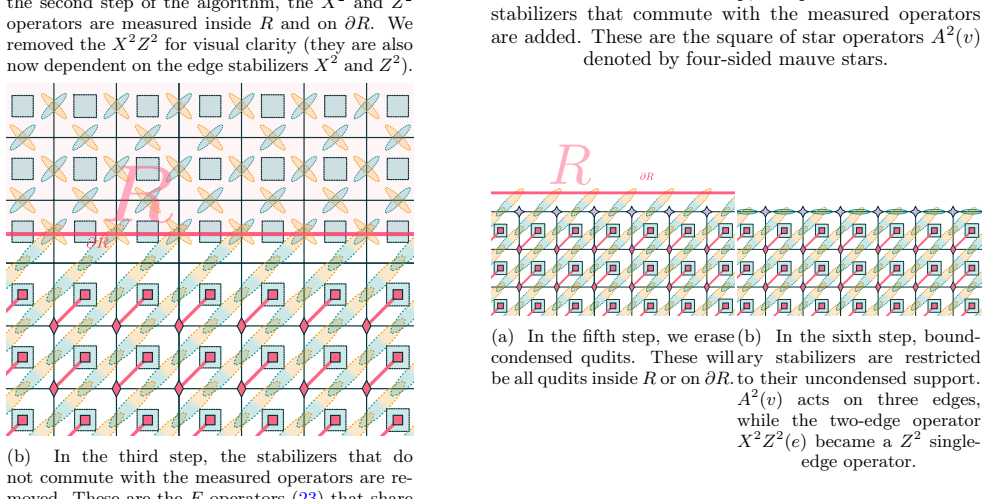
It can be easily checked that they all commute with each other. The configuration after the first two steps is shown in Fig. 25. In the third step, we remove the old stabilizers that do not commute with the new ones. These will include all the old star and plaquette stabilizers of both layers in the bulk of the region𝑅. In addition, we remove the star ope...
-
[2]
P. W. Shor, Scheme for reducing decoherence in quantum computer memory, Physical Review A52, R2493 (1995)
work page 1995
-
[3]
Stabilizer Codes and Quantum Error Correction
D. Gottesman,Stabilizer Codes and Quantum Error Cor- rection, Ph.D. thesis, California Institute of Technology, Pasadena, CA (1997), arXiv:quant-ph/9705052
work page internal anchor Pith review Pith/arXiv arXiv 1997
- [4]
-
[5]
Kitaev, Fault-tolerant quantum computation by anyons, Annals of Physics303, 2–30 (2003)
A. Kitaev, Fault-tolerant quantum computation by anyons, Annals of Physics303, 2–30 (2003)
work page 2003
- [6]
-
[7]
K. J. Satzinger, Y.-J. Liu, A. Smith, C. Knapp, M. Newman, C. Jones, Z. Chen, C. Quintana, X. Mi, A. Dunsworth, C. Gidney,et al., Realizing topologically ordered states on a quantum processor, Science374, 1237–1241 (2021)
work page 2021
-
[8]
D. Bluvstein, S. J. Evered, A. A. Geim, S. H. Li, H. Zhou, T. Manovitz, S. Ebadi, M. Cain, M. Kali- nowski, D. Hangleiter, J. P. Bonilla Ataides, N. Maskara, I. Cong, X. Gao, P. Sales Rodriguez, T. Karolyshyn, G. Semeghini, M. J. Gullans, M. Greiner, V. Vuletić, and M. D. Lukin, Logical quantum processor based on reconfigurable atom arrays, Nature626, 58–...
work page 2023
-
[9]
C., Barends, R., Biswas, R., Boixo, S., Brandao, F
P. Sales Rodriguez, J. M. Robinson, P. N. Jepsen, Z. He, C. Duckering, C. Zhao, K.-H. Wu, J. Campo, K. Bag- nall, M. Kwon,et al., Experimental demonstration of logical magic state distillation, Nature 10.1038/s41586- 025-09367-3 (2025)
-
[10]
A. Paetznick, M. P. da Silva, C. Ryan-Anderson, J. M. Bello-Rivas, J. P. Campora, A. Chernoguzov, J. M. Dreil- ing, C. Foltz, F. Frachon, J. P. Gaebler,et al., Demon- stration of logical qubits and repeated error correction with better-than-physical error rates (2024)
work page 2024
-
[11]
R. S. Gupta, N. Sundaresan, T. Alexander, C. J. Wood, S. T. Merkel, M. B. Healy, M. Hillenbrand, T. Jochym- O’Connor, J. R. Wootton, T. J. Yoder, A. W. Cross, M. Takita, and B. J. Brown, Encoding a magic state with beyond break-even fidelity, Nature625, 259–263 (2024)
work page 2024
-
[12]
R. Acharya, I. Aleiner, R. Allen, T. I. Andersen, M. Ans- mann, F. Arute, K. Arya, A. Asfaw, J. Atalaya, R. Bab- bush,et al., Suppressing quantum errors by scaling a surface code logical qubit, Nature614, 676–681 (2023)
work page 2023
-
[13]
D. Bluvstein, H. Levine, G. Semeghini, T. T. Wang, S. Ebadi, M. Kalinowski, A. Keesling, N. Maskara, H. Pichler, M. Greiner, V. Vuletić, and M. D. Lukin, A quantum processor based on coherent transport of en- tangled atom arrays, Nature604, 451–456 (2022)
work page 2022
-
[14]
V. V. Sivak, A. Eickbusch, B. Royer, S. Singh, I. Tsiout- sios, S. Ganjam, A. Miano, B. L. Brock, A. Z. Ding, L. Frunzio, S. M. Girvin, R. J. Schoelkopf, and M. H. De- voret, Real-time quantum error correction beyond break- even, Nature616, 50–55 (2023)
work page 2023
-
[15]
S.Krinner, N.Lacroix, A.Remm, A.DiPaolo, E.Genois, C. Leroux, C. Hellings, S. Lazar, F. Swiadek, J. Her- rmann, G.J.Norris, C.K.Andersen, M.Müller, A.Blais, C. Eichler, and A. Wallraff, Realizing repeated quantum error correction in a distance-three surface code, Nature 605, 669–674 (2022)
work page 2022
-
[16]
C. Ryan-Anderson, J. G. Bohnet, K. Lee, D. Gresh, A. Hankin, J. P. Gaebler, D. Francois, A. Chernoguzov, D.Lucchetti, N.C.Brown, T.M.Gatterman, S.K.Halit, K. Gilmore, J. A. Gerber, B. Neyenhuis, D. Hayes, and R. P. Stutz, Realization of real-time fault-tolerant quan- tum error correction, Phys. Rev. X11, 041058 (2021)
work page 2021
-
[17]
R. Acharya, D. A. Abanin, L. Aghababaie-Beni, I. Aleiner, T. I. Andersen, M. Ansmann, F. Arute, K. Arya, A. Asfaw, N. Astrakhantsev,et al., Quantum error correction below the surface code threshold, Nature 638, 920–926 (2024)
work page 2024
-
[18]
Y. Hu, Y. Wan, and Y.-S. Wu, Twisted quantum dou- ble model of topological phases in two dimensions, Phys. Rev. B87, 125114 (2013)
work page 2013
-
[19]
Haase, Claire Ed- munds, Lukas Postler, Andrew J
Michael Meth, Jinglei Zhang, Jan F. Haase, Claire Ed- munds, Lukas Postler, Andrew J. Jena, Alex Steiner, Luca Dellantonio, Rainer Blatt, Peter Zoller, Thomas Monz, Philipp Schindler, Christine Muschik, and Martin Ringbauer, Simulating two-dimensional lattice gauge theories on a qudit quantum computer, Nature Physics21, 570 (2025)
work page 2025
-
[20]
Nicolas P. D. Sawaya, Tim Menke, Thi Ha Kyaw, Sonika Johri, Alán Aspuru-Guzik, and Gian G. Guer- reschi, Resource-efficient digital quantum simulation of 𝑑-level systems for photonic, vibrational, and spin-𝑠 hamiltonians, npj Quantum Information6, 49 (2020)
work page 2020
-
[21]
A. Bocharov, M. Roetteler, and Krysta M. Svore, Fac- toring with qutrits: Shor’s algorithm on ternary and metaplectic quantum architectures, Physical Review A 96, 012306 (2017)
work page 2017
-
[22]
Pranav Gokhale, Yiqing Ding, Travis Tomesh, Mar- tinSuchara, MargaretMartonosi,andFredericT.Chong, Asymptotic improvements to quantum circuits via qutrits, inProceedings of the 46th International Sympo- sium on Computer Architecture (ISCA)(ACM, 2019) pp. 554–566
work page 2019
-
[23]
Ji Chu, Xiaoyu He, Yuxuan Zhou,et al., Scalable al- gorithm simplification using quantum and logic, Nature Physics19, 126 (2023)
work page 2023
-
[24]
E. T. Campbell, H. Anwar, and D. E. Browne, Magic- state distillation in all prime dimensions using quantum reed–muller codes, Physical Review X2, 041021 (2012)
work page 2012
-
[25]
E. T. Campbell, Enhanced fault-tolerant quantum com- puting ind-level systems, Physical Review Letters113, 230501 (2014)
work page 2014
- [26]
-
[27]
E. O. Kiktenko, A. S. Nikolaeva, P. Xu, G. V. Shlyap- nikov, and A. K. Fedorov, Scalable quantum computing with qudits on a graph, Phys. Rev. A101, 022304 (2020)
work page 2020
-
[28]
Irene Fernández De Fuentes, Tim Botzem, Mark A. I. Johnson,et al., Navigating the 16-dimensional hilbert space of a high-spin donor qudit with electric and magnetic fields, Nature Communications15, 1380 (2024)
work page 2024
-
[29]
Vilas, Paige Robichaud, Christian Hallas, Grace K
Nathaniel B. Vilas, Paige Robichaud, Christian Hallas, Grace K. Li, Loïc Anderegg, and John M. Doyle, An optical tweezer array of ultracold polyatomic molecules, Nature628, 282 (2024)
work page 2024
-
[30]
S. Chaudhury, S. T. Merkel, A. Silberfarb, I. H. Deutsch, andP.S.Jessen,Quantumcontrolofthehyperfinespinof 38 a cs atom ensemble, Physical Review Letters99, 163002 (2007)
work page 2007
-
[31]
Michael Kues, Christian Reimer, Pawel Roztocki, Luis Romero Cortés, Stefano Sciara, Bastian Wetzel, Yingnan Zhang, Alfredo Cino, S.-T. Chu, B. E. Little, et al., On-chip generation of high-dimensional entangled quantum states and their coherent control, Nature546, 622 (2017)
work page 2017
-
[32]
Yuntian Chi, Jing Huang, Zhenda Zhang,et al., A programmable qudit-based quantum processor, Nature Communications13, 1166 (2022)
work page 2022
-
[33]
B. L. Brock, S. Singh, A. Eickbusch, V. V. Sivak, A. Z. Ding, L. Frunzio, S. Girvin, and M. Devoret, Quan- tum error correction of qudits beyond break-even, Nature 641, 612 (2025)
work page 2025
-
[34]
L. B. Nguyen, Y. Chi, Z. Zhang, Y. Sun, X. Chen, Z. Zhai, B. Tang, and Y. Yang, Empowering a qudit-based quantum processor by traversing the dual bosonic ladder, Nature Communications15, 7117 (2024)
work page 2024
-
[35]
S. Roy, X. Wu, H. J. Kim, J. Lee, Y. Zhao,et al., Syn- thetic high angular momentum spin dynamics in a mi- crowave oscillator, Physical Review X15, 021009 (2025)
work page 2025
-
[36]
Z. Wang, R. W. Parker, E. Champion, and M. S. Blok, High-𝑒𝑗/𝑒𝑐 transmon qudits with up to 12 levels, Physical Review Applied23, 034046 (2025)
work page 2025
-
[37]
F. M. Leupold, P. Jurcevic, C. Hempel, G. A. Kaza- kov, M. Giustina, R. Blatt, and C. F. Roos, Sustained state-independent quantum contextual correlations from a single ion, Physical Review Letters120, 180401 (2018)
work page 2018
-
[38]
Schmiegelow, Kai Kieling, Rainer Blatt, and Christian F
Martin Ringbauer, Jan Hapla, Christian T. Schmiegelow, Kai Kieling, Rainer Blatt, and Christian F. Roos, A uni- versal qudit quantum processor with trapped ions, Na- ture Physics18, 1053 (2022)
work page 2022
-
[39]
C. Adambukulam, B. Johnson, A. Morello, and A. Laucht, Hyperfine spectroscopy and fast, all-optical arbitrary state initialization and readout of a single, ten-level {73}ge vacancy nuclear spin qudit in diamond, Physical Review Letters132, 060603 (2024)
work page 2024
-
[40]
V. A. Soltamov, P. V. Klimov, N. A. Zakharenko, E. B. Monakhov, and P. G. Baranov, Excitation and coherent control of spin qudit modes in silicon carbide at room temperature, Nature Communications10, 1678 (2019)
work page 2019
-
[41]
T. D. Ellison, Y.-A. Chen, A. Dua, W. Shirley, N. Tanti- vasadakarn, and D. J. Williamson, Pauli stabilizer mod- els of twisted quantum doubles, PRX Quantum3, 010353 (2022)
work page 2022
-
[42]
Universal topological phase of 2D stabilizer codes
H. Bombín, G. Duclos-Cianci, and D. Poulin, Uni- versal topological phase of two-dimensional stabilizer codes, New Journal of Physics14, 073048 (2012), arXiv:1103.4606
work page internal anchor Pith review Pith/arXiv arXiv 2012
-
[43]
Structure of 2D Topological Stabilizer Codes
H. Bombín, Structure of 2d topological stabilizer codes, Communications in Mathematical Physics327, 387 (2014), arXiv:1107.2707
work page internal anchor Pith review Pith/arXiv arXiv 2014
- [44]
-
[45]
H. Bombin and M. A. Martin-Delgado, Family of non- abelian kitaev models on a lattice: Topological conden- sation and confinement, Phys. Rev. B78, 115421 (2008)
work page 2008
- [46]
-
[47]
Kong, Anyon condensation and tensor categories, Nu- clear Physics B886, 436–482 (2014)
L. Kong, Anyon condensation and tensor categories, Nu- clear Physics B886, 436–482 (2014)
work page 2014
-
[48]
I. Cong, M. Cheng, and Z. Wang, Hamiltonian and alge- braic theories of gapped boundaries in topological phases of matter, Communications in Mathematical Physics 355, 645–689 (2017)
work page 2017
-
[49]
L. Kong, X.-G. Wen, and H. Zheng, Boundary-bulk rela- tion in topological orders, Nuclear Physics B922, 62–76 (2017)
work page 2017
-
[50]
A. Bullivant, Y. Hu, and Y. Wan, Twisted quantum dou- ble model of topological order with boundaries, Phys. Rev. B96, 165138 (2017)
work page 2017
- [51]
-
[52]
Y. Li, Z. Song, A. Kubica, and I. H. Kim, Domain walls from spt-sewing (2024)
work page 2024
-
[53]
M. Li, X. Yang, and X.-Y. Dong, Gapped boundaries of kitaev’s quantum double models: A lattice realization of anyon condensation from lagrangian algebras (2025)
work page 2025
-
[54]
Bombin, Topological order with a twist: Ising anyons from an abelian model, Phys
H. Bombin, Topological order with a twist: Ising anyons from an abelian model, Phys. Rev. Lett.105, 030403 (2010)
work page 2010
-
[55]
S. Bravyi, M. B. Hastings, and S. Michalakis, Topologi- cal quantum order: Stability under local perturbations, Journal of Mathematical Physics51, 10.1063/1.3490195 (2010)
-
[56]
D. K. Tuckett, A. S. Darmawan, C. T. Chubb, S. Bravyi, S.D.Bartlett,andS.T.Flammia,Tailoringsurfacecodes for highly biased noise, Phys. Rev. X9, 041031 (2019)
work page 2019
-
[57]
Topological interactions in broken gauge theories
M. de Wild Propitius,Topological interactions in bro- ken gauge theories, Phd thesis, University of Amster- dam, Amsterdam, The Netherlands (1995), 168 pages. Available athttps://arxiv.org/abs/hep-th/9511195, arXiv:hep-th/9511195 [hep-th]
work page internal anchor Pith review Pith/arXiv arXiv 1995
-
[58]
V. G. Drinfel’d, Quantum groups, Journal of Soviet Mathematics41, 898–915 (1988)
work page 1988
-
[59]
R. Dijkgraaf and E. Witten, Topological gauge theories and group cohomology, Communications in Mathemati- cal Physics129, 393 (1990)
work page 1990
-
[60]
The terms edge and qudit are essentially synonymous in this work
-
[61]
Gheorghiu, Standard form of qudit stabilizer groups, Physics Letters A378, 505–509 (2014)
V. Gheorghiu, Standard form of qudit stabilizer groups, Physics Letters A378, 505–509 (2014)
work page 2014
-
[62]
Wilczek, Quantum mechanics of fractional-spin parti- cles, Phys
F. Wilczek, Quantum mechanics of fractional-spin parti- cles, Phys. Rev. Lett.49, 957 (1982)
work page 1982
-
[63]
S. B. Bravyi and A. Y. Kitaev, Quantum codes on a lattice with boundary (1998)
work page 1998
-
[64]
A. Kapustin and N. Saulina, Topological boundary con- ditions in abelian chern–simons theory, Nuclear Physics B845, 393–435 (2011)
work page 2011
-
[65]
T. Lan, J. C. Wang, and X.-G. Wen, Gapped domain walls, gapped boundaries, and topological degeneracy, Phys. Rev. Lett.114, 076402 (2015)
work page 2015
-
[66]
Bombin, Clifford gates by code deformation, New Journal of Physics13, 043005 (2011)
H. Bombin, Clifford gates by code deformation, New Journal of Physics13, 043005 (2011)
work page 2011
-
[67]
T. J. Yoder and I. H. Kim, The surface code with a twist, Quantum1, 2 (2017)
work page 2017
-
[68]
M. S. Kesselring, F. Pastawski, J. Eisert, and B. J. Brown, The boundaries and twist defects of the color code and their applications to topological quantum com- putation, Quantum2, 101 (2018). 39
work page 2018
-
[69]
T. R. Scruby and D. E. Browne, A hierarchy of anyon models realised by twists in stacked surface codes, Quan- tum4, 251 (2020)
work page 2020
-
[70]
Petiziol, Non-abelian anyons in periodically driven abelian spin liquids, Phys
F. Petiziol, Non-abelian anyons in periodically driven abelian spin liquids, Phys. Rev. Lett.133, 036601 (2024)
work page 2024
-
[71]
B. J. Brown, K. Laubscher, M. S. Kesselring, and J. R. Wootton,Pokingholesandcuttingcornerstoachieveclif- ford gates with the surface code, Phys. Rev. X7, 021029 (2017)
work page 2017
-
[72]
A. Benhemou, J. K. Pachos, and D. E. Browne, Non- abelian statistics with mixed-boundary punctures on the toric code, Phys. Rev. A105, 042417 (2022)
work page 2022
-
[73]
A. Krishna and D. Poulin, Topological wormholes: Non- local defects on the toric code, Physical Review Research 2, 10.1103/PhysRevResearch.2.023116 (2020)
-
[74]
A. J. Landahl and B. C. A. Morrison, Logical fermions for fault-tolerant quantum simulation (2021)
work page 2021
-
[75]
M. A. Levin and X.-G. Wen, String-net condensation: A physical mechanism for topological phases, Phys. Rev. B 71, 045110 (2005)
work page 2005
-
[76]
G. S. Canright, S. M. Girvin, and A. Brass, Superconduc- tive pairing of fermions and semions in two dimensions, Phys. Rev. Lett.63, 2295 (1989)
work page 1989
-
[77]
R. W. Hamming, Error detecting and error correcting codes, The Bell System Technical Journal29, 147 (1950)
work page 1950
-
[78]
Gaitan,Quantum Error Correction and Fault Tolerant Quantum Computing(CRC Press, Boca Raton, 2008)
F. Gaitan,Quantum Error Correction and Fault Tolerant Quantum Computing(CRC Press, Boca Raton, 2008)
work page 2008
-
[79]
F. Burnell, Anyon condensation and its applications, An- nual Review of Condensed Matter Physics9, 307–327 (2018)
work page 2018
-
[80]
M. S. Kesselring, J. C. Magdalena de la Fuente, F. Thom- sen, J. Eisert, S. D. Bartlett, and B. J. Brown, Anyon condensation and the color code, PRX Quantum5, 010342 (2024)
work page 2024
discussion (0)
Sign in with ORCID, Apple, or X to comment. Anyone can read and Pith papers without signing in.