REVIEW 5 major objections 5 minor 110 references
Advancements in Crop Analysis through Deep Learning and Explainable AI
T0 review · 5 major / 5 minor · reviewed 2026-08-05 · deepseek-v4-flash
Pith's one-line read A CNN pipeline is reported to classify five rice grain varieties and four rice leaf diseases with near-perfect accuracy, with LIME and SHAP overlays revealing the image regions behind each prediction.
desk verdict A thesis draft with plausible numbers but untraceable provenance; the crowd-counting leftovers make it impossible to verify what was actually run. read the letter →
The pith
A machine-rendered reading of the paper's core claim, the machinery that carries it, and where it could break.
The reading
What carries the argument
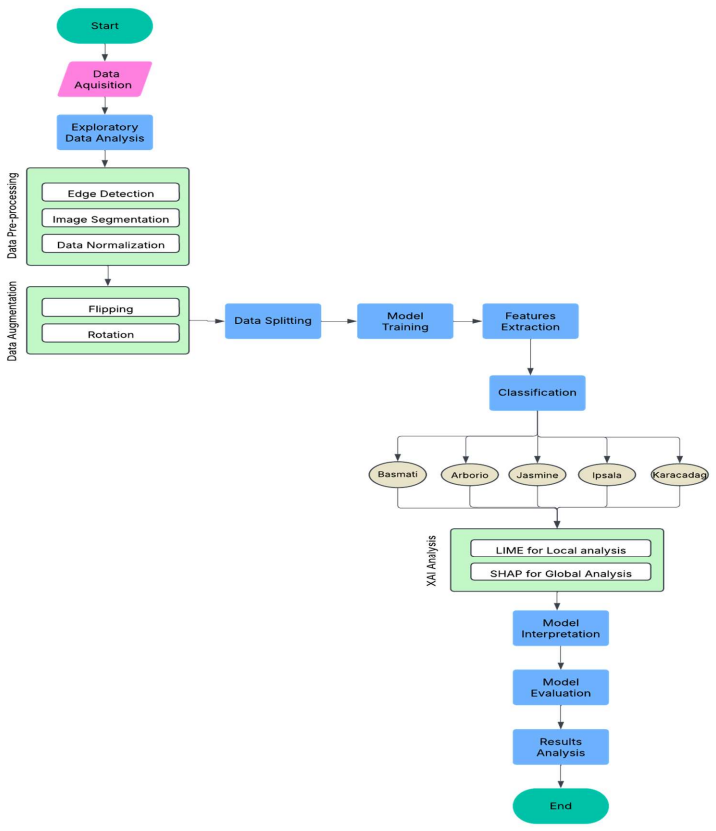
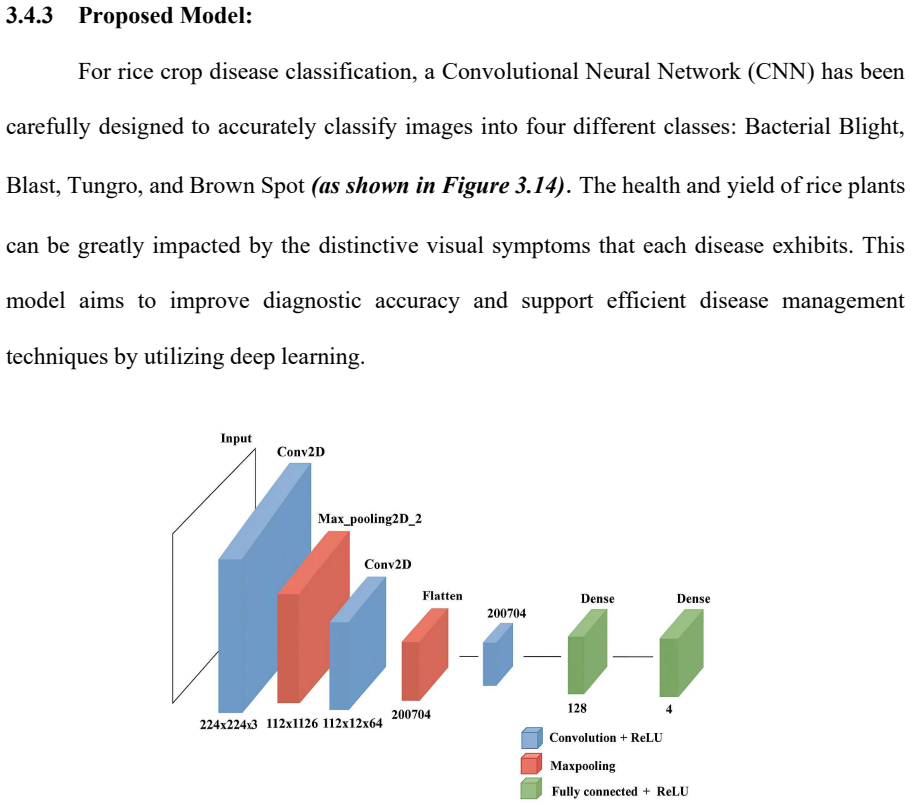
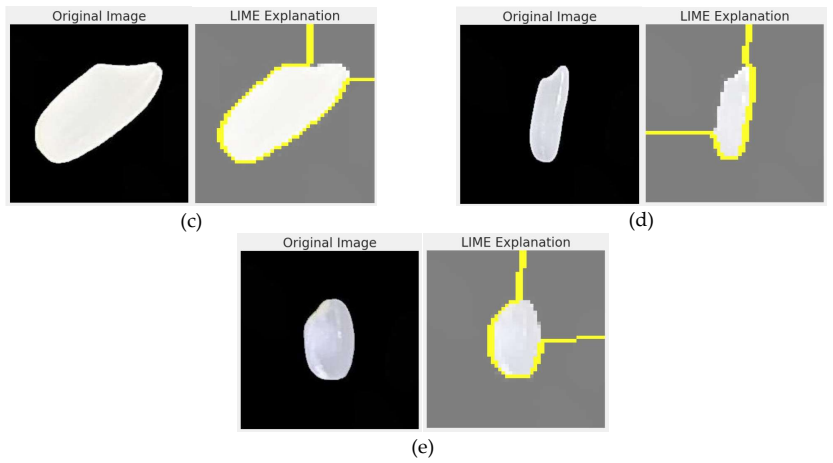
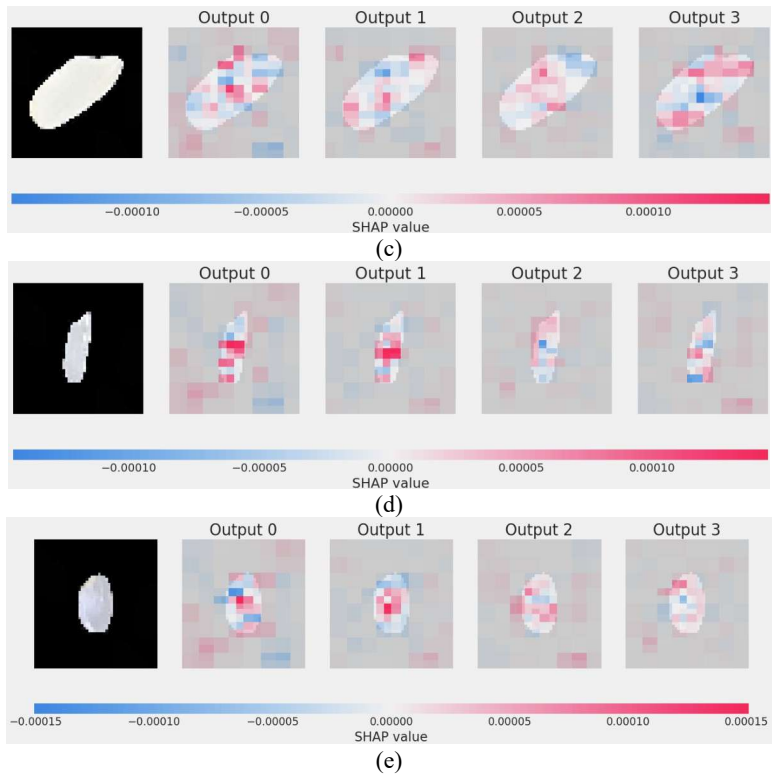
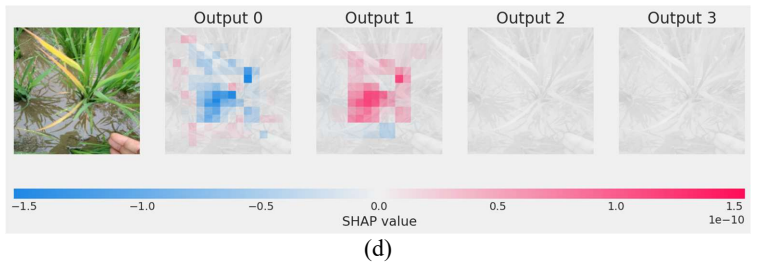
The machinery is a two-stage pipeline. First, a feature extractor: a small custom CNN (two Conv2D blocks, max pooling, a 32-unit dense layer, and a five-unit softmax head) for grains, and pretrained backbones (ResNet-50, VGG16, MobileNet-V2, DenseNet121) for leaf diseases, with Canny edge detection and segmentation applied before training. Second, an explainability stage: LIME constructs local surrogate models to highlight the image regions that pushed a prediction, and SHAP assigns per-pixel additive attributions. The claim is that these two stages together turn a black-box classifier into a transparent crop-analysis tool.
What would settle it
Re-run the described pipeline on the specific public datasets the text names (after locating the correct dataset sources) and check whether per-class F1 scores for the five grains and ResNet-50's 99.82% disease accuracy reproduce; also verify that the cited references actually contain those datasets. Failure to reproduce the confusion matrices or the reported ROC/AUC values would settle the claim.
Extended reading notes
Core claim
On the paper's own terms, the central discovery is that a single deep-learning workflow—image preprocessing (grayscale conversion, Canny edge detection, segmentation, normalization, rotation and flipping), a custom CNN for grains, pretrained CNNs for diseases, then LIME and SHAP post-hoc explanations—separates the five grain classes with per-class F1 scores between 0.986 and 0.997, and separates the four disease classes with ResNet-50 reaching 99.82% accuracy. The authors take these results to show that standard, non-specialised CNN architectures are sufficient for this level of crop analysis, and that the LIME/SHAP overlays make the basis of each prediction visible to non-experts.
Load-bearing premise
The load-bearing premise is that the pipeline described in the manuscript is the one actually run on the named public datasets; this premise is currently unverifiable because Section 3.3.1 cites the 75K grain dataset as reference [47], which is a MobileNetV3 architecture paper, and Section 3.4.1 cites the 6K disease dataset as reference [77], which is a rice-disease SVM paper, so the provenance of the reported accuracy numbers is not established by the text itself.
Editorial extensions
If this is right
- If the reported numbers hold, rice grain quality grading could be automated with camera-based CNN inspection, replacing or prioritising manual sorting.
- Early leaf-disease diagnosis becomes feasible on still images, giving farmers a low-cost second opinion before the disease spreads.
- The LIME/SHAP overlays give quality analysts a concrete audit trail: each automated decision is accompanied by the image regions that drove it.
- The model comparison points to ResNet-50 as the strongest of the tested pretrained backbones for this disease dataset, informing future architecture choices.
Reading between the lines
- Beyond the paper: the decisive test for the explainability claim is behavioural—whether LIME/SHAP overlays help a human inspector catch wrong classifications faster or more accurately than a bare confidence score.
- Beyond the paper: the pipeline should be re-run on field-captured images with varied lighting, angles, and backgrounds; the reported accuracy is on curated public images, and transfer to realistic field conditions is an open question.
- Beyond the paper: the manuscript's internal inconsistencies in dataset citations leave the provenance of the accuracy numbers unresolved until the exact datasets are located and the experiments are rerun.
Signed reviews
Editorial analysis
A structured set of objections, weighed in public.
Referee Report
Summary. The manuscript, submitted as an arXiv preprint in cs.CV, is an unrevised Master's thesis that proposes a deep-learning pipeline for two crop-analysis tasks: classifying five rice grain varieties (Arborio, Basmati, Ipsala, Jasmine, Karacadag) on a 75,000-image dataset, and classifying four rice leaf diseases (Bacterial Blight, Blast, Brown Spot, Tungro) on a 6,000-image dataset. The authors report near-perfect accuracy: F1-scores of 0.986–0.997 for grains (Table 4.4), 99.82% accuracy for ResNet-50 on disease classification (Table 5.4), and AUC = 1.00 for disease classification (Figure 5.3). They augment the classifiers with LIME and SHAP explanations to make predictions transparent. The central load-bearing claims are the accuracy numbers and the interpretability of the decisions.
Significance. If substantiated, the results would be a competent but not methodologically novel application of standard CNN classifiers and post-hoc XAI tools to two public agricultural datasets. The confusion-matrix counts and class-wise scores are internally plausible: the test-set totals are consistent with an 80/10/10 split of 75,000 and 6,000 images, and the reported F1-scores are in line with published results on the same rice-grain dataset. The explicit use of LIME and SHAP side-by-side is a useful practical comparison. However, the manuscript's central empirical claims are not verifiable from the text alone: the datasets are cited to method papers rather than dataset sources, the described preprocessing is not consistently connected to the reported model inputs, and several models discussed in the narrative (InceptionResNetV2, DenseNet201) do not appear in the results tables. No code, data links, or reproducibility artifacts are provided. These issues are load-bearing because the accuracy claims cannot be traced to a concrete, reproducible pipeline.
major comments (5)
- [Section 3.3.1 / Reference [47]] The rice grain dataset is claimed to be the 'Rice Image Dataset' on Kaggle, cited as [47], but reference [47] is Howard et al., 'Searching for MobileNetV3' (ICCV 2019), a network-architecture paper, not a dataset. Similarly, Section 3.4.1 cites [77] for the rice leaf disease dataset, but [77] is Sethy et al., a 'Deep feature based rice leaf disease identification using support vector machine' method paper. These are not cosmetic citation errors: the dataset identity (splits, preprocessing, class balance) is the foundation of every accuracy number in Tables 4.4, 5.3, and 5.4. The authors must cite the actual dataset URLs or DOIs and specify the exact versions used; otherwise, the reported numbers cannot be independently checked or reproduced.
- [Section 4.1 / Table 4.1 vs. Section 4.2 / Table 4.2] The grain-classification pipeline is internally inconsistent about what the CNN actually saw. Section 3.3.3 describes Canny edge detection, segmentation, normalization, and rotation/flip augmentation, but Table 4.1 infers an input size of '50×50×1' while Table 4.2 states 'Image Size 50x50' with '03 (RGB)' channels. More importantly, the text never states whether the model was trained on raw, edge-detected, segmented, normalized, or augmented images. Figure 4.3 shows the 'Original Image' and LIME overlay, not the edge/segmented version. Without this mapping, the preprocessing descriptions are decorative and the provenance of Table 4.4's numbers is untraceable.
- [Section 5.1 / Table 5.1 vs. Section 3.4.3] The disease-classification model description is contradictory across chapters. Section 5.1.2/Table 5.1 specify a 50×50 RGB input for the CNN, while Section 3.4.3 describes the proposed CNN as using '224x224 pixels' RGB input. Table 5.4 reports results for ResNet-50, VGG-16, MobileNet-V2, and DenseNet121, but Chapter 6 states that 'InceptionResNetV2 and DenseNet201 have shown that they are better in reaching high levels of accuracies' without those models appearing in any results table. Figure 5.8 is captioned as the 'Custom CNN' SHAP output, but its architecture and relation to the models in Table 5.4 are unspecified. The reader cannot determine which model produced Table 5.3 or the confusion matrix in Figure 5.2.
- [Section 5.3 / Figure 5.3] The abstract and text claim 'outstanding area under the ROC curve in every class' and AUC = 1.00. Figure 5.3 shows a micro-average ROC curve only; no per-class AUC values, confidence intervals, or statistical comparison are provided. On a near-perfect four-class problem, a micro-average AUC of 1.00 is plausible but says nothing about per-class uncertainty, especially with a small test set (≈150 images per class). The claim as stated is not supported by the reported evidence. The authors should report per-class AUC with confidence intervals or bootstrap estimates, or soften the claim.
- [Figure 3.5 caption] Figure 3.5, referenced in Section 3.2 as the proposed rice grain classification system, bears the caption 'Proposed architecture for crowd counting using self-supervised training. Stage 1 utilizes the rotation task for self-supervised training, and stage 2 uses distribution matching for density estimation.' This is unrelated to the rice-grain task and appears to be a template artifact. Its presence in the methodology chapter compounds the provenance problem: if the system diagram is not the described system, the reader cannot trust the surrounding experimental description either.
minor comments (5)
- [Throughout] The manuscript contains numerous copy-paste artifacts: Chapter 1 refers to 'crowd scene analysis' in the outline (Section 1.8), Section 2.1 says 'A brief review of the current approaches along with their shortcomings for crowd scene analysis,' and Figure 1.6 is captioned 'Significance of Crowd Scene Analysis' while the surrounding text discusses rice grain classification. These should be corrected.
- [Table 5.2] The class name 'Burst' appears in Table 5.2, while the text and elsewhere use 'Blast.' This is likely a typo but should be fixed because it is a class label.
- [Section 3.3.4 / Table 4.2] The optimizer is described as 'Adamax' in Section 3.3.4 but 'ADAM' in Table 4.2 and Section 4.2. Please state the exact optimizer and learning rate.
- [References] References are internally duplicated (e.g., [73] appears twice with different content, [111] duplicates [110]), and several reference numbers do not match the cited content (e.g., [47], [77] as noted above). A systematic reference audit is needed.
- [Figures 5.4 and 5.7] Figures 5.4 and 5.7 both have captions saying 'MobileNet-V2' for the LIME visualization, which is certainly a labeling error; one of them presumably corresponds to a different model or should be removed. This makes the XAI comparison confusing.
Circularity Check
No circular derivation: the accuracy and XAI claims are empirical measurements on external datasets, not results forced by the model definitions or by a self-citation chain.
full rationale
The thesis is an applied deep-learning study: it trains CNN/transfer-learning models on external image datasets and reports measured accuracy, precision, recall, F1, confusion matrices, ROC curves, and LIME/SHAP visualizations. No equation in the paper defines a quantity in terms of the quantity it is supposed to predict, and no parameter fitted to a subset is later relabeled as a prediction. The claims are empirical, not derived. The XAI component is post-hoc interpretation of already-trained models; it does not define the accuracy numbers. The citations to prior work are background/literature and are not invoked as a uniqueness theorem or as the justification for the central empirical claim. The reviewer-identified problems—wrong dataset citations ([47] is a MobileNetV3 paper, [77] is an SVM disease paper), the crowd-counting figure caption (Figure 3.5), contradictory input sizes (50x50x1 vs 50x50x3 vs 224x224), and inconsistent model lists (Tables 5.3/5.4 vs Chapter 6)—are serious provenance, reproducibility, and correctness defects, but they are not circularity: none of them makes an output equal to an input by construction. Accordingly, no circular step is identified and the circularity score is 0.
Assumptions & free parameters
free parameters (5)
- Data split ratio (train/validation/test) =
80/10/10
- Best-epoch stopping point (grain model) =
epoch 10
- Grain CNN hyperparameters =
32 and 64 3x3 filters, 2x2 max pooling, dense 32, Adamax/ADAM, L2 regularization
- Image input size and channels =
50x50x3 implied, 50x50x1 claimed in Table 4.1
- Data augmentation settings =
rotation 90 and 180 degrees, flipping with rate -1 to +1
assumptions (4)
- standard math Standard deep learning machinery (backpropagation, SGD/Adam convergence, softmax classification) works as taught.
- domain assumption The publicly available Kaggle images of isolated grains and leaves are correctly labeled and representative of the five varieties and four diseases.
- domain assumption Morphological image features (size, shape, color, texture) captured in the images are sufficient to separate all five grain varieties and four diseases.
- ad hoc to paper The described experimental pipeline (Canny edge detection, segmentation, normalization, augmentation, then CNN training) is the pipeline actually run.
Cite this review
Pith. "Pith review of Advancements in Crop Analysis through Deep Learning and Explainable AI." pith.science (2026). https://pith.science/paper/VZZ4OFCU
@misc{pith2026250819307,
  author       = {Pith},
  title        = {Pith review of: Advancements in Crop Analysis through Deep Learning and Explainable AI},
  year         = {2026},
  howpublished = {\url{https://pith.science/paper/VZZ4OFCU}},
  note         = {Machine review of arXiv:2508.19307}
}
read the original abstract
Rice is a staple food of global importance in terms of trade, nutrition, and economic growth. Among Asian nations such as China, India, Pakistan, Thailand, Vietnam and Indonesia are leading producers of both long and short grain varieties, including basmati, jasmine, arborio, ipsala, and kainat saila. To ensure consumer satisfaction and strengthen national reputations, monitoring rice crops and grain quality is essential. Manual inspection, however, is labour intensive, time consuming and error prone, highlighting the need for automated solutions for quality control and yield improvement. This study proposes an automated approach to classify five rice grain varieties using Convolutional Neural Networks (CNN). A publicly available dataset of 75000 images was used for training and testing. Model evaluation employed accuracy, recall, precision, F1-score, ROC curves, and confusion matrices. Results demonstrated high classification accuracy with minimal misclassifications, confirming the model effectiveness in distinguishing rice varieties. In addition, an accurate diagnostic method for rice leaf diseases such as Brown Spot, Blast, Bacterial Blight, and Tungro was developed. The framework combined explainable artificial intelligence (XAI) with deep learning models including CNN, VGG16, ResNet50, and MobileNetV2. Explainability techniques such as SHAP (SHapley Additive exPlanations) and LIME (Local Interpretable Model-agnostic Explanations) revealed how specific grain and leaf features influenced predictions, enhancing model transparency and reliability. The findings demonstrate the strong potential of deep learning in agricultural applications, paving the way for robust, interpretable systems that can support automated crop quality inspection and disease diagnosis, ultimately benefiting farmers, consumers, and the agricultural economy.
Figures


Figures from the paper (35 more)








Reference graph
Works this paper leans on
-
[47]
A. Howard, M. Sandler, G. Chu, L.-C. Chen, B. Chen, M. Tan, W. Wang, Y. Zhu, R. Pang, V. Vasudevan and others, "Searching for mobilenetv3," in Proceedings of the IEEE/CVF international conference on computer vision, 2019
work page 2019
-
[77]
Deep feature based rice leaf disease identification using support vector machine,
P. K. Sethy, N. K. Barpanda, A. K. Rath and S. K. Behera, "Deep feature based rice leaf disease identification using support vector machine," Computers and Electronics in Agriculture, vol. 175, p. 105527, 2020
work page 2020
-
[1]
Precision Agriculture Technologies for crop monitoring and management,
S. Fathima and A. Jagan, "Precision Agriculture Technologies for crop monitoring and management," in 2024 2nd DMIHER International Conference on Artificial Intelligence in Healthcare, Education and Industry (IDICAIEI), 2024
2024
-
[2]
A comprehensive review on smart and sustainable agriculture using IoT technologies,
V. Kumar, K. V. Sharma, N. Kedam, A. Patel, T. R. Kate and U. Rathnayake, "A comprehensive review on smart and sustainable agriculture using IoT technologies," Smart Agricultural Technology, p. 100487, 2024
2024
-
[3]
A comprehensive review of remote sensing platforms, sensors, and applications in nut crops,
H. Jafarbiglu and A. Pourreza, "A comprehensive review of remote sensing platforms, sensors, and applications in nut crops," Computers and Electronics in Agriculture, vol. 197, p. 106844, 2022
2022
-
[4]
Remote Sensing from Different Sources for Crop Growth Monitoring in the Area of the Lower Northern Mississippi,
Y. Huang, G. Feng, H. Tewolde and M. Shankle, "Remote Sensing from Different Sources for Crop Growth Monitoring in the Area of the Lower Northern Mississippi," Challenges, vol. 14, p. 12, February 2023
2023
-
[5]
Enhancing precision agriculture: A comprehensive review of machine learning and AI vision applications in all-terrain vehicle for farm automation,
M. Padhiary, D. Saha, R. Kumar, L. N. Sethi and A. Kumar, "Enhancing precision agriculture: A comprehensive review of machine learning and AI vision applications in all-terrain vehicle for farm automation," Smart Agricultural Technology, p. 100483, 2024
2024
-
[6]
Application of digital technologies for ensuring agricultural productivity,
R. Abiri, N. Rizan, S. K. Balasundram, A. B. Shahbazi and H. Abdul-Hamid, "Application of digital technologies for ensuring agricultural productivity," Heliyon, vol. 9, 2023
2023
Show all 110 references
-
[7]
Sustainable Practices for Enhancing Soil Health and Crop Quality in Modern Agriculture: A Review.,
D.-C. Țopa, S. Căpșună, A.-E. Calistru and C. Ailincăi, "Sustainable Practices for Enhancing Soil Health and Crop Quality in Modern Agriculture: A Review.," Agriculture; Basel, vol. 15, 2025
2025
-
[8]
Early diagnosis of rice plant disease using machine learning techniques,
M. Sharma, C. J. Kumar and A. Deka, "Early diagnosis of rice plant disease using machine learning techniques," Archives of Phytopathology and Plant Protection, vol. 55, p. 259–283, 2022
2022
-
[9]
Unravelling the use of artificial intelligence in management of insect pests,
B. Kariyanna and M. Sowjanya, "Unravelling the use of artificial intelligence in management of insect pests," Smart Agricultural Technology, p. 100517, 2024
2024
-
[10]
Classification of Crops,
R. S. Dangi, E. Joshi, N. Singh, S. Agrawal, A. Kumar, A. Trivedi and R. Lautre, "Classification of Crops," Frontiers of Agronomy, p. 1
-
[11]
Crops Disease Detection, from Leaves to Field: What We Can Expect from Artificial Intelligence,
Y. Lebrini and A. Ayerdi Gotor, "Crops Disease Detection, from Leaves to Field: What We Can Expect from Artificial Intelligence," Agronomy, vol. 14, p. 2719, 2024
2024
-
[12]
A world of 8 billion,
L. Zeifman, S. Hertog, V. Kantorova, J. Wilmoth and others, "A world of 8 billion," 2022
2022
-
[13]
The global population will soon reach 8 billion—then what,
M. Herrmann, "The global population will soon reach 8 billion—then what," Newyork, ABD. Erişim Adresi https://www. un. org/en/un-chronicle/global-population-will-soon-reach-8- billion-then-what adresinden alındı, 2022. 67
2022
-
[14]
Crowd Scene Analysis Using Deep Learning Techniques,
M. J. Asif, "Crowd Scene Analysis Using Deep Learning Techniques," arXiv preprint arXiv:2505.08834, 2025
2025 arXiv
-
[15]
Crowd Scene Analysis: Crowd Counting using MCNN based on Self-Supervised training with Attention Mechanism,
M. J. Asif, M. Asad and S. Imran, "Crowd Scene Analysis: Crowd Counting using MCNN based on Self-Supervised training with Attention Mechanism," in 2023 25th International Multitopic Conference (INMIC), 2023
2023
-
[16]
Major trends in population growth around the world,
D. Gu, K. Andreev and M. E. Dupre, "Major trends in population growth around the world," China CDC weekly, vol. 3, p. 604, 2021
2021
-
[17]
What's beneath the future: World population prospects,
P. Gerland, "What's beneath the future: World population prospects," in Semaine Data-SHS, 2023
2023
-
[18]
Climate change and food security: risks and responses,
V. Gitz, A. Meybeck, L. Lipper, C. D. Young and S. Braatz, "Climate change and food security: risks and responses," Food and Agriculture Organization of the United Nations (FAO) Report, vol. 110, p. 3–36, 2016
2016
-
[19]
Advancing sustainability: The impact of emerging technologies in agriculture,
A. Gamage, R. Gangahagedara, S. Subasinghe, J. Gamage, C. Guruge, S. Senaratne, T. Randika, C. Rathnayake, Z. Hameed, T. Madhujith and others, "Advancing sustainability: The impact of emerging technologies in agriculture," Current Plant Biology, p. 100420, 2024
2024
-
[20]
IoT-based agriculture management techniques for sustainable farming: A comprehensive review,
H. Shahab, M. Iqbal, A. Sohaib, F. U. Khan and M. Waqas, "IoT-based agriculture management techniques for sustainable farming: A comprehensive review," Computers and Electronics in Agriculture, vol. 220, p. 108851, 2024
2024
-
[21]
Advanced technologies for precision tree fruit disease management: A review,
Y. Yang, P. Mali, L. Arthur, F. Molaei, S. Atsyo, J. Geng, L. He and S. Ghatrehsamani, "Advanced technologies for precision tree fruit disease management: A review," Computers and Electronics in Agriculture, vol. 229, p. 109704, 2025
2025
-
[22]
Plant disease detection by imaging sensors–parallels and specific demands for precision agriculture and plant phenotyping,
A.-K. Mahlein, "Plant disease detection by imaging sensors–parallels and specific demands for precision agriculture and plant phenotyping," Plant disease, vol. 100, p. 241–251, 2016
2016
-
[23]
AI-enabled crop health monitoring and nutrient management in smart agriculture,
S. K. Swarnkar, L. Dewangan, O. Dewangan, T. M. Prajapati and F. Rabbi, "AI-enabled crop health monitoring and nutrient management in smart agriculture," in 2023 6th International Conference on Contemporary Computing and Informatics (IC3I), 2023
2023
-
[24]
Implementation of artificial intelligence in agriculture for optimisation of irrigation and application of pesticides and herbicides,
T. Talaviya, D. Shah, N. Patel, H. Yagnik and M. Shah, "Implementation of artificial intelligence in agriculture for optimisation of irrigation and application of pesticides and herbicides," Artificial intelligence in agriculture, vol. 4, p. 58–73, 2020
2020
-
[26]
Crop Yield Prediction Using Artificial Intelligence and Remote Sensing Methods,
R. Banerjee, Bharti, P. Das and S. Khan, "Crop Yield Prediction Using Artificial Intelligence and Remote Sensing Methods," in Artificial Intelligence and Smart Agriculture: Technology and Applications, Springer, 2024, p. 103–117. 68
2024
-
[27]
Tree crop yield estimation and prediction using remote sensing and machine learning: A systematic review,
C. Trentin, Y. Ampatzidis, C. Lacerda and L. Shiratsuchi, "Tree crop yield estimation and prediction using remote sensing and machine learning: A systematic review," Smart Agricultural Technology, p. 100556, 2024
2024
-
[28]
Artificial intelligence techniques in crop yield estimation based on Sentinel-2 data: A comprehensive survey,
M. F. Aslan, K. Sabanci and B. Aslan, "Artificial intelligence techniques in crop yield estimation based on Sentinel-2 data: A comprehensive survey," Sustainability, vol. 16, p. 8277, 2024
2024
-
[29]
Crop yield prediction using machine learning: A systematic literature review,
T. Van Klompenburg, A. Kassahun and C. Catal, "Crop yield prediction using machine learning: A systematic literature review," Computers and electronics in agriculture, vol. 177, p. 105709, 2020
2020
-
[30]
Crop price prediction using supervised machine learning algorithms,
R. Dhanapal, A. AjanRaj, S. Balavinayagapragathish and J. Balaji, "Crop price prediction using supervised machine learning algorithms," in Journal of Physics: Conference Series, 2021
2021
-
[31]
Crop price prediction system using machine learning algorithms,
P. Samuel, B. Sahithi, T. Saheli, D. Ramanika and N. A. Kumar, "Crop price prediction system using machine learning algorithms," Quest Journals Journal of Software Engineering and Simulation, vol. 2, p. 9288, 2020
2020
-
[32]
An intelligent crop price prediction using suitable machine learning algorithm,
I. Ghutake, R. Verma, R. Chaudhari and V. Amarsinh, "An intelligent crop price prediction using suitable machine learning algorithm," in ITM web of conferences, 2021
2021
-
[33]
Farm\_{e}{r}{a}: Precision farming with GIS, AI pest management, smart irrigation, data analytics, and optimized crop planning,
K. P. Reddy, M. R. Thanka, E. B. Edwin, V. Ebenezer, P. Joy and others, "Farm\_{e}{r}{a}: Precision farming with GIS, AI pest management, smart irrigation, data analytics, and optimized crop planning," in 2024 International Conference on Inventive Computation Technologies (ICI...
2024
-
[34]
Advanced technologies and artificial intelligence in agriculture,
A. Uzhinskiy, "Advanced technologies and artificial intelligence in agriculture," AppliedMath, vol. 3, p. 799–813, 2023
2023
-
[35]
Crop classification method based on optimal feature selection and hybrid CNN-RF networks for multi-temporal remote sensing imagery,
S. Yang, L. Gu, X. Li, T. Jiang and R. Ren, "Crop classification method based on optimal feature selection and hybrid CNN-RF networks for multi-temporal remote sensing imagery," Remote sensing, vol. 12, p. 3119, 2020
2020
-
[36]
Classification of white rice grain quality using ANN: a review,
A. S. Hamzah and A. Mohamed, "Classification of white rice grain quality using ANN: a review," IAES International Journal of Artificial Intelligence, vol. 9, p. 600, 2020
2020
-
[37]
Contrastive analysis of rice grain classification techniques: multi-class support vector machine vs artificial neural network,
S. Ibrahim, S. B. A. Kamaruddin, A. Zabidi and N. A. M. Ghani, "Contrastive analysis of rice grain classification techniques: multi-class support vector machine vs artificial neural network," IAES International Journal of Artificial Intelligence, vol. 9, p. 616, 2020
2020
-
[38]
Smart disease detection system for citrus fruits using deep learning with edge computing,
P. Dhiman, A. Kaur, Y. Hamid, E. Alabdulkreem, H. Elmannai and N. Ababneh, "Smart disease detection system for citrus fruits using deep learning with edge computing," Sustainability, vol. 15, p. 4576, 2023
2023
-
[39]
Enhancing rice leaf disease classification: a customized convolutional neural network approach,
A. K. Abasi, S. N. Makhadmeh, O. A. Alomari, M. Tubishat and H. J. Mohammed, "Enhancing rice leaf disease classification: a customized convolutional neural network approach," Sustainability, vol. 15, p. 15039, 2023. 69
2023
-
[40]
Enhancing rice crop management: Disease classification using convolutional neural networks and mobile application integration,
M. M. Hasan, T. Rahman, A. S. Uddin, S. M. Galib, M. R. Akhond, M. J. Uddin and M. A. Hossain, "Enhancing rice crop management: Disease classification using convolutional neural networks and mobile application integration," Agriculture, vol. 13, p. 1549, 2023
2023
-
[41]
Rice Disease Recognition using Transfer Learning Xception Convolutional Neural Network,
A. R. Muslikh, A. A. Ojugo and others, "Rice Disease Recognition using Transfer Learning Xception Convolutional Neural Network," Jurnal Teknik Informatika (JUTIF), vol. 4, p. 1535– 1540, 2023
2023
-
[42]
A disease index for efficiently detecting wheat fusarium head blight using sentinel-2 multispectral imagery,
L. Liu, Y. Dong, W. Huang, X. Du, B. Ren, L. Huang, Q. Zheng and H. Ma, "A disease index for efficiently detecting wheat fusarium head blight using sentinel-2 multispectral imagery," IEEE Access, vol. 8, p. 52181–52191, 2020
2020
-
[43]
Close range spectral imaging for disease detection in plants using autonomous platforms: a review on recent studies,
P. Mishra, G. Polder and N. Vilfan, "Close range spectral imaging for disease detection in plants using autonomous platforms: a review on recent studies," Current robotics reports, vol. 1, p. 43–48, 2020
2020
-
[44]
Comparative Study of Various Optimizers and Transfer Learning Methods of Rice Leaf Disease Detection Using CNN,
K. R. Amith, K. Rao, A. Kodipalli, T. Rao, B. R. Rohini and Y. C. Kiran, "Comparative Study of Various Optimizers and Transfer Learning Methods of Rice Leaf Disease Detection Using CNN," in 2023 International Conference on Recent Advances in Science and Engineering Technology ...
2023
-
[45]
Transfer learning using vgg-16 with deep convolutional neural network for classifying images,
S. Tammina, "Transfer learning using vgg-16 with deep convolutional neural network for classifying images," International Journal of Scientific and Research Publications (IJSRP), vol. 9, p. 143–150, 2019
2019
-
[46]
Rethinking the inception architecture for computer vision,
C. Szegedy, V. Vanhoucke, S. Ioffe, J. Shlens and Z. Wojna, "Rethinking the inception architecture for computer vision," in Proceedings of the IEEE conference on computer vision and pattern recognition, 2016
2016
-
[48]
" Why should i trust you?
M. T. Ribeiro, S. Singh and C. Guestrin, "" Why should i trust you?" Explaining the predictions of any classifier," in Proceedings of the 22nd ACM SIGKDD international conference on knowledge discovery and data mining, 2016
2016
-
[49]
A study of LIME and SHAP model explainers for autonomous disease predictions,
S. Rao, S. Mehta, S. Kulkarni, H. Dalvi, N. Katre and M. Narvekar, "A study of LIME and SHAP model explainers for autonomous disease predictions," in 2022 IEEE Bombay Section Signature Conference (IBSSC), 2022
2022
-
[50]
A perspective on explainable artificial intelligence methods: SHAP and LIME,
A. M. Salih, Z. Raisi-Estabragh, I. B. Galazzo, P. Radeva, S. E. Petersen, K. Lekadir and G. Menegaz, "A perspective on explainable artificial intelligence methods: SHAP and LIME," Advanced Intelligent Systems, vol. 7, p. 2400304, 2025
2025
-
[51]
A unified approach to interpreting model predictions,
S. M. Lundberg and S.-I. Lee, "A unified approach to interpreting model predictions," Advances in neural information processing systems, vol. 30, 2017. 70
2017
-
[52]
Strategic Customer Segmentation: Harnessing Machine Learning For Retaining Satisfied Customers,
H. Khalid, S. Saqib, M. J. Asif and D. A. Dewi, "Strategic Customer Segmentation: Harnessing Machine Learning For Retaining Satisfied Customers," Lahore Garrison University Research Journal of Computer Science and Information Technology, vol. 8, 2024
2024
-
[53]
Advanced artificial intelligence techniques for real-time predictive maintenance in industrial IoT systems: a comprehensive analysis and framework,
M. Abouelyazid, "Advanced artificial intelligence techniques for real-time predictive maintenance in industrial IoT systems: a comprehensive analysis and framework," J. AI-Assist. Sci. Discov, vol. 3, p. 271–313, 2023
2023
-
[54]
A comprehensive review on breast cancer detection, classification and segmentation using deep learning,
B. Abhisheka, S. K. Biswas and B. Purkayastha, "A comprehensive review on breast cancer detection, classification and segmentation using deep learning," Archives of Computational Methods in Engineering, vol. 30, p. 5023–5052, 2023
2023
-
[55]
A review of deep learning-based multiple-lesion recognition from medical images: classification, detection and segmentation,
H. Jiang, Z. Diao, T. Shi, Y. Zhou, F. Wang, W. Hu, X. Zhu, S. Luo, G. Tong and Y.-D. Yao, "A review of deep learning-based multiple-lesion recognition from medical images: classification, detection and segmentation," Computers in Biology and Medicine, vol. 157, p. 106726, 2023
2023
-
[56]
Deep learning-based approaches for robust classification of cervical cancer,
I. Pacal and S. Kılıcarslan, "Deep learning-based approaches for robust classification of cervical cancer," Neural Computing and Applications, vol. 35, p. 18813–18828, 2023
2023
-
[57]
Convolution neural network for breast cancer detection and classification using deep learning,
B. S. Abunasser, M. R. J. Al-Hiealy, I. S. Zaqout and S. S. Abu-Naser, "Convolution neural network for breast cancer detection and classification using deep learning," Asian Pacific journal of cancer prevention: APJCP, vol. 24, p. 531, 2023
2023
-
[58]
Machine learning-based patient classification system for adults with stroke: a systematic review,
S. Ruksakulpiwat, W. Thongking, W. Zhou, C. Benjasirisan, L. Phianhasin, N. K. Schiltz and S. Brahmbhatt, "Machine learning-based patient classification system for adults with stroke: a systematic review," Chronic Illness, vol. 19, p. 26–39, 2023
2023
-
[59]
Development of Pneumonia Patient Classification Model Using Fair Federated Learning,
D.-h. Kim, K. Oh, S.-h. Kang and Y. Lee, "Development of Pneumonia Patient Classification Model Using Fair Federated Learning," in International Conference on Intelligent Human Computer Interaction, 2023
2023
-
[60]
Classification of rice varieties with deep learning methods,
M. Koklu, I. Cinar and Y. S. Taspinar, "Classification of rice varieties with deep learning methods," Computers and electronics in agriculture, vol. 187, p. 106285, 2021
2021
-
[61]
A comprehensive survey on weed and crop classification using machine learning and deep learning,
F. D. Adhinata, R. Sumiharto and others, "A comprehensive survey on weed and crop classification using machine learning and deep learning," Artificial intelligence in agriculture, 2024
2024
-
[62]
Machine learning approach for the classification of wheat grains,
D. Agarwal, P. Bachan and others, "Machine learning approach for the classification of wheat grains," Smart Agricultural Technology, vol. 3, p. 100136, 2023
2023
-
[63]
Enhancing Sustainable Rice Grain Quality Analysis with Efficient SVM Optimization Using Genetic Algorithm,
Y. Ramdhani and D. P. Alamsyah, "Enhancing Sustainable Rice Grain Quality Analysis with Efficient SVM Optimization Using Genetic Algorithm," in E3S Web of Conferences, 2023
2023
-
[64]
Detection and classification of tomato crop disease using convolutional neural network,
G. Sakkarvarthi, G. W. Sathianesan, V. S. Murugan, A. J. Reddy, P. Jayagopal and M. Elsisi, "Detection and classification of tomato crop disease using convolutional neural network," Electronics, vol. 11, p. 3618, 2022. 71
2022
-
[65]
Rice (Oryza Sativa) Grading classification using Hybrid Model Deep Convolutional Neural Networks-Support Vector Machine Classifier,
K. M. A. Bejerano, C. C. Hortinela IV and J. J. R. Balbin, "Rice (Oryza Sativa) Grading classification using Hybrid Model Deep Convolutional Neural Networks-Support Vector Machine Classifier," in 2022 IEEE International Conference on Artificial Intelligence in Engineering and ...
2022
-
[66]
Rice Grain Classification for Agricultural Products Marketing-A Deep Learning Approach,
M. S. Rayudu, L. K. Pampana, S. Myneni and S. Kalavari, "Rice Grain Classification for Agricultural Products Marketing-A Deep Learning Approach," in 2023 First International Conference on Advances in Electrical, Electronics and Computational Intelligence (ICAEECI), 2023
2023
-
[67]
A generic approach for wheat disease classification and verification using expert opinion for knowledge-based decisions,
W. Haider, A.-U. Rehman, N. M. Durrani and S. U. Rehman, "A generic approach for wheat disease classification and verification using expert opinion for knowledge-based decisions," IEEE Access, vol. 9, p. 31104–31129, 2021
2021
-
[68]
Rice varieties classification using machine learning algorithms,
P. Saxena, K. Priya, S. Goel, P. K. Aggarwal, A. Sinha and P. Jain, "Rice varieties classification using machine learning algorithms," Journal of Pharmaceutical Negative Results, vol. 13, p. 3762–3772, 2022
2022
-
[69]
Seasonal crops disease prediction and classification using deep convolutional encoder network,
A. Khamparia, G. Saini, D. Gupta, A. Khanna, S. Tiwari and V. H. C. de Albuquerque, "Seasonal crops disease prediction and classification using deep convolutional encoder network," Circuits, Systems, and Signal Processing, vol. 39, p. 818–836, 2020
2020
-
[70]
Rice leaf disease detection using machine learning techniques,
K. Ahmed, T. R. Shahidi, S. M. I. Alam and S. Momen, "Rice leaf disease detection using machine learning techniques," in 2019 International Conference on Sustainable Technologies for Industry 4.0 (STI), 2019
2019
-
[71]
Automated recognition of rice grain diseases using deep learning,
S. H. Emon, M. A. H. Mridha and M. Shovon, "Automated recognition of rice grain diseases using deep learning," in 2020 11th International Conference on Electrical and Computer Engineering (ICECE), 2020
2020
-
[72]
Exploring classification of rice leaf diseases using machine learning and deep learning,
M. Aggarwal, V. Khullar and N. Goyal, "Exploring classification of rice leaf diseases using machine learning and deep learning," in 2023 3rd International Conference on Innovative Practices in Technology and Management (ICIPTM), 2023
2023
-
[73]
Automated wheat Disease detection using Deep Learning: an object detection and Classification approach,
S. Etaati, J. Khoramdel and E. Najafi, "Automated wheat Disease detection using Deep Learning: an object detection and Classification approach," in 2023 11th RSI International Conference on Robotics and Mechatronics (ICRoM), 2023
2023
-
[74]
Smart paddy crop disease identification and management using deep convolution neural network and SVM classifier,
R. Rajmohan, M. Pajany, R. Rajesh, D. R. Raman and U. Prabu, "Smart paddy crop disease identification and management using deep convolution neural network and SVM classifier," International journal of pure and applied mathematics, vol. 118, p. 255–264, 2018
2018
-
[75]
Rice blast disease recognition using a deep convolutional neural network,
W.-j. Liang, H. Zhang, G.-f. Zhang and H.-x. Cao, "Rice blast disease recognition using a deep convolutional neural network," Scientific reports, vol. 9, p. 1–10, 2019
2019
-
[76]
Rice plant disease detection using image processing and probabilistic neural network,
İ. Ökten and U. Yüzgeç, "Rice plant disease detection using image processing and probabilistic neural network," in International congress of electrical and computer engineering, 2022. 72
2022
-
[78]
A deep learning approach for inter-patient classification of premature ventricular contraction from electrocardiogram,
Z. Wang, K. Wang, X. Chen, Y. Zheng and X. Wu, "A deep learning approach for inter-patient classification of premature ventricular contraction from electrocardiogram," Biomedical Signal Processing and Control, vol. 94, p. 106265, 2024
2024
-
[79]
Application of AI techniques and robotics in agriculture: A review,
M. Wakchaure, B. K. Patle and A. K. Mahindrakar, "Application of AI techniques and robotics in agriculture: A review," Artificial Intelligence in the Life Sciences, vol. 3, p. 100057, 2023
2023
-
[80]
Agricultural land systems importance for supporting food security and sustainable development goals: A systematic review,
C. M. Viana, D. Freire, P. Abrantes, J. Rocha and P. Pereira, "Agricultural land systems importance for supporting food security and sustainable development goals: A systematic review," Science of the total environment, vol. 806, p. 150718, 2022
2022
-
[81]
Rice Varieties Classification Using Neural Network and Transfer Learning with MobileNetV2,
V. Vania, A. Setyadi, I. M. D. Widyatama and F. I. Kurniadi, "Rice Varieties Classification Using Neural Network and Transfer Learning with MobileNetV2," in 2023 4th International Conference on Artificial Intelligence and Data Sciences (AiDAS), 2023
2023
-
[82]
Rice leaves disease detection and classification using transfer learning technique,
S. K. Upadhyay and others, "Rice leaves disease detection and classification using transfer learning technique," in 2022 2nd international conference on advance computing and innovative technologies in engineering (ICACITE), 2022
2022
-
[83]
A. K. Tyagi and A. Abraham, Recurrent Neural Networks: Concepts and Applications Recurrent Neural Networks: Concepts and Applications, 2022
2022
-
[84]
CNN Architectures: Alex Net, Le Net, VGG, Google Net, Res Net,
M. Swapna, Y. K. Sharma and B. M. G. Prasadh, "CNN Architectures: Alex Net, Le Net, VGG, Google Net, Res Net," Int. J. Recent Technol. Eng, vol. 8, p. 953–960, 2020
2020
-
[85]
Robots in agriculture: prospects, impacts, ethics, and policy,
R. Sparrow and M. Howard, "Robots in agriculture: prospects, impacts, ethics, and policy," precision agriculture, vol. 22, p. 818–833, 2021
2021
-
[86]
Fundamentals of recurrent neural network (RNN) and long short-term memory (LSTM) network,
A. Sherstinsky, "Fundamentals of recurrent neural network (RNN) and long short-term memory (LSTM) network," Physica D: Nonlinear Phenomena, vol. 404, p. 132306, 2020
2020
-
[87]
Sustainable farming practices and soil health: A pathway to achieving SDGs and future prospects,
P. Sharma, P. Sharma and N. Thakur, "Sustainable farming practices and soil health: A pathway to achieving SDGs and future prospects," Discover Sustainability, vol. 5, p. 250, 2024
2024
-
[88]
Applications of remote sensing in agriculture-A Review,
P. Shanmugapriya, S. Rathika, T. Ramesh and P. Janaki, "Applications of remote sensing in agriculture-A Review," Int. J. Curr. Microbiol. Appl. Sci, vol. 8, p. 2270–2283, 2019
2019
-
[89]
Deep learning in neural networks: An overview,
J. Schmidhuber, "Deep learning in neural networks: An overview," Neural networks, vol. 61, p. 85–117, 2015
2015
-
[90]
Path planning aware of robot’s center of mass for steep slope vineyards,
L. Santos, F. Santos, J. Mendes, P. Costa, J. Lima, R. Reis and P. Shinde, "Path planning aware of robot’s center of mass for steep slope vineyards," Robotica, vol. 38, p. 684–698, 2020
2020
-
[91]
A cascade network for the classification of rice grain based on single rice kernel,
K. Robert Singh and S. Chaudhury, "A cascade network for the classification of rice grain based on single rice kernel," Complex & Intelligent Systems, vol. 6, p. 321–334, 2020. 73
2020
-
[92]
Optimizing Crop Yield Prediction in Precision Agriculture with Hyperspectral Imaging-Unmixing and Deep Learning.,
O. Rama Devi, M. S. Al Ansari, B. P. Reddy, M. HT, Y. A. Baker El-Ebiary, M. Rengarajan and others, "Optimizing Crop Yield Prediction in Precision Agriculture with Hyperspectral Imaging-Unmixing and Deep Learning.," International Journal of Advanced Computer Science & Applicat...
2023
-
[93]
Machine vision approach for classification of rice varieties using texture features,
S. Qadri, T. Aslam, S. A. Nawaz, N. Saher, A. Razzaq, M. Ur Rehman, N. Ahmad, F. Shahzad and S. Furqan Qadri, "Machine vision approach for classification of rice varieties using texture features," International Journal of Food Properties, vol. 24, p. 1615–1630, 2021
2021
-
[94]
DeepRiceTransfer: Exploiting CNN Transfer Learning for Effective Rice Variety Classification,
P. K. Priya, P. Kirupa, P. Thilakaveni, K. N. Devi, M. Mahabooba and S. Jayachitra, "DeepRiceTransfer: Exploiting CNN Transfer Learning for Effective Rice Variety Classification," in 2024 International Conference on Social and Sustainable Innovations in Technology and Engineer...
2024
-
[95]
A model for smart agriculture using IoT,
K. A. Patil and N. R. Kale, "A model for smart agriculture using IoT," in 2016 international conference on global trends in signal processing, information computing and communication (ICGTSPICC), 2016
2016
-
[96]
Deep learning-based classification of fruit diseases: An application for precision agriculture,
I. M. Nasir, A. Bibi, J. H. Shah, M. A. Khan, M. Sharif, K. Iqbal, Y. Nam and S. Kadry, "Deep learning-based classification of fruit diseases: An application for precision agriculture," 2021
2021
-
[97]
Remote sensing and AI-based monitoring of legume crop health and growth,
I. S. Na, S. Lee, A. M. Alamri and S. A. AlQahtani, "Remote sensing and AI-based monitoring of legume crop health and growth," Legume Research, vol. 47, p. 1179–1184, 2024
2024
-
[98]
Precision agriculture for crop and livestock farming—Brief review,
A. Monteiro, S. Santos and P. Gonçalves, "Precision agriculture for crop and livestock farming—Brief review," Animals, vol. 11, p. 2345, 2021
2021
-
[99]
An overview of cooperative robotics in agriculture,
C. Lytridis, V. G. Kaburlasos, T. Pachidis, M. Manios, E. Vrochidou, T. Kalampokas and S. Chatzistamatis, "An overview of cooperative robotics in agriculture," Agronomy, vol. 11, p. 1818, 2021
2021
-
[100]
Kujawa and G
S. Kujawa and G. Niedbała, Artificial neural networks in agriculture, vol. 11, MDPI, 2021, p. 497
2021
-
[101]
Remote sensing in agriculture— accomplishments, limitations, and opportunities,
S. Khanal, K. Kc, J. P. Fulton, S. Shearer and E. Ozkan, "Remote sensing in agriculture— accomplishments, limitations, and opportunities," Remote sensing, vol. 12, p. 3783, 2020
2020
-
[102]
DeepCrop: Deep learning-based crop disease prediction with web application,
M. M. Islam, M. A. A. Adil, M. A. Talukder, M. K. U. Ahamed, M. A. Uddin, M. K. Hasan, S. Sharmin, M. M. Rahman and S. K. Debnath, "DeepCrop: Deep learning-based crop disease prediction with web application," Journal of Agriculture and Food Research, vol. 14, p. 100764, 2023
2023
-
[103]
Rice grain classification using multi-class support vector machine (SVM),
S. Ibrahim, N. A. Zulkifli, N. Sabri, A. A. Shari and M. R. M. Noordin, "Rice grain classification using multi-class support vector machine (SVM)," IAES International Journal of Artificial Intelligence, vol. 8, p. 215, 2019
2019
-
[104]
Agricultural productivity and food supply to meet increased demands,
D. M. K. S. Hemathilake and D. M. C. C. Gunathilake, "Agricultural productivity and food supply to meet increased demands," in Future foods, Elsevier, 2022, p. 539–553. 74
2022
-
[105]
Generative adversarial networks,
I. Goodfellow, J. Pouget-Abadie, M. Mirza, B. Xu, D. Warde-Farley, S. Ozair, A. Courville and Y. Bengio, "Generative adversarial networks," Communications of the ACM, vol. 63, p. 139– 144, 2020
2020
-
[106]
Optimizing agricultural data analysis techniques through ai-powered decision-making processes,
E. Elbasi, N. Mostafa, C. Zaki, Z. AlArnaout, A. E. Topcu and L. Saker, "Optimizing agricultural data analysis techniques through ai-powered decision-making processes," Applied Sciences, vol. 14, p. 8018, 2024
2024
-
[107]
Generative adversarial networks: An overview,
A. Creswell, T. White, V. Dumoulin, K. Arulkumaran, B. Sengupta and A. A. Bharath, "Generative adversarial networks: An overview," IEEE signal processing magazine, vol. 35, p. 53–65, 2018
2018
-
[108]
Rice classification and quality detection success with artificial intelligence technologies,
G. Çınarer, N. Erbaş and A. Öcal, "Rice classification and quality detection success with artificial intelligence technologies," Brazilian Archives of Biology and Technology, vol. 67, p. e24220754, 2024
2024
-
[109]
CNN variants for computer vision: History, architecture, application, challenges and future scope,
D. Bhatt, C. Patel, H. Talsania, J. Patel, R. Vaghela, S. Pandya, K. Modi and H. Ghayvat, "CNN variants for computer vision: History, architecture, application, challenges and future scope," Electronics, vol. 10, p. 2470, 2021
2021
-
[111]
A survey on deep learning and its impact on agriculture: challenges and opportunities,
M. Albahar, "A survey on deep learning and its impact on agriculture: challenges and opportunities," Agriculture, vol. 13, p. 540, 2023
2023
-
[112]
On the frontiers of rice grain analysis, classification and quality grading: A review,
S. B. Ahmed, S. F. Ali and A. Z. Khan, "On the frontiers of rice grain analysis, classification and quality grading: A review," IEEE Access, vol. 9, p. 160779–160796, 2021
2021
Reviewed August 5, 2026 · model on record in the stance chip above.
Discussion (0). Continue with ORCID to comment.