REVIEW 4 major objections 4 minor 77 references
Graph neural networks memorize node labels far more on low-homophily graphs, and feature-based rewiring cuts both memorization and privacy leakage.
Reviewed by Pith at T0; open to challenge. T0 means a machine referee read the full paper against a public rubric. the ladder, T0–T4 →
GNNs memorize node labels more on low-homophily graphs, a behavior NCMemo can quantify and graph rewiring can partially mitigate.
T0 review reviewed 2026-08-05 challenge →
load-bearing objection First systematic study of GNN memorization, but the batch estimator behind its headline homophily–memorization trend is confounded by task difficulty. the 4 major comments →
Memorization in Graph Neural Networks
The pith
A machine-rendered reading of the paper's core claim, the machinery that carries it, and where it could break.
The reading
Core claim
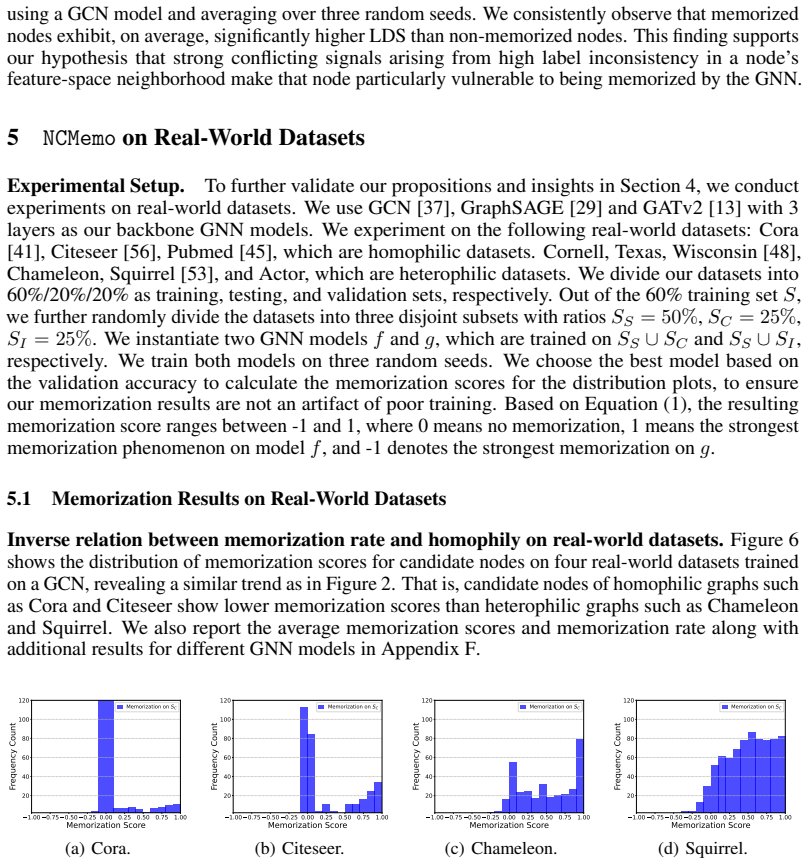
NCMemo measures per-node label memorization as the expected increase in a node's predicted label probability when the node is present in training versus absent, approximated by comparing two models trained on non-overlapping candidate batches. Using this measure, the paper claims an inverse relationship: as homophily rises from 0 to 1, memorization rate falls, reaching 0% at maximum homophily on the synthetic graphs; on real datasets, heterophilic graphs show memorization rates around 38–54%, against 8–28% for homophilic ones. The offered mechanism is that GNN optimization pushes the Neural Tangent Kernel to align with the adjacency matrix regardless of whether structure helps, and in low-ho
What carries the argument
The load-bearing measure is NCMemo's memorization score: for a node, the expected probability the model assigns to its true label when the node is in training minus that probability when the node is left out, approximated by comparing a model trained on shared plus candidate nodes with one trained on shared plus independent nodes. The explanatory mechanism is the GNN's implicit structural bias, read through the Neural Tangent Kernel: training pushes the kernel-graph alignment upward regardless of homophily, and in low-homophily graphs this geometry forces kernel-target alignment down, leaving label memorization as the only route to low training loss. The node-level discriminator is the Label
Load-bearing premise
The whole analysis depends on a cheap two-model approximation—one model trained with a 25% candidate batch, one without it—being a faithful stand-in for true leave-one-out memorization; the paper itself notes it removes batches of nodes rather than single nodes, so if that proxy is off, the reported rates and every trend built on them would shift.
What would settle it
Retrain a GNN many times on a low-homophily graph, each time leaving out a single different training node, and compare those true leave-one-out scores to NCMemo's two-model batch approximation. If the batch approximation does not reproduce the per-node ordering of true leave-one-out scores, the reported memorization rates and the inverse-homophily trend would not be supported.
If this is right
- Heterophilic graph benchmarks will show inflated memorization, so accuracy gains on them may reflect fitting labels instead of learning transferable structure; evaluations on low-homophily data should report memorization alongside accuracy.
- Nodes flagged as memorized are precisely the ones membership-inference attacks single out: on the lowest-homophily synthetic graph the attack reaches 0.936 AUC versus 0.538 at maximum homophily.
- Feature-similarity rewiring that raises homophily cuts memorization rate and membership-inference risk, with AUC dropping by more than 20% on the lowest-homophily graphs while test accuracy stays flat or improves.
- The memorization rate climbs over training epochs, fastest on low-homophily graphs, so early stopping and homophily-aware training can be expected to lower memorization.
- The inverse homophily–memorization relation holds across GCN, GraphSAGE, GATv2, and SGC on real datasets, making it a general property of message-passing GNNs rather than an artifact of one architecture.
Where Pith is reading between the lines
- If the inverse homophily law is right, a model's generalization on heterophilic graphs is partly a memorization story; architectures that adaptively down-weight uninformative edges should show a flatter memorization-versus-homophily slope, which is a testable prediction.
- The Label Disagreement Score could be used before training as a sanitization signal—relabeling, dropping, or down-weighting high-LDS nodes—and one could measure whether that reduces memorization more cheaply than rewiring.
- Rewiring changes the graph's label-feature correspondence, so the reported accuracy preservation may hide a distribution shift; a useful extension is to measure memorization and privacy risk along the full edge-budget curve rather than at one chosen budget.
- The framework's extension to graph classification finds zero memorization on clean benchmarks but detects it after adding noise to candidate graphs, suggesting memorization in graph classification is tied to atypical instances—worth testing on naturally long-tailed graph datasets.
Editorial analysis
A structured set of objections, weighed in public.
Referee Report
Summary. The paper introduces NCMemo, a framework for measuring label memorization in semi-supervised node classification. The framework compares two GNN models, one trained with a candidate node set and one trained without it, and defines a per-node memorization score and a memorization rate. Based on experiments on synthetic and real-world graphs across several GNN architectures, the paper claims an inverse relationship between memorization rate and graph homophily (Proposition 1), explains this through NTK alignment dynamics (Propositions 2 and 3), introduces a Label Disagreement Score to identify memorization-prone nodes (Proposition 4), and proposes graph rewiring as a mitigation that also reduces membership-inference privacy risk. The paper includes extensive experiments, additional analyses on graph classification, larger datasets, and a graph transformer, plus runtimes and a code link.
Significance. If the central result holds, this is a valuable contribution to the understanding of memorization in GNNs and has practical privacy implications. The empirical scope is broad: four GNN backbones, multiple real datasets, controlled synthetic homophily levels, and a direct evaluation of membership-inference risk. The authors also provide a candidate mitigation (graph rewiring) and demonstrate its effect on both memorization and privacy metrics. The framework is computationally lightweight and the paper includes a reproducibility link. However, the central claim rests on a batch approximation of leave-one-out memorization that is not validated, and the theoretical propositions are largely observational or rely on an assumption that restates the observed phenomenon. These issues need to be addressed before the results can be accepted as stated.
major comments (4)
- [§3, Eq. (1)–(2); §5; Appendix F.3] The memorization score used in all experiments is not the leave-one-out quantity in Eq. (1). Model g is trained on SS∪SI, so for a candidate vi∈SC, g has not only vi removed but the entire candidate block SC (25% of training nodes) removed and replaced by SI. As the paper acknowledges in F.3, this is a batch approximation. The bias is likely homophily-dependent: in low-homophily graphs, labels are less predictable from neighbors and features, so removing a block of training labels degrades g's accuracy on SC more than in high-homophily graphs. This can inflate M(vi) uniformly and manufacture the inverse MR–homophily trend (Fig. 3, Prop. 1) even if per-node LOO memorization were flat. Please validate the approximation against true leave-one-out on at least one synthetic and one small real graph, or provide a formal bound on the bias as a function of h. Without this, the central claim is n
- [§4.2; Appendix D.2, Prop. 2] The 'simple proof' in D.2 does not establish memorization. Assumption 1 restates the observed tendency that A(Θt,A) increases during training; Assumption 2 is essentially the definition of low homophily. The triangle-inequality argument only derives a lower bound on the angle between Θt and Θ*, i.e., low kernel-target alignment. Nothing in the proof relates these geometric constraints to M(vi) or the memorization rate; the connection is asserted. Proposition 2 itself is a list of empirical observations (i)–(iii). We recommend reframing Prop. 2 as an empirical finding supported by a geometric consistency check, or providing a rigorous argument linking alignment dynamics to the memorization score. As written, the proof gives the appearance of a theorem where none is established.
- [§4.2, Prop. 3; Figs. 5 and 7] The Pearson correlations between MR and the final alignments are computed on the same trained models that produce both quantities, and both MR and alignment are strongly driven by the common factor h. The correlations are therefore descriptive fits, not independent confirmations of a predictive relationship. This is especially concerning for the synthetic data (Fig. 5), where the five points are separated by construction. Please report partial correlations controlling for homophily, or show within-graph variance across seeds, to demonstrate that the relationship is not purely an artifact of the h-axis. The statement that these results 'validate' Prop. 3 is overstated.
- [§4.3, Tables 1–2; §4.1, Eq. (2)] The LDS analysis relies on classifying nodes as memorized or non-memorized using the batch estimator and threshold τ=0.5. If the estimator is biased (Comment 1), the LDS separation may partly reflect that bias rather than a true per-node phenomenon. Additionally, τ=0.5 is introduced as a predefined threshold but is not inherent to the Feldman definition cited; it is a new hyperparameter that can amplify systematic calibration differences between f and g. Please re-run the LDS analysis with a validated memorization estimator, or at least show robustness to τ and to alternative extreme-score comparisons.
minor comments (4)
- [§5 vs. Appendix I.2] The data split is inconsistent: Section 5 states SS=50%, SC=25%, SI=25%, while Appendix I.2 says SS=80%, SI=SC=10%. This makes the experimental setup ambiguous and should be corrected.
- [§4.1, Prop. 1] The phrase 'inversely proportional' suggests MR ∝ 1/h, but the results only support a monotonic decrease. Please use 'decreases with' or state the specific functional form if one is intended.
- [Table 19] The homophily values for Cornell, Texas, and Wisconsin are reported as negative (−0.20, −0.23, −0.13). Edge homophily is defined on [0,1] in Eq. (5); please clarify which metric is reported (e.g., adjusted homophily) and cite the source.
- [Appendix F.3] The sentence 'this keeps the overhead minimal while still aligning closely with the theoretical definition' is unsupported. Given the concern in Major Comment 1, please provide evidence or temper this claim.
Circularity Check
Reported memorization–homophily trend is largely an artifact of the batch two-model estimator; the central proposition reduces by construction.
specific steps
-
self definitional
[Section 4, data-partitioning setup and Eq. (1)-(2); Appendix F.3]
"Subsequently, we train model f on SS ∪ SC and model g on SS ∪ SI. ... Our method only requires a single additional trained model and evaluates the effect for simultaneous removal of batches of nodes (25% of training nodes)."
For vi∈SC, g has not seen vi or any other candidate node, so E_g[Pr(g(vi)=yi)] in Eq. (1) measures how well yi can be predicted from graph structure/features without the label. This is exactly what homophily controls: at h=1.0 neighbors determine the label, so g is as confident as f and M≈0; at h=0.0 g's accuracy on SC collapses while f can fit the labels, so M is large. The reported inverse MR-homophily trend (Prop. 1) is therefore a property of the batch estimator, not an independent discovery about per-sample memorization; the paper's own F.3 acknowledges the proxy but does not account for its homophily dependence.
-
self definitional
[Section 4.3, Eq. (4), Table 1]
"We consistently observe that memorized nodes exhibit, on average, significantly higher LDS than non-memorized nodes. This finding supports our hypothesis that strong conflicting signals arising from high label inconsistency in a node’s feature-space neighborhood make that node particularly vulnerable to being memorized by the GNN."
Memorized nodes are defined by M(vi)>τ, i.e., f samples the candidate's label correctly while g (trained without SC) does not. High LDS means the node's label is atypical among its feature neighbors, which is precisely the condition that makes g fail. Thus the Proposition 4 association is largely encoded in the two-model partition rather than being an independent characterization of which nodes a GNN memorizes.
full rationale
The paper's main derivation is empirical rather than a formal derivation from first principles. The NTK analysis in Appendix D.2 is a valid triangle-inequality implication, but Assumption 1 restates the observed increasing A(Θt,A) that Proposition 2 is supposed to establish, so it does not independently explain memorization. The core problem is that NCMemo's reported memorization scores are not the leave-one-out quantity of Eq. (1): f sees SS∪SC, g sees SS∪SI, so for each vi∈SC, g is missing the entire candidate block. The gap M_batch(vi) is dominated by how predictable yi is from homophily-driven context; hence Prop. 1's inverse MR-homophily curve is essentially fixed by the estimator. Similarly, the LDS result labels as 'memorized' exactly the nodes where the no-candidate model fails, which are the high-LDS nodes by construction. The paper's self-citations ([63], [54]) are methodological and not load-bearing. Because the central quantitative claim reduces to the estimator's construction rather than to an independent per-sample LOO measurement, I assign 6.
Axiom & Free-Parameter Ledger
free parameters (3)
- Memorization threshold tau =
0.5
- LDS hyperparameter k =
3
- Rewiring edge budget =
100, 500, or 1000 per graph
axioms (3)
- domain assumption GNN training dynamics increase kernel-graph alignment (Assumption 1, Appendix D.1)
- domain assumption Low homophily implies low alignment between the adjacency matrix and the optimal kernel (Assumption 2)
- standard math Feldman's Lemma 4.2 and 4.3 relating memorization to the generalization gap
Cite this review
Pith. "Pith review of Memorization in Graph Neural Networks." pith.science (2026). https://pith.science/paper/2J4DAJ7C
@misc{pith2026250819352,
  author       = {Pith},
  title        = {Pith review of: Memorization in Graph Neural Networks},
  year         = {2026},
  howpublished = {\url{https://pith.science/paper/2J4DAJ7C}},
  note         = {Machine review of arXiv:2508.19352}
}
read the original abstract
Deep neural networks (DNNs) have been shown to memorize their training data, yet similar analyses for graph neural networks (GNNs) remain largely under-explored. We introduce NCMemo (Node Classification Memorization), the first framework to quantify label memorization in semi-supervised node classification. We first establish an inverse relationship between memorization and graph homophily, i.e., the property that connected nodes share similar labels/features. We find that lower homophily significantly increases memorization, indicating that GNNs rely on memorization to learn less homophilic graphs. Secondly, we analyze GNN training dynamics. We find that the increased memorization in low homophily graphs is tightly coupled to the GNNs' implicit bias on using graph structure during learning. In low homophily regimes, this structure is less informative, hence inducing memorization of the node labels to minimize training loss. Finally, we show that nodes with higher label inconsistency in their feature-space neighborhood are significantly more prone to memorization. Building on our insights into the link between graph homophily and memorization, we investigate graph rewiring as a means to mitigate memorization. Our results demonstrate that this approach effectively reduces memorization without compromising model performance. Moreover, we show that it lowers the privacy risk for previously memorized data points in practice. Thus, our work not only advances understanding of GNN learning but also supports more privacy-preserving GNN deployment.
Figures




Reference graph
Works this paper leans on
-
[1]
MixHop: Higher-order graph convolutional architectures via sparsified neighborhood mixing
Sami Abu-El-Haija, Bryan Perozzi, Amol Kapoor, Nazanin Alipourfard, Kristina Lerman, Hrayr Harutyunyan, Greg Ver Steeg, and Aram Galstyan. MixHop: Higher-order graph convolutional architectures via sparsified neighborhood mixing. In Kamalika Chaudhuri and Ruslan Salakhutdinov, editors, Proceedings of the 36th International Conference on Machine Learning, ...
work page 2019
-
[2]
On the bottleneck of graph neural networks and its practical implications
Uri Alon and Eran Yahav. On the bottleneck of graph neural networks and its practical implications. In International Conference on Learning Representations, 2021. URL https: //openreview.net/forum?id=i80OPhOCVH2
work page 2021
-
[3]
Gholamali Aminian, Yixuan He, Gesine Reinert, Łukasz Szpruch, and Samuel N. Cohen. Generalization error of graph neural networks in the mean-field regime, 2024. URL https: //arxiv.org/abs/2402.07025
work page internal anchor Pith review Pith/arXiv arXiv 2024
-
[4]
Du, Wei Hu, Zhiyuan Li, and Ruosong Wang
Sanjeev Arora, Simon S. Du, Wei Hu, Zhiyuan Li, and Ruosong Wang. Fine-grained analysis of optimization and generalization for overparameterized two-layer neural networks. CoRR, abs/1901.08584, 2019. URL http://arxiv.org/abs/1901.08584
Pith/arXiv arXiv 1901
-
[5]
A closer look at memorization in deep networks
Devansh Arpit, Stanislaw Jastrzkebski, Nicolas Ballas, David Krueger, Emmanuel Bengio, Maxinder S Kanwal, Tegan Maharaj, Asja Fischer, Aaron Courville, Yoshua Bengio, et al. A closer look at memorization in deep networks. In International conference on machine learning, pages 233–242. PMLR, 2017
work page 2017
-
[6]
Deep learning through the lens of example difficulty
Robert John Nicholas Baldock, Hartmut Maennel, and Behnam Neyshabur. Deep learning through the lens of example difficulty. In A. Beygelzimer, Y . Dauphin, P. Liang, and J. Wortman Vaughan, editors, Advances in Neural Information Processing Systems , 2021. URL https: //openreview.net/forum?id=WWRBHhH158K
work page 2021
-
[7]
Emergence of scaling in random networks
Albert-László Barabási and Réka Albert. Emergence of scaling in random networks. Science, 286(5439):509–512, October 1999. ISSN 1095-9203. doi: 10.1126/science.286.5439.509. URL http://dx.doi.org/10.1126/science.286.5439.509
-
[8]
The pitfalls of memorization: When memorization hurts generalization, 2024
Reza Bayat, Mohammad Pezeshki, Elvis Dohmatob, David Lopez-Paz, and Pascal Vincent. The pitfalls of memorization: When memorization hurts generalization, 2024. URL https: //arxiv.org/abs/2412.07684
Pith/arXiv arXiv 2024
-
[9]
Graph neural networks use graphs when they shouldn’t, 2024
Maya Bechler-Speicher, Ido Amos, Ran Gilad-Bachrach, and Amir Globerson. Graph neural networks use graphs when they shouldn’t, 2024. URL https://arxiv.org/abs/2309. 04332
work page 2024
-
[10]
Make heterophily graphs better fit gnn: A graph rewiring approach, 2022
Wendong Bi, Lun Du, Qiang Fu, Yanlin Wang, Shi Han, and Dongmei Zhang. Make heterophily graphs better fit gnn: A graph rewiring approach, 2022
work page 2022
-
[11]
Memorization and optimization in deep neural networks with minimum over-parameterization
Simone Bombari, Mohammad Hossein Amani, and Marco Mondelli. Memorization and optimization in deep neural networks with minimum over-parameterization. Advances in Neural Information Processing Systems, 35:7628–7640, 2022
work page 2022
-
[12]
Biognn: How graph neural networks can solve biological problems
Pietro Bongini, Niccolò Pancino, Franco Scarselli, and Monica Bianchini. Biognn: How graph neural networks can solve biological problems. In Artificial Intelligence and Machine Learning for Healthcare, pages 211–231. Springer, 2023
work page 2023
-
[13]
Shaked Brody, Uri Alon, and Eran Yahav. How attentive are graph attention networks? In International Conference on Learning Representations, 2022. URL https://openreview. net/forum?id=F72ximsx7C1. 10
work page 2022
-
[14]
Bronstein, Joan Bruna, Taco Cohen, and Petar Velickovic
Michael M. Bronstein, Joan Bruna, Taco Cohen, and Petar Velickovic. Geometric deep learning: Grids, groups, graphs, geodesics, and gauges. CoRR, abs/2104.13478, 2021. URL https: //arxiv.org/abs/2104.13478
Pith/arXiv arXiv 2021
-
[15]
Extracting training data from large language models
Nicholas Carlini, Florian Tramer, Eric Wallace, Matthew Jagielski, Ariel Herbert-V oss, Kather- ine Lee, Adam Roberts, Tom Brown, Dawn Song, Ulfar Erlingsson, et al. Extracting training data from large language models. In 30th USENIX security symposium (USENIX Security 21), pages 2633–2650, 2021
2021
-
[16]
Membership inference attacks from first principles
Nicholas Carlini, Steve Chien, Milad Nasr, Shuang Song, Andreas Terzis, and Florian Tramer. Membership inference attacks from first principles. In 2022 IEEE symposium on security and privacy (SP), pages 1897–1914. IEEE, 2022
work page 2022
-
[17]
The privacy onion effect: Memorization is relative
Nicholas Carlini, Matthew Jagielski, Chiyuan Zhang, Nicolas Papernot, Andreas Terzis, and Florian Tramer. The privacy onion effect: Memorization is relative. Advances in Neural Information Processing Systems, 35:13263–13276, 2022
work page 2022
-
[18]
Quantifying memorization across neural language models, 2022
Nicholas Carlini, Daphne Ippolito, Matthew Jagielski, Katherine Lee, Florian Tramer, and Chiyuan Zhang. Quantifying memorization across neural language models, 2022. URL https://arxiv. org/abs/2202.07646, 2023
Pith/arXiv arXiv 2022
-
[19]
Nello Cristianini, John Shawe-Taylor, André Elisseeff, and Jaz Kandola. On kernel-target alignment. In T. Dietterich, S. Becker, and Z. Ghahramani, edi- tors, Advances in Neural Information Processing Systems , volume 14. MIT Press,
-
[20]
Attentive walk-aggregating graph neural networks
Mehmet F Demirel, Shengchao Liu, Siddhant Garg, Zhenmei Shi, and Yingyu Liang. Attentive walk-aggregating graph neural networks. Transactions on Machine Learning Research, 2022. ISSN 2835-8856. URL https://openreview.net/forum?id=TWSTyYd2Rl
work page 2022
-
[21]
Does learning require memorization? a short tale about a long tail
Vitaly Feldman. Does learning require memorization? a short tale about a long tail. In Proceedings of the 52nd Annual ACM SIGACT Symposium on Theory of Computing , pages 954–959, 2020
2020
-
[22]
How powerful are k-hop message passing graph neural networks
Jiarui Feng, Yixin Chen, Fuhai Li, Anindya Sarkar, and Muhan Zhang. How powerful are k-hop message passing graph neural networks. Advances in Neural Information Processing Systems, 35:4776–4790, 2022
work page 2022
-
[23]
Matthias Fey and Jan E. Lenssen. Fast graph representation learning with PyTorch Geometric. In ICLR Workshop on Representation Learning on Graphs and Manifolds, 2019
work page 2019
-
[24]
Justin Gilmer, Samuel S. Schoenholz, Patrick F. Riley, Oriol Vinyals, and George E. Dahl. Neural message passing for quantum chemistry. In Proceedings of the 34th International Conference on Machine Learning - Volume 70, ICML’17, page 1263–1272. JMLR.org, 2017
work page 2017
-
[25]
Giraldo, Konstantinos Skianis, Thierry Bouwmans, and Fragkiskos D
Jhony H. Giraldo, Konstantinos Skianis, Thierry Bouwmans, and Fragkiskos D. Malliaros. On the trade-off between over-smoothing and over-squashing in deep graph neural networks. In Proceedings of the 32nd ACM International Conference on Information and Knowledge Management, CIKM ’23, page 566–576, New York, NY , USA, 2023. Association for Computing Machine...
arXiv 2023
-
[26]
Understanding the difficulty of training deep feedforward neural networks
Xavier Glorot and Yoshua Bengio. Understanding the difficulty of training deep feedforward neural networks. In Yee Whye Teh and Mike Titterington, editors,Proceedings of the Thirteenth International Conference on Artificial Intelligence and Statistics, volume 9 of Proceedings of Machine Learning Research, pages 249–256, Chia Laguna Resort, Sardinia, Italy...
- [27]
-
[28]
Hamilton, Rex Ying, and Jure Leskovec
William L. Hamilton, Rex Ying, and Jure Leskovec. Inductive representation learning on large graphs. In Proceedings of the 31st International Conference on Neural Information Processing Systems, NIPS’17, page 1025–1035, Red Hook, NY , USA, 2017. Curran Associates Inc. ISBN 9781510860964
work page 2017
-
[29]
Hamilton, Zhitao Ying, and Jure Leskovec
William L. Hamilton, Zhitao Ying, and Jure Leskovec. Inductive Representation Learning on Large Graphs. In NIPS, pages 1024–1034, 2017
work page 2017
-
[30]
Open graph benchmark: Datasets for machine learning on graphs
Weihua Hu, Matthias Fey, Marinka Zitnik, Yuxiao Dong, Hongyu Ren, Bowen Liu, Michele Catasta, and Jure Leskovec. Open graph benchmark: Datasets for machine learning on graphs. arXiv preprint arXiv:2005.00687, 2020
Pith/arXiv arXiv 2005
-
[31]
Neural tangent kernel: Convergence and generalization in neural networks
Arthur Jacot, Franck Gabriel, and Clement Hongler. Neural tangent kernel: Convergence and generalization in neural networks. In S. Bengio, H. Wallach, H. Larochelle, K. Grauman, N. Cesa-Bianchi, and R. Garnett, editors, Advances in Neural Information Processing Sys- tems, volume 31. Curran Associates, Inc., 2018. URL https://proceedings.neurips.cc/ paper_...
work page 2018
-
[32]
Spectral graph pruning against over-squashing and over-smoothing
Adarsh Jamadandi, Celia Rubio-Madrigal, and Rebekka Burkholz. Spectral graph pruning against over-squashing and over-smoothing. In The Thirty-eighth Annual Conference on Neural Information Processing Systems, 2024
work page 2024
-
[33]
Kedar Karhadkar, Pradeep Kr. Banerjee, and Guido Montufar. FoSR: First-order spectral rewiring for addressing oversquashing in GNNs. In The Eleventh International Confer- ence on Learning Representations , 2023. URL https://openreview.net/forum?id= 3YjQfCLdrzz
work page 2023
-
[34]
Homophily influences ranking of minorities in social networks
Fariba Karimi, Mathieu Génois, Claudia Wagner, Philipp Singer, and Markus Strohmaier. Homophily influences ranking of minorities in social networks. Scientific Reports, 8(1), July
-
[35]
Not too little, not too much: a theoretical analysis of graph (over)smoothing
Nicolas Keriven. Not too little, not too much: a theoretical analysis of graph (over)smoothing. In The First Learning on Graphs Conference, 2022. URL https://openreview.net/forum? id=KQNsbAmJEug
work page 2022
-
[36]
Convergence and Stability of Graph Convolutional Networks on Large Random Graphs
Nicolas Keriven, Alberto Bietti, and Samuel Vaiter. Convergence and stability of graph convolu- tional networks on large random graphs, 2020. URL https://arxiv.org/abs/2006.01868
work page internal anchor Pith review Pith/arXiv arXiv 2020
-
[37]
Thomas N. Kipf and Max Welling. Semi-Supervised Classification with Graph Convolutional Networks. In ICLR, 2017
work page 2017
-
[38]
Qiongxiu Li, Xiaoyu Luo, Yiyi Chen, and Johannes Bjerva. Trustworthy machine learning via memorization and the granular long-tail: A survey on interactions, tradeoffs, and beyond, 2025. URL https://arxiv.org/abs/2503.07501
Pith/arXiv arXiv 2025
-
[39]
Towards bridging generalization and expressivity of graph neural networks, 2024
Shouheng Li, Floris Geerts, Dongwoo Kim, and Qing Wang. Towards bridging generalization and expressivity of graph neural networks, 2024. URL https://arxiv.org/abs/2410. 10051
work page 2024
-
[40]
Can neural network memorization be localized? arXiv preprint arXiv:2307.09542, 2023
Pratyush Maini, Michael C Mozer, Hanie Sedghi, Zachary C Lipton, J Zico Kolter, and Chiyuan Zhang. Can neural network memorization be localized? arXiv preprint arXiv:2307.09542, 2023
Pith/arXiv arXiv 2023
-
[41]
Automat- ing the construction of internet portals with machine learning
Andrew Kachites McCallum, Kamal Nigam, Jason Rennie, and Kristie Seymore. Automat- ing the construction of internet portals with machine learning. Information Retrieval, 3(2): 127–163, 2000. doi: 10.1023/A:1009953814988. URL https://doi.org/10.1023/A: 1009953814988
-
[42]
Schoenholz, Muratahan Aykol, Gowoon Cheon, and Ekin Dogus Cubuk
Amil Merchant, Simon Batzner, Samuel S. Schoenholz, Muratahan Aykol, Gowoon Cheon, and Ekin Dogus Cubuk. Scaling deep learning for materials discovery. Nature, 624(7990): 80–85, 2023. doi: 10.1038/s41586-023-06735-9. URL https://doi.org/10.1038/ s41586-023-06735-9 . 12
-
[43]
Kriege, Franka Bause, Kristian Kersting, Petra Mutzel, and Marion Neumann
Christopher Morris, Nils M. Kriege, Franka Bause, Kristian Kersting, Petra Mutzel, and Marion Neumann. Tudataset: A collection of benchmark datasets for learning with graphs. CoRR, abs/2007.08663, 2020. URL https://arxiv.org/abs/2007.08663
Pith/arXiv arXiv 2007
-
[44]
Are GATs out of balance? In Thirty-seventh Conference on Neural Information Processing Systems, 2023
Nimrah Mustafa, Aleksandar Bojchevski, and Rebekka Burkholz. Are GATs out of balance? In Thirty-seventh Conference on Neural Information Processing Systems, 2023. URL https: //openreview.net/forum?id=qY7UqLoora
work page 2023
-
[45]
Query-driven active surveying for collective classification
Galileo Namata, Ben London, Lise Getoor, and Bert Huang. Query-driven active surveying for collective classification. 2012
work page 2012
-
[46]
Revisiting over-smoothing and over-squashing using ollivier-ricci curvature, 2023
Khang Nguyen, Hieu Nong, Vinh Nguyen, Nhat Ho, Stanley Osher, and Tan Nguyen. Revisiting over-smoothing and over-squashing using ollivier-ricci curvature, 2023
work page 2023
-
[47]
Giannis Nikolentzos, George Dasoulas, and Michalis Vazirgiannis. k-hop graph neural networks,
-
[48]
Geom-gcn: Geo- metric graph convolutional networks
Hongbin Pei, Bingzhe Wei, Kevin Chen-Chuan Chang, Yu Lei, and Bo Yang. Geom-gcn: Geo- metric graph convolutional networks. In International Conference on Learning Representations,
-
[49]
Oleg Platonov, Denis Kuznedelev, Artem Babenko, and Liudmila Prokhorenkova. Charac- terizing graph datasets for node classification: Homophily-heterophily dichotomy and be- yond. In Thirty-seventh Conference on Neural Information Processing Systems, 2023. URL https://openreview.net/forum?id=m7PIJWOdlY
work page 2023
-
[50]
Oleg Platonov, Denis Kuznedelev, Michael Diskin, Artem Babenko, and Liudmila Prokhorenkova. A critical look at evaluation of gnns under heterophily: Are we really making progress? In The Eleventh International Conference on Learning Representations, 2023
work page 2023
-
[51]
Recipe for a General, Powerful, Scalable Graph Transformer
Ladislav Rampášek, Mikhail Galkin, Vijay Prakash Dwivedi, Anh Tuan Luu, Guy Wolf, and Dominique Beaini. Recipe for a General, Powerful, Scalable Graph Transformer. Advances in Neural Information Processing Systems, 35, 2022
work page 2022
-
[52]
Graph neural networks for materials science and chemistry
Patrick Reiser, Marlen Neubert, André Eberhard, Luca Torresi, Chen Zhou, Chen Shao, Hous- sam Metni, Clint van Hoesel, Henrik Schopmans, Timo Sommer, and Pascal Friederich. Graph neural networks for materials science and chemistry. Communications Materials , 3(1):93, 2022. doi: 10.1038/s43246-022-00315-6. URL https://doi.org/10.1038/ s43246-022-00315-6
-
[53]
URL https://openreview.net/forum?id=S1e2agrFvS
-
[54]
GNNs getting comfy: Com- munity and feature similarity guided rewiring
Celia Rubio-Madrigal, Adarsh Jamadandi, and Rebekka Burkholz. GNNs getting comfy: Com- munity and feature similarity guided rewiring. In The Thirteenth International Conference on Learning Representations, 2025. URL https://openreview.net/forum?id=g6v09VxgFw
work page 2025
-
[55]
The graph neural network model
Franco Scarselli, Marco Gori, Ah Chung Tsoi, Markus Hagenbuchner, and Gabriele Monfardini. The graph neural network model. IEEE Transactions on Neural Networks, 20(1):61–80, 2009. doi: 10.1109/TNN.2008.2005605
arXiv 2009
-
[56]
Collective classification in network data
Prithviraj Sen, Galileo Namata, Mustafa Bilgic, Lise Getoor, Brian Galligher, and Tina Eliassi-Rad. Collective classification in network data. AI Magazine, 29(3):93, Sep. 2008. doi: 10.1609/aimag.v29i3.2157. URL https://ojs.aaai.org/index.php/aimagazine/ article/view/2157
-
[57]
Pitfalls of graph neural network evaluation, 2019
Oleksandr Shchur, Maximilian Mumme, Aleksandar Bojchevski, and Stephan Günnemann. Pitfalls of graph neural network evaluation, 2019
2019
-
[58]
Multi-scale attributed node embedding
Benedek Rozemberczki, Carl Allen, and Rik Sarkar. Multi-scale attributed node embedding. CoRR, abs/1909.13021, 2019. URL http://arxiv.org/abs/1909.13021
Pith/arXiv arXiv 1909
-
[59]
Membership inference attacks against machine learning models
Reza Shokri, Marco Stronati, Congzheng Song, and Vitaly Shmatikov. Membership inference attacks against machine learning models. In 2017 IEEE symposium on security and privacy (SP), pages 3–18. IEEE, 2017
2017
-
[60]
Towards understanding generalization of graph neural networks
Huayi Tang and Yong Liu. Towards understanding generalization of graph neural networks. In Andreas Krause, Emma Brunskill, Kyunghyun Cho, Barbara Engelhardt, Sivan Sabato, and Jonathan Scarlett, editors, Proceedings of the 40th International Conference on Machine Learning, volume 202 of Proceedings of Machine Learning Research, pages 33674–33719. PMLR, 23...
work page 2023
-
[61]
Jake Topping, Francesco Di Giovanni, Benjamin Paul Chamberlain, Xiaowen Dong, and Michael M. Bronstein. Understanding over-squashing and bottlenecks on graphs via curvature. In International Conference on Learning Representations, 2022. URL https://openreview. net/forum?id=7UmjRGzp-A
work page 2022
-
[62]
Petar Veliˇckovi´c, Guillem Cucurull, Arantxa Casanova, Adriana Romero, Pietro Liò, and Yoshua Bengio. Graph Attention Networks. In ICLR, 2018
work page 2018
-
[63]
Graph neural networks in particle physics
Jonathan Shlomi, Peter Battaglia, and Jean-Roch Vlimant. Graph neural networks in particle physics. Machine Learning: Science and Technology, 2(2):021001, jan 2021. doi: 10.1088/ 2632-2153/abbf9a. URL https://doi.org/10.1088/2632-2153/abbf9a. 13
-
[64]
A Manifold Perspective on the Statistical Generalization of Graph Neural Networks
Zhiyang Wang, Juan Cervino, and Alejandro Ribeiro. A manifold perspective on the statistical generalization of graph neural networks, 2024. URL https://arxiv.org/abs/2406.05225
work page internal anchor Pith review Pith/arXiv arXiv 2024
-
[65]
Simplifying graph convolutional networks
Felix Wu, Amauri Souza, Tianyi Zhang, Christopher Fifty, Tao Yu, and Kilian Weinberger. Simplifying graph convolutional networks. In Kamalika Chaudhuri and Ruslan Salakhutdinov, editors, Proceedings of the 36th International Conference on Machine Learning, volume 97 of Proceedings of Machine Learning Research, pages 6861–6871. PMLR, 09–15 Jun 2019. URL ht...
work page 2019
-
[66]
How graph neural networks learn: Lessons from training dynamics in function space, 2024
Chenxiao Yang, Qitian Wu, David Wipf, Ruoyu Sun, and Junchi Yan. How graph neural networks learn: Lessons from training dynamics in function space, 2024. URL https:// openreview.net/forum?id=OBITU0NAKl
work page 2024
-
[67]
Understanding deep learning requires rethinking generalization
Chiyuan Zhang, Samy Bengio, Moritz Hardt, Benjamin Recht, and Oriol Vinyals. Understanding deep learning requires rethinking generalization. In International Conference on Learning Representations, 2017. URL https://openreview.net/forum?id=Sy8gdB9xx
work page 2017
-
[68]
Memorization in self-supervised learning improves downstream generalization
Wenhao Wang, Muhammad Ahmad Kaleem, Adam Dziedzic, Michael Backes, Nicolas Papernot, and Franziska Boenisch. Memorization in self-supervised learning improves downstream generalization. In The Twelfth International Conference on Learning Representations, 2024. URL https://openreview.net/forum?id=KSjPaXtxP8
work page 2024
-
[73]
Be- yond homophily in graph neural networks: Current limitations and effective designs
Jiong Zhu, Yujun Yan, Lingxiao Zhao, Mark Heimann, Leman Akoglu, and Danai Koutra. Be- yond homophily in graph neural networks: Current limitations and effective designs. Advances in Neural Information Processing Systems, 33, 2020. 14 A Limitations and Future Work Limitations. Our work proposes an end-to-end framework to study the memorization phenomenon ...
work page 2020
-
[74]
is defined as Θ∗ = ¯Y ¯YT and it measures how similar two instances of data points are. Further, we can define a similarity metric that measures the alignment between two kernelsK1 and K2 as 15 A(K1, K2) = ⟨K1, K2⟩F ||K1||F ||K2||F (7) This metric can be seen as a generalization of the cosine similarity applied to matrices and it satisfies the triangle in...
-
[75]
Based on Assumption 1, a high kernel-graph alignment implies, the angle ϵ between A and Θt should be small (ideally, 0◦), from a geometrical perspective we can think of this as two vectors pointing in the same direction4
-
[76]
Inequality 10 states that γ must be greater than or equal to this large angle (δ − ϵ)
Based on Assumption 2, in low homophily settings, the angle δ between A and Θ∗ should be large (e.g, 90◦) Therefore, the term δ − ϵ represents a large angle minus a small angle, which is still a large angle (quantitatively close to δ). Inequality 10 states that γ must be greater than or equal to this large angle (δ − ϵ). This forces γ itself to be large. ...
work page 1993
-
[77]
while also improving the generalization performance on downstream tasks. Our theoretical results in Section 4 demonstrate that one of the key factors influencing memorization in GNNs is the graph homophily. Ideally, we can optimize homophily directly to control the memorization. However, the challenge here is that calculating homophily requires access to ...
work page 2029
-
[2001]
URL https://proceedings.neurips.cc/paper_files/paper/2001/file/ 1f71e393b3809197ed66df836fe833e5-Paper.pdf
work page 2001
-
[2010]
URL https://proceedings.mlr.press/v9/glorot10a.html
PMLR. URL https://proceedings.mlr.press/v9/glorot10a.html
-
[2018]
doi: 10.1038/s41598-018-29405-7
ISSN 2045-2322. doi: 10.1038/s41598-018-29405-7. URL http://dx.doi.org/10. 1038/s41598-018-29405-7
-
[2020]
URL https://arxiv.org/abs/1907.06051
work page internal anchor Pith review Pith/arXiv arXiv 1907
This paper was first reviewed by deepseek-v4-flash on August 5, 2026.
discussion (0)
Sign in with ORCID, Apple, or X to comment. Anyone can read and Pith papers without signing in.