REVIEW 3 major objections 3 minor 22 references
Reflective Agreement: Combining Self-Mixture of Agents with a Sequence Tagger for Robust Event Extraction
T0 review · 3 major / 3 minor · reviewed 2026-08-05 · deepseek-v4-flash
Pith's one-line read LLM ensemble plus tagger tops event extraction on three benchmarks
desk verdict Hybrid pipeline and decomposed instruction tuning are genuinely useful, but the abstract's SOTA claim is contradicted by the paper's own Table 1. read the letter →
The pith
A machine-rendered reading of the paper's core claim, the machinery that carries it, and where it could break.
The reading
What carries the argument
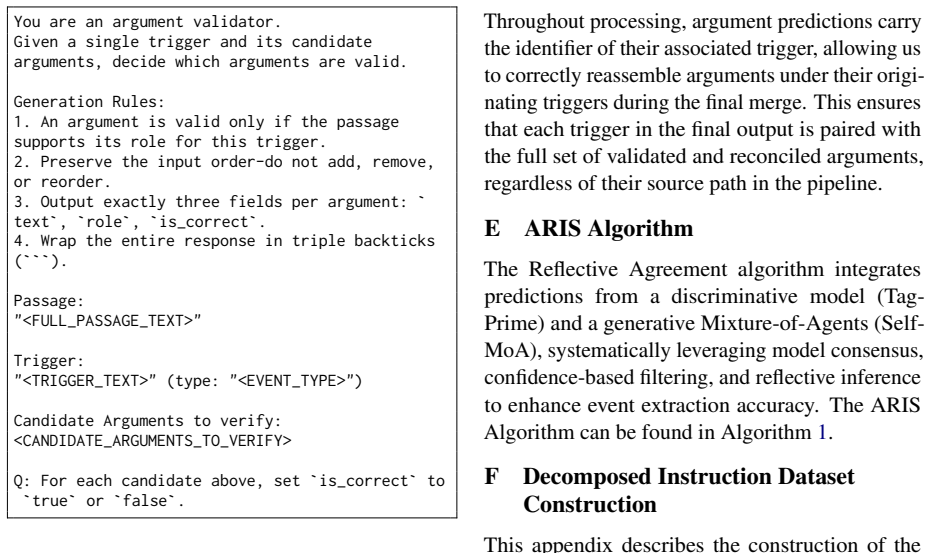
The Reflective Agreement mechanism: the consensus set is the intersection of Self-MoA and tagger predictions; the disagreement set is filtered by two dataset/temperature-specific confidence thresholds; the residual ambiguity set goes to a reflection module that prompts the LLM to verify triggers and arguments with binary classifications. The decomposed instruction-tuning curriculum (thirteen task variants) is the enabling training signal that gives the reflection module its event-structure competence.
What would settle it
Run ARIS on the same test sets while varying each confidence threshold across the fitted range and compare F1; if some settings produce identical results to settings where the reflection branch is never reached, that would show reflection is not the operative component. A direct check is to disable the reflection module, keeping only agreement detection and confidence filtering; if F1 does not drop measurably on instances actually routed to reflection, the reflection claim is not supported.
Extended reading notes
Core claim
ARIS's central claim is that the disagreement set between a generative ensemble and a discriminative tagger is not homogeneous and should not be handled with one strategy. The paper partitions disagreements by confidence—tagging confidence from softmax scores, generative confidence from the fraction of agents making the same prediction—and shows that keeping high-confidence single-source predictions, dropping low-confidence ones, and reflecting only on the middle band yields higher F1 than either model alone or a debate-based alternative. A second claim is that decomposed instruction fine-tuning, a curriculum of thirteen tasks from trigger/non-trigger discrimination to full event-structure c
Load-bearing premise
The entire disagreement-routing mechanism assumes that the validation-tuned confidence thresholds—and the comparability of tagger softmax scores with agent-vote frequencies—carry over to the test distribution; if those thresholds are miscalibrated, the keep, drop, and reflect split silently changes and the claimed gains can vanish.
Editorial extensions
If this is right
- If the claim holds, hybrid event extraction no longer needs unstructured debate loops; agreement plus selective reflection is a cheaper, more controllable reconciliation mechanism.
- Argument extraction, the subtask with the lowest baseline F1, is where the hybrid pays off most—gains of roughly 3 to 12 F1 points over TagPrime across the three datasets.
- ARIS's F1 varies by less than 2 points across sampling temperatures, so the consensus and confidence pipeline absorbs decode diversity.
- Decomposed instruction fine-tuning outperforms end-to-end fine-tuning for the same LLM, suggesting curriculum-style event-extraction training is a reusable recipe beyond ARIS itself.
Reading between the lines
- The routing logic—consensus, high-confidence keep, low-confidence drop, reflect on the middle—could transfer to other structured prediction tasks such as relation extraction or semantic role labeling, where a cheap discriminative anchor and an expensive generative model disagree; the paper does not test this.
- Several fitted thresholds in Tables 4 and 5 exceed 1.0 (for example, CASIE and MLEE trigger θ+SMoA = 1.10), meaning the high-confidence Self-MoA keep branch is never exercised in those configurations; the reflection module's contribution should be interpreted only where thresholds actually route instances to it.
- The reported gains carry a large inference-cost multiplier: ten parallel LLM decodes plus reflection calls. The paper acknowledges the overhead but does not quantify latency or cost, so practical deployment value depends on trade-offs left unmeasured.
- A reader wanting to deploy this approach should first check whether validation-tuned confidence thresholds transfer to their own test distribution, since the entire disagreement-routing mechanism is threshold-driven.
Editorial analysis
A structured set of objections, weighed in public.
Referee Report
Summary. The manuscript proposes ARIS, a hybrid event-extraction pipeline that combines a fine-tuned LLM ensemble (Self-MoA, ten agents) with a RoBERTa-based sequence tagger (TagPrime). Predictions are merged by overlap-based agreement detection, confidence filtering with dataset- and temperature-specific thresholds, and an LLM reflection module that verifies ambiguous triggers and arguments. The LLM is fine-tuned with a decomposed instruction curriculum (13 variants) covering trigger and argument subtasks. Experiments on CASIE, M2E2, and MLEE report micro-F1 for trigger/argument identification and classification, along with ablations against TagPrime and LLM baselines. The paper claims state-of-the-art results on all three benchmarks.
Significance. The decomposed instruction fine-tuning and the explicit reporting of per-dataset/per-temperature thresholds are useful contributions; the ablation separating Self-MoA, TagPrime, and their combination is informative. The central claim, however, is not supported by the paper's own Table 1: on CASIE both ARIS variants are below TagPrime on trigger metrics, and on MLEE the Llama-based ARIS also trails TagPrime on trigger metrics. The architecture may still offer value for argument extraction and for stabilizing performance across sampling temperatures, but the advertised 'outperforms existing state-of-the-art across three benchmark datasets' claim is false as stated. Because the headline contribution rests on this claim, the result cannot be accepted in its current form.
major comments (3)
- [Abstract / §4.3 / Table 1] The central claim 'outperforms existing state-of-the-art event extraction methods across three benchmark datasets' is contradicted by Table 1. TagPrime is identified as the current SOTA in §4.3, yet on CASIE ARIS-Llama reports Trg-I=70.78, Trg-C=70.27 and ARIS-Phi reports Trg-I=69.08, Trg-C=68.39, both below TagPrime's 72.00/71.60. On MLEE, ARIS-Llama also underperforms TagPrime on trigger metrics (73.80/70.33 vs 74.61/72.38). Section 4.3 retreats to saying the method is 'competitive' with TagPrime for CASIE trigger detection, which is inconsistent with the abstract and conclusion. The authors must either qualify the claim to specific datasets/metrics or revise the headline; as written, the paper's own results refute it.
- [Appendix E (Algorithm 1) vs §3.4–3.5] Algorithm 1 is inconsistent with the method description. Section 3.4 defines three thresholds, θS, θ+SMoA, and θ−SMoA, with three outcomes (retain, drop, reflect), whereas Algorithm 1 uses a single threshold τ and only two branches (high-confidence vs ambiguous), with combined_conf = (conftagger + confSMoA)/#models. The main text never defines combined_conf or τ. This makes the actual aggregation procedure irreproducible. Additionally, Tables 4/5 list θ+SMoA values greater than 1.0 (e.g., 1.10 for Phi-3 on CASIE and MLEE), outside the valid range for a proportion/softmax score; this means the high-confidence Self-MoA branch is never exercised in those configurations. The authors should reconcile the algorithm with the prose and explain or correct the out-of-range thresholds.
- [§4.3 baseline comparisons] DEBATE-EE and MMUTF are reported using F1 scores 'provided in their original papers' rather than re-evaluated under the same TextEE split1 preprocessing. Without a shared evaluation protocol, the claimed superiority over these two systems is not established. This matters because the SOTA claim depends on comparing against these baselines, not only TagPrime. The authors should either re-run those baselines on their exact splits and metrics or clearly mark the comparison as cross-paper and not directly comparable.
minor comments (3)
- [Appendix E, Algorithm 1] The tuple notation is inconsistent: (t, p) is defined as an ordered trigger representation, but the agreement lines use (t, p, _). The algorithm also handles triggers only, while §3.6 includes arguments; an argument-level algorithm or a reference to the argument aggregation in Appendix D would improve clarity.
- [§4.4 / Table 2] Table 2 is described as presenting averaged results across all datasets, but no per-dataset break-down is given in the main text. Since the paper emphasizes dataset-specific behavior elsewhere, a per-dataset version or a note on variance would help the reader assess the temperature-stability claim.
- [Throughout] There are minor typographical issues (e.g., 'togeneratetrigger' in Appendix F.1, 'Event Decomposed Fine-Tuning' capitalization) and no statement of code or data availability. Providing a public repository would substantially aid reproducibility.
Circularity Check
No circularity: ARIS is an empirical ensemble whose test metrics are measured, not derived from its inputs.
full rationale
ARIS is an inference-time ensemble that combines the outputs of a Self-MoA LLM ensemble and a TagPrime sequence tagger through agreement detection, confidence-based filtering, and an LLM reflection module. The confidence thresholds are tuned on validation sets (Appendix B) and final numbers are micro-F1 on held-out test splits; no equation defines the test metric in terms of the model's own inputs. TagPrime is used both as a component and as a baseline, but the final prediction set is not a superset of TagPrime by construction: low-confidence TagPrime disagreements can be dropped, and the reflection module can discard or alter candidates. Therefore any gain over TagPrime is an empirical outcome, not a mathematical identity. There are no load-bearing self-citations, no imported uniqueness theorems, and no fitted parameter being renamed as a prediction. The abstract's claim to outperform existing state-of-the-art 'across three benchmark datasets' is not supported by Table 1 (e.g., ARIS-Llama CASIE Trg-I=70.78 vs TagPrime 72.00; ARIS-Llama MLEE Trg-C=70.33 vs TagPrime 72.38), but that is a correctness/consistency issue, not circularity. Likewise, thresholds exceeding 1.0 in Appendix B indicate some branches are never exercised, but this is an implementation/overfitting concern rather than a circular-reasoning concern. The derivation chain is self-contained: each component is independently trained or prompted, and the reported results are measured on data not used for fitting the thresholds.
Assumptions & free parameters
free parameters (4)
- Confidence thresholds theta_S, theta+_SMoA, theta-_SMoA =
Varies per dataset, model, and temperature; e.g., Llama-3.1 CASIE trigger thresholds at temp 0.9: 0.004, 0.90, 0.50 (Tab
- Number of Self-MoA agents n=10 =
10
- LoRA rank, alpha, dropout, epochs =
r=32, alpha=128, dropout=0.05, 2 epochs
- Span-overlap agreement threshold =
Not specified
assumptions (3)
- domain assumption Span overlap between two predictions indicates the same event mention
- domain assumption Tagger softmax confidence and Self-MoA consensus frequency are comparable and thresholdable together
- domain assumption Validation-tuned thresholds transfer to the test distribution
Cite this review
Pith. "Pith review of Reflective Agreement: Combining Self-Mixture of Agents with a Sequence Tagger for Robust Event Extraction." pith.science (2026). https://pith.science/paper/MIXC6WIW
@misc{pith2026250819359,
  author       = {Pith},
  title        = {Pith review of: Reflective Agreement: Combining Self-Mixture of Agents with a Sequence Tagger for Robust Event Extraction},
  year         = {2026},
  howpublished = {\url{https://pith.science/paper/MIXC6WIW}},
  note         = {Machine review of arXiv:2508.19359}
}
read the original abstract
Event Extraction (EE) involves automatically identifying and extracting structured information about events from unstructured text, including triggers, event types, and arguments. Traditional discriminative models demonstrate high precision but often exhibit limited recall, particularly for nuanced or infrequent events. Conversely, generative approaches leveraging Large Language Models (LLMs) provide higher semantic flexibility and recall but suffer from hallucinations and inconsistent predictions. To address these challenges, we propose Agreement-based Reflective Inference System (ARIS), a hybrid approach combining a Self Mixture of Agents with a discriminative sequence tagger. ARIS explicitly leverages structured model consensus, confidence-based filtering, and an LLM reflective inference module to reliably resolve ambiguities and enhance overall event prediction quality. We further investigate decomposed instruction fine-tuning for enhanced LLM event extraction understanding. Experiments demonstrate our approach outperforms existing state-of-the-art event extraction methods across three benchmark datasets.
Figures


Figures from the paper (2 more)


Reference graph
Works this paper leans on
-
[1]
Computed confidence score distributions sep- arately for correct (found in gold annotations) and incorrect predictions
-
[2]
Used descriptive statistics (mean, median, quartiles) to guide a targeted search range for optimal thresholds
-
[3]
Conducted a search within this range, select- ing thresholds that maximized the validation set F1 score. This threshold selection procedure was repeated in- dividually for trigger and argument predictions, en- suring dataset-specific tuning that improved overall performance. After the agreement detection phase, predictions identified as disagreements are ...
-
[4]
Context: Supplies the complete passage and candidate triggers or arguments for accurate contextual evaluation
-
[5]
Example output: Demonstrates the required structured output format. C.2 LLM Configuration For both trigger and argument reflection, we use our fine-tuned LLMs with the following settings to ensure deterministic and accurate outputs: • Temperature: 0.1 (to ensure consistent, de- terministic outputs) • Max tokens: 4096 You previously identified the followin...
-
[6]
LC4EE: LLMs as good corrector for event extraction. In Findings of the Association for Compu- tational Linguistics: ACL 2024, pages 12028–12038, Bangkok, Thailand. Association for Computational Linguistics. A Agreement Detection Agreement detection reconciles event predictions from the Self-MoA ensemble and the sequence tag- ger by identifying cases where...
work page 2024
-
[10]
Role specification: Defines the LLM’s pre- cise role (e.g., argument validator)
-
[11]
Task description: Provides explicit instruc- tions for classifying candidates
Show all 22 references
-
[12]
Generation rules : Sets strict output con- straints to avoid hallucinations and ensure structured responses
-
[15]
Classify each phrase as either 'Trigger' or ' Non-Trigger'
-
[16]
phrase1":
Output strictly in the required format-no extra text. Output Format (strict): - Wrap the answer in triple backticks ( ```) - Write: ClassificationMap = {"phrase1": " Trigger", "phrase2": "Non-Trigger", ...} Example: ```ClassificationMap = {"therapy": "Trigger", " increase dose...
-
[17]
An argument is valid only if the passage supports its role for this trigger
-
[18]
Preserve the input order-do not add, remove, or reorder
-
[19]
Output exactly three fields per argument: ` text`, `role`, `is_correct`
-
[20]
<FULL_PASSAGE_TEXT>
Wrap the entire response in triple backticks (```). Passage: "<FULL_PASSAGE_TEXT>" Trigger: "<TRIGGER_TEXT>" (type: "<EVENT_TYPE>") Candidate Arguments to verify: <CANDIDATE_ARGUMENTS_TO_VERIFY> Q: For each candidate above, set `is_correct` to `true` or `false`. Figure 3: Stru...
-
[21]
List arguments in the exact order they appear in the passage
-
[22]
arg1", "arg2
Ignore argument roles and include only the argument texts. Output Format (strict): - Wrap the answer in triple backticks ( ```). - Write: Arguments = ["arg1", "arg2", ...]. Example: ``` Arguments = ["insulin", "VEGF"] ``` Passage: "US Needs Broad Coalition to Fight IS Militant...
-
[2012]
Bioinformatics, 28(18):i575– i581
Event extraction across multiple levels of bi- ological organization. Bioinformatics, 28(18):i575– i581. Gerard Salton and Christopher Buckley. 1988. Term- weighting approaches in automatic text retrieval. In- formation processing & management , 24(5):513– 523. Taneeya Satyapa...
1988
-
[2020]
In The Thirty-Fourth AAAI Confer- ence on Artificial Intelligence (AAAI)
Casie: Extracting cybersecurity event informa- tion from text. In The Thirty-Fourth AAAI Confer- ence on Artificial Intelligence (AAAI). Philipp Seeberger, Dominik Wagner, and Korbinian Riedhammer. 2024. MMUTF: Multimodal multime- dia event argument extraction with unified tem...
2024
-
[2023]
Advances in neural information processing systems, 36:11809–11822
Tree of thoughts: Deliberate problem solving with large language models. Advances in neural information processing systems, 36:11809–11822. Eric Zelikman, Yuhuai Wu, Jesse Mu, and Noah Good- man. 2022. Star: Bootstrapping reasoning with rea- soning. Advances in Neural Informat...
2022
-
[2024]
In The Twelfth International Conference on Learning Representa- tions
Chateval: Towards better LLM-based eval- uators through multi-agent debate. In The Twelfth International Conference on Learning Representa- tions. Ruirui Chen, Chengwei Qin, Weifeng Jiang, and Dongkyu Choi. 2024. Is a large language model a good annotator for event extraction?...
2024 arXiv
-
[2025]
arXiv preprint arXiv:2502.16377
Instruction-tuning llms for event extrac- tion with annotation guidelines. arXiv preprint arXiv:2502.16377. Junlin Wang, Jue W ANG, Ben Athiwaratkun, Ce Zhang, and James Zou. 2025. Mixture-of-agents enhances large language model capabilities. In The Thirteenth International Co...
2025 arXiv
Reviewed August 5, 2026 · model on record in the stance chip above.
Discussion (0). Sign in to comment.