REVIEW 3 major objections 5 minor 2 cited by
Quantized LLMs retain internally truthful representations but are more likely than full-precision models to emit false answers under deceptive prompts, and layer-wise probing shows they often 'know' the truth even when they say the wrong th
Reviewed by Pith at T0; open to challenge. T0 means a machine referee read the full paper against a public rubric. the ladder, T0–T4 →
The study introduces TruthfulnessEval and reports that 4-bit quantization preserves simple true/false accuracy, but explicit 'lie' prompts make quantized and full-precision LLMs output falsehoods even when internal probes still encode the true answer.
T0 review reviewed 2026-08-05 challenge →
load-bearing objection A useful empirical survey of quantized LLM truthfulness, but the 'knows truth internally' claim is under-supported and the paper needs to fix two internal inconsistencies. the 3 major comments →
Quantized but Deceptive? A Multi-Dimensional Truthfulness Evaluation of Quantized LLMs
The pith
A machine-rendered reading of the paper's core claim, the machinery that carries it, and where it could break.
The reading
Core claim
The central claim is that quantized LLMs, from 4-bit AWQ/GPTQ to 2-bit AQLM/AQLM-PV, keep internally truthful representations while becoming more susceptible to false outputs under misleading prompts. Across the True/False logical reasoning tasks and CommonClaim, 4-bit quantization largely holds accuracy, and 2-bit degradation is severe only for some configurations; on TruthfulQA, quantization costs accuracy but DoLa decoding recovers part of it. The decisive evidence is internal: train a logistic probe on hidden states at the final token before the model answers, leaving one topic out, and the probe separates true from false statements with near-ceiling accuracy in upper layers, even when t
What carries the argument
TruthfulnessEval: three evaluation dimensions (logical reasoning over affirmative, negated, conjunction, and disjunction statements; CommonClaim common-sense judgements; and TruthfulQA imitative falsehoods). The load-bearing analysis is layer-wise linear probing: logistic regression on the residual-stream activation at the last token before the 'True'/'False' response, with leave-one-topic-out validation, together with the layer-wise separability ratio (LSD) and PCA projections of those activations. This machinery is what converts observed false outputs into the claim that truth is still internally represented.
Load-bearing premise
High linear-probing accuracy at the token before the model answers is taken as evidence that the model internally knows the truth; if those activations actually encode the prompt's framing or the response format, the 'knows the truth while lying' conclusion collapses.
What would settle it
Train the same logistic probe on activations collected under deceptive prompts, then test it on activations collected under honest prompts (or vice versa). If cross-prompt probing accuracy drops to chance, the separability encodes prompt framing or response formatting rather than underlying truth, and the 'knows the truth while lying' claim collapses.
If this is right
- 4-bit quantization (AWQ and GPTQ) largely preserves truthfulness on affirmative, negated, and conjunction judgements plus CommonClaim, so memory savings do not automatically trade away stored knowledge.
- 2-bit quantization can sharply degrade logical truthfulness, with AQLM-PV-1x16 dropping by up to roughly 40 points on some statement types, while finer codebook configurations (2x8) recover much of the loss.
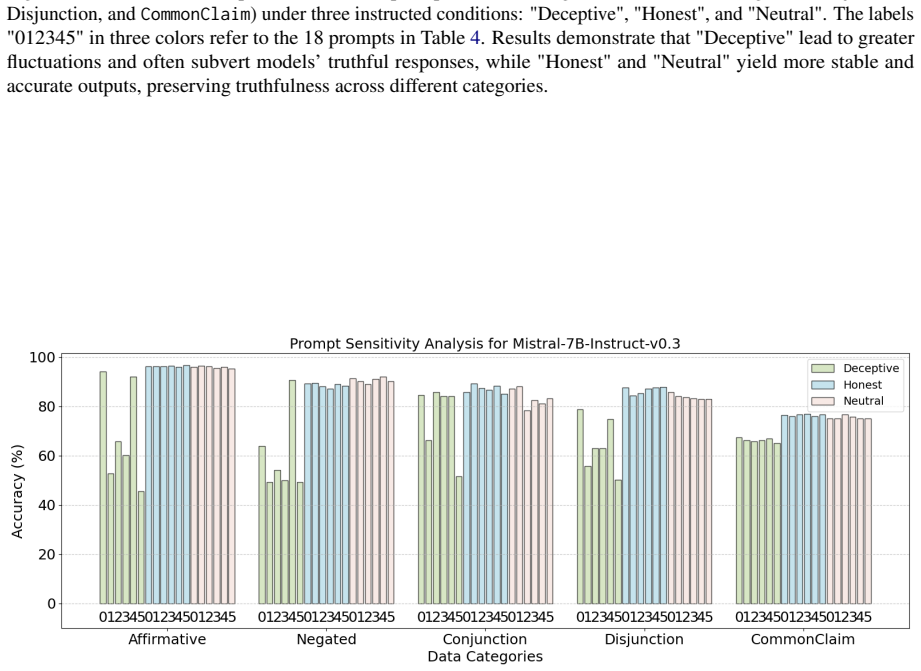
- Deceptive prompt rephrasings, rather than quantization alone, drive false outputs; honest and neutral rephrasings stabilize accuracy across model sizes and bit widths.
- DoLa decoding improves both truthfulness and informativeness scores on TruthfulQA for quantized models without retraining, suggesting mitigation is possible at inference time.
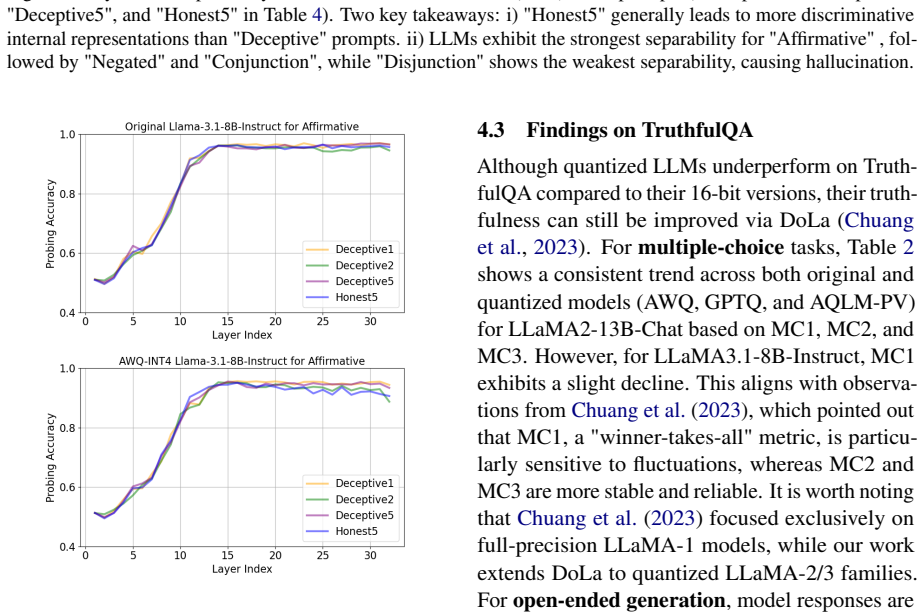
- Layer-wise probing stays near ceiling accuracy for quantized models even under deceptive prompts, so behavioral lies are not accompanied by a loss of linearly decodable truth.
Where Pith is reading between the lines
- This suggests that fixing truthfulness after quantization may be a decoding or alignment problem rather than a knowledge-preservation problem: if the truth direction remains linearly readable, steering activations along it could recover accuracy.
- The result implies that prompt sensitivity should be reported alongside standard quantization benchmarks, since perplexity and zero-shot scores can hide prompt-induced untruthfulness.
- Because probe separability is measured at the final token before the response, an alternative reading remains that the probe picks up response framing; a cross-condition probe test would settle whether the representation is genuinely truth-specific.
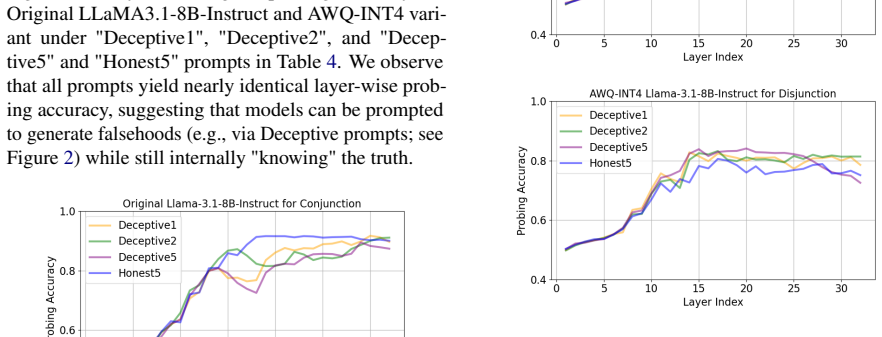
- The disjunction weakness of small models suggests logical connectives are where quantization and scale interact worst, and testing XOR, implication, or equivalence statements would likely show even larger gaps.
Editorial analysis
A structured set of objections, weighed in public.
Referee Report
Summary. The paper introduces TruthfulnessEval, a three-part benchmark for evaluating the truthfulness of quantized LLMs: logical reasoning (affirmative, negated, conjunction, disjunction), common sense (CommonClaim), and imitative falsehoods (TruthfulQA). It evaluates 4-bit (GPTQ, AWQ) and 2-bit (AQLM, AQLM-PV) quantized variants of LLaMA, Mistral, and Qwen models. The main empirical claims are that 4-bit quantization largely preserves accuracy on simple true/false statements, that 2-bit quantization degrades performance, that deceptive prompts can override truthful behavior while honest/neutral prompts stabilize it, and that layer-wise probing and PCA show quantized models still 'internally know the truth' even when they output false statements under deceptive prompts. The paper also shows that DoLa decoding mitigates some TruthfulQA degradation.
Significance. If the central claims hold, the paper provides a useful benchmark and a potentially important practical message: quantized models may retain factual knowledge while becoming more vulnerable to prompt-level manipulation. The evaluation covers several model families, quantization methods, and bit-widths, and the use of externally labeled true/false datasets and leave-one-topic-out probing is a methodological strength. The DoLa mitigation result is also practically relevant. However, the most novel interpretive claim—that quantized models 'know the truth internally yet still produce false outputs'—rests on a probing analysis whose current form is not fully convincing, and at least one quantitative claim in Section 4.1 contradicts the paper's own Table 1.
major comments (3)
- [§4.1, Table 1] The text states that the 2-bit degradation of LLaMA3.1-8B-AQLM-PV-1x16 'can be mitigated via two 8-bit codebooks and group-size of 8, as shown in the AQLM-PV-2x8 row.' Comparing the rows directly: Affirmative 85.11→68.48, Negated 92.03→49.41, Conjunction 91.34→81.08, CommonClaim 75.93→73.21. Only Disjunction improves (48.78→63.45). Thus, the 2x8 configuration is worse on four of five categories and substantially worse on negated statements. This claim must be corrected or re-analyzed; as written, it is contradicted by the paper's own data.
- [§4.2, Abstract, Contributions] The paper frames quantized models as especially susceptible to deceptive prompts, but it does not provide a quantitative comparison of prompt sensitivity across precisions. Section 4.2 says deceptive prompts subvert responses 'regardless of whether models are in full precision, 4-bit, or 2-bit,' which undercuts any precision-specific effect. Figures 2 and 6–9 plot many model/prompt combinations but no table or summary statistic quantifies original-vs-quantized differences, nor is there any variance/uncertainty estimate. Please provide per-condition accuracy tables with error bars or bootstrap intervals and, if the claim is that quantization increases susceptibility, a direct statistical test of that difference.
- [§5.1, Figure 4, Footnote 7] The central 'knows the truth' conclusion rests on logistic-regression probes fit separately for each prompt condition. This shows that, within a given prompt, truth labels are linearly decodable from final-token activations. It does not show that the same truth representation underlies behavior across prompts; the probe could exploit prompt-specific instruction/format features. To support the paper's stronger phrasing—that models 'retain internally truthful representations' even under deceptive prompts—please report cross-prompt probe transfer (e.g., train on honest/neutral, test on deceptive, and vice versa) and a shuffled-label control. Without this, the conclusion should be weakened to 'truth labels are linearly decodable within each prompt condition.'
minor comments (5)
- [Limitations] The Limitations section says 'conducting a systematic study of prompt sensitivity ... is worth doing,' but Section 4.2 is precisely a prompt-sensitivity study. Please clarify whether the present analysis is considered preliminary or whether this sentence is a remnant from an earlier draft.
- [§5.1] The text says 'we train logistical regression classifiers'—the correct term is 'logistic regression.' This appears in the layer-wise probing description and in captions of Figures 4 and 13–15.
- [Appendix B] There is a typo: 'we employ OpenAI’s GPT-4o API to to assess the truthfulness.' Please correct.
- [Abstract] The abstract says 'Codes and data are available here,' but no URL or repository link appears in the manuscript. Please add the actual link for reproducibility.
- [Figures 2, 6–9] These figures have identical captions and are difficult to read in the provided text. Please ensure the main-text figure is legible and that the appendix versions are clearly labeled by model; ideally, include a numeric table of per-prompt accuracies.
Circularity Check
No significant circularity; one definitional tautology in the interpretive 'knows the truth' claim.
specific steps
-
self definitional
[Footnote 7; Section 5.1 (Layer-wise Probing Accuracy)]
"Following Bürger et al. (2024), we define "LLMs internally 'knowing' the truth" as the existence of intermediate linearly separable features of truthfulness during inference. ... probing accuracy increases sharply from lower to middle layers and then plateaus near 1.0 in the upper layers, indicating that models can be deliberately prompted to generate falsehoods (e.g., via Deceptive prompts; see Figure 2) while they are still internally "knowing" the truth."
The paper's central interpretive claim—that models 'know the truth' despite emitting false outputs—is established by the same operational definition used to measure it. 'Knowing' is defined as the existence of linearly separable truthfulness features, and the evidence offered is linear-probe accuracy. Under the paper's own definition, the conclusion is a restatement of the probe result rather than an independent derivation. This does not affect the behavioral accuracy tables, which are evaluated against external labels, nor the prompt-sensitivity comparisons.
full rationale
Most of the paper's empirical content is self-contained and not circular. The behavioral evaluations (Table 1, Table 2, Figure 2) compare model outputs against externally labeled datasets (Bürger et al., TruthfulQA, CommonClaim) and do not fit a parameter that is subsequently renamed as a prediction. The probe in Section 5.1 is trained with leave-one-topic-out cross-validation, so its accuracy is an honest held-out measure. The only mildly circular element is interpretive: the paper defines 'knowing the truth' (footnote 7) as the existence of linearly separable truth features, and then uses high linear-probing accuracy as evidence for that same 'knowing.' Under the paper's own definition the conclusion is a tautology rather than an independent discovery, but the definition is stated explicitly and borrowed from prior work, so it does not undermine the behavioral results. There is no load-bearing self-citation (the cited works' author lists do not overlap with the present paper), no fitted input is called a prediction, and no uniqueness theorem is imported from the authors. The deceptive-prompt finding is a manipulation effect rather than a circular derivation: the prompt explicitly instructs lying, so observing more false outputs under it is expected, but the paper's quantitative comparisons across precisions and the probing results are not forced by construction.
Axiom & Free-Parameter Ledger
axioms (6)
- domain assumption Ground-truth labels in the six topic datasets, CommonClaim, and TruthfulQA correctly represent truthfulness.
- domain assumption The hidden state at the final token before the 'True'/'False' response is a valid location to read internal truth knowledge.
- domain assumption High accuracy of a linear probe with leave-one-topic-out means the model itself encodes the true answer.
- domain assumption GPT-4o evaluations of truthfulness and informativeness in open-ended TruthfulQA generation are reliable.
- domain assumption Deceptive prompts that explicitly instruct the model to lie are a meaningful measure of deceptive behavior.
- domain assumption Findings generalize from the evaluated models (up to 72B) to quantized LLMs broadly.
Cite this review
Pith. "Pith review of Quantized but Deceptive? A Multi-Dimensional Truthfulness Evaluation of Quantized LLMs." pith.science (2026). https://pith.science/paper/TK37BV6S
@misc{pith2026250819432,
  author       = {Pith},
  title        = {Pith review of: Quantized but Deceptive? A Multi-Dimensional Truthfulness Evaluation of Quantized LLMs},
  year         = {2026},
  howpublished = {\url{https://pith.science/paper/TK37BV6S}},
  note         = {Machine review of arXiv:2508.19432}
}
read the original abstract
Quantization enables efficient deployment of large language models (LLMs) in resource-constrained environments by significantly reducing memory and computation costs. While quantized LLMs often maintain performance on perplexity and zero-shot tasks, their impact on truthfulness-whether generating truthful or deceptive responses-remains largely unexplored. In this work, we introduce TruthfulnessEval, a comprehensive evaluation framework for assessing the truthfulness of quantized LLMs across three dimensions: (1) Truthfulness on Logical Reasoning; (2) Truthfulness on Common Sense; and (3) Truthfulness on Imitative Falsehoods. Using this framework, we examine mainstream quantization techniques (ranging from 4-bit to extreme 2-bit) across several open-source LLMs. Surprisingly, we find that while quantized models retain internally truthful representations, they are more susceptible to producing false outputs under misleading prompts. To probe this vulnerability, we test 15 rephrased variants of "honest", "neutral" and "deceptive" prompts and observe that "deceptive" prompts can override truth-consistent behavior, whereas "honest" and "neutral" prompts maintain stable outputs. Further, we reveal that quantized models "know" the truth internally yet still produce false outputs when guided by "deceptive" prompts via layer-wise probing and PCA visualizations. Our findings provide insights into future designs of quantization-aware alignment and truthfulness interventions.
Figures








Forward citations
Cited by 2 Pith papers
-
HindsightBench: A Black-Box Behavioral Audit Protocol for Parametric Hindsight in Time-Indexed LLM Decision Tasks
An integrated black-box audit protocol profiles parametric hindsight in LLMs and shows the date-trigger reflex tracks training generation, not scale, while effective knowledge cutoffs span 22 months.
-
From Signal Degradation to Computation Collapse: Uncovering the Two Failure Modes of LLM Quantization
LLM 2-bit quantization fails via either cumulative signal degradation or early computation collapse in key components.
Reference graph
Works this paper leans on
-
[1]
Josh Achiam, Steven Adler, Sandhini Agarwal, Lama Ahmad, Ilge Akkaya, Florencia Leoni Aleman, Diogo Almeida, Janko Altenschmidt, Sam Altman, Shyamal Anadkat, and 1 others. 2023. Gpt-4 technical report. arXiv preprint arXiv:2303.08774
Pith/arXiv arXiv 2023
-
[2]
Saleh Ashkboos, Amirkeivan Mohtashami, Maximilian Croci, Bo Li, Pashmina Cameron, Martin Jaggi, Dan Alistarh, Torsten Hoefler, and James Hensman. 2024. Quarot: Outlier-free 4-bit inference in rotated llms. Advances in Neural Information Processing Systems, 37:100213--100240
work page 2024
-
[3]
Amos Azaria and Tom Mitchell. 2023. The internal state of an llm knows when it's lying. arXiv preprint arXiv:2304.13734
Pith/arXiv arXiv 2023
-
[4]
Yannis Belkhiter, Giulio Zizzo, and Sergio Maffeis. 2024. Harmlevelbench: Evaluating harm-level compliance and the impact of quantization on model alignment. arXiv preprint arXiv:2411.06835
Pith/arXiv arXiv 2024
-
[5]
Lennart B \"u rger, Fred A Hamprecht, and Boaz Nadler. 2024. Truth is universal: Robust detection of lies in llms. arXiv preprint arXiv:2407.12831
Pith/arXiv arXiv 2024
-
[6]
Collin Burns, Haotian Ye, Dan Klein, and Jacob Steinhardt. 2022. Discovering latent knowledge in language models without supervision. arXiv preprint arXiv:2212.03827
Pith/arXiv arXiv 2022
-
[7]
Stephen Casper, Jason Lin, Joe Kwon, Gatlen Culp, and Dylan Hadfield-Menell. 2023. Explore, establish, exploit: Red teaming language models from scratch. arXiv preprint arXiv:2306.09442
Pith/arXiv arXiv 2023
-
[8]
Yuji Chai, John Gkountouras, Glenn G Ko, David Brooks, and Gu-Yeon Wei. 2023. Int2. 1: Towards fine-tunable quantized large language models with error correction through low-rank adaptation. arXiv preprint arXiv:2306.08162
Pith/arXiv arXiv 2023
-
[9]
Yung-Sung Chuang, Yujia Xie, Hongyin Luo, Yoon Kim, James Glass, and Pengcheng He. 2023. Dola: Decoding by contrasting layers improves factuality in large language models. arXiv preprint arXiv:2309.03883
Pith/arXiv arXiv 2023
-
[10]
Tim Dettmers, Artidoro Pagnoni, Ari Holtzman, and Luke Zettlemoyer. 2023. Qlora: Efficient finetuning of quantized llms. Advances in neural information processing systems, 36:10088--10115
2023
-
[11]
Dayou Du, Yijia Zhang, Shijie Cao, Jiaqi Guo, Ting Cao, Xiaowen Chu, and Ningyi Xu. 2024. Bitdistiller: Unleashing the potential of sub-4-bit llms via self-distillation. arXiv preprint arXiv:2402.10631
Pith/arXiv arXiv 2024
-
[12]
Abhimanyu Dubey, Abhinav Jauhri, Abhinav Pandey, Abhishek Kadian, Ahmad Al-Dahle, Aiesha Letman, Akhil Mathur, Alan Schelten, Amy Yang, Angela Fan, and 1 others. 2024. The llama 3 herd of models. arXiv preprint arXiv:2407.21783
Pith/arXiv arXiv 2024
-
[13]
Kazuki Egashira, Mark Vero, Robin Staab, Jingxuan He, and Martin Vechev. 2024. Exploiting llm quantization. arXiv preprint arXiv:2405.18137
Pith/arXiv arXiv 2024
-
[14]
Vage Egiazarian, Andrei Panferov, Denis Kuznedelev, Elias Frantar, Artem Babenko, and Dan Alistarh. 2024. Extreme compression of large language models via additive quantization. arXiv preprint arXiv:2401.06118
Pith/arXiv arXiv 2024
-
[15]
Elias Frantar, Saleh Ashkboos, Torsten Hoefler, and Dan Alistarh. 2022. Gptq: Accurate post-training quantization for generative pre-trained transformers. arXiv preprint arXiv:2210.17323
Pith/arXiv arXiv 2022
-
[16]
Leo Gao, Jonathan Tow, Baber Abbasi, Stella Biderman, Sid Black, Anthony DiPofi, Charles Foster, Laurence Golding, Jeffrey Hsu, Alain Le Noac'h, Haonan Li, Kyle McDonell, Niklas Muennighoff, Chris Ociepa, Jason Phang, Laria Reynolds, Hailey Schoelkopf, Aviya Skowron, Lintang Sutawika, and 5 others. 2024. https://doi.org/10.5281/zenodo.12608602 A framework...
-
[17]
Han Guo, Philip Greengard, Eric P Xing, and Yoon Kim. 2023. Lq-lora: Low-rank plus quantized matrix decomposition for efficient language model finetuning. arXiv preprint arXiv:2311.12023
Pith/arXiv arXiv 2023
-
[18]
Thilo Hagendorff. 2024. Deception abilities emerged in large language models. Proceedings of the National Academy of Sciences, 121(24):e2317967121
work page 2024
-
[19]
Soufiane Hayou, Nikhil Ghosh, and Bin Yu. 2024. Lora+: Efficient low rank adaptation of large models. arXiv preprint arXiv:2402.12354
Pith/arXiv arXiv 2024
-
[20]
Junyuan Hong, Jinhao Duan, Chenhui Zhang, Zhangheng Li, Chulin Xie, Kelsey Lieberman, James Diffenderfer, Brian Bartoldson, Ajay Jaiswal, Kaidi Xu, and 1 others. 2024. Decoding compressed trust: Scrutinizing the trustworthiness of efficient llms under compression. arXiv preprint arXiv:2403.15447
Pith/arXiv arXiv 2024
-
[21]
Albert Q Jiang, Alexandre Sablayrolles, Arthur Mensch, Chris Bamford, Devendra Singh Chaplot, Diego de las Casas, Florian Bressand, Gianna Lengyel, Guillaume Lample, Lucile Saulnier, and 1 others. 2023. Mistral 7b. arXiv preprint arXiv:2310.06825
Pith/arXiv arXiv 2023
-
[22]
Jeonghoon Kim, Jung Hyun Lee, Sungdong Kim, Joonsuk Park, Kang Min Yoo, Se Jung Kwon, and Dongsoo Lee. 2023 a . Memory-efficient fine-tuning of compressed large language models via sub-4-bit integer quantization. Advances in Neural Information Processing Systems, 36:36187--36207
work page 2023
-
[23]
Sehoon Kim, Coleman Hooper, Amir Gholami, Zhen Dong, Xiuyu Li, Sheng Shen, Michael W Mahoney, and Kurt Keutzer. 2023 b . Squeezellm: Dense-and-sparse quantization. arXiv preprint arXiv:2306.07629
Pith/arXiv arXiv 2023
-
[24]
Jiedong Lang, Zhehao Guo, and Shuyu Huang. 2024. A comprehensive study on quantization techniques for large language models. In 2024 4th International Conference on Artificial Intelligence, Robotics, and Communication (ICAIRC), pages 224--231. IEEE
work page 2024
-
[25]
Changhun Lee, Jungyu Jin, Taesu Kim, Hyungjun Kim, and Eunhyeok Park. 2023. Owq: Lessons learned from activation outliers for weight quantization in large language models. arXiv preprint arXiv:2306.02272, 2
Pith/arXiv arXiv 2023
-
[26]
Kenneth Li, Oam Patel, Fernanda Vi \'e gas, Hanspeter Pfister, and Martin Wattenberg. 2024 a . Inference-time intervention: Eliciting truthful answers from a language model. Advances in Neural Information Processing Systems, 36
work page 2024
-
[27]
Liang Li, Qingyuan Li, Bo Zhang, and Xiangxiang Chu. 2024 b . Norm tweaking: High-performance low-bit quantization of large language models. In Proceedings of the AAAI Conference on Artificial Intelligence, volume 38, pages 18536--18544
work page 2024
-
[28]
Yixiao Li, Yifan Yu, Chen Liang, Pengcheng He, Nikos Karampatziakis, Weizhu Chen, and Tuo Zhao. 2023. Loftq: Lora-fine-tuning-aware quantization for large language models. arXiv preprint arXiv:2310.08659
Pith/arXiv arXiv 2023
-
[29]
Ji Lin, Jiaming Tang, Haotian Tang, Shang Yang, Wei-Ming Chen, Wei-Chen Wang, Guangxuan Xiao, Xingyu Dang, Chuang Gan, and Song Han. 2024. Awq: Activation-aware weight quantization for on-device llm compression and acceleration. Proceedings of Machine Learning and Systems, 6:87--100
work page 2024
-
[30]
Stephanie Lin, Jacob Hilton, and Owain Evans. 2021. Truthfulqa: Measuring how models mimic human falsehoods. arXiv preprint arXiv:2109.07958
Pith/arXiv arXiv 2021
-
[31]
Jing Liu, Ruihao Gong, Xiuying Wei, Zhiwei Dong, Jianfei Cai, and Bohan Zhuang. 2023 a . Qllm: Accurate and efficient low-bitwidth quantization for large language models. arXiv preprint arXiv:2310.08041
Pith/arXiv arXiv 2023
-
[32]
Peiyu Liu, Zikang Liu, Ze-Feng Gao, Dawei Gao, Wayne Xin Zhao, Yaliang Li, Bolin Ding, and Ji-Rong Wen. 2023 b . Do emergent abilities exist in quantized large language models: An empirical study. arXiv preprint arXiv:2307.08072
Pith/arXiv arXiv 2023
-
[33]
Zechun Liu, Barlas Oguz, Changsheng Zhao, Ernie Chang, Pierre Stock, Yashar Mehdad, Yangyang Shi, Raghuraman Krishnamoorthi, and Vikas Chandra. 2023 c . Llm-qat: Data-free quantization aware training for large language models. arXiv preprint arXiv:2305.17888
Pith/arXiv arXiv 2023
-
[34]
Shuming Ma, Hongyu Wang, Lingxiao Ma, Lei Wang, Wenhui Wang, Shaohan Huang, Lifeng Dong, Ruiping Wang, Jilong Xue, and Furu Wei. 2024. The era of 1-bit llms: All large language models are in 1.58 bits. arXiv preprint arXiv:2402.17764, 1
Pith/arXiv arXiv 2024
-
[35]
Vladimir Malinovskii, Denis Mazur, Ivan Ilin, Denis Kuznedelev, Konstantin Burlachenko, Kai Yi, Dan Alistarh, and Peter Richtarik. 2024. Pv-tuning: Beyond straight-through estimation for extreme llm compression. Advances in Neural Information Processing Systems, 37:5074--5121
work page 2024
-
[36]
Samuel Marks and Max Tegmark. 2023. The geometry of truth: Emergent linear structure in large language model representations of true/false datasets. arXiv preprint arXiv:2310.06824
Pith/arXiv arXiv 2023
-
[37]
Libo Qin, Qiguang Chen, Xiachong Feng, Yang Wu, Yongheng Zhang, Yinghui Li, Min Li, Wanxiang Che, and Philip S Yu. 2024. Large language models meet nlp: A survey. arXiv preprint arXiv:2405.12819
Pith/arXiv arXiv 2024
-
[38]
Anku Rani, Dwip Dalal, Shreya Gautam, Pankaj Gupta, Vinija Jain, Aman Chadha, Amit Sheth, and Amitava Das. 2023. Sepsis: I can catch your lies--a new paradigm for deception detection. arXiv preprint arXiv:2312.00292
work page internal anchor Pith review Pith/arXiv arXiv 2023
-
[39]
J \'e r \'e my Scheurer, Mikita Balesni, and Marius Hobbhahn. 2023. Large language models can strategically deceive their users when put under pressure. arXiv preprint arXiv:2311.07590
Pith/arXiv arXiv 2023
-
[40]
Wenqi Shao, Mengzhao Chen, Zhaoyang Zhang, Peng Xu, Lirui Zhao, Zhiqian Li, Kaipeng Zhang, Peng Gao, Yu Qiao, and Ping Luo. 2023. Omniquant: Omnidirectionally calibrated quantization for large language models. arXiv preprint arXiv:2308.13137
Pith/arXiv arXiv 2023
-
[41]
Hugo Touvron, Louis Martin, Kevin Stone, Peter Albert, Amjad Almahairi, Yasmine Babaei, Nikolay Bashlykov, Soumya Batra, Prajjwal Bhargava, Shruti Bhosale, and 1 others. 2023. Llama 2: Open foundation and fine-tuned chat models. arXiv preprint arXiv:2307.09288
Pith/arXiv arXiv 2023
-
[42]
Kai Wang, Yihao Zhang, and Meng Sun. 2025. When thinking llms lie: Unveiling the strategic deception in representations of reasoning models. arXiv preprint arXiv:2506.04909
Pith/arXiv arXiv 2025
-
[43]
Xiuying Wei, Yunchen Zhang, Xiangguo Zhang, Ruihao Gong, Shanghang Zhang, Qi Zhang, Fengwei Yu, and Xianglong Liu. 2022. Outlier suppression: Pushing the limit of low-bit transformer language models. Advances in Neural Information Processing Systems, 35:17402--17414
work page 2022
-
[44]
Yichen Wu, Xudong Pan, Geng Hong, and Min Yang. 2025. Opendeception: Benchmarking and investigating ai deceptive behaviors via open-ended interaction simulation. arXiv preprint arXiv:2504.13707
arXiv 2025
-
[45]
Guangxuan Xiao, Ji Lin, Mickael Seznec, Hao Wu, Julien Demouth, and Song Han. 2023. Smoothquant: Accurate and efficient post-training quantization for large language models. In International Conference on Machine Learning, pages 38087--38099. PMLR
2023
-
[46]
Yuhui Xu, Lingxi Xie, Xiaotao Gu, Xin Chen, Heng Chang, Hengheng Zhang, Zhengsu Chen, Xiaopeng Zhang, and Qi Tian. 2023. Qa-lora: Quantization-aware low-rank adaptation of large language models. arXiv preprint arXiv:2309.14717
Pith/arXiv arXiv 2023
-
[47]
Yuzhuang Xu, Xu Han, Zonghan Yang, Shuo Wang, Qingfu Zhu, Zhiyuan Liu, Weidong Liu, and Wanxiang Che. 2024 a . Onebit: Towards extremely low-bit large language models. arXiv preprint arXiv:2402.11295
Pith/arXiv arXiv 2024
-
[48]
Zhichao Xu, Ashim Gupta, Tao Li, Oliver Bentham, and Vivek Srikumar. 2024 b . Beyond perplexity: Multi-dimensional safety evaluation of llm compression. arXiv preprint arXiv:2407.04965
work page internal anchor Pith review Pith/arXiv arXiv 2024
-
[49]
An Yang, Baosong Yang, Beichen Zhang, Binyuan Hui, Bo Zheng, Bowen Yu, Chengyuan Li, Dayiheng Liu, Fei Huang, Haoran Wei, and 1 others. 2024. Qwen2. 5 technical report. arXiv preprint arXiv:2412.15115
Pith/arXiv arXiv 2024
-
[50]
Zhewei Yao, Reza Yazdani Aminabadi, Minjia Zhang, Xiaoxia Wu, Conglong Li, and Yuxiong He. 2022. Zeroquant: Efficient and affordable post-training quantization for large-scale transformers. Advances in Neural Information Processing Systems, 35:27168--27183
work page 2022
-
[51]
Sibo Yi, Yule Liu, Zhen Sun, Tianshuo Cong, Xinlei He, Jiaxing Song, Ke Xu, and Qi Li. 2024. Jailbreak attacks and defenses against large language models: A survey. arXiv preprint arXiv:2407.04295
Pith/arXiv arXiv 2024
-
[52]
Zhihang Yuan, Lin Niu, Jiawei Liu, Wenyu Liu, Xinggang Wang, Yuzhang Shang, Guangyu Sun, Qiang Wu, Jiaxiang Wu, and Bingzhe Wu. 2023. Rptq: Reorder-based post-training quantization for large language models. arXiv preprint arXiv:2304.01089
Pith/arXiv arXiv 2023
-
[53]
Wayne Xin Zhao, Kun Zhou, Junyi Li, Tianyi Tang, Xiaolei Wang, Yupeng Hou, Yingqian Min, Beichen Zhang, Junjie Zhang, Zican Dong, and 1 others. 2023. A survey of large language models. arXiv preprint arXiv:2303.18223
Pith/arXiv arXiv 2023
-
[54]
Yilong Zhao, Chien-Yu Lin, Kan Zhu, Zihao Ye, Lequn Chen, Size Zheng, Luis Ceze, Arvind Krishnamurthy, Tianqi Chen, and Baris Kasikci. 2024. Atom: Low-bit quantization for efficient and accurate llm serving. Proceedings of Machine Learning and Systems, 6:196--209
2024
-
[55]
Zixuan Zhou, Xuefei Ning, Ke Hong, Tianyu Fu, Jiaming Xu, Shiyao Li, Yuming Lou, Luning Wang, Zhihang Yuan, Xiuhong Li, and 1 others. 2024. A survey on efficient inference for large language models. arXiv preprint arXiv:2404.14294
Pith/arXiv arXiv 2024
-
[56]
Jingming Zhuo, Songyang Zhang, Xinyu Fang, Haodong Duan, Dahua Lin, and Kai Chen. 2024. Prosa: Assessing and understanding the prompt sensitivity of llms. arXiv preprint arXiv:2410.12405
Pith/arXiv arXiv 2024
-
[57]
online" 'onlinestring :=
ENTRY address archivePrefix author booktitle chapter edition editor eid eprint eprinttype howpublished institution journal key month note number organization pages publisher school series title type volume year doi pubmed url lastchecked label extra.label sort.label short.list INTEGERS output.state before.all mid.sentence after.sentence after.block STRING...
-
[58]
write newline
" write newline "" before.all 'output.state := FUNCTION n.dashify 't := "" t empty not t #1 #1 substring "-" = t #1 #2 substring "--" = not "--" * t #2 global.max substring 't := t #1 #1 substring "-" = "-" * t #2 global.max substring 't := while if t #1 #1 substring * t #2 global.max substring 't := if while FUNCTION word.in bbl.in capitalize " " * FUNCT...
This paper was first reviewed by deepseek-v4-flash on August 5, 2026.
discussion (0)
Sign in with ORCID, Apple, or X to comment. Anyone can read and Pith papers without signing in.