REVIEW 4 major objections 5 minor 37 references
Bridging Language Gaps: Enhancing Few-Shot Language Adaptation
T0 review · 4 major / 5 minor · reviewed 2026-08-05 · deepseek-v4-flash
Pith's one-line read CoLAP claims contrastive alignment of target-language examples with English makes few-shot cross-lingual transfer outperform baselines.
desk verdict A genuinely useful few-shot cross-lingual adaptation recipe, but the paper overclaims its own results and has reproducibility blockers in the loss definitions and layer selection. read the letter →
The pith
A machine-rendered reading of the paper's core claim, the machinery that carries it, and where it could break.
The reading
What carries the argument
The mechanism is a pair of contrastive objectives added to the cross-entropy loss during the few-shot target-language adaptation phase. Prompted inputs are passed through the PLM and the hidden state at <EOS> (or the <mask> token for masked models) is used as the representation. XRCL pulls each target-language representation toward its English translation (positive pair) and away from all other English instances; XCCL instead uses all same-label English instances as positives and different-label instances as negatives, removing the need for parallel translations. The paper also identifies layer 10 of XLM-R as the best representation layer for the contrastive loss, and proposes selecting few-
What would settle it
Train CoLAP XCCL and the PCT baseline on the same K=5 and K=10 episodes for a language with no parallel English data and check whether XCCL's average accuracy actually exceeds PCT's across a held-out set of languages; if the advantage does not reproduce, the data-efficiency claim is settled. The paper's own ablation, which removes the contrastive loss and shows a performance drop, is a within-paper version of this test.
Extended reading notes
Core claim
The central claim is that discriminative task-specific information can be transferred from English to lower-resource languages with very few labeled examples by aligning representations at few-shot fine-tuning time rather than at pretraining time. CoLAP does this by prompting a multilingual model for the task, extracting an <EOS>/<mask> hidden representation, and training with L = L_CE + L_contrastive on an episode of K target-language examples plus K English examples. The XRCL variant treats each target example's English translation as its positive pair; the XCCL variant treats all English examples with the same class label as positives. Across XNLI, AmericasNLI, and MultiTACRED, with encod
Load-bearing premise
The load-bearing premise is that the few-shot target-language examples and the source-language examples are parallel corpora whose direct translations are meaning-preserving; if translations are noisy, misaligned, or unavailable in a real deployment, the XRCL contrastive signal is corrupted and the claimed gains would not transfer.
Editorial extensions
If this is right
- CoLAP with K=5 target examples outperforms in-context learning on XNLI, AmNLI, and MultiTACRED for Gemma 2 and Mistral, with average gains of 6.41 and 6.93 accuracy points.
- The XCCL variant needs no parallel translations and stays within about one point of XRCL once K>=10, so labeled target examples alone can drive adaptation.
- Prompt-based contrastive alignment works across encoder-only and decoder-only models and needs no new model parameters.
- Similarity-based exemplar selection improves data efficiency for languages represented in pretraining; with K=5 selected examples CoLAP exceeds randomly selected K=250 examples on XNLI.
Reading between the lines
- The failure of English-based exemplar selection on unseen languages suggests a testable fix: build class prototypes from target-language representations rather than English, which may extend the data-efficiency gain to truly unseen languages.
- If task-specific representations are as simple as the paper argues, the same contrastive recipe should transfer to other classification tasks and to token-level tasks with minimal adaptation, though the XCCL objective in its current form is limited to classification.
- The layer-10 finding is model- and task-specific; a practical extension would search layer choice per task family or make the contrastive layer learnable rather than fixing it at one layer.
- The ablation shows combining XRCL and XCCL helps but requires translations; a translator-free hybrid could use back-translation or synthetic parallel data to get part of the XRCL signal, a direction the paper does not explore.
Signed reviews
Editorial analysis
A structured set of objections, weighed in public.
Referee Report
Summary. The paper proposes CoLAP, a few-shot cross-lingual transfer method that combines prompt-based fine-tuning with two contrastive objectives: XRCL, which aligns parallel source–target sentence representations, and XCCL, which aligns representations of same-class instances without parallel data. The method is evaluated on XNLI, AmericasNLI, and MultiTACRED using XLM-R, Gemma 2, and Mistral, and the authors claim it outperforms few-shot cross-lingual baselines and in-context learning even with very few target-language examples.
Significance. If the claims held, CoLAP would be a practically useful, data-efficient method for adapting multilingual PLMs to low-resource languages, and the introduction of a non-parallel contrastive objective (XCCL) is a sensible direction. The paper ships code, covers three model families and three tasks, and evaluates very-low-resource languages. However, the central empirical claim is not supported by the paper's own tables, and the loss equations are formally incorrect as written, so the contribution is not currently established.
major comments (4)
- [Section 3.2, Eqs. (1) and (2)] Both L_XRCL and L_XCCL are written as -log[exp(phi(ri,T, r+_i)/tau) / exp(phi(ri,T, r−_i)/tau)], with r−_i defined as a set. This is not the InfoNCE/contrastive loss described in the text: there is no summation over negative pairs, and the denominator does not include the positive pair or a partition function. As written, the expression is not even a well-defined probability. This is a load-bearing specification error because the method's core objective is not reproducible from the text.
- [Section 5, Table 1, and Abstract] The abstract states that CoLAP 'outperforms few-shot cross-lingual transfer baselines and in-context learning, even with limited available data.' Table 1 directly contradicts this. For example, at K=5 on MultiTACRED, PCT beats CoLAP w/ XRCL for Gemma (44.00 vs 43.47) and for Mistral (43.35 vs 38.73). PCT also wins at K=50 on MultiTACRED-XLM-R (75.36 vs 73.98), at K=100 on MultiTACRED-XLM-R (78.26 vs 77.29), and at K=250 on AmNLI-Mistral (45.21 vs 42.45), among other cells. The text in Section 5 is internally contradictory: 'CoLAP surpasses the performance of its benchmarks, except in the AmNLI dataset for Gemma and Mistral' is immediately followed by 'Even in the high-resource setting of K=250 exemplars, CoLAP exceeds the performance of its benchmarks.' The headline claim is overstated and not supported by the reported results.
- [Sections 4.1 and 5.2] The paper states that no validation set is used during few-shot fine-tuning, yet Section 5.2 selects the contrastive layer by evaluating on the test sets of XNLI and AmNLI (Figure 5). This is test-set-based hyperparameter selection, which can inflate reported performance and invalidate the strength of the comparisons. Additionally, Appendix A observes that models with K>100 'gain performance when trained up to 50 epochs,' but the main training protocol fixes 10 epochs; it is unclear whether the K=100 and K=250 results in Table 1 used 10 or 50 epochs, and whether this decision was also based on test performance. The evaluation protocol needs to be clarified and, ideally, a validation split introduced for any hyperparameter choice.
- [Sections 4.2 and 7] The XRCL variant assumes that the target-language few-shot examples and the source-language examples are parallel translations. The Limitations section acknowledges this, but the paper does not analyze how sensitive XRCL is to noisy or unavailable translations. More importantly, the XCCL variant, which is supposed to remove this dependency, also fails to beat PCT in many configurations (e.g., MultiTACRED at K=50 for all models, and AmNLI at K=250 for Mistral). Thus the claimed practical advantage of CoLAP over a strong prompt-based baseline is not demonstrated even under the favorable parallel-data assumption for XRCL, nor under the more realistic non-parallel setting for XCCL.
minor comments (5)
- [Section 3.1] The text says the hidden state of the <EOS> token is used for label prediction, but footnote 2 correctly notes that masked language models use the <mask> token. This should be stated in the main text for clarity.
- [Table 1, K=0 row] The row labeled 'CoLAP' at K=0 is not described anywhere; it appears to be the prompted model without contrastive adaptation. This should be defined explicitly, or the row should be relabeled, since 'CoLAP' normally implies the contrastive objectives.
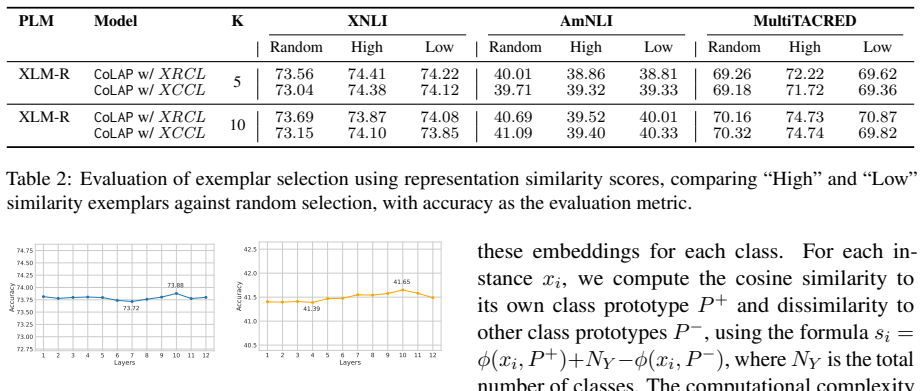
- [Section 5.3 and Table 2] The claim that similarity-based exemplar selection 'improves data efficiency by at least 50%' is not directly supported by the table. The reported improvements are small absolute accuracy differences, and the '50%' figure is never defined. Please clarify the metric and provide a significance test or variance estimate.
- [Appendix A] There is a typo: 'the number relation types' should be 'the number of relation types.' Also, the relation mapping from 41 to 31 labels is only mentioned in the appendix; this is an important experimental detail that should appear in the main text, since it changes the task definition for all models.
- [Section 3.2] Equations (1) and (2) are identical in form; only the definitions of r+ and r− differ. This is fine, but the text could explicitly state that the same loss functional is used with different positive/negative sets, rather than presenting the same equation twice.
Circularity Check
No circularity: CoLAP is an empirical method paper; the comparative claims are measured, not derived from their inputs.
full rationale
CoLAP is an empirical method paper; there is no derivation chain whose conclusion is identical to an input. The contrastive losses (XRCL, XCCL) are defined explicitly and their effect is measured on test data. The paper contains no load-bearing self-citations: the reference list includes no self-citations by the authors, and no uniqueness theorem is imported from prior work. The only circularity-adjacent concern is that Section 5.2 selects the contrastive layer (10th for XLM-R) after evaluating on the test set, and Section 4.1 states 'we do not use a dedicated validation set during few-shot fine-tuning.' This is a hyperparameter-selection-bias problem, not a reduction of the result to its inputs by construction; it does not force the central comparative claim, and indeed Table 1 contains multiple cells where PCT outperforms CoLAP. Appendix A notes that CoLAP models with K>100 'gain performance when trained up to 50 epochs,' but the paper reports fixed 10-epoch results, so no fitted epoch count is renamed as a prediction. The Limitations section explicitly acknowledges that XRCL 'requires translated instance pairs'—a limitation, not a circular step. The abstract's universal claim is internally contradicted by Table 1 (e.g., MultiTACRED K=5 Gemma: PCT 44.00 vs CoLAP 43.47; Mistral 43.35 vs 38.73) and Section 5 contains self-contradictory sentences ('CoLAP surpasses... except in the AmNLI dataset for Gemma and Mistral' followed by 'Even in the high-resource setting... CoLAP exceeds the performance of its benchmarks'). These are correctness/reporting issues, not circularity under the definitions in this analysis. Therefore the circularity score is 0.
Assumptions & free parameters
free parameters (4)
- Temperature tau in contrastive losses =
not reported in the paper
- Contrastive layer index =
10 (for XLM-R)
- LoRA rank and alpha for Gemma and Mistral =
r=16, alpha=32
- Merged relation label mapping on MultiTACRED =
41 labels reduced to 31
assumptions (4)
- domain assumption Downstream task representations are less complex than language-modeling representations and can be transferred data-efficiently between languages.
- domain assumption DT and DS are parallel corpora for XRCL: each target-language few-shot example has a direct translation in the source-language set.
- domain assumption Machine-translated XNLI and MultiTACRED, and human-translated AmericasNLI, preserve class labels and sentence meaning well enough for contrastive alignment.
- domain assumption A fixed 10-epoch training schedule without a validation set is a fair protocol for all methods.
Cite this review
Pith. "Pith review of Bridging Language Gaps: Enhancing Few-Shot Language Adaptation." pith.science (2026). https://pith.science/paper/LCVRR74J
@misc{pith2026250819464,
  author       = {Pith},
  title        = {Pith review of: Bridging Language Gaps: Enhancing Few-Shot Language Adaptation},
  year         = {2026},
  howpublished = {\url{https://pith.science/paper/LCVRR74J}},
  note         = {Machine review of arXiv:2508.19464}
}
read the original abstract
The disparity in language resources poses a challenge in multilingual NLP, with high-resource languages benefiting from extensive data, while low-resource languages lack sufficient data for effective training. Our Contrastive Language Alignment with Prompting (CoLAP) method addresses this gap by integrating contrastive learning with cross-lingual representations, facilitating task-specific knowledge transfer from high-resource to lower-resource languages. The primary advantage of our approach is its data efficiency, enabling rapid adaptation to new languages and reducing the need for large labeled datasets. We conduct experiments with multilingual encoder-only and decoder-only language models on natural language understanding tasks, including natural language inference and relation extraction, evaluating performance across both high- and low-resource languages. Our results demonstrate that CoLAP outperforms few-shot cross-lingual transfer baselines and in-context learning, even with limited available data. This effectively narrows the cross-lingual performance gap, contributing to the development of more efficient multilingual NLP techniques.
Figures


Figures from the paper (2 more)

Reference graph
Works this paper leans on
-
[1]
online" 'onlinestring :=
ENTRY address archivePrefix author booktitle chapter edition editor eid eprint eprinttype howpublished institution journal key month note number organization pages publisher school series title type volume year doi pubmed url lastchecked label extra.label sort.label short.list INTEGERS output.state before.all mid.sentence after.sentence after.block STRING...
-
[2]
write newline
" write newline "" before.all 'output.state := FUNCTION n.dashify 't := "" t empty not t #1 #1 substring "-" = t #1 #2 substring "--" = not "--" * t #2 global.max substring 't := t #1 #1 substring "-" = "-" * t #2 global.max substring 't := while if t #1 #1 substring * t #2 global.max substring 't := if while FUNCTION word.in bbl.in capitalize " " * FUNCT...
-
[3]
Alan Ansell, Edoardo Maria Ponti, Jonas Pfeiffer, Sebastian Ruder, Goran Glava s , Ivan Vuli \'c , and Anna Korhonen. 2021. https://doi.org/10.18653/v1/2021.findings-emnlp.410 MAD - G : M ultilingual adapter generation for efficient cross-lingual transfer . In Findings of the Association for Computational Linguistics: EMNLP 2021, pages 4762--4781, Punta C...
-
[4]
Steven Cao, Nikita Kitaev, and Dan Klein. 2020. https://openreview.net/forum?id=r1xCMyBtPS Multilingual alignment of contextual word representations . In The Eigth International Conference on Learning Representations, ICLR 2020
work page 2020
-
[5]
Zewen Chi, Li Dong, Furu Wei, Nan Yang, Saksham Singhal, Wenhui Wang, Xia Song, Xian-Ling Mao, Heyan Huang, and Ming Zhou. 2021. https://doi.org/10.18653/v1/2021.naacl-main.280 I nfo XLM : An information-theoretic framework for cross-lingual language model pre-training . In Proceedings of the 2021 Conference of the North American Chapter of the Associatio...
-
[6]
Alexis Conneau, Kartikay Khandelwal, Naman Goyal, Vishrav Chaudhary, Guillaume Wenzek, Francisco Guzm \'a n, Edouard Grave, Myle Ott, Luke Zettlemoyer, and Veselin Stoyanov. 2020. https://doi.org/10.18653/v1/2020.acl-main.747 Unsupervised cross-lingual representation learning at scale . In Proceedings of the 58th Annual Meeting of the Association for Comp...
-
[7]
Alexis Conneau, Ruty Rinott, Guillaume Lample, Adina Williams, Samuel Bowman, Holger Schwenk, and Veselin Stoyanov. 2018. https://doi.org/10.18653/v1/D18-1269 XNLI : Evaluating cross-lingual sentence representations . In Proceedings of the 2018 Conference on Empirical Methods in Natural Language Processing, pages 2475--2485, Brussels, Belgium. Association...
-
[8]
Tim Dettmers, Artidoro Pagnoni, Ari Holtzman, and Luke Zettlemoyer. 2023. https://openreview.net/forum?id=OUIFPHEgJU QL o RA : Efficient finetuning of quantized LLM s . In Thirty-seventh Conference on Neural Information Processing Systems
work page 2023
Show all 37 references
-
[9]
Jacob Devlin, Ming-Wei Chang, Kenton Lee, and Kristina Toutanova. 2019. https://doi.org/10.18653/v1/N19-1423 BERT : Pre-training of deep bidirectional transformers for language understanding . In Proceedings of the 2019 Conference of the North A merican Chapter of the Associat...
2019 doi
-
[10]
Abteen Ebrahimi, Manuel Mager, Arturo Oncevay, Vishrav Chaudhary, Luis Chiruzzo, Angela Fan, John Ortega, Ricardo Ramos, Annette Rios, Ivan Vladimir Meza Ruiz, Gustavo Gim \'e nez-Lugo, Elisabeth Mager, Graham Neubig, Alexis Palmer, Rolando Coto-Solano, Thang Vu, and Katharina...
2022 doi
-
[11]
Markus Freitag, David Vilar, David Grangier, Colin Cherry, and George Foster. 2022. https://doi.org/10.18653/v1/2022.findings-acl.263 A natural diet: Towards improving naturalness of machine translation output . In Findings of the Association for Computational Linguistics: ACL...
2022 doi
-
[12]
Gemma Team , Morgane Riviere, Shreya Pathak, Pier Giuseppe Sessa, Cassidy Hardin, Surya Bhupatiraju, Léonard Hussenot, Thomas Mesnard, Bobak Shahriari, Alexandre Ramé, Johan Ferret, Peter Liu, Pouya Tafti, Abe Friesen, Michelle Casbon, Sabela Ramos, Ravin Kumar, Charline Le La...
2024 arXiv
-
[13]
Yiduo Guo, Yaobo Liang, Dongyan Zhao, Bing Liu, and Nan Duan. 2023. https://doi.org/10.18653/v1/2023.acl-long.221 Analyzing and reducing the performance gap in cross-lingual transfer with fine-tuning slow and fast . In Proceedings of the 61st Annual Meeting of the Association ...
2023 doi
-
[14]
Leonhard Hennig, Philippe Thomas, and Sebastian M \"o ller. 2023. https://doi.org/10.18653/v1/2023.acl-long.210 M ulti TACRED : A multilingual version of the TAC relation extraction dataset . In Proceedings of the 61st Annual Meeting of the Association for Computational Lingui...
2023 doi
-
[15]
Edward Hu, Yelong Shen, Phillip Wallis, Zeyuan Allen-Zhu, Yuanzhi Li, Shean Wang, and Weizhu Chen
J. Edward Hu, Yelong Shen, Phillip Wallis, Zeyuan Allen-Zhu, Yuanzhi Li, Shean Wang, and Weizhu Chen. 2021. https://api.semanticscholar.org/CorpusID:235458009 Lora: Low-rank adaptation of large language models . ArXiv, abs/2106.09685
2021 arXiv
-
[16]
Lianzhe Huang, Shuming Ma, Dongdong Zhang, Furu Wei, and Houfeng Wang. 2022. https://doi.org/10.18653/v1/2022.emnlp-main.790 Zero-shot cross-lingual transfer of prompt-based tuning with a unified multilingual prompt . In Proceedings of the 2022 Conference on Empirical Methods ...
2022 doi
-
[17]
Albert Q. Jiang, Alexandre Sablayrolles, Arthur Mensch, Chris Bamford, Devendra Singh Chaplot, Diego de las Casas, Florian Bressand, Gianna Lengyel, Guillaume Lample, Lucile Saulnier, Lélio Renard Lavaud, Marie-Anne Lachaux, Pierre Stock, Teven Le Scao, Thibaut Lavril, Thomas ...
2023 arXiv
-
[18]
Anne Lauscher, Vinit Ravishankar, Ivan Vuli \'c , and Goran Glava s . 2020. https://doi.org/10.18653/v1/2020.emnlp-main.363 From zero to hero: O n the limitations of zero-shot language transfer with multilingual T ransformers . In Proceedings of the 2020 Conference on Empirica...
2020 doi
-
[19]
Ilya Loshchilov and Frank Hutter. 2017. https://api.semanticscholar.org/CorpusID:53592270 Decoupled weight decay regularization . In The Fifth International Conference on Learning Representations, ICLR 2017
2017
-
[20]
Ercong Nie, Sheng Liang, Helmut Schmid, and Hinrich Sch \"u tze. 2023. https://doi.org/10.18653/v1/2023.findings-acl.528 Cross-lingual retrieval augmented prompt for low-resource languages . In Findings of the Association for Computational Linguistics: ACL 2023, pages 8320--83...
2023 doi
-
[21]
Lin Pan, Chung-Wei Hang, Haode Qi, Abhishek Shah, Saloni Potdar, and Mo Yu. 2021. https://doi.org/10.18653/v1/2021.naacl-main.20 Multilingual BERT post-pretraining alignment . In Proceedings of the 2021 Conference of the North American Chapter of the Association for Computatio...
2021 doi
-
[22]
Edoardo Maria Ponti, Goran Glava s , Olga Majewska, Qianchu Liu, Ivan Vuli \'c , and Anna Korhonen. 2020. https://doi.org/10.18653/v1/2020.emnlp-main.185 XCOPA : A multilingual dataset for causal commonsense reasoning . In Proceedings of the 2020 Conference on Empirical Method...
2020 doi
-
[23]
Kunxun Qi, Hai Wan, Jianfeng Du, and Haolan Chen. 2022. https://doi.org/10.18653/v1/2022.acl-long.134 Enhancing cross-lingual natural language inference by prompt-learning from cross-lingual templates . In Proceedings of the 60th Annual Meeting of the Association for Computati...
2022 doi
-
[24]
Sebastian Ruder, Ivan Vuli\' c , and Anders S gaard. 2019. https://doi.org/10.1613/jair.1.11640 A survey of cross-lingual word embedding models . J. Artif. Int. Res., 65(1):569–630
2019 doi
-
[25]
Timo Schick and Hinrich Sch \"u tze. 2021. https://doi.org/10.18653/v1/2021.eacl-main.20 Exploiting cloze-questions for few-shot text classification and natural language inference . In Proceedings of the 16th Conference of the European Chapter of the Association for Computatio...
2021 doi
-
[26]
Fabian David Schmidt, Ivan Vuli \'c , and Goran Glava s . 2022. https://doi.org/10.18653/v1/2022.emnlp-main.736 Don ' t stop fine-tuning: On training regimes for few-shot cross-lingual transfer with multilingual language models . In Proceedings of the 2022 Conference on Empiri...
2022 doi
-
[27]
Fabian David Schmidt, Ivan Vuli \'c , and Goran Glava s . 2023. https://doi.org/10.18653/v1/2023.acl-long.314 Free lunch: Robust cross-lingual transfer via model checkpoint averaging . In Proceedings of the 61st Annual Meeting of the Association for Computational Linguistics (...
2023 doi
-
[28]
Aaron van den Oord, Yazhe Li, and Oriol Vinyals. 2019. https://arxiv.org/abs/1807.03748 Representation learning with contrastive predictive coding . Preprint, arXiv:1807.03748
2019 arXiv
-
[29]
Genta Winata, Shijie Wu, Mayank Kulkarni, Thamar Solorio, and Daniel Preotiuc-Pietro. 2022. https://aclanthology.org/2022.aacl-main.59 Cross-lingual few-shot learning on unseen languages . In Proceedings of the 2nd Conference of the Asia-Pacific Chapter of the Association for ...
2022
-
[30]
Genta Indra Winata, Alham Fikri Aji, Samuel Cahyawijaya, Rahmad Mahendra, Fajri Koto, Ade Romadhony, Kemal Kurniawan, David Moeljadi, Radityo Eko Prasojo, Pascale Fung, Timothy Baldwin, Jey Han Lau, Rico Sennrich, and Sebastian Ruder. 2023. https://doi.org/10.18653/v1/2023.eac...
2023 doi
-
[31]
Shijie Wu and Mark Dredze. 2020. https://doi.org/10.18653/v1/2020.repl4nlp-1.16 Are all languages created equal in multilingual BERT ? In Proceedings of the 5th Workshop on Representation Learning for NLP, pages 120--130, Online. Association for Computational Linguistics
2020 doi
-
[32]
Shaoyang Xu, Junzhuo Li, and Deyi Xiong. 2023. https://doi.org/10.18653/v1/2023.emnlp-main.226 Language representation projection: Can we transfer factual knowledge across languages in multilingual language models? In Proceedings of the 2023 Conference on Empirical Methods in ...
2023 doi
-
[33]
Huiyun Yang, Huadong Chen, Hao Zhou, and Lei Li. 2022. https://openreview.net/forum?id=OjPmfr9GkVv Enhancing cross-lingual transfer by manifold mixup . In The Tenth International Conference on Learning Representations, ICLR 2022, Virtual Event, April 25-29, 2022
2022
-
[34]
Mengjie Zhao and Hinrich Sch \"u tze. 2021. https://doi.org/10.18653/v1/2021.emnlp-main.672 Discrete and soft prompting for multilingual models . In Proceedings of the 2021 Conference on Empirical Methods in Natural Language Processing, pages 8547--8555, Online and Punta Cana,...
2021 doi
-
[35]
Mengjie Zhao, Yi Zhu, Ehsan Shareghi, Ivan Vuli \'c , Roi Reichart, Anna Korhonen, and Hinrich Sch \"u tze. 2021. https://doi.org/10.18653/v1/2021.acl-long.447 A closer look at few-shot crosslingual transfer: The choice of shots matters . In Proceedings of the 59th Annual Meet...
2021 doi
-
[36]
Bo Zheng, Li Dong, Shaohan Huang, Wenhui Wang, Zewen Chi, Saksham Singhal, Wanxiang Che, Ting Liu, Xia Song, and Furu Wei. 2021. https://doi.org/10.18653/v1/2021.acl-long.264 Consistency regularization for cross-lingual fine-tuning . In Proceedings of the 59th Annual Meeting o...
2021 doi
-
[37]
Meng Zhou, Xin Li, Yue Jiang, and Lidong Bing. 2023. https://doi.org/10.18653/v1/2023.findings-acl.700 Enhancing cross-lingual prompting with dual prompt augmentation . In Findings of the Association for Computational Linguistics: ACL 2023, pages 11008--11020, Toronto, Canada....
2023 doi
Reviewed August 5, 2026 · model on record in the stance chip above.
Discussion (0). Continue with ORCID to comment.