REVIEW 3 major objections 4 minor 228 references
This thesis argues that task bots can adapt to new user behavior, take on new tasks, and avoid hallucinated facts through self-learning loops that minimize human annotation.
Reviewed by Pith at T0; open to challenge. T0 means a machine referee read the full paper against a public rubric. the ladder, T0–T4 →
A thesis that combines self-learning from dialog logs, schema-guided prompting, and self-aligned factuality to build task bots with minimal human intervention.
T0 review reviewed 2026-08-05 challenge →
load-bearing objection A thesis that repackages three already-published papers: no new results, but the underlying methods are solid and the limitations are honestly stated at the end. the 3 major comments →
Building Task Bots with Self-learning for Enhanced Adaptability, Extensibility, and Factuality
The pith
A machine-rendered reading of the paper's core claim, the machinery that carries it, and where it could break.
The reading
Core claim
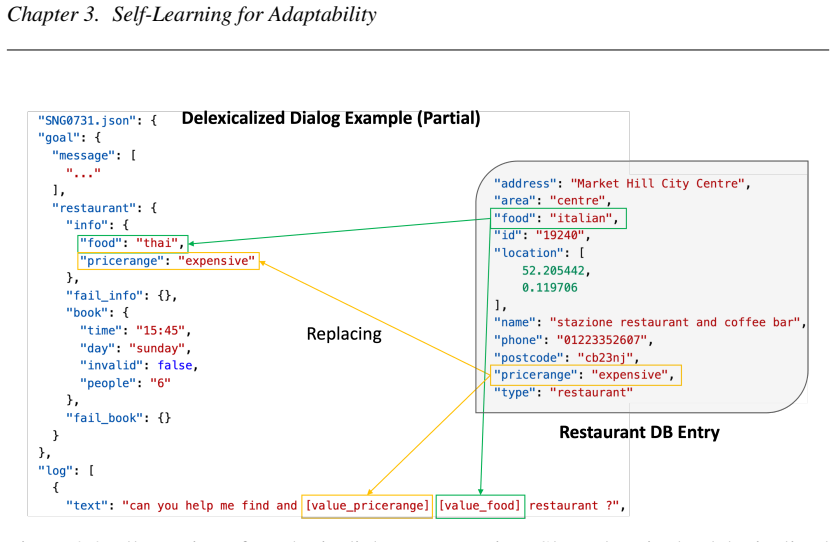
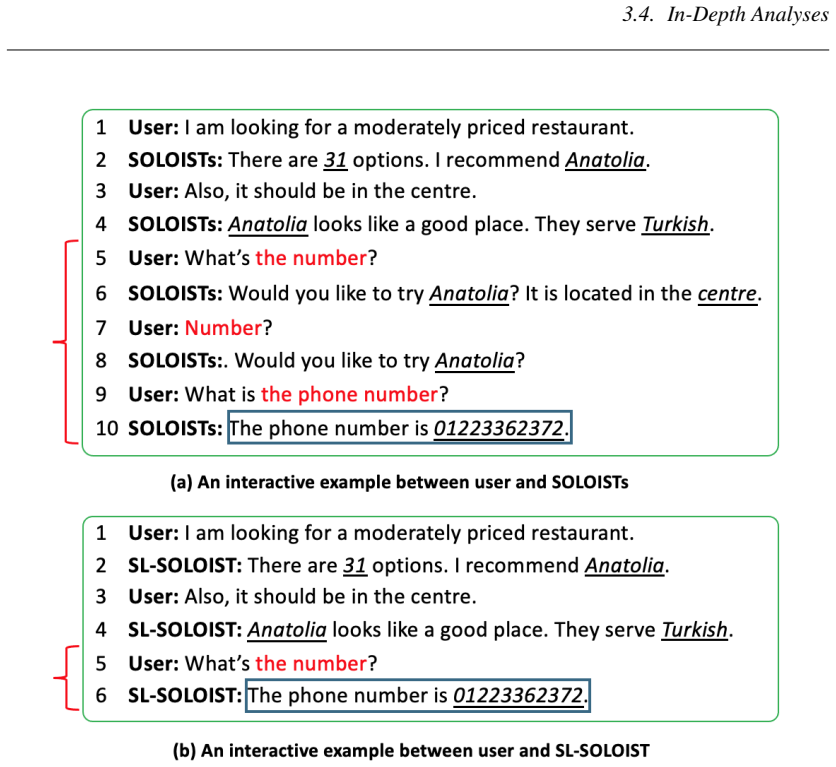
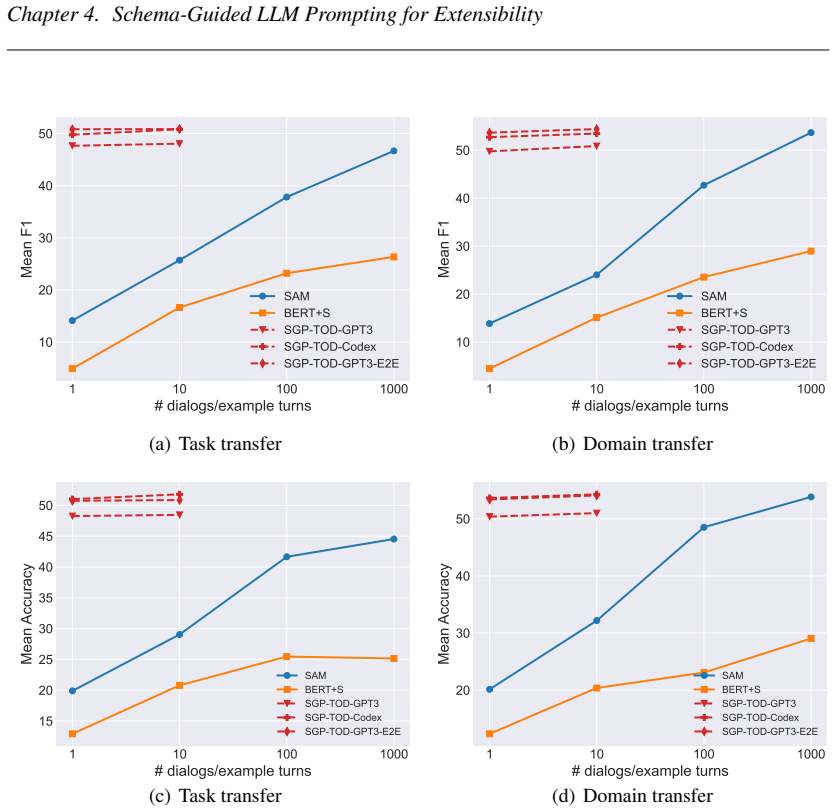
The paper establishes, across three frameworks, that internal signals can substitute for external supervision in task-bot maintenance. In SL-AGENT, a reward model is trained on a few labeled dialogs plus synthetic positive and negative examples, then used to score unlabeled human-bot logs; REINFORCE-style refinement of the dialog model improves Inform, Success, and Combined scores on four single-domain tasks, matching or nearing the upper bound set by turn-level human feedback. In SGP-TOD, a frozen LLM prompted with belief instructions and a policy skeleton achieves state-of-the-art zero-shot results on MultiWOZ, RADDLE, and STAR, outperforming few-shot prompting baselines and, on domain-ext
What carries the argument
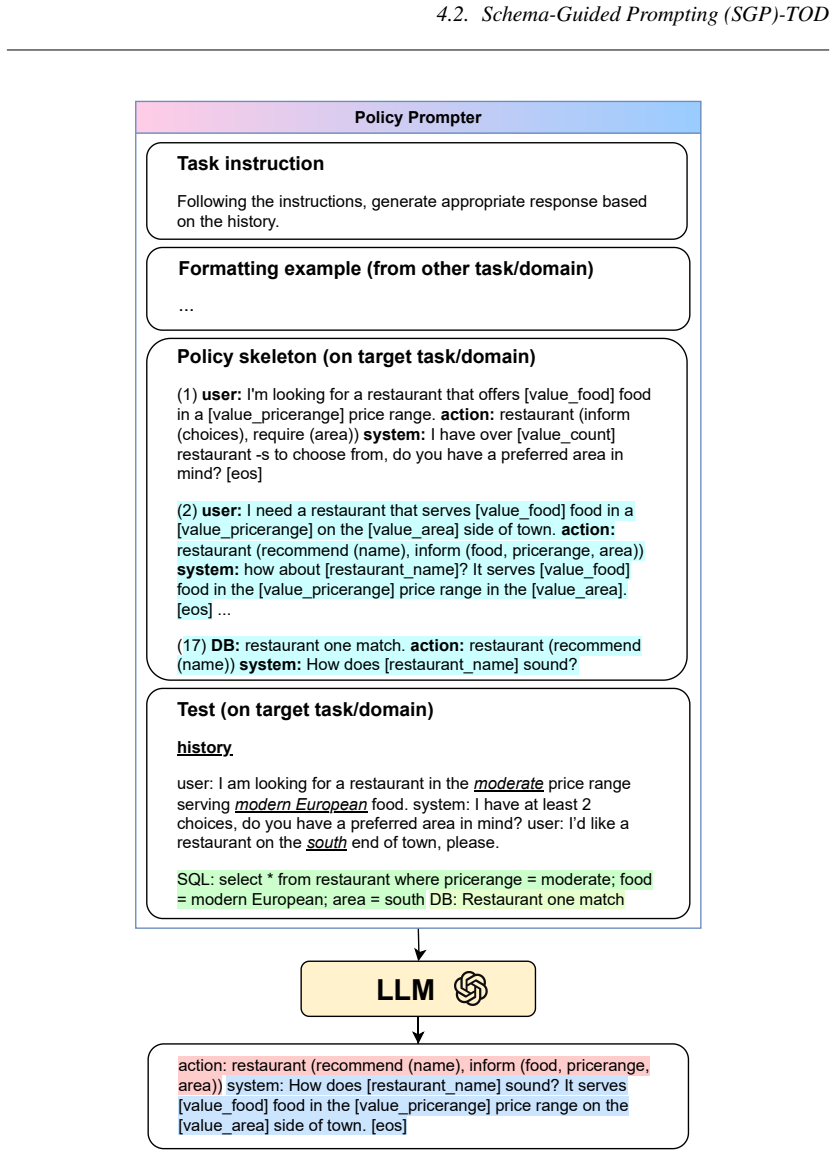
Three mechanisms carry the argument. (1) A turn-level reward model trained with a contrastive objective on positive examples (original and back-translated user utterances) and five negative categories (repetition, inconsistency, partial information, non-fluency, misunderstanding); this model judges response quality in unlabeled logs and drives REINFORCE refinement. (2) A task schema, composed of a task-specific ontology listing slots and values and a policy skeleton of template dialog turns; two prompters, the DST Prompter and Policy Prompter, convert the schema and dialog history into prompts for a frozen LLM, with belief states expressed as SQL-like queries and database state fetched expli
Load-bearing premise
The load-bearing premise is that the pre-trained reward model scores response quality correctly on unlabeled human-bot logs, including novel user phrasings and newly extended tasks; if that signal is wrong, reinforcement learning entrenches the error instead of fixing it.
What would settle it
Take unlabeled human-bot logs from a deployed bot, have human annotators score each turn, and compare with the SL-AGENT reward model's scores; if rank correlation is near zero on turns containing unseen slot values or phrasings, then the RL refinement loop cannot systematically distinguish good from bad responses and will amplify reward-model noise rather than improve the bot.
If this is right
- A deployed task bot can improve on unseen user phrasings with zero new human annotations, reaching levels close to what turn-level human feedback would provide.
- New task capabilities can be added by editing the task schema: inserting, amending, or removing template turns in the policy skeleton, with no new training data.
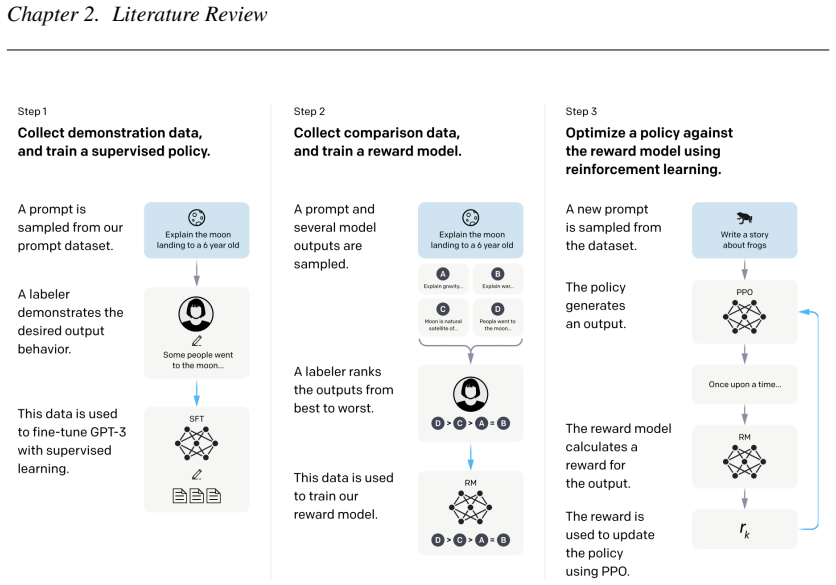
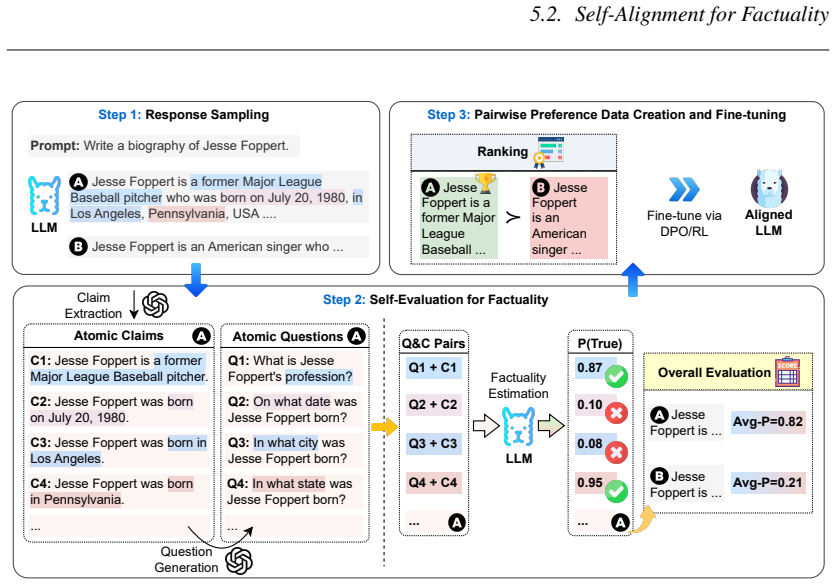
- Factuality of an LLM can be improved by using its own claim-level true/false evaluations as DPO training signals, reducing the need for human preference labeling.
- The three mechanisms can be composed: machine teaching supplies a few corrected dialogs for a new function, the reward model then lets the bot self-refine from logs, and self-evaluation guards the responses against hallucination.
- Confidence calibration of self-evaluation, improved by SK-TUNING, makes the factuality signal more reliable and can likely transfer to other self-improvement settings.
Where Pith is reading between the lines
- The five negative-response categories in SL-AGENT are a portable recipe: any domain where one can define repetition, inconsistency, partial information, non-fluency, and misunderstanding could reuse the same reward-model construction without hand-labeling.
- SGP-TOD's schema-guided prompting and SL-AGENT's self-refinement could be combined so that after a schema extension is deployed, the bot automatically adapts to how real users phrase queries about the new slots, potentially removing even the machine-teaching correction step.
- SELF-EVAL's claim-level factuality scores could also be used at inference time to rank multiple candidate responses, not only as DPO training labels; the paper does not test this directly.
- The main risk in self-alignment is that when the LLM's internal knowledge is wrong on a topic, its self-evaluation will confidently label the wrong claim as true; detecting knowledge boundaries, which the thesis lists as future work, would be a natural safeguard.
Editorial analysis
A structured set of objections, weighed in public.
Referee Report
Summary. The manuscript presents three self-contained chapters addressing three post-deployment challenges for task-oriented dialogue systems: adaptability to unseen user behaviors (SL-Agent), extensibility to new tasks (SGP-TOD), and factuality of generated responses (Self-Alignment for Factuality). SL-Agent trains a turn-level reward model on synthetic positive/negative examples and uses REINFORCE on unlabeled human-bot logs to refine a SOLOIST dialog model. SGP-TOD uses hand-built belief instructions and policy skeletons to prompt a frozen LLM to perform belief-state tracking, action selection, and response generation in a zero-shot manner. Self-Alignment for Factuality samples multiple candidate responses, estimates their factuality via the LLM's own self-evaluation (with optional SK-Tuning), constructs preference pairs, and fine-tunes with DPO. The three components are evaluated on MultiWOZ/RADDLE/STAR and TruthfulQA/BioGEN with automatic and human metrics. The thesis claims minimal or zero human intervention across all three axes.
Significance. If the claims are fully supported, the work would be practically significant: SL-Agent offers a way to exploit unlabeled interaction logs without human reward annotation; SGP-TOD provides a training-free alternative to fine-tuning for new task schemas; Self-Alignment points to a DPO-based route to factuality using the model's own knowledge signal. The experiments are broad and include comparisons with several strong baselines, ablations, and human evaluations. However, the strongest advertised property—zero-human-annotation adaptation to truly unseen behaviors—is weakened by the simulation design, and the factuality pipeline delegates key steps to an external model and uses golden-answer supervision during SK-Tuning. The contribution is therefore a useful set of empirical frameworks rather than a fully autonomous self-learning system.
major comments (3)
- [§3.3.2, Eq. (3.2), Table 3.4] The simulation evidence for zero-annotation adaptability is circular as presented. The reward model is trained to discriminate five hand-defined corruption categories in §3.2.3 (repetition, inconsistency, partial information, non-fluency, misunderstanding), and the 'unseen' human-bot logs in §3.3.2 are generated 'by introducing noise through response corruption.' If the same corruption taxonomy was used to create the simulated logs, then Table 3.4 demonstrates that SL-Agent can recognize and correct the exact error types its reward model was built to detect, not that it generalizes to genuinely novel user behaviors. The manuscript should specify the corruption procedure in the simulation and, for a load-bearing test, hold out one or more error categories from reward training. The real-scenario experiment (Table 3.5) is less circular but uses only 30 logs and does not measure reward-model
- [§5.2.1–5.2.3, Eq. (5.3)] The factuality framework is self-referential: preference labels are derived from the same model's self-evaluation p(True|q,a), and DPO then trains that model to prefer responses with high self-evaluation scores. Systematic overconfidence or task-specific bias in SELF-EVAL will therefore be reinforced rather than corrected. The manuscript acknowledges overconfidence in §5.2.2 and introduces SK-Tuning as mitigation, but SK-Tuning itself requires ground-truth answers and Deberta-Large-MNLI entailment to construct True/False labels, so the pipeline is not purely self-supervised. Moreover, claim extraction and question generation are delegated to GPT-3.5-turbo, so the 'self' is partly external. The paper should quantify how much of the DPO gain survives when preference labels are replaced by oracle factuality labels, and should compare against a non-self-referential reward model.
- [§4.2.4, §4.3.1, Table 4.1] The zero-shot extensibility claim rests on manually engineered task schemas: belief instructions contain all slot names and plausible values, and policy skeletons contain 10–20 hand-written template turns per task. The 'zero-shot' label is standard in the prompting literature, but the central claim of 'minimal human effort' is sensitive to schema-engineering cost. The manuscript should include an explicit accounting of the human effort needed to author a new schema (or a study of how much performance degrades when the schema is imperfect), and it should state that the method does not remove the need for symbolic task design.
minor comments (4)
- [§3.3.2, Table 3.4] The text says 'Table 4.2 presents the end-to-end evaluation results'; this should be Table 3.4. Similar cross-reference errors appear in §3.3.3 ('reported in Table 4.2') and §3.2.2.
- [Table 3.4, Table 3.5] Significance is reported only as 'p < 0.01 based on Combined' without stating the test, the number of runs, or the variance. Given that the table reports per-domain results, a paired test across domains or a confidence interval would be more informative.
- [§5.2.2, Table 5.1] The prompt shown uses a True/False format, but the narrative sometimes refers to 'A'/'B' as the output. Clarify whether the reported p(True) is the probability assigned to the 'True' token or the probability of the letter 'A'.
- [Chapter 3–5] The manuscript repeatedly uses inconsistent spacing in model names such as 'S OLOIST', 'SL-S OLOIST', and 'S GP-TOD'. A final formatting pass is needed.
Circularity Check
One self-referential reward loop in the factuality chapter; adaptability and extensibility chapters are externally benchmarked and not demonstrated circular.
specific steps
-
self definitional
[Section 5.2.1 Overview (Steps 2-3), Section 5.2.2 Eq. 5.1, Section 5.2.3 Eq. 5.3]
"In this step, we evaluate the factuality of the generated candidate responses ... by leveraging the intrinsic knowledge of LLMs. ... we select the top α responses as the preferred responses y_w and the remaining responses as the dis-preferred ones y_l, resulting in a set of preference pairs D = {(x,y_w,y_l)}. ... Finally, we align the LLM with these preference data via DPO. (Sec. 5.2.1) ... p(True|q,a) = f_M(q,a) (Eq. 5.1)"
The preference labels used for DPO are produced by SELF-EVAL, which is built on the same LLM M whose responses it judges (p(True|q,a)=f_M(q,a)). DPO (Eq. 5.3) then fits the policy to prefer exactly those responses that M's own evaluator scores higher. If p(True) is miscalibrated for a claim, the loop reinforces the error rather than correcting it; the paper itself concedes overconfidence with SELF-EVAL-P(TRUE) and adds external SK-Tuning with golden answers to patch the signal. The external test benchmarks and SK-Tuning provide independent evidence, so the circularity is partial: the training labels are self-defined, but the final factuality claim is externally evaluated.
full rationale
The thesis contains three largely independent contributions. SGP-TOD (Ch. 4) is a prompting strategy evaluated against external benchmarks (MultiWOZ, RADDLE, STAR, domain-extension); the manual policy skeleton is derived from a few training dialogs, which weakens the 'zero-shot' label but is not a circular derivation. SL-Agent (Ch. 3) trains a reward model on human-annotated error categories and then applies it to unlabeled logs; this is a legitimate two-stage pipeline. The main unresolved risk is the simulation: Section 3.3.2 says the 45 'unseen' dialogs are made imperfect 'by introducing noise through response corruption,' while Section 3.2.3 defines the reward model's negative examples using five specific corruption categories. The manuscript does not explicitly state that the simulation corruptions are the same five categories, so I do not count this as a demonstrated reduction, but the lack of specification leaves the zero-annotation adaptability claim vulnerable to that critique. The clearest circular feature is in Chapter 5: the factuality preference data are labeled by the model's own self-evaluation (Eq. 5.1) and then used as DPO targets (Eq. 5.3), making the raw reward loop self-referential. The paper acknowledges overconfidence and adds SK-Tuning with external golden labels, and the final evaluation is external, so the central claim still has independent content. Overall score 4.
Axiom & Free-Parameter Ledger
free parameters (2)
- top fraction alpha for preference selection
- DPO beta
axioms (4)
- domain assumption A pre-trained reward model can assess response quality in unlabeled human-bot logs, including novel user behaviors.
- domain assumption An LLM's self-evaluation probability p(True|q,a) correlates with factual correctness.
- domain assumption Hand-crafted task schemas (ontology plus dialog flow) are sufficient to guide a frozen LLM to complete new tasks.
- standard math REINFORCE policy gradient and DPO loss are valid optimization objectives.
Cite this review
Pith. "Pith review of Building Task Bots with Self-learning for Enhanced Adaptability, Extensibility, and Factuality." pith.science (2026). https://pith.science/paper/WL35XDB3
@misc{pith2026250819689,
  author       = {Pith},
  title        = {Pith review of: Building Task Bots with Self-learning for Enhanced Adaptability, Extensibility, and Factuality},
  year         = {2026},
  howpublished = {\url{https://pith.science/paper/WL35XDB3}},
  note         = {Machine review of arXiv:2508.19689}
}
read the original abstract
Developing adaptable, extensible, and accurate task bots with minimal or zero human intervention is a significant challenge in dialog research. This thesis examines the obstacles and potential solutions for creating such bots, focusing on innovative techniques that enable bots to learn and adapt autonomously in constantly changing environments.
Figures












Reference graph
Works this paper leans on
-
[1]
URL: " 'urlintro :=
ENTRY address author booktitle chapter edition editor howpublished institution journal key month note number organization pages publisher school series title type volume year eprint doi pubmed url lastchecked label extra.label sort.label short.list INTEGERS output.state before.all mid.sentence after.sentence after.block STRINGS urlintro eprinturl eprintpr...
-
[2]
write newline
" write newline "" before.all 'output.state := FUNCTION n.dashify 't := "" t empty not t #1 #1 substring "-" = t #1 #2 substring "--" = not "--" * t #2 global.max substring 't := t #1 #1 substring "-" = "-" * t #2 global.max substring 't := while if t #1 #1 substring * t #2 global.max substring 't := if while FUNCTION word.in bbl.in capitalize " " * FUNCT...
-
[3]
Zeyuan Allen-Zhu and Yuanzhi Li. 2023. http://arxiv.org/abs/2309.14402 Physics of language models: Part 3.2, knowledge manipulation
Pith/arXiv arXiv 2023
-
[4]
Rohan Anil, Andrew M Dai, Orhan Firat, Melvin Johnson, Dmitry Lepikhin, Alexandre Passos, Siamak Shakeri, Emanuel Taropa, Paige Bailey, Zhifeng Chen, et al. 2023. Palm 2 technical report. arXiv preprint arXiv:2305.10403
Pith/arXiv arXiv 2023
-
[5]
Anthropic. 2024. https://www.anthropic.com/news/claude-3-5-sonnet Claude 3.5 sonnet . Anthropic Blog
2024
-
[6]
Amanda Askell, Yuntao Bai, Anna Chen, Dawn Drain, Deep Ganguli, Tom Henighan, Andy Jones, Nicholas Joseph, Ben Mann, Nova DasSarma, Nelson Elhage, Zac Hatfield-Dodds, Danny Hernandez, Jackson Kernion, Kamal Ndousse, Catherine Olsson, Dario Amodei, Tom Brown, Jack Clark, Sam McCandlish, Chris Olah, and Jared Kaplan. 2021. http://arxiv.org/abs/2112.00861 A ...
Pith/arXiv arXiv 2021
-
[7]
Amos Azaria and Tom Mitchell. 2023. https://doi.org/10.18653/v1/2023.findings-emnlp.68 The internal state of an LLM knows when it ' s lying . In Findings of the Association for Computational Linguistics: EMNLP 2023, pages 967--976, Singapore. Association for Computational Linguistics
-
[8]
Yuntao Bai, Andy Jones, Kamal Ndousse, Amanda Askell, Anna Chen, Nova DasSarma, Dawn Drain, Stanislav Fort, Deep Ganguli, Tom Henighan, Nicholas Joseph, Saurav Kadavath, Jackson Kernion, Tom Conerly, Sheer El-Showk, Nelson Elhage, Zac Hatfield-Dodds, Danny Hernandez, Tristan Hume, Scott Johnston, Shauna Kravec, Liane Lovitt, Neel Nanda, Catherine Olsson, ...
Pith/arXiv arXiv 2022
-
[9]
Yuntao Bai, Saurav Kadavath, Sandipan Kundu, Amanda Askell, Jackson Kernion, Andy Jones, Anna Chen, Anna Goldie, Azalia Mirhoseini, Cameron McKinnon, Carol Chen, Catherine Olsson, Christopher Olah, Danny Hernandez, Dawn Drain, Deep Ganguli, Dustin Li, Eli Tran-Johnson, Ethan Perez, Jamie Kerr, Jared Mueller, Jeffrey Ladish, Joshua Landau, Kamal Ndousse, K...
Pith/arXiv arXiv 2022
-
[10]
Ralph Allan Bradley and Milton E Terry. 1952. Rank analysis of incomplete block designs: I. the method of paired comparisons. Biometrika, 39(3/4):324--345
1952
-
[11]
Tom Brown, Benjamin Mann, Nick Ryder, Melanie Subbiah, Jared D Kaplan, Prafulla Dhariwal, Arvind Neelakantan, Pranav Shyam, Girish Sastry, Amanda Askell, Sandhini Agarwal, Ariel Herbert-Voss, Gretchen Krueger, Tom Henighan, Rewon Child, Aditya Ramesh, Daniel Ziegler, Jeffrey Wu, Clemens Winter, Chris Hesse, Mark Chen, Eric Sigler, Mateusz Litwin, Scott Gr...
2020
-
[12]
Tom B. Brown, Benjamin Mann, Nick Ryder, Melanie Subbiah, Jared Kaplan, Prafulla Dhariwal, Arvind Neelakantan, Pranav Shyam, Girish Sastry, Amanda Askell, Sandhini Agarwal, Ariel Herbert-Voss, Gretchen Krueger, Tom Henighan, Rewon Child, Aditya Ramesh, Daniel M. Ziegler, Jeffrey Wu, Clemens Winter, Christopher Hesse, Mark Chen, Eric Sigler, Mateusz Litwin...
Pith/arXiv arXiv 2020
-
[13]
Pawe Budzianowski, Tsung-Hsien Wen, Bo-Hsiang Tseng, I \ n igo Casanueva, Ultes Stefan, Ramadan Osman, and Milica Ga s i\'c. 2018 a . Multiwoz - a large-scale multi-domain wizard-of-oz dataset for task-oriented dialogue modelling. In Proceedings of the 2018 Conference on Empirical Methods in Natural Language Processing (EMNLP)
2018
-
[14]
Pawe Budzianowski, Tsung-Hsien Wen, Bo-Hsiang Tseng, Inigo Casanueva, Stefan Ultes, Osman Ramadan, and Milica Ga s i \'c . 2018 b . Multiwoz--a large-scale multi-domain wizard-of-oz dataset for task-oriented dialogue modelling. arXiv preprint arXiv:1810.00278
Pith/arXiv arXiv 2018
-
[15]
Collin Burns, Pavel Izmailov, Jan Hendrik Kirchner, Bowen Baker, Leo Gao, Leopold Aschenbrenner, Yining Chen, Adrien Ecoffet, Manas Joglekar, Jan Leike, Ilya Sutskever, and Jeff Wu. 2023. http://arxiv.org/abs/2312.09390 Weak-to-strong generalization: Eliciting strong capabilities with weak supervision
Pith/arXiv arXiv 2023
-
[16]
Yupeng Chang, Xu Wang, Jindong Wang, Yuan Wu, Linyi Yang, Kaijie Zhu, Hao Chen, Xiaoyuan Yi, Cunxiang Wang, Yidong Wang, Wei Ye, Yue Zhang, Yi Chang, Philip S. Yu, Qiang Yang, and Xing Xie. 2023. http://arxiv.org/abs/2307.03109 A survey on evaluation of large language models
Pith/arXiv arXiv 2023
-
[17]
Jiefeng Chen, Jinsung Yoon, Sayna Ebrahimi, Sercan O Arik, Tomas Pfister, and Somesh Jha. 2023 a . http://arxiv.org/abs/2310.11689 Adaptation with self-evaluation to improve selective prediction in llms
Pith/arXiv arXiv 2023
-
[18]
Mark Chen, Jerry Tworek, Heewoo Jun, Qiming Yuan, Henrique Ponde de Oliveira Pinto, Jared Kaplan, Harri Edwards, Yuri Burda, Nicholas Joseph, Greg Brockman, et al. 2021. Evaluating large language models trained on code. arXiv preprint arXiv:2107.03374
Pith/arXiv arXiv 2021
-
[19]
Xinyun Chen, Renat Aksitov, Uri Alon, Jie Ren, Kefan Xiao, Pengcheng Yin, Sushant Prakash, Charles Sutton, Xuezhi Wang, and Denny Zhou. 2023 b . http://arxiv.org/abs/2311.17311 Universal self-consistency for large language model generation
Pith/arXiv arXiv 2023
-
[20]
Zhoujun Cheng, Tianbao Xie, Peng Shi, Chengzu Li, Rahul Nadkarni, Yushi Hu, Caiming Xiong, Dragomir Radev, Mari Ostendorf, Luke Zettlemoyer, Noah A. Smith, and Tao Yu. 2023. Binding language models in symbolic languages. ICLR, abs/2210.02875
Pith/arXiv arXiv 2023
-
[21]
Aakanksha Chowdhery, Sharan Narang, Jacob Devlin, Maarten Bosma, Gaurav Mishra, Adam Roberts, Paul Barham, Hyung Won Chung, Charles Sutton, Sebastian Gehrmann, Parker Schuh, Kensen Shi, Sasha Tsvyashchenko, Joshua Maynez, Abhishek Rao, Parker Barnes, Yi Tay, Noam Shazeer, Vinodkumar Prabhakaran, Emily Reif, Nan Du, Ben Hutchinson, Reiner Pope, James Bradb...
Pith/arXiv arXiv 2022
-
[22]
Christiano, Jan Leike, Tom B
Paul F. Christiano, Jan Leike, Tom B. Brown, Miljan Martic, Shane Legg, and Dario Amodei. 2017. https://proceedings.neurips.cc/paper/2017/hash/d5e2c0adad503c91f91df240d0cd4e49-Abstract.html Deep reinforcement learning from human preferences . In Advances in Neural Information Processing Systems 30: Annual Conference on Neural Information Processing System...
2017
-
[23]
Yung-Sung Chuang, Yujia Xie, Hongyin Luo, Yoon Kim, James Glass, and Pengcheng He. 2023. Dola: Decoding by contrasting layers improves factuality in large language models. arXiv preprint arXiv:2309.03883
Pith/arXiv arXiv 2023
-
[24]
Roi Cohen, Mor Geva, Jonathan Berant, and Amir Globerson. 2023. https://doi.org/10.18653/v1/2023.findings-eacl.139 Crawling the internal knowledge-base of language models . In Findings of the Association for Computational Linguistics: EACL 2023, pages 1856--1869, Dubrovnik, Croatia. Association for Computational Linguistics
-
[25]
ContextualAI. 2024. https://contextual.ai/introducing-rag2/ Introducing rag 2.0
2024
-
[26]
Yinpei Dai, Hangyu Li, Chengguang Tang, Yongbin Li, Jian Sun, and Xiaodan Zhu. 2020. Learning low-resource end-to-end goal-oriented dialog for fast and reliable system deployment. In Proceedings of the 58th Annual Meeting of the Association for Computational Linguistics, pages 609--618
2020
-
[27]
Google DeepMind. 2024. https://deepmind.google/technologies/gemini/ Gemini 2.0 . Google Blog
2024
-
[29]
Jacob Devlin, Ming-Wei Chang, Kenton Lee, and Kristina Toutanova. 2019 a . http://arxiv.org/abs/1810.04805 Bert: Pre-training of deep bidirectional transformers for language understanding
Pith/arXiv arXiv 2019
-
[30]
Jacob Devlin, Ming - Wei Chang, Kenton Lee, and Kristina Toutanova. 2019 b . https://doi.org/10.18653/v1/n19-1423 BERT: pre-training of deep bidirectional transformers for language understanding . In Proceedings of the 2019 Conference of the North American Chapter of the Association for Computational Linguistics: Human Language Technologies, NAACL-HLT 201...
-
[31]
Shehzaad Dhuliawala, Mojtaba Komeili, Jing Xu, Roberta Raileanu, Xian Li, Asli Celikyilmaz, and Jason Weston. 2023. http://arxiv.org/abs/2309.11495 Chain-of-verification reduces hallucination in large language models
Pith/arXiv arXiv 2023
-
[32]
Qingxiu Dong, Lei Li, Damai Dai, Ce Zheng, Zhiyong Wu, Baobao Chang, Xu Sun, Jingjing Xu, Lei Li, and Zhifang Sui. 2023. http://arxiv.org/abs/2301.00234 A survey on in-context learning
Pith/arXiv arXiv 2023
-
[33]
Sergey Edunov, Myle Ott, Michael Auli, and David Grangier. 2018. Understanding back-translation at scale. arXiv preprint arXiv:1808.09381
Pith/arXiv arXiv 2018
-
[34]
Teddy Ferdinan, Jan Kocoń, and Przemysław Kazienko. 2024. http://arxiv.org/abs/2402.09147 Into the unknown: Self-learning large language models
Pith/arXiv arXiv 2024
-
[35]
Jan-Philipp Fränken, Eric Zelikman, Rafael Rafailov, Kanishk Gandhi, Tobias Gerstenberg, and Noah D. Goodman. 2024. http://arxiv.org/abs/2404.14313 Self-supervised alignment with mutual information: Learning to follow principles without preference labels
Pith/arXiv arXiv 2024
-
[36]
Zeyu Gan and Yong Liu. 2024. http://arxiv.org/abs/2410.01720 Towards a theoretical understanding of synthetic data in llm post-training: A reverse-bottleneck perspective
Pith/arXiv arXiv 2024
-
[37]
Jianfeng Gao, Michel Galley, and Lihong Li. 2018 a . https://doi.org/10.18653/v1/P18-5002 Neural approaches to conversational AI . In Proceedings of the 56th Annual Meeting of the Association for Computational Linguistics: Tutorial Abstracts, pages 2--7, Melbourne, Australia. Association for Computational Linguistics
-
[38]
Jianfeng Gao, Michel Galley, and Lihong Li. 2018 b . Neural approaches to conversational ai. In The 41st International ACM SIGIR Conference on Research & Development in Information Retrieval, pages 1371--1374
2018
-
[39]
Jianfeng Gao, Michel Galley, and Lihong Li. 2019. http://arxiv.org/abs/1809.08267 Neural approaches to conversational ai
Pith/arXiv arXiv 2019
-
[40]
Luyu Gao, Zhuyun Dai, Panupong Pasupat, Anthony Chen, Arun Tejasvi Chaganty, Yicheng Fan, Vincent Zhao, Ni Lao, Hongrae Lee, Da-Cheng Juan, and Kelvin Guu. 2023. https://doi.org/10.18653/v1/2023.acl-long.910 RARR : Researching and revising what language models say, using language models . In Proceedings of the 61st Annual Meeting of the Association for Co...
-
[41]
Silin Gao, Yichi Zhang, Zhijian Ou, and Zhou Yu. 2020. Paraphrase augmented task-oriented dialog generation. arXiv preprint arXiv:2004.07462
Pith/arXiv arXiv 2020
-
[42]
Milica Ga s i \'c , Filip Jur c \' c ek, Blaise Thomson, Kai Yu, and Steve Young. 2011. On-line policy optimisation of spoken dialogue systems via live interaction with human subjects. In 2011 IEEE Workshop on Automatic Speech Recognition & Understanding, pages 312--317. IEEE
2011
-
[43]
Milica Gasic, Dongho Kim, Pirros Tsiakoulis, Catherine Breslin, Matthew Henderson, Martin Szummer, Blaise Thomson, and Steve J. Young. 2014 a . Incremental on-line adaptation of pomdp-based dialogue managers to extended domains. In INTERSPEECH
2014
-
[44]
Milica Gasic, Dongho Kim, Pirros Tsiakoulis, Catherine Breslin, Matthew Henderson, Martin Szummer, Blaise Thomson, and Steve J. Young. 2014 b . http://www.isca-speech.org/archive/interspeech\_2014/i14\_0140.html Incremental on-line adaptation of pomdp-based dialogue managers to extended domains . In INTERSPEECH 2014, 15th Annual Conference of the Internat...
2014
-
[45]
Zorik Gekhman, Gal Yona, Roee Aharoni, Matan Eyal, Amir Feder, Roi Reichart, and Jonathan Herzig. 2024. http://arxiv.org/abs/2405.05904 Does fine-tuning llms on new knowledge encourage hallucinations?
Pith/arXiv arXiv 2024
-
[46]
Anirudh Goyal and Yoshua Bengio. 2022. Inductive biases for deep learning of higher-level cognition. Proceedings of the Royal Society A, 478(2266):20210068
2022
-
[47]
Suriya Gunasekar, Yi Zhang, Jyoti Aneja, Caio César Teodoro Mendes, Allie Del Giorno, Sivakanth Gopi, Mojan Javaheripi, Piero Kauffmann, Gustavo de Rosa, Olli Saarikivi, Adil Salim, Shital Shah, Harkirat Singh Behl, Xin Wang, Sébastien Bubeck, Ronen Eldan, Adam Tauman Kalai, Yin Tat Lee, and Yuanzhi Li. 2023. http://arxiv.org/abs/2306.11644 Textbooks are ...
Pith/arXiv arXiv 2023
-
[48]
Chulaka Gunasekara, Seokhwan Kim, Luis Fernando D'Haro, Abhinav Rastogi, Yun-Nung Chen, Mihail Eric, Behnam Hedayatnia, Karthik Gopalakrishnan, Yang Liu, Chao-Wei Huang, et al. 2020. Overview of the ninth dialog system technology challenge: Dstc9. arXiv preprint arXiv:2011.06486
Pith/arXiv arXiv 2020
-
[49]
Chuan Guo, Geoff Pleiss, Yu Sun, and Kilian Q. Weinberger. 2017. http://arxiv.org/abs/1706.04599 On calibration of modern neural networks
Pith/arXiv arXiv 2017
-
[50]
Donghoon Ham, Jeong-Gwan Lee, Youngsoo Jang, and Kee-Eung Kim. 2020. https://www.aclweb.org/anthology/2020.acl-main.54/ End-to-end neural pipeline for goal-oriented dialogue systems using gpt-2 . In Proceedings of the 58th Annual Meeting of the Association for Computational Linguistics, pages 583--592
2020
-
[51]
Braden Hancock, Antoine Bordes, Pierre-Emmanuel Mazare, and Jason Weston. 2019. Learning from dialogue after deployment: Feed yourself, chatbot! arXiv preprint arXiv:1901.05415
Pith/arXiv arXiv 2019
-
[52]
Pengcheng He, Xiaodong Liu, Jianfeng Gao, and Weizhu Chen. 2021. https://openreview.net/forum?id=XPZIaotutsD Deberta: Decoding-enhanced bert with disentangled attention . In International Conference on Learning Representations
2021
-
[53]
Wanwei He, Yinpei Dai, Yinhe Zheng, Yuchuan Wu, Zheng Cao, Dermot Liu, Peng Jiang, Min Yang, Fei Huang, Luo Si, et al. 2022. Galaxy: A generative pre-trained model for task-oriented dialog with semi-supervised learning and explicit policy injection. Proceedings of the AAAI Conference on Artificial Intelligence
2022
-
[54]
Dan Hendrycks, Collin Burns, Steven Basart, Andy Zou, Mantas Mazeika, Dawn Song, and Jacob Steinhardt. 2021. Measuring massive multitask language understanding. Proceedings of the International Conference on Learning Representations (ICLR)
2021
-
[55]
John R Hershey and Peder A Olsen. 2007. Approximating the kullback leibler divergence between gaussian mixture models. In 2007 IEEE International Conference on Acoustics, Speech and Signal Processing-ICASSP'07, volume 4, pages IV--317. IEEE
2007
-
[56]
Ari Holtzman, Jan Buys, Li Du, Maxwell Forbes, and Yejin Choi. 2019. The curious case of neural text degeneration. arXiv preprint arXiv:1904.09751
Pith/arXiv arXiv 2019
-
[57]
Ari Holtzman, Jan Buys, Li Du, Maxwell Forbes, and Yejin Choi. 2020. https://openreview.net/forum?id=rygGQyrFvH The curious case of neural text degeneration . In 8th International Conference on Learning Representations, ICLR 2020, Addis Ababa, Ethiopia, April 26-30, 2020 . OpenReview.net
2020
-
[58]
Ehsan Hosseini-Asl, Bryan McCann, Chien-Sheng Wu, Semih Yavuz, and Richard Socher. 2020. https://arxiv.org/abs/2005.00796 A simple language model for task-oriented dialogue . arXiv preprint arXiv:2005.00796
Pith/arXiv arXiv 2020
-
[59]
Smith, and Mari Ostendorf
Yushi Hu, Chia-Hsuan Lee, Tianbao Xie, Tao Yu, Noah A. Smith, and Mari Ostendorf. 2022. https://aclanthology.org/2022.findings-emnlp.193 In-context learning for few-shot dialogue state tracking . In Findings of the Association for Computational Linguistics: EMNLP 2022, pages 2627--2643, Abu Dhabi, United Arab Emirates. Association for Computational Linguistics
2022
-
[60]
Lei Huang, Weijiang Yu, Weitao Ma, Weihong Zhong, Zhangyin Feng, Haotian Wang, Qianglong Chen, Weihua Peng, Xiaocheng Feng, Bing Qin, and Ting Liu. 2023. http://arxiv.org/abs/2311.05232 A survey on hallucination in large language models: Principles, taxonomy, challenges, and open questions
Pith/arXiv arXiv 2023
-
[61]
Zhen Huang, Zengzhi Wang, Shijie Xia, Xuefeng Li, Haoyang Zou, Ruijie Xu, Run-Ze Fan, Lyumanshan Ye, Ethan Chern, Yixin Ye, Yikai Zhang, Yuqing Yang, Ting Wu, Binjie Wang, Shichao Sun, Yang Xiao, Yiyuan Li, Fan Zhou, Steffi Chern, Yiwei Qin, Yan Ma, Jiadi Su, Yixiu Liu, Yuxiang Zheng, Shaoting Zhang, Dahua Lin, Yu Qiao, and Pengfei Liu. 2024. http://arxiv...
Pith/arXiv arXiv 2024
-
[62]
Vojt e ch Hude c ek and Ondrej Dusek. 2023. https://doi.org/10.18653/v1/2023.sigdial-1.21 Are large language models all you need for task-oriented dialogue? In Proceedings of the 24th Annual Meeting of the Special Interest Group on Discourse and Dialogue, pages 216--228, Prague, Czechia. Association for Computational Linguistics
-
[63]
Vojtech Hudecek and Ondrej Dusek. 2023. https://doi.org/10.48550/arXiv.2304.06556 Are llms all you need for task-oriented dialogue? CoRR, abs/2304.06556
work page internal anchor Pith review Pith/arXiv arXiv doi:10.48550/arxiv.2304.06556 2023
-
[64]
Smith, Yejin Choi, and Hannaneh Hajishirzi
Hamish Ivison, Yizhong Wang, Jiacheng Liu, Zeqiu Wu, Valentina Pyatkin, Nathan Lambert, Noah A. Smith, Yejin Choi, and Hannaneh Hajishirzi. 2024. http://arxiv.org/abs/2406.09279 Unpacking dpo and ppo: Disentangling best practices for learning from preference feedback
Pith/arXiv arXiv 2024
-
[65]
Ziwei Ji, Nayeon Lee, Rita Frieske, Tiezheng Yu, Dan Su, Yan Xu, Etsuko Ishii, Yejin Bang, Andrea Madotto, and Pascale Fung. 2023. https://doi.org/10.1145/3571730 Survey of hallucination in natural language generation . ACM Comput. Surv. , 55(12):248:1--248:38
doi:10.1145/3571730 2023
-
[66]
Zhengbao Jiang, Zhiqing Sun, Weijia Shi, Pedro Rodriguez, Chunting Zhou, Graham Neubig, Xi Victoria Lin, Wen tau Yih, and Srinivasan Iyer. 2024. http://arxiv.org/abs/2402.12847 Instruction-tuned language models are better knowledge learners
Pith/arXiv arXiv 2024
-
[67]
Saurav Kadavath, Tom Conerly, Amanda Askell, Tom Henighan, Dawn Drain, Ethan Perez, Nicholas Schiefer, Zac Hatfield-Dodds, Nova DasSarma, Eli Tran-Johnson, Scott Johnston, Sheer El-Showk, Andy Jones, Nelson Elhage, Tristan Hume, Anna Chen, Yuntao Bai, Sam Bowman, Stanislav Fort, Deep Ganguli, Danny Hernandez, Josh Jacobson, Jackson Kernion, Shauna Kravec,...
Pith/arXiv arXiv 2022
-
[68]
Mihir Kale and Abhinav Rastogi. 2020. https://doi.org/10.18653/v1/2020.emnlp-main.527 Template guided text generation for task-oriented dialogue . In Proceedings of the 2020 Conference on Empirical Methods in Natural Language Processing, EMNLP 2020, Online, November 16-20, 2020 , pages 6505--6520. Association for Computational Linguistics
-
[69]
Diederik P Kingma and Jimmy Ba. 2014. Adam: A method for stochastic optimization. arXiv preprint arXiv:1412.6980
Pith/arXiv arXiv 2014
-
[70]
Bongard, Andrew P
Dhireesha Kudithipudi, Mario Aguilar - Simon, Jonathan Babb, Maxim Bazhenov, Douglas Blackiston, Josh C. Bongard, Andrew P. Brna, Suraj Chakravarthi Raja, Nick Cheney, Jeff Clune, Anurag Reddy Daram, Stefano Fusi, Peter Helfer, Leslie Kay, Nicholas Ketz, Zsolt Kira, Soheil Kolouri, Jeffrey L. Krichmar, Sam Kriegman, Michael Levin, Sandeep Madireddy, Santo...
2022
-
[71]
Lorenz Kuhn, Yarin Gal, and Sebastian Farquhar. 2023. https://openreview.net/pdf?id=VD-AYtP0dve Semantic uncertainty: Linguistic invariances for uncertainty estimation in natural language generation . In The Eleventh International Conference on Learning Representations, ICLR 2023, Kigali, Rwanda, May 1-5, 2023 . OpenReview.net
2023
-
[72]
Wai-Chung Kwan, Hong-Ru Wang, Hui-Min Wang, and Kam-Fai Wong. 2023. https://doi.org/10.1007/s11633-022-1347-y A survey on recent advances and challenges in reinforcement learning methods for task-oriented dialogue policy learning . Machine Intelligence Research, 20(3):318–334
-
[73]
Jinhyuk Lee, Anthony Chen, Zhuyun Dai, Dheeru Dua, Devendra Singh Sachan, Michael Boratko, Yi Luan, Sébastien M. R. Arnold, Vincent Perot, Siddharth Dalmia, Hexiang Hu, Xudong Lin, Panupong Pasupat, Aida Amini, Jeremy R. Cole, Sebastian Riedel, Iftekhar Naim, Ming-Wei Chang, and Kelvin Guu. 2024. http://arxiv.org/abs/2406.13121 Can long-context language m...
Pith/arXiv arXiv 2024
-
[74]
Nayeon Lee, Wei Ping, Peng Xu, Mostofa Patwary, Pascale Fung, Mohammad Shoeybi, and Bryan Catanzaro. 2023. http://arxiv.org/abs/2206.04624 Factuality enhanced language models for open-ended text generation
Pith/arXiv arXiv 2023
-
[75]
Wenqiang Lei, Xisen Jin, Min-Yen Kan, Zhaochun Ren, Xiangnan He, and Dawei Yin. 2018. Sequicity: Simplifying task-oriented dialogue systems with single sequence-to-sequence architectures. In Proceedings of the 56th Annual Meeting of the Association for Computational Linguistics (Volume 1: Long Papers), pages 1437--1447
2018
-
[76]
Chunyuan Li, Zhe Gan, Zhengyuan Yang, Jianwei Yang, Linjie Li, Lijuan Wang, and Jianfeng Gao. 2024 a . https://doi.org/10.1561/0600000110 Multimodal foundation models: From specialists to general-purpose assistants . Found. Trends Comput. Graph. Vis., 16(1-2):1--214
-
[77]
Jiacheng Li, Ming Wang, Jin Li, Jinmiao Fu, Xin Shen, Jingbo Shang, and Julian McAuley. 2023 a . http://arxiv.org/abs/2305.13731 Text is all you need: Learning language representations for sequential recommendation
Pith/arXiv arXiv 2023
-
[78]
Jinchao Li, Baolin Peng, Sungjin Lee, Jianfeng Gao, Ryuichi Takanobu, Qi Zhu, Minlie Huang, Hannes Schulz, Adam Atkinson, and Mahmoud Adada. 2020. Results of the multi-domain task-completion dialog challenge. In Proceedings of the 34th AAAI Conference on Artificial Intelligence, Eighth Dialog System Technology Challenge Workshop, volume 7
2020
-
[79]
Junyi Li, Jie Chen, Ruiyang Ren, Xiaoxue Cheng, Wayne Xin Zhao, Jian-Yun Nie, and Ji-Rong Wen. 2024 b . The dawn after the dark: An empirical study on factuality hallucination in large language models. arXiv preprint arXiv:2401.03205
Pith/arXiv arXiv 2024
-
[80]
Kenneth Li, Oam Patel, Fernanda Viégas, Hanspeter Pfister, and Martin Wattenberg. 2023 b . http://arxiv.org/abs/2306.03341 Inference-time intervention: Eliciting truthful answers from a language model
Pith/arXiv arXiv 2023
-
[81]
Liunian Harold Li, Jack Hessel, Youngjae Yu, Xiang Ren, Kai-Wei Chang, and Yejin Choi. 2023 c . https://doi.org/10.18653/v1/2023.acl-long.150 Symbolic chain-of-thought distillation: Small models can also `` think '' step-by-step . In Proceedings of the 61st Annual Meeting of the Association for Computational Linguistics (Volume 1: Long Papers), pages 2665...
This paper was first reviewed by deepseek-v4-flash on August 5, 2026.
discussion (0)
Sign in with ORCID, Apple, or X to comment. Anyone can read and Pith papers without signing in.