REVIEW 4 major objections 6 minor 53 references
The paper claims that an attention-driven VR-AI workflow makes product form design four times faster while improving expert-rated quality.
Reviewed by Pith at T0; open to challenge. T0 means a machine referee read the full paper against a public rubric. the ladder, T0–T4 →
An attention-aware VR plus agentic-AI workflow (EUPHORIA-RETINA) is reported to make product form design over four times faster and to produce expert-preferred renderings, based on a small comparative study.
T0 review reviewed 2026-08-05 challenge →
load-bearing objection The efficiency win is real and the system is a genuine integration, but the Phase 2 evidence contradicts itself and undercuts the attention-preference mechanism the authors lean on. the 4 major comments →
Attention is also needed for form design
The pith
A machine-rendered reading of the paper's core claim, the machinery that carries it, and where it could break.
The reading
Core claim
On its own terms, the paper establishes a new workflow and tests it end-to-end: EUPHORIA surrounds a designer with hundreds of images in a VR 'moodspace', tracks gaze continuously, and ranks images by total fixation duration; RETINA then crops the attended regions (ROIs), extracts shape via Holistically-Nested Edge Detection, derives colour palettes, and uses LLM/LIM agents to write shape, texture, and colour descriptors before generating concept sketches and photorealistic renderings. In the decisive experiment, four designers solved four intentionally conflicting design briefs through four workflows in a Latin Square design. The fully automated Path RD was not only over four times faster b
What carries the argument
The load-bearing mechanism is the implicit-attention signal: in the EUPHORIA VR moodspace, a ray-tracing eye-tracker records where and how long the designer looks at each of hundreds of displayed images, and total fixation duration is treated as a ranked preference signal. RETINA's agentic pipeline then makes that signal legible by producing three feature maps—an ROI collage of high-attention image regions, an HED edge collage for shape, and a dominant colour palette—plus LLM-generated textual descriptors, which feed two generative agents (concept sketch and photorealistic rendering). The inverse Plackett-Luce model with gradient-descent maximum-likelihood estimation converts 50 experts' ord
Load-bearing premise
The whole pipeline depends on the claim that total gaze-fixation duration in the VR moodspace encodes the aesthetic preference that should drive the design, even though the paper's own Phase 2 found that correlation disappears in goal-directed search (r = -0.0915, p = 0.2786).
What would settle it
Run Phase 3 with EUPHORIA's gaze ranking replaced by random selection from the same keyword-populated image set, keeping RETINA identical; if expert worthiness and effectiveness scores do not drop, the attention mechanism is not the source of the reported gains. Alternatively, check whether per-participant fixation-duration rankings predict the designer's stated preferred rendering; if not, the preference signal is weak.
If this is right
- Moodboarding's most time-consuming stages—collection, selection, composition—can be automated from gaze data, freeing designers for reflection and curation.
- Novice designers can produce expert-preferred product forms without executing manual sketching, because RETINA performs the feature-to-form translation.
- The designer's job becomes strategic direction: providing keywords, exploring the moodspace, and selecting among AI-generated concepts rather than generating every option by hand.
- Design briefs with deliberately contradictory style keywords are feasible to reconcile through a larger implicitly-selected image set than a human moodboarder would compile.
- A fourfold time saving at equal or higher expert-rated quality makes rapid iteration across many concepts practical.
Where Pith is reading between the lines
- The Phase 2 decoupling of gaze duration from preference under goal-directed search (r = -0.0915, p = 0.2786) suggests that EUPHORIA's use of fixation duration as the preference signal in Phase 3 may not be doing the causal work the title implies; the quality gains could come largely from RETINA's generation from a much larger, keyword-filtered image set (over 1,200 images vs. roughly 100). This is
- A direct test: replacing the gaze-ranked image set with a keyword-matching baseline while keeping RETINA fixed would isolate whether gaze adds quality or only convenience. This is my suggested extension.
- The same attention-capture-plus-agentic-generation loop could plausibly be transferred to typography, interface design, or brand identity, where moodboarding is also used, though the paper does not test those domains.
- The worthiness-score comparison would be stronger if physical prototypes or rendered-user testing were included, since expert ratings of digital renders may not predict real-world appeal; the authors list this as a limitation and my inference follows from it.
Editorial analysis
A structured set of objections, weighed in public.
Referee Report
Summary. This manuscript proposes and evaluates an attention-aware form design framework combining EUPHORIA (a VR environment with eye-tracking that is intended to capture implicit aesthetic preference) and RETINA (an agentic AI pipeline that translates gaze-derived features into concept sketches and renderings). The paper reports three phases: Phase 1 (n=30) finds a positive correlation between gaze fixation duration and explicit preference in unconstrained exploration (r=0.3819, p<0.0001); Phase 2 (n=30) reports that emotional priming produces convergence in visual selections and also decouples fixation duration from preference in goal-directed search; Phase 3 (4 designers x 4 workflows in a Latin-square design) compares a conventional workflow, two partially automated workflows, and a fully automated EUPHORIA-RETINA workflow (Path RD). The headline claims are that Path RD reduces average total design time from 04:22:45 to 00:51:30 and that Path RD outputs receive the highest expert-based inverse Plackett-Luce worthiness scores and the highest Design Effectiveness scores across all four problems. The authors conclude that the work demonstrates a paradigm shift from Computer-Assisted Design to Designer-Assisting Computers.
Significance. The work is ambitious and, if the empirical claims hold, represents a concrete end-to-end validation of a gaze-driven, agentic AI design workflow. The paper has several genuine strengths: a custom VR implementation with integrated eye-tracking; a three-phase research structure; a Latin-square design in Phase 3; a large expert panel of 50 evaluators; blind presentation of final renderings; and explicit discussion of limitations. The use of an inverse Plackett-Luce model to convert ordinal rankings into worthy scores is a useful methodological contribution. However, the current evidence is not yet sufficient to support the central causal claims. The most serious issue is an internal inconsistency between Phase 2 and Phase 3: Phase 2 shows that fixation duration ceases to be a preference proxy in goal-directed search, yet Phase 3 uses fixation duration as the preference signal in the same kind of goal-directed task. In addition, the Phase 2 convergence claim is contradicted by the reported low median overlap, and the Phase 3 quality/efficiency claims lack inferential statistics despite being based on only four designers. The framework and results are promising, but these load-bearing
major comments (4)
- [§10.4.2 (Figure 25) vs. §5.2.2 (Table 6) and §11.3] Phase 2's goal-directed/conditioned-search result shows that fixation duration is not correlated with explicit preference (r=-0.0915, p=0.2786); the authors interpret long fixations as 'cognitive effort in assessing relevance.' Yet EUPHORIA's Phase 3 selection mechanism still ranks images by total fixation duration as the implicit preference signal, and Phase 3 is itself a goal-directed task (design briefs with keywords). The paper does not explain why a signal that was shown to decouple from preference in Phase 2 can still be used as a preference proxy in Phase 3. Unless this is resolved—e.g., by validating the fixation-preference link under the specific Phase 3 instructions, or by redefining the selection signal as task-relevance—the claim that superior Phase 3 outcomes are 'attention-driven' is unsupported; they could be due entirely to RETINA's generative capability.
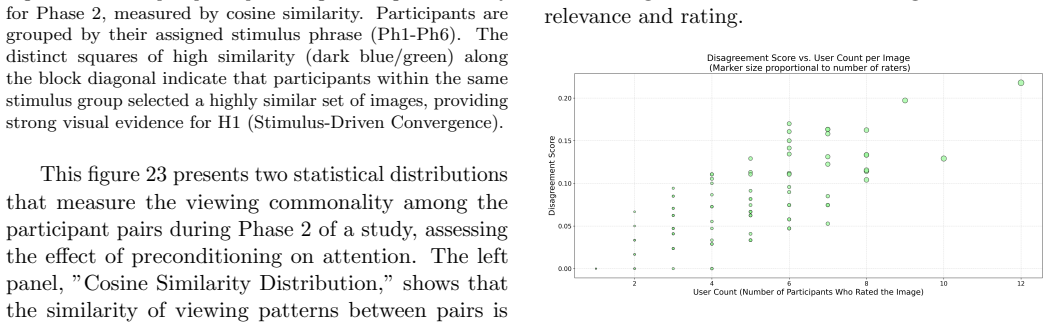
- [§10.4.1 (Figures 22 and 23)] The quantitative distributions reported for Phase 2 are at odds with the conclusion that H3 was validated. The median pairwise cosine similarity is 0.0891 and the median number of common viewed images is 1.00. These are low values. The declaration of convergence relies on the block-diagonal appearance of the heatmap in Figure 22, but the distributions suggest that most pairs—possibly including many within-group pairs—had little overlap. To support H3, the authors need to report within-stimulus-group similarity separately from between-group similarity, test whether within-group values are significantly higher, and clarify whether the median of 1.00 common image applies to all pairs or to a subset.
- [§11.8 (Table 8, Figures 43 and 44)] The central efficiency and quality claims are based on only four designers. The fourfold time reduction (04:22:45 to 00:51:30) is reported as an average without variance, and the inverse Plackett-Luce worthiness scores are point estimates without uncertainty. No inferential test accompanies the claims that Path RD is 'consistently' highest. Given the strength of the conclusions, the paper should provide permutation tests or bootstrap confidence intervals for the worthiness and design-effectiveness scores and a paired analysis of completion times, or alternatively explicitly frame the Phase 3 results as descriptive pilot data without strong causal wording.
- [§7.2.1 (ROI Extraction Agent) and §5.2.2 (Eye-Tracking)] The ROI fixation-duration threshold and the image-selection attention threshold are described as 'predefined' but no values or sensitivity analyses are given. Because these thresholds determine which images and which image regions are passed to RETINA, the Phase 3 outcomes could depend on unstated free parameters. The authors should state the threshold values and test robustness to those choices, or justify the choices empirically using the Phase 1 and Phase 2 data.
minor comments (6)
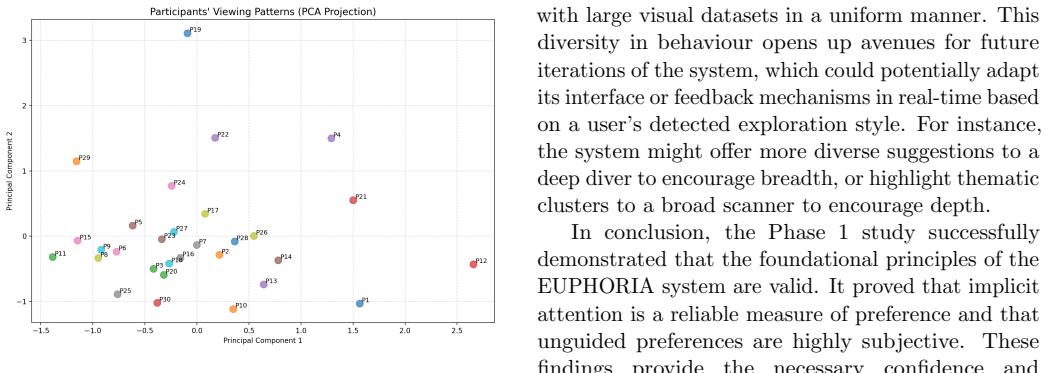
- [§9.4.3, Figure 21 caption] The caption reads 'Phase 2: Participants’ Viewing Patterns (PCA Projection)' but this figure belongs to the Phase 1 analysis; the phase label should be corrected.
- [§10.4.1, Figure 22 caption] The caption refers to 'H1 (Stimulus-Driven Convergence),' but the corresponding hypothesis is H3. This incorrect hypothesis number should be fixed.
- [§8.3] The text says the detailed workflow is 'given in Figure 4'; based on the surrounding content, this appears to be a cross-reference to Table 4, not Figure 4.
- [§11.8.2] The phrase 'the unambiguous successor' is unclear; it should likely read 'the unambiguous winner' or similar.
- [§9.2.4] The phrase 'images they gave attention to' is awkward; use 'images they attended to'.
- [Abstract] The abstract describes the validation as a 'two-part study,' but the paper reports three experimental phases. This wording should be aligned with the actual structure.
Circularity Check
No significant circularity; the empirical chain is independently grounded.
full rationale
The paper's core derivation chain is not circular. Phase 1 establishes gaze-fixation duration as a proxy for preference using independent participants and explicit preference ratings (r=0.3819, p<0.0001, Section 9.4.1), so the EUPHORIA selection mechanism is not validated by its own outputs. Phase 3's quality comparisons rest on expert rankings and ratings collected blind to workflow origin (Section 11.4), and the Worthiness and Design Effectiveness scores are descriptive summaries of those expert judgments, not inputs to the system or fitted parameters renamed as predictions. The inverse Plackett-Luce model is fitted to the observed rankings and reports a latent worthiness score; this is a data summary, not a prediction from the system. The reference list contains no prior works by the present authors, so no self-citation chain is load-bearing. The Phase 2 result that fixation duration decouples from preference under goal-directed search (r=-0.0915, p=0.2786, Section 10.4.2) is a serious internal-validity concern for Phase 3's use of the same gaze signal, but it does not make the derivation circular: the paper itself reports the decoupling, and the Phase 3 outcome metrics are independently evaluated. No equation or construction reduces a claimed result to its own input. Therefore, the appropriate circularity score is 0.
Axiom & Free-Parameter Ledger
free parameters (3)
- ROI fixation-duration threshold =
not reported
- Inverse Plackett-Luce worthiness scores =
estimated per path and per problem (Fig. 43)
- Image selection attention threshold =
not reported
axioms (5)
- domain assumption Gaze fixation duration is a valid proxy for aesthetic preference in the EUPHORIA environment.
- domain assumption Expert ratings on eight aesthetic criteria and expert rankings are a valid operationalization of design quality.
- domain assumption The four contradictory-style design briefs are representative of form design tasks.
- standard math Standard statistical models (Pearson correlation, Plackett-Luce MLE) are correctly applied.
- domain assumption The image sets populated via API keyword search adequately sample the intended aesthetic space.
Cite this review
Pith. "Pith review of Attention is also needed for form design." pith.science (2026). https://pith.science/paper/PFRFUXZ6
@misc{pith2026250819708,
  author       = {Pith},
  title        = {Pith review of: Attention is also needed for form design},
  year         = {2026},
  howpublished = {\url{https://pith.science/paper/PFRFUXZ6}},
  note         = {Machine review of arXiv:2508.19708}
}
read the original abstract
Conventional product design is a cognitively demanding process, limited by its time-consuming nature, reliance on subjective expertise, and the opaque translation of inspiration into tangible concepts. This research introduces a novel, attention-aware framework that integrates two synergistic systems: EUPHORIA, an immersive Virtual Reality environment using eye-tracking to implicitly capture a designer's aesthetic preferences, and RETINA, an agentic AI pipeline that translates these implicit preferences into concrete design outputs. The foundational principles were validated in a two-part study. An initial study correlated user's implicit attention with explicit preference and the next one correlated mood to attention. A comparative study where 4 designers solved challenging design problems using 4 distinct workflows, from a manual process to an end-to-end automated pipeline, showed the integrated EUPHORIA-RETINA workflow was over 4 times more time-efficient than the conventional method. A panel of 50 design experts evaluated the 16 final renderings. Designs generated by the fully automated system consistently received the highest Worthiness (calculated by an inverse Plackett-Luce model based on gradient descent optimization) and Design Effectiveness scores, indicating superior quality across 8 criteria: novelty, visual appeal, emotional resonance, clarity of purpose, distinctiveness of silhouette, implied materiality, proportional balance, & adherence to the brief. This research presents a validated paradigm shift from traditional Computer-Assisted Design (CAD) to a collaborative model of Designer-Assisting Computers (DAC). By automating logistical and skill-dependent generative tasks, the proposed framework elevates the designer's role to that of a creative director, synergizing human intuition with the generative power of agentic AI to produce higher-quality designs more efficiently.
Figures








Reference graph
Works this paper leans on
-
[1]
editor Annie Gentes, Fred eric Valentin, E.B.e. (Ed.), . title Mood boards as a tool for the ” in-discipline ” of design. IASDR Interplay 2015, Nov 2015 . publisher IASDR Interplay , address Brisbane, Australia
work page 2015
-
[2]
author Bar, M. , author Neta, M. , year 2006 . title Humans prefer curved visual objects . journal Psychol. Sci. volume 17 , pages 645--648
work page 2006
-
[3]
author Borji, A. , author Itti, L. , year 2013 . title State-of-the-art in visual attention modeling . journal IEEE Transactions on Pattern Analysis and Machine Intelligence volume 35 , pages 185–207 . http://ieeexplore.ieee.org/document/6180177/, :10.1109/TPAMI.2012.89
-
[4]
, author Department of Design, Politecnico di Milano (Italy) , author Celi, M
author Brevi, F. , author Department of Design, Politecnico di Milano (Italy) , author Celi, M. , author Gaetani, F. , author Department of Design, Politecnico di Milano (Italy) , author Department of Design, Politecnico di Milano (Italy) , year 2019 . title Creating moodboards with digital tools: A new educational approach , in: booktitle Education and N...
work page 2019
-
[5]
author Brom, C. , author Stárková, T. , author Lukavský, J. , author Javora, O. , author Bromová, E. , year 2016 . title Eye tracking in emotional design research: What are its limitations? , in: booktitle Proceedings of the 9th Nordic Conference on Human-Computer Interaction , publisher ACM , address Gothenburg Sweden . p. pages 1–6 . https://dl.acm.org/...
-
[6]
author Bundesen, C. , author Habekost, T. , author Kyllingsbæk, S. , year 2005 . title A neural theory of visual attention: Bridging cognition and neurophysiology. journal Psychological Review volume 112 , pages 291–328 . https://doi.apa.org/doi/10.1037/0033-295X.112.2.291, :10.1037/0033-295X.112.2.291
-
[7]
author Casakin, H. , author Levy, S. , year 2023 . title Measuring behaviors for assessing design expertise: A comprehensive framework for professional development . journal Sage Open volume 13 , pages 21582440231206625 . https://journals.sagepub.com/doi/10.1177/21582440231206625, :10.1177/21582440231206625
-
[8]
author Chang, H.C. , author Lai, H.H. , author Chang, Y.M. , year 2006 . title Expression modes used by consumers in conveying desire for product form: A case study of a car . journal International Journal of Industrial Ergonomics volume 36 , pages 3–10 . https://linkinghub.elsevier.com/retrieve/pii/S0169814105001046, :10.1016/j.ergon.2005.06.004
-
[9]
author Chipambwa, W. , author Chikwanya, E.V. , year 2022 . title Design communication: Fashion design students' perspectives on digital vs physical mood boards , in: booktitle Proceedings - The Eleventh International Symposium GRID 2022 , publisher University of Novi Sad, Faculty of technical sciences, Department of graphic engineering and design . p. pa...
-
[10]
author Das, A. , author Wu, Z. , author Skrjanec, I. , author Feit, A.M. , year 2024 . title Shifting focus with hceye: Exploring the dynamics of visual highlighting and cognitive load on user attention and saliency prediction . journal Proceedings of the ACM on Human-Computer Interaction volume 8 , pages 1–18 . https://dl.acm.org/doi/10.1145/3655610, :10...
-
[11]
author Duchowski, A.T. , year 2002 . title A breadth-first survey of eye-tracking applications . journal Behavior Research Methods, Instruments, & Computers volume 34 , pages 455–470 . http://link.springer.com/10.3758/BF03195475, :10.3758/BF03195475
-
[12]
author Ekman, P. , author Friesen, W.V. , author Ellsworth, P. , year 2013 . title Emotion in the human face: Guidelines for research and an integration of findings . volume volume 11 . publisher Elsevier
work page 2013
-
[13]
author Endrissat, N. , author Islam, G. , author Noppeney, C. , year 2016 . title Visual organizing: Balancing coordination and creative freedom via mood boards . journal Journal of Business Research volume 69 , pages 2353–2362 . https://linkinghub.elsevier.com/retrieve/pii/S0148296315004270, :10.1016/j.jbusres.2015.10.004
-
[14]
author Freeman, C. , author Marcketti, S. , author Karpova, E. , year 2017 . title Creativity of images: using digital consensual assessment to evaluate mood boards . journal Fashion and Textiles volume 4 , pages 17 . https://fashionandtextiles.springeropen.com/articles/10.1186/s40691-017-0102-4, :10.1186/s40691-017-0102-4
-
[15]
author Gere, A. , author Kókai, Z. , author Sipos, L. , year 2017 . title Influence of mood on gazing behavior: Preliminary evidences from an eye-tracking study . journal Food Quality and Preference volume 61 , pages 1–5 . https://linkinghub.elsevier.com/retrieve/pii/S0950329317301040, :10.1016/j.foodqual.2017.05.004
-
[16]
author Hessels, R.S. , author Nuthmann, A. , author Nyström, M. , author Andersson, R. , author Niehorster, D.C. , author Hooge, I.T.C. , year 2024 . title The fundamentals of eye tracking part 1: The link between theory and research question . journal Behavior Research Methods volume 57 , pages 16 . https://link.springer.com/10.3758/s13428-024-02544-8, :...
-
[17]
author Itti, L. , author Koch, C. , year 2001 . title Computational modelling of visual attention . journal Nature Reviews Neuroscience volume 2 , pages 194–203 . https://www.nature.com/articles/35058500, :10.1038/35058500
arXiv 2001
-
[18]
author Johnson, A. , author Proctor, R.W. , year 2004 . title Attention: theory and practice . publisher Sage Publications , address Thousand Oaks, Calif
work page 2004
-
[19]
author Kahneman, D. , author Sibony, O. , author Sunstein, C.R. , year 2021 . title Noise: a flaw in human judgment . publisher Little, Brown Spark , address New York
work page 2021
-
[20]
author Katicic, J. , author Häfner, P. , author Ovtcharova, J. , year 2015 . title Methodology for emotional assessment of product design by customers in virtual reality . journal Presence: Teleoperators and Virtual Environments volume 24 , pages 62–73 . https://direct.mit.edu/pvar/article/24/1/62-73/18887, :10.1162/PRES_a_00215
-
[21]
author Kavakli, M. , author Gero, J.S. , year 2003 . title Strategic knowledge differences between an expert and a novice designer , in: booktitle Human Behaviour in Design . publisher Springer Berlin Heidelberg , address Berlin, Heidelberg , pp. pages 42--52
work page 2003
-
[22]
author Kim, J. , author Ryu, H. , year 2014 . title A design thinking rationality framework: Framing and solving design problems in early concept generation . journal Human–Computer Interaction volume 29 , pages 516–553 . http://www.tandfonline.com/doi/abs/10.1080/07370024.2014.896706, :10.1080/07370024.2014.896706
arXiv 2014
-
[23]
author Koch, J. , author Taffin, N. , author Lucero, A. , author Mackay, W.E. , year 2020 . title Semanticcollage: Enriching digital mood board design with semantic labels , in: booktitle Proceedings of the 2020 ACM Designing Interactive Systems Conference , publisher ACM , address Eindhoven Netherlands . p. pages 407–418 . https://dl.acm.org/doi/10.1145/...
arXiv 2020
-
[24]
author Kowler, E. , year 2011 . title Eye movements: The past 25years . journal Vision Research volume 51 , pages 1457–1483 . https://linkinghub.elsevier.com/retrieve/pii/S0042698910005924, :10.1016/j.visres.2010.12.014
-
[25]
author Lavie, N. , author Hirst, A. , author de Fockert, J.W. , author Viding, E. , year 2004 . title Load theory of selective attention and cognitive control . journal J. Exp. Psychol. Gen. volume 133 , pages 339--354
work page 2004
-
[26]
author Lim, J.Z. , author Mountstephens, J. , author Teo, J. , year 2020 . title Emotion Recognition Using Eye-Tracking: Taxonomy, Review and Current Challenges . journal Sensors volume 20 , pages 2384 . https://www.mdpi.com/1424-8220/20/8/2384, :10.3390/s20082384
-
[27]
author Mcdonagh, D. , author Storer, I. , year 2004 . title Mood Boards as a Design Catalyst and Resource: Researching an Under-Researched Area . journal The Design Journal volume 7 , pages 16–31 . https://www.tandfonline.com/doi/full/10.2752/146069204789338424, :10.2752/146069204789338424
-
[28]
author Norman, D.A. , year 2007 . title The design of future things . publisher Basic Books , address New York
work page 2007
-
[29]
author Novak, J.S. , author Masner, J. , author Benda, P. , author Simek, P. , author Merunka, V. , year 2024 . title Eye Tracking, Usability, and User Experience: A Systematic Review . journal International Journal of Human–Computer Interaction volume 40 , pages 4484–4500 . https://www.tandfonline.com/doi/full/10.1080/10447318.2023.2221600, :10.1080/1044...
arXiv 2024
-
[30]
author Orquin, J.L. , author Mueller Loose , S. , year 2013 . title Attention and choice: A review on eye movements in decision making . journal Acta Psychologica volume 144 , pages 190–206 . https://linkinghub.elsevier.com/retrieve/pii/S0001691813001364, :10.1016/j.actpsy.2013.06.003
-
[31]
author Park, H.S. , year 2016 . title A Review on the Application of Eye-tracking in Design Areas . journal Journal of the Ergonomics Society of Korea volume 35 , pages 391–401 . http://www.dbpia.co.kr/Journal/ArticleDetail/NODE07071518, :10.5143/JESK.2016.35.5.391
-
[32]
author Plaat, A. , author van Duijn, M. , author van Stein, N. , author Preuss, M. , author van der Putten, P. , author Batenburg, K.J. , year 2025 . title Agentic large language models, a survey . http://arxiv.org/abs/2503.23037 arXiv:2503.23037
arXiv 2025
-
[33]
author Posner, M.I. , year 1980 . title Orienting of attention . journal Quarterly journal of experimental psychology volume 32 , pages 3--25
work page 1980
-
[34]
author Reis, M.R.D. , author Merino, E.A.D. , year 2021 . title Image composition influences on the mood board visual reading process through eye-tracking . journal Product Management & Development volume 19 , pages e20210010 . http://www.pmd.igdp.org.br/article/doi/10.4322/pmd.2021.005, :10.4322/pmd.2021.005
-
[35]
author Rieuf, V. , author Bouchard, C. , author Aoussat, A. , year 2015 . title Immersive moodboards, a comparative study of industrial design inspiration material . journal J. of Design Research volume 13 , pages 78 . http://www.inderscience.com/link.php?id=67233, :10.1504/JDR.2015.067233
-
[36]
author Rieuf, V. , author Bouchard, C. , author Meyrueis, V. , author Omhover, J.F. , year 2017 . title Emotional activity in early immersive design: Sketches and moodboards in virtual reality . journal Design Studies volume 48 , pages 43–75 . https://linkinghub.elsevier.com/retrieve/pii/S0142694X16300771, :10.1016/j.destud.2016.11.001
-
[37]
author Robinson, A.C. , . title Visualizing Ideas and Opportunities through Mood Boards . https://shorturl.at/QGMxq
-
[38]
author Saito, T. , author Nouchi, R. , author Kinjo, H. , author Kawashima, R. , year 2017 . title Gaze Bias in Preference Judgments by Younger and Older Adults . journal Frontiers in Aging Neuroscience volume 9 , pages 285 . http://journal.frontiersin.org/article/10.3389/fnagi.2017.00285/full, :10.3389/fnagi.2017.00285
-
[39]
author Sapkota, R. , author Roumeliotis, K.I. , author Karkee, M. , year 2025 . title AI agents vs. agentic AI : A conceptual taxonomy, applications and challenges . http://arxiv.org/abs/2505.10468 arXiv:2505.10468
arXiv 2025
-
[40]
author Schneider, J. , year 2025 . title Generative to agentic AI : Survey, conceptualization, and challenges . http://arxiv.org/abs/2504.18875 arXiv:2504.18875
Pith/arXiv arXiv 2025
-
[41]
author Shimojo, S. , author Simion, C. , author Shimojo, E. , author Scheier, C. , year 2003 . title Gaze bias both reflects and influences preference . journal Nature Neuroscience volume 6 , pages 1317–1322 . https://www.nature.com/articles/nn1150, :10.1038/nn1150
-
[42]
author Solstad, T. , author Kaspersen, E. , author Eggen, M. , year 2025 . title Eye movements in conceptual and non-conceptual thinking . journal Educational Studies in Mathematics volume 118 , pages 323–338 . https://link.springer.com/10.1007/s10649-024-10358-w, :10.1007/s10649-024-10358-w
-
[43]
author Spawforth-Jones, S. , year 2021 . title Utilising Mood Boards as an Image Elicitation Tool in Qualitative Research . journal Sociological Research Online volume 26 , pages 871–888 . https://journals.sagepub.com/doi/10.1177/1360780421993486, :10.1177/1360780421993486
-
[44]
author Stappers, P. , author Lee, S. , author Harada, A. , year 2002 . title Design based on kansei , in: booktitle Pleasure With Products . publisher CRC Press , p. pages 392
work page 2002
-
[45]
author Treisman, A.M. , author Gelade, G. , year 1980 . title A feature-integration theory of attention . journal Cognitive psychology volume 12 , pages 97--136
work page 1980
-
[46]
author Tuszyńska-Bogucka, W. , author Kwiatkowski, B. , author Chmielewska, M. , author Dzieńkowski, M. , author Kocki, W. , author Pełka, J. , author Przesmycka, N. , author Bogucki, J. , author Galkowski, D. , year 2020 . title The effects of interior design on wellness – Eye tracking analysis in determining emotional experience of architectural space. ...
work page 2020
-
[47]
author Wickens, C. , year 2021 . title Attention: Theory, Principles, Models and Applications . journal International Journal of Human–Computer Interaction volume 37 , pages 403–417 . https://www.tandfonline.com/doi/full/10.1080/10447318.2021.1874741, :10.1080/10447318.2021.1874741
arXiv 2021
-
[48]
author Wolf, A. , author Ounjai, K. , author Takahashi, M. , author Kobayashi, S. , author Matsuda, T. , author Lauwereyns, J. , year 2018 . title Evaluative Processing of Food Images: A Conditional Role for Viewing in Preference Formation . journal Frontiers in Psychology volume 9 , pages 936 . https://www.frontiersin.org/article/10.3389/fpsyg.2018.00936...
-
[49]
author Xie, X. , year 2023 . title The cognitive process of creative design: A perspective of divergent thinking . journal Thinking Skills and Creativity volume 48 , pages 101266 . https://linkinghub.elsevier.com/retrieve/pii/S1871187123000366, :10.1016/j.tsc.2023.101266
-
[50]
author Ye, J. , author Campbell, R. , author Page, T. , author Badni, K. , year 2006 . title An investigation into the implementation of virtual reality technologies in support of conceptual design . journal Design Studies volume 27 , pages 77–97 . https://linkinghub.elsevier.com/retrieve/pii/S0142694X05000347, :10.1016/j.destud.2005.06.002
-
[51]
write newline
" write newline "" before.all 'output.state := FUNCTION n.dashify 't := "" t empty not t #1 #1 substring "-" = t #1 #2 substring "--" = not "--" * t #2 global.max substring 't := t #1 #1 substring "-" = "-" * t #2 global.max substring 't := while if t #1 #1 substring * t #2 global.max substring 't := if while FUNCTION word.in bbl.in ":" * " " * FUNCTION f...
-
[52]
write newline
" write newline "" before.all 'output.state := FUNCTION n.dashify 't := "" t empty not t #1 #1 substring "-" = t #1 #2 substring "--" = not "--" * t #2 global.max substring 't := t #1 #1 substring "-" = "-" * t #2 global.max substring 't := while if t #1 #1 substring * t #2 global.max substring 't := if while FUNCTION word.in bbl.in ":" * " " * FUNCTION f...
-
[53]
write newline
" write newline "" before.all 'output.state := FUNCTION n.dashify 't := "" t empty not t #1 #1 substring "-" = t #1 #2 substring "--" = not "--" * t #2 global.max substring 't := t #1 #1 substring "-" = "-" * t #2 global.max substring 't := while if t #1 #1 substring * t #2 global.max substring 't := if while FUNCTION word.in bbl.in ":" * " " * FUNCTION f...
This paper was first reviewed by deepseek-v4-flash on August 5, 2026.
discussion (0)
Sign in with ORCID, Apple, or X to comment. Anyone can read and Pith papers without signing in.