REVIEW 4 major objections 5 minor 25 references
Training utterances need no longer be labeled for every task: a learned task vector added to the acoustic embeddings lets a transducer ASR model switch between active tasks and match or beat a fully labeled baseline.
Reviewed by Pith at T0; open to challenge. T0 means a machine referee read the full paper against a public rubric. the ladder, T0–T4 →
Adding task-specific learned vectors to acoustic embeddings lets a transducer ASR model train on partially labeled data, matching or beating the fully labeled TokenVerse baseline on most tasks.
T0 review reviewed 2026-08-05 challenge →
load-bearing objection Useful partial-label multitask extension, but the headline 'on par' claim holds only for the unscalable variant, and the partial-label experiment never exercises the scalable one. the 4 major comments →
TokenVerse++: Towards Flexible Multitask Learning with Dynamic Task Activation
The pith
A machine-rendered reading of the paper's core claim, the machinery that carries it, and where it could break.
The reading
Core claim
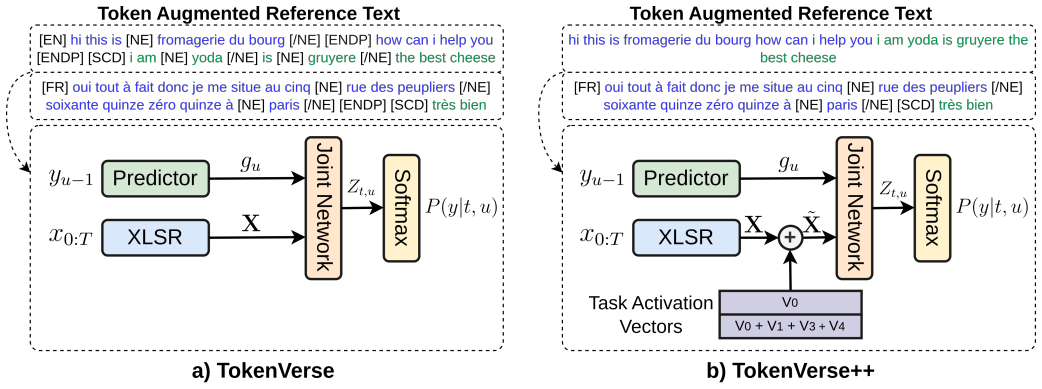
The paper's central claim is that dynamic task activation can be implemented by a single element-wise addition to the acoustic embedding stream: each task k owns a learnable vector v_k, and an utterance annotated for the task set c_i is processed as X~ = X + sum_{k in c_i} v_k. During training, the selected combination reflects the labels actually available for that utterance; during inference, any combination can be activated by choosing or summing the corresponding vectors. The authors test two parameterizations: one vector per task combination (exponential in the number of tasks, best quality) and one vector per task summed together (linear in the number of tasks, slight quality cost). Th
What carries the argument
The dynamic task-activation vector. A learnable vector v_k in the embedding dimension is attached to each task, and the model's acoustic embedding X is shifted by the sum of the vectors of the tasks active for the current utterance (or, in the alternative design, by a dedicated vector for the whole combination). This task-specific bias is what conditions the XLSR-Transducer to output the right set of tokens for that utterance. The paper shows the conditioning works best when applied after the feature encoder rather than after the full XLSR encoder, and identifies the central design tradeoff: combination-specific vectors maximize performance but cost 2^K parameters, while per-task summation s
Load-bearing premise
The load-bearing premise is that adding one learned vector to the internal speech representation, with no gating or nonlinear transform, is enough to condition the transducer for any combination of active tasks; if that simple additive shift cannot carry the task information, dynamic activation fails.
What would settle it
Train TokenVerse++ with a nonlinear task-conditioning module, such as feature-wise scaling or a learned projection of the same task vectors, under the identical partial-label data setup; if any task combination is consistently better with nonlinear conditioning across random seeds, the claim that element-wise addition is sufficient is refuted. A cheaper test: with per-task vectors, increase the number of tasks until two different task combinations produce identical summed vectors, and check whether performance drops exactly for those colliding combinations.
If this is right
- ASR-only corpora labeled only with transcripts can be folded into multitask training and improve transcription without hurting auxiliary tasks.
- A new task can be added without re-annotating old data: its vector is trained whenever an utterance has labels for it, and other utterances simply do not activate it.
- At inference the model can be run with any subset of tasks active, so the same checkpoint serves ASR-only, NER-enabled, or fully multitask deployment.
- Under a fixed parameter budget, per-task summation is the scalable choice; under a fixed quality bar, per-combination vectors are safer for small task counts.
Where Pith is reading between the lines
- An implication the authors leave implicit is that the same mechanism should transfer to other auxiliary speech labels beyond language ID, such as emotion, disfluency, or sentiment, wherever cheap partial annotations exist; this is testable by swapping the task vector with no architectural change.
- Because summation is many-to-one, the per-task strategy will eventually hit a combinatorial ambiguity: with K tasks, two different combinations can produce identical summed vectors. Orthogonal initialization or hierarchical vectors might push that limit, but the paper only notes the tradeoff and does not explore it.
- The additive bias can be read as a form of per-task domain shift; if so, vector geometry should predict transfer between similar tasks, a hypothesis the paper's activation-table results hint at without testing directly.
- A practical extension would be to train the task vectors as continuous prompts on top of a lightly trained encoder, but the paper only reports full end-to-end training.
Editorial analysis
A structured set of objections, weighed in public.
Referee Report
Summary. TokenVerse++ extends the TokenVerse multitask ASR framework by adding learnable task-activation vectors to acoustic embeddings of the XLSR-Transducer. The paper proposes two mechanisms: one learnable vector per task combination (exponential in the number of tasks) and one learnable vector per task summed for the active combination (linear). Experiments compare against TokenVerse on the English four-task DefinedAI setup and on a multilingual five-task setup (ASR, SCD, endpointing, NER, LID) with and without partially annotated CommonVoice data. The paper claims that TokenVerse++ matches or exceeds TokenVerse across tasks and that the partial-label capability improves ASR while maintaining auxiliary-task performance.
Significance. The core idea is simple and practically motivated: allowing a transducer-based multitask model to train on utterances with only a subset of task labels removes the exhaustive-annotation bottleneck of TokenVerse. If the scalable per-task summation mechanism worked as claimed, this would be a useful contribution. The paper provides a fairly comprehensive multilingual evaluation and directly compares with the authors' own TokenVerse baseline. However, the empirical support for the scalable variant is the weak point: the best results are obtained with the exponentially parameterized per-combination variant, and the partial-label experiment uses only that variant. The abstract and conclusion overstate what is demonstrated.
major comments (4)
- [Abstract; §IV-A, Table II] The unqualified claim that 'TokenVerse++ achieves results on par with or exceeding TokenVerse across multiple tasks' is not supported for the scalable per-task summation mechanism. In Table II, per-task summation after the feature encoder gives NER F1 55.4 vs. TokenVerse 57.6 and SCD 89.4 vs. 90.3; after the full XLSR encoder, NER drops to 53.1. These are not the 'slight degradation' described in §IV-A: a 2.2–4.5 point NER loss is a substantial task-level regression. The variant that does match or exceed TokenVerse is the per-combination variant, which requires 2^K learnable vectors and is acknowledged in §II-C as exponentially unscalable. The central 'on par' claim must be qualified to the specific variant and should not be stated globally in the abstract.
- [§IV-B, Table III] The claim that adding CommonVoice 'largely maintains' or yields only 'isolated, minor degradations' for tasks without CV labels is contradicted by the numbers. On Spanish, SCD drops from 66.9 to 62.7 (−4.2), endpointing from 67.5 to 62.1 (−5.4), and NER from 42.9 to 39.3 (−3.6); German NER drops from 25.8 to 25.1. These are substantial degradations, not marginal. The partial-label integration therefore does not uniformly improve or even maintain all auxiliary tasks, and the conclusion that the approach 'further enhanced ASR performance' while preserving auxiliary tasks needs to be revised to reflect these trade-offs.
- [§II-C, Eq. (3); §IV-B] The key flexibility claim—training with partially annotated utterances—is only demonstrated with the per-combination variant, not with the scalable per-task summation variant. Table III's 'TokenVerse++ (with CV)' row uses per-combination vectors, as stated in §IV-B. Since the per-task summation variant already shows NER/SCD degradations in Table II, it is not established that the scalable mechanism preserves multitask performance under partial labels. The paper should either run the per-task summation variant in the partial-label setting or explicitly restrict the scalability/flexibility claim to the per-combination mechanism, which would substantially weaken the central contribution.
- [§II-B, Eq. (2)] The paper states, 'we hypothesize that a simple element-wise addition is sufficient to effectively condition the embeddings,' but this assumption is never tested against nonlinear conditioning alternatives (e.g., FiLM, gating, or a small MLP). The empirical gap between per-combination and per-task summation is consistent with the additive bias being insufficient for some task combinations. Given that Eq. (3) is the proposed scalable mechanism, a small ablation comparing additive bias to a simple nonlinear conditioner would help establish whether the failure is due to summation ambiguity or to the additive form itself. Without this, the sufficiency claim in §II-B is unsupported.
minor comments (5)
- [§IV-A] The phrase 'slight degradation' for the per-task summation variant understates the NER loss (2.2–4.5 points). Suggest rewording to 'substantial degradation on NER' or providing a fuller quantitative description.
- [Abstract; §V] The abstract and conclusion should explicitly mention which variant (per-combination vs. per-task summation) achieves the claimed results. Currently the reader must infer this from Tables II and III.
- [Footnote 1 (page 2)] The DPP initialization experiment is mentioned as showing no improvement, but no details (numbers, configuration) are given. Either provide the numbers or remove the footnote to avoid an unverifiable claim.
- [Table IV] The ITT (Inactive Tasks Token) column is not defined in the table caption or text. For the 'All Tasks' row the value is '–', which is unexplained. Please define ITT and explain why it is omitted for the all-tasks condition.
- [§II-C] The description says a task combination is selected 'with equal probability' or 'determined by the available labels'—these are different training protocols. Clarify which is used for the fully annotated baseline comparison and which for the partial-label experiment.
Circularity Check
No significant circularity: dynamic task activation is a trainable conditioning mechanism evaluated against external benchmarks; the 'hypothesis' of additive conditioning is an assumption, not a derived result.
full rationale
The paper's derivation chain is: define learnable per-task vectors v_k, form the activation vector by summation (Eq. 3), train the XLSR-Transducer with partial labels, and measure WER/F1/accuracy on DefinedAI and CommonVoice test sets. Each of these is either a modeling choice (Section II-B/C) or an empirical result (Tables II-IV). The learnable vectors are optimized against task losses, and the reported metrics are computed on held-out annotations, not on quantities constructed from the fitted vectors themselves. The sentence 'We hypothesize that a simple element-wise addition is sufficient' (Section II-B) is an explicit assumption — a robustness concern — not a circular self-derivation, and it is tested empirically rather than assumed true. The baseline comparisons use the authors' previous TokenVerse, but only as an external benchmark with published numbers; nothing in the argument entails the conclusions from that citation alone. No equation defines its target result in terms of its own fitted parameters, and no reported prediction is statistically forced by a fit to a subset of the same metrics. The skeptical observations about NER/SCD degradation and the use of the per-combination variant for partial-label experiments are legitimate empirical criticisms, but they are not circularity. Therefore the paper is self-contained with respect to circularity, and the score is 0.
Axiom & Free-Parameter Ledger
free parameters (1)
- Task activation vectors (per-combination or per-task) =
learned during training, dimension d of acoustic embeddings
axioms (4)
- domain assumption XLSR-Transducer with pruned RNN-T loss is a valid base model for token-based multitask prediction (inherited from TokenVerse).
- ad hoc to paper Adding a bias vector to acoustic embeddings conditions the network without harming ASR (Eq. 2).
- domain assumption Token-level interleaving of task labels (e.g., [EN] tokens for LID) is a valid multitask target representation.
- domain assumption Uniform random selection of task combinations during training (or label-based selection) yields a model that generalizes to any combination at inference.
invented entities (1)
-
Task activation vector (v_k or v_{c_i})
no independent evidence
Cite this review
Pith. "Pith review of TokenVerse++: Towards Flexible Multitask Learning with Dynamic Task Activation." pith.science (2026). https://pith.science/paper/7EFKW5ER
@misc{pith2026250819856,
  author       = {Pith},
  title        = {Pith review of: TokenVerse++: Towards Flexible Multitask Learning with Dynamic Task Activation},
  year         = {2026},
  howpublished = {\url{https://pith.science/paper/7EFKW5ER}},
  note         = {Machine review of arXiv:2508.19856}
}
read the original abstract
Token-based multitasking frameworks like TokenVerse require all training utterances to have labels for all tasks, hindering their ability to leverage partially annotated datasets and scale effectively. We propose TokenVerse++, which introduces learnable vectors in the acoustic embedding space of the XLSR-Transducer ASR model for dynamic task activation. This core mechanism enables training with utterances labeled for only a subset of tasks, a key advantage over TokenVerse. We demonstrate this by successfully integrating a dataset with partial labels, specifically for ASR and an additional task, language identification, improving overall performance. TokenVerse++ achieves results on par with or exceeding TokenVerse across multiple tasks, establishing it as a more practical multitask alternative without sacrificing ASR performance.
Figures
Reference graph
Works this paper leans on
-
[1]
TokenVerse: Towards Unifying Speech and NLP Tasks via Transducer- based ASR,
S. Kumar, S. Madikeri, J. P. Zuluaga Gomez, I. Thorbecke, E. Villatoro- tello, S. Burdisso, P. Motlicek, K. P. D. S, and A. Ganapathiraju, “TokenVerse: Towards Unifying Speech and NLP Tasks via Transducer- based ASR,” in Proceedings of the 2024 Conference on Empirical Methods in Natural Language Processing , Y . Al-Onaizan, M. Bansal, and Y .-N. Chen, Eds...
work page 2024
-
[2]
Robust speech recognition via large-scale weak super- vision,
A. Radford, J. W. Kim, T. Xu, G. Brockman, C. McLeavey, and I. Sutskever, “Robust speech recognition via large-scale weak super- vision,” in International Conference on Machine Learning . PMLR, 2023, pp. 28 492–28 518
2023
-
[3]
End-to-end named entity recognition from english speech,
H. Yadav, S. Ghosh, Y . Yu, and R. R. Shah, “End-to-end named entity recognition from english speech,” arXiv preprint arXiv:2005.11184 , 2020
Pith/arXiv arXiv 2005
-
[4]
SpeechComposer: Unifying Multiple Speech Tasks with Prompt Composition
Y . Wu, S. Maiti, Y . Peng, W. Zhang, C. Li, Y . Wang, X. Wang, S. Watanabe, and R. Song, “SpeechComposer: Unifying Multiple Speech Tasks with Prompt Composition,” arXiv preprint arXiv:2401.18045 , 2024
work page internal anchor Pith review Pith/arXiv arXiv 2024
-
[5]
Speechprompt v2: Prompt tuning for speech classification tasks,
K.-W. Chang, Y .-K. Wang, H. Shen, I.-t. Kang, W.-C. Tseng, S.- W. Li, and H.-y. Lee, “Speechprompt v2: Prompt tuning for speech classification tasks,” arXiv preprint arXiv:2303.00733 , 2023
Pith/arXiv arXiv 2023
-
[6]
Joint speech recognition and speaker diarization via sequence transduction,
L. E. Shafey, H. Soltau, and I. Shafran, “Joint speech recognition and speaker diarization via sequence transduction,” arXiv preprint arXiv:1907.05337, 2019
Pith/arXiv arXiv 1907
-
[7]
W. Xia, H. Lu, Q. Wang, A. Tripathi, Y . Huang, I. L. Moreno, and H. Sak, “Turn-to-diarize: Online speaker diarization constrained by transformer transducer speaker turn detection,” in ICASSP. IEEE, 2022, pp. 8077–8081
work page 2022
-
[8]
Multitask Speech Recognition and Speaker Change Detection for Unknown Number of Speakers,
S. Kumar, S. Madikeri, N. Iuliia, E. VILLATORO-TELLO, P. Motlicek, K. P. D. S, S. P. Dubagunta, and A. Ganapathiraju, “Multitask Speech Recognition and Speaker Change Detection for Unknown Number of Speakers,” in Proceedings of the 49th IEEE International Conference on Acoustics, Speech, & Signal Processing (ICASSP) 2024 , 2024
work page 2024
-
[9]
A survey on deep learning for named entity recognition,
J. Li, A. Sun, J. Han, and C. Li, “A survey on deep learning for named entity recognition,” IEEE transactions on knowledge and data engineering, vol. 34, no. 1, pp. 50–70, 2020
2020
-
[10]
Y . Zou, L. Zhao, Y . Kang, J. Lin, M. Peng, Z. Jiang, C. Sun, Q. Zhang, X. Huang, and X. Liu, “Topic-oriented spoken dialogue summarization for customer service with saliency-aware topic modeling,” in Proceed- ings of the AAAI Conference on Artificial Intelligence , vol. 35, 2021, pp. 14 665–14 673
work page 2021
-
[11]
Topic-aware multi-turn dialogue mod- eling,
Y . Xu, H. Zhao, and Z. Zhang, “Topic-aware multi-turn dialogue mod- eling,” in Proceedings of the AAAI Conference on Artificial Intelligence , vol. 35, 2021, pp. 14 176–14 184
work page 2021
-
[12]
W. R. Huang, C. Allauzen, T. Chen, K. Gupta, K. Hu, J. Qin, Y . Zhang, Y . Wang, S.-Y . Chang, and T. N. Sainath, “Multilingual and Fully Non- Autoregressive ASR with Large Language Model Fusion: A Compre- hensive Study,” in ICASSP 2024-2024 IEEE International Conference on Acoustics, Speech and Signal Processing (ICASSP) . IEEE, 2024, pp. 13 306–13 310
work page 2024
-
[13]
C.-H. H. Yang, Y . Gu, Y .-C. Liu, S. Ghosh, I. Bulyko, and A. Stolcke, “Generative Speech Recognition Error Correction With Large Language Models and Task-Activating Prompting,” in 2023 IEEE Automatic Speech Recognition and Understanding Workshop (ASRU) , 2023, pp. 1–8
work page 2023
-
[14]
An Embarrassingly Simple Approach for LLM with Strong ASR Capacity,
Z. Ma, G. Yang, Y . Yang, Z. Gao, J. Wang, Z. Du, F. Yu, Q. Chen, S. Zheng, S. Zhang et al. , “An Embarrassingly Simple Approach for LLM with Strong ASR Capacity,” arXiv preprint arXiv:2402.08846 , 2024
Pith/arXiv arXiv 2024
-
[15]
SpeechVerse: A Large-scale Generalizable Audio Language Model,
N. Das, S. Dingliwal, S. Ronanki, R. Paturi, D. Huang, P. Mathur, J. Yuan, D. Bekal, X. Niu, S. M. Jayanthi et al. , “SpeechVerse: A Large-scale Generalizable Audio Language Model,” arXiv preprint arXiv:2405.08295, 2024
Pith/arXiv arXiv 2024
-
[16]
Performance Evaluation of SLAM-ASR: The Good, the Bad, the Ugly, and the Way Forward,
S. Kumar, I. Thorbecke, S. Burdisso, E. Villatoro-Tello, M. KE, K. Ha- cio˘glu, P. Rangappa, P. Motlicek, A. Ganapathiraju, and A. Stolcke, “Performance Evaluation of SLAM-ASR: The Good, the Bad, the Ugly, and the Way Forward,” in 2025 IEEE International Conference on Acoustics, Speech, and Signal Processing Workshops (ICASSPW) . IEEE, 2025, pp. 1–5
work page 2025
-
[17]
XLSR-Transducer: Streaming ASR for Self-Supervised Pretrained Models,
S. Kumar, S. Madikeri, J. Zuluaga-Gomez, E. Villatoro-Tello, I. Thor- becke, P. Motlicek, M. KE, and A. Ganapathiraju, “XLSR-Transducer: Streaming ASR for Self-Supervised Pretrained Models,” in ICASSP 2025-2025 IEEE International Conference on Acoustics, Speech and Signal Processing (ICASSP) . IEEE, 2025, pp. 1–5
work page 2025
-
[18]
PromptASR for Contextualized ASR with Controllable Style,
X. Yang, W. Kang, Z. Yao, Y . Yang, L. Guo, F. Kuang, L. Lin, and D. Povey, “PromptASR for Contextualized ASR with Controllable Style,” in ICASSP 2024 - 2024 IEEE International Conference on Acoustics, Speech and Signal Processing (ICASSP) , 2024, pp. 10 536– 10 540
work page 2024
-
[19]
Prefix-Tuning: Optimizing Continuous Prompts for Generation,
X. L. Li and P. Liang, “Prefix-Tuning: Optimizing Continuous Prompts for Generation,” in Proceedings of the 59th Annual Meeting of the Association for Computational Linguistics and the 11th International Joint Conference on Natural Language Processing (Volume 1: Long Papers), C. Zong, F. Xia, W. Li, and R. Navigli, Eds. Online: Association for Computation...
work page 2021
-
[20]
X. Liu, Y . Zheng, Z. Du, M. Ding, Y . Qian, Z. Yang, and J. Tang, “GPT Understands, Too,” 2023. [Online]. Available: https://arxiv.org/abs/2103.10385
Pith/arXiv arXiv 2023
-
[21]
Pruned RNN-T for fast, memory-efficient ASR training,
F. Kuang, L. Guo, W. Kang, L. Lin, M. Luo, Z. Yao, and D. Povey, “Pruned RNN-T for fast, memory-efficient ASR training,”arXiv preprint arXiv:2206.13236, 2022
Pith/arXiv arXiv 2022
-
[22]
Sequence transduction with recurrent neural networks,
A. Graves, “Sequence transduction with recurrent neural networks,” arXiv preprint arXiv:1211.3711 , 2012
Pith/arXiv arXiv 2012
-
[23]
Un- supervised cross-lingual representation learning for speech recognition,
A. Conneau, A. Baevski, R. Collobert, A. Mohamed, and M. Auli, “Un- supervised cross-lingual representation learning for speech recognition,” arXiv preprint arXiv:2006.13979 , 2020
Pith/arXiv arXiv 2006
-
[24]
On two ways to use determi- nantal point processes for monte carlo integration,
G. Gautier, R. Bardenet, and M. Valko, “On two ways to use determi- nantal point processes for monte carlo integration,” Advances in Neural Information Processing Systems , vol. 32, 2019
work page 2019
-
[25]
Common V oice: A Massively-Multilingual Speech Corpus,
R. Ardila, M. Branson, K. Davis, M. Kohler, J. Meyer, M. Henretty, R. Morais, L. Saunders, F. Tyers, and G. Weber, “Common V oice: A Massively-Multilingual Speech Corpus,” in Proceedings of the Twelfth Language Resources and Evaluation Conference , 2020, pp. 4218–4222
work page 2020
This paper was first reviewed by deepseek-v4-flash on August 5, 2026.
discussion (0)
Sign in with ORCID, Apple, or X to comment. Anyone can read and Pith papers without signing in.