REVIEW 3 major objections 4 minor 34 references
FARM: Frame-Accelerated Augmentation and Residual Mixture-of-Experts for Physics-Based High-Dynamic Humanoid Control
T0 review · 3 major / 4 minor · reviewed 2026-08-05 · deepseek-v4-flash
Pith's one-line read A residual mixture-of-experts with frame-accelerated augmentation lets one physics-based humanoid controller track explosive, high-dynamic motions without losing its accuracy on ordinary motions.
desk verdict A sensible residual MoE method for high-dynamic humanoid control, but the benchmark appears to be built from the baseline's failures—so the headline numbers need a careful second look. read the letter →
The pith
A machine-rendered reading of the paper's core claim, the machinery that carries it, and where it could break.
The reading
What carries the argument
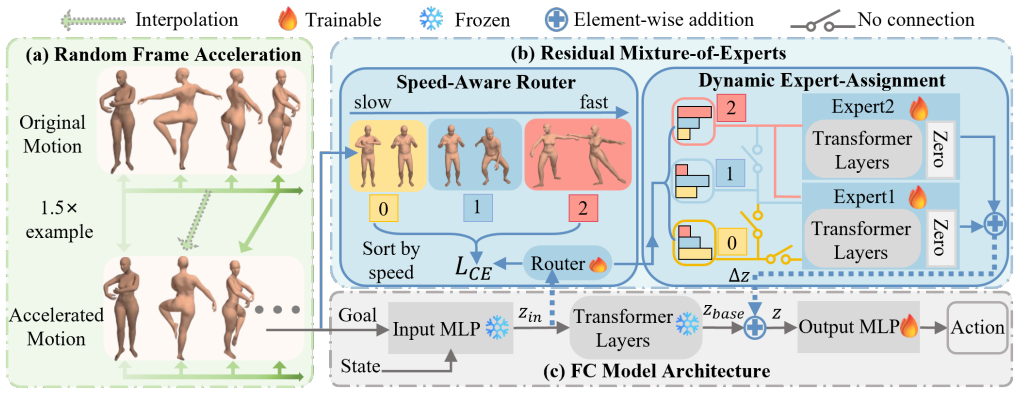
The load-bearing mechanism is the residual mixture-of-experts: a frozen pretrained controller is augmented by expert transformer adapters whose outputs enter through zero-initialized projections, so the residual path starts as a no-op. The speed-aware router assigns samples to one of three speed bands via a cross-entropy auxiliary loss, and dynamic expert-assignment activates the top k experts where k is the router's argmax, with weights formed by cumulative router probabilities. Frame-accelerated augmentation supplies the high-dynamic signal: it resamples each training clip at a random 1.0–1.5× speed and feeds the accelerated poses to the controller at the original 30 Hz rate, widening inte
What would settle it
Run FARM and the FC baseline on an independently curated set of high-dynamic motions that no controller was used to screen; if FARM does not reproduce roughly the 42.8% failure reduction and 14.6% MPJPEg improvement there, the benchmark's baseline-screened selection is the source of the reported gains.
Extended reading notes
Core claim
The central claim is that high-dynamic humanoid motion tracking can be improved without degrading low-dynamic performance by combining frame-accelerated augmentation with a residual mixture-of-experts architecture. The base FC controller is kept frozen, and a residual MoE adds expert corrections only for high-velocity segments. A speed-aware router sorts training samples into speed bands and supervises the router with those labels, while dynamic expert-assignment activates zero, one, or more experts depending on the router's confidence, so easy motions run through the base controller alone and hard motions recruit more capacity. The paper also introduces HDHM, a 3,593-clip benchmark of physi
Load-bearing premise
The HDHM benchmark clips are collected by running the FC baseline and keeping motions it fails on, so the claimed improvements may reflect fitting to that specific selection rather than a general advantage on all high-dynamic motions.
Editorial extensions
If this is right
- High-dynamic control skills can be mined from predominantly low-dynamic data via speed resampling, reducing the need for new explosive-motion capture collections.
- Freezing the base controller while adding a residual MoE protects existing low-dynamic accuracy; the reported AMASS success stays at 100% with less than 2 mm added MPJPEg.
- Adaptive expert activation means compute follows motion intensity: roughly 80% of low-dynamic frames use only the base controller, while over half of HDHM frames engage one or two experts.
- Failure-case fine-tuning concentrates training on informative hard samples, cutting training time from 35 hours to 6 hours while slightly improving both HDHM and AMASS-test metrics.
- The HDHM benchmark provides the first public high-dynamic evaluation set, covering dance, sports, kungfu, text-generated, and video-converted motions, allowing standardized comparison for future controllers.
Reading between the lines
- Left implicit by the paper: frame-accelerated augmentation is a generic stress test for any tracking policy, so one testable extension is mapping a controller's failure boundary across continuous speed factors rather than only the 1.0–1.5× range used here.
- The speed-aware routing idea could extend beyond joint speed to other continuous difficulty axes, such as terrain roughness, external perturbation magnitude, or task complexity, whenever samples can be labeled along that axis.
- Because HDHM clips were selected by running the FC baseline and keeping its failures, an independent high-dynamic benchmark not screened by any baseline would be needed to separate FARM's genuine generalization from selection bias.
- For real-robot deployment, the residual design might serve as an online adaptation layer on top of a deployed base controller, but the paper does not test sim-to-real transfer or latency, so that remains an open extension.
Editorial analysis
A structured set of objections, weighed in public.
Referee Report
Summary. The paper proposes FARM, a physics-based humanoid controller that combines frame-accelerated augmentation, a frozen/partially frozen FC base controller, and a residual mixture-of-experts (MoE) module with a speed-aware router and dynamic expert assignment. Training uses hard samples mined from AMASS by running the FC baseline at 1.25x speed, then applying random 1.0–1.5x acceleration. The authors curate a new HDHM benchmark of 3,593 high-dynamic clips from five sources and report that FARM reduces the tracking failure rate on HDHM by 42.8% (from 7.7% to 4.4%) and lowers MPJPEg by 14.6% (from 111.3 mm to 95.0 mm) relative to FC, while preserving near-perfect accuracy on AMASS. Ablations examine the contribution of each component, and a failure-data fine-tuning strategy is shown to reduce training time.
Significance. If the claimed results are valid, the paper makes a useful contribution to physics-based humanoid control: it identifies a concrete limitation of existing AMASS-trained controllers on high-dynamic motions and proposes a modular architectural fix (residual MoE with speed-aware routing) plus a data-augmentation scheme that requires only low-dynamic motion data. The curated HDHM benchmark, if released in an unbiased form, would also be a valuable community resource. The authors report four-seed averages and provide a detailed ablation table, which is a strength. However, the central quantitative claims depend on the integrity of the HDHM evaluation set, and that set is described in Appendix A as being selected using the very baseline being compared. This, together with an inconsistency in the DEA formulation, prevents the current manuscript from supporting its headline conclusions.
major comments (3)
- [Appendix A; Table 1; §3.1] HDHM curation is not independent of the baseline. Appendix A says 'we first run the FC baseline policy on all candidate sequences and collect those with significant tracking failures.' If this uses the same failure criterion as §3.1 (MPJPEg > 0.5 m at any frame), then FC should fail on essentially all HDHM clips, contradicting the 92.3% success rate in Table 1. If 'significant tracking failures' means a weaker/different criterion, it must be specified precisely. As written, the evaluation set is enriched for FC failures, and FARM is additionally trained on FC-mined failure cases (§3.1, Table 4), so the reported 42.8% failure-rate reduction is not an unbiased estimate. Please re-curate HDHM without using FC as a filter, report results on the full candidate pool before filtering, or provide another unbiased benchmark; also report per-seed results/error bars.
- [§3.3, Eq. (4); §B.2] The DEA formulation as written cannot activate more than E-1 experts. With p∈R^E and k=argmax(p), k ranges over {0,...,E-1}, so the maximum number of active experts is E-1. Since §B.2 reports E=2 experts, the model should only ever activate 0 or 1 experts. This contradicts Figure 6, which shows frames with 2 active experts, and Figure 7, which states that over half of HDHM frames involve one or two experts. Either the router outputs E+1 logits (including a no-expert option) or the activation rule is described incorrectly. This is load-bearing for the DEA 'adaptive capacity' claim, and the notation must be corrected and matched to the implementation.
- [Table 1; §4.2] The results are described as averaged over four random seeds, but no standard deviations, confidence intervals, or per-seed values are given. For many of the reported differences (e.g., EMDB success 95.5% vs 97.7%, Text-Convert MPJPEg 76.9 vs 71.2 mm), one cannot assess whether the differences are significant. Quantitative claims such as 'consistently outperforms baselines across all subsets' need variance information, especially because the benchmark construction already introduces a baseline-dependent selection step.
minor comments (4)
- [§3.1] Typo: 'Issac Lab' should be 'Isaac Lab'.
- [Appendix B.3, Table 5] The caption says 'training parameters are shown in Figure 5', but the hyperparameters are in Table 5; the cross-reference is incorrect.
- [Table 3] The parenthetical percentage changes are ambiguous. For example, 92.3% to 95.1% is shown as '+3.0%', which is closer to a relative change (3.0%) than an absolute percentage-point change (+2.8 pp). Please define the convention used.
- [General] The paper promises code and dataset release, but the Appendix A description of the filtering procedure is not fully reproducible: the 'significant tracking failures' criterion is not quantified, and the manual filtering thresholds for 'mild imperfections' are subjective. Please provide the exact filtering code/checklist or a more operational definition.
Circularity Check
HDHM benchmark is curated from FC baseline failures, and FARM is trained on FC-mined failures, so the central comparison is evaluated on a baseline-dependent set.
-
other
[Section 3.1 (Overall framework) and Appendix A (HDHM Datasets)]
"To mine such samples, we uniformly accelerate the entire AMASS dataset by a factor of 1.25× and apply the base FC controller πF C to perform inference on the accelerated motion sequences. Motions that the controller fails to track under this setting are collected as hard samples. ... To ensure physical plausibility while maintaining motion diversity, we first run the FC baseline policy on all candidate sequences and collect those with significant tracking failures."
The same baseline FC is used to select both the training hard samples (Section 3.1) and the evaluation benchmark HDHM (Appendix A). FARM is trained on FC-failure data and then evaluated on clips selected by the same FC controller's failures. The headline 42.8% failure-rate reduction is therefore measured on a test set that is not independent of the comparator: it is enriched for FC's failure modes. This does not make FARM's win a logical tautology, but the benchmark is not an unbiased sample of 'high-dynamic humanoid motion'; it is a sample of motions the baseline finds difficult, which biases the comparison in FARM's favor. The account is also hard to reconcile with Table 1, where FC attains 92.3% success on HDHM, indicating that the curation criterion ('significant tracking failures') is
full rationale
No self-citation chain or equation-level circularity is present. The method components (frame-accelerated augmentation, residual MoE, SAR/DEA) are internally consistent and are not derived from the target result. However, the central empirical claim—FARM reduces tracking failure rate by 42.8% on HDHM—rests on a benchmark whose construction is entangled with the baseline being compared. Appendix A states that HDHM clips were collected by running FC and keeping those with significant tracking failures, while Section 3.1 shows FARM is trained on hard samples mined with the same FC failure criterion. Thus the training distribution and evaluation distribution are both FC-failure-selected, making the test set a biased measure of FARM's generalization relative to FC. This is a selection-bias/circular-evaluation issue rather than a mathematical tautology, so a moderate score of 4 is appropriate; a higher score would require the improvement to be forced by construction, which is not the case here. Additionally, the inconsistency between the Appendix A curation description and Table 1's 92.3% FC success rate on HDHM weakens confidence in the benchmark's reported construction, but that is a correctness/validity concern rather than a derivation-level circularity.
Assumptions & free parameters
free parameters (4)
- Acceleration factor range v ~ U[1.0, 1.5] =
1.0-1.5
- Number of experts E =
2
- Speed loss coefficient lambda_speed =
1.0
- Hard-sample mining speed 1.25x =
1.25
assumptions (4)
- domain assumption The FC controller from MaskedMimic provides reliable low-dynamic tracking and its frozen features can support a residual correction path.
- domain assumption Frame acceleration by up to 1.5x produces physically plausible training motions.
- domain assumption Tracking performance on HDHM is a valid proxy for high-dynamic humanoid control ability.
- standard math The standard RL objective with PPO and the reward formulation from Tessler et al. are sufficient for training the controller.
Cite this review
Pith. "Pith review of FARM: Frame-Accelerated Augmentation and Residual Mixture-of-Experts for Physics-Based High-Dynamic Humanoid Control." pith.science (2026). https://pith.science/paper/75UK6PGT
@misc{pith2026250819926,
  author       = {Pith},
  title        = {Pith review of: FARM: Frame-Accelerated Augmentation and Residual Mixture-of-Experts for Physics-Based High-Dynamic Humanoid Control},
  year         = {2026},
  howpublished = {\url{https://pith.science/paper/75UK6PGT}},
  note         = {Machine review of arXiv:2508.19926}
}
read the original abstract
Unified physics-based humanoid controllers are pivotal for robotics and character animation, yet models that excel on gentle, everyday motions still stumble on explosive actions, hampering real-world deployment. We bridge this gap with FARM (Frame-Accelerated Augmentation and Residual Mixture-of-Experts), an end-to-end framework composed of frame-accelerated augmentation, a robust base controller, and a residual mixture-of-experts (MoE). Frame-accelerated augmentation exposes the model to high-velocity pose changes by widening inter-frame gaps. The base controller reliably tracks everyday low-dynamic motions, while the residual MoE adaptively allocates additional network capacity to handle challenging high-dynamic actions, significantly enhancing tracking accuracy. In the absence of a public benchmark, we curate the High-Dynamic Humanoid Motion (HDHM) dataset, comprising 3593 physically plausible clips. On HDHM, FARM reduces the tracking failure rate by 42.8\% and lowers global mean per-joint position error by 14.6\% relative to the baseline, while preserving near-perfect accuracy on low-dynamic motions. These results establish FARM as a new baseline for high-dynamic humanoid control and introduce the first open benchmark dedicated to this challenge. The code and dataset will be released at https://github.com/Colin-Jing/FARM.
Figures


Figures from the paper (6 more)


Reference graph
Works this paper leans on
-
[1]
Chen, Z.; Ji, M.; Cheng, X.; Peng, X.; Peng, X. B.; and Wang, X. 2025. GMT: General Motion Tracking for Humanoid Whole-Body Control. arXiv preprint arXiv:2506.14770
arXiv 2025
-
[2]
Da Silva, M.; Abe, Y.; and Popovi \'c , J. 2008. Simulation of human motion data using short-horizon model-predictive control. In Computer Graphics Forum, volume 27, 371--380. Wiley Online Library
work page 2008
-
[3]
Huang, R.; Zhu, S.; Du, Y.; and Zhao, H. 2025. MoE-Loco: Mixture of Experts for Multitask Locomotion. arXiv preprint arXiv:2503.08564
arXiv 2025
-
[4]
Kaufmann, M.; Song, J.; Guo, C.; Shen, K.; Jiang, T.; Tang, C.; Z \'a rate, J. J.; and Hilliges, O. 2023. Emdb: The electromagnetic database of global 3d human pose and shape in the wild. In Proceedings of the IEEE/CVF International Conference on Computer Vision, 14632--14643
work page 2023
-
[5]
Kingma, D. P.; and Ba, J. 2014. Adam: A method for stochastic optimization. arXiv preprint arXiv:1412.6980
arXiv 2014
-
[6]
Lee, Y.; Kim, S.; and Lee, J. 2010. Data-driven biped control. In ACM SIGGRAPH 2010 Papers, SIGGRAPH '10. New York, NY, USA: Association for Computing Machinery. ISBN 9781450302104
work page 2010
-
[7]
Li, R.; Yang, S.; Ross, D. A.; and Kanazawa, A. 2021. Learn to dance with aist++: Music conditioned 3d dance generation. arXiv preprint arXiv:2101.08779, 2(3)
arXiv 2021
-
[8]
Lin, J.; Zeng, A.; Lu, S.; Cai, Y.; Zhang, R.; Wang, H.; and Zhang, L. 2023. Motion-x: A large-scale 3d expressive whole-body human motion dataset. Advances in Neural Information Processing Systems, 36: 25268--25280
2023
Show all 34 references
-
[9]
Loper, M.; Mahmood, N.; Romero, J.; Pons-Moll, G.; and Black, M. J. 2015. SMPL: a skinned multi-person linear model. ACM Trans. Graph., 34(6)
2015
-
[10]
Luo, Z.; Cao, J.; Kitani, K.; Xu, W.; et al. 2023. Perpetual humanoid control for real-time simulated avatars. In Proceedings of the IEEE/CVF International Conference on Computer Vision, 10895--10904
2023
-
[11]
M.; and Xu, W
Luo, Z.; Cao, J.; Merel, J.; Winkler, A.; Huang, J.; Kitani, K. M.; and Xu, W. 2024. Universal Humanoid Motion Representations for Physics-Based Control. In The Twelfth International Conference on Learning Representations
2024
-
[12]
Luo, Z.; Hachiuma, R.; Yuan, Y.; and Kitani, K. 2021. Dynamics-regulated kinematic policy for egocentric pose estimation. Advances in Neural Information Processing Systems, 34: 25019--25032
2021
-
[13]
Luo, Z.; Yuan, Y.; and Kitani, K. M. 2022. From universal humanoid control to automatic physically valid character creation. arXiv preprint arXiv:2206.09286
2022 arXiv
-
[14]
F.; Pons-Moll, G.; and Black, M
Mahmood, N.; Ghorbani, N.; Troje, N. F.; Pons-Moll, G.; and Black, M. J. 2019. AMASS : Archive of Motion Capture as Surface Shapes. In International Conference on Computer Vision, ICCV, 5442--5451
2019
-
[15]
L.; Singh, R.; Guo, Y.; Mazhar, H.; Mandlekar, A.; Babich, B.; State, G.; Hutter, M.; and Garg, A
Mittal, M.; Yu, C.; Yu, Q.; Liu, J.; Rudin, N.; Hoeller, D.; Yuan, J. L.; Singh, R.; Guo, Y.; Mazhar, H.; Mandlekar, A.; Babich, B.; State, G.; Hutter, M.; and Garg, A. 2023. Orbit: A Unified Simulation Framework for Interactive Robot Learning Environments. IEEE Robotics and A...
2023
-
[16]
P.; Mirza, M.; Graves, A.; Lillicrap, T.; Harley, T.; Silver, D.; and Kavukcuoglu, K
Mnih, V.; Badia, A. P.; Mirza, M.; Graves, A.; Lillicrap, T.; Harley, T.; Silver, D.; and Kavukcuoglu, K. 2016. Asynchronous methods for deep reinforcement learning. In International conference on machine learning, 1928--1937. PmLR
2016
-
[17]
Mu, S.; and Lin, S. 2025. A comprehensive survey of mixture-of-experts: Algorithms, theory, and applications. arXiv preprint arXiv:2503.07137
2025
-
[18]
B.; Abbeel, P.; Levine, S.; and Van de Panne, M
Peng, X. B.; Abbeel, P.; Levine, S.; and Van de Panne, M. 2018. Deepmimic: Example-guided deep reinforcement learning of physics-based character skills. ACM Transactions On Graphics (TOG), 37(4): 1--14
2018
-
[19]
B.; Ma, Z.; Abbeel, P.; Levine, S.; and Kanazawa, A
Peng, X. B.; Ma, Z.; Abbeel, P.; Levine, S.; and Kanazawa, A. 2021. Amp: Adversarial motion priors for stylized physics-based character control. ACM Transactions on Graphics (ToG), 40(4): 1--20
2021
-
[20]
Schulman, J.; Wolski, F.; Dhariwal, P.; Radford, A.; and Klimov, O. 2017. Proximal policy optimization algorithms. arXiv preprint arXiv:1707.06347
2017 arXiv
-
[21]
Shen, Z.; Pi, H.; Xia, Y.; Cen, Z.; Peng, S.; Hu, Z.; Bao, H.; Hu, R.; and Zhou, X. 2024. World-Grounded Human Motion Recovery via Gravity-View Coordinates. In SIGGRAPH Asia Conference Proceedings
2024
-
[22]
Tessler, C.; Guo, Y.; Nabati, O.; Chechik, G.; and Peng, X. B. 2024. Maskedmimic: Unified physics-based character control through masked motion inpainting. ACM Transactions on Graphics (TOG), 43(6): 1--21
2024
-
[23]
B.; Bermano, A
Tevet, G.; Raab, S.; Cohan, S.; Reda, D.; Luo, Z.; Peng, X. B.; Bermano, A. H.; and van de Panne, M. 2024. CLoSD: Closing the Loop between Simulation and Diffusion for multi-task character control. arXiv:2410.03441
2024 arXiv
-
[24]
Tevet, G.; Raab, S.; Gordon, B.; Shafir, Y.; Cohen-Or, D.; and Bermano, A. H. 2022. Human motion diffusion model. arXiv preprint arXiv:2209.14916
2022 arXiv
-
[25]
Tsuchida, S.; Fukayama, S.; Hamasaki, M.; and Goto, M. 2019. AIST Dance Video Database: Multi-Genre, Multi-Dancer, and Multi-Camera Database for Dance Information Processing. In ISMIR, volume 1, 6
2019
-
[26]
N.; Kaiser, .; and Polosukhin, I
Vaswani, A.; Shazeer, N.; Parmar, N.; Uszkoreit, J.; Jones, L.; Gomez, A. N.; Kaiser, .; and Polosukhin, I. 2017. Attention is all you need. Advances in neural information processing systems, 30
2017
-
[27]
Wang, D.; Wang, X.; Liu, X.; Shi, J.; Zhao, Y.; Bai, C.; and Li, X. 2025. MoRE: Mixture of Residual Experts for Humanoid Lifelike Gaits Learning on Complex Terrains. arXiv preprint arXiv:2506.08840
2025 arXiv
-
[28]
Wang, T.; Guo, Y.; Shugrina, M.; and Fidler, S. 2020. Unicon: Universal neural controller for physics-based character motion. arXiv preprint arXiv:2011.15119
2020 arXiv
-
[29]
Yuan, Y.; and Kitani, K. 2020. Residual force control for agile human behavior imitation and extended motion synthesis. Advances in Neural Information Processing Systems, 33: 21763--21774
2020
-
[30]
Zhang, L.; Rao, A.; and Agrawala, M. 2023. Adding conditional control to text-to-image diffusion models. In Proceedings of the IEEE/CVF international conference on computer vision, 3836--3847
2023
-
[31]
Zheng, X.; Liao, L.; Li, X.; Jiao, J.; Wang, R.; Gao, F.; Wang, S.; and Wang, R. 2024. Pku-dymvhumans: A multi-view video benchmark for high-fidelity dynamic human modeling. In Proceedings of the IEEE/CVF Conference on Computer Vision and Pattern Recognition, 22530--22540
2024
-
[32]
Zhu, Q.; Zhang, H.; Lan, M.; and Han, L. 2023. Neural categorical priors for physics-based character control. ACM Transactions on Graphics (TOG), 42(6): 1--16
2023
-
[33]
, " * write output.state after.block = add.period write newline
ENTRY address archivePrefix author booktitle chapter edition editor eid eprint howpublished institution isbn journal key month note number organization pages publisher school series title type volume year label extra.label sort.label short.list INTEGERS output.state before.all...
-
[34]
write newline
" write newline "" before.all 'output.state := FUNCTION n.dashify 't := "" t empty not t #1 #1 substring "-" = t #1 #2 substring "--" = not "--" * t #2 global.max substring 't := t #1 #1 substring "-" = "-" * t #2 global.max substring 't := while if t #1 #1 substring * t #2 gl...
Reviewed August 5, 2026 · model on record in the stance chip above.
Discussion (0). Sign in to comment.