REVIEW 2 major objections 4 minor 36 references
Learned dual-fisheye calibration turns imperfect 360° captures into seamless rendered views.
Reviewed by Pith at T0; open to challenge. T0 means a machine referee read the full paper against a public rubric. the ladder, T0–T4 →
Training 3D Gaussian splatting with a learnable dual-fisheye distortion model, then turning it off at inference, renders seamless 360-degree novel views from imperfect panoramas.
T0 review reviewed 2026-08-05 challenge →
load-bearing objection Solid practical calibration for 360° 3DGS, but the angular-distortion component is under-validated and the 'seamless' claim rests on an identifiability assumption. the 2 major comments →
Seam360GS: Seamless 360{\deg} Gaussian Splatting from Real-World Omnidirectional Images
The pith
A machine-rendered reading of the paper's core claim, the machinery that carries it, and where it could break.
The reading
Core claim
The paper's central claim is that the two failure modes of consumer dual-fisheye 360° cameras—the physical separation of the front and back optical centers and the angular distortion introduced by stitching—can be modeled and corrected inside a 3D Gaussian splatting optimization. Instead of treating input panoramas as perfectly calibrated spherical images, the method re-expresses each ideal Gaussian in front- and back-camera coordinates using learned translations ΔT_F and ΔT_B, then rotates it by a learned per-ray angular distortion ΔR_F or ΔR_B (Eqs. 4–9). Training jointly fits both the scene and these calibration variables to the imperfect captures through a photometric loss; at inference
What carries the argument
The central mechanism is a distortion-aware dual-fisheye Gaussian transformation. Each 3D Gaussian is first translated from an ideal center to the learned front/back fisheye centers via ΔT_F and ΔT_B, then rotated by a smooth, learnable angular-distortion grid ΔR(θ, φ) sampled bilinearly in spherical coordinates, producing camera-specific Gaussians that are rasterized separately and merged into a complete 360° panorama. During training this reproduces the artifact patterns of real captures, so the photometric loss drives both the scene and the calibration variables; during inference the calibration is switched off, making the original ideal Gaussians render a seamless view.
Load-bearing premise
The load-bearing premise is that a single learned translation per fisheye plus a smooth per-ray rotation field can fully represent the misalignment of a real dual-fisheye panorama; if the camera also has radial distortion, rolling-shutter effects, or nonlinear stitching errors, the fitted rotation can absorb scene-geometry errors and produce visually seamless but geometrically wrong views.
What would settle it
Render a known 3D calibration object (for example a checkerboard rig or a straight-edged corridor) through the learned dual-fisheye model and inspect the merged 360° output: if straight 3D lines bend across the front/back seam, or if the recovered ΔR changes substantially when the scene content changes while the camera is fixed, the angular-distortion field is overfitting to scene geometry rather than recovering true lens distortion. A second check is to compare depth maps rendered with and without the calibration module against a structure-from-motion or LiDAR reference.
If this is right
- Seamless 360° novel views become obtainable from ordinary consumer panoramas, without raw fisheye capture or per-view manual alignment.
- Calibration variables are optimized only during training, so inference stays real-time; the paper reports roughly 30% faster test-time rendering than OmniGS while using fewer Gaussians.
- The angular-distortion grid learned for one scene transfers to other scenes from the same camera, suggesting a device-level calibration can be reused.
- The same pipeline works on both equirectangular panoramas and raw dual-fisheye inputs, with a small quality gain on raw fisheye, broadening its applicability.
- Ablation results show both calibration components matter, with angular-distortion correction contributing more than lens-gap translation; disabling both costs about 1 dB PSNR on the 360Roam indoor scenes.
Where Pith is reading between the lines
- Because the calibration is fitted with photometric loss alone, the learned ΔR may absorb geometric errors in textureless regions; the paper itself reports reduced calibration performance there, so 'seamless' should be read as a visual property first, with geometric fidelity needing a separate check.
- The near-identical ΔR across scenes from the same camera suggests a practical extension the paper does not test: pre-train the calibration module on a few scenes, freeze it, and then train new scenes faster.
- The synthetic gaps are sampled within ±2 cm, so the model's behavior for larger baseline errors or for non-rotational distortion (for example rolling-shutter effects) is untested; extending the calibration with more intrinsic parameters is a natural next step.
- Since the reported ground truth itself contains stitching artifacts, part of the measured gain may come from outputting a cleaner image than the reference; an evaluation against a high-quality panoramic capture or a laser scan would better separate calibration accuracy from image smoothing.
Editorial analysis
A structured set of objections, weighed in public.
Referee Report
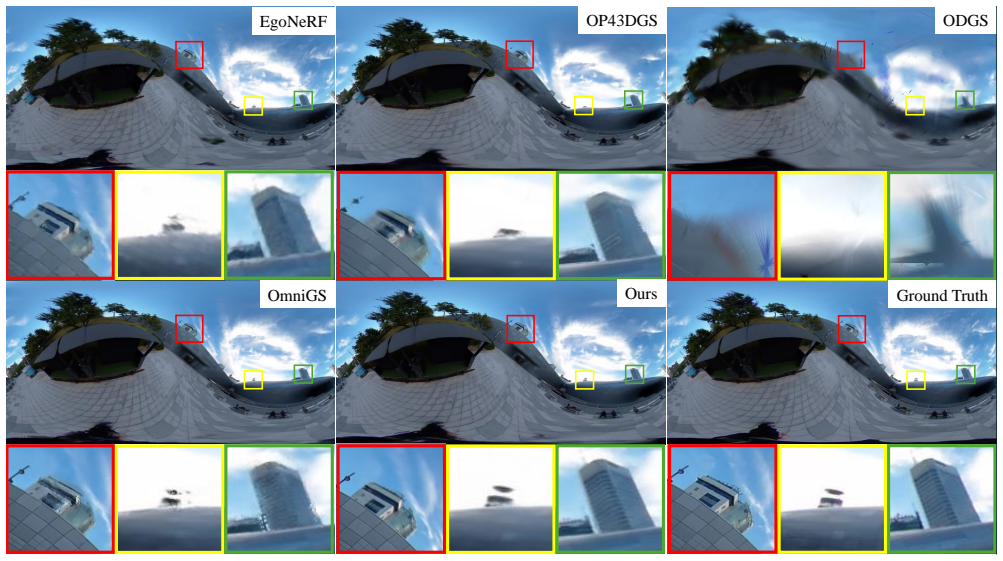
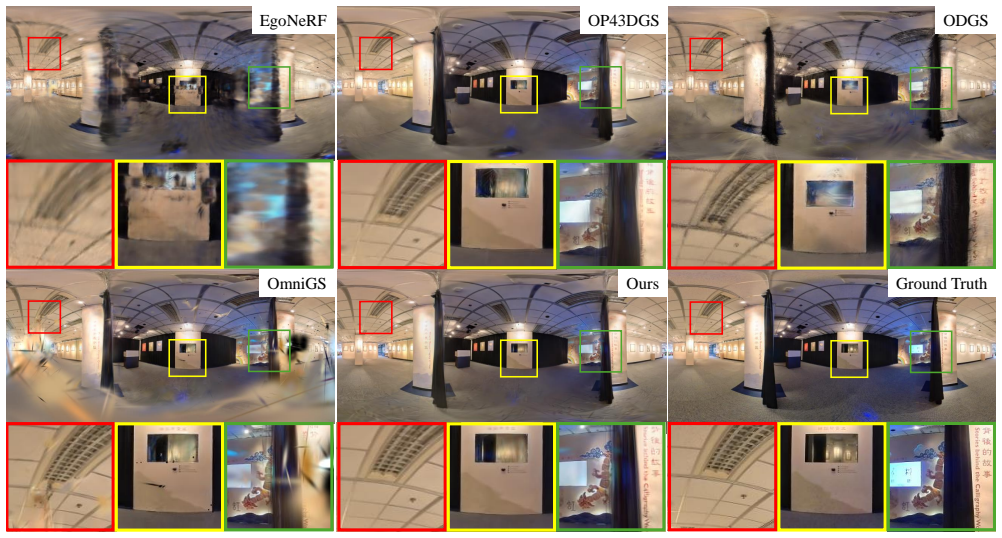
Summary. The paper proposes Seam360GS, a 3D Gaussian Splatting framework for 360° novel-view synthesis that explicitly models artifacts of consumer dual-fisheye cameras. It translates Gaussians to per-camera centers with learnable vectors ΔT_F, ΔT_B and applies a learned per-ray angular distortion field ΔR_F, ΔR_B when rasterizing front/back views; the two views are then concatenated to reproduce the imperfect input panoramas. At inference the distortion module is disabled, yielding an 'ideal' seamless panorama. Experiments on a synthetic dataset, EgoNeRF/Ricoh360, and 360Roam show consistent improvements over four baselines in PSNR/SSIM/LPIPS, and an ablation confirms both components contribute. A synthetic experiment validates the learned inter-camera translation against ground truth.
Significance. If the calibration is physically meaningful, the method is practically valuable: it addresses a real, under-studied problem—stitching artifacts in consumer 360° cameras—within the efficient 3DGS paradigm, with no extra inference cost. The paper is well specified, uses standard benchmarks and baselines, and includes a synthetic calibration test and component ablations. The main limitation is that the angular distortion field is never validated against ground truth, so the central 'seamless and geometrically accurate' claim rests on an identifiability assumption. This is a correctness risk that should be resolved before publication.
major comments (2)
- [§3.2, Eqs. (8)–(9), and §4.2, Table 1] The angular distortion field ΔR is load-bearing for the paper's 'flawless seamless rendering' claim, but it is learned only under a photometric loss against distorted panoramas. Table 1 validates the inter-camera translation ΔT against synthetic ground truth, but no experiment measures the error in ΔR. Because the Gaussian scene geometry is optimized simultaneously, many (ΔR, scene) pairs can produce nearly identical distorted training views: the model may absorb scene-reconstruction errors into ΔR and then remove them at inference, yielding a smooth but geometrically false 'ideal' view. The cross-scene consistency of ΔR reported in Supplementary Sec. B is consistent with a camera property but does not establish that it is the true physical distortion. Please add a synthetic experiment with known angular distortions and report recovery error for ΔR, or evaluate the undistorted renderings
- [§4.3, Tables 2–4] The core empirical claim is an average PSNR gain of ~0.9–1.0 dB over the strongest baseline, but no error bars, multiple seeds, or significance tests are reported. The real-world ground truth itself contains stitching artifacts, so the reported metrics measure fidelity to imperfect images, not correctness of the seamless rendering. Also, the OP43DGS results on Ricoh360 come from a checkpoint saved when training terminated due to out-of-memory (Sec. 4.1); this is disclosed but should be highlighted in the table and considered when interpreting the ranking. A dedicated evaluation around the seam region and a geometric check would substantially strengthen the paper.
minor comments (4)
- [§4.1, Implementations] The text says 'OP43DGS [22]' but OP43DGS is reference [29]; [22] is OmniGS. Please correct the citation.
- [§4.3, Table 2] The text claims the method uses 'fewer Gaussians' than baselines. This is true on Synthetic and 360Roam, but on Ricoh360 Ours (621K) is slightly above OmniGS (619K). Please qualify the claim.
- [§3.1, Eq. (3)] The simplified rendering equation writes ∥p − π(m_i)∥²_W_i as a Mahalanobis distance, but W_i is not defined in the simplified formulation. A one-sentence definition or a pointer to [16] would avoid confusion.
- [§4.2, Table 1] The comparison with OmniNeRF mixes input formats: ours consumes stitched ERP panoramas, while OmniNeRF consumes raw dual-fisheye images. The large MAE gap may be partly attributable to the input representation, not only to the calibration mechanism. Please state this explicitly or add an ERP-input variant of OmniNeRF.
Circularity Check
No significant circularity: the central claim is an empirical comparison against external baselines; calibration parameters are fitted, not predictions derived from the target.
full rationale
The paper's central claim is that jointly optimizing 3D Gaussian parameters with translation vectors ΔT and angular distortion grids ΔR yields seamless 360° novel views from imperfect dual-fisheye panoramas. The load-bearing evaluation is Table 2, an empirical comparison of PSNR/SSIM/LPIPS against external baselines (EgoNeRF, OP43DGS, ODGS, OmniGS) on real-world datasets. This is not circular: the reported numbers are measured against held-out ground-truth images, not derived from the fitted parameters by construction. The calibration variables ΔT and ΔR are learned parameters, and the 'seamless' output at inference is obtained by omitting them; this is the intended inversion of the fitted artifact model, not a prediction of a quantity that was itself used as the fit target. The synthetic calibration assessment (Sec. 4.2, Table 1) measures recovery of a known inter-camera gap from synthetic data; although the forward model resembles the data-generation setup, the ground-truth gap is external to the optimization and the MAE is a genuine error measure, so this is a self-consistency check rather than a circular reduction. There are no load-bearing self-citations: the authors do not cite their own prior work to justify the core model, and the cited baselines are external. The Limitations paragraph (Sec. 5) notes degraded performance in textureless regions, which is a stated weakness, not a circular step. The identifiability concern that ΔR might absorb scene-geometry errors under photometric loss alone is a correctness/validity risk about whether the learned distortion is the true camera distortion, but it is not a circularity in the paper's equations: no Eq. X is defined in terms of Eq. Y, and no fitted parameter is renamed as a prediction. Accordingly, no circular steps are exhibited, and the score is 0.
Axiom & Free-Parameter Ledger
free parameters (2)
- dT_F, dT_B (per-camera translation vectors) =
not reported; synthetic MAE 0.115 cm vs ground truth
- dR_F, dR_B (angular distortion grids) =
not reported as numbers; resolutions tested 16x32 to 128x256
axioms (5)
- standard math 3DGS rendering equations (Eqs. 1-3) correctly model the scene
- domain assumption OmniGS 360-degree rasterizer correctly projects Gaussians onto the unit sphere
- ad hoc to paper Dual-fisheye artifacts can be modeled by a per-camera 3D translation plus a smooth per-ray rotation field (Eqs. 4-9)
- domain assumption The angular distortion grids are smooth, enforced by total variation loss
- domain assumption Input ERP panoramas are a valid representation for training
Cite this review
Pith. "Pith review of Seam360GS: Seamless 360{\deg} Gaussian Splatting from Real-World Omnidirectional Images." pith.science (2026). https://pith.science/paper/2DFUM7BQ
@misc{pith2026250820080,
  author       = {Pith},
  title        = {Pith review of: Seam360GS: Seamless 360\deg Gaussian Splatting from Real-World Omnidirectional Images},
  year         = {2026},
  howpublished = {\url{https://pith.science/paper/2DFUM7BQ}},
  note         = {Machine review of arXiv:2508.20080}
}
read the original abstract
360-degree visual content is widely shared on platforms such as YouTube and plays a central role in virtual reality, robotics, and autonomous navigation. However, consumer-grade dual-fisheye systems consistently yield imperfect panoramas due to inherent lens separation and angular distortions. In this work, we introduce a novel calibration framework that incorporates a dual-fisheye camera model into the 3D Gaussian splatting pipeline. Our approach not only simulates the realistic visual artifacts produced by dual-fisheye cameras but also enables the synthesis of seamlessly rendered 360-degree images. By jointly optimizing 3D Gaussian parameters alongside calibration variables that emulate lens gaps and angular distortions, our framework transforms imperfect omnidirectional inputs into flawless novel view synthesis. Extensive evaluations on real-world datasets confirm that our method produces seamless renderings-even from imperfect images-and outperforms existing 360-degree rendering models.
Figures



Reference graph
Works this paper leans on
- [1]
- [2]
-
[3]
Deep learning for omnidirectional vision: A survey and new perspectives
Hao Ai, Zidong Cao, Jinjing Zhu, Haotian Bai, Yucheng Chen, and Ling Wang. Deep learning for omnidirectional vision: A survey and new perspectives. arXiv preprint arXiv:2205.10468, 2022. 2
Pith/arXiv arXiv 2022
-
[4]
360-gs: Layout-guided panoramic gaussian splatting for indoor roaming
Jiayang Bai, Letian Huang, Jie Guo, Wen Gong, Yuanqi Li, and Yanwen Guo. 360-gs: Layout-guided panoramic gaussian splatting for indoor roaming. arXiv preprint arXiv:2402.00763, 2024. 2, 3, 4
Pith/arXiv arXiv 2024
-
[5]
Speeded- up robust features (surf)
Herbert Bay, Tinne Tuytelaars, and Luc Van Gool. Speeded- up robust features (surf). In Computer Vision and Image Un- derstanding, pages 346–359. Elsevier, 2008. 2
work page 2008
-
[6]
Nope-nerf: Optimising neu- ral radiance field with no pose prior
Wenjing Bian, Zirui Wang, Kejie Li, Jiawang Bian, and Victor Adrian Prisacariu. Nope-nerf: Optimising neu- ral radiance field with no pose prior. In Proceedings of the IEEE/CVF Conference on Computer Vision and Pattern Recognition (CVPR), 2023. 3
work page 2023
-
[7]
Automatic panoramic image stitching using invariant features
Matthew Brown and David G Lowe. Automatic panoramic image stitching using invariant features. In International Journal of Computer Vision , pages 59–73. Springer, 2007. 2
work page 2007
-
[8]
Panogrf: Generalizable spherical radiance fields for wide-baseline panoramas
Zheng Chen, Yan-Pei Cao, Yuan-Chen Guo, Chen Wang, Ying Shan, and Song-Hai Zhang. Panogrf: Generalizable spherical radiance fields for wide-baseline panoramas. In NeurIPS, 2023. 3
work page 2023
-
[9]
Bal- anced spherical grid for egocentric view synthesis
Changwoon Choi, Sang Min Kim, and Young Min Kim. Bal- anced spherical grid for egocentric view synthesis. InCVPR,
-
[10]
Boyang Deng, Jonathan T. Barron, and Pratul P. Srinivasan. JaxNeRF: an efficient JAX implementation of NeRF. 2020. 6
work page 2020
-
[11]
Random sample consensus: a paradigm for model fitting with applications to image analysis and automated cartography.Communications of the ACM, 24(6):381–395, 1981
Martin A Fischler and Robert C Bolles. Random sample consensus: a paradigm for model fitting with applications to image analysis and automated cartography.Communications of the ACM, 24(6):381–395, 1981. 2
1981
-
[12]
Yang Fu, Sifei Liu, Amey Kulkarni, Jan Kautz, Alexei A. Efros, and Xiaolong Wang. Colmap-free 3d gaussian splat- ting. In Proceedings of the IEEE/CVF Conference on Com- puter Vision and Pattern Recognition (CVPR), 2024. 2, 3
work page 2024
-
[13]
Omni-nerf: neural radiance field from 360 image captures
Kai Gu, Thomas Maugey, Sebastian Knorr, and Christine Guillemot. Omni-nerf: neural radiance field from 360 image captures. In 2022 IEEE International Conference on Multi- media and Expo (ICME), pages 1–6. IEEE, 2022. 4, 6
work page 2022
-
[14]
360roam: Real-time indoor roaming us- ing geometry-aware 360° radiance fields
Huajian Huang, Yingshu Chen, Tianjia Zhang, and Sai- Kit Yeung. 360roam: Real-time indoor roaming us- ing geometry-aware 360° radiance fields. arXiv preprint arXiv:2208.02705, 2022. 2, 3, 6
Pith/arXiv arXiv 2022
-
[15]
SC-omniGS: Self-calibrating omnidirectional gaussian splatting
Huajian Huang, Yingshu Chen, Longwei Li, Hui Cheng, Tristan Braud, Yajie Zhao, and Sai-Kit Yeung. SC-omniGS: Self-calibrating omnidirectional gaussian splatting. In The Thirteenth International Conference on Learning Represen- tations, 2025. 2, 4, 13
work page 2025
-
[16]
3d gaussian splatting for real-time radiance field rendering
Bernhard Kerbl, Georgios Kopanas, Thomas Leimk ¨uhler, and George Drettakis. 3d gaussian splatting for real-time radiance field rendering. ACM Trans. Graph., 42(4):139–1,
-
[17]
Atten- tive deep stitching and quality assessment for 360° omnidi- rectional images
Hak Gu Kim, Heoun-Taek Lim, and Yong Man Ro. Atten- tive deep stitching and quality assessment for 360° omnidi- rectional images. IEEE Journal of Selected Topics in Signal Processing, 14(1):209–221, 2020. 2
work page 2020
-
[18]
Omnistitch: Depth-aware stitching framework for omnidirectional im- ages
Minsu Kim, Jaewon Lee, and Sungmin Park. Omnistitch: Depth-aware stitching framework for omnidirectional im- ages. In Proceedings of the ACM Multimedia Conference ,
-
[19]
Imagenet classification with deep convolutional neural net- works
Alex Krizhevsky, Ilya Sutskever, and Geoffrey E Hinton. Imagenet classification with deep convolutional neural net- works. In NeurIPS. Curran Associates, Inc., 2012. 6
work page 2012
-
[20]
360fu- sionnerf: Panoramic neural radiance fields with joint guid- ance
Shreyas Kulkarni, Peng Yin, and Sebastian Scherer. 360fu- sionnerf: Panoramic neural radiance fields with joint guid- ance. In IEEE/RSJ International Conference on Intelligent Robots and Systems (IROS), 2023. 3
work page 2023
-
[21]
Odgs: 3d scene reconstruction from omni- directional images with 3d gaussian splattings
Suyoung Lee, Jaeyoung Chung, Jaeyoo Huh, and Ky- oung Mu Lee. Odgs: 3d scene reconstruction from omni- directional images with 3d gaussian splattings. In NeurIPS,
-
[22]
Longwei Li, Huajian Huang, Sai-Kit Yeung, and Hui Cheng. Omnigs: Omnidirectional gaussian splatting for fast radiance field reconstruction using omnidirectional images. arXiv preprint arXiv:2404.03202, 2024. 2, 3, 4, 6, 8, 12, 13, 14
Pith/arXiv arXiv 2024
-
[23]
Barf: Bundle-adjusting neural radiance fields
Chen-Hsuan Lin, Wei-Chiu Ma, Antonio Torralba, and Si- mon Lucey. Barf: Bundle-adjusting neural radiance fields. In Proceedings of the IEEE/CVF International Conference on Computer Vision (ICCV), 2021. 2, 3
work page 2021
-
[24]
Distinctive image features from scale- invariant keypoints
David G Lowe. Distinctive image features from scale- invariant keypoints. International Journal of Computer Vi- sion, 60(2):91–110, 2004. 2
work page 2004
-
[25]
Nerf: Representing scenes as neural radiance fields for view syn- thesis
Ben Mildenhall, Pratul P Srinivasan, Matthew Tancik, Jonathan T Barron, Ravi Ramamoorthi, and Ren Ng. Nerf: Representing scenes as neural radiance fields for view syn- thesis. Communications of the ACM, 65(1):99–106, 2021. 2, 3
work page 2021
-
[26]
Pytorch: An im- perative style, high-performance deep learning library
Adam Paszke, Sam Gross, Francisco Massa, Adam Lerer, James Bradbury, Gregory Chanan, Trevor Killeen, Zeming Lin, Natalia Gimelshein, Luca Antiga, et al. Pytorch: An im- perative style, high-performance deep learning library. Ad- vances in neural information processing systems , 32, 2019. 6
work page 2019
-
[27]
Park, Keunhong and Henzler, Philipp and Mildenhall, Ben and Barron, Jonathan T. and Martin-Brualla, Ricardo. Camp: Camera preconditioning for neural radiance fields. In ACM Trans. Graph., 2023. 2, 3
work page 2023
-
[28]
Sparf: Neural radiance fields from sparse and noisy poses
Prune Truong, Marie-Julie Rakotosaona, Fabian Manhardt, and Federico Tombari. Sparf: Neural radiance fields from sparse and noisy poses. In Proceedings of the IEEE/CVF Conference on Computer Vision and Pattern Recognition (CVPR), 2023. 2, 3
work page 2023
-
[29]
X. Wang and et al. op43dgs: Optimized projection for 360° gaussian splatting. In Proceedings of the IEEE/CVF Confer- ence on Computer Vision and Pattern Recognition (CVPR) ,
-
[30]
Self- calibrating neural radiance fields
Christopher Choy Animashree Anandkumar Minsu Cho Yoonwoo Jeong, Seokjun Ahn and Jaesik Park. Self- calibrating neural radiance fields. In ICCV, 2021. 2, 3
work page 2021
-
[31]
The unreasonable effectiveness of deep features as a perceptual metric
Richard Zhang, Phillip Isola, Alexei A Efros, Eli Shechtman, and Oliver Wang. The unreasonable effectiveness of deep features as a perceptual metric. In CVPR, 2018. 6
2018
-
[32]
2, 3, 4, 6, 12, 13, 14
-
[33]
Nerf–: Neural radiance fields without camera pose calibration
Weidi Xie Min Chen Victor Adrian Prisacariu Zirui Wang, Shangzhe Wu. Nerf–: Neural radiance fields without camera pose calibration. In Proceedings of the IEEE/CVF Confer- ence on Computer Vision and Pattern Recognition (CVPR) ,
-
[35]
Depth-aware stitching framework for omnidirectional vision
Wei Zhang, Ming Li, and Jian Chen. Depth-aware stitching framework for omnidirectional vision. In Proceedings of the ICCV Workshops, 2023. 2
work page 2023
-
[2021]
2, 3 Seam360GS: Seamless 360° Gaussian Splatting from Real-World Omnidirectional Images Supplementary Material A. Baseline Comparisons with Dual-Fisheye and MVG We further evaluate our method using raw dual-fisheye inputs. Tab.5 and Fig.5 show that applying our seamless calibration al- gorithm to fisheye images yields a meaningful improvement (PSNR +0.34d...
-
[2023]
2, 3, 5, 6, 12, 13, 14
This paper was first reviewed by deepseek-v4-flash on August 5, 2026.
discussion (0)
Sign in with ORCID, Apple, or X to comment. Anyone can read and Pith papers without signing in.