REVIEW 3 major objections 4 minor 43 references
Linking heterogeneous microstructure informatics with expert characterization knowledge through customized and hybrid vision-language representations for industrial qualification
T0 review · 3 major / 4 minor · reviewed 2026-08-05 · deepseek-v4-flash
Pith's one-line read This paper argues that CLIP and FLAVA embeddings, customized with expert-annotated positive and negative references, can zero-shot classify microstructure micrographs as acceptable or defective against industrial qualification criteria with
desk verdict Plausible VLM-based microstructure qualification framework, but the reported evaluation is in-sample, so the zero-shot generalization claim is unsupported. read the letter →
The pith
A machine-rendered reading of the paper's core claim, the machinery that carries it, and where it could break.
The reading
What carries the argument
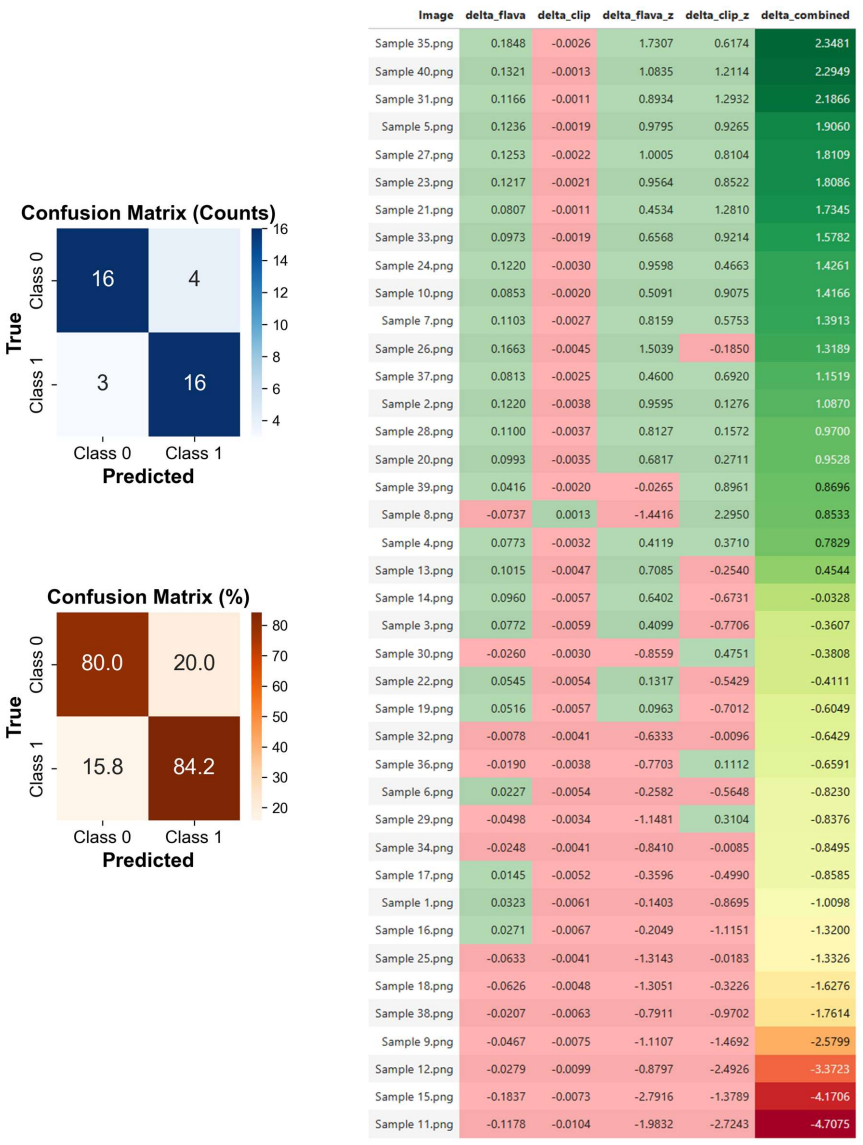
The net similarity delta with customized positive and negative references. For each expert assessment, Equations 5-8 define mean positive and negative embeddings: average CLIP text embeddings of ideal and non-ideal textual descriptions, and average FLAVA image embeddings of pre-qualified and defective example micrographs. A query image's signed score is cos(image, positive reference) minus cos(image, negative reference), computed separately in the CLIP vision-language space and the FLAVA vision-vision space. The two deltas are standardized by z-scores over the dataset and summed into the hybrid score whose sign yields the zero-shot label. This object carries the argument because it converts
What would settle it
Score metallographs from a build or batch that contributed no reference images and no z-score calibration statistics: build the positive and negative references from one set of samples and classify a completely separate set, then compare labels against expert annotations. If accuracy on the held-out set drops toward chance or degrades markedly relative to the in-sample numbers, the zero-shot generalization claim fails. A quicker audit is to check whether any image used to compute the average reference embeddings (Eq. 7) is also in the scored set; if so, the reported accuracies are in-sample by
Extended reading notes
Core claim
The central claim is that general-purpose embeddings from pre-trained vision-language models, too generic on their own for microstructure data, can be turned into domain-grounded qualification criteria by comparing every query image against averaged positive and negative reference embeddings built from expert-annotated images and their textual descriptions. For each expert assessment the score is a similarity delta: cosine similarity to the positive reference minus cosine similarity to the negative reference. The framework then hybridizes two complementary models: CLIP supplies the image-to-text delta, which stays stable across phrasings of the same criterion and improves when prompts name t
Load-bearing premise
The argument rests on the assumption that a handful of hand-picked reference images and text prompts, selected from the same dataset that is then scored, represent the full range of acceptable and defective microstructures; the paper does not report excluding reference images from the scored set, so the demonstrated accuracies may be in-sample rather than evidence of generalization to unseen microstructures.
Editorial extensions
If this is right
- Zero-shot qualification of microstructures against expert criteria is feasible without task-specific retraining, provided the positive and negative references cover the range of defect variants for each criterion.
- FLAVA and CLIP contribute complementary strengths; a hybrid score exploits FLAVA's sharper visual discrimination and CLIP's stable, phrasing-robust textual alignment.
- Z-score normalization is decision-relevant, not cosmetic: it flips borderline classifications by rebalancing the influence of each model near the zero threshold.
- Color-aware textual prompts that mirror the segmentation color code materially improve CLIP image-to-text alignment, a cheap prompt-engineering lever for this domain.
- The same reference-and-threshold machinery can be assembled into a modular detection tree and multimodal knowledge base that supports retrieval, semantic search, and human-in-the-loop threshold adjustment.
Reading between the lines
- A direct test of the zero-shot claim would score metallographs from an entirely different build or batch, with references drawn only from the current one; the paper scores all images in a single dataset against references selected from that same dataset, so its accuracies are likely an optimistic bound on cross-build transfer.
- The hybrid sum of z-scored deltas is one fusion rule; weighted or learned fusion, or voting across criteria, are untested alternatives, and the paper's own tool proposal lists them only as interface options.
- The color-aware prompting result suggests a transferable recipe: aligning prompt vocabulary with the segmentation color map may boost cross-modal similarity in other segmentation-based inspection pipelines, and could be tested cheaply on grayscale or SEM imagery.
- Reference-set ablation, adding one positive or negative example at a time and measuring accuracy gain, would reveal how many expert-annotated examples are actually needed, which the paper does not quantify.
Editorial analysis
A structured set of objections, weighed in public.
Referee Report
Summary. The paper proposes a vision-language framework for industrial qualification of additively manufactured Ni-WC metal matrix composites. It uses semantic segmentation (MicroSegQ+) to extract microstructure information, then encodes this information and expert characterization texts with CLIP and FLAVA. To improve over generic embeddings, the authors introduce customized representations based on positive/negative reference images and text prompts, compute per-modality similarity deltas, z-score normalize them, and fuse the deltas into a hybrid score that is thresholded at zero. The authors claim this enables zero-shot classification of previously unseen microstructures and validate it on a 40-image metallography dataset across several expert-assessment criteria, reporting confusion matrices and retrieval accuracies. The paper also proposes an industrial knowledge-base use case and a decision-tree workflow.
Significance. If the central zero-shot claim were properly supported, the paper would make a useful contribution: it addresses a real bottleneck in materials qualification, encodes domain expertise in text prompts, and combines complementary strengths of CLIP and FLAVA. The expert-assessment prompt design and the idea of customizing similarity with positive/negative references are interesting, and the paper includes interpretability analyses of embedding dimensions. However, the current evidence does not support the headline claim. The evaluation is in-sample: references and z-score statistics are derived from the same 40-image dataset that is then scored. No held-out split, cross-validation, or independent test set is described. The load-bearing assertion of zero-shot generalization is therefore unsubstantiated, and the reported accuracies cannot be interpreted as predictive performance.
major comments (3)
- [Section 5] The experimental protocol is in-sample. The text states that 'representative positive and negative image samples were selected' and then 'cosine similarity was used to score all images in the dataset with respect to both positive and negative references.' Since the reference images are drawn from the same 40-image dataset that is subsequently scored, the confusion matrices in Figs. 26-28 measure nearest-class-mean performance on the training set, not zero-shot classification of unseen microstructures. The z-score normalization in Eqs. (9)-(10) compounds the leakage: the mean and standard deviation of the deltas are computed over the entire dataset, so each query contributes to its own normalization statistics. No held-out split, leave-one-out scheme, or restriction of references to samples excluded from scoring is reported. This directly contradicts the abstract and Section 4E claim of z
- [Section 5] The retrieval accuracies in Tables 2 and 3 are computed by ranking all images in the dataset against text prompts and comparing the rankings with expert labels. This is an in-library retrieval evaluation, not a test of generalization. In addition, no baseline comparisons are provided (e.g., segmentation-statistics classifiers, simple image features, or supervised models), and no error bars, confidence intervals, or statistical tests support the reported differences between FLAVA, CLIP, and CLIP-with-color. The paper's claims that hybrid scoring 'significantly improved classification performance' are therefore not quantitatively established.
- [Section 5] There is a substantive inconsistency in the expert-assessment numbering. Section 4C defines EA-1 Dilution, EA-2 HAZ, EA-3 Reinforcement Area, EA-4 Porosity, EA-5 Dissolution, and EA-6 Distribution. However, Tables 2 and 3 use rows labeled '#1', '#3', '#5', and the accompanying text refers to these as Dilution, Porosity, and Distribution, respectively. This mapping does not match the definitions in Section 4C and makes the retrieval results difficult to interpret. The manuscript also does not specify which sample IDs were used as positive/negative references in each of the three hybrid classification experiments, which is essential for reproducibility and for assessing the degree of overlap between reference and scored images.
minor comments (4)
- [Throughout] The token 'FLA V A' appears with artificial spaces throughout the manuscript; it should be 'FLAVA' consistently.
- [Section 7] The limitations paragraph lists manual prompts, lack of fine-tuning, and sensitivity to selected references, but does not acknowledge the in-sample evaluation protocol or the absence of a held-out set. This should be stated explicitly.
- [Data Availability] The data availability statement says data 'will be released upon publication' but provides no repository or access mechanism. Given that the experimental claims depend on the reference-selection choices, a concrete data/code release would materially aid reproducibility.
- [Tables 2-3] The row labels '#1', '#3', '#5' should be expanded to the full EA names, and the numbering should be aligned with Section 4C. Also, the text reports 'top-5 accuracies of 60% in EA1... 40% in EA3... 80% in EA5' but the table rows do not identify which EA each row represents.
Circularity Check
Evaluation of the zero-shot claim is in-sample: reference images and z-score statistics are derived from the same 40-image dataset that is scored, so reported accuracies cannot demonstrate generalization to unseen microstructures.
-
fitted input called prediction
[Section 5, 'Customized and Hybrid Representations' paragraph; Section 4E (Eqs. 7-8)]
"First, representative positive and negative image samples were selected and passed through the pre-trained FLAVA model to obtain normalized visual embeddings. ... For each modality, average positive and negative embeddings were computed, and cosine similarity was used to score all images in the dataset with respect to both positive and negative references."
Eq. (7) constructs the positive/negative reference embeddings from expert-selected images, and Eq. (8) scores every image in the dataset against those same references. The dataset is the 40-sample Ni-WC MMC set (Table A1), so the reference images are part of the scored set. The confusion matrices (Figs. 26-28) therefore measure how well each image matches the centroid of its own class (and the opposite class), i.e., training-set accuracy of a nearest-class-mean classifier. The Abstract's 'zero-shot classification of previously unseen microstructures' is not tested: there is no held-out split, cross-validation, or ablation in which the scored images are excluded from reference construction, so the reported accuracies cannot support the central claim.
-
other
[Section 4E, 'Hybridization of embeddings' (z-score normalization, after Eqs. 7-8)]
"To combine the CLIP and FLAVA deltas, each is standardized using z-score normalization across all samples to regularize the dynamic range of pretrained modalities within the dataset distribution. Let μ_CLIP and σ_CLIP denote the mean and standard deviation of Δ_CLIP ... and similarly for FLAVA."
The z-score statistics are computed over the same dataset that is subsequently classified. Each query image contributes to the μ and σ used to standardize its own delta, so the final hybrid score is not an independent per-image prediction. This is an additional leakage path: even if a future held-out image were scored, the reported numbers as computed reflect dataset-derived normalization, and the paper provides no held-out evaluation that removes this dependence.
full rationale
The paper's method itself is not mathematically circular in the sense of deriving a claimed result from an identical premise, and no load-bearing argument rests on a self-citation chain: the citation of [3] (MicroSegQ+) is used for the segmentation tool, not to establish the zero-shot VLR claim. The circularity burden is in the evaluation protocol. The central claim 'zero-shot classification of previously unseen microstructures' is supported only by experiments in which the positive and negative references (Eq. 7) are chosen from the same 40-image dataset that is then scored, and in which z-score normalization (Section 4E) is computed across all scored samples. Thus Figures 26-28 and the associated accuracies are in-sample similarity scores, not evidence of generalization to unseen microstructures. The paper even acknowledges in its limitations that the models 'may underperform when faced with out-of-distribution images' and that performance 'depends on careful calibration and may be sensitive to selected references,' which is consistent with this assessment. Because the claimed novelty is precisely the ability to qualify new/incoming micrographs without task-specific retraining, and the reported validation never separates references or normalization statistics from the scored set, the central experimental evidence reduces to a self-similarity measure. Score 7 reflects partial but load-bearing circularity: the derivation is self-contained, but the headline prediction claim is not supported by an independent test.
Assumptions & free parameters
free parameters (3)
- Positive/negative reference image sets per expert assessment =
Not specified; selected from the 40-sample dataset
- Text prompts for each expert assessment =
In Table 1
- Z-score normalization statistics =
Mean and standard deviation of deltas computed over all scored samples
assumptions (3)
- domain assumption Cosine similarity in CLIP/FLAVA embedding space is a valid measure of semantic alignment for microstructural expert criteria
- domain assumption The expert-labeled annotations in Table A1 are correct ground truth
- domain assumption Semantic segmentation masks from MicroSegQ+ are accurate on this dataset
Cite this review
Pith. "Pith review of Linking heterogeneous microstructure informatics with expert characterization knowledge through customized and hybrid vision-language representations for industrial qualification." pith.science (2026). https://pith.science/paper/S7FMZD2T
@misc{pith2026250820243,
  author       = {Pith},
  title        = {Pith review of: Linking heterogeneous microstructure informatics with expert characterization knowledge through customized and hybrid vision-language representations for industrial qualification},
  year         = {2026},
  howpublished = {\url{https://pith.science/paper/S7FMZD2T}},
  note         = {Machine review of arXiv:2508.20243}
}
read the original abstract
Rapid and reliable qualification of advanced materials remains a bottleneck in industrial manufacturing, particularly for heterogeneous structures produced via non-conventional additive manufacturing processes. This study introduces a novel framework that links microstructure informatics with a range of expert characterization knowledge using customized and hybrid vision-language representations (VLRs). By integrating deep semantic segmentation with pre-trained multi-modal models (CLIP and FLAVA), we encode both visual microstructural data and textual expert assessments into shared representations. To overcome limitations in general-purpose embeddings, we develop a customized similarity-based representation that incorporates both positive and negative references from expert-annotated images and their associated textual descriptions. This allows zero-shot classification of previously unseen microstructures through a net similarity scoring approach. Validation on an additively manufactured metal matrix composite dataset demonstrates the framework's ability to distinguish between acceptable and defective samples across a range of characterization criteria. Comparative analysis reveals that FLAVA model offers higher visual sensitivity, while the CLIP model provides consistent alignment with the textual criteria. Z-score normalization adjusts raw unimodal and cross-modal similarity scores based on their local dataset-driven distributions, enabling more effective alignment and classification in the hybrid vision-language framework. The proposed method enhances traceability and interpretability in qualification pipelines by enabling human-in-the-loop decision-making without task-specific model retraining. By advancing semantic interoperability between raw data and expert knowledge, this work contributes toward scalable and domain-adaptable qualification strategies in engineering informatics.
Figures


Figures from the paper (20 more)




Reference graph
Works this paper leans on
-
[1]
Gibson, I., Rosen, D. W., Stucker, B., Khorasani, M., Rosen, D., Stucker, B., and Khorasani, M., Additive manufacturing technologies. V ol. 17. 2021: Springer
work page 2021
-
[2]
DeCost, B. L., Jain, H., Rollett, A. D., and Holm, E. A., Computer vision and machine learning for autonomous characterization of am powder feedstocks. Jom, 2017. 69(3): p. 456-465
work page 2017
-
[3]
F., El Haddad, R., Zimmermann, M., Wood, G., Lamouche, G., Wanjara, P., and Zhao, Y
Safdar, M., Li, Y . F., El Haddad, R., Zimmermann, M., Wood, G., Lamouche, G., Wanjara, P., and Zhao, Y . F., Accelerated semantic segmentation of additively manufactured metal matrix composites: Generating datasets, evaluating convolutional and transformer models, and developing the MicroSegQ+ Tool. Expert Systems with Applications, 2024. 251: p. 123974
work page 2024
-
[4]
Rose, D., Forth, J., Henein, H., Wolfe, T., and Qureshi, A. J., Automated semantic segmentation of NiCrBSi-WC optical microscopy images using convolutional neural networks. Computational Materials Science, 2022. 210: p. 111391
work page 2022
-
[5]
Zhang, C., Zhao, Y . F., and El Haddad, R., Understanding the Impact of Applying Large Language Model in Engineering Design Education. Journal of Computing and Information Science in Engineering, 2025. 25(2)
work page 2025
-
[6]
Safdar, M., Xie, J., Mircea, A., and Zhao, Y . F., Human–Artificial Intelligence Teaming for Scientific Information Extraction From Data-Driven Additive Manufacturing Literature Using Large Language Models. Journal of Computing and Information Science in Engineering, 2025. 25(7). DOI: 10.1115/1.4068275
-
[7]
Fan, H., Liu, C., Janvisloo, N. E., Bian, S., Fuh, J. Y . H., Lu, W. F., and Li, B., MaViLa: Unlocking new potentials in smart manufacturing through vision language models. Journal of Manufacturing Systems, 2025. 80: p. 258-271
work page 2025
-
[8]
IEEE Transactions on Pattern Analysis and Machine Intelligence, 2024
Zhang, J., Huang, J., Jin, S., and Lu, S., Vision-language models for vision tasks: A survey. IEEE Transactions on Pattern Analysis and Machine Intelligence, 2024
work page 2024
Show all 43 references
-
[9]
F., Advancing machine learning in additive manufacturing: Perspectives on data challenges, model development, and industrial adoption
Safdar, M., Xie, J., and Zhao, Y . F., Advancing machine learning in additive manufacturing: Perspectives on data challenges, model development, and industrial adoption. ESAM, 2025. 1(1). DOI: 10.36922/esam025040004
2025 doi
-
[10]
F., On the data quality and imbalance in machine learning-based design and manufacturing—A systematic review
Xie, J., Sun, L., and Zhao, Y . F., On the data quality and imbalance in machine learning-based design and manufacturing—A systematic review. Engineering, 2025. 45: p. 105-131
2025
-
[11]
Advanced Engineering Informatics, 2025
Mustapha, K., A survey of emerging applications of large language models for problems in mechanics, product design, and manufacturing. Advanced Engineering Informatics, 2025. 64: p. 103066
2025
-
[12]
DeCost, B. L. and Holm, E. A., A computer vision approach for automated analysis and classification of microstructural image data. Computational materials science, 2015. 110: p. 126- 133
2015
-
[13]
and Lee, G., Hybrid large language model approach for prompt and sensitive defect management: A comparative analysis of hybrid, non-hybrid, and GraphRAG approaches
Jeon, K. and Lee, G., Hybrid large language model approach for prompt and sensitive defect management: A comparative analysis of hybrid, non-hybrid, and GraphRAG approaches. Advanced Engineering Informatics, 2025. 64: p. 103076
2025
-
[14]
Advanced Engineering Informatics, 2025
Wang, Y ., Luo, H., and Fang, W., An integrated approach for automatic safety inspection in construction: Domain knowledge with multimodal large language model. Advanced Engineering Informatics, 2025. 65: p. 103246. 44
2025
-
[15]
and Olivetti, E., MatKG: An autonomously generated knowledge graph in Material Science
Venugopal, V . and Olivetti, E., MatKG: An autonomously generated knowledge graph in Material Science. Scientific Data, 2024. 11(1): p. 217
2024
-
[16]
Advanced Engineering Informatics,
Ren, J., Ahmad, R., Li, D., Ma, Y ., and Hui, J., Industrial applications of digital twins: A systematic investigation based on bibliometric analysis. Advanced Engineering Informatics,
-
[17]
and Hadjidoukas, P., Deep learning based automated fracture identification in material characterization experiments
Karathanasopoulos, N. and Hadjidoukas, P., Deep learning based automated fracture identification in material characterization experiments. Advanced Engineering Informatics, 2024. 60: p. 102402
2024
-
[18]
Information Fusion, 2022
Luengo, J., Moreno, R., Sevillano, I., Charte, D., Pelaez-Vegas, A., Fernandez-Moreno, M., Mesejo, P ., and Herrera, F., A tutorial on the segmentation of metallographic images: Taxonomy, new MetalDAM dataset, deep learning-based ensemble model, experimental analysis and chall...
2022
-
[19]
The International Journal of Advanced Manufacturing Technology, 2024
Deshpande, S., Venugopal, V ., Kumar, M., and Anand, S., Deep learning-based image segmentation for defect detection in additive manufacturing: An overview. The International Journal of Advanced Manufacturing Technology, 2024. 134(5): p. 2081-2105
2024
-
[20]
Engineering Applications of Artificial Intelligence, 2023
Thisanke, H., Deshan, C., Chamith, K., Seneviratne, S., Vidanaarachchi, R., and Herath, D., Semantic segmentation using Vision Transformers: A survey. Engineering Applications of Artificial Intelligence, 2023. 126: p. 106669
2023
-
[21]
K., Montoya, J
Mrdjenovich, D., Horton, M. K., Montoya, J. H., Legaspi, C. M., Dwaraknath, S., Tshitoyan, V ., Jain, A., and Persson, K. A., Propnet: a knowledge graph for materials science. Matter, 2020. 2(2): p. 464-480
2020
-
[22]
Advances in Neural Information Processing Systems, 2024
Ye, Y ., Ren, J., Wang, S., Wan, Y ., Razzak, I., Hoex, B., Wang, H., Xie, T., and Zhang, W., Construction and Application of Materials Knowledge Graph in Multidisciplinary Materials Science via Large Language Model. Advances in Neural Information Processing Systems, 2024. 37:...
2024
-
[23]
arXiv preprint arXiv:2407.06564, 2024
Kau, A., He, X., Nambissan, A., Astudillo, A., Yin, H., and Aryani, A., Combining knowledge graphs and large language models. arXiv preprint arXiv:2407.06564, 2024
2024 arXiv
-
[24]
Y ., Large language models: Expectations for semantics-driven systems engineering
Buchmann, R., Eder, J., Fill, H.-G., Frank, U., Karagiannis, D., Laurenzi, E., Mylopoulos, J., Plexousakis, D., and Santos, M. Y ., Large language models: Expectations for semantics-driven systems engineering. Data & Knowledge Engineering, 2024. 152: p. 102324
2024
-
[25]
Materials Today Communications, 2024
Satpute, P., Tiwari, S., Gupta, M., and Ghosh, S., Exploring large language models for microstructure evolution in materials. Materials Today Communications, 2024. 40: p. 109583
2024
-
[26]
Zhang, S., Wang, W. Y ., Wang, X., Li, G., Ren, Y ., Gao, X., Sun, F., Tang, B., Song, H., and Li, J., Large language models enabled intelligent microstructure optimization and defects classification of welded titanium alloys. Journal of Materials Informatics, 2024. 4(4): p. N/A-N/A
2024
-
[27]
and Farimani, A
Pak, P. and Farimani, A. B., AdditiveLLM: Large Language Models Predict Defects in Additive Manufacturing. arXiv preprint arXiv:2501.17784, 2025
2025
-
[28]
K., Zhang, Z., Seo, J., Kuo, R., Jiang, R., Strubell, E., and Rollett, A
Verma, A. K., Zhang, Z., Seo, J., Kuo, R., Jiang, R., Strubell, E., and Rollett, A. D., Structured Extraction of Process Structure Properties Relationships in Materials Science. arXiv preprint arXiv:2504.03979, 2025
2025
-
[29]
Advanced Engineering Informatics, 2025
Yang, C., Huang, X., Zhang, Y ., Huang, Z., Liu, F., and Wan, Y ., Expert decision support system for biologically inspired product design integrating emotional preferences and image generation. Advanced Engineering Informatics, 2025. 66: p. 103431
2025
-
[30]
Advanced Engineering Informatics, 2024
Lian, Z., Zhou, Z., Hu, C., Feng, Z., Ning, P., and Ming, Z., Interpretable large-scale belief rule base for complex industrial systems modeling with expert knowledge and limited data. Advanced Engineering Informatics, 2024. 62: p. 102852
2024
-
[31]
Advanced Engineering Informatics, 2023
Liu, T., Zheng, H., Zheng, P., Bao, J., Wang, J., Liu, X., and Yang, C., An expert knowledge- empowered CNN approach for welding radiographic image recognition. Advanced Engineering Informatics, 2023. 56: p. 101963
2023
-
[32]
and Yin, X., Tailored Vision-Language Framework for Automated Hazard Identification And Report Generation in Construction Sites
Chen, Q. and Yin, X., Tailored Vision-Language Framework for Automated Hazard Identification And Report Generation in Construction Sites. Available at SSRN 5137949. 45
-
[33]
T., Chen, L., Ng, Y
Khan, M. T., Chen, L., Ng, Y . H., Feng, W., Tan, N. Y . J., and Moon, S. K., Fine-Tuning Vision- Language Model for Automated Engineering Drawing Information Extraction. arXiv preprint arXiv:2411.03707, 2024
2024 arXiv
-
[34]
K., and Zhao, Y
Xie, J., Safdar, M., Chen, L., Moon, S. K., and Zhao, Y . F., Audio-visual cross-modality knowledge transfer for machine learning-based in-situ monitoring in laser additive manufacturing. Additive Manufacturing, 2025: p. 104692
2025
-
[35]
Automation in Construction, 2024
Chen, H., Hou, L., Wu, S., Zhang, G., Zou, Y ., Moon, S., and Bhuiyan, M., Augmented reality, deep learning and vision-language query system for construction worker safety. Automation in Construction, 2024. 157: p. 105158
2024
-
[36]
J., Cephalo: Multi‐Modal Vision‐Language Models for Bio‐Inspired Materials Analysis and Design
Buehler, M. J., Cephalo: Multi‐Modal Vision‐Language Models for Bio‐Inspired Materials Analysis and Design. Advanced Functional Materials, 2024. 34(49): p. 2409531
2024
-
[37]
Liu, X., Wang, Y ., Yang, T., Liu, X., and Wen, X.-D., AlchemBERT: Exploring Lightweight Language Models for Materials Informatics. 2025
2025
-
[38]
J., Materials science in the era of large language models: a perspective
Lei, G., Docherty, R., and Cooper, S. J., Materials science in the era of large language models: a perspective. Digital Discovery, 2024. 3(7): p. 1257-1272
2024
-
[39]
S., Desrosiers, A., Andreaco, A., and Sangid, M
Stopka, K. S., Desrosiers, A., Andreaco, A., and Sangid, M. D., A methodology for the rapid qualification of additively manufactured materials based on pore defect structures. Integrating Materials and Manufacturing Innovation, 2024. 13(1): p. 335-359
2024
-
[40]
I., Lamikiz, A., and Mayr, P., Digital Twin of the laser- DED process based on a multiscale approach
Hartmann, S., Murua, O., Arrizubieta, J. I., Lamikiz, A., and Mayr, P., Digital Twin of the laser- DED process based on a multiscale approach. Simulation Modelling Practice and Theory, 2024. 132: p. 102881
2024
-
[41]
L., Bose, S., Bandyopadhyay, A., Schoenung, J
Svetlizky, D., Das, M., Zheng, B., Vyatskikh, A. L., Bose, S., Bandyopadhyay, A., Schoenung, J. M., Lavernia, E. J., and Eliaz, N., Directed energy deposition (DED) additive manufacturing: Physical characteristics, defects, challenges and applications. Materials Today, 2021. 4...
2021
-
[42]
W., Hallacy, C., Ramesh, A., Goh, G., Agarwal, S., Sastry, G., Askell, A., Mishkin, P., and Clark, J
Radford, A., Kim, J. W., Hallacy, C., Ramesh, A., Goh, G., Agarwal, S., Sastry, G., Askell, A., Mishkin, P., and Clark, J. Learning transferable visual models from natural language supervision. in International conference on machine learning. 2021. PmLR
2021
-
[43]
Flava: A foundational language and vision alignment model
Singh, A., Hu, R., Goswami, V ., Couairon, G., Galuba, W., Rohrbach, M., and Kiela, D. Flava: A foundational language and vision alignment model. in Proceedings of the IEEE/CVF conference on computer vision and pattern recognition. 2022. 46 Table A1: Expert-labeled metallograp...
2022
Reviewed August 5, 2026 · model on record in the stance chip above.
Discussion (0). Sign in to comment.