REVIEW 4 major objections 7 minor 2 references
Strong Raman Optical Activity and Chiral Phonons in Chiral Hybrid Organic-Inorganic Perovskites
T0 review · 4 major / 7 minor · reviewed 2026-08-15 · deepseek-v4-flash
Pith's one-line read Circularly polarized excitation produces large, enantiomer-dependent intensity differences in the low-frequency Raman spectra of chiral hybrid perovskites, and calculations identify the active modes as chiral phonons with opposite angular…
desk verdict First circularly polarized Raman study on chiral perovskites, but the central ROA claim is undone by the paper's own absorption explanation and missing CD baseline; the DFT phonon angular momentum work stands on its own. read the letter →
The pith
A machine-rendered reading of the paper's core claim, the machinery that carries it, and where it could break.
The reading
What carries the argument
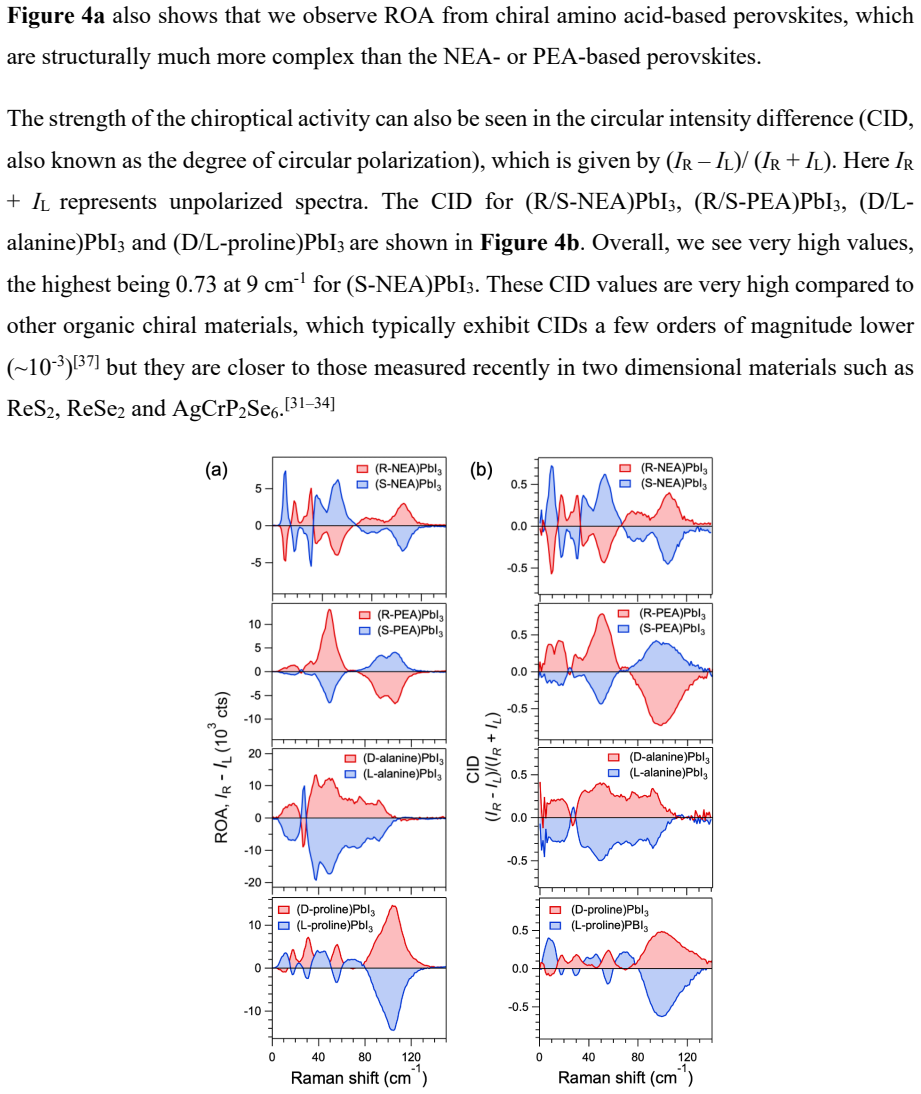
The experimental machinery is the circularly polarized Raman measurement in co- and cross-circular configurations (RR, LL, RL, LR), with Raman optical activity defined as the intensity difference I_R - I_L and quantified by the circular intensity difference (I_R - I_L)/(I_R + I_L). The theoretical machinery is the phonon angular momentum expression J = ℏ u^† M^α u, where M^α is built from the Levi-Civita tensor and projects phonon eigenvectors onto rotational motion. The chain that carries the argument is: circular dichroism near the band edge proves chirality transfer; low-frequency Raman peaks are assigned to Pb-I octahedral vibrations; the strongly asymmetric modes coincide with calculated modes carrying finite phonon angular momentum; and the near-perfect enantiomer swap in the spectra links the intensity asymmetry directly to the handedness of the crystal.
What would settle it
Measure the same enantiomer's Raman spectra with a fixed incident circular polarization while switching only the detected circular polarization, and also record how I_R - I_L scales with crystal thickness and excitation wavelength; if the asymmetry scales with absorbed power and follows the circular dichroism spectrum, it is absorption-gated rather than phonon ROA, whereas if it survives normalization by absorbed power and changes with detection handedness, the chiral scattering tensor claim is supported.
Extended reading notes
Core claim
The central claim is that chirality transfer from the chiral organic cation to the lead-iodide octahedra makes the low-frequency phonons of chiral hybrid organic-inorganic perovskites intrinsically chiral, so that right- and left-circularly polarized excitation produces markedly different Raman spectra. For each enantiomer pair, the RL spectrum of one crystal matches the LR spectrum of the other, meaning the polarization asymmetry swaps with molecular handedness. First-principles phonon calculations reproduce all twelve observed peaks and assign the strongly asymmetric modes to Pb-I octahedral vibrations; phonon angular momentum calculations yield modes with opposite signs of Jx, Jy, and Jz along different Brillouin-zone directions, including a pair near 10.7 cm-1 whose atoms rotate clockwise and anticlockwise with near-unity angular momentum. The paper concludes that the strong Raman optical activity and the chiral phonon modes are direct consequences of the chiral distortion of the octahedral sublattice, making circularly polarized Raman a broadly applicable probe of chirality transfer in CHOIPs.
Load-bearing premise
The paper's load-bearing premise is that the difference between right- and left-circularly excited Raman spectra is Raman optical activity of the phonon modes, even though the paper itself says the difference is due to preferential absorption of the two circular polarizations by the enantiomers; if absorption rather than a chiral scattering tensor drives the asymmetry, the central claim of strong phonon ROA would need to be reformulated.
Editorial extensions
If this is right
- Low-frequency circularly polarized Raman becomes a general, sub-bandgap diagnostic for chirality transfer in chiral hybrid organic-inorganic perovskites, applicable across a wide range of chiral organic cations.
- If the phonons genuinely carry angular momentum, resonant or near-resonant excitation could couple chiral phonons to electronic spin or valley degrees of freedom, enabling control of circularly polarized luminescence in these materials.
- The high degree of circular polarization, with CID up to 0.73, implies that individual octahedral modes can be selectively pumped by choosing the handedness of the excitation, a step toward chiral Raman lasers and circular polarization filters.
- The persistence of narrow Raman lines from 100 to 400 K indicates that the chiral octahedral network is rigid against phase transitions, extending the useful operating range of CHOIP optoelectronic and phononic devices.
Reading between the lines
- The paper does not separate absorption-gated selection from scattering-tensor ROA in its static optical setup; a thickness- and wavelength-dependent study would test whether the reported I_R - I_L asymmetry scales with circular dichroism absorption.
- The perfect enantiomer swap (RL of the R crystal equals LR of the S crystal) hints that preferential absorption of one circular polarization before an otherwise identical Raman scattering event may dominate; if so, the effect is better called circular-dichroism-gated Raman rather than conventional phonon ROA, while the calculated chiral phonons would still stand.
- Extending the measurements toward the band edge or to resonant excitation could reveal whether chiral phonons couple to excitons in the lead-iodide sublattice, linking phonon angular momentum to the circularly polarized luminescence already known in these materials.
- The same phonon angular momentum analysis should transfer to other chiral space groups, offering a screening criterion: materials with large computed phonon angular momentum in low-frequency modes are the best candidates for observing mode-selective circular polarization effects.
Signed reviews
Editorial analysis
A structured set of objections, weighed in public.
Referee Report
Summary. The paper reports the synthesis and characterization of chiral hybrid organic-inorganic perovskites (CHOIPs) based on R/S-NEA, R/S-PEA, D/L-alanine, and D/L-proline cations, and presents low-frequency circularly polarized Raman spectra (785 nm excitation) alongside DFT calculations of phonon modes and phonon angular momentum (PAM). The authors claim strong Raman optical activity (ROA) with circular intensity differences as high as 0.73, attribute the effect to chirality transfer from the organic linkers to the PbI3 octahedra, and identify several chiral phonon modes with opposite PAM from first-principles calculations. The central claim is that circularly polarized light selectively excites low-frequency Raman-active modes of the lead-iodide sublattice and that these modes carry phonon angular momentum.
Significance. If fully substantiated, this work would be a notable advance in chiroptical spectroscopy of hybrid perovskites, offering a new probe of chirality transfer and chiral phonons in solids. The DFT calculations and PAM analysis follow standard, transparent methods, and the paper provides crystallographic data (CCDC), detailed synthetic procedures, and temperature-dependent measurements, which are commendable. However, the experimental ROA claim is undermined by the paper's own attribution of the observed intensity differences to preferential absorption of the excitation beam rather than to a chiral Raman scattering tensor, and by the absence of a 785-nm circular dichroism baseline. The mode-level interpretation is further weakened by substantial mismatches between RL and LR peak frequencies in Table 1. The computational identification of chiral phonons is independent and valuable, but it does not rescue the central experimental conclusion.
major comments (4)
- [Results and Discussion (Figure 2 discussion)] The paper states that the large variation in peak intensities between RL and LR spectra is 'due to preferential absorption of RCP or LCP excitation by the two CHOIP enantiomers,' yet it subsequently defines the difference as Raman optical activity. Preferential absorption is circular dichroism of the excitation beam, not a property of the Raman scattering tensor, so the difference does not by itself measure ROA of the phonon modes. No CD or polarization-resolved transmission measurement at 785 nm is reported, despite the excitation being sub-bandgap, so the magnitude of absorption-induced asymmetry is unknown. This conflation is load-bearing and invalidates the central claim of strong ROA.
- [Table 1] The peak frequencies listed for the RL and LR configurations differ substantially for the same nominal modes: peak 4 at 34.1 versus 31.1 cm-1, peak 6 at 47.6 versus 42.8 cm-1, peak 7 at 52.7 versus 46.6 cm-1, and peak 9 at 94 versus 101.1 cm-1. If the same phonon is being excited in both configurations, its frequency should be independent of the circular polarization combination; the observed differences indicate that different modes are selected in RL versus LR. Consequently, computing IRL - ILR at fixed wavenumbers does not measure the ROA of a single mode, and the mode-level interpretation of the ROA and CID spectra is not justified.
- [Results and Discussion (text preceding Table 1)] The statement that calculated peaks are blue-shifted by 'between 0.7 - 7.7 cm-1' is contradicted by Table 1: peak 9 (measured 75.4 versus calculated 83.7 cm-1) differs by 8.3 cm-1, peak 10 (90.8 versus 99.8 cm-1) by 9.0 cm-1, and peak 11 (107.5 versus 105.8 cm-1) is red-shifted. The larger deviations indicate that the assignment of several experimental peaks to specific calculated modes is insecure, which further weakens the claimed correspondence between calculated chiral phonons and experimental ROA features.
- [Results and Discussion (ROA definition and CID)] The circular intensity difference is defined as (IR - IL)/(IR + IL), with the text stating that 'IR + IL represents unpolarized spectra.' However, the unpolarized spectra were measured separately, not as the sum of RL and LR intensities, so the denominator is not the total scattered intensity for the same scattering configuration. The quantitative CID values, including the peak value of 0.73, are therefore not a well-defined standard circular intensity difference and may be dominated by differences in excitation throughput between polarization configurations unless a common normalization is established.
minor comments (7)
- [Introduction] Typo: 'we well as structural metrics' should read 'as well as structural metrics.'
- [Figure 2 caption] The caption writes '(R/S-NEA)PBI3'; the chemical formula should be PbI3, not PBI3.
- [Experimental section] 'mucasol/ DI water' should be 'Mucasol/DI water' for clarity.
- [Throughout] The symbol 'G point' is used in place of the standard notation 'Γ point'; this should be corrected for consistency with the literature.
- [Computational Details] The phonon angular momentum expression in the text contains a garbled symbol ('%') in the matrix product; please typeset the equation correctly.
- [Table 1] The calculated frequency column is not labeled with units; add 'cm-1' for consistency with the measured columns.
- [Conclusions] The conclusions state that the experimental modes 'exhibit opposite phonon angular momenta due to their chiral nature,' but the text near Figure 6 acknowledges that the splitting is too small to measure and that the correspondence between calculated and measured modes is difficult to establish; the conclusions should be moderated accordingly.
Circularity Check
No significant circularity: the ROA/absorption confound is a measurement-interpretation issue, not a circular derivation.
full rationale
The derivation chain is self-contained. The experimental claim rests on direct polarized Raman measurements; ROA is explicitly defined as the difference between RCP- and LCP-excited intensities, so the reported intensity asymmetry is an observation rather than a quantity derived from a fitted model. The paper's attribution of that asymmetry to preferential absorption is a potential confound for the physical interpretation, but it is a validity concern, not a circular reduction: no fitted parameter, imported uniqueness theorem, or self-citation is needed to produce the intensity difference. The DFT Raman spectra and phonon angular momentum calculations use standard VASP/Phonopy methods and the experimental crystal structure, with no parameters fitted to the ROA/CID data; mode matching is by frequency and is admittedly loose ('it is difficult to find the exact correspondence between the chiral phonons measured experimentally, the ROA intensities and the calculated modes'), which is a limitation rather than circularity. The only self-citation (Ref. 34, ACS Nano 2025) is used to contextualize CID magnitudes alongside independent Refs. 31-33 and is not load-bearing. Table 1 shows RL/LR frequency differences (e.g., 52.7 vs 46.6 cm-1 for mode 7), which raises the question whether fixed-wavenumber subtractions compare the same mode, but even if this undermines the ROA interpretation, it does not make the result equivalent to its inputs by construction.
Assumptions & free parameters
assumptions (3)
- domain assumption PBE+D3 DFT with a 1x1x1 supercell and finite-displacement phonons accurately describes the low-frequency phonon modes of these soft hybrid perovskites.
- domain assumption The harmonic approximation at 0 K represents the room-temperature Raman spectrum of these anharmonic materials.
- standard math The phonon angular momentum operator from Zhang and Niu (Refs 39-41) applies to degenerate modes at the zone center in the P212121 space group.
Cite this review
Pith. "Pith review of Strong Raman Optical Activity and Chiral Phonons in Chiral Hybrid Organic-Inorganic Perovskites." pith.science (2026). https://pith.science/paper/KLALVH6F
@misc{pith2026250820338,
  author       = {Pith},
  title        = {Pith review of: Strong Raman Optical Activity and Chiral Phonons in Chiral Hybrid Organic-Inorganic Perovskites},
  year         = {2026},
  howpublished = {\url{https://pith.science/paper/KLALVH6F}},
  note         = {Machine review of arXiv:2508.20338}
}
read the original abstract
Hybrid organic-inorganic perovskites with chiral organic cations are very interesting for optoelectronic applications because of their intrinsically chiral light-matter interactions. Chiral distortions in these materials lead to circular dichroism, circular birefringence, and circularly polarized luminescence in the band transitions of the inorganic sublattice. Raman-active vibrational modes in these crystals are governed by crystal symmetry and therefore are also strongly impacted by the nature and magnitude of the chiral distortions. Here, we report low-frequency Raman modes that are sensitive to circularly polarized excitation in chiral hybrid organic-inorganic perovskites (CHOIPs) across a wide range of structures and compositions. The circularly polarized Raman spectra from enantiomers of CHOIP single crystals exhibit sharp modes below 150 cm-1, corresponding to vibrations of the lead iodide octahedra. These modes exhibit strong differences in intensities (Raman optical activity, ROA) depending on the handedness of the excitation, with high degree of polarization for several modes. Calculations reveal the presence of several chiral phonon modes with opposite phonon angular momenta. The strong ROA and the chiral phonon modes are a direct consequence of chirality transfer from the chiral organic linker to the lead iodide octahedra in the CHOIP structure, resulting in a strong chiroptical response in the phonon modes.
Figures


Figures from the paper (1 more)

Reference graph
Works this paper leans on
-
[9]
M. T. Pham, E. Amerling, T. A. Ngo, H. M. Luong, K. Hansen, H. T. Pham, T. N. Vu, H. Tran, L. Whittaker‐Brooks, T. D. Nguyen, Advanced Optical Materials 2022, 10, 2101232. [10] Y. Shao, W. Gao, H. Yan, R. Li, I. Abdelwahab, X. Chi, L. Rogée, L. Zhuang, W. Fu, S. P. Lau, Nature communications 2022, 13, 138. [11] H. Duim, M. A. Loi, Matter 2021, 4, 3835. [1...
work page 2022
-
[29]
Chiral Phonons in 2D Halide Perovskites
K. Ishito, H. Mao, K. Kobayashi, Y. Kousaka, Y. Togawa, H. Kusunose, J. Kishine, T. Satoh, Chirality 2023, 35, 338. [30] K. Ishito, H. Mao, Y. Kousaka, Y. Togawa, S. Iwasaki, T. Zhang, S. Murakami, J. Kishine, T. Satoh, Nat. Phys. 2023, 19, 35. [31] S. Zhang, N. Mao, N. Zhang, J. Wu, L. Tong, J. Zhang, ACS nano 2017, 11, 10366. [32] S. Zhang, J. Huang, Y....
work page Pith review arXiv doi:10.48550/arxiv.2411.17225 2023
Reviewed August 15, 2026 · model on record in the stance chip above.
Discussion (0). Continue with ORCID to comment.