REVIEW 4 major objections 5 minor 39 references
This paper proposes replacing exhaustive antenna selection in flexible XL-MIMO with an array configuration codebook, cutting the search from all (M choose N) pixel combinations to a few thousand structured layouts.
Reviewed by Pith at T0; open to challenge. T0 means a machine referee read the full paper against a public rubric. the ladder, T0–T4 →
A codebook of pre-designed array configurations (compact, sparse, modular, nested, co-prime) enables low-overhead antenna activation training for XL-MIMO communication and localization, with two-stage scanning approaching exhaustive search performance.
T0 review reviewed 2026-08-05 challenge →
load-bearing objection Solid engineering paper with a genuinely new ACC concept and clean closed-form results; the two-stage scanning heuristic is the main soft spot but is addressable, so it deserves refereeing. the 4 major comments →
Flexible XL-MIMO via Array Configuration Codebook: Codebook Design and Array Configuration Training
The pith
A machine-rendered reading of the paper's core claim, the machinery that carries it, and where it could break.
The reading
Core claim
The paper's core claim is that an array configuration codebook (ACC), a subset of all antenna-activation patterns, can make flexible XL-MIMO practical. Each codeword fixes the positions of the N activated antenna pixels and belongs to one of five parameterized array families: compact array (CA), uniform sparse array (USA), modular array (MoA), nested array (NA), and co-prime array (CPA). Each family is controlled by a common reference-position parameter plus one family-specific parameter: sparsity level, module spacing, inner-array size, or first-array size. The crucial assertion is that optimizing over this structured subset is both tractable and near-optimal: for M=256, N=32, exhaustive AC
What carries the argument
The central object is the array configuration codebook (ACC): a pre-designed set of codewords, each encoding the positions of N activated antenna pixels as one parameterized array layout, with the codebook size far smaller than the full set of (M choose N) combinations. The two-stage training scheme is the algorithmic tool that makes the codebook practical: stage 1 coarsely samples each architecture at non-overlapping positions along the array, and stage 2 freezes the architecture-specific parameter and sweeps adjacent pixel positions around the best coarse codeword. A complementary closed-form incremental SINR expression in the greedy antenna-selection benchmark reuses previous-step results
Load-bearing premise
The two-stage scan assumes that a coarse stage-1 sample can be refined locally, meaning the sum-rate surface is smooth and does not hide a better codeword at an architecture parameter that stage 1 skipped; if it does, the search can miss the ACC optimum.
What would settle it
Simulate many user/scatterer geometries and compare the two-stage output with the exhaustive ACC best; any geometry where the two-stage sum rate is materially below exhaustive—for instance, when the optimal sparsity level falls between the coarse stage-1 samples—would show the locality assumption behind the scheme fails.
If this is right
- A base station with N RF chains and M low-cost antenna pixels can reconfigure its active array by switching codewords, keeping hardware cost low while tracking changing user locations.
- The two-stage scan reduces the search from 5.824e40 antenna combinations to 6961 codebook entries, and to 1120 in the worst case, making dynamic array reconfiguration feasible in practice.
- For multi-user communication, uniform sparse arrays (or compact arrays at high user density) give the highest sum rate, while for localization, nested arrays give the lowest AoA RMSE, so the codebook can be partitioned by scenario to cut training overhead further.
- The greedy antenna-selection benchmark shows closed-form incremental SINR updates, making sequential antenna selection computationally cheap when a codebook search is not used.
- The ACC idea naturally extends to other array families such as minimum-redundancy and minimum-holes arrays, which the paper explicitly flags as future work.
Where Pith is reading between the lines
- A testable implication the paper leaves open is that the two-stage scan's coarse-to-fine logic relies on the sum-rate surface being smooth in the architecture parameters; comparing two-stage with exhaustive ACC on clustered-scatterer geometries would reveal how often the coarse grid skips the optimal layout.
- Because codewords are just pixel-position lists, the ACC idea could be combined with codebook-based beamforming, letting the base station jointly pick an array layout and a beam codebook entry—an extension the paper does not develop.
- The localization results suggest a natural integrated-sensing-and-communication reading: a single ACC scan could serve both sum-rate and AoA objectives through a weighted utility, whereas the paper treats them as separate scenarios.
- The reference-position parameter makes the codebook a spatial-shift codebook, so in line-of-sight or near-field channels the optimal codeword is likely to track the user cluster's positional centroid; one could try to predict the best codeword from location estimates instead of scanning it.
Editorial analysis
A structured set of objections, weighed in public.
Referee Report
Summary. The paper proposes an array configuration codebook (ACC) for flexible XL-MIMO with limited RF chains. Each codeword specifies the positions of N activated antenna pixels among M pixels; a concrete ACC is designed from CA, USA, MoA, NA, and CPA, each parameterized by a reference position and an architecture-specific parameter (η, Γ, N_in, N_f). For multi-user uplink communication, the paper formulates sum-rate maximization over the ACC and proposes exhaustive scanning and a two-stage scanning scheme: stage 1 coarsely samples one codeword per block of physical dimension N̄_a d, and stage 2 fixes the architecture-specific parameter and scans adjacent reference positions pixel-by-pixel. A greedy AS benchmark is developed with a closed-form incremental SINR update (Proposition 2). The training is extended to a wireless localization scenario with AoA RMSE as the utility. Simulation results show large performance variations across codewords and between architectures, and the two-stage scheme is claimed to achieve performance comparable to exhaustive scanning at much lower overhead (e.g., 1120 vs 6961 codewords for M=256, N=32).
Significance. If validated, the ACC concept provides a practical middle ground between exhaustive antenna selection (with (M choose N) combinations) and fixed arrays, enabling dynamic pixel activation at pilot-scale overhead. The paper gives a clean codebook construction for five classic array architectures, with explicit codebook sizes, and derives two propositions in detail: Proposition 1 (feasible nested-array region) and Proposition 2 (incremental SINR) are algebraically consistent. The overhead numbers and the distinction between communication and localization scenarios are also useful. The main reservation is that the central efficiency claim rests on a two-stage heuristic whose suboptimality is not characterized, and the comparison with greedy AS mixes incompatible complexity measures. These issues are load-bearing for the paper's main contribution and need to be addressed before acceptance.
major comments (4)
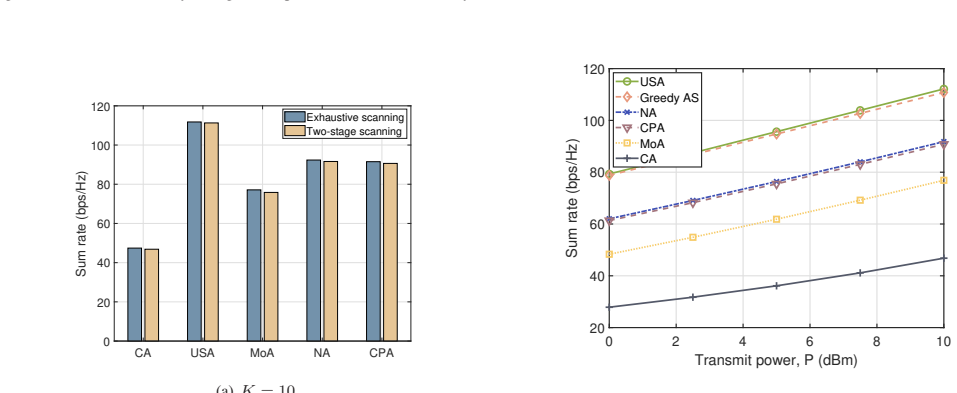
- [Section IV-B, Eqs. (25)-(31), Table I, Fig. 6] The central efficiency claim—that two-stage scanning yields 'comparable performance' to exhaustive scanning at 1120 vs 6961 codewords—is not backed by any optimality or suboptimality result. Stage 1 samples only one reference position per block of length N̄_a; stage 2 then freezes the architecture-specific parameter ϕ_a at its stage-1 value and scans only the T_a forward positions in (27)-(29). If the true best codeword lies in a different block, or if the best ϕ_a at fine reference positions differs from the ϕ_a selected on the coarse grid, the ACC optimum is never examined. No smoothness or unimodality property of R(w) is proved. Fig. 6 only shows K=10 and K=100 for a single geometry, with no quantification of the gap or its distribution. Please either provide a bound or sufficient conditions, or substantially broaden the experiments and temper the 'comparable' claim.
- [Section IV-C / VI-A] The overhead comparison between two-stage ACC and greedy AS mixes incompatible units. The two-stage overhead is the number of codeword evaluations (1120, or 162 for USA), each of which requires computing the sum rate of K users via SINRs (20) or (22), involving matrix inverses. The greedy AS overhead is the number of antenna-pixel candidate evaluations (7696, or 3976 for the parameter setting used in Fig. 7), each using the incremental update (36) at a much lower per-evaluation cost. To establish 'superiority ... in terms of training overhead reduction', the paper needs a per-evaluation complexity comparison or a total-operation count, not just a count of evaluations.
- [Abstract / Section VI-A, Figs. 7-8] The abstract states that ACC 'improves the system performance compared with conventional AS schemes', but the results show that two-stage scanning over USA is only 'comparable' to greedy AS in sum rate (Fig. 7), and the gap varies with K and eventually diminishes (Fig. 8). The concrete advantage over greedy AS demonstrated in the paper is in training overhead, not in sum-rate performance. Please revise the abstract and conclusion to state the comparison accurately, or supply results where ACC is strictly better in performance.
- [Section V, Eqs. (46)-(47), Figs. 9-10] In the localization extension, the two-stage scanning is applied 'similarly', but no comparison against exhaustive scanning over the ACC is reported for the RMSE utility. Figs. 9-10 show only the two-stage results per architecture. Since the same coarse/fine heuristic is used, the localization claims inherit the unquantified suboptimality of Section IV-B. An exhaustive-scanning comparison or an explicit limitation statement should be added.
minor comments (5)
- [Section VI vs Section IV-B] The simulation setup states N=16, while the numerical example in Section IV-B uses N=32. Please clarify which configuration applies to each figure and overhead number.
- [Section III, Eq. (15)] The codebook size is defined as the sum of the sizes of the five sub-codebooks. If the same pixel position vector can be generated by more than one architecture, the distinct-codebook count is smaller. Please state whether W_ACC is treated as a multiset or whether duplicate codewords are explicitly removed.
- [Algorithm 2] The algorithm uses the calligraphic set M and the scalar M for the total pixel count, which is confusing. Please rename the set, e.g., to A or C.
- [Section IV-B, Eq. (27)] The second term in the min in (27) is only briefly justified. Please spell out the boundary condition: the last activated pixel must not exceed (M-1)/2 d.
- [Notation] In Eq. (39), the far-field array response vector is written without a normalization factor; if the unit-norm convention is intended, it should be stated, since the localization spectrum in (45) depends on the norm convention.
Circularity Check
No significant circularity: the ACC overhead reduction is definitional, and the performance claims rest on independent simulations and classic external results, not on self-cited or fitted inputs.
full rationale
The paper's central claims are (i) that an ACC of pre-designed array configurations reduces the antenna-activation search space relative to exhaustive AS, and (ii) that a two-stage scanning scheme achieves performance comparable to exhaustive ACC scanning with lower overhead. Claim (i) is a direct consequence of the definitions: W_ACC is constructed as a subset of W with |W_ACC| = 6961 for M=256, N=32, versus |W| = C(256,32) ~ 5.824e40 (Sec. III and Sec. IV-A). This is counting, not circular. Claim (ii) is validated by simulation in Sec. VI-A, Fig. 6, where exhaustive scanning over the same codebook is the independent reference; no fitted parameter is used to produce the two-stage result. The two-stage scheme's stage-2 search (Eqs. 25-31) freezes the architecture-specific parameter from stage 1 and scans adjacent reference positions; this is a heuristic whose suboptimality gap is not bounded, so it is a correctness/robustness limitation, not a circularity. The greedy AS benchmark is derived independently via a Woodbury-identity incremental SINR formula (Prop. 2, Appendix B) and is not equivalent to the ACC training problem. Self-citations [23]-[29] are background on sparse-array properties (grating lobes, difference co-arrays) and are not load-bearing for the paper's main derivation; the associated claims are standard results or are directly demonstrated by the paper's simulations. No uniqueness theorem is imported from the authors, and no ansatz is smuggled in via citation to define the two-stage search. The paper is therefore self-contained with respect to its contribution: the codebook search reduction is enumerative, and the performance comparisons are empirical against exhaustive baselines.
Axiom & Free-Parameter Ledger
axioms (7)
- domain assumption Deterministic channel model with known gains and locations
- domain assumption Antenna pixel spacing d=λ/2 is fixed and mutual coupling is ignored
- domain assumption Near-field spherical-wave response model (Eq. 17) is exact for communication
- domain assumption Far-field steering vector (Eq. 39) and Bartlett spectrum (Eq. 45) for localization
- standard math Woodbury matrix identity is used without proof
- domain assumption Difference co-array property of nested arrays (Eqs. 43-44)
- domain assumption Pixel activation network and RF switching have negligible cost/latency
Cite this review
Pith. "Pith review of Flexible XL-MIMO via Array Configuration Codebook: Codebook Design and Array Configuration Training." pith.science (2026). https://pith.science/paper/27YOZRND
@misc{pith2026250820369,
  author       = {Pith},
  title        = {Pith review of: Flexible XL-MIMO via Array Configuration Codebook: Codebook Design and Array Configuration Training},
  year         = {2026},
  howpublished = {\url{https://pith.science/paper/27YOZRND}},
  note         = {Machine review of arXiv:2508.20369}
}
read the original abstract
XL-MIMO emerges as a promising technology to achieve unprecedented enhancements in spectral efficiency and spatial resolution, via orders-of-magnitude increase in the antenna array size. However, the practical issues of high hardware cost and power consumption pose great challenges towards the cost-effective implementation of XL-MIMO. To address such challenges, this paper proposes a novel concept called array configuration codebook (ACC), which enables flexible XL-MIMO cost-effectively and improves the system performance compared with conventional antenna selection (AS) schemes with limited number of RF chains. Specifically, ACC refers to a set of pre-designed array configuration codewords, where each codeword specifies the positions of activated antenna pixels. Then, flexible XL-MIMO architecture can be enabled via dynamical pixel activation based on the designed ACC, without having to exhaustively try all possible combinations of the antenna pixels activations. As an illustration, we give a specific codebook design, encompassing the classic compact array (CA), uniform sparse array (USA), modular array (MoA), nested array (NA), and co-prime array (CPA), and each codeword is specified by one array configuration parameter. With the designed ACC, array configuration training is considered for multi-UE communication to maximize the sum rate. To reduce the training overhead of exhaustive scanning, a two-stage scanning scheme is proposed, including the array- and pixel-level scanning. For comparison, the greedy AS scheme is proposed, where the resulting incremental SINR expression by activating antenna pixel sequentially is derived in closed-form. Subsequently, array configuration training is extended to the wireless localization scenario. Simulation results demonstrate the effectiveness of codeword optimization for scenarios of multi-UE communication and wireless localization.
Figures




Reference graph
Works this paper leans on
-
[1]
Framework and overall objectives of the future develop ment of IMT for 2030 and beyond,
“Framework and overall objectives of the future develop ment of IMT for 2030 and beyond,” ITU-R, Jun. 2023
work page 2030
-
[2]
Massive MIMO is a reality – what is next?: Five pro mising research directions for antenna arrays,
E. Bj¨ ornson, L. Sanguinetti, H. Wymeersch, J. Hoydis, a nd T. L. Marzetta, “Massive MIMO is a reality – what is next?: Five pro mising research directions for antenna arrays,” Digit. Signal Process. , vol. 94, pp. 3–20, Nov. 2019
work page 2019
-
[3]
Communicating with extremely large-s cale ar- ray/surface: Unified modeling and performance analysis,
H. Lu and Y . Zeng, “Communicating with extremely large-s cale ar- ray/surface: Unified modeling and performance analysis,” IEEE Trans. Wireless Commun., vol. 21, no. 6, pp. 4039–4053, Jun. 2022
2022
-
[4]
A tutorial on near-field XL-MIMO communications towards 6G,
H. Lu et al. , “A tutorial on near-field XL-MIMO communications towards 6G,” IEEE Commun. Surv. Tuts. , vol. 26, no. 4, pp. 2213–2257, 4th Quart. 2024
work page 2024
-
[5]
To ward extra large-scale mimo: New channel properties and low-cos t designs,
Y . Han, S. Jin, M. Matthaiou, T. Q. Quek, and C.-K. Wen, “To ward extra large-scale mimo: New channel properties and low-cos t designs,” IEEE Internet Things J. , vol. 10, no. 16, pp. 14 569–14 594, Aug. 2023
work page 2023
-
[6]
Extremely large-scale MIMO: Fundamentals, challenges, s olutions, and future directions,
Z. Wang, J. Zhang, H. Du, W. E. Sha, B. Ai, D. Niyato, and M. D ebbah, “Extremely large-scale MIMO: Fundamentals, challenges, s olutions, and future directions,” IEEE Wireless Commun., vol. 31, no. 3, pp. 117–124, Jun. 2024
work page 2024
-
[7]
TeraNets: Ultra -broadband communication networks in the terahertz band,
I. F. Akyildiz, J. M. Jornet, and C. Han, “TeraNets: Ultra -broadband communication networks in the terahertz band,” IEEE Wireless Com- mun., vol. 21, no. 4, pp. 130–135, Aug. 2014
work page 2014
-
[8]
Intellige nt reflecting surface-aided wireless communications: A tutor ial,
Q. Wu, S. Zhang, B. Zheng, C. Y ou, and R. Zhang, “Intellige nt reflecting surface-aided wireless communications: A tutor ial,” IEEE Trans. Commun., vol. 69, no. 5, pp. 3313–3351, May 2021
2021
-
[9]
Smart radio environments emp owered by reconfigurable intelligent surfaces: How it works, state of research, and the road ahead,
M. Di Renzo, A. Zappone, M. Debbah, M.-S. Alouini, C. Y uen , J. de Rosny, and S. Tretyakov, “Smart radio environments emp owered by reconfigurable intelligent surfaces: How it works, state of research, and the road ahead,” IEEE J. Sel. Areas Commun. , vol. 38, no. 11, pp. 2450–2525, Nov. 2020
2020
-
[10]
F. Liu, Y . Cui, C. Masouros, J. Xu, T. X. Han, Y . C. Eldar, a nd S. Buzzi, “Integrated sensing and communications: Toward dual-func tional wire- less networks for 6G and beyond,” IEEE J. Sel. Areas Commun. , vol. 40, no. 6, pp. 1728–1767, Jun. 2022
work page 2022
-
[11]
A tutorial on MIMO-OFDM ISAC: From far-field to near-field,
Q. Dai et al. , “A tutorial on MIMO-OFDM ISAC: From far-field to near-field,” arXiv preprint arXiv:2504.19091 , 2025
arXiv 2025
-
[12]
Toward environment-aware 6G communi cations via channel knowledge map,
Y . Zeng and X. Xu, “Toward environment-aware 6G communi cations via channel knowledge map,” IEEE Wireless Commun. , vol. 28, no. 3, pp. 84–91, Jun. 2021
2021
-
[13]
Dig ital beamforming-based massive MIMO transceiver for 5G millime ter-wave communications,
B. Y ang, Z. Y u, J. Lan, R. Zhang, J. Zhou, and W. Hong, “Dig ital beamforming-based massive MIMO transceiver for 5G millime ter-wave communications,” IEEE Trans. Microw. Theory Techn. , vol. 66, no. 7, pp. 3403–3418, Jul. 2018
work page 2018
-
[14]
Spatially sparse precoding in millimeter wave MIMO system s,
O. El Ayach, S. Rajagopal, S. Abu-Surra, Z. Pi, and R. W. H eath, “Spatially sparse precoding in millimeter wave MIMO system s,” IEEE Trans. Wireless Commun. , vol. 13, no. 3, pp. 1499–1513, Mar. 2014
2014
-
[15]
An overview of signal processing techniques for mi llimeter wave MIMO systems,
R. W. Heath, N. Gonzalez-Prelcic, S. Rangan, W. Roh, and A. M. Sayeed, “An overview of signal processing techniques for mi llimeter wave MIMO systems,” IEEE J. Sel. Top. Signal Process. , vol. 10, no. 3, pp. 436–453, Apr. 2016
work page 2016
-
[16]
Hybrid analog and digital beamfor ming for mmWave OFDM large-scale antenna arrays,
F. Sohrabi and W. Y u, “Hybrid analog and digital beamfor ming for mmWave OFDM large-scale antenna arrays,” IEEE J. Sel. Areas Com- mun., vol. 35, no. 7, pp. 1432–1443, Jul. 2017. 14 γ(n) k,m = ¯Pk ( ˜h(n) k 2 − ( ˜h(n) k ) H H(n) k G(n) k ( H(n) k ) H ˜h(n) k ) = ¯Pk ( ˜h(n−1) k 2 + |hk,m|2− [ ( ˜h(n−1) k ) H , h∗ k,m ] [ H(n−1) k dH ...
work page 2017
-
[17]
Millimeter wave MIMO with lens ant enna array: A new path division multiplexing paradigm,
Y . Zeng and R. Zhang, “Millimeter wave MIMO with lens ant enna array: A new path division multiplexing paradigm,” IEEE Trans. Commun. , vol. 64, no. 4, pp. 1557–1571, Apr. 2016
work page 2016
-
[18]
Antenna selection in MIM O systems,
S. Sanayei and A. Nosratinia, “Antenna selection in MIM O systems,” IEEE Commun. Mag. , vol. 42, no. 10, pp. 68–73, Oct. 2004
work page 2004
-
[19]
Fast antenn a subset selection in MIMO systems,
M. Gharavi-Alkhansari and A. B. Gershman, “Fast antenn a subset selection in MIMO systems,” IEEE Trans. Signal Process., vol. 52, no. 2, pp. 339–347, Feb. 2004
work page 2004
-
[20]
Fast antenna selection for near-field delay alignment modulation,
H. Lu and Y . Zeng, “Fast antenna selection for near-field delay alignment modulation,” IEEE Wireless Commun. Lett. , vol. 14, no. 3, pp. 751–755, Mar. 2025
work page 2025
-
[21]
Sparse MIMO for ISAC: New opportunities and challenges,
X. Li, H. Min, Y . Zeng, S. Jin, L. Dai, Y . Y uan, and R. Zhang , “Sparse MIMO for ISAC: New opportunities and challenges,” IEEE Wireless Commun., vol. 32, no. 4, pp. 170–178, Aug. 2025
2025
-
[22]
Sparse linear arrays for direction-of-arrival estimati on: A tutorial overview,
X. Li et al. , “Sparse linear arrays for direction-of-arrival estimati on: A tutorial overview,” IEEE Aerosp. Electron. Syst. Mag. , 2025, doi: 10.1109/MAES.2025.3527917
-
[23]
Can sparse arrays outperform collo cated arrays for future wireless communications?
H. Wang and Y . Zeng, “Can sparse arrays outperform collo cated arrays for future wireless communications?” in Proc. IEEE GLOBECOM W orkshops (GC Wkshps), 2023, pp. 667–672
work page 2023
-
[24]
H. Wang, C. Feng, Y . Zeng, S. Jin, C. Y uen, B. Clerckx, and R. Zhang, “Enhancing spatial multiplexing and interference suppres sion for near- and far-field communications with sparse MIMO,” arXiv preprint arXiv:2408.01956, 2024
work page internal anchor Pith review Pith/arXiv arXiv 2024
-
[25]
Multi-user modular XL-MIMO communications: Near-field beam focusing pattern a nd user grouping,
X. Li, Z. Dong, Y . Zeng, S. Jin, and R. Zhang, “Multi-user modular XL-MIMO communications: Near-field beam focusing pattern a nd user grouping,” IEEE Trans. Wireless Commun. , vol. 23, no. 10, pp. 13 766– 13 781, Oct. 2024
work page 2024
-
[26]
Group movable anten na with flexible sparsity: Joint array position and sparsity optimi zation,
H. Lu, Y . Zeng, S. Jin, and R. Zhang, “Group movable anten na with flexible sparsity: Joint array position and sparsity optimi zation,” IEEE Wireless Commun. Lett. , vol. 13, no. 12, pp. 3573–3577, Dec. 2024
2024
-
[27]
Nested arrays: A novel ap proach to array processing with enhanced degrees of freedom,
P . Pal and P . P . V aidyanathan, “Nested arrays: A novel ap proach to array processing with enhanced degrees of freedom,” IEEE Trans. Signal Process., vol. 58, no. 8, pp. 4167–4181, Aug. 2010
work page 2010
-
[28]
Sparse sensing with co-p rime samplers and arrays,
P . P . V aidyanathan and P . Pal, “Sparse sensing with co-p rime samplers and arrays,” IEEE Trans. Signal Process. , vol. 59, no. 2, pp. 573–586, Feb. 2011
work page 2011
-
[29]
H. Min, X. Li, R. Li, and Y . Zeng, “Integrated localizati on and commu- nication with sparse MIMO: Will virtual array technology al so benefit wireless communication?” arXiv preprint arXiv:2502.18241 , 2025
work page internal anchor Pith review Pith/arXiv arXiv 2025
-
[30]
F luid antenna systems,
K.-K. Wong, A. Shojaeifard, K.-F. Tong, and Y . Zhang, “F luid antenna systems,” IEEE Trans. Wireless Commun., vol. 20, no. 3, pp. 1950–1962, Mar. 2021
1950
-
[31]
Movable antennas for wirele ss commu- nication: Opportunities and challenges,
L. Zhu, W. Ma, and R. Zhang, “Movable antennas for wirele ss commu- nication: Opportunities and challenges,” IEEE Commun. Mag. , vol. 62, no. 6, pp. 114–120, Jun. 2024
2024
-
[32]
A tutorial on movable antennas for wireless networks,
L. Zhu et al. , “A tutorial on movable antennas for wireless networks,” IEEE Commun. Surv. Tuts. , 2025, doi: 10.1109/COMST.2025.3546373
arXiv 2025
-
[33]
Z. Dong, Z. Zhou, and Y . Zeng, “Ray antenna array: A novel cost- effective multi-antenna architecture for enhanced wirele ss communica- tion,” in Proc. IEEE V eh. Technol. Conf. , Jun. 2025
work page 2025
-
[34]
H. Jiang and Y . Zeng, “Ray antenna array achieves unifor m angular resolution cost-effectively for low-altitude UA V swarm IS AC,” arXiv preprint arXiv:2505.10306, 2025
work page internal anchor Pith review Pith/arXiv arXiv 2025
-
[35]
Z. Dong, Z. Zhou, and Y . Zeng, “A novel cost-effective MI MO archi- tecture with ray antenna array for enhanced wireless commun ication performance,” arXiv preprint arXiv:2505.23394 , 2025
Pith/arXiv arXiv 2025
-
[36]
Joint source–channel coding: Fundamentals and recent progress i n practical designs,
D. G¨ und¨ uz, M. A. Wigger, T.-Y . Tung, P . Zhang, and Y . Xi ao, “Joint source–channel coding: Fundamentals and recent progress i n practical designs,” Proc. IEEE , 2024
work page 2024
-
[37]
Beam codebook based beamforming protocol for multi- Gbps millimeter-wave WPAN systems,
J. Wang et al., “Beam codebook based beamforming protocol for multi- Gbps millimeter-wave WPAN systems,” IEEE J. Sel. Areas Commun. , vol. 27, no. 8, pp. 1390–1399, Oct. 2009
work page 2009
-
[38]
MIMO evolution toward 6G: Mod ular massive MIMO in low-frequency bands,
J. Jeon, G. Lee, A. A. Ibrahim, J. Y uan, G. Xu, J. Cho, E. On ggosanusi, Y . Kim, J. Lee, and J. C. Zhang, “MIMO evolution toward 6G: Mod ular massive MIMO in low-frequency bands,” IEEE Commun. Mag. , vol. 59, no. 11, pp. 52–58, Nov. 2021
work page 2021
-
[39]
A. F. Molisch, Wireless communications. John Wiley & Sons, 2012, vol. 34
work page 2012
This paper was first reviewed by deepseek-v4-flash on August 5, 2026.
discussion (0)
Sign in with ORCID, Apple, or X to comment. Anyone can read and Pith papers without signing in.