REVIEW 4 major objections 7 minor 18 references
Ultra-Low-Latency Spiking Neural Networks with Temporal-Dependent Integrate-and-Fire Neuron Model for Objects Detection
T0 review · 4 major / 7 minor · reviewed 2026-08-15 · deepseek-v4-flash
Pith's one-line read A time-position-coding neuron plus a delayed-firing rule lets converted spiking detectors reach near-ANN accuracy in five time-steps: 74.41% AP@0.50 on PASCAL VOC and 55.73% on COCO.
desk verdict A plausible tdIF neuron idea buried under a latency claim that the paper's own pipeline formula contradicts; worth a careful referee, but not as-is. read the letter →
The pith
A machine-rendered reading of the paper's core claim, the machinery that carries it, and where it could break.
The reading
What carries the argument
The load-bearing object is the temporal-dependent integrate-and-fire (tdIF) neuron, which at time-step $t$ scales incoming current and firing threshold by $c[t] = 2^{T-t}$, making the network use binary positional coding of time: a spike at step 1 carries weight $2^{T-1}$ and one at step $T$ carries weight 1. Two mechanisms support it. The delay-spike rule (Alg. 1) withholds firing until $T_{\text{delay}}$ steps of accumulation are complete, then emits spikes deterministically against the total potential, driving the residual membrane potential to zero. The quant-clip activation (Eq. 11) trains the source ANN with the same quantization the SNN will face, and the conversion-error identity $Err^l = 0$ holds provided $T = L$ and $\theta^l = \lambda^l$. The decoding rule $O_{\text{tdIF}} = \sum_t V_o[t]\cdot 2^{T-t}/(2^T - 1)$ turns the final membrane potentials into real-valued regression outputs — box coordinates and lane maps — and per-layer threshold tables $\hat{\theta}^l[t] = 2^{T-t}\theta^l$ implement the neuron with one extra bit-shift per integration, keeping tdIF's energy within the same order of magnitude as a plain IF neuron.
What would settle it
Count the real end-to-end time-steps of the converted YOLOv3–ResNet34 detector, including every layer's accumulate-then-fire phase as in Section 5.3: if the total is $(n+1)\times T$ with $T=5$ — hundreds of steps for a deep backbone — the 'within 5 time-steps' claim is per-layer, not end-to-end. As a second check, train the source ANN with quant-steps $L$ much larger than the SNN time-step $T$ and test the claimed error-free identity (Eq. 12); the paper's own Table 6 shows $L=128$ with $T=3$ drops VOC AP to 11.49%, so the lossless claim only holds in the matched regime.
Extended reading notes
Core claim
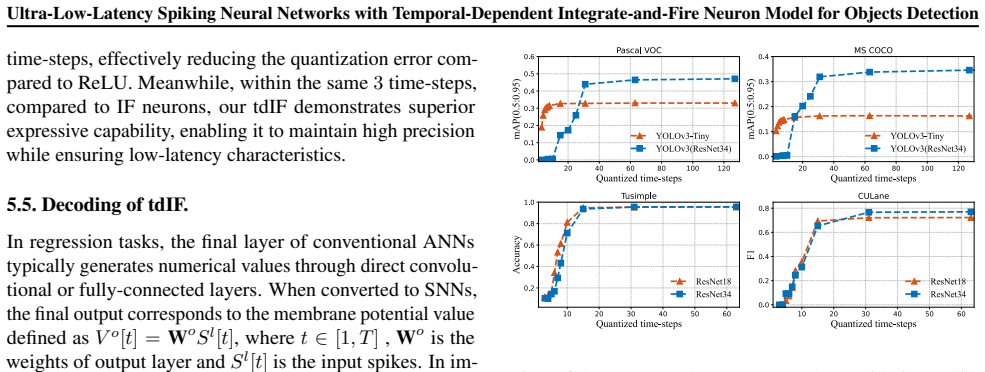
The paper's central claim is that the two classic sources of ANN-SNN conversion error — residual membrane potential left over from irregular spike timing, and quantization from coarse firing-rate coding — can be attacked together, and that the residual gap is closed by encoding value in the temporal position of spikes rather than in spike count alone. Concretely it asserts that a source ANN trained with a quant-clip activation ($L$ quantization levels, per-layer trainable ceiling $\lambda$) converts to a tdIF-based SNN with zero conversion error whenever the SNN runs for $T = L$ time-steps and the firing thresholds satisfy $\theta = \lambda$ (Eq. 12). Empirically it claims this surpasses all prior conversion-based detectors: 43.46 AP@0.50:0.95 and 74.41 AP@0.50 on PASCAL VOC, and 31.93 and 55.73 AP@0.50 on COCO, with a YOLOv3/ResNet34 backbone at five time-steps, and the first successful converted lane detector, at 95.48% accuracy on Tusimple and 76.65% F1 on CULane, with per-neuron energy within the same order of magnitude as a standard IF neuron.
Load-bearing premise
The paper's headline that detection runs within five time-steps counts only a single layer's waiting window; its own pipeline formula (Section 5.3, with $T_{\text{delay}} = T$ in every experiment) gives total steps of $T + n\times T_{\text{delay}}$, so a deep detector actually runs for hundreds of steps end to end.
Editorial extensions
If this is right
- Converted spiking networks become realistic engines for real-time perception: the same backbone that needs 40 or 2000 steps in earlier conversion methods is reported to detect objects at five steps, which on neuromorphic hardware translates directly into lower latency and per-frame energy.
- The delay-spike rule and tdIF neuron are validated end-to-end on two distinct regression tasks, showing the conversion recipe is not tied to a single detection head.
- Deep backbones are where the big gains appear (ResNet34 beats the Tiny backbone by about 10 AP points at five steps), but they lose more accuracy at the lowest step counts; the paper's appendix shows the loss at $T=3$–$4$ grows with depth, mapping exactly where the method is most and least forgiving.
- At matched accuracy, tdIF energy stays in the same order of magnitude as IF: an 8-step tdIF YOLOv3 uses about 3.4 times the power of an 8-step IF baseline but exceeds the accuracy of a 32-step IF model, so the low-step advantage is not bought with a per-step energy explosion.
Reading between the lines
- The weighting $c[t] = 2^{T-t}$ makes the tdIF decoder literally read out a fixed-point binary numeral from the final membrane potential, which the paper does not say in so many words; that viewpoint suggests pushing to multi-bit or mixed-radix codings, or even an adaptive radix, as a route below five steps.
- Read with Section 5.3's own accounting, 'within five time-steps' is a per-layer figure: the end-to-end cost is $T + n\times T_{\text{delay}}$, and with $T_{\text{delay}} = T$ a ResNet34-scale detector runs for hundreds of steps; a fair cross-method comparison would report total time-steps or steady-state frames per second rather than per-layer steps.
- The sharp drop when $T_{\text{delay}}$ falls below 2 — tdIF has no accuracy at $T_{\text{delay}} = 0$ or 1 — indicates the method depends on holding inputs for a full accumulation window; injecting arrival jitter into the accumulated input on event-driven hardware would directly test where that dependence starts to hurt.
- The appendix's table of one quant-step $L$ evaluated at several SNN time-steps $T$ is effectively a latency-accuracy trade curve, and a runtime controller that sets $T$ to meet a latency budget could be built from it without retraining — the paper does not propose this, but its own data already supports it.
Signed reviews
Editorial analysis
A structured set of objections, weighed in public.
Referee Report
Summary. The manuscript proposes an ANN-to-SNN conversion method for object detection and lane detection, built on two components: a delay-spike scheme that accumulates input for T_delay time-steps before firing in order to suppress residual membrane potential, and a temporal-dependent IF (tdIF) neuron that weights inputs, thresholds, and decoding by powers c[t]=2^{T-t} so that time-steps carry binary positional information. The source ANN is trained with a quant-clip activation function (Eq. 11) and then converted to the SNN. The paper reports state-of-the-art results on PASCAL VOC, MS COCO, Tusimple and CULane at '5 time-steps', together with an instruction-level energy analysis on a digital neuromorphic processor model.
Significance. If the claims were valid, the combination of temporal binary coding and residual-potential suppression would be a meaningful contribution to low-latency ANN-SNN conversion for regression-heavy vision tasks. The paper provides a public code link, reports per-instruction energy costs for IF versus tdIF neurons, and evaluates on four datasets with two architectures each, which is more than many conversion papers provide. However, the headline 'ultra-low latency within 5 time-steps' is contradicted by the paper's own latency formula, and the zero-conversion-error proof is an identity rather than a verified property of the combined tdIF/delay-spike dynamics. These issues bear directly on the central contribution.
major comments (4)
- [§5.3 and §6.1] The per-sample latency claim is contradicted by the paper's own accounting. Section 5.3 states that 'for an SNN with n layers, the total inference time-steps are T + n × T_delay', and Section 6.1 states that all experiments use T_delay = T. Therefore a single image requires (n+1)T time-steps from input to output, not T steps. For YOLOv3(ResNet34) at T=5, this is hundreds of time-steps even with a modest layer count. The pipelining in Figure 5 increases throughput but does not shorten the latency of any one image. The 'time-steps: 5' columns in Tables 1 and 2 are per-layer coding parameters, not end-to-end latency, so the abstract's 'within 5 time-steps' and the comparisons with Fast-SNN (7 time-steps) and Spiking-YOLO (2000 time-steps) are not made on the same metric.
- [§5.1, Eq. (12)] The proof that the conversion error is zero is a definitional identity, not a property of the proposed neurons. Substituting T = L and theta^l = lambda^l into Eq. (12) makes the two clipped-floor expressions identical by construction; no SNN dynamics, delay-spike rule, or tdIF mechanism is used in the argument. Moreover, the reported experiments do not satisfy the stated condition: Table 6 trains the quant-clip ANN with quantized time-steps L in {16, 32, 64, 128} and runs the SNN with T in {3, 4, 5, 7, 8, 10}, so T ≠ L for essentially all headline results. The formal zero-error guarantee therefore does not apply to any of the numbers in Tables 1 and 2.
- [§5.2 and §5.4] The combined tdIF plus delay-spike dynamics are never formally specified. Algorithm 1 describes delay-spike for the standard IF update of Eqs. (2)-(4), with no c[t] weighting, while Eqs. (17)-(19) define tdIF without any explicit delay-spike stage. The manuscript does not state whether the accumulation and firing stages of Algorithm 1 use c[t]W^l and c[t]theta^l, nor how T_delay interacts with the time-dependent threshold. Consequently, the assertion in Section 5.4 that r^l = sum_t c[t]S^l[t]/T' 'can also be mapped to a^l of the ANN' is not a derivation; Eq. (20) alone does not establish that the converted SNN reproduces the quant-clip activation.
- [Table 6] Table 6 contains non-monotonic results that contradict the paper's error analysis and its claim in Section 6.1.2 that 'the model achieves consistent accuracy when the time-steps extends beyond 5'. For ResNet34+Condlane on Tusimple with quantized time-steps 16, the reported Acc is 93.55 at T=4, 87.45 at T=5, 69.67 at T=7, and 68.54 at T=8. Table 1 similarly shows YOLOv3(ResNet34) at T=7 exceeding T=8 on VOC (78.80 vs. 78.46). These patterns are unexplained and undermine the claim that more inference time-steps monotonically reduce quantization error; they require either a correction or a detailed explanation.
minor comments (7)
- [§4, Eq. (5)] The summation index in Eq. (5) is written as PT_{n=1}; it should be sum_{t=1}^T.
- [Algorithm 1] The loop indices in Algorithm 1 are inconsistent when T_delay = T: in stage 1 the condition t > T_delay is never satisfied, and stage 2 begins at t = T - T_delay = 0, which is outside the valid time-step range.
- [Appendix .2, Table 6] Table 6 would benefit from a caption that clearly separates the quant-clip training time-step L ('Quantized time-steps') from the SNN inference time-step T, since the text's phrase 'the same time-steps' is ambiguous here.
- [§6, datasets] MS COCO 2017 is cited as (Wang et al., 2023) in Section 6; the dataset itself should be cited as (Lin et al., 2014).
- [§6.1.2] There is a typo 'OCFS' in Section 6.1.2; it should read 'QCFS'.
- [Figure 7] The caption of Figure 7 contains unexplained numeric strings such as 'voc 72,3940,3936,3916,3548,2608,768'; these should be clarified or removed.
- [§6.3.2] The statement that tdIF consumes 'about 2 to 3 times more energy' is followed by Table 5 showing 3.4× for YOLOv3(ResNet34); the text should state the range accurately or explain why 3.4× is treated as consistent with 'same order of magnitude'.
Circularity Check
The zero-conversion-error proof is a definitional identity: the ANN quant-clip activation (Eq. 11) is the same function as the SNN firing-rate mapping, and Eq. 12 is forced to zero by setting T=L and theta=lambda; empirical benchmarks are externally grounded.
-
self definitional
[Section 5.1, Eq. (12), with Eqs. (8) and (11)]
"With this new activation function, we can prove that the estimated conversion error between SNNs and ANNs is zero. When an ANN with activation function Eq. 11 is converted to an SNN with the same weight. According to Eq. 7, the conversion error can be written as: Err l = rl − al = clip(1/T floor(xlT/θl), 0, 1) − clip(1/L floor(xlL/λl), 0, 1). If we have the conditionsT = L, θl = λl, then the conversion errorErr l = 0."
The source ANN's activation in Eq. 11 is defined as the quant-clip function λ_l clip((1/L) floor(x_l L/λ_l),0,1), and the SNN firing rate in Eq. 8 is clip((1/T) floor(x_l T/θ_l),0,1). Eq. 12 then sets T=L and θ_l=λ_l, making the two expressions syntactically identical; Err_l=0 follows from the definitions, not from any property of IF/tdIF dynamics. The claimed proof restates the conversion construction: the ANN was trained with exactly the function the SNN is built to reproduce, so residual-potential and quantization errors are declared zero rather than demonstrated. For tdIF, the same equality is rebuilt with T'=2^T−1 in Eq. 20, so the equivalence remains a design identity.
full rationale
The paper's only load-bearing derivation that reduces to its own inputs is the zero-conversion-error argument in Eq. 12. Because the ANN quant-clip activation and the SNN rate mapping are the same function, imposing T=L and θ=λ makes the claimed error vanish by construction; this is self-definitional rather than an empirical or dynamical finding. I do not treat this as evidence that the tdIF/delay-spike proposal is invalid: the headline detection and lane results are evaluated on external benchmarks (PASCAL VOC, MS COCO, TuSimple, CULane) against prior methods, and those numbers stand independently of the identity. No load-bearing self-citations were found; the authors' prior hardware work is cited only as background. The abstract's 'within 5 time-steps' versus the Section 5.3 total-latency formula T + n×T_delay is a serious accounting/correctness inconsistency, but it is not a circularity: it is a mismatch between a reported per-layer coding parameter and end-to-end latency, not a result that is equivalent to its input by definition. For that reason the circularity score is moderate rather than severe: one definitional 'proof' in an otherwise externally grounded empirical paper.
Assumptions & free parameters
free parameters (3)
- trainable per-layer scale lambda^l =
determined during ANN training, not reported per layer
- quantization time-steps L =
32, 64, 128, or 256 per Table 6; not reported for Table 1
- delay parameter T_delay =
T_delay = T in all main experiments; ablated 0 to 8
assumptions (4)
- domain assumption Rate-coding equivalence between IF spiking rates and ReLU activations (Eqs. 5-6)
- domain assumption The source ANN must be trained with the quant-clip activation (Eq. 11) so that the SNN conversion is error-free by construction (Eq. 12)
- domain assumption Input to each neuron is unbiased and bounded within [0, theta^l] (Eq. 16)
- ad hoc to paper The tdIF weighted accumulation sum c[t] S[t] / T' equals the ANN activation a (Section 5.4)
invented entities (2)
-
tdIF neuron (temporal-dependent IF)
independent evidence
-
delay-spike inference pipeline
independent evidence
Cite this review
Pith. "Pith review of Ultra-Low-Latency Spiking Neural Networks with Temporal-Dependent Integrate-and-Fire Neuron Model for Objects Detection." pith.science (2026). https://pith.science/paper/62WILOET
@misc{pith2026250820392,
  author       = {Pith},
  title        = {Pith review of: Ultra-Low-Latency Spiking Neural Networks with Temporal-Dependent Integrate-and-Fire Neuron Model for Objects Detection},
  year         = {2026},
  howpublished = {\url{https://pith.science/paper/62WILOET}},
  note         = {Machine review of arXiv:2508.20392}
}
read the original abstract
Spiking Neural Networks (SNNs), inspired by the brain, are characterized by minimal power consumption and swift inference capabilities on neuromorphic hardware, and have been widely applied to various visual perception tasks. Current ANN-SNN conversion methods have achieved excellent results in classification tasks with ultra-low time-steps, but their performance in visual detection tasks remains suboptimal. In this paper, we propose a delay-spike approach to mitigate the issue of residual membrane potential caused by heterogeneous spiking patterns. Furthermore, we propose a novel temporal-dependent Integrate-and-Fire (tdIF) neuron architecture for SNNs. This enables Integrate-and-fire (IF) neurons to dynamically adjust their accumulation and firing behaviors based on the temporal order of time-steps. Our method enables spikes to exhibit distinct temporal properties, rather than relying solely on frequency-based representations. Moreover, the tdIF neuron maintains energy consumption on par with traditional IF neuron. We demonstrate that our method achieves more precise feature representation with lower time-steps, enabling high performance and ultra-low latency in visual detection tasks. In this study, we conduct extensive evaluation of the tdIF method across two critical vision tasks: object detection and lane line detection. The results demonstrate that the proposed method surpasses current ANN-SNN conversion approaches, achieving state-of-the-art performance with ultra-low latency (within 5 time-steps).
Figures


Figures from the paper (5 more)




Reference graph
Works this paper leans on
-
[1]
Bochkovskiy, A., Wang, C.-Y ., and Liao, H.-Y . M. Yolov4: Optimal speed and accuracy of object detection. arXiv preprint arXiv:2004.10934,
arXiv 2004
-
[6]
U., Neil, D., Binas, J., Cook, M., Liu, S.-C., and Pfeiffer, M
Diehl, P. U., Neil, D., Binas, J., Cook, M., Liu, S.-C., and Pfeiffer, M. Fast-classifying, high-accuracy spiking deep networks through weight and threshold balancing. In 2015 International joint conference on neural networks (IJCNN), pp. 1–8. ieee,
2015
-
[7]
Optimal ann-snn conversion for fast and accurate inference in deep spiking neural networks
Ding, J., Yu, Z., Tian, Y ., and Huang, T. Optimal ann-snn conversion for fast and accurate inference in deep spiking neural networks. arXiv preprint arXiv:2105.11654,
-
[10]
Li, Y ., He, X., Dong, Y ., Kong, Q., and Zeng, Y . Spike calibration: Fast and accurate conversion of spiking neu- ral network for object detection and segmentation. arXiv preprint arXiv:2207.02702,
-
[11]
Lin, T.-Y ., Maire, M., Belongie, S., Hays, J., Perona, P., Ra- manan, D., Doll´ar, P., and Zitnick, C. L. Microsoft coco: Common objects in context. In Computer Vision–ECCV 2014: 13th European Conference, Zurich, Switzerland, September 6-12, 2014, Proceedings, Part V 13, pp. 740–
2014
-
[15]
Open the box of digital neuromor- phic processor: Towards effective algorithm-hardware co-design
Tang, G., Safa, A., Shidqi, K., Detterer, P., Traferro, S., Konijnenburg, M., Sifalakis, M., van Schaik, G.-J., and Yousefzadeh, A. Open the box of digital neuromor- phic processor: Towards effective algorithm-hardware co-design. In 2023 IEEE International Symposium on Circuits and Systems (ISCAS), pp. 1–5. IEEE,
work page 2023
-
[16]
Zheng, H., Wu, Y ., Deng, L., Hu, Y ., and Li, G
arXiv preprint arXiv:2107.08430, 2021a. Zheng, H., Wu, Y ., Deng, L., Hu, Y ., and Li, G. Going deeper with directly-trained larger spiking neural net- works. In Proceedings of the AAAI conference on artifi- cial intelligence, volume 35, pp. 11062–11070, 2021b. 15 Ultra-Low-Latency Spiking Neural Networks with Temporal-Dependent Integrate-and-Fire Neuron ...
-
[17]
is a dataset of highway driving scenes, which contains 3.3k training images and 2.8k validation images. CULane(Pan et al., 2018). is a widely used large lane detection dataset with 9 different scenarios (Urban&highway), which contains 88.9k training images and 34.7k validation images. For training preprocessing, we utilize techniques such as Random Blur, ...
work page 2018
Show all 18 references
-
[128]
IoU between the predicted lane line and GT label is taken for judging whether a sample is true positive (TP) or false positive (FP) or false negative (FN)
For CULane, we utilizes the F1 measure as in (Liu et al., 2021). IoU between the predicted lane line and GT label is taken for judging whether a sample is true positive (TP) or false positive (FP) or false negative (FN). IoU of two lines is defined as the IoU of their masks wi...
2021
-
[2015]
V ., Dittmann, R., Linares-Barranco, B., Sebastian, A., Le Gallo, M., Redaelli, A., Slesazeck, S., Mikolajick, T., Spiga, S., Menzel, S., et al
Christensen, D. V ., Dittmann, R., Linares-Barranco, B., Sebastian, A., Le Gallo, M., Redaelli, A., Slesazeck, S., Mikolajick, T., Spiga, S., Menzel, S., et al. 2022 roadmap on neuromorphic computing and engineering. Neuromorphic Computing and Engineering, 2(2):022501,
2022
-
[2016]
and Zeng, Y
Li, Y . and Zeng, Y . Efficient and accurate conversion of spiking neural network with burst spikes. arXiv preprint arXiv:2204.13271,
-
[2018]
Lane detection and classification using cascaded cnns
Pizzati, F., Allodi, M., Barrera, A., and Garc ´ıa, F. Lane detection and classification using cascaded cnns. In Com- puter Aided Systems Theory–EUROCAST 2019: 17th International Conference, Las Palmas de Gran Canaria, Spain, February 17–22, 2019, Revised Selected Papers, Part...
2019
-
[2019]
A., Garside, J., Temple, S., Galluppi, F., Patterson, C., Lester, D
Painkras, E., Plana, L. A., Garside, J., Temple, S., Galluppi, F., Patterson, C., Lester, D. R., Brown, A. D., and Furber, S. B. Spinnaker: A 1-w 18-core system-on-chip for massively-parallel neural network simulation. IEEE Jour- nal of Solid-State Circuits, 48(8):1943–1953,
1943
-
[2020]
Optimal ann-snn conversion for high-accuracy and ultra-low-latency spiking neural networks
Bu, T., Fang, W., Ding, J., Dai, P., Yu, Z., and Huang, T. Optimal ann-snn conversion for high-accuracy and ultra-low-latency spiking neural networks. arXiv preprint arXiv:2303.04347,
-
[2021]
and Gu, S
Deng, S. and Gu, S. Optimal conversion of conventional ar- tificial neural networks to spiking neural networks. arXiv preprint arXiv:2103.00476,
-
[2022]
Object detec- tion with spiking neural networks on automotive event data
Cordone, L., Miramond, B., and Thierion, P. Object detec- tion with spiking neural networks on automotive event data. In 2022 International Joint Conference on Neural Networks (IJCNN), pp. 1–8. IEEE,
2022
-
[2023]
Kim, S., Park, S., Na, B., Kim, J., and Yoon, S. Towards fast and accurate object detection in bio-inspired spiking 13 Ultra-Low-Latency Spiking Neural Networks with Temporal-Dependent Integrate-and-Fire Neuron Model for Objects Detection neural networks through bayesian optim...
2023
-
[2024]
Optimal ann-snn conversion with group neurons
Lv, L., Fang, W., Yuan, L., and Tian, Y . Optimal ann-snn conversion with group neurons. In ICASSP 2024-2024 IEEE International Conference on Acoustics, Speech and Signal Processing (ICASSP), pp. 6475–6479. IEEE,
2024
Reviewed August 15, 2026 · model on record in the stance chip above.
Discussion (0). Continue with ORCID to comment.