REVIEW 4 major objections 5 minor 56 references
The paper claims that instruction-based image editing can be reframed as reference-image-based text-to-image generation, and that attention bridges between two UNets make the resulting edits more accurate and more consistent than instructio
Reviewed by Pith at T0; open to challenge. T0 means a machine referee read the full paper against a public rubric. the ladder, T0–T4 →
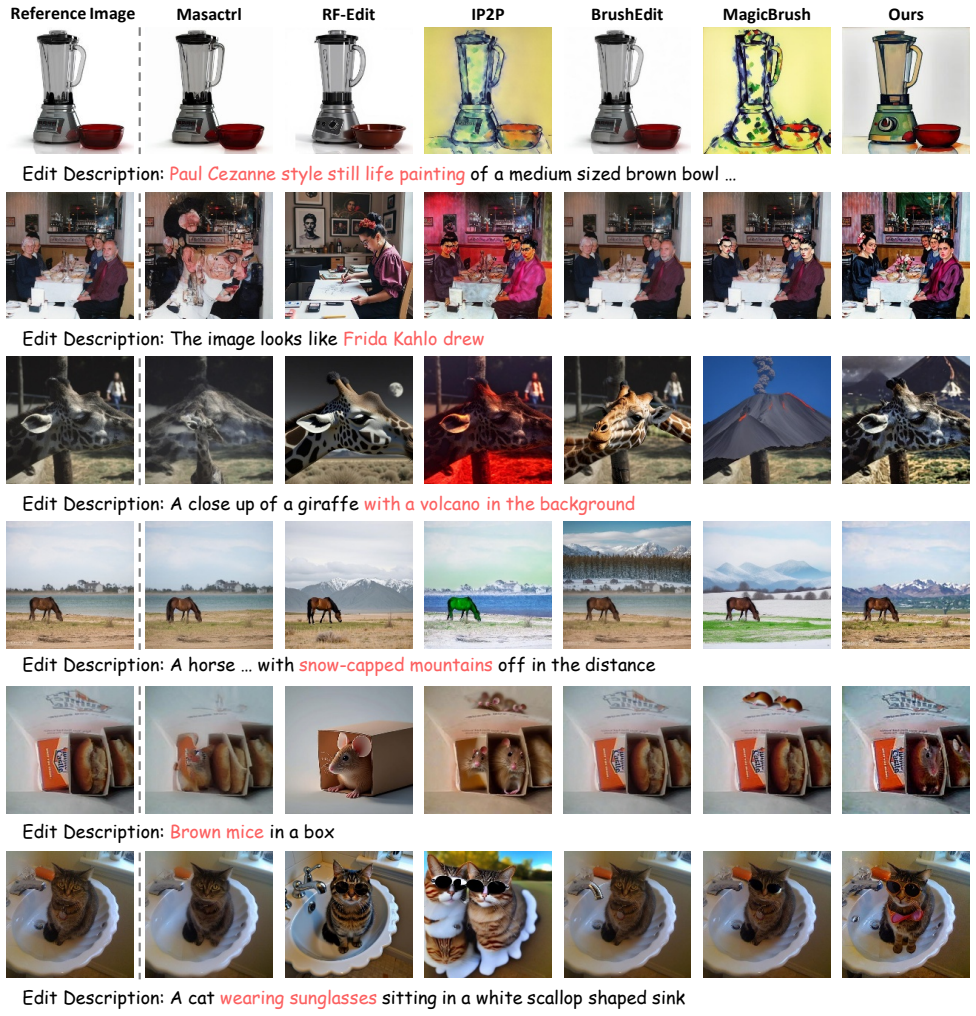
DescriptiveEdit turns semantic editing into reference-conditioned text-to-image generation, reporting state-of-the-art scores on the Emu Edit benchmark with a frozen backbone and about 75M trainable parameters.
T0 review reviewed 2026-08-05 challenge →
load-bearing objection A genuinely useful reframing of editing as reference-conditioned T2I generation, undermined by an unreproducible evaluation protocol that makes the headline numbers unproven. the 4 major comments →
Describe, Don't Dictate: Semantic Image Editing with Natural Language Intent
The pith
A machine-rendered reading of the paper's core claim, the machinery that carries it, and where it could break.
The reading
Core claim
The central claim is that 'instruction-based image editing' can be equivalently staged as 'instructions → edit descriptions → edited images', and that a text-to-image model conditioned on a reference image and an edit description can perform the edit better than models trained on instruction triplets. The mechanism is a Cross-Attentive UNet: a frozen denoising UNet and a reference UNet with shared weights operate in parallel, and at matched self-attention layers the reference UNet's query attends to the denoising UNet's key and value features. The resulting reference-enhanced feature is added to the denoising UNet's self-attention output through a zero-initialized learned linear layer, so th
What carries the argument
The load-bearing object is an attention bridge between two UNets: at self-attention layers, the reference UNet encoding the original image provides queries Q_Io, the denoising UNet provides keys K_Te and values V_Te, and the cross-attention output Z' = CA(Q_Io, K_Te, V_Te) is blended into the denoising stream as Zin = Z + Linear(Z'), where Linear is zero-initialized. This carries reference image structure into prompt-driven generation while leaving the base model's weights untouched, and the zero initialization ensures training starts from the unmodified text-to-image behavior.
Load-bearing premise
The reported gains rest on the assumption that the manually filtered Emu Edit subset is a fair, representative test bed; the paper does not disclose how many or which samples were removed, and some baseline numbers were taken from the original unfiltered benchmark.
What would settle it
Recompute the main table on the full, unfiltered Emu Edit test set with every baseline running on the identical samples, and also on the authors' filtered subset; if the L1 advantage over AnyEdit (0.065 vs 0.067) or the DINO-I advantage (0.843 vs 0.809) disappears or flips, the claimed consistency improvement is not supported. Auditing the removed samples for caption–source mismatches would show whether the filter disproportionately penalized other methods.
If this is right
- Instruction-labeled editing datasets become less necessary: ordinary image–description pairs can supply the training signal for the attention bridges.
- Because the base model stays frozen, community extensions such as ControlNet, IP-Adapter, and external style checkpoints can be combined with the editor without retraining.
- The same attention-bridge recipe transfers beyond UNet backbones to Diffusion Transformer models such as Flux.
- The λI guidance term gives users a single control knob that trades edit strength against reference preservation.
- Description prompts provide richer conditioning than instruction prompts, yielding more precise edits under the same intended change.
Where Pith is reading between the lines
- If the reframing holds, instruction datasets could be bypassed entirely: any captioner that converts instructions into descriptions could generate training pairs at web scale, letting editing scale with text-to-image data.
- A direct testable extension is training on pure caption–image pairs with synthetic descriptions and checking whether editing accuracy holds without any instruction labels.
- The manual filtering of the Emu Edit benchmark leaves the exact numerical ranking provisional; running every baseline on the same filtered subset, or publishing the filter criteria, would settle whether the reported improvements are robust.
- The attention-bridge pattern may transfer to other consistency-critical tasks, such as subject-driven generation, video editing, or inpainting, because it injects reference structure without altering base weights.
Editorial analysis
A structured set of objections, weighed in public.
Referee Report
Summary. The paper proposes DescriptiveEdit, a semantic image editing framework that reframes instruction-based editing as reference-image-based text-to-image generation. The method freezes a pre-trained T2I UNet, adds a second 'Ref-UNet' to encode the input image, and introduces attention-bridge layers between the two UNets (Eq. 4), followed by a learnable zero-initialized linear fusion (Eq. 5) and LoRA-based tuning. Training uses the UltraEdit dataset, with a modified diffusion objective and classifier-free guidance at inference (Eqs. 6-7). Experiments on the Emu Edit benchmark claim improvements in editing accuracy and consistency over training-free and training-based baselines (Table 1), and additional ablations and qualitative demonstrations show compatibility with ControlNet, IP-Adapter, and DiT-based models such as Flux.
Significance. If the empirical claims were solid, this would be a useful contribution: the conceptual reframing from instructions to descriptions is elegant, the architecture is parameter-efficient and non-invasive, and compatibility with existing T2I ecosystems is a practical advantage. The paper also includes several controlled ablations (attention fusion strategies, description vs. instruction inputs) that support the design choices internally. However, the headline quantitative claim currently rests on a manually filtered evaluation whose criteria and counts are unreported and whose baseline protocols are not apples-to-apples, so the significance of the reported gains cannot be assessed without additional evidence.
major comments (4)
- [Sec. 4.1 and Table 1] The manual filtering of the Emu Edit test set is underspecified: the paper does not state how many samples were removed, what exact criteria defined a 'non-compliant' sample, or whether the retained sample IDs are released. This makes the evaluation non-reproducible. More importantly, Table 1 mixes protocols: EmuEdit* is taken from the original paper and therefore was evaluated on the unfiltered benchmark, while the other methods (and ours) are scored on the filtered subset. If the filter disproportionately removes cases where other methods succeed or where DescriptiveEdit fails, the reported margins (e.g., DINO-I 0.843 vs. EmuEdit* 0.819, CLIP-I 0.874 vs. 0.859) could be protocol artifacts. The authors must provide the filter criteria, removal count, the full list of retained sample IDs, and re-evaluate all baselines on the same filtered subset.
- [Table 1 and Sec. 4.2] The quantitative comparison lacks statistical support. No error bars, confidence intervals, or multiple-seed results are reported, and several headline margins are extremely small: L1 0.065 vs. AnyEdit† 0.067, CLIP-T 0.315 vs. RF-Edit 0.319 (the latter is actually higher for the baseline), and PSNR 20.99 vs. FPE 20.41. Given the manual filtering issue above, these differences could easily be within noise. The paper should report variance across seeds or at least confidence intervals, and should identify which pairwise improvements are statistically significant.
- [Sec. 3.2.1, Eq. (4)] The described attention-bridge mechanism is underspecified and potentially inconsistent with the stated goal. Eq. (4) sets Z' = CA(Q_Io, K_Te, V_Te), with the query taken from the Ref-UNet's self-attention and the key/value from the denoising UNet's self-attention. The text says this 'enables the denoising UNet to incorporate information from the Ref-UNet,' but as written, the query comes from the reference branch, not the denoising branch. This would more naturally route the denoising UNet's features through reference-position queries rather than injecting reference content into the denoising stream. The tensor-shape alignment and the role of each branch (which attends to which) need to be stated explicitly, and Eq. (4) should include the projection matrices. This is central to the proposed architecture, so a clear correction or justification is required.
- [Sec. 3.3 and Table 2] The training/inference setup is reported only partially. Eq. (6) conditions on Z_o^s with a fixed s=0, but the paper does not specify how the reference UNet processes this clean latent versus the noisy latent of the edited image in terms of shared or separate timestep embeddings. Similarly, Table 2 ('Description vs. Instruction') does not state on which test set these numbers are computed or whether the same filtering was applied. These omissions make it hard to reproduce the controlled comparison that supports the central conceptual claim.
minor comments (5)
- [Table 1] The method name is spelled 'DescribeEdit' in the table row, which is inconsistent with 'DescriptiveEdit' elsewhere. Also, the footnote says † indicates retraining 'on our training dataset,' but it is unclear whether this means the UltraEdit dataset or a different subset; please clarify.
- [Sec. 4.2] The text states 'our model achieves a competitive CLIP-T score (0.315), which is comparable to RF-Edit (0.319),' but 0.315 is below 0.319. This phrasing is misleading; either report it as slightly lower or explain why the difference is not meaningful.
- [Sec. 4.4] The ablation on λI reports a sensible qualitative range (1 to 2.5) but no quantitative curves. Adding a plot of consistency metrics vs. λI would strengthen this section.
- [Fig. 2] The attention-bridge diagram is hard to read at the current resolution; the flow from Ref-UNet to the denoising UNet and back should be drawn with clearer arrows and labeled tensor dimensions.
- [References] Some references appear twice (e.g., [10] and [31] list the same paper with slightly different venue formatting). Please unify.
Circularity Check
No circular derivation; the self-referential evaluation-protocol issue is a soundness concern, not circularity.
full rationale
The paper is an empirical systems paper. Its central claim is that instruction-based editing can be reframed as reference-image-based text-to-image generation, implemented by attention bridges between a frozen denoising UNet and a reference UNet with LoRA tuning. The load-bearing equations—Eq. (4), Z' = CA(Q_Io, K_Te, V_Te), and Eq. (5), Zin = Z + Linear(Z')—are architectural definitions, not reductions of the reported metrics to fitted inputs. Training uses the UltraEdit dataset and the diffusion objective in Eq. (6), while evaluation is on the Emu Edit benchmark against external baselines; the headline L1, DINO-I, CLIP-I, and PSNR numbers are therefore measured outputs, not quantities defined by the method's construction. No load-bearing self-citation chain or imported uniqueness theorem is present: self-citations such as [7] and [42] appear only in related-work enumerations and are not used to justify the central claim. The only self-referential element is the manual filtering of the Emu Edit test set described in Sec. 4.1 ('we manually filter out non-compliant samples before calculating the metrics'). That is a genuine soundness and auditability concern—filter sizes and criteria are unreported, and EmuEdit* results are taken from the original unfiltered benchmark—but it is a data-selection/protocol issue, not a derivation that reduces to its own inputs. Under the circularity definition used here, the paper is self-contained against external benchmarks and exhibits no significant circularity.
Axiom & Free-Parameter Ledger
free parameters (5)
- guidance weight lambda_I =
1.0-2.5 (recommended range)
- guidance weight lambda_T =
not specified
- LoRA rank / alpha =
64 / 64
- conditioning dropout =
5%
- reference timestep s =
0
axioms (4)
- domain assumption Attention bridges between the Ref-UNet and the frozen denoising UNet transmit sufficient structural and semantic information for editing (Eq. 4).
- domain assumption Descriptive prompts are inherently more compatible with pre-trained T2I priors than imperative instructions.
- domain assumption Frozen SD1.5 retains generative capacity when conditioned through added zero-initialized linear layers and attention bridges.
- standard math Standard LDM objective and IP2P-style classifier-free guidance are valid for this conditional setting (Eqs. 6, 7).
Cite this review
Pith. "Pith review of Describe, Don't Dictate: Semantic Image Editing with Natural Language Intent." pith.science (2026). https://pith.science/paper/L3LCJY5K
@misc{pith2026250820505,
  author       = {Pith},
  title        = {Pith review of: Describe, Don't Dictate: Semantic Image Editing with Natural Language Intent},
  year         = {2026},
  howpublished = {\url{https://pith.science/paper/L3LCJY5K}},
  note         = {Machine review of arXiv:2508.20505}
}
read the original abstract
Despite the progress in text-to-image generation, semantic image editing remains a challenge. Inversion-based algorithms unavoidably introduce reconstruction errors, while instruction-based models mainly suffer from limited dataset quality and scale. To address these problems, we propose a descriptive-prompt-based editing framework, named DescriptiveEdit. The core idea is to re-frame `instruction-based image editing' as `reference-image-based text-to-image generation', which preserves the generative power of well-trained Text-to-Image models without architectural modifications or inversion. Specifically, taking the reference image and a prompt as input, we introduce a Cross-Attentive UNet, which newly adds attention bridges to inject reference image features into the prompt-to-edit-image generation process. Owing to its text-to-image nature, DescriptiveEdit overcomes limitations in instruction dataset quality, integrates seamlessly with ControlNet, IP-Adapter, and other extensions, and is more scalable. Experiments on the Emu Edit benchmark show it improves editing accuracy and consistency.
Figures




Reference graph
Works this paper leans on
-
[1]
Blended diffusion for text-driven editing of natural images
Omri Avrahami, Dani Lischinski, and Ohad Fried. Blended diffusion for text-driven editing of natural images. In CVPR, pages 18208–18218, 2022. 2
work page 2022
-
[2]
In- structpix2pix: Learning to follow image editing instructions
Tim Brooks, Aleksander Holynski, and Alexei A Efros. In- structpix2pix: Learning to follow image editing instructions. In CVPR, pages 18392–18402, 2023. 2, 4, 5, 6
work page 2023
-
[3]
Masactrl: Tuning-free mu- tual self-attention control for consistent image synthesis and editing
Mingdeng Cao, Xintao Wang, Zhongang Qi, Ying Shan, Xi- aohu Qie, and Yinqiang Zheng. Masactrl: Tuning-free mu- tual self-attention control for consistent image synthesis and editing. In ICCV, pages 22560–22570, 2023. 2, 5, 6
work page 2023
-
[4]
Emerg- ing properties in self-supervised vision transformers
Mathilde Caron, Hugo Touvron, Ishan Misra, Herv ´e J´egou, Julien Mairal, Piotr Bojanowski, and Armand Joulin. Emerg- ing properties in self-supervised vision transformers. In Pro- ceedings of the IEEE/CVF international conference on com- puter vision, pages 9650–9660, 2021. 5
2021
-
[5]
Diffusion forcing: Next-token prediction meets full-sequence diffu- sion
Boyuan Chen, Diego Mart ´ı Mons ´o, Yilun Du, Max Sim- chowitz, Russ Tedrake, and Vincent Sitzmann. Diffusion forcing: Next-token prediction meets full-sequence diffu- sion. NeurIPS, pages 24081–24125, 2025. 4
work page 2025
-
[6]
Pixart-alpha: Fast training of diffusion transformer for photorealistic text-to-image syn- thesis
Junsong Chen, YU Jincheng, GE Chongjian, Lewei Yao, Enze Xie, Zhongdao Wang, James Kwok, Ping Luo, Huchuan Lu, and Zhenguo Li. Pixart-alpha: Fast training of diffusion transformer for photorealistic text-to-image syn- thesis. In ICLR, 2024. 1
work page 2024
-
[7]
Region-aware text-to-image generation via hard binding and soft refinement
Zhennan Chen, Yajie Li, Haofan Wang, Zhibo Chen, Zhengkai Jiang, Jun Li, Qian Wang, Jian Yang, and Ying Tai. Region-aware text-to-image generation via hard binding and soft refinement. arXiv preprint arXiv:2411.06558, 2024. 2
Pith/arXiv arXiv 2024
-
[8]
Turboedit: Text-based image editing using few-step diffusion models, 2024
Gilad Deutch, Rinon Gal, Daniel Garibi, Or Patashnik, and Daniel Cohen-Or. Turboedit: Text-based image editing using few-step diffusion models, 2024. 5, 6
work page 2024
-
[9]
Scaling recti- fied flow transformers for high-resolution image synthesis
Patrick Esser, Sumith Kulal, Andreas Blattmann, Rahim Entezari, Jonas M ¨uller, Harry Saini, Yam Levi, Dominik Lorenz, Axel Sauer, Frederic Boesel, et al. Scaling recti- fied flow transformers for high-resolution image synthesis. In ICML, 2024. 1
work page 2024
-
[10]
Scaling recti- fied flow transformers for high-resolution image synthesis
Patrick Esser, Sumith Kulal, Andreas Blattmann, Rahim Entezari, Jonas M ¨uller, Harry Saini, Yam Levi, Dominik Lorenz, Axel Sauer, Frederic Boesel, et al. Scaling recti- fied flow transformers for high-resolution image synthesis. In ICML, 2024. 2
work page 2024
-
[11]
DiT4Edit: Diffusion Transformer for Image Editing
Kunyu Feng, Yue Ma, Bingyuan Wang, Chenyang Qi, Haozhe Chen, Qifeng Chen, and Zeyu Wang. Dit4edit: Dif- fusion transformer for image editing. CoRR:2411.03286,
work page internal anchor Pith review Pith/arXiv arXiv
-
[12]
Guiding instruction-based im- age editing via multimodal large language models
Tsu-Jui Fu, Wenze Hu, Xianzhi Du, William Yang Wang, Yinfei Yang, and Zhe Gan. Guiding instruction-based im- age editing via multimodal large language models. In ICLR,
-
[13]
Ian Goodfellow, Jean Pouget-Abadie, Mehdi Mirza, Bing Xu, David Warde-Farley, Sherjil Ozair, Aaron Courville, and Yoshua Bengio. Generative adversarial nets. NeurIPS, 2014. 2
work page 2014
-
[14]
Prompt-to-prompt image editing with cross attention control
Amir Hertz, Ron Mokady, Jay Tenenbaum, Kfir Aberman, Yael Pritch, and Daniel Cohen-Or. Prompt-to-prompt image editing with cross attention control. CoRR, 2022. 1, 2, 4
work page 2022
-
[15]
Classifier-free diffusion guidance
Jonathan Ho and Tim Salimans. Classifier-free diffusion guidance. CoRR:2207.12598, 2022. 4
Pith/arXiv arXiv 2022
-
[16]
Denoising dif- fusion probabilistic models
Jonathan Ho, Ajay Jain, and Pieter Abbeel. Denoising dif- fusion probabilistic models. NeurIPS, 33:6840–6851, 2020. 1
work page 2020
-
[17]
Lora: Low-rank adaptation of large language models
Edward J Hu, Yelong Shen, Phillip Wallis, Zeyuan Allen- Zhu, Yuanzhi Li, Shean Wang, Lu Wang, Weizhu Chen, et al. Lora: Low-rank adaptation of large language models. ICLR, page 3, 2022. 2, 3, 4, 5
work page 2022
-
[18]
Animate anyone: Consistent and controllable image- to-video synthesis for character animation
Li Hu. Animate anyone: Consistent and controllable image- to-video synthesis for character animation. In CVPR, pages 8153–8163, 2024. 3
work page 2024
-
[19]
Smartedit: Exploring com- plex instruction-based image editing with multimodal large language models
Yuzhou Huang, Liangbin Xie, Xintao Wang, Ziyang Yuan, Xiaodong Cun, Yixiao Ge, Jiantao Zhou, Chao Dong, Rui Huang, Ruimao Zhang, et al. Smartedit: Exploring com- plex instruction-based image editing with multimodal large language models. In CVPR, pages 8362–8371, 2024. 2
work page 2024
-
[20]
Pnp inversion: Boosting diffusion-based editing with 3 lines of code
Xuan Ju, Ailing Zeng, Yuxuan Bian, Shaoteng Liu, and Qiang Xu. Pnp inversion: Boosting diffusion-based editing with 3 lines of code. International Conference on Learning Representations (ICLR), 2024. 5, 6
work page 2024
-
[21]
Multi-concept customiza- tion of text-to-image diffusion
Nupur Kumari, Bingliang Zhang, Richard Zhang, Eli Shechtman, and Jun-Yan Zhu. Multi-concept customiza- tion of text-to-image diffusion. In CVPR, pages 1931–1941,
1931
-
[22]
Black Forest Labs. Flux. https://github.com/ black-forest-labs/flux, 2024. 1, 2, 8
work page 2024
-
[23]
Autoregressive image generation without vec- tor quantization
Tianhong Li, Yonglong Tian, He Li, Mingyang Deng, and Kaiming He. Autoregressive image generation without vec- tor quantization. NeurIPS, 37:56424–56445, 2024. 1
work page 2024
-
[24]
Brushedit: All-in-one image inpainting and editing
Yaowei Li, Yuxuan Bian, Xuan Ju, Zhaoyang Zhang, Ying Shan, Yuexian Zou, and Qiang Xu. Brushedit: All-in-one image inpainting and editing. CoRR, abs/2412.10316, 2024. 5, 6
Pith/arXiv arXiv 2024
-
[25]
Flow matching for generative mod- eling
Yaron Lipman, Ricky TQ Chen, Heli Ben-Hamu, Maximil- ian Nickel, and Matt Le. Flow matching for generative mod- eling. CoRR:2210.02747, 2022. 1
Pith/arXiv arXiv 2022
-
[26]
Bingyan Liu, Chengyu Wang, Tingfeng Cao, Kui Jia, and Jun Huang. Towards understanding cross and self-attention in stable diffusion for text-guided image editing, 2024. 5, 6
work page 2024
-
[27]
Towards understanding cross and self-attention in stable diffusion for text-guided image editing
Bingyan Liu, Chengyu Wang, Tingfeng Cao, Kui Jia, and Jun Huang. Towards understanding cross and self-attention in stable diffusion for text-guided image editing. In CVPR, pages 7817–7826, 2024. 2
work page 2024
-
[28]
Decoupled weight decay regularization
Ilya Loshchilov and Frank Hutter. Decoupled weight decay regularization. CoRR:1711.05101, 2017. 5
Pith/arXiv arXiv 2017
-
[29]
Glide: Towards photorealis- tic image generation and editing with text-guided diffusion models
Alexander Quinn Nichol, Prafulla Dhariwal, Aditya Ramesh, Pranav Shyam, Pamela Mishkin, Bob Mcgrew, Ilya Sutskever, and Mark Chen. Glide: Towards photorealis- tic image generation and editing with text-guided diffusion models. In ICML, pages 16784–16804, 2022. 2, 4
work page 2022
-
[30]
Scalable diffusion models with transformers
William Peebles and Saining Xie. Scalable diffusion models with transformers. In CVPR, pages 4195–4205, 2023. 2
work page 2023
-
[31]
Scalable diffusion models with transformers
William Peebles and Saining Xie. Scalable diffusion models with transformers. In ICCV, pages 4195–4205, 2023. 1
work page 2023
-
[32]
Sdxl: Improving latent diffusion models for high-resolution image synthesis
Dustin Podell, Zion English, Kyle Lacey, Andreas Blattmann, Tim Dockhorn, Jonas M ¨uller, Joe Penna, and Robin Rombach. Sdxl: Improving latent diffusion models for high-resolution image synthesis. In ICLR, 2024. 1
work page 2024
-
[33]
Learn- ing transferable visual models from natural language super- vision
Alec Radford, Jong Wook Kim, Chris Hallacy, Aditya Ramesh, Gabriel Goh, Sandhini Agarwal, Girish Sastry, Amanda Askell, Pamela Mishkin, Jack Clark, et al. Learn- ing transferable visual models from natural language super- vision. In ICML, pages 8748–8763, 2021. 5
work page 2021
-
[34]
Zero-shot text-to-image generation
Aditya Ramesh, Mikhail Pavlov, Gabriel Goh, Scott Gray, Chelsea V oss, Alec Radford, Mark Chen, and Ilya Sutskever. Zero-shot text-to-image generation. In ICML, pages 8821– 8831, 2021. 2
work page 2021
-
[35]
Hierarchical text-conditional image gener- ation with CLIP latents
Aditya Ramesh, Prafulla Dhariwal, Alex Nichol, Casey Chu, and Mark Chen. Hierarchical text-conditional image gener- ation with CLIP latents. CoRR, abs/2204.06125, 2022. 2
Pith/arXiv arXiv 2022
-
[36]
High-resolution image syn- thesis with latent diffusion models
Robin Rombach, Andreas Blattmann, Dominik Lorenz, Patrick Esser, and Bj¨orn Ommer. High-resolution image syn- thesis with latent diffusion models. In CVPR, pages 10684– 10695, 2022. 1
2022
-
[37]
High-resolution image syn- thesis with latent diffusion models
Robin Rombach, Andreas Blattmann, Dominik Lorenz, Patrick Esser, and Bj¨orn Ommer. High-resolution image syn- thesis with latent diffusion models. In CVPR, pages 10684– 10695, 2022. 2, 3, 5
work page 2022
-
[38]
Semantic im- age inversion and editing using rectified stochastic differen- tial equations
Litu Rout, Yujia Chen, Nataniel Ruiz, Constantine Carama- nis, Sanjay Shakkottai, and Wen-Sheng Chu. Semantic im- age inversion and editing using rectified stochastic differen- tial equations. CoRR:2410.10792, 2024. 1, 2
Pith/arXiv arXiv 2024
-
[39]
Laion-5b: An open large-scale dataset for train- ing next generation image-text models
Christoph Schuhmann, Romain Beaumont, Richard Vencu, Cade Gordon, Ross Wightman, Mehdi Cherti, Theo Coombes, Aarush Katta, Clayton Mullis, Mitchell Worts- man, et al. Laion-5b: An open large-scale dataset for train- ing next generation image-text models. NeurIPS, 35:25278– 25294, 2022. 1
work page 2022
-
[40]
Emu edit: Precise image editing via recognition and genera- tion tasks
Shelly Sheynin, Adam Polyak, Uriel Singer, Yuval Kirstain, Amit Zohar, Oron Ashual, Devi Parikh, and Yaniv Taigman. Emu edit: Precise image editing via recognition and genera- tion tasks. In CVPR, pages 8871–8879, 2024. 2, 5, 6
work page 2024
-
[41]
Deep unsupervised learning using nonequilibrium thermodynamics
Jascha Sohl-Dickstein, Eric Weiss, Niru Maheswaranathan, and Surya Ganguli. Deep unsupervised learning using nonequilibrium thermodynamics. In ICML, pages 2256– 2265, 2015. 2
work page 2015
-
[42]
Postedit: Posterior sampling for efficient zero-shot image editing
Feng Tian, Yixuan Li, Yichao Yan, Shanyan Guan, Yanhao Ge, and Xiaokang Yang. Postedit: Posterior sampling for efficient zero-shot image editing. CoRR, 2024. 1
work page 2024
-
[43]
Keyu Tian, Yi Jiang, Zehuan Yuan, Bingyue Peng, and Liwei Wang. Visual autoregressive modeling: Scalable image gen- eration via next-scale prediction.NeurIPS, 37:84839–84865,
-
[44]
Plug-and-play diffusion features for text-driven image-to-image translation
Narek Tumanyan, Michal Geyer, Shai Bagon, and Tali Dekel. Plug-and-play diffusion features for text-driven image-to-image translation. In CVPR, pages 1921–1930,
1921
-
[45]
Taming rectified flow for inversion and editing
Jiangshan Wang, Junfu Pu, Zhongang Qi, Jiayi Guo, Yue Ma, Nisha Huang, Yuxin Chen, Xiu Li, and Ying Shan. Taming rectified flow for inversion and editing. CoRR:2411.04746,
-
[46]
Peng Wang, Shuai Bai, Sinan Tan, Shijie Wang, Zhihao Fan, Jinze Bai, Keqin Chen, Xuejing Liu, Jialin Wang, Wenbin Ge, et al. Qwen2-vl: Enhancing vision-language model’s perception of the world at any resolution.CoRR:2409.12191,
-
[47]
Imagen editor and editbench: Advancing and evaluating text-guided image inpainting
Su Wang, Chitwan Saharia, Ceslee Montgomery, Jordi Pont- Tuset, Shai Noy, Stefano Pellegrini, Yasumasa Onoe, Sarah Laszlo, David J Fleet, Radu Soricut, et al. Imagen editor and editbench: Advancing and evaluating text-guided image inpainting. In CVPR, pages 18359–18369, 2023. 2
work page 2023
-
[48]
Zhou Wang, A.C. Bovik, H.R. Sheikh, and E.P. Simoncelli. Image quality assessment: from error visibility to structural similarity. IEEE Transactions on Image Processing , 13(4): 600–612, 2004. 5
work page 2004
-
[49]
Omniedit: Building im- age editing generalist models through specialist supervision
Cong Wei, Zheyang Xiong, Weiming Ren, Xinrun Du, Ge Zhang, and Wenhu Chen. Omniedit: Building im- age editing generalist models through specialist supervision. CoRR:2411.07199, 2024. 2
Pith/arXiv arXiv 2024
-
[50]
Ip- adapter: Text compatible image prompt adapter for text-to- image diffusion models
Hu Ye, Jun Zhang, Sibo Liu, Xiao Han, and Wei Yang. Ip- adapter: Text compatible image prompt adapter for text-to- image diffusion models. CoRR:2308.06721, 2023. 2, 3, 8
Pith/arXiv arXiv 2023
-
[51]
Anyedit: Mastering unified high-quality image editing for any idea
Qifan Yu, Wei Chow, Zhongqi Yue, Kaihang Pan, Yang Wu, Xiaoyang Wan, Juncheng Li, Siliang Tang, Hanwang Zhang, and Yueting Zhuang. Anyedit: Mastering unified high-quality image editing for any idea. CoRR, 2024. 2, 5, 6
work page 2024
-
[52]
Magicbrush: A manually annotated dataset for instruction- guided image editing
Kai Zhang, Lingbo Mo, Wenhu Chen, Huan Sun, and Yu Su. Magicbrush: A manually annotated dataset for instruction- guided image editing. NeurIPS, pages 31428–31449, 2023. 2, 5, 6
work page 2023
-
[53]
Adding conditional control to text-to-image diffusion models
Lvmin Zhang, Anyi Rao, and Maneesh Agrawala. Adding conditional control to text-to-image diffusion models. In ICCV, pages 3836–3847, 2023. 2, 4, 8
work page 2023
-
[54]
The unreasonable effectiveness of deep features as a perceptual metric
Richard Zhang, Phillip Isola, Alexei A Efros, Eli Shechtman, and Oliver Wang. The unreasonable effectiveness of deep features as a perceptual metric. In CVPR, pages 586–595,
-
[55]
Ultraedit: Instruction-based fine-grained image editing at scale
Haozhe Zhao, Xiaojian Shawn Ma, Liang Chen, Shuzheng Si, Rujie Wu, Kaikai An, Peiyu Yu, Minjia Zhang, Qing Li, and Baobao Chang. Ultraedit: Instruction-based fine-grained image editing at scale. NeurIPS, pages 3058–3093, 2025. 2, 5
work page 2025
-
[56]
Kv-edit: Training-free image editing for precise background preservation
Tianrui Zhu, Shiyi Zhang, Jiawei Shao, and Yansong Tang. Kv-edit: Training-free image editing for precise background preservation. CoRR:2502.17363, 2025. 1
Pith/arXiv arXiv 2025
This paper was first reviewed by deepseek-v4-flash on August 5, 2026.
discussion (0)
Sign in with ORCID, Apple, or X to comment. Anyone can read and Pith papers without signing in.