REVIEW 4 major objections 6 minor 3 cited by
A new type of multi-branch periodic orbits in dyonic black holes
T0 review · 4 major / 6 minor · reviewed 2026-08-15 · deepseek-v4-flash
Pith's one-line read Dyonic black holes with a non-monotonic metric function admit several closed bound orbits with the same rational label, including bound orbits with energy greater than one.
desk verdict Genuinely new periodic-orbit phenomena in a non-monotonic dyonic black hole, but the central existence claim needs the numerics substantiated before I'd trust it. read the letter →
The pith
A machine-rendered reading of the paper's core claim, the machinery that carries it, and where it could break.
The reading
What carries the argument
The load-bearing object is the metric function $f(r)=1-2M/r+\alpha_1 p^2/r^2+(q^2/(\alpha_1 r^2))\,{}_2F_1(1/4,1;5/4;-4p^2\alpha_2/(r^4\alpha_1))$, whose $\alpha_1$-dependent non-monotonicity creates the double-barrier effective potential. The analysis then hangs on three conditions: marginally bound orbits at $V_{\rm eff}=1$ and $\partial_r V_{\rm eff}=0$, ISCO at $V_{\rm eff}=E^2$ with $\partial_r V_{\rm eff}=\partial_{rr}V_{\rm eff}=0$, and the frequency-ratio integral $\Delta\phi_r=2\int L/(r^2\sqrt{E^2-V_{\rm eff}})\,dr$ whose value, through $q=\Delta\phi_r/(2\pi)-1$, assigns the $(z,w,v)$ rational label and winding number $n=z(1+q)$ to each closed orbit. This machinery converts the question of how many periodic orbits exist for a given $q$ into a root-finding problem for the energy and angular momentum that make the integral take a fixed rational value; a double-well potential makes that problem genuinely multi-valued.
What would settle it
Recompute the two listed energies for $q=(1,2,0)$ at $\alpha_1=1.025755$ and $L=2.778089089$ using an independent high-precision integrator for Eq. (15); if the two solutions collapse to one, or if a computed trajectory fails to close with winding number $n=z(1+q)=3$, the multi-branch claim is refuted.
Extended reading notes
Core claim
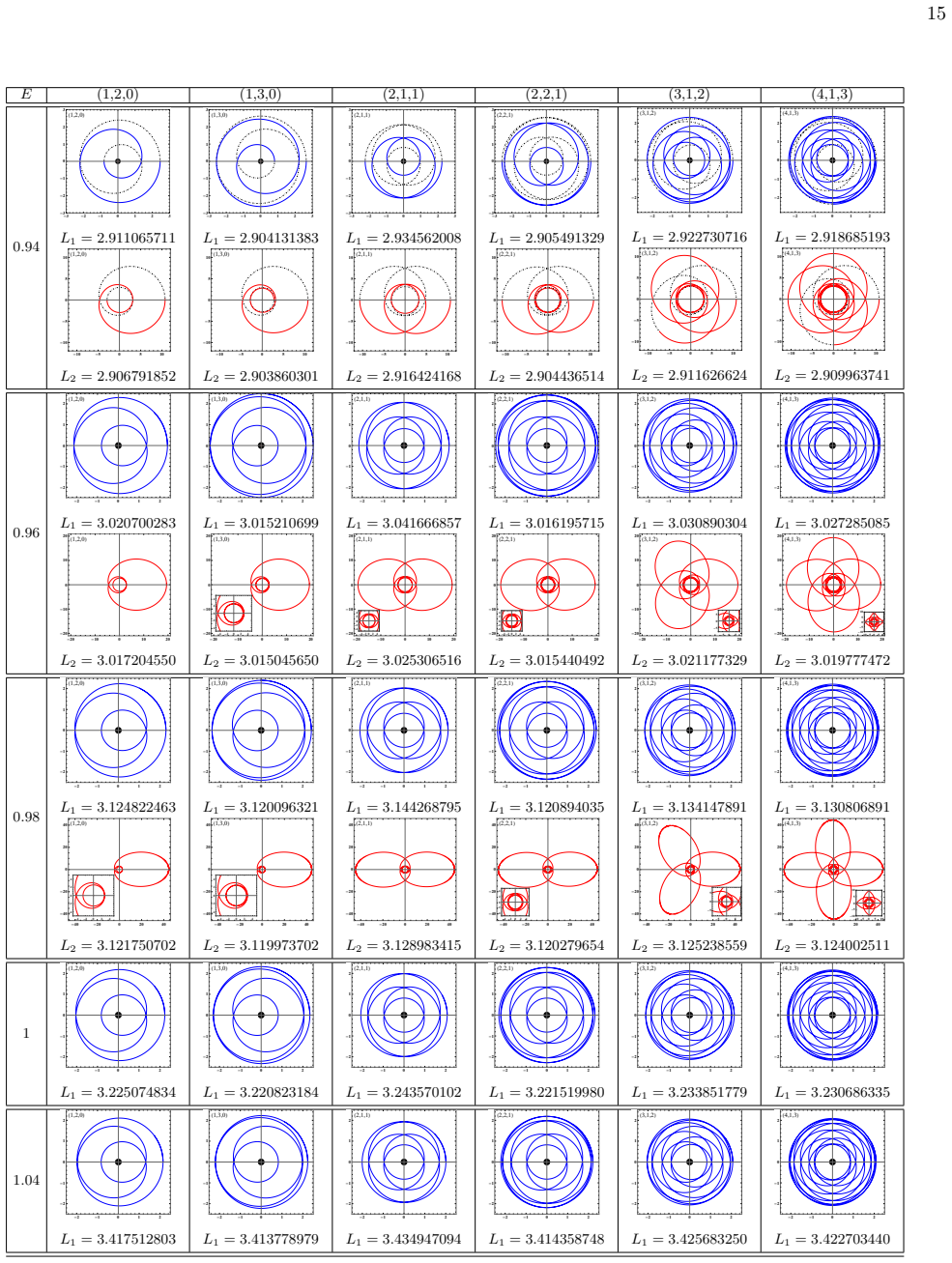
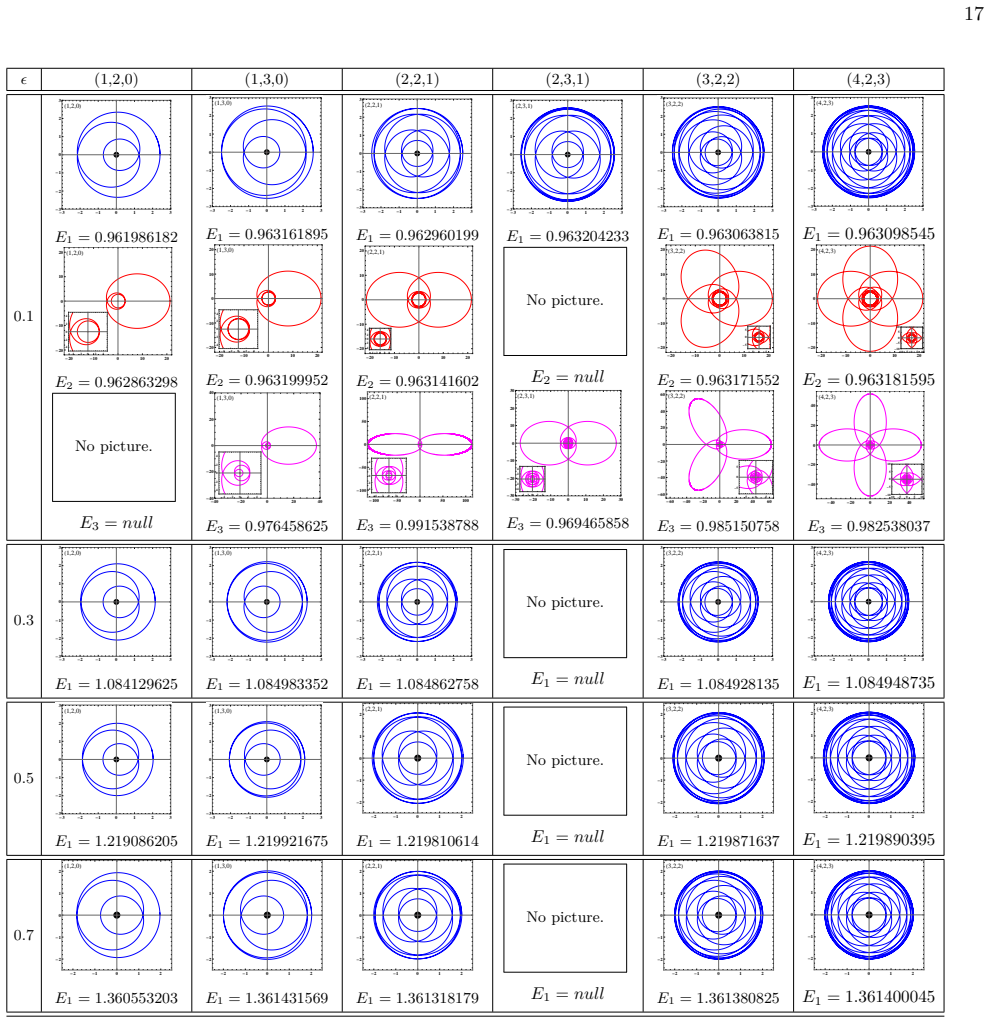
The central claim is that in the parameter window $1.025755\le \alpha_1<1.07317$ of the dyonic black hole family (with $M=1$, $\alpha_2=2.76$, $p=0.15$, $q=1.05$), the metric function $f(r)$ is non-monotonic outside the event horizon and produces an effective potential $V_{\rm eff}=f(r)(1+L^2/r^2)$ with two maxima and two minima. Because of that landscape, the equations defining marginally bound orbits have three solutions, and the frequency-ratio integral that assigns each periodic orbit its rational label $q=\Delta\phi_r/(2\pi)-1$ becomes multi-valued in energy and angular momentum. The paper exhibits explicit closed trajectories: for example, at $\alpha_1=1.025755$ with $\epsilon=0.1$, the same $q=(1,2,0)$ appears at $E\approx0.91771$ and $E\approx0.91870$, and for some labels a third branch appears at higher $E$. All branches have the same winding number $n=z(1+q)$ and are topologically equivalent in the $(z,w,v)$ classification, yet they differ in radial extent and eccentricity; the innermost branch even becomes more circular as $E$ or $L$ increases while outer branches become more eccentric. The same analysis shows that bound orbits with $E>1$ exist whenever the outer barrier exceeds unity, a feature absent for monotonic $f(r)$.
Load-bearing premise
The argument assumes the numerical evaluation of the metric function and of the orbit conditions is accurate enough to resolve energy differences as small as about one part in a thousand; if it is not, the claimed separate branches could merge or disappear.
Editorial extensions
If this is right
- In the non-monotonic window, the standard one-periodic-orbit-per-rational-label tables are incomplete: the same $q$ can correspond to two or three closed orbits, so searches that invert $q$ to $(E,L)$ must allow multiple solutions.
- Bound motion is not limited to $E<1$ in these spacetimes; particles with energy above the asymptotic value can still be trapped by the outer barrier, which changes how 'bound' should be defined near such objects.
- All branches with the same $q$ share the same winding number and $(z,w,v)$ classification, so interpretations that rely only on orbit topology will not distinguish them; the radial profile matters.
- Monotonic $f(r)$ cases, including the three- and four-horizon regimes, reduce to the known single-branch behavior, so the multi-branch phenomenon is tied to the shape of $f(r)$, not to the number of horizons alone.
Reading between the lines
- Any static spherically symmetric metric whose $f(r)$ develops two local minima outside the horizon should show the same double-barrier orbit structure; testing a different theory, such as a compact object with a nested shell, would indicate whether the mechanism is generic.
- The paper fixes $\alpha_2=2.76$, $p=0.15$, and $q=1.05$; mapping the second and third branch boundaries across those parameters would show how robust the branches are and where they pinch off.
- If real, $E>1$ bound orbits would be an unusual gravitational-wave source: particles could orbit in a well behind an outer barrier without escaping, and the paper does not yet compute such waveforms.
- The reported inversion, where inner branches become more circular as energy rises while outer branches grow more eccentric, could serve as a geometric fingerprint for non-monotonic metric functions, provided an independent calculation reproduces it.
Signed reviews
Editorial analysis
A structured set of objections, weighed in public.
Referee Report
Summary. The paper studies bound periodic orbits of massive test particles in a static, spherically symmetric dyonic black hole arising from quasi-topological electromagnetism, with metric function given by Eq. (3). For fixed M=1, α2=2.76, p=0.15, q=1.05 and varying α1, the authors classify horizon structures and identify a non-monotonic regime 1.025755≤α1<1.07317 in which f(r) is non-monotonic outside the horizon and the effective potential develops a double-barrier structure. Within this regime they report three marginally bound orbit (MBO) branches, two of which (LMBO2 and LMBO3) are used to construct double-well effective potentials, and they present numerical evidence for multiple energy branches of periodic orbits with the same rational number q=(z,w,v), including bound orbits with E>1. For the monotonic regimes (3- and 4-horizon, and the second 1-/2-horizon range), they recover a single MBO and a single periodic orbit branch per q, consistent with previous results. The paper combines the standard Levin et al. periodic-orbit classification with a specific modified-gravity black hole family and provides extensive tables and trajectory figures.
Significance. If the numerical claims are robust, the paper reports a genuinely new orbital phenomenon: a non-monotonic metric function outside the horizon produces a double-barrier effective potential, multiple MBOs, multiple periodic-orbit branches sharing the same rational label q, and E>1 orbits confined by an outer barrier. These features are absent in Schwarzschild, Kerr, and Reissner-Nordström backgrounds and could be relevant for strong-field tests of modified gravity and for EMRI waveform modeling. The paper is clearly structured, uses standard geodesic and periodic-orbit formalism, and provides a large set of explicit trajectories and parameter tables. Its main weaknesses are numerical: the hypergeometric evaluation in Eq. (3) is undocumented, and the branch-splitting evidence rests on energy differences as small as a few times 10^-5 without error estimates or convergence criteria.
major comments (4)
- [Section II A, Eq. (3)] The central non-monotonicity of f(r) relies on numerical evaluation of 2F1(1/4,1;5/4; -4p^2 α2/(r^4 α1)) for large negative arguments. For the representative parameters, at r≈0.2 the argument is approximately -150 and at r≈0.15 it is approximately -480, far outside the |z|<1 radius of convergence of the defining series; the chosen sheet of the analytic continuation is therefore crucial. The paper states neither the evaluation algorithm nor any validation against an independent method, so the double-barrier structure and all subsequent claims rest on an undocumented numerical step. Please specify the hypergeometric evaluation method, provide convergence or cross-check tests (for example, against a power series in a different variable or known limits), and quantify the resulting uncertainty in f and its derivatives near the inner barrier.
- [Section IV A, Tables I-VI] The multi-branch claim is supported by energy and angular momentum roots that are very close together; for example, in Table II for (1,2,0) at ϵ=0.1, E1=0.917706569 and E2=0.918695150 differ by about 10^-3, while for (2,3,1) the E1 and E2 values differ by about 3×10^-5. The paper gives no root-finding tolerances, no quadrature error estimates for Eq. (15), and no convergence criteria for the numerical integration of the geodesic equations. Please add error bars or tolerance-based statements demonstrating that these roots are distinct beyond numerical error; otherwise the branch splitting could be an artifact of the numerical scheme.
- [Section IV A, Fig. 3 and concluding summary] The analysis finds three MBO branches but excludes the first branch (LMBO1<LISCO) with the explanation that the corresponding potential shapes are 'not associated with normal closed bound orbits.' Since the abstract and conclusions emphasize 'multiple marginally bound orbits,' this exclusion needs a quantitative demonstration (for example, a scan for periodic solutions in that angular momentum range) rather than a post hoc statement. If no periodic orbits exist there, that should be shown; if they do exist, they should be included in the analysis.
- [Section IV A, E>1 bound orbits] Because Veff→1 from below at spatial infinity, an orbit with E>1 is not bound in the usual asymptotic sense; it is confined by the outer potential barrier. The paper should state this distinction explicitly and demonstrate for the plotted E>1 trajectories that the radial turning points and the barrier prevent escape. Currently the phrase 'bound orbits with E>1' is used without this caveat, and the figures alone do not show that the orbit cannot eventually cross the outer barrier over longer integration times.
minor comments (6)
- [Eq. (17)] The stated condition 1≤v≤z−1 excludes the single-leaf cases (1,2,0) and (1,3,0) used throughout; the later text correctly uses v∈[0,z−1], so Eq. (17) should be corrected.
- [Tables I, II, and Fig. 8] The value of α1 is inconsistent: Tables I and II use 1.025775, while the text and Table III use 1.025755, and Fig. 8(a) labels the single-horizon case as 1.012577 rather than 1.025755.
- [Throughout] There are numerous typographical errors, including 'V ertex number', 'emains identical', 'MBOLMBO2', 'LMB02', and 'rNBO3' in Fig. 3; these should be corrected before publication.
- [Section IV A, Fig. 5 discussion] The inner local minimum of the effective potential is described as 'a marginally stable circular orbit,' but a local minimum is a stable circular orbit; marginal stability corresponds to an inflection point where ∂rrVeff=0. The terminology should be fixed.
- [Figures 9 and 15] Several figure cells contain 'No picture' placeholders instead of trajectories (for example, Fig. 9, (2,3,1) at ϵ=0.3); these should either be filled with the corresponding orbit or removed, since a placeholder is not an informative scientific result.
- [Table VII caption] The caption states 'Lα1=1.8', which is presumably a typo for 'Lα1=1.08'; in addition, the two-horizon cases α1=1.5 and α1=10 in Table VIII are described as 'four-horizon black holes', inconsistent with the text of Section IV C.
Circularity Check
No circularity: the multi-branch periodic orbits are obtained by directly solving geodesic equations for an externally supplied metric.
full rationale
The derivation chain is self-contained given the input spacetime. The metric function f(r) in Eq. (3) is taken from Ref. [39], whose author group does not overlap with the present authors, and no parameter is fitted to the quantities being predicted. The MBO and ISCO conditions in Eqs. (10) and (11) and the frequency-ratio integral in Eq. (15) are solved directly for the tabulated energies and angular momenta, so the branch energies are roots of those equations rather than fitted inputs relabeled as predictions. The double-barrier effective potential and the resulting E>1 bound orbits are derived properties of Veff = f(r)(1+L^2/r^2) for a non-monotonic f(r), not assumptions embedded in the calculation. Self-citations [40,44,45,46] are used only for context, comparison, and topological classification (e.g., consistency with paired stable/unstable circular orbits) and are not load-bearing premises of the existence claim. Numerical robustness concerns about the hypergeometric evaluation, root finding, and near-degenerate branch energies are correctness risks, not instances of circular reasoning. Therefore no significant circularity is found.
Assumptions & free parameters
free parameters (3)
- α2 (quasi-topological coupling) =
2.76
- p (magnetic charge) =
0.15
- q (electric charge) =
1.05
assumptions (4)
- domain assumption The dyonic black hole metric (Eq. 3) exactly solves the quasi-topological electromagnetic action (Eq. 2) with the stated energy conditions.
- standard math Timelike geodesics are governed by the effective potential Veff = f(r)(1 + L^2/r^2) with f = g for the static spherically symmetric line element.
- standard math The Levin-Perez-Giz classification (z,w,v) and the rational number q = w + v/z uniquely label bound periodic orbits in spherical symmetry.
- ad hoc to paper The specific parameter values α2 = 2.76, p = 0.15, q = 1.05 are representative of the non-monotonic regime.
Cite this review
Pith. "Pith review of A new type of multi-branch periodic orbits in dyonic black holes." pith.science (2026). https://pith.science/paper/YBKOO3R2
@misc{pith2026250820558,
  author       = {Pith},
  title        = {Pith review of: A new type of multi-branch periodic orbits in dyonic black holes},
  year         = {2026},
  howpublished = {\url{https://pith.science/paper/YBKOO3R2}},
  note         = {Machine review of arXiv:2508.20558}
}
abstract
In this work, we investigate bound periodic orbits of timelike particles in the spacetime of dyonic black holes arising from quasi-topological electromagnetic theory. By varying the coupling parameter $\alpha_1$, the corresponding black hole solutions exhibit diverse horizon structures, including naked singularities and black holes with one to four horizons. We find that for sufficiently small $\alpha_1$, the metric function $f(r)$ becomes non-monotonic outside the event horizon in spacetimes with one or two horizons, while in all other cases, $f(r)$ remains strictly monotonic. In the non-monotonic regime, the radial effective potential develops a double-barrier structure, allowing the emergence of multiple marginally bound orbits and multiple branches of periodic orbits associated with the same rational number $l$. Although differing in radial structure, these orbit branches are topologically equivalent. Remarkably, when the outer potential barrier exceeds unity, bound orbits with energy $E>1$ become possible, in addition to the standard $E<1$ branches. When the peak reaches $E=1$, up to three distinct bound orbit branches may coexist. We also identify a novel eccentricity behavior, the innermost branch becomes increasingly circular with increasing energy or angular momentum, while outer branches exhibit greater eccentricity and a larger apastron-periastron separation. These features, absent in previous studies, are unique signatures of non-monotonic metric functions. In contrast, monotonic cases yield a single-well potential, a unique marginally bound orbit, and a single periodic orbit branch per $q$, consistent with earlier findings. Our results highlight the critical role of the metric function's shape in determining the orbital structure around dyonic black holes.
Figures


Figures from the paper (31 more)







Forward citations
Cited by 3 Pith papers
-
Gravitational radiations from periodic orbits around a black hole in the effective field theory extension of general relativity
Periodic orbits around EFTGR black holes produce gravitational waveforms whose substructures increase in complexity with higher zoom numbers.
-
Periodic orbits and their gravitational waves in EMRIs: supermassive black hole affected by galactic dark matter halos
Periodic zoom-whirl orbits and their gravitational waveforms in NFW, Beta, and Moore dark matter halos deviate from Schwarzschild predictions by an amount set by halo mass and radius, with NFW and Beta nearly identica...
-
Periodic Timelike Motion and Gravitational Wave Signatures around a Magnetically Charged Black Hole Surrounded by Quintessence
Quintessence shifts orbital radii, turning points, and zoom-whirl parameters for timelike geodesics around a magnetically charged black hole, producing burst-like gravitational waveforms whose phase, timing, and milli...
Reference graph
Works this paper leans on
-
[1]
For 1 .025755 ≤ α1 < 1.07317 (1-/2- horizon black holes): The metric function f(r) exhibits non- monotonicity outside the event horizon, resulting in a double-barrier effective potential structure. In this regime, three MBO solutions emerge, though we only fo- cused on the two outer ones, LMBO2 and LMBO3, which define the dual potential wells. The inner p...
-
[2]
Trajectories of periodic orbits with two horizons • Periodic orbits for L∈ [LISCO,L MBO2] in the two- horizon case As shown in FIG. 1, the metric functionf(r) of the dy- onic black hole is non-monotonic outside the event hori- zon not only in the single-horizon case at α1 = 1.025755, but also in the range 1 .025755 < α1 < 1.07317, where the spacetime poss...
work page 2024
-
[3]
The effective potential is of the stan- dard single-well type, supporting only one MBO solution
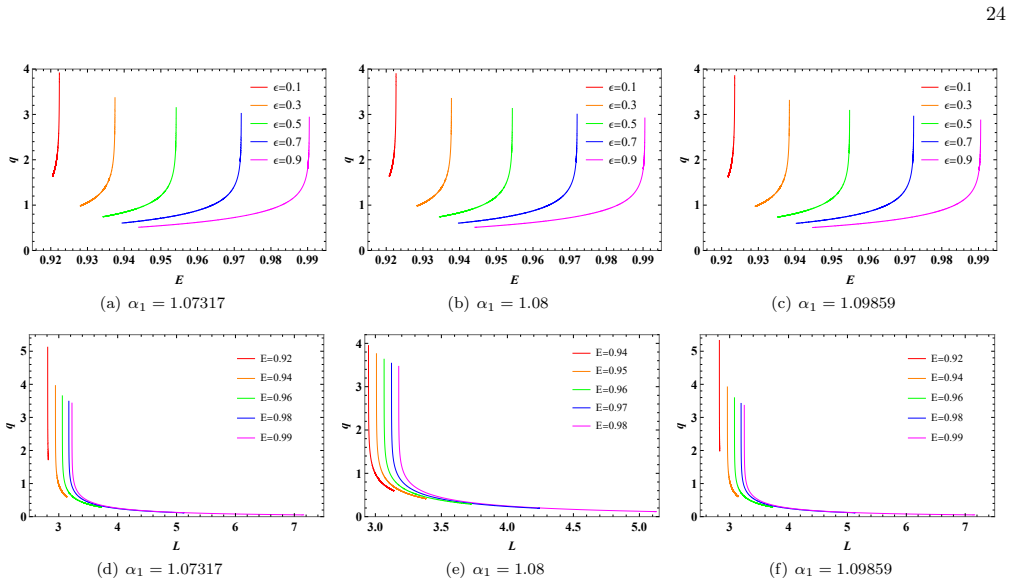
For 1 .07317≤ α1≤ 1.09859 (3-/4- horizon black holes): The metric function becomes monotonic outside the event horizon. The effective potential is of the stan- dard single-well type, supporting only one MBO solution. Consequently, only a single branch of periodic orbits is permitted, all with energy E <1. These periodic orbits exhibit regular behavior, wi...
-
[4]
Tal- ent Scientific Fund of Lanzhou University
For 1 .09859 < α1≤ 43.31447 (1-/2- horizon black holes): Although the black hole possesses only one or two horizons, the function f(r) remains monotonic outside the horizon. However, the radius of the event horizon itself varies non-monotonically with α1, which in turn leads to non-monotonic variations in the MBO radius rMBO, ISCO radius rISCO, and the as...
work page 2024
-
[5]
B. P. Abbott et al. [LIGO Scientific and Virgo], Ob- servation of Gravitational Waves from a Binary Black Hole Merger , Phys. Rev. Lett. 116, 061102 (2016), [arXiv:1602.03837 [gr-qc]]
arXiv 2016
-
[6]
B. P. Abbott et al. [LIGO Scientific and Virgo], GW151226: Observation of Gravitational Waves from a 22-Solar-Mass Binary Black Hole Coalescence , Phys. Rev. Lett. 116, 241103 (2016), [arXiv:1606.04855 [gr- qc]]
arXiv 2016
-
[7]
K. Akiyama et al. [Event Horizon Telescope], First M87 Event Horizon Telescope Results. I. The Shadow of the Supermassive Black Hole , Astrophys. J. Lett. 875, L1 (2019), [arXiv:1906.11238 [astro-ph.GA]]
arXiv 2019
-
[8]
K. Akiyama et al. [Event Horizon Telescope], First Sagittarius A* Event Horizon Telescope Results. I. The Shadow of the Supermassive Black Hole in the Center of the Milky Way , Astrophys. J. Lett. 930, L12 (2022), [arXiv:2311.08680 [astro-ph.HE]]
arXiv 2022
Show all 55 references
-
[9]
Grandclement, C
P. Grandclement, C. Som´ e, and E. Gourgoulhon, Mod- els of rotating boson stars and geodesics around them: new type of orbits , Phys. Rev. D 90, 024068 (2014), [arXiv:1405.4837 [gr-qc]]
2014 arXiv
-
[10]
Grould, Z
M. Grould, Z. Meliani, F. H. Vincent, P. Grandcl´ ement, and E. Gourgoulhon, Comparing timelike geodesics around a Kerr black hole and a boson star , Class. Quant. Grav. 34, 215007 (2017), [arXiv:1709.05938 [astro-ph.HE]]
2017 arXiv
-
[11]
M. C. Teodoro, L. G. Collodel, and J. Kunz, Retrograde Polish Doughnuts around Boson Stars , JCAP 03, 063 (2021), [arXiv:2011.10288 [gr-qc]]
2021 arXiv
-
[12]
Muller, Exact geometric optics in a Morris-Thorne wormhole spacetime, Phys
T. Muller, Exact geometric optics in a Morris-Thorne wormhole spacetime, Phys. Rev. D 77, 044043 (2008)
2008
-
[13]
M. C. Teodoro, L. G. Collodel, D. Doneva, J. Kunz, P. Nedkova, and S. Yazadjiev, Thick toroidal configura- tions around scalarized Kerr black holes , Phys. Rev. D 104, 124047 (2021), [arXiv:2108.08640 [gr-qc]]
2021 arXiv
-
[14]
P. V. P. Cunha, C. A. R. Herdeiro, E. Radu, and H. F. Runarsson, Shadows of Kerr black holes with scalar hair , Phys. Rev. Lett. 115, 211102 (2015), [arXiv:1509.00021 [gr-qc]]
2015 arXiv
-
[15]
G. W. Gibbons and C. A. R. Herdeiro, Supersymmetric rotating black holes and causality violation, Class. Quant. Grav. 16, 3619-3652 (1999), [arXiv:hep-th/9906098 [hep- th]]
1999 arXiv
-
[16]
C. A. R. Herdeiro, Special properties of five-dimensional BPS rotating black holes , Nucl. Phys. B 582, 363-392 (2000), [arXiv:hep-th/0003063 [hep-th]]
2000 arXiv
-
[17]
Diemer and J
V. Diemer and J. Kunz, Supersymmetric rotating black hole spacetime tested by geodesics , Phys. Rev. D 89, 084001 (2014), [arXiv:1312.6540 [gr-qc]]
2014 arXiv
-
[18]
J. F. M. Delgado, C. A. R. Herdeiro, and E. Radu, Equatorial timelike circular orbits around generic ul- tracompact objects, Phys. Rev. D 105, 064026 (2022), [arXiv:2107.03404 [gr-qc]]
2022 arXiv
-
[19]
Leh´ ebel and V
A. Leh´ ebel and V. Cardoso, Fate of observers in circular motion , Phys. Rev. D 105, 064014 (2022), [arXiv:2202.08850 [gr-qc]]
2022 arXiv
-
[20]
Glampedakis and D
K. Glampedakis and D. Kennefick, Zoom and whirl: Ec- centric equatorial orbits around spinning black holes and their evolution under gravitational radiation reaction , Phys. Rev. D 66, 044002 (2002) [arXiv:gr-qc/0203086 [gr-qc]]
2002 arXiv
-
[21]
Levin and G
J. Levin and G. Perez-Giz, A Periodic table for Black Hole Orbits , Phys. Rev. D 77, 103005 (2008), [arXiv:0802.0459 [gr-qc]]
2008 arXiv
-
[22]
Grossman, J
R. Grossman, J. Levin, and G. Perez-Giz, Faster computation of adiabatic extreme mass-ratio inspirals using resonances , Phys. Rev. D 88, 023002 (2013), [arXiv:1108.1819 [gr-qc]]
2013 arXiv
-
[23]
Healy, J
J. Healy, J. Levin, and D. Shoemaker, Zoom-Whirl Orbits 30 in Black Hole Binaries , Phys. Rev. Lett. 103, 131101 (2009), [arXiv:0907.0671 [gr-qc]]
2009 arXiv
-
[24]
C. H. Wang, X. C. Meng, Y. P. Zhang, T. Zhu, and S. W. Wei, Equatorial periodic orbits and gravitational waveforms in a black hole free of Cauchy horizon , JCAP 07 021 (2025), [arXiv:2502.08994 [gr-qc]]
2025
-
[25]
Y. K. Lim and Z. C. Yeo, Energies and angular momenta of periodic Schwarzschild geodesics , Phys. Rev. D 109, 024037 (2024), [arXiv:2401.13894 [gr-qc]]
2024 arXiv
-
[26]
Levin and B
J. Levin and B. Grossman, Multi-horizon and Critical Behavior in Gravitational Collapse of Massless Scalar Dynamics of Black Hole Pairs. I. Periodic tables , Phys. Rev. D 79, 043016 (2009), [arXiv:0809.3838 [gr-qc]]
2009 arXiv
-
[27]
Levin and G
J. Levin and G. Perez-Giz, Homoclinic Orbits around Spinning black holes. I. Exact Solution for the Kerr Sepa- ratrix, Phys. Rev. D 79, 124013 (2009), [arXiv:0811.3814 [gr-qc]]
2009 arXiv
-
[28]
Levin, Energy Level Diagrams for black hole Orbits , Class
J. Levin, Energy Level Diagrams for black hole Orbits , Class. Quant. Grav. 26, 235010 (2009), [arXiv:0907.5195 [gr-qc]]
2009 arXiv
-
[29]
Grossman, J
R. Grossman, J. Levin, and G. Perez-Giz, The harmonic structure of generic Kerr orbits, Phys. Rev. D 85, 023012 (2012), [arXiv:1105.5811 [gr-qc]]
2012 arXiv
-
[30]
Misra and J
V. Misra and J. Levin, Rational Orbits around Charged Black Holes , Phys. Rev. D 82, 083001 (2010), [arXiv:1007.2699 [gr-qc]]
2010 arXiv
-
[31]
Haroon and T
S. Haroon and T. Zhu, Periodic orbits and their gravi- tational wave radiations in black hole with dark matter halo, [arXiv:2502.09171 [gr-qc]]
-
[32]
T. Y. Zhou and Y. Xie, Precessing and periodic motions around a black-bounce/traversable wormhole , Eur. Phys. J. C 80, 1070 (2020)
2020
-
[33]
S. W. Wei, J. Yang, and Y. X. Liu, Geodesics and pe- riodic orbits in Kehagias-Sfetsos black holes in deformed Ho˘ rava-Lifshitz gravity, Phys. Rev. D 99, 104016 (2019), [arXiv:1904.03129 [gr-qc]]
2019 arXiv
-
[34]
Jiang, M
H. Jiang, M. Alloqulov, Q. Wu, S. Shaymatov, and T. Zhu, Periodic orbits and plasma effects on gravita- tional weak lensing by self-dual black hole in loop quan- tum gravity, Phys. Dark Univ. 46, 101627 (2024)
2024
-
[35]
S. Yang, Y. P. Zhang, T. Zhu, L. Zhao, and Y. X. Liu, Gravitational waveforms from periodic orbits around a quantum-corrected black hole , JCAP 01, 091 (2025), [arXiv:2407.00283 [gr-qc]]
2025 arXiv
-
[36]
Z. Y. Tu, T. Zhu, and A. Z. Wang, Periodic orbits and their gravitational wave radiations in a polymer black hole in loop quantum gravity , Phys. Rev. D 108, 2 (2023), [arXiv:2304.14160 [gr-qc]]
2023 arXiv
-
[37]
G. Z. Babar, A. Z. Babar, and Y. K. Lim, Periodic orbits around a spherically symmetric naked singularity , Phys. Rev. D 96, 084052 (2017), [arXiv:1710.09581 [gr-qc]]
2017 arXiv
-
[38]
J. W. Chen and J. S. Yang, Timelike periodic orbits and gravitational waveforms around quantum-corrected black holes, Eur. Phys. J. C 85, 726 (2025), [arXiv:2505.02660 [gr-qc]]
2025 arXiv
-
[39]
L. P. Meng, Z. Y. Xu, and M. Tang, Periodic Orbits and Gravitational Wave Radiation of Black Holes in 4D-EGB gravity, [arXiv:2506.05015 [gr-qc]]
-
[40]
Lu and T
S. Lu and T. Zhu, Gravitational radiations from periodic orbits around Einstein-Æther black holes , [arXiv:2505.00294 [gr-qc]]
-
[41]
Azreg-A¨ ınou, Z
M. Azreg-A¨ ınou, Z. Chen, B. Deng, M. Jamil, T. Zhu, Q. Wu, and Y. K. Lim, Orbital mechanics and quasiperi- odic oscillation resonances of black holes in Einstein- Æther theory , Phys. Rev. D 102, 044028 (2020) [arXiv:2004.02602 [gr-qc]]
2020 arXiv
-
[42]
Alloqulov, S
M. Alloqulov, S. Shaymatov, B. Ahmedov, and T. Zhu, Nonlinear electrodynamic black hole’s impact on the gravitational waveforms from periodic orbits , [arXiv:2508.05245 [gr-qc]]
-
[43]
H. S. Liu, Z. F. Mai, Y. Z. Li, and H. L¨ u, Quasi- topological Electromagnetism: Dark Energy, Dyonic Black Holes, Stable Photon Spheres and Hidden Electro- magnetic Duality , Sci. China Phys. Mech. Astron. 63, 240411 (2020), [arXiv:1907.10876 [hep-th]]
2020 arXiv
-
[44]
S. W. Wei, Topological Charge and Black Hole Pho- ton Spheres , Phys. Rev. D 102, 064039 (2020), [arXiv:2006.02112 [gr-qc]]
2020 arXiv
-
[45]
Q. Y. Gan, P. Wang, H. W. Wu, and H. T. Yang, Photon spheres and spherical accretion image of a hairy black hole , Phys. Rev. D 104, 024003 (2021), [arXiv:2104.08703 [gr-qc]]
2021 arXiv
-
[46]
Q. Y. Gan, P. Wang, H. W. Wu, and H. T. Yang, Photon ring and observational appearance of a hairy black hole , Phys. Rev. D 104, 044049 (2021), [arXiv:2105.11770 [gr- qc]]
2021 arXiv
-
[47]
G. Z. Guo, X. Jiang, P. Wang, and H. W. Wu, Gravita- tional lensing by black holes with multiple photon spheres , Phys. Rev. D 105, 124064 (2022), [arXiv:2204.13948 [gr- qc]]
2022 arXiv
-
[48]
S. W. Wei, Y. P. Zhang, Y. X. Liu, and R. B. Mann, Static spheres around spherically symmetric black hole spacetime , Phys. Rev. Res. 5, 043050 (2023), [arXiv:2303.06814 [gr-qc]]
2023 arXiv
-
[49]
S. W. Wei and Y. X. Liu, Aschenbach effect and cir- cular orbits in static and spherically symmetric black hole backgrounds, Phys. Dark Univ. 43, 101409 (2024), [arXiv:2308.11883 [gr-qc]]
2024 arXiv
-
[50]
Ye and S
X. Ye and S. W. Wei, Distinct topological configura- tions of equatorial timelike circular orbit for spherically symmetric (hairy) black holes , JCAP 07, 049 (2023), [arXiv:2301.04786 [gr-qc]]
2023 arXiv
-
[51]
X. Zhou, S. B. Chen, and J. L. Jing, Geometrically thick equilibrium tori around a dyonic black hole with quasi- topological electromagnetism, Eur. Phys. J. C 84, 130 (2024), [arXiv:2307.01996 [gr-qc]]
2024 arXiv
-
[52]
Y. Q. Lei, X. H. Ge, and C. Ran,Chaos of particle motion near a black hole with quasitopological electromagnetism , Phys. Rev. D 104, 046020 (2021), [arXiv:2008.01384 [hep-th]]
2021 arXiv
-
[53]
Huang, M
H. Huang, M. Y. Ou, M. Y. Lai, and H. Lu, Echoes from classical black holes , Phys. Rev. D 105, 104049 (2022), [arXiv:2112.14780 [hep-th]]
2022 arXiv
-
[54]
M. D. Li, H. M. Wang, and S. W. Wei, Triple points and novel phase transitions of dyonic AdS black holes with quasitopological electromagnetism, Phys. Rev. D 105, 104048 (2022), [arXiv:2201.09026 [gr-qc]]
2022 arXiv
-
[55]
Z. Q. Chen and S. W. Wei, Thermodynamical topology with multiple defect curves for dyonic AdS black holes , Eur. Phys. J. C 84, 1294 (2024), [arXiv:2405.07525 [hep- th]]
2024 arXiv
Reviewed August 15, 2026 · model on record in the stance chip above.
Discussion (0). Continue with ORCID to comment.