REVIEW 3 major objections 5 minor 3 cited by
Electromagnetic properties of heavy-light mesons
T0 review · 3 major / 5 minor · reviewed 2026-08-05 · deepseek-v4-flash
Pith's one-line read The paper claims that a flavour-dependent quark–gluon interaction, used consistently in the bound-state and quark–photon vertex equations, reproduces the measured pion and kaon electromagnetic form factors and predicts charge radii for heav
desk verdict Solid, honest extension of the BSE framework to heavy-light form factors; the new radii are plausible but need a sensitivity analysis for the axial-WTI violation before I'd fully trust them. read the letter →
The pith
A machine-rendered reading of the paper's core claim, the machinery that carries it, and where it could break.
The reading
What carries the argument
The load-bearing object is the flavour-dependent interaction kernel I_ff'(q²) = ᾱ_T(q²) A_f(q²) A_{f'}(q²): the modified Taylor effective charge times the quark wave functions of the two flavours. Because A_f encodes how each flavour is dressed by strong interactions, the kernel automatically couples heavier quarks more strongly, and it enters the gap equation, the Bethe–Salpeter equation, and the quark–photon vertex equation in the same combination, so it fixes the whole calculation consistently. The second central object is the nonperturbative quark–photon vertex, split into a Ball–Chiu longitudinal part (fixed by the Ward–Takahashi identity and expressed through the A and B quark function
What would settle it
A lattice QCD calculation of the D, Ds, and B charge radii with uncertainties near 5%, or a first measurement of the space-like D-meson form factor at an electron-ion collider, would test the predicted values (0.428 fm, 0.368 fm, 0.631 fm). Inside the framework, recomputing the full chain with a kernel that restores the axial Ward–Takahashi identity for unequal quark flavours—the paper applies this only to the D-meson mass, shifting it from 1.93 to 1.99 GeV—and checking whether the radii move by more than the lattice error bars would quantify the main systematic uncertainty.
Extended reading notes
Core claim
Within the Bethe–Salpeter framework, the authors compute space-like electromagnetic form factors for pseudoscalar mesons—pion, kaon, D, Ds, B, Bs, Bc, ηc and ηb—using a flavour-dependent effective interaction derived from the dressed quark-gluon vertices. The interaction carries the quark wave functions of both flavours, so heavier quarks couple more strongly, and it feeds every dynamical equation in the same combination. The quark-photon vertex is solved nonperturbatively with its full longitudinal (Ball–Chiu) and eight transverse components. The central results are that the pion and kaon form factors track the measured data across the space-like region, and that the predicted charge radii—
Load-bearing premise
The paper treats the axial Ward–Takahashi identity violation caused by the flavour-mixed interaction kernel when the two quark flavours differ as negligible: its effect on the quark mass function is quantified at up to about 9% for the u–b case, but the bound-state amplitudes and the final form factors and radii are not corrected for it.
Editorial extensions
If this is right
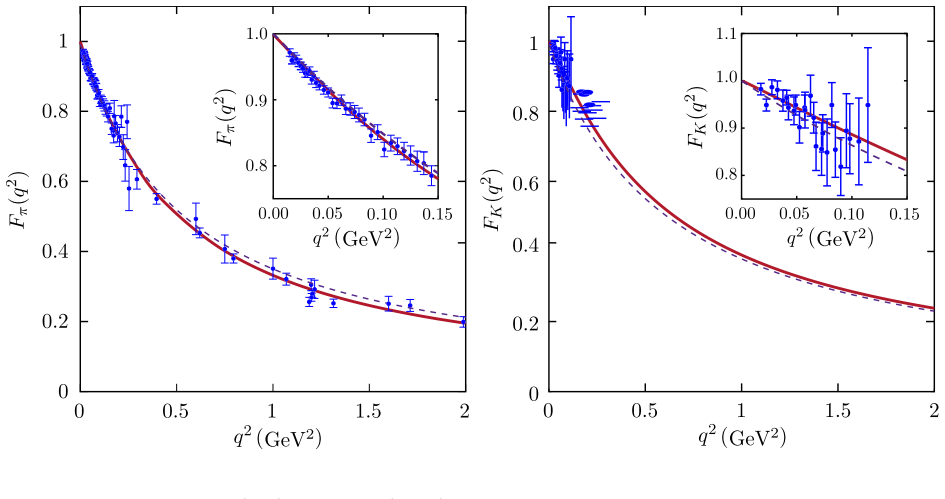
- Because the same flavour-dependent kernel enters the quark gap equation, the Bethe–Salpeter equation, and the quark–photon vertex equation, the close agreement with the measured pion and kaon form factors checks the coupled system as a whole, not one ingredient in isolation.
- The heavy-light charge radii (0.428 fm for D, 0.368 fm for Ds, 0.631 fm for B, 0.213 fm for Bc) provide concrete numbers for future lattice and experimental determinations in a sector where almost no direct data exist yet.
- The framework reproduces the expected pattern across flavours—smaller charge radii for heavier quark content, and negative squared radii (imaginary radii) for neutral mesons such as K0, B0, and Bs—consistent with charge-conjugation constraints.
- The machinery is not restricted to pseudoscalars: the same interaction and vertex construction extend to vector mesons (ρ, K*) and, in principle, to baryons, giving a single flavour-dependent input across hadron classes.
- For the charge-conjugation-even ηc and ηb, the total form factor vanishes identically, but the computed single-quark contributions still carry structural information, with ηb falling off more slowly than ηc at large momentum transfer.
Reading between the lines
- The D-versus-Ds radius pair (0.428 fm vs 0.368 fm here, versus the algebraic model's 0.680 fm vs 0.372 fm) is a discriminating benchmark: a percent-level lattice calculation of one of these radii would effectively choose between the two dynamical pictures.
- Although the paper stops at pseudoscalars, the same flavour-dependent kernel and full quark-photon vertex should carry over to ρ and K* form factors; the transverse-vertex effects that grow with mass asymmetry are likely to be even more pronounced there.
- The most asymmetric system (u–b) is where the flavour-dependent mechanism is pushed hardest, so a future measurement of the B-meson charge radius is the cleanest external test of whether the interaction's flavour sensitivity is correct.
Editorial analysis
A structured set of objections, weighed in public.
Referee Report
Summary. The paper presents a calculation of spacelike electromagnetic form factors and charge radii for pseudoscalar mesons, including the light pion/kaon sector and heavy-light systems (D, D_s, B, B_s, B_c, η_c, η_b), within a Bethe-Salpeter framework. The key novel input is a flavour-dependent effective interaction I_{ff'} taken from Ref. [32], combined with a nonperturbative quark-photon vertex whose SDE is solved including both Ball-Chiu longitudinal and transverse components. The authors report excellent agreement of the pion and kaon form factors with experimental data, and compare their charge radii with experiment, lattice QCD, and several models. They identify, in Section III, a quantitative axial Ward-Takahashi identity (WTI) violation induced by the flavour-dependent kernel for f ≠ f', but they do not propagate this systematic into the heavy-light observables.
Significance. If the results are robust, the paper would be a valuable step toward a unified, parameter-lean description of light and heavy-light meson structure: no parameters are fitted to the electromagnetic observables, the light-meson form factors match data, and the framework extends the successful flavour-dependent interaction of Ref. [32] to form factors. The explicit treatment of the quark-photon vertex via its full SDE is also a strength. However, the central heavy-light claim is currently weakened by an unquantified systematic (the axial WTI violation of Section III) and by the absence of any error estimates on the computed radii. The comparison with lattice QCD for the D_s meson is particularly concerning. These issues do not invalidate the light-meson results, but they must be addressed before the heavy-light agreement can be considered established.
major comments (3)
- [§III and Table I] The axial WTI violation for f ≠ f' is quantified in the quark dressing functions (up to ~9% in M_f, Fig. 4) and is shown to shift the D-meson mass from 1.93 GeV to 1.99 GeV, but this systematic is never propagated to the BS amplitudes (Eq. 2.11) or to the heavy-light form factors/radii. The actual calculation in Section V reuses the original diagonal-kernel propagators, and no uncertainty from the WTI violation is attached to the entries of Table I. Since the heavy-light radii are compared with lattice values without any theoretical error, the claimed agreement is not yet established. I request that the authors either recompute the heavy-light observables with the off-diagonal-dressed propagators, or provide a quantitative estimate of the induced shift in the charge radii.
- [Table I (D_s row)] The D_s charge radius predicted in this work, 0.368 fm, differs from the lattice central value quoted in the same table, 0.465(57) fm, by about 20% (roughly 1.7σ of the lattice error). This is not 'overall good agreement' if D_s is included. With only two heavy-light lattice points (D and D_s) and one of them substantially off, the summary in the abstract and Section V(vi) overstates the level of agreement. The authors should either explain the source of this discrepancy (e.g., truncation effects, different renormalization schemes) or temper the claim.
- [General (Tables I and Figs. 8–9)] No statistical or systematic uncertainties are quoted for any computed form factor or charge radius. Since the paper's main comparisons are with experimental data and lattice QCD, central values alone are insufficient to judge agreement. At minimum, the authors should assign a systematic uncertainty from the dominant sources (the axial WTI violation of Section III, the Chebyshev truncation, the η-parameter dependence, and the complex-conjugate pole parametrization for b quarks). The claim on the D_s radius, in particular, cannot be assessed without such an error budget.
minor comments (5)
- [Eq. (2.1)] The notation '− → F_s(q^2) = J·pav/(2pav^2)' is confusing; the arrow appears to mean 'where' or 'so that'. Please rewrite this definition more clearly.
- [Fig. 4] The caption simply reads 'The relative errors.' This is uninformative; please specify which quantities are shown and how the errors are defined (the definitions are in Eq. (3.8), but the caption should be self-contained).
- [Table I] The use of a trailing 'i' to denote that the square of the radius is negative (e.g., 0.270i fm) is unusual and can be confused with the imaginary unit. A separate column for r^2 or an explicit notation such as 'r^2 < 0' would be clearer.
- [§V(iv)] The text states 'in Figure 8 and Figure 9' without pointing to specific panels. Some panels (e.g., bottom-right of Fig. 9 for K^0, B^0, B_s) are not discussed in the text. Please refer to each panel explicitly.
- [§V(i)] The values of the routing parameter η in Eq. (5.2) are given as fixed inputs, but no sensitivity analysis is presented. A short discussion of how the results depend on η would strengthen the presentation.
Circularity Check
No significant circularity: the computed form factors are genuine outputs of a coupled DSE/BSE system, checked against external data.
full rationale
The derivation chain (Eqs. 2.10, 2.11, 2.13 plus the quark-photon vertex SDE, feeding Eq. 2.2 and hence F_s) contains no fitted parameter that is renamed as a prediction. The current quark masses (5.1), the momentum-routing parameters eta (5.2), and the effective interaction (2.6) are inputs taken from Ref. [32]; they are not adjusted to the electromagnetic observables computed here. The pion and kaon form factors, and the heavy-light charge radii, are therefore genuine outputs of the BSE calculation, and the agreement with experimental and lattice data in Figs. 8-9 and Table I is a nontrivial external check. The main self-citation, [32], supplies the effective kernel and the quark dressing functions, but this is a normal model input rather than a conclusion derived from the present results; moreover, the light-meson form-factor comparisons provide independent falsifiability. No step reduces by definition to its own input. The paper itself flags a limitation in Sec. III: the flavour-off-diagonal kernel I_{ff'} (Eq. 2.6 with f != f') violates the axial Ward-Takahashi identity, with pointwise differences up to ~3% in A and ~9% in M (Fig. 4) and a D-meson mass shift from 1.93 GeV to 1.99 GeV when off-diagonal-dressed propagators are used. That uncertainty is not propagated to the BS amplitudes or to the charge radii in Table I. This is a robustness/correctness gap, not circularity: the final predictions are not defined in terms of the WTI-violation check. Hence the appropriate finding is no significant circularity.
Assumptions & free parameters
free parameters (4)
- Current quark masses (m_u/d, m_s, m_c, m_b) =
0.005, 0.094, 1.1, 3.5 GeV
- Eta parameters =
0.47, 0.41, 0.38, 0.25, 0.24, 0.16
- Modified Taylor coupling fit parameters =
Not given (Eq. (20) of Ref. [32])
- Complex-conjugate pole parameters for b-quark propagator =
Not given (Ref. [32])
assumptions (5)
- domain assumption Bethe-Salpeter equation in impulse approximation gives the correct hadronic electromagnetic current.
- ad hoc to paper The effective interaction I_{ff'} = alpha_T A_f A_{f'} is the complete kernel for gap, BSE, and quark-photon SDE.
- ad hoc to paper Axial Ward-Takahashi identity violation for f != f' is negligible for the computed form factors.
- ad hoc to paper The quark propagator for b quarks can be represented by complex-conjugate poles.
- domain assumption The transverse quark-photon vertex basis of Ref. [57] spans the relevant structure.
Cite this review
Pith. "Pith review of Electromagnetic properties of heavy-light mesons." pith.science (2026). https://pith.science/paper/PG4YNTVI
@misc{pith2026250820631,
  author       = {Pith},
  title        = {Pith review of: Electromagnetic properties of heavy-light mesons},
  year         = {2026},
  howpublished = {\url{https://pith.science/paper/PG4YNTVI}},
  note         = {Machine review of arXiv:2508.20631}
}
read the original abstract
Within the Bethe-Salpeter framework, we present a computation of space-like electromagnetic form factors for pseudoscalar mesons, including light and heavy-light systems. Our approach employs a flavour-dependent variation of the standard Taylor effective charge, which contains key contributions from the quark-gluon vertices. This effective interaction is a common ingredient of all relevant dynamical equations, and accommodates the crucial mass differences between the various quark flavours. Particular attention is paid to the nonperturbative determination of the quark-photon vertex. The computed electromagnetic form factors for the pion and the kaon mesons show excellent agreement with experimental determinations. In addition, the predictions for the charge radii of heavy-light systems are in overall good agreement with lattice QCD.
Figures


Figures from the paper (6 more)



Forward citations
Cited by 3 Pith papers
-
Electromagnetic form factors and structure of the $T_{bb}$ tetraquark from lattice QCD
Lattice QCD on one ensemble yields electromagnetic form factors for T_bb, indicating a compact heavy diquark plus light antidiquark bound state with charge radius smaller than the BB* threshold.
-
Pseudoscalar charmonium and bottomonium: light-front wave functions, distribution amplitudes and distribution functions
A modified non-separable LFWF ansatz for pseudoscalar heavy quarkonia enables computation of zero-skewness GPDs, EM and gravitational form factors, and transverse distributions within the Schwinger-function framework.
-
Pseudoscalar charmonium and bottomonium: light-front wave functions, distribution amplitudes and distribution functions
Extends LFWF studies to heavy pseudoscalar quarkonia via a modified non-separable ansatz that reproduces their properties and enables computation of GPDs, electromagnetic and gravitational form factors, and transverse...
Reference graph
Works this paper leans on
-
[32]
F. F. Mojica, C. E. Vera, E. Rojas, and B. El-Bennich, Phys. Rev. D 96, 014012 (2017)
work page 2017
-
[1]
+ A(p2 2) 2 , λ 2 = A(p2
-
[2]
− A(p2 2) p2 1 − p2 2 , λ 3 = B(p2
-
[3]
− B(p2 2) p2 1 − p2 2 , λ 4 = 0 . (4.5) The transverse component Γ µ T (p1, p2) may be expanded as Γµ T (q, u) = 8X i=1 hi(q, u) τ µ i , (4.6) where the τ µ i are the elements of an eight-dimensional basis, and the hi(q, u) denote the associated form factors. Specifically, we employ the basis of [57], whose elements are given by τ µ 1 = tµν qq γν , τ µ 2 ...
work page 2022
-
[4]
E. E. Salpeter and H. A. Bethe, Phys. Rev. 84, 1232 (1951)
1951
- [5]
-
[6]
Quantum mechanics of one- and two-electron systems,
H. A. Bethe and E. E. Salpeter, “Quantum mechanics of one- and two-electron systems,” in Atoms I / Atome I (Springer Berlin Heidelberg, Berlin, Heidelberg, 1957) pp. 88–436
work page 1957
- [7]
Show all 77 references
-
[8]
Jain and H
P. Jain and H. J. Munczek, Phys. Rev. D 48, 5403 (1993)
1993
-
[9]
H. J. Munczek, Phys. Rev. D 52, 4736 (1995)
1995
-
[10]
Maris and P
P. Maris and P. C. Tandy, Phys. Rev. C 61, 045202 (2000)
2000
-
[11]
I. C. Cloet, G. Eichmann, B. El-Bennich, T. Klahn, and C. D. Roberts, Few Body Syst. 46, 1 (2009)
2009
-
[12]
El-Bennich, J
B. El-Bennich, J. P. B. C. de Melo, B. Loiseau, J. P. Dedonder, and T. Frederico, Braz. J. Phys. 38, 465 (2008)
2008
-
[13]
Sanchis-Alepuz, R
H. Sanchis-Alepuz, R. Williams, and R. Alkofer, Phys. Rev. D 87, 096015 (2013)
2013
-
[14]
E. Weil, G. Eichmann, C. S. Fischer, and R. Williams, Phys. Rev. D 96, 014021 (2017)
2017
-
[15]
Eichmann, C
G. Eichmann, C. S. Fischer, E. Weil, and R. Williams, Phys. Lett. B 797, 134855 (2019), [Erratum: Phys.Lett.B 799, 135029 (2019)]
2019
-
[16]
Eichmann, C
G. Eichmann, C. S. Fischer, and R. Williams, Phys. Rev. D 101, 054015 (2020)
2020
-
[17]
A. S. Miramontes, H. Sanchis Alepuz, and R. Alkofer, Phys. Rev. D 103, 116006 (2021)
2021
-
[18]
Miramontes, A
A. Miramontes, A. Bashir, K. Raya, and P. Roig, Phys. Rev. D 105, 074013 (2022)
2022
-
[19]
Y.-Z. Xu, M. Ding, K. Raya, C. D. Roberts, J. Rodr ´ ıguez-Quintero, and S. M. Schmidt, Eur. Phys. J. C 84, 191 (2024)
2024
-
[20]
Eichmann, C
G. Eichmann, C. S. Fischer, E. Weil, and R. Williams, Phys. Lett. B 774, 425 (2017)
2017
-
[21]
K. Raya, L. Chang, A. Bashir, J. J. Cobos-Martinez, L. X. Guti´ errez-Guerrero, C. D. Roberts, and P. C. Tandy, Phys. Rev. D 93, 074017 (2016)
2016
-
[22]
Xu, JHEP 07, 118 (2024)
Y.-Z. Xu, JHEP 07, 118 (2024)
2024
-
[23]
A. S. Miramontes, K. Raya, A. Bashir, P. Roig, and G. Paredes-Torres, Chin. Phys. C 49, 083108 (2025)
2025
-
[24]
Y.-Z. Xu, A. Bashir, K. Raya, J. Rodr ´ ıguez-Quintero, and J. Segovia, (2025), arXiv:2506.17993 [hep-ph]. 20
2025 arXiv
-
[25]
A. S. Miramontes, G. Eichmann, and R. Alkofer, Phys. Lett. B 868, 139659 (2025)
2025
-
[26]
Eichmann, H
G. Eichmann, H. Sanchis-Alepuz, R. Williams, R. Alkofer, and C. S. Fischer, Prog. Part. Nucl. Phys. 91, 1 (2016)
2016
-
[27]
Maris and P
P. Maris and P. C. Tandy, Phys. Rev. C 60, 055214 (1999)
1999
-
[28]
Alkofer, P
R. Alkofer, P. Watson, and H. Weigel, Phys. Rev. D 65, 094026 (2002)
2002
-
[29]
Nicmorus, G
D. Nicmorus, G. Eichmann, A. Krassnigg, and R. Alkofer, Phys. Rev. D 80, 054028 (2009)
2009
-
[30]
Hilger, M
T. Hilger, M. Gomez-Rocha, and A. Krassnigg, Phys. Rev. D 91, 114004 (2015)
2015
-
[31]
Hilger, C
T. Hilger, C. Popovici, M. Gomez-Rocha, and A. Krassnigg, Phys. Rev. D 91, 034013 (2015)
2015
-
[33]
F. E. Serna, B. El-Bennich, and G. Krein, Phys. Rev. D 96, 014013 (2017)
2017
-
[34]
´A. S. Miramontes, R. Alkofer, C. S. Fischer, and H. Sanchis-Alepuz, Phys. Lett. B 833, 137291 (2022)
2022
-
[35]
F. Gao, A. S. Miramontes, J. Papavassiliou, and J. M. Pawlowski, Phys. Lett. B 863, 139384 (2025)
2025
-
[36]
A. S. Miramontes, J. M. Morgado Chavez, J. Papavassiliou, and J. M. Pawlowski, (2025), arXiv:2507.15646 [hep-ph]
2025
-
[37]
Br¨ ommelet al
D. Br¨ ommelet al. (QCDSF/UKQCD), Eur. Phys. J. C 51, 335 (2007)
2007
-
[38]
Frezzotti, V
R. Frezzotti, V. Lubicz, and S. Simula (ETM), Phys. Rev. D 79, 074506 (2009)
2009
-
[39]
P. A. Boyle, J. M. Flynn, A. Juttner, C. Kelly, H. P. de Lima, C. M. Maynard, C. T. Sachrajda, and J. M. Zanotti, JHEP 07, 112 (2008)
2008
-
[40]
Aoki et al
S. Aoki et al. (JLQCD, TWQCD), Phys. Rev. D 80, 034508 (2009)
2009
-
[41]
B. B. Brandt, A. J¨ uttner, and H. Wittig, JHEP 11, 034 (2013)
2013
-
[42]
H. B. Meyer, Phys. Rev. Lett. 107, 072002 (2011)
2011
-
[43]
Erben, J
F. Erben, J. R. Green, D. Mohler, and H. Wittig, Phys. Rev. D 101, 054504 (2020)
2020
-
[44]
Accardi et al
A. Accardi et al. , Eur. Phys. J. A 60, 173 (2024)
2024
-
[45]
Abdul Khalek et al
R. Abdul Khalek et al. , Nucl. Phys. A 1026, 122447 (2022)
2022
-
[46]
D. P. Anderle et al. , Front. Phys. (Beijing) 16, 64701 (2021)
2021
-
[47]
Eichmann, R
G. Eichmann, R. Alkofer, I. C. Cloet, A. Krassnigg, and C. D. Roberts, Phys. Rev. C 77, 042202 (2008)
2008
-
[48]
Eichmann and D
G. Eichmann and D. Nicmorus, Phys. Rev. D 85, 093004 (2012)
2012
-
[49]
Celmaster and R
W. Celmaster and R. J. Gonsalves, Phys. Rev. D 20, 1420 (1979). 21
1979
-
[50]
Hasenfratz and P
A. Hasenfratz and P. Hasenfratz, Phys. Lett. B 93, 165 (1980)
1980
-
[51]
Braaten and J
E. Braaten and J. P. Leveille, Phys. Rev. D 24, 1369 (1981)
1981
-
[52]
Athenodorou, D
A. Athenodorou, D. Binosi, P. Boucaud, F. De Soto, J. Papavassiliou, J. Rodriguez-Quintero, and S. Zafeiropoulos, Phys. Lett. B 761, 444 (2016)
2016
-
[53]
Itzykson and J
C. Itzykson and J. B. Zuber, Quantum Field Theory, International Series In Pure and Applied Physics (McGraw-Hill, New York, 1980)
1980
-
[54]
V. A. Miransky, Dynamical Symmetry Breaking in Quantum Field Theories (WORLD SCI- ENTIFIC, 1994)
1994
-
[55]
M. R. Frank, Phys. Rev. C 51, 987 (1995)
1995
-
[56]
A. S. Miramontes and H. Sanchis-Alepuz, Eur. Phys. J. A 55, 170 (2019)
2019
-
[57]
Leutnant and A
M. Leutnant and A. Sternbeck, PoS Confinement2018, 095 (2018)
2018
-
[58]
C. Tang, F. Gao, and Y.-X. Liu, Phys. Rev. D 100, 056001 (2019)
2019
-
[59]
J. S. Ball and T.-W. Chiu, Phys. Rev. D 22, 2550 (1980), [Erratum: Phys.Rev.D 23, 3085 (1981)]
1980
-
[60]
Eichmann, Acta Phys
G. Eichmann, Acta Phys. Polon. Supp. 7, 597 (2014)
2014
-
[61]
Williams, Phys
R. Williams, Phys. Lett. B 798, 134943 (2019)
2019
-
[62]
W. H. Press, B. P. Flannery, S. A. Teukolsky, and W. T. Vetterling, Numerical Recipes in FORTRAN 77: The Art of Scientific Computing , 2nd ed. (Cambridge University Press, 1992)
1992
-
[63]
Sanchis-Alepuz and R
H. Sanchis-Alepuz and R. Williams, Comput. Phys. Commun. 232, 1 (2018)
2018
-
[64]
C. N. Brown, C. R. Canizares, W. E. Cooper, A. M. Eisner, G. J. Feldmann, C. A. Lichtenstein, L. Litt, W. Loceretz, V. B. Montana, and F. M. Pipkin, Phys. Rev. D 8, 92 (1973)
1973
-
[65]
C. J. Bebek et al. , Phys. Rev. D 9, 1229 (1974)
1974
-
[66]
Horn et al
T. Horn et al. (Jefferson Lab F(pi)-2), Phys. Rev. Lett. 97, 192001 (2006)
2006
-
[67]
S. R. Amendolia et al. (NA7), Nucl. Phys. B 277, 168 (1986)
1986
-
[68]
E. B. Dally et al. , Phys. Rev. Lett. 45, 232 (1980)
1980
-
[69]
Volmer et al
J. Volmer et al. (Jefferson Lab F(pi)), Phys. Rev. Lett. 86, 1713 (2001)
2001
-
[70]
R. J. Hern´ andez-Pinto, L. X. Guti´ errez-Guerrero, A. Bashir, M. A. Bedolla, and I. M. Higuera- Angulo, Phys. Rev. D 107, 054002 (2023)
2023
-
[71]
Almeida-Zamora, J
B. Almeida-Zamora, J. J. Cobos-Mart ´ ınez, A. Bashir, K. Raya, J. Rodr ´ ıguez-Quintero, and J. Segovia, Phys. Rev. D 109, 014016 (2024). 22
2024
-
[72]
G. Wang, J. Liang, T. Draper, K.-F. Liu, and Y.-B. Yang (chiQCD), Phys. Rev. D 104, 074502 (2021)
2021
-
[73]
K. U. Can, G. Erkol, M. Oka, A. Ozpineci, and T. T. Takahashi, Phys. Lett. B 719, 103 (2013)
2013
-
[74]
Stamen, D
D. Stamen, D. Hariharan, M. Hoferichter, B. Kubis, and P. Stoffer, Eur. Phys. J. C 82, 432 (2022)
2022
-
[75]
T. P. Leplumey and P. Stoffer, (2025), arXiv:2501.09643 [hep-ph]
2025 arXiv
- [76]
-
[77]
R. L. Workman et al. (Particle Data Group), PTEP 2022, 083C01 (2022). 23
2022
Reviewed August 5, 2026 · model on record in the stance chip above.
Discussion (0). Sign in to comment.