REVIEW 3 major objections 5 minor 87 references
HiddenObject: Modality-Agnostic Fusion for Multimodal Hidden Object Detection
T0 review · 3 major / 5 minor · reviewed 2026-08-05 · deepseek-v4-flash
Pith's one-line read HiddenObject claims a single Mamba-based fusion network outperforms prior RGB-thermal and RGB-depth detectors on four of five benchmarks.
desk verdict A plausible Mamba fusion variant that is undermined by overclaimed SOTA numbers and missing significance tests; worth a careful revision, not a desk reject. read the letter →
The pith
A machine-rendered reading of the paper's core claim, the machinery that carries it, and where it could break.
The reading
What carries the argument
The central mechanism is the multimodal selective-scan fusion block (MMFF) plus a decoder-side assignment of the state-space readout. In a selective state-space scan, the output is y = C h, and which matrix C is chosen determines what gets extracted from the hidden state. The decoder computes A, B, and Delta from the lower-level feature, feeds the lower-level embedding into the scan, but computes C from the higher-level (RGB-anchored) feature, so the readout is conditioned on the richer modality. In MMFF, two modality features are linearly projected, scanned through SS2D in four directions, and the concatenated sequence is also scanned in reverse, flipped back, added, and re-split, then scal
What would settle it
Re-run every baseline in Tables 2-4 under HiddenObject's exact protocol: same optimizer, learning rate, epochs, batch size, 640x480 input, and same train/val splits, then check whether HiddenObject still holds the top mIoU, S_alpha, F_beta, and E_phi values. Separately, drop the thermal or depth channel at inference and measure the performance drop to test whether the claimed modality-agnostic fusion actually preserves detection when a sensor fails.
Extended reading notes
Core claim
In the paper's own terms, the discovery is that a Mamba (selective state-space) backbone can serve as a modality-agnostic fusion engine for hidden object detection. The network encodes RGB and an X-modality (thermal or depth) with two weight-shared Vision Mamba branches, then fuses at four scales through a Multimodal Feature Fusion module whose cross-scan and reverse-scan sequence exchange lets each modality read the other's context. Its channel-aware decoder performs SS2D scans where the A, B, and Delta matrices come from lower-level features while matrix C, the readout from the hidden state, comes from the higher-level feature, giving the stronger modality control over the output. Reported
Load-bearing premise
The reported superiority assumes that published baseline numbers from different backbones, input resolutions, and training recipes can be compared directly with a single new run under the authors' setup; if those baselines were re-run under the same protocol and scored differently, the claimed margins would change.
Editorial extensions
If this is right
- One training protocol covers RGB-thermal, RGB-depth, and any future X-modality, so deploying the model in agriculture or robotics with different sensors does not require architecture changes.
- The multiscale fusion plus Mamba linear-complexity design suggests the gains do not rely on a heavy transformer decoder; the VMamba-S backbone keeps the model comparatively light.
- The decoder's C-from-higher-feature readout provides a natural handle for missing-modality scenarios: when one sensor drops out, the remaining modality can still drive the hidden-state readout.
- The ACOD-12K results bring camouflaged-object-detection metrics into multimodal benchmarks, allowing structural measures such as S_alpha and E_phi rather than only mIoU.
- Because the same code sets new bests across datasets, existing unimodal detectors that fail under occlusion and camouflage could be upgraded by swapping in the fusion mechanism without task-specific redesign.
Reading between the lines
- A fair test of the claimed margins would re-run each baseline in Tables 2-4 under HiddenObject's exact training protocol; if those numbers shift, the architecture claim may survive while the precise margins change.
- The paper's modality-agnostic claim predicts that NIR, event-camera, or any aligned extra modality could be fed through the same X-modality branch with no architectural change, and that this should generalize; this is directly testable.
- The decoder's choice to compute C from the higher-level feature rather than from the fused feature is not ablated; isolating that choice would show where the gain actually comes from.
- Because the thermal and depth experiments share weights, the model could be trained jointly on RGB-T and RGB-D data in one pass; the paper does not test this combined setting.
Editorial analysis
A structured set of objections, weighed in public.
Referee Report
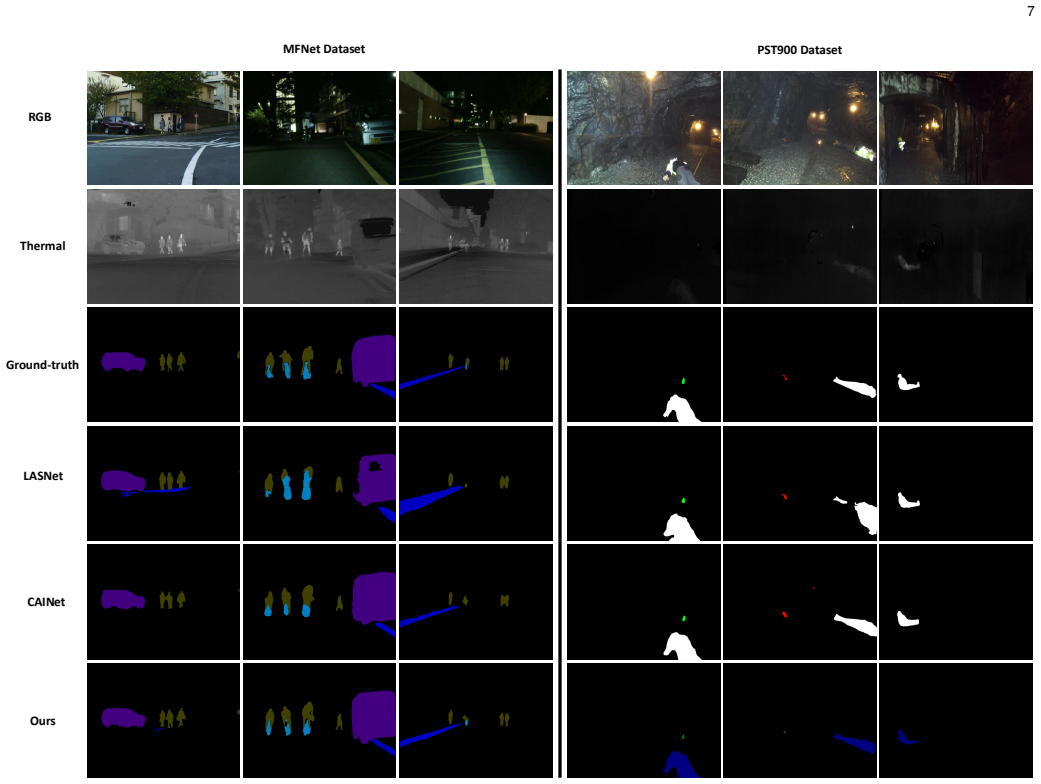
Summary. The manuscript proposes HiddenObject, a multimodal fusion framework built on VMamba SS2D modules. It uses a dual-stream encoder with shared weights for RGB and X-modality, an MMFF module that scans a concatenated RGB-X sequence and adds a reverse-scan flip-back branch, and a channel-aware decoder in which the SS2D matrix C is computed from higher-level or RGB features while A, B, and Δ come from lower-level features. The method is evaluated on RGB-T semantic segmentation (MFNet, PST900), RGB-D segmentation (NYU Depth V2, SUN RGB-D), and RGB-D concealed-object detection (ACOD-12K). The authors report the highest mIoU on MFNet and PST900 and claim significant improvements over all existing methods on ACOD-12K.
Significance. If the comparisons were properly controlled, the MMFF arrangement and the decoder's asymmetric use of the RGB feature would be a useful baseline for modality-agnostic hidden object detection, especially given the limited number of Mamba-based multimodal fusion studies on concealed-object benchmarks. The paper also benefits from a broad benchmark suite spanning thermal and depth modalities. However, the current evidence does not establish the stated SOTA claims: baseline numbers are taken from heterogeneous settings, the ACOD-12K 'significant' claim conflicts with the paper's own table and discussion, and no ablation isolates the proposed components. The architecture may well be competitive, but the validation as presented is insufficient.
major comments (3)
- [Abstract, §4.2, Table 4] The claim that 'our model significantly outperforms existing methods across all metrics' on ACOD-12K is not supported by Table 4. Compared with RISNet, Ours is 0.865 vs 0.87 in Sα (lower after rounding), 0.807 vs 0.80 in Fβ (+0.007), and 0.965 vs 0.97 in Eφ (tied within rounding). No error bars or significance tests are reported, and the Discussion in §4.2 admits that 'the observed fluctuations are not statistically significant in most cases.' This is an internal inconsistency in the paper's strongest claim; it must be replaced by a defensible statement and supported by multi-seed runs or statistical tests.
- [§4.1, Tables 2-3] The SOTA and 'highest' claims rely on direct comparison with published baseline numbers obtained under different backbones, input resolutions, and training protocols. For example, Table 3 mixes ResNet-152, MiT-B3/B4, ViT-B, MobileNet-V2, and VMamba-S at resolutions from 480×480 to 640×640. Crucially, the text says Ours 'achieves the highest mIoU of 52.1 on SUN RGB-D,' but Table 3 lists Sigma (VMamba-S) at 52.4, so this is factually wrong. Likewise, on NYU, Ours is third (56.8) behind Sigma (57.0) and CMNeXt (56.9), not merely 'slightly behind CMNeXt.' The authors need to re-run baselines under their own protocol or clearly qualify the comparisons as cross-paper.
- [§3.3, §3.4, Tables 2-4] No ablation isolates the novelty. The closest comparison, Sigma (VMamba-S), differs from Ours in multiple ways: fusion arrangement, decoder C computation, scaling parameters, shuffling, and upsampling. Without removing or replacing the proposed MMFF and decoder components one at a time, the reported gains cannot be attributed to the paper's contribution. A minimal ablation should include: (a) Sigma's fusion in the same encoder, (b) Ours without the reverse-scan flip-back addition, and (c) decoder C computed from the lower-level or RGB feature instead of the higher-level feature. This is necessary even to support 'competitive' rather than 'SOTA.'
minor comments (5)
- [Figure 6] The caption says 'PSD900' but should be 'PST900.'
- [Figure 1] The caption uses 'ACOD-K12' while the rest of the paper uses 'ACOD-12K.'
- [§4.1 Implementation Detail] The text says 'All methods were trained and evaluated on a cluster equipped with NVIDIA RTX 3090 GPUs.' This cannot be true for baseline scores copied from other papers; please clarify which numbers were re-run and which were taken from publications.
- [Table 3] The table would benefit from a column noting the evaluation protocol and training data, and the 'In. Size' column should be consistently reported for every method.
- [§4.2 Discussion] The Discussion assigns all metric differences to 'not statistically significant' without reporting variances, confidence intervals, or seeds. Either provide the underlying statistics or remove the statistical phrasing.
Circularity Check
No significant circularity: the paper is an empirical architecture/benchmark study; the reported numbers come from direct evaluation on external datasets and no prediction reduces to a fitted parameter or self-citation chain.
full rationale
This is an empirical architecture paper, not a derivation. The claimed contributions — a Mamba-based fusion mechanism and a channel-aware decoder — are described as architectural designs, and the evidence is direct benchmark performance on external datasets (MFNet, PST900, NYU Depth V2, SUN RGB-D, ACOD-12K). I checked the seven circularity patterns. (1) Self-definitional: no quantity is defined in terms of the target result; the decoder's use of the RGB feature for matrix C is an architectural choice, not a definition that forces the reported scores. (2) Fitted input called prediction: no parameter is fit to a subset and then reported as a prediction; all metrics are measured on test sets. (3) Self-citation load-bearing: the paper cites prior work by one of the authors ([2], [3]) only to motivate why RGB-only detection is hard; these citations do not support the architecture's validity or the benchmark claims. (4) Uniqueness imported from authors: no uniqueness theorem is invoked. (5) Ansatz smuggled in via citation: the design is said to be 'Inspired by CMX and Sigma', but these are external prior works and the paper explicitly lists what is distinct about the fusion module; no core premise is adopted merely by self-citation. (6) Renaming known result: the paper does not rename an existing pattern; it presents a new network and compares it with baselines. The main weaknesses — baseline comparability across different backbones/resolutions and the 'significantly outperforms' wording on ACOD-12K despite near-tied numbers — are correctness/evidentiary concerns, not circularity. There is no equation, fitted parameter, or self-citation chain that makes the reported results equivalent to the inputs by construction. Therefore the appropriate circularity score is 0.
Assumptions & free parameters
free parameters (3)
- Learning rate, weight decay, epochs, batch size =
6e-5, 0.01, 500, 8
- Input resolution =
640x480
- MMFF scaling parameters and channel widths
assumptions (6)
- standard math ZOH discretization and first-order Taylor approximation of B are valid for the SS2D modules
- domain assumption ImageNet-1K pretrained VMamba weights, shared between the RGB and X-modality streams, produce useful features for thermal and depth inputs
- domain assumption Published baseline numbers from different papers are directly comparable to the authors' single runs
- ad hoc to paper Computing decoder SS2D matrix C from the RGB feature while A, B, and delta come from lower-level features improves detection
- ad hoc to paper Reversed scan of the concatenated RGB-X sequence in MMFF, followed by flip-back and addition, is beneficial
- domain assumption ACOD-12K COD metrics are appropriate for this task and comparable to prior reported values
Cite this review
Pith. "Pith review of HiddenObject: Modality-Agnostic Fusion for Multimodal Hidden Object Detection." pith.science (2026). https://pith.science/paper/OIINRUIH
@misc{pith2026250821135,
  author       = {Pith},
  title        = {Pith review of: HiddenObject: Modality-Agnostic Fusion for Multimodal Hidden Object Detection},
  year         = {2026},
  howpublished = {\url{https://pith.science/paper/OIINRUIH}},
  note         = {Machine review of arXiv:2508.21135}
}
read the original abstract
Detecting hidden or partially concealed objects remains a fundamental challenge in multimodal environments, where factors like occlusion, camouflage, and lighting variations significantly hinder performance. Traditional RGB-based detection methods often fail under such adverse conditions, motivating the need for more robust, modality-agnostic approaches. In this work, we present HiddenObject, a fusion framework that integrates RGB, thermal, and depth data using a Mamba-based fusion mechanism. Our method captures complementary signals across modalities, enabling enhanced detection of obscured or camouflaged targets. Specifically, the proposed approach identifies modality-specific features and fuses them in a unified representation that generalizes well across challenging scenarios. We validate HiddenObject across multiple benchmark datasets, demonstrating state-of-the-art or competitive performance compared to existing methods. These results highlight the efficacy of our fusion design and expose key limitations in current unimodal and na\"ive fusion strategies. More broadly, our findings suggest that Mamba-based fusion architectures can significantly advance the field of multimodal object detection, especially under visually degraded or complex conditions.
Figures


Figures from the paper (4 more)



Reference graph
Works this paper leans on
-
[1]
Object detection in 20 years: A survey,
Z. Zou, K. Chen, Z. Shi, Y. Guo, and J. Ye, “Object detection in 20 years: A survey,”Proceedings of the IEEE, vol. 111, no. 3, pp. 257–276,
-
[2]
Leveraging open-vocabulary diffusion to camouflaged instance segmentation,
T.-A. Vu, D. T. Nguyen, Q. Guo, B.-S. Hua, N. M. Chung, I. W. Tsang, and S.-K. Yeung, “Leveraging open-vocabulary diffusion to camouflaged instance segmentation,” 2023. [Online]. Available: https://arxiv.org/abs/2312.17505 1
-
[3]
Transcues: Boundary and reflection-empowered pyramid vision transformer for semantic transparent object segmentation,
T.-A. Vu, N. T. Hai, Z. Zheng, B.-S. Hua, Q. Guo, I. Tsang, and S.-K. Yeung, “Transcues: Boundary and reflection-empowered pyramid vision transformer for semantic transparent object segmentation,” 2024. [Online]. Available: https://openreview.net/ forum?id=e9bEoxNiTJ 1
2024
-
[4]
Thermal imaging system and its real-time applications: a survey,
M. Rai, T. Maity, and R. Yadav, “Thermal imaging system and its real-time applications: a survey,”Journal of Engineering Technology, vol. 6, no. 2, pp. 290–303, 2017. 1
2017
-
[5]
A survey on rgb-d datasets,
A. Lopes, R. Souza, and H. Pedrini, “A survey on rgb-d datasets,” Computer Vision and Image Understanding, vol. 222, p. 103489, 2022. 1
2022
-
[6]
Seeing through fog without seeing fog: Deep multimodal sensor fusion in unseen adverse weather,
M. Bijelic, T. Gruber, F. Mannan, F. Kraus, W. Ritter, K. Dietmayer, and F. Heide, “Seeing through fog without seeing fog: Deep multimodal sensor fusion in unseen adverse weather,” inThe IEEE Conference on Computer Vision and Pattern Recognition (CVPR), June
-
[7]
Multimodal dataset for localization, mapping and crop monitoring in citrus tree farms,
H. Teng, Y. Wang, X. Song, and K. Karydis, “Multimodal dataset for localization, mapping and crop monitoring in citrus tree farms,” in Advances in Visual Computing. Cham: Springer Nature Switzerland, 2023, pp. 571–582. 1
2023
-
[8]
Depth- aware concealed crop detection in dense agricultural scenes,
L. Wang, J. Yang, Y. Zhang, F. Wang, and F. Zheng, “Depth- aware concealed crop detection in dense agricultural scenes,” in Proceedings of the IEEE/CVF Conference on Computer Vision and Pattern Recognition (CVPR), June 2024, pp. 17 201–17 211. 1, 6, 7, 8
2024
Show all 87 references
-
[9]
Citdet: A benchmark dataset for citrus fruit detection,
J. James, H. Manching, M. Mattia, K. Bowman, A. Hulse-Kemp, and W. Beksi, “Citdet: A benchmark dataset for citrus fruit detection,” IEEE Robotics and Automation Letters, vol. PP , pp. 1–8, 12 2024. 1
2024
-
[10]
Multi-modal fusion trans- former for end-to-end autonomous driving,
A. Prakash, K. Chitta, and A. Geiger, “Multi-modal fusion trans- former for end-to-end autonomous driving,” inProceedings of the IEEE/CVF conference on computer vision and pattern recognition, 2021, pp. 7077–7087. 1
2021
-
[11]
Multi-level fusion for robust rgbt tracking via enhanced thermal representation,
Z. Tang, T. Xu, X.-J. Wu, and J. Kittler, “Multi-level fusion for robust rgbt tracking via enhanced thermal representation,”ACM Trans- actions on Multimedia Computing, Communications and Applications, vol. 20, no. 10, pp. 1–24, 2024. 1
2024
-
[12]
Mfnet: Towards real-time semantic segmentation for autonomous vehicles with multi-spectral scenes,
Q. Ha, K. Watanabe, T. Karasawa, Y. Ushiku, and T. Harada, “Mfnet: Towards real-time semantic segmentation for autonomous vehicles with multi-spectral scenes,” in2017 IEEE/RSJ International Conference on Intelligent Robots and Systems (IROS), 2017, pp. 5108–
2017
-
[13]
Rtfnet: Rgb-thermal fusion network for semantic segmentation of urban scenes,
Y. Sun, W. Zuo, and M. Liu, “Rtfnet: Rgb-thermal fusion network for semantic segmentation of urban scenes,”IEEE Robotics and Automation Letters, vol. 4, no. 3, pp. 2576–2583, 2019. 2, 5, 6
2019
-
[14]
Pst900: Rgb-thermal calibration, dataset and segmentation network,
S. S. Shivakumar, N. Rodrigues, A. Zhou, I. D. Miller, V . Kumar, and C. J. Taylor, “Pst900: Rgb-thermal calibration, dataset and segmentation network,” 2019. 2, 5, 6
2019
-
[15]
Fruity: A multi-modal dataset for fruit recognition and 6D-Pose estimation in precision agriculture,
M. Abdulsalam, Z. Chekakta, N. Aouf, and M. Hogan, “Fruity: A multi-modal dataset for fruit recognition and 6D-Pose estimation in precision agriculture,” in2023 31st Mediterranean Conference on Control and Automation (MED). IEEE, Jun. 2023, pp. 144–149. 2
2023
-
[16]
Firestereo: Forest infrared stereo dataset for uas depth perception in visually degraded environments,
D. Dhrafani, Y. Liu, A. Jong, U. Shin, Y. He, T. Harp, Y. Hu, J. Oh, and S. Scherer, “Firestereo: Forest infrared stereo dataset for uas depth perception in visually degraded environments,”IEEE Robotics and Automation Letters, vol. 10, no. 4, pp. 3302–3309, 2025. 2
2025
-
[17]
Caltech aerial rgb-thermal dataset in the wild,
C. Lee, M. Anderson, N. Ranganathan, X. Zuo, K. Do, G. Gkioxari, and S.-J. Chung, “Caltech aerial rgb-thermal dataset in the wild,” inEuropean Conference on Computer Vision. Springer, 2024, pp. 236–256. 2
2024
-
[18]
End-to-end object detection with transformers,
N. Carion, F. Massa, G. Synnaeve, N. Usunier, A. Kirillov, and S. Zagoruyko, “End-to-end object detection with transformers,” in European conference on computer vision. Springer, 2020, pp. 213–229. 2
2020
-
[19]
Deformable {detr}: Deformable transformers for end-to-end object detection,
X. Zhu, W. Su, L. Lu, B. Li, X. Wang, and J. Dai, “Deformable {detr}: Deformable transformers for end-to-end object detection,” inInternational Conference on Learning Representations, 2021. 2
2021
-
[20]
Conditional detr for fast training convergence,
D. Meng, X. Chen, Z. Fan, G. Zeng, H. Li, Y. Yuan, L. Sun, and J. Wang, “Conditional detr for fast training convergence,” in Proceedings of the IEEE/CVF International Conference on Computer Vision, 2021, pp. 3651–3660. 2
2021
-
[21]
Efficient detr: Improv- ing end-to-end object detector with dense prior,
Z. Yao, J. Ai, B. Li, and C. Zhang, “Efficient detr: Improv- ing end-to-end object detector with dense prior,”arXiv preprint arXiv:2104.01318, 2021. 2
2021 arXiv
-
[22]
DAB-DETR: Dynamic anchor boxes are better queries for DETR,
S. Liu, F. Li, H. Zhang, X. Yang, X. Qi, H. Su, J. Zhu, and L. Zhang, “DAB-DETR: Dynamic anchor boxes are better queries for DETR,” inInternational Conference on Learning Representations, 2022. 2
2022
-
[23]
Dn- detr: Accelerate detr training by introducing query denoising,
F. Li, H. Zhang, S. Liu, J. Guo, L. M. Ni, and L. Zhang, “Dn- detr: Accelerate detr training by introducing query denoising,” inProceedings of the IEEE/CVF Conference on Computer Vision and Pattern Recognition, 2022, pp. 13 619–13 627. 2
2022
-
[24]
DINO: DETR with improved denoising anchor boxes for end-to-end object detection,
H. Zhang, F. Li, S. Liu, L. Zhang, H. Su, J. Zhu, L. Ni, and H.-Y. Shum, “DINO: DETR with improved denoising anchor boxes for end-to-end object detection,” inThe Eleventh International Conference on Learning Representations, 2023. 2
2023
-
[25]
Detrs beat yolos on real-time object detection,
Y. Zhao, W. Lv, S. Xu, J. Wei, G. Wang, Q. Dang, Y. Liu, and J. Chen, “Detrs beat yolos on real-time object detection,” inProceedings of the IEEE/CVF Conference on Computer Vision and Pattern Recognition, 2024, pp. 16 965–16 974. 2 10
2024
-
[26]
Rt-detrv2: Improved baseline with bag-of-freebies for real-time detection transformer,
W. Lv, Y. Zhao, Q. Chang, K. Huang, G. Wang, and Y. Liu, “Rt-detrv2: Improved baseline with bag-of-freebies for real-time detection transformer,” 2024. [Online]. Available: https://arxiv.org/abs/2407.17140 2
2024 arXiv
-
[27]
Mamba: Linear-time sequence modeling with selective state spaces,
A. Gu and T. Dao, “Mamba: Linear-time sequence modeling with selective state spaces,” inFirst Conference on Language Modeling,
-
[28]
Vision mamba: efficient visual representation learning with bidirectional state space model,
L. Zhu, B. Liao, Q. Zhang, X. Wang, W. Liu, and X. Wang, “Vision mamba: efficient visual representation learning with bidirectional state space model,” inProceedings of the 41st International Conference on Machine Learning, ser. ICML’24, 2024. 2
2024
-
[29]
Training data-efficient image transformers & distillation through attention,
H. Touvron, M. Cord, M. Douze, F. Massa, A. Sablayrolles, and H. J´egou, “Training data-efficient image transformers & distillation through attention,” inInternational Conference on Machine Learning. PMLR, 2021, pp. 10 347–10 357. 2
2021
-
[30]
Mamba yolo: A simple baseline for object detection with state space model,
Z. Wang, C. Li, H. Xu, and X. Zhu, “Mamba yolo: A simple baseline for object detection with state space model,” inThe 39th Annual AAAI Conference on Artificial Intelligence, 2025. 2
2025
-
[31]
Fusion-mamba for cross-modality object detection,
W. Dong, H. Zhu, S. Lin, X. Luo, Y. Shen, X. Liu, J. Zhang, G. Guo, and B. Zhang, “Fusion-mamba for cross-modality object detection,” arXiv preprint arXiv:2402.16853, 2024. 2
2024 arXiv
-
[32]
Coupled mamba: Enhanced multimodal fusion with coupled state space model,
W. Li, H. Zhou, J. Yu, Z. Song, and W. Yang, “Coupled mamba: Enhanced multimodal fusion with coupled state space model,” in The Thirty-eighth Annual Conference on Neural Information Processing Systems, 2024. 2
2024
-
[33]
Sigma: Siamese mamba network for multi-modal semantic segmentation,
Z. Wan, P . Zhang, Y. Wang, S. Yong, S. Stepputtis, K. Sycara, and Y. Xie, “Sigma: Siamese mamba network for multi-modal semantic segmentation,” in2025 IEEE/CVF Winter Conference on Applications of Computer Vision (WACV). IEEE, 2025, pp. 1734–1744. 2, 4, 5, 6, 8
2025
-
[34]
Faster r-cnn: Towards real- time object detection with region proposal networks,
S. Ren, K. He, R. Girshick, and J. Sun, “Faster r-cnn: Towards real- time object detection with region proposal networks,”Advances in Neural Information Processing Systems, vol. 28, 2015. 2
2015
-
[35]
You only look once: Unified, real-time object detection,
J. Redmon, S. Divvala, R. Girshick, and A. Farhadi, “You only look once: Unified, real-time object detection,” inProceedings of the IEEE Conference on Computer Vision and Pattern Recognition, 2016, pp. 779–788. 2
2016
-
[36]
Yolo9000: Better, faster, stronger,
J. Redmon and A. Farhadi, “Yolo9000: Better, faster, stronger,” in Proceedings of the IEEE Conference on Computer Vision and Pattern Recognition, 2017, pp. 7263–7271. 2
2017
-
[37]
Yolov7: Trainable bag-of-freebies sets new state-of-the-art for real-time object detec- tors,
C.-Y. Wang, A. Bochkovskiy, and H.-Y. M. Liao, “Yolov7: Trainable bag-of-freebies sets new state-of-the-art for real-time object detec- tors,” inProceedings of the IEEE/CVF Conference on Computer Vision and Pattern Recognition, 2023, pp. 7464–7475. 2
2023
-
[38]
Fully convolutional region proposal networks for multispectral person detection,
D. K ¨onig, M. Adam, C. Jarvers, G. Layher, H. Neumann, and M. Teutsch, “Fully convolutional region proposal networks for multispectral person detection,” inProceedings of the IEEE Conference on Computer Vision and Pattern Recognition Workshops, 2017, pp. 49–
2017
-
[39]
Cross-modality attentive feature fusion for object detection in multispectral remote sensing imagery,
F. Qingyun and W. Zhaokui, “Cross-modality attentive feature fusion for object detection in multispectral remote sensing imagery,” Pattern Recognition, vol. 130, p. 108786, 2022. 3
2022
-
[40]
Adopting the yolov4 architecture for low-latency multispectral pedestrian detection in autonomous driving,
K. Roszyk, M. R. Nowicki, and P . Skrzypczy ´nski, “Adopting the yolov4 architecture for low-latency multispectral pedestrian detection in autonomous driving,”Sensors, vol. 22, no. 3, p. 1082,
-
[41]
Multimodal object detection by channel switching and spatial attention,
Y. Cao, J. Bin, J. Hamari, E. Blasch, and Z. Liu, “Multimodal object detection by channel switching and spatial attention,” in Proceedings of the IEEE/CVF Conference on Computer Vision and Pattern Recognition, 2023, pp. 403–411. 3
2023
-
[42]
Cross-modality fusion transformer for multispectral object detection,
F. Qingyun, H. Dapeng, and W. Zhaokui, “Cross-modality fusion transformer for multispectral object detection,”arXiv preprint arXiv:2111.00273, 2021. 3
2021 arXiv
-
[43]
Lraf-net: Long-range attention fusion network for visible-infrared object detection,
H. Fu, S. Wang, P . Duan, C. Xiao, R. Dian, S. Li, and Z. Li, “Lraf-net: Long-range attention fusion network for visible-infrared object detection,”IEEE Transactions on Neural Networks and Learning Systems, 2023. 3
2023
-
[44]
Multi-modal feature pyramid transformer for rgb-infrared object detection,
Y. Zhu, X. Sun, M. Wang, and H. Huang, “Multi-modal feature pyramid transformer for rgb-infrared object detection,”IEEE Transactions on Intelligent Transportation Systems, 2023. 3
2023
-
[45]
Icafusion: Iterative cross-attention guided feature fusion for multispectral object detection,
J. Shen, Y. Chen, Y. Liu, X. Zuo, H. Fan, and W. Yang, “Icafusion: Iterative cross-attention guided feature fusion for multispectral object detection,”Pattern Recognition, vol. 145, p. 109913, 2024. 3
2024
-
[46]
Improving multispectral pedes- trian detection by addressing modality imbalance problems,
K. Zhou, L. Chen, and X. Cao, “Improving multispectral pedes- trian detection by addressing modality imbalance problems,” in Computer Vision–ECCV 2020: 16th European Conference, Glasgow, UK, August 23–28, 2020, Proceedings, Part XVIII 16. Springer, 2020, pp. 787–803. 3
2020
-
[47]
Baanet: Learning bi-directional adaptive attention gates for multispectral pedestrian detection,
X. Yang, Y. Qian, H. Zhu, C. Wang, and M. Yang, “Baanet: Learning bi-directional adaptive attention gates for multispectral pedestrian detection,” in2022 International Conference on Robotics and Automation (ICRA). IEEE, 2022, pp. 2920–2926. 3
2022
-
[48]
Multispectral fusion for object detection with cyclic fuse-and-refine blocks,
H. Zhang, E. Fromont, S. Lef `evre, and B. Avignon, “Multispectral fusion for object detection with cyclic fuse-and-refine blocks,” in 2020 IEEE International Conference on Image Processing (ICIP). IEEE, 2020, pp. 276–280. 3
2020
-
[49]
Guided attentive feature fusion for multispectral pedestrian detection,
——, “Guided attentive feature fusion for multispectral pedestrian detection,” inProceedings of the IEEE/CVF Winter Conference on Applications of Computer Vision, 2021, pp. 72–80. 3
2021
-
[50]
Weakly aligned feature fusion for multimodal object detection,
L. Zhang, Z. Liu, X. Zhu, Z. Song, X. Yang, Z. Lei, and H. Qiao, “Weakly aligned feature fusion for multimodal object detection,” IEEE Transactions on Neural Networks and Learning Systems, 2021. 3
2021
-
[51]
Uncertainty-guided cross- modal learning for robust multispectral pedestrian detection,
J. U. Kim, S. Park, and Y. M. Ro, “Uncertainty-guided cross- modal learning for robust multispectral pedestrian detection,”IEEE Transactions on Circuits and Systems for Video Technology, vol. 32, no. 3, pp. 1510–1523, 2021. 3
2021
-
[52]
Confidence-aware fusion using dempster-shafer theory for multispectral pedestrian detection,
Q. Li, C. Zhang, Q. Hu, H. Fu, and P . Zhu, “Confidence-aware fusion using dempster-shafer theory for multispectral pedestrian detection,”IEEE Transactions on Multimedia, 2022. 3
2022
-
[53]
Stabilizing multispectral pedestrian detection with evidential hybrid fusion,
Q. Li, C. Zhang, Q. Hu, P . Zhu, H. Fu, and L. Chen, “Stabilizing multispectral pedestrian detection with evidential hybrid fusion,” IEEE Transactions on Circuits and Systems for Video Technology, 2023. 3
2023
-
[54]
Mlpd: Multi-label pedestrian detector in multispectral domain,
J. Kim, H. Kim, T. Kim, N. Kim, and Y. Choi, “Mlpd: Multi-label pedestrian detector in multispectral domain,”IEEE Robotics and Automation Letters, vol. 6, no. 4, pp. 7846–7853, 2021. 3
2021
-
[55]
Damsdet: Dynamic adaptive multispectral detection transformer with competitive query selection and adaptive feature fusion,
J. Guo, C. Gao, F. Liu, D. Meng, and X. Gao, “Damsdet: Dynamic adaptive multispectral detection transformer with competitive query selection and adaptive feature fusion,” inEuropean Conference on Computer Vision. Springer, 2024, pp. 464–481. 3
2024
-
[56]
E2E-MFD: Towards end-to-end synchronous multimodal fusion detection,
J. Zhang, M. Cao, W. Xie, J. Lei, D. Li, W. Huang, Y. Li, and X. Yang, “E2E-MFD: Towards end-to-end synchronous multimodal fusion detection,”Advances in Neural Information Processing Systems, vol. 37, pp. 52 296–52 322, 2024. 3
2024
-
[57]
Efficiently modeling long sequences with structured state spaces,
A. Gu, K. Goel, and C. Re, “Efficiently modeling long sequences with structured state spaces,” inInternational Conference on Learning Representations, 2022. 3
2022
-
[58]
Combining recurrent, convolutional, and continuous-time models with linear state space layers,
A. Gu, I. Johnson, K. Goel, K. Saab, T. Dao, A. Rudra, and C. R ´e, “Combining recurrent, convolutional, and continuous-time models with linear state space layers,”Advances in neural information processing systems, vol. 34, pp. 572–585, 2021. 3
2021
-
[59]
Simplified state space layers for sequence modeling,
J. T. Smith, A. Warrington, and S. Linderman, “Simplified state space layers for sequence modeling,” inThe Eleventh International Conference on Learning Representations, 2023. 3
2023
-
[60]
Cmx: Cross-modal fusion for rgb-x semantic segmentation with transformers,
J. Zhang, H. Liu, K. Yang, X. Hu, R. Liu, and R. Stiefelhagen, “Cmx: Cross-modal fusion for rgb-x semantic segmentation with transformers,”IEEE Transactions on Intelligent Transportation Systems, vol. 24, no. 12, pp. 14 679–14 694, 2023. 4, 6, 8
2023
-
[61]
GeminiFusion: Efficient pixel-wise multimodal fusion for vision transformer,
D. Jia, J. Guo, K. Han, H. Wu, C. Zhang, C. Xu, and X. Chen, “GeminiFusion: Efficient pixel-wise multimodal fusion for vision transformer,” inProceedings of the 41st International Conference on Machine Learning, ser. Proceedings of Machine Learning Research, vol. 235. PMLR, 21...
2024
-
[62]
VMamba: Visual state space model,
Y. Liu, Y. Tian, Y. Zhao, H. Yu, L. Xie, Y. Wang, Q. Ye, J. Jiao, and Y. Liu, “VMamba: Visual state space model,” inThe Thirty-eighth Annual Conference on Neural Information Processing Systems, 2024. 4
2024
-
[63]
Shapeconv: Shape-aware convolutional layer for indoor rgb-d semantic segmentation,
J. Cao, H. Leng, D. Lischinski, D. Cohen-Or, C. Tu, and Y. Li, “Shapeconv: Shape-aware convolutional layer for indoor rgb-d semantic segmentation,” inProceedings of the IEEE/CVF International Conference on Computer Vision, 2021, pp. 7088–7097. 4
2021
-
[64]
Spatial information guided convolution for real-time rgbd semantic segmentation,
L.-Z. Chen, Z. Lin, Z. Wang, Y.-L. Yang, and M.-M. Cheng, “Spatial information guided convolution for real-time rgbd semantic segmentation,”IEEE Transactions on Image Processing, vol. 30, pp. 2313–2324, 2021. 4
2021
-
[65]
Acnet: Attention-based network to exploit complementary features for rgbd semantic segmentation,
X. Hu, K. Yang, L. Fei, and K. Wang, “Acnet: Attention-based network to exploit complementary features for rgbd semantic segmentation,” in2019 IEEE International Conference on Image Processing (ICIP). IEEE, 2019, pp. 1440–1444. 4
2019
-
[66]
Bi-directional cross-modality feature propagation with separation- and-aggregation gate for rgb-d semantic segmentation,
X. Chen, K.-Y. Lin, J. Wang, W. Wu, C. Qian, H. Li, and G. Zeng, “Bi-directional cross-modality feature propagation with separation- and-aggregation gate for rgb-d semantic segmentation,” inEuropean Conference on Computer Vision. Springer, 2020, pp. 561–577. 4
2020
-
[67]
Indoor segmentation and support inference from rgbd images,
P . K. Nathan Silberman, Derek Hoiem and R. Fergus, “Indoor segmentation and support inference from rgbd images,” inECCV,
-
[68]
Sun rgb-d: A rgb-d scene understanding benchmark suite,
S. Song, S. P . Lichtenberg, and J. Xiao, “Sun rgb-d: A rgb-d scene understanding benchmark suite,” in2015 IEEE Conference on Computer Vision and Pattern Recognition (CVPR), 2015, pp. 567–576. 6, 7
2015
-
[69]
Gmnet: Graded- feature multilabel-learning network for rgb-thermal urban scene semantic segmentation,
W. Zhou, J. Liu, J. Lei, L. Yu, and J.-N. Hwang, “Gmnet: Graded- feature multilabel-learning network for rgb-thermal urban scene semantic segmentation,”IEEE Transactions on Image Processing, vol. 30, pp. 7790–7802, 2021. 5, 6
2021
-
[70]
Ccaffmnet: Dual-spectral semantic segmentation network with channel-coordinate attention feature fusion module,
S. Yi, J. Li, X. Liu, and X. Yuan, “Ccaffmnet: Dual-spectral semantic segmentation network with channel-coordinate attention feature fusion module,”Neurocomputing, vol. 482, pp. 236–251, 2022. 5, 6
2022
-
[71]
Context-aware interaction network for rgb-t semantic segmentation,
Y. Lv, Z. Liu, and G. Li, “Context-aware interaction network for rgb-t semantic segmentation,”IEEE Transactions on Multimedia, pp. 1–13, 2023. 5, 6, 8
2023
-
[72]
Rgb-t semantic segmentation with location, activation, and sharpening,
G. Li, Y. Wang, Z. Liu, X. Zhang, and D. Zeng, “Rgb-t semantic segmentation with location, activation, and sharpening,”IEEE Transactions on Circuits and Systems for Video Technology, vol. 33, no. 3, pp. 1223–1235, 2022. 5, 6
2022
-
[73]
Multimodal token fusion for vision transformers,
Y. Wang, X. Chen, L. Cao, W. Huang, F. Sun, and Y. Wang, “Multimodal token fusion for vision transformers,” inProceedings of the IEEE/CVF conference on computer vision and pattern recognition, 2022, pp. 12 186–12 195. 5, 8
2022
-
[74]
Multimae: Multi-modal multi-task masked autoencoders,
R. Bachmann, D. Mizrahi, A. Atanov, and A. Zamir, “Multimae: Multi-modal multi-task masked autoencoders,” inEuropean Confer- ence on Computer Vision. Springer, 2022, pp. 348–367. 5, 8
2022
-
[75]
Deep multimodal fusion by channel exchanging,
Y. Wang, W. Huang, F. Sun, T. Xu, Y. Rong, and J. Huang, “Deep multimodal fusion by channel exchanging,”Advances in neural information processing systems, vol. 33, pp. 4835–4845, 2020. 5, 8
2020
-
[76]
Pixel difference convolutional network for rgb-d semantic segmentation,
J. Yang, L. Bai, Y. Sun, C. Tian, M. Mao, and G. Wang, “Pixel difference convolutional network for rgb-d semantic segmentation,” IEEE Transactions on Circuits and Systems for Video Technology, vol. 34, no. 3, pp. 1481–1492, 2023. 5, 8
2023
-
[77]
Delivering arbitrary-modal semantic segmen- tation,
J. Zhang, R. Liu, H. Shi, K. Yang, S. Reiß, K. Peng, H. Fu, K. Wang, and R. Stiefelhagen, “Delivering arbitrary-modal semantic segmen- tation,” inProceedings of the IEEE/CVF Conference on Computer Vision and Pattern Recognition, 2023, pp. 1136–1147. 5, 8
2023
-
[78]
Depth- aided camouflaged object detection,
Q. Wang, J. Yang, X. Yu, F. Wang, P . Chen, and F. Zheng, “Depth- aided camouflaged object detection,” inProceedings of the 31st ACM International Conference on Multimedia, 2023, pp. 3297–3306. 5, 8
2023
-
[79]
Source-free depth for object pop-out,
Z. Wu, D. P . Paudel, D.-P . Fan, J. Wang, S. Wang, C. Demonceaux, R. Timofte, and L. Van Gool, “Source-free depth for object pop-out,” inProceedings of the IEEE/CVF International Conference on Computer Vision, 2023, pp. 1032–1042. 5, 8
2023
-
[80]
High-resolution iterative feedback network for camouflaged object detection,
X. Hu, S. Wang, X. Qin, H. Dai, W. Ren, D. Luo, Y. Tai, and L. Shao, “High-resolution iterative feedback network for camouflaged object detection,” inProceedings of the AAAI Conference on Artificial Intelligence, 2023, pp. 881–889. 5, 8
2023
-
[81]
Feature shrinkage pyramid for camouflaged object detection with transformers,
Z. Huang, H. Dai, T.-Z. Xiang, S. Wang, H.-X. Chen, J. Qin, and H. Xiong, “Feature shrinkage pyramid for camouflaged object detection with transformers,” inProceedings of the IEEE/CVF conference on computer vision and pattern recognition, 2023, pp. 5557–
2023
-
[82]
Hidanet: Rgb-d salient object detection via hierarchical depth awareness,
Z. Wu, G. Allibert, F. Meriaudeau, C. Ma, and C. Demonceaux, “Hidanet: Rgb-d salient object detection via hierarchical depth awareness,”IEEE Transactions on Image Processing, vol. 32, pp. 2160– 2173, 2023. 6, 8
2023
-
[83]
Object segmentation by mining cross-modal semantics,
Z. Wu, J. Wang, Z. Zhou, Z. An, Q. Jiang, C. Demonceaux, G. Sun, and R. Timofte, “Object segmentation by mining cross-modal semantics,” inProceedings of the 31st ACM International Conference on Multimedia, 2023, pp. 3455–3464. 6, 8
2023
-
[84]
Fusionmamba: Dynamic feature enhancement for multimodal image fusion with mamba,
X. Xie, Y. Cui, T. Tan, X. Zheng, and Z. Yu, “Fusionmamba: Dynamic feature enhancement for multimodal image fusion with mamba,” Visual Intelligence, vol. 2, no. 1, p. 37, 2024. 6, 8
2024
-
[85]
Structure- measure: A new way to evaluate foreground maps,
D.-P . Fan, M.-M. Cheng, Y. Liu, T. Li, and A. Borji, “Structure- measure: A new way to evaluate foreground maps,” inProceedings of the IEEE International Conference on Computer Vision (ICCV), 2017, pp. 4548–4557. 6
2017
-
[86]
Enhanced-alignment measure for binary foreground map evaluation,
D.-P . Fan, C. Gong, Y. Cao, B. Ren, M.-M. Cheng, and A. Borji, “Enhanced-alignment measure for binary foreground map evaluation,” inProceedings of the International Joint Conference on Artificial Intelligence (IJCAI), 2018, pp. 698–704. [Online]. Available: https://arxiv.org/...
2018 arXiv
-
[87]
Saliency detection via graph-based manifold ranking,
M.-M. Cheng, N. J. Mitra, X. Huang, P . H. S. Torr, and S.-M. Hu, “Saliency detection via graph-based manifold ranking,” in Proceedings of the IEEE Conference on Computer Vision and Pattern Recognition (CVPR), 2013, pp. 3166–3173. [Online]. Available: https://ieeexplore.ieee.o...
2013
Reviewed August 5, 2026 · model on record in the stance chip above.
Discussion (0). Sign in to comment.