REVIEW 4 major objections 5 minor 21 references
A Mixture of Experts Gating Network for Enhanced Surrogate Modeling in External Aerodynamics
T0 review · 4 major / 5 minor · reviewed 2026-08-05 · deepseek-v4-flash
Pith's one-line read A learned pointwise gating network blends three CFD surrogate models and reports lower error than the best of them.
desk verdict A practical MoE stacking paper with a clean entropy-regularization story, but the missing ensemble-average baseline and lack of uncertainty quantification keep it from being conclusive. read the letter →
The pith
A machine-rendered reading of the paper's core claim, the machinery that carries it, and where it could break.
The reading
What carries the argument
The load-bearing mechanism is the gating network: a three-hidden-layer MLP (128 units per layer, ReLU) that takes per-point expert predictions and a surface normal as input and emits softmax weights over the three experts, separately for pressure and wall shear stress. The final prediction is the weighted sum of the frozen expert outputs plus an optional learned bias correction. The training objective adds a Shannon-entropy term, −λH(w), to the prediction mean-squared error; this entropy regularizer is what keeps the gate from assigning nearly all weight to the strongest expert, and the paper demonstrates its role through duplicate-input and entropy-minimization experiments.
What would settle it
On a held-out vehicle whose local geometry (for example a sharp trailing edge or an unusual mirror shape) differs from training shapes, compute each expert's pointwise error and the gate's assigned weight on those regions. If the gate does not systematically give more weight to the locally most accurate expert, or if the MoE's overall L-2 error is not below DoMINO's on that vehicle, the claim that the gate learns transferable, physics-informed arbitration fails.
Extended reading notes
Core claim
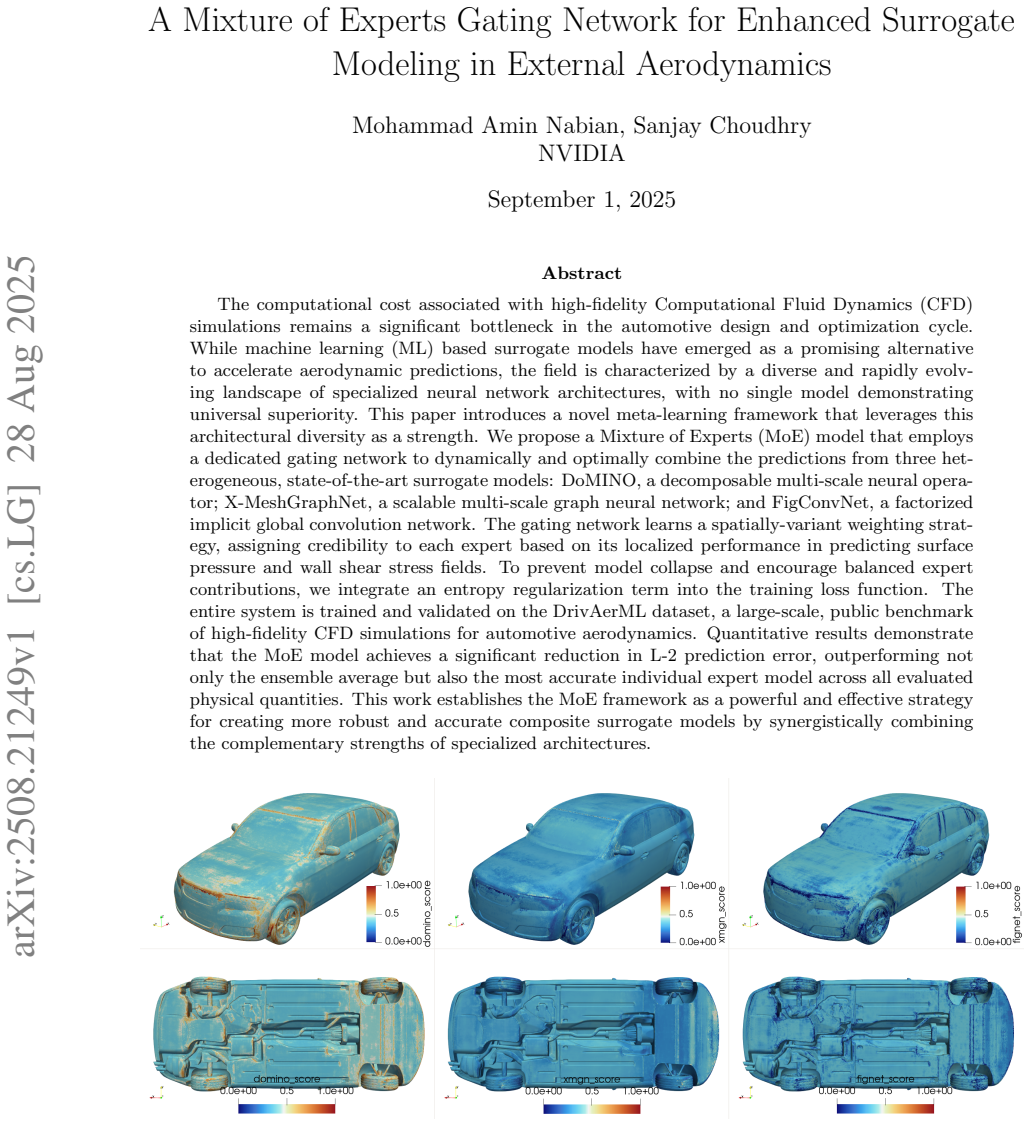
Using the predictions of three pre-trained surrogate models as inputs to a learned pointwise router, the paper's MoE computes the final field as a weighted sum of expert outputs, with separate weight heads for pressure and wall shear stress. The gating network is an MLP that takes the expert predictions at a point plus the local surface normal and outputs softmax weights. Trained with a mean-squared-error loss augmented by a Shannon-entropy term that discourages overconfidence in any one expert, the gate learns spatially coherent weights: the point-cloud operator DoMINO is trusted at the front stagnation region, the graph-based X-MeshGraphNet near mirrors, A-pillars, and the spoiler, and the
Load-bearing premise
The gating network generalizes pointwise expert weighting learned on training vehicles to unseen geometries, even though it only sees expert outputs and surface normals, not the full shape.
Editorial extensions
If this is right
- Composite surrogates built by gating over existing models can be improved without retraining the underlying experts, so a new architecture can be added to the ensemble as soon as its predictions are available.
- Pointwise gating weights double as interpretable diagnostics: a vehicle region where the gate trusts a weaker expert flags a local flow feature worth remedying in that expert or rechecking with high-fidelity CFD.
- Entropy regularization becomes a practical safeguard for soft ensembles: without it the gate collapses to the strongest expert and the ensemble loses its edge, as the paper's ablation shows.
- Because the gating network is lightweight, the blended model retains the inference speed of the underlying surrogates, preserving the near-real-time aerodynamic feedback that makes surrogates useful in design loops.
Reading between the lines
- If the error structure of the three experts shifts with geometry, the gate—which never sees the full shape—may not transfer its learned preferences; a direct test is to compare gate weights against each expert's local error on unfamiliar vehicle shapes.
- The entropy of the gate's weight distribution is a natural uncertainty proxy: high-entropy points are where experts disagree, which could guide targeted data collection or CFD verification.
- The same gating scheme could be carried to other engineering domains with multiple competing surrogate architectures, though its benefit would depend on those experts being genuinely complementary rather than highly correlated.
- A stronger version of the gate could be made geometry-aware, for example by feeding signed-distance or coarse shape encodings, so it can re-learn expert preferences for out-of-distribution geometries; the current input features do not support that.
Editorial analysis
A structured set of objections, weighed in public.
Referee Report
Summary. The paper proposes a Mixture of Experts (MoE) gating network that combines three pre-trained surrogate models -- DoMINO, X-MeshGraphNet, and FigConvNet -- for surface pressure and wall shear stress prediction in automotive aerodynamics. The gating network is a pointwise MLP whose inputs are the expert predictions and optionally the surface normal; it outputs softmax weights and, optionally, additive bias-correction terms. Training uses MSE losses for pressure and shear stress plus an entropy-regularization term on the gating weights. The authors report on the DrivAerML benchmark that the MoE attains lower L-2 relative errors than each individual expert across all four output quantities, and they present qualitative visualizations of spatially meaningful gating weights. The central claim is plausible and the approach is well motivated, but the quantitative evidence is incomplete in ways that affect the strength of the conclusions.
Significance. If fully validated, the contribution is practically useful: it offers a modular, model-agnostic way to combine diverse neural surrogates, with potential transfer to other scientific ML domains. Strengths include the use of a large public high-fidelity benchmark, three genuinely heterogeneous state-of-the-art experts, an entropy-regularization treatment of expert collapse, and a sanity check in which duplicated inputs receive equal weights. However, the paper currently lacks statistical rigor (no error bars, no significance tests, no test-set size), omits the ensemble-average baseline that is explicitly claimed in the abstract, and provides only one aggregate test-set number and one visual example to support the load-bearing generalization claim. The significance of the work is therefore conditional on strengthening these empirical foundations.
major comments (4)
- [Abstract; §5.1, Table 1] The abstract and §5.1 claim that the MoE outperforms the ensemble average, but Table 1 reports no ensemble-average row and the baseline is never defined. Since Eq. (1) is a weighted sum, the uniform average (1/3 of each expert, no bias term) is the natural baseline and should be reported. Without it, a central advertised claim is unsupported and the reader cannot judge whether the learned gating adds value over simple averaging.
- [§4.2, §5.1, Table 1] The quantitative results are presented as single point estimates with no error bars, no significance tests, and no reported number of test vehicles or random seeds. The MoE is trained for only 10 epochs with batch size 1, and the margins over the second-best expert are small (e.g., WSS-x: 0.14 vs 0.17; WSS-y: 0.19 vs 0.22). The claim that the MoE 'significantly' outperforms the best expert needs standard deviations over multiple training runs and/or a paired significance test, plus the test-set size.
- [§3.2, Input Features; §5.1] The gating network's inputs are only the per-point expert predictions and the surface normal. It does not receive global geometry or point coordinates. Therefore, the gate can only transfer to unseen vehicles if the experts' relative error structure is predictable from these local features. The paper's evidence for such transfer is a single aggregate L-2 table and one qualitative example (ID 129). To support the generalization claim, the authors should report the per-vehicle error distribution and analyze performance across geometry clusters or with respect to distance from the training set; otherwise, the pointwise weighting may fail on geometries where the expert-error structure shifts.
- [§3.3, §5.3, Figs. 2-5] The entropy-regularization ablation is qualitative only. The reported MoE improvement (e.g., pressure L-2 of 0.08 vs 0.10) is obtained with lambda_entropy=0.01, but the paper does not show how test error varies with this hyperparameter. Since the cost surface may be flat or the improvement may be sensitive to lambda_entropy, the authors should report test L-2 for a small grid of lambda_entropy values (including 0) for both pressure and shear stress.
minor comments (5)
- [§4.2] Hyperparameters are given in a mix of prose and code-style names (e.g., 'lambda entropy: 0.01', 'num epochs: 10'). Please unify notation and state explicitly whether a validation split was used for model selection.
- [§5.2, Figure 1] The qualitative discussion attributes physical meaning to the gating weights on a single sample. Adding colorbars, axis labels, and a comparison with the ground-truth flow field would make the visualization more informative and less subjective.
- [§2.2.2] There is a missing reference marker after 'early GNNs faced significant limitations in scalability' (the text shows '[?]'). Please fill in the citation.
- [§4.3, Eq. (7)] The L-2 relative error is standard, but because the denominator is the norm of the true field, the metric can be sensitive to global scaling of the field. This is not a flaw, but a brief note on the interpretation would help.
- [§5.1] The claim that 'the final composite prediction is superior to the contribution of any single member' is stronger than what the aggregate table shows. Consider tempering the language or providing evidence that the improvement is not driven by a few samples.
Circularity Check
No significant circularity: the MoE result is a held-out supervised combination; self-citations describe expert models and are not load-bearing.
full rationale
The paper's central claim is an empirical result: a MoE gating network trained on the DrivAerML training split produces lower L-2 relative errors on a held-out test set than each of its three expert models (Table 1). The composition rule PMoE = Wp,1·PDoMINO + Wp,2·PFigConvNet + Wp,3·PXMGN + Cp,MoE (Eq. 1) is a stacking/ensemble model, not a derivation from the experts; the gating weights and bias are free parameters fitted to ground-truth labels. Nothing in the equations forces the reported test-set improvement. In particular, a softmax-weighted convex combination with an additive bias has enough capacity to match the best expert on the training loss, but the paper demonstrates generalization on a separate test split, so the improvement is not an identity. The only self-referential element is that the three experts are prior NVIDIA papers ([14], [16], [2]); those citations are used to describe the pre-trained expert architectures, not to justify the gating-network result. No uniqueness theorem, ansatz smuggled via citation, or definitional reduction is invoked. The absence of a reported ensemble-average baseline (despite the abstract claiming outperformance over it) is a reporting/empirical-validity deficiency, not circularity, and the generalization of pointwise weights to unseen geometry is an empirical assumption tested by the held-out evaluation. Therefore no significant circularity is present.
Assumptions & free parameters
free parameters (4)
- lambda_entropy =
0.01
- MLP hidden layer sizes =
3 hidden layers, 128 neurons each
- Learning rate schedule and training duration =
1e-3 to 5e-6 over 10 epochs
- Bias correction terms =
learned outputs Cp,Ce
assumptions (4)
- domain assumption DrivAerML ground truth is accurate and representative of high-fidelity automotive CFD.
- domain assumption The three expert models are treated as fixed, pre-trained surrogates whose outputs are reliable inputs for the gating network.
- domain assumption A pointwise weighted sum of the three expert predictions plus bias correction is an expressive enough family to capture the optimal combination.
- domain assumption Entropy regularization promotes diversity and robust gating without degrading predictive accuracy.
Cite this review
Pith. "Pith review of A Mixture of Experts Gating Network for Enhanced Surrogate Modeling in External Aerodynamics." pith.science (2026). https://pith.science/paper/OFJZURJU
@misc{pith2026250821249,
  author       = {Pith},
  title        = {Pith review of: A Mixture of Experts Gating Network for Enhanced Surrogate Modeling in External Aerodynamics},
  year         = {2026},
  howpublished = {\url{https://pith.science/paper/OFJZURJU}},
  note         = {Machine review of arXiv:2508.21249}
}
read the original abstract
The computational cost associated with high-fidelity CFD simulations remains a significant bottleneck in the automotive design and optimization cycle. While ML-based surrogate models have emerged as a promising alternative to accelerate aerodynamic predictions, the field is characterized by a diverse and rapidly evolving landscape of specialized neural network architectures, with no single model demonstrating universal superiority. This paper introduces a novel meta-learning framework that leverages this architectural diversity as a strength. We propose a Mixture of Experts (MoE) model that employs a dedicated gating network to dynamically and optimally combine the predictions from three heterogeneous, state-of-the-art surrogate models: DoMINO, a decomposable multi-scale neural operator; X-MeshGraphNet, a scalable multi-scale graph neural network; and FigConvNet, a factorized implicit global convolution network. The gating network learns a spatially-variant weighting strategy, assigning credibility to each expert based on its localized performance in predicting surface pressure and wall shear stress fields. To prevent model collapse and encourage balanced expert contributions, we integrate an entropy regularization term into the training loss function. The entire system is trained and validated on the DrivAerML dataset, a large-scale, public benchmark of high-fidelity CFD simulations for automotive aerodynamics. Quantitative results demonstrate that the MoE model achieves a significant reduction in L-2 prediction error, outperforming not only the ensemble average but also the most accurate individual expert model across all evaluated physical quantities. This work establishes the MoE framework as a powerful and effective strategy for creating more robust and accurate composite surrogate models by synergistically combining the complementary strengths of specialized architectures.
Figures


Figures from the paper (2 more)


Reference graph
Works this paper leans on
-
[1]
Drivaerml: High- fidelity computational fluid dynamics dataset for road-car external aerodynamics
Neil Ashton, Charles Mockett, Marian Fuchs, Louis Fliessbach, Hendrik Hetmann, Thilo Knacke, Norbert Schonwald, Vangelis Skaperdas, Grigoris Fotiadis, Astrid Walle, et al. Drivaerml: High- fidelity computational fluid dynamics dataset for road-car external aerodynamics. arXiv preprint arXiv:2408.11969, 2024
arXiv 2024
-
[2]
Factorized implicit global convolution for automotive computational fluid dynamics prediction
Chris Choy, Alexey Kamenev, Jean Kossaifi, Max Rietmann, Jan Kautz, and Kamyar Aziz- zadenesheli. Factorized implicit global convolution for automotive computational fluid dynamics prediction. arXiv preprint arXiv:2502.04317, 2025. 15
arXiv 2025
-
[3]
Machine learning–accelerated computational fluid dynamics
Dmitrii Kochkov, Jamie A Smith, Ayya Alieva, Qing Wang, Michael P Brenner, and Stephan Hoyer. Machine learning–accelerated computational fluid dynamics. Proceedings of the National Academy of Sciences, 118(21):e2101784118, 2021
2021
-
[4]
Machine learning for road vehicle aerodynamics
Vidyasagar Ananthan, Neil Ashton, Nate Chadwick, Mariano Lizarraga, Danielle Maddix, Satheesh Maheswaran, Pablo Hermoso Moreno, Parisa M Shabestari, Sandeep Sovani, Shreyas Subramanian, et al. Machine learning for road vehicle aerodynamics. Technical report, SAE Technical Paper, 2024
work page 2024
-
[5]
Applying Machine Learning in CFD to Accelerate Simulation. Neural Con- cept, accessed August 27, 2025, https://www.neuralconcept.com/post/ applying-machine-learning-in-cfd-to-accelerate-simulation
work page 2025
-
[6]
Neuralcfd: Deep learning on high-fidelity automotive aerodynamics simulations
Maurits Bleeker, Matthias Dorfer, Tobias Kronlachner, Reinhard Sonnleitner, Benedikt Alkin, and Johannes Brandstetter. Neuralcfd: Deep learning on high-fidelity automotive aerodynamics simulations. arXiv e-prints, pages arXiv–2502, 2025
work page 2025
-
[7]
Recent advances on machine learning for computational fluid dynamics: A survey
Haixin Wang, Yadi Cao, Zijie Huang, Yuxuan Liu, Peiyan Hu, Xiao Luo, Zezheng Song, Wanjia Zhao, Jilin Liu, Jinan Sun, et al. Recent advances on machine learning for computational fluid dynamics: A survey. arXiv preprint arXiv:2408.12171, 2024
arXiv 2024
-
[8]
MeshGraphNet for transient vortex shedding. NVIDIA Docs, accessed August 27, 2025, https://docs.nvidia.com/deeplearning/physicsnemo/physicsnemo-core/examples/ cfd/vortex_shedding_mgn/readme.html
work page 2025
Show all 21 references
-
[9]
Reducing frequency bias of fourier neural operators in 3d seismic wavefield simulations through multistage training
Qingkai Kong, Caifeng Zou, Youngsoo Choi, Eric M Matzel, Kamyar Azizzadenesheli, Zachary E Ross, Arthur J Rodgers, and Robert W Clayton. Reducing frequency bias of fourier neural operators in 3d seismic wavefield simulations through multistage training. Seismological Research ...
2025
-
[10]
Efficient learning of mesh-based physical simulation with bi-stride multi-scale graph neural network
Yadi Cao, Menglei Chai, Minchen Li, and Chenfanfu Jiang. Efficient learning of mesh-based physical simulation with bi-stride multi-scale graph neural network. In International conference on machine learning, pages 3541–3558. PMLR, 2023
2023
-
[11]
Hierarchical mixtures of experts and the em algorithm
Michael I Jordan and Robert A Jacobs. Hierarchical mixtures of experts and the em algorithm. Neural computation, 6(2):181–214, 1994
1994
-
[12]
DataCamp, accessed August 27, 2025, https://www.datacamp.com/blog/mixture-of-experts-moe
What Is Mixture of Experts (MoE)? How It Works, Use Cases & More. DataCamp, accessed August 27, 2025, https://www.datacamp.com/blog/mixture-of-experts-moe
2025
-
[13]
ˇCVUT DSpace, accessed August 27, 2025, https://dspace.cvut.cz/bitstream/handle/ 10467/123538/F3-BP-2025-Bakhtigariev-Robert-thesis.pdf
Surrogate Machine Learning Model Workflow for Prediction of Aerodynamic Forces on Vehi- cles. ˇCVUT DSpace, accessed August 27, 2025, https://dspace.cvut.cz/bitstream/handle/ 10467/123538/F3-BP-2025-Bakhtigariev-Robert-thesis.pdf
2025
-
[14]
Domino: A decomposable multi-scale iterative neural operator for modeling large scale engineering simulations
Rishikesh Ranade, Mohammad Amin Nabian, Kaustubh Tangsali, Alexey Kamenev, Oliver Hen- nigh, Ram Cherukuri, and Sanjay Choudhry. Domino: A decomposable multi-scale iterative neural operator for modeling large scale engineering simulations. arXiv preprint arXiv:2501.13350, 2025
2025 arXiv
-
[15]
Deus Ex Machina, ac- cessed August 27, 2025, https://deus-ex-machina-ism.com/?p=68105&lang=en
Overview of MeshGraphNets, algorithms and implementation examples. Deus Ex Machina, ac- cessed August 27, 2025, https://deus-ex-machina-ism.com/?p=68105&lang=en
2025
-
[16]
X- meshgraphnet: Scalable multi-scale graph neural networks for physics simulation
Mohammad Amin Nabian, Chang Liu, Rishikesh Ranade, and Sanjay Choudhry. X- meshgraphnet: Scalable multi-scale graph neural networks for physics simulation. arXiv preprint arXiv:2411.17164, 2024
2024 arXiv
-
[17]
Mul- tiscale meshgraphnets
Meire Fortunato, Tobias Pfaff, Peter Wirnsberger, Alexander Pritzel, and Peter Battaglia. Mul- tiscale meshgraphnets. arXiv preprint arXiv:2210.00612, 2022
2022 arXiv
-
[18]
Integrated surrogate model-based approach for aerodynamic design optimization of three-stage axial compressor in gas turbine applications
Jinxin Cheng, Bin Li, Xiancheng Song, Xinfang Ji, Yong Zhang, Jiang Chen, and Hang Xiang. Integrated surrogate model-based approach for aerodynamic design optimization of three-stage axial compressor in gas turbine applications. Energies, 2025. 16
2025
-
[19]
The application of ensemble machine learning methods for construction of surrogate models in problems of preliminary design of an aircraft wing airfoil
Daneil Petrov, Artem Golev, and Alexander Moskovtsev. The application of ensemble machine learning methods for construction of surrogate models in problems of preliminary design of an aircraft wing airfoil. In 2024 17th International Conference on Management of Large-Scale Sys...
2024
-
[20]
Airfoil aerodynamic optimization design using ensemble learning surrogate model
Shu Wang, Qinzheng Xu, and Nan Wei. Airfoil aerodynamic optimization design using ensemble learning surrogate model. Journal of Aerospace Engineering, 37(6):04024093, 2024
2024
-
[21]
A comprehensive survey of mixture-of-experts: Algorithms, theory, and applications
Siyuan Mu and Sen Lin. A comprehensive survey of mixture-of-experts: Algorithms, theory, and applications. arXiv preprint arXiv:2503.07137, 2025. 17
2025
Reviewed August 5, 2026 · model on record in the stance chip above.
Discussion (0). Sign in to comment.