REVIEW 4 major objections 4 minor 57 references
Reducing Sensing Time through Offline Experimental Design for Nuclear Spin Detection
T0 review · 4 major / 4 minor · reviewed 2026-08-05 · deepseek-v4-flash
Pith's one-line read The paper claims that picking only the measurement delays where simulated signals diverge most can cut nuclear-spin detection time by 85% — from 11 hours to 1.6 hours — with modest loss of detected spins.
desk verdict The 85% headline reduction is a simulated extrapolation; the experimentally supported claim is 50% at Nm=250, and the paper's real value is the first experimental SALI validation plus a clean variance-based selection criterion—worth reviewing, but the authors need to be more careful about what was measured versus predicted. read the letter →
The pith
A machine-rendered reading of the paper's core claim, the machinery that carries it, and where it could break.
The reading
What carries the argument
SALI (Signal-to-image ArtificiaL Intelligence) is a deep convolutional neural network trained on 5 million simulated signals; inputs are survival probabilities from CPMG pulse sequences with N=32 and N=256 π-pulses, and outputs are 204×160 images with Gaussian peaks at each detected spin's perpendicular and parallel hyperfine couplings. SIG is the offline selector: for each candidate inter-pulse delay τ, it computes the variance of the simulated survival probability across hyperfine-parameter samples drawn from the prior, then keeps the N_p delays with largest variance (4000 per signal at high field, 8000 at low field). This lets the network be trained only on informative delays, so the expe
What would settle it
Run the low-field protocol on a real NV-13C sample: generate the SIG-selected 8000 delays at 1 ns resolution, acquire with 100 repetitions per point (3.2 hours), and compare the detected spin count and coupling errors against the full 8-hour reference; if the 3.2-hour run does not match or beat the reference's F1-score and MAE, the predicted 60% reduction does not hold. At high field, repeat the 1.6-hour SIG acquisition several times on the same device and require at least 25 of the 27 reference spins to appear in each run.
Extended reading notes
Core claim
The central claim is that the expected variance of the measured survival probability over the prior distribution of hyperfine couplings is an adequate, computationally cheap proxy for expected information gain in choosing which data points to measure. Because the binary-outcome expectation simplifies, SIG(τ) is just the variance of the simulated signal itself, Var_{A~p(A)}[P_x(τ|A)]. Points with high variance are those most sensitive to differences in the unknown couplings and therefore carry most of the discrimination power. Integrated with SALI, this offline selection recovers nearly the same nuclear-spin map from a small subset of delays: 27 spins detected from full data versus 25 from SI
Load-bearing premise
The numerical simulator with fitted coherence times and simulated shot noise reproduces real NV-13C signals closely enough at the SIG-selected delays, and the prior used to compute SIG covers the real hyperfine couplings; this is especially load-bearing for the low-field 60% result, which is entirely simulated.
Editorial extensions
If this is right
- Quantum register and memory characterization could target 25 or more nuclear spins in under two hours instead of overnight, at the cost of missing a couple of weakly visible spins.
- Because SALI can be retrained on any subset of delays, the pipeline transfers to new selection rules or new pulse sequences without changing the deployment model.
- At low field, improving temporal resolution from 4 ns to 1 ns and applying SIG could make low-field characterization practical within the same 8-hour budget, with better detection metrics than the reference.
- Shot noise can be increased to 100 repetitions per point with only slight degradation, offering a second time-saving knob beyond point selection.
- The SIG principle is general: it could be applied to other multi-parameter quantum estimation problems with binary measurements and a known signal model.
Reading between the lines
- My inference: the core insight generalizes beyond NV centers — for any parametric signal model with binary outcomes, the most informative offline measurements may be those at which the signal's prior variance is largest, replacing costly Bayesian EIG computations.
- My inference: the high-field 85% number combines SIG point selection with reduced repetitions; a sharper test would separate how much savings comes from each ingredient.
- My inference: the low-field result is entirely simulated and shares its resolution improvement with SIG selection, so the 60% figure should be read as a prediction to be confirmed experimentally before relying on it.
- My inference: because SALI is trained on simulations using the same selected delays, the approach is sensitive to model mismatch; a mismatch between simulated and real spin-bath behavior could degrade real-time performance even if SIG picks sensible points.
Editorial analysis
A structured set of objections, weighed in public.
Referee Report
Summary. The paper proposes surrogate information gain (SIG), a variance-based, computationally tractable figure of merit for offline experimental design, and integrates it with the SALI deep-learning model for nuclear spin detection using nitrogen-vacancy centers. The core idea is to select the most informative measurement delays according to the variance of the simulated signal over a prior distribution of hyperfine couplings, thereby reducing the total acquisition time while preserving characterization accuracy. In the high-field regime (Bz = 404 G), the authors report an 85% reduction in measurement time, from 11 hours to 1.6 hours, and in the low-field regime (Bz = 40.4 G), a 60% reduction, from 8 hours to 3.2 hours. The high-field 4-hour case (Np = 4000 selected points per signal, Nm = 250) is tested on experimental data and recovers 25 of 27 reference spins. The lower-time cases (Nm = 200, 150, 100) and the entire low-field analysis are evaluated only on simulated measurements generated from the same signal model used for training. The paper also provides the first experimental validation of the SALI model, with 27 of 29 detected spins matching reference predictions from Ref. [26].
Significance. If the claims are fully supported, the work would make a useful contribution to quantum sensing and nuclear spin characterization by offering a simple, offline, and computationally light alternative to Bayesian experimental design. The paper has clear strengths: it introduces a concrete and interpretable selection criterion, validates SALI on real experimental data against a known 27-spin cluster, and provides extensive numerical tables of F1-score and MAE. The high-field experimental result at 4 hours (a 50% reduction relative to the 2-input, 8-hour baseline) is a genuine and valuable demonstration. However, the headline claims of 85% and 60% time reductions are not directly supported by experiment: they rely on simulated test sets and, in the low-field case, on a simultaneous change in temporal resolution. The absence of a random-subsampling control means the specific benefit of SIG over simple uniform point selection is not isolated. These issues do not invalidate the overall approach, but they require substantial revision of the claims and additional control comparisons before the paper can be accepted.
major comments (4)
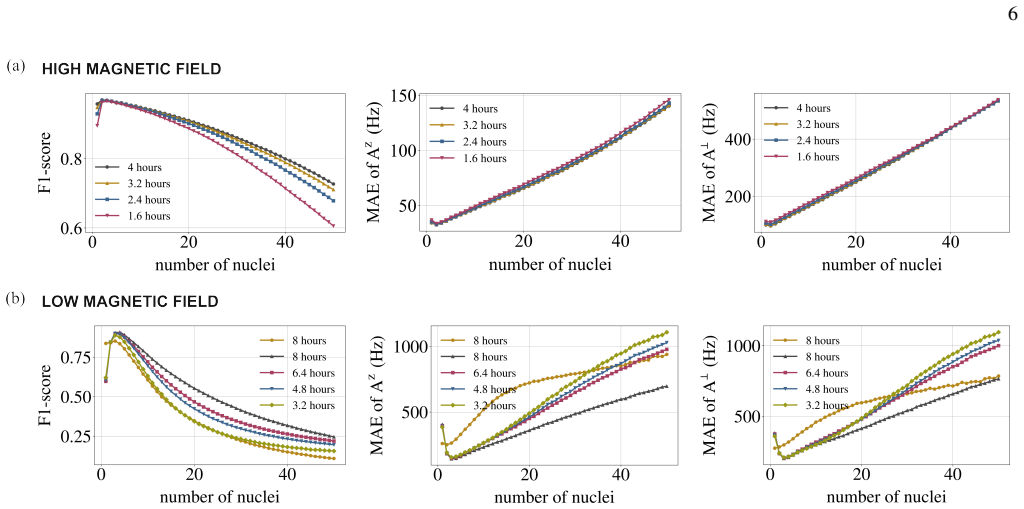
- [Sec. IV C, Fig. 3(a)] The 85% time-reduction claim (11 h -> 1.6 h) is not experimentally validated. Section IV C states that the model at Nm = 200, 150, 100 is 'tested with simulated measurements,' using the same signal simulator (Eqs. S2-S4) on which the model was trained. The only experimentally tested SIG configuration is the 4-hour case with Nm = 250 (Sec. IV B). Moreover, the 11-hour baseline uses four input signals (N = 32, 96, 128, 256), while the 1.6-hour SIG model uses only two SIG-selected signals (N = 32, 256). The comparison therefore conflates a reduction in number of input signals with the effect of SIG. The abstract and conclusions should state that the experimentally supported reduction is 50% (8 h -> 4 h) at Nm = 250, and that the additional reduction to 1.6 h is a simulation-based prediction conditional on simulator fidelity.
- [Sec. V, Fig. 3(b), Tables VI-VIII] The 60% low-field time reduction is entirely simulated and is confounded by a simultaneous change in temporal resolution: the reference model uses Δτ = 4 ns over τ32 ∈ [6,50] μs and τ256 ∈ [10,40] μs, while the SIG-based model uses Δτ = 1 ns over τ ∈ [1,50] μs. The improvement cannot be attributed to SIG alone. Additionally, the statement that the SIG-based 8-hour model 'outperforms the reference model' is not uniformly true: Table VI shows that for 1 nuclear spin the reference F1 is 0.8374 while the SIG 8-hour F1 is 0.6058. The claim should be qualified, and a same-resolution, same-time baseline should be provided to separate the effects of resolution and selection.
- [Sec. IV B and Sec. III] The paper does not include a control with an equal number of randomly selected or uniformly subsampled data points. The comparison in Sec. IV B is between the full 8-hour signals and the SIG-selected 4-hour signals. Since the selected points are a small subset, some of the time reduction may simply come from measuring fewer points, not from the SIG criterion. To support the claim that SIG is the reason for the preserved accuracy, the authors should compare against a baseline with the same Np and same total time but with points chosen randomly or uniformly. This control is particularly important because the central message is that variance-based selection is superior to naive subsampling.
- [Sec. II A and Sec. IV C] The numerical signal simulator and the prior over hyperfine couplings are load-bearing for the extrapolated claims. The SIG selection, the training data, and the simulated test sets at Nm = 200/150/100 and in the low-field regime all derive from the same Px model (Eqs. S2-S4) and the same prior (Az ∈ [-50,50] kHz, A⊥ ∈ [2,80] kHz, n uniform in [1,50]). Thus the simulated performance gains are self-consistency predictions rather than independent tests of the model. The high-field 4-hour experimental result provides external validation for that particular operating point, but it does not validate the simulator at high shot noise (Nm = 100) or in the low-field regime. The authors should explicitly state this limitation and, ideally, provide a measured dataset at reduced Nm to test the shot-noise extrapolation.
minor comments (4)
- [Abstract and Sec. VI] The abstract and conclusions say the 85% reduction is 'validated with experimental data' and 'demonstrated,' which is stronger than what Sec. IV supports. Please revise to distinguish experimentally measured gains from simulation-based predictions.
- [Fig. 1 caption] The caption states '30 nuclear spins are detected' in the first case, while Sec. II B and Tables I-II report 29 spins (27 green + 2 red). This is likely a typo and should be corrected.
- [Tables VI-VIII] The low-field tables list two columns both labeled '8 hours'; the first is the reference model and the second the SIG-based model. Please label these columns to avoid ambiguity.
- [Ref. [41]] The supplemental material reference is titled 'Supplemental Material for Letter Optimizing the Characterization of Nuclear Spin Clusters with an AI Model,' which does not match the present paper's title. Please cite the correct supplementary document.
Circularity Check
No significant circularity: the experimentally validated 50% time reduction anchors the central claim, and the simulated extrapolations are transparently labeled as in silico tests rather than outputs forced by construction.
full rationale
The paper's derivation chain is not circular in the sense defined here. SIG is introduced as a variance-based selection criterion (Eqs. 2-3) computed from the signal model and the prior; it is not a fitted parameter, and SALI's performance after selection is evaluated rather than assumed. The high-field 50% reduction to 4 hours is tested against real experimental data from Ref. [26], with 25/27 reference spins recovered (Sec. IV B, Fig. 1), so the central experimental claim has independent grounding. The additional high-field reductions (Nm=200,150,100) and the low-field 60% prediction are explicitly described as simulated: Sec. IV C states "We generate the same test set as in the original dataset but modify the number of measurements" and Fig. 3(a) labels the Nm=100 case as "tested with simulated measurements"; Sec. V similarly says "we evaluate the methodology introduced in Sec. III on simulations only." Evaluating on synthetic test sets generated from the same simulator used for training is a standard in silico consistency check, not a definitional identity: the F1/MAE outcomes are learned and could in principle have degraded sharply, so the claim is a model-based prediction rather than a tautology. Self-citations to the SALI model [38] and to parallel work [40] are not load-bearing: the paper explicitly performs the first experimental validation of SALI here, and [40] is only mentioned as future direction. The abstract's phrasing "validated with experimental data, resulting in an 85% reduction" does somewhat overstate the experimental support, since the 85% figure includes the simulated Nm=100 leg, but that is an external-validity/overclaim concern, not circularity. No equation or fitted parameter is shown to reduce to its own input by construction, so the appropriate finding is no significant circularity.
Assumptions & free parameters
free parameters (7)
- Prior range Az in [-50, 50] kHz
- Prior range A_perp in [2, 80] kHz
- Number of spins prior n ~ Uniform(1,50)
- Coherence time parameters T_{N=4}=3 ms, eta=0.8 =
T_4 = 3 ms, eta = 0.8
- Number of SIG-selected points Np =
Np = 4000 (high field), 8000 (low field)
- Averaging repetitions Nm =
250, 200, 150, 100
- Spin-bath coupling range =
A_perp in [0,2] kHz
assumptions (4)
- domain assumption The CPMG survival probability for an NV coupled to n 13C spins is given by Eqs. S2-S4 (product of M_j factors).
- domain assumption NV decoherence is captured by Px = (1 + M e^{-tau/T})/2 with T_N = T_4 (N/4)^eta.
- domain assumption The uniform prior over Az, A_perp, and n is representative of the target experimental population.
- standard math Monte Carlo estimates with 50,000 samples for SIG and 5M samples for training approximate the true variance and data distribution.
Cite this review
Pith. "Pith review of Reducing Sensing Time through Offline Experimental Design for Nuclear Spin Detection." pith.science (2026). https://pith.science/paper/ETGXPEC7
@misc{pith2026250821450,
  author       = {Pith},
  title        = {Pith review of: Reducing Sensing Time through Offline Experimental Design for Nuclear Spin Detection},
  year         = {2026},
  howpublished = {\url{https://pith.science/paper/ETGXPEC7}},
  note         = {Machine review of arXiv:2508.21450}
}
abstract
The characterization of nuclear spin environments in solid-state devices plays an important role in advancing quantum technologies, yet traditional methods often demand long measurement times. To address this challenge, we integrate surrogate information gain (SIG) into our deep learning model based on the SALI architecture. By using SIG for data point selection, we achieve a significant reduction in experimental time while maintaining high precision in nuclear spin detection. SIG is a figure of merit based on the expected variance of the signal, which is more straightforward to compute than the expected information gain (EIG) rooted in Bayesian estimation, and, crucially, it selects experiments that are more robust to experimental imperfections. We demonstrate our approach on a nitrogen-vacancy (NV) center in diamond coupled to $^{13}$C nuclei. In the high-field regime, our variance-based optimization is validated with experimental data, resulting in an 85$\%$ reduction in measurement time for a modest reduction in performance. In the low-field regime, we explore the model's performance on simulated data, predicting a 60$\%$ reduction in the total experimental time by improving the temporal resolution of the measurements and applying SIG. This demonstrates the potential of integrating deep learning with optimized signal selection to enhance the efficiency of quantum sensing and nuclear spin characterization, paving the way for scaling these techniques to larger nuclear spin systems.
Figures


Reference graph
Works this paper leans on
- [26]
-
[24]
M. H. Abobeih, J. Cramer, M. A. Bakker, N. Kalb, M. Markham, D. J. Twitchen, and T. H. Taminiau, One-second coherence for a single electron spin coupled to a multi-qubit nuclear-spin environment, Nat. Commun. 9, 2552 (2018)
2018
-
[1]
L. Childress, and R. Hanson, Diamond NV centers for quan- tum computing and quantum networks, MRS Bull. 38, 134-138 (2013)
work page 2013
-
[2]
We then apply a dynamical decoupling sequence (τ−π−τ) repeated N times (CPMG sequence), where “ π” represents a π-pulse on the electron spin, and τ the inter-pulse delay, followed by single-shot optical spin readout. By repeating this process Nm times, one can measure the survival probability Px≡ Px(τ) of the initial state. We indicate the complementary p...
-
[3]
M. A. Nielsen, and I. L. Chuang, Quantum Computation and Quantum Information, Cambridge University Press (2010)
work page 2010
-
[4]
V . V orobyov, J. Javadzade, M. Joli ffe, F. Kaiser, and J. Wrachtrup, Addressing Single Nuclear Spins Quantum Memo- ries by a Central Electron Spin, Appl. Magn. Reson. 53, 1317- 1330 (2022)
work page 2022
- [5]
-
[6]
J. Du, F. Shi, X. Kong, F. Jelezko, and J. Wrachtrup, Single- molecule scale magnetic resonance spectroscopy using quantum diamond sensors, Rev. Mod. Phys. 96, 025001 (2024)
work page 2024
Show all 57 references
-
[7]
Schwartz, J
I. Schwartz, J. Rosskopf, S. Schmitt, B. Tratzmiller, Q. Chen, L. P. McGuinness, F. Jelezko, and M. B. Plenio, Blueprint for nanoscale NMR, Sci. Rep. 9, 6938 (2019)
2019
-
[8]
Budakian, A
R. Budakian, A. Finkler, A. Eichler, M. Poggio, C. L. Degen, s. Tabatabaei, I. Lee, P. C. Hammel, S. P. Eugene, T. H. Taminiau, R. L. Walsworth, P. London, A. B. Jayich, A. Ajoy, A. Pillai, J. Wrachtrup, F. Jelezko, Y . Bae, A. J. Heinrich, C. R. Ast, P. Bertet, P. Cappellaro,...
2024
-
[9]
M. H. Abobeih, Y . Wang, J. Randall, S. J. H. Loenen, C. E. Bradley, M. Markham, D. J. Twitchen, B. M. Terhal, and T. H. Taminiau Fault-tolerant operation of a logical qubit in a diamond quantum processor, Nat. 606, 884-889 (2022)
2022
-
[10]
Reiner, Y
J. Reiner, Y . Chung, S. H. Misha, C. Lehner, C. Moehle, D. Poulos, S. Monir, K. J. Charde, P. Macha, L. Kranz, I. Thorvald- son, B. Thorgrimsson, D. Keith, Y . L. Hsueh, R. Rahman, S. K. Gorman, J. G. Keizer, and M. Y . Simmons, High-fidelity initial- ization and control of e...
2024
-
[11]
Cramer, N
J. Cramer, N. Kalb, M. A. Rol, B. Hensen, M. S. Blok, M. Markham, D. J. Twitchen, R. Hanson, and T. H. Taminiau, Re- peated quantum error correction on a continuously encoded qubit by real-time feedback, Nat. Commun. 7, 11526 (2016)
2016
-
[12]
C. E. Bradley, S. W. de Bone, P. F. W. M ¨oller, S. Baier, M. J. Degen, S. J. H. Loenen, H. P. Bartling, M.Markham, D. J. Twitchen, R. Hanson, D. Elkouss, and T. H. Taminiau, Robust quantum-network memory based on spin qubits in isotopically engineered diamond, Npj Quantum Inf...
2022
-
[13]
H. B. van Ommen, G. L. van de Stolpe, N. Demetriou, H. K. C. Beukers, J. Yun, T. R. J. Fortuin, M. Iuliano, A. R.-P. Mont- blanch, R. Hanson, and T. H. Taminiau, Improved Electron- Nuclear Quantum Gates for Spin Sensing and Control, PRX Quantum 6, 020309 (2025)
2025
-
[14]
C. L. Degen, F. Reinhard, and P. Cappellaro, Quantum sensing, Rev. Mod. Phys. 89, 035002 (2017)
2017
-
[15]
H. K. Beukers, C. Waas, M. Pasini, H. B. Van Ommen, Z. Ademi, M. Iuliano, N. Codreanu, J. M. Brevoord, T. Turan, T. H. Taminiau, and R. Hanson, Control of solid-state nuclear spin qubits using an electron spin-1 /2, Phys. Rev. X 15, 021011 (2025)
2025
-
[16]
Bourassa, C
A. Bourassa, C. P. Anderson, K. C. Miao, M. Onizhuk, H. Ma, A. L. Crook, H. Abe, J. Ul-Hassan, T. Ohshima, N. T. Son, G. Galli, and D. D. Awschalom, Entanglement and control of sin- gle nuclear spins in isotopically engineered silicon carbide, Nat. Mater. 19, 1319-1325 (2020)
2020
-
[17]
Maity, B
S. Maity, B. Pingault, G. Joe, M. Chalupnik, D. Assumpc ¸˜ao, E. Cornell, L. Shao, and M. Lonˇcar, Mechanical control of a single nuclear spin, Phys. Rev. X 12, 011056 (2022)
2022
-
[18]
N. Zhao, J. Honert, B. Schmid, M. Klas, J. Isoya, M. Markham, D. Twitchen, F. Jelezko, R. B. Liu, H. Fedder, and J. Wrachtrup, Sensing single remote nuclear spins, Nat. Nanotechnol. 7, 657- 662 (2012)
2012
-
[19]
T. H. Taminiau, J. J. T. Wagenaar, T. Van der Sar, F. Jelezko, V . V . Dobrovitski, and R. Hanson, Detection and Control of In- dividual Nuclear Spins using a Weakly Coupled Electron Spin, Phys. Rev. Lett. 109, 137602 (2012)
2012
-
[20]
Kolkowitz, Q
S. Kolkowitz, Q. P. Unterreithmeier, S. D. Bennett, and M. D. Lukin, Sensing Distant Nuclear Spins with a Single Electron Spin, Phys. Rev. Lett. 109, 137601 (2012)
2012
-
[21]
M ¨uller, X
C. M ¨uller, X. Kong, J. M. Cai, K. Melentijevi ´c, A. Stacey, M. Markham, D. Twitchen, J. Isoya, S. Pezzagna, J. Meijer, J. F. Du, M. B. Plenio, B. Naydenov, L. P. McGuinness, and F. Jelezko, Nuclear magnetic resonance spectroscopy with single spin sen- sitivity, Nat. Commun....
2014
-
[22]
J. C., E. G. and B. V . acknowledge the Quench project that has received funding from the European Union’s Horizon Europe - The EU Research and Innovation Pro- gramme under grant agreement No 101135742. C. B. acknowledges support by the Engineering and Physical Sciences Resear...
-
[25]
G. Q. Liu, J. Xing, W. L. Ma, P. Wang, C. H. Li, H. C. Po, Y . R. Zhang, H. Fan, R. B. Liu, and X. Y . Pan, Single-Shot Readout of a Nuclear Spin Weakly Coupled to a Nitrogen-Vacancy Center at Room Temperature, Phys. Rev. Lett.118, 150504 (2017)
2017
-
[27]
6 Figure 3
This indicates that the selected data points preserve the most informative features of the signal, providing su fficient information to accurately characterize the system. 6 Figure 3. Performance metrics demonstrating model robustness against shot noise in di fferent magnetic ...
-
[28]
M. H. Abobeih, J. Randall, C. E. Bradley, H. P. Bartling, M. A. Bakker, M. J. Degen, M. Markham, D. J. Twitchen, and T. H. Taminiau, Atomic-scale imaging of a 27-nuclear-spin cluster using a quantum sensor, Nature 576, 411-415 (2019)
2019
-
[29]
K. Jung, M. H. Abobeih, J. Yun, G. Kim, H. Oh, A. Henry, T. H. Taminiau, and D. Kim, Deep learning enhanced individual nuclear-spin detection, Npj Quantum Inf. 7, 41 (2021)
2021
-
[30]
A. N. Poteshman, M. Onizhuk, C. Egerstrom, D. P. Mark, D. D. Awschalom, F. J. Heremans, and G. Galli, High-throughput spin-bath characterization of spin-defects in semiconductors, arXiv:2506.19259 (2025)
2025
-
[31]
C. E. Bradley, J. Randall, M. H. Abobeih, R. C. Berrevoets, M. J. Degen, M. A. Bakker, M. Markham, D. J. Twitchen, and T. H. Taminiau, A Ten-Qubit Solid-State Spin Register with Quantum Memory up to One Minute, Phys. Rev. X 9, 031045 (2019)
2019
-
[32]
Zahedian, V
M. Zahedian, V . V orobyov, and J. Wrachtrup, Blueprint for effi- cient nuclear spin characterization with color centers, Phys. Rev. B 109, 214111 (2024)
2024
-
[33]
D. D. Awschalom, R. Hanson, J. Wrachtrup, and B. B. Zhou, Quantum technologies with optically interfaced solid-state spins, Nat. Photonics 12, 516-527 (2018)
2018
-
[34]
Robledo, L
L. Robledo, L. Childress, H. Bernien, B. Hensen, P. F. Alke- made, and R. Hanson, High-fidelity projective read-out of a solid-state spin quantum register, Nat. 477, 574-578 (2011). 9
2011
-
[35]
Zhang, Y
Q. Zhang, Y . Guo, W. Ji, M. Wang, J. Yin, F. Kong, Y . Lin, C. Yin, F. Shi, Y . Wang, and J. Du, High-fidelity single-shot readout of single electron spin in diamond with spin-to-charge conver- sion, Nat. Commun. 12, 1529 (2021)
2021
-
[36]
Gebhart, R
V . Gebhart, R. Santagati, A. A. Gentile, E. M. Gauger, D. Craig, N. Ares, L Banchi, F. Marquardt, L. Pezz`e, and C. Bonato, Learning quantum systems, Nat. Rev. Phys. 5, 141-156 (2023)
2023
-
[37]
T. Joas, S. Schmitt, R. Santagati, A. A. Gentile, C. Bonato, A. Laing, L. P. McGuinness, and F. Jelezko, Online adaptive quan- tum characterization of a nuclear spin, Npj Quantum Inf. 7, 56 (2021)
2021
-
[38]
M. J. Arshad, C. Bekker, B. Haylock, K. Skrzypczak, D. White, B. Griffiths, J. Gore, G. W. Morley, P. Salter, J. Smith, I. Zohar, A. Finkler, Y . Altmann, E. M. Gauger, and C. Bonato, Real-time adaptive estimation of decoherence timescales for a single qubit, Phys. Rev. Appl. ...
2024
-
[39]
Belliardo, F
F. Belliardo, F. Zoratti, F. Marquardt, and V . Giovan- netti, Model-aware reinforcement learning for high-performance Bayesian experimental design in quantum metrology, Quantum 8, 1555 (2024)
2024
-
[40]
Belliardo, F
F. Belliardo, F. Zoratti, and V . Giovannetti, Applications of model-aware reinforcement learning in Bayesian quantum metrology, Phys. Rev. A109, 062609 (2024)
2024
-
[41]
Varona-Uriarte, C
B. Varona-Uriarte, C. Munuera-Javaloy, E. Terradillos, Y . Ban, A. Alvarez-Gila, E. Garrote, and J. Casanova, Automatic Detec- tion of Nuclear Spins at Arbitrary Magnetic Fields via Signal-to- Image AI Model, Phys. Rev. Lett. 132, 150801 (2024)
2024
-
[42]
F. Shi, X. Kong, P. Wang, F. Kong, N. Zhao, R. B. Liu, and J. Du, Sensing and atomic-scale structure analysis of single nuclear-spin clusters in diamond, Nat. Phys. 10, 21-25 (2014)
2014
-
[43]
Belliardo, E
F. Belliardo, E. M. Gauger, T. H. Taminiau, Y . Altmann, and C. Bonato, A multi-dimensional quantum estimation and model learning framework based on variational Bayesian inference, arXiv:2507.23130 (2025)
2025 arXiv
-
[44]
Supplemental Material for Letter Optimizing the Characteriza- tion of Nuclear Spin Clusters with an AI Model
-
[45]
D. V . Lindley, On a measure of the information provided by an experiment, Ann. Math. Statist. 27, 986–1005 (1956), doi:10.1214/aoms/1177728069
1956
-
[46]
Rainforth, A
T. Rainforth, A. Foster, D. R. Ivanova, F. Bickford Smith, Mod- ern Bayesian Experimental Design, Statist. Sci. 39 (1) 100 - 114 (2024)
2024
-
[47]
Sarra and F
L. Sarra and F. Marquardt, Deep Bayesian experimental design for quantum many-body systems, Mach. Learn.: Sci. Technol. 4 045022 (2023)
2023
-
[48]
L. Jing, P. Du, H. Tang, and W. Zhang, Noise-resistant quantum memory enabled by Hamiltonian engineering, Phys. Rev. A107, 012601 (2023)
2023
-
[49]
V . V . Dobrovitski, J. M. Taylor, and M. D. Lukin, Long-lived memory for electronic spin in a quantum dot: Numerical analy- sis, Phys. Rev. B 73, 245318 (2006)
2006
-
[50]
A. M. Waeber, G. Gillard, G. Ragunathan, M. Hopkinson, P. Spencer, D. A. Ritchie, M. S.Skolnick, and E. A. Chekhovich, Pulse control protocols for preserving coherence in dipolar- coupled nuclear spin baths, Nat. Commun. 10, 3157 (2019)
2019
-
[51]
J. C. Marcks, B. Pingault, J. Zhang, C. Zeledon, F. J. Heremans, and D. D. Awschalom, Nuclear spin engineering for quantum information science, J. Mater. Res., 1-16 (2025)
2025
-
[52]
K. D. Briegel, N. R. von Grafenstein, J. C. Draeger, P. Bl¨umler, R. D. Allert, and D. B. Bucher, Optical widefield nuclear mag- netic resonance microscopy, Nat. Commun. 16, 1281 (2025)
2025
-
[53]
Aslam, M
N. Aslam, M. Pfender, P. Neumann, R. Reuter, A. Zappe, F. F´avaro de Oliveira, A. Denisenko, H. Sumiya, S. Onoda, J. Isoya, and J. Wrachtrup, Nanoscale nuclear magnetic resonance with chemical resolution, Science 357, 67-71 (2017)
2017
-
[54]
Aslam, H
N. Aslam, H. Zhou, E. K. Urbach, M. J. Turner, R. L. Walsworth, M. D. Lukin, and H. Park, Quantum sensors for biomedical applications, Nat. Rev. Phys. 5, 157-169 (2023)
2023
-
[55]
Valeri, V
M. Valeri, V . Cimini, S. Piacentini, F. Ceccarelli, E. Polino, F. Hoch, G. Bizzarri, G. Corrielli, N. Spagnolo, R. Osellame, and F. Sciarrino, Experimental multiparameter quantum metrology in adaptive regime, Phys. Rev. Res.5, 013138 (2023)
2023
-
[56]
Valeri, E
M. Valeri, E. Polino, D. Poderini, S. Giacomini, G. Corrielli, A. Crespi, R. Osellame, N. Spagnolo, and F. Sciarrino, Experimen- tal adaptive Bayesian estimation of multiple phases with limited data, npj Quantum Inf. 6, 92 (2020)
2020
-
[57]
Tsang, H
M. Tsang, H. M. Wiseman, and C. M. Caves, Fundamental quantum limit to waveform estimation, Phys. Rev. Lett. 106, 090401 (2011)
2011
-
[58]
J. W. Gardner, T. Gefen, S. A. Haine, J. J. Hope, J. Preskill, Y . Chen, and L. McCuller, Stochastic waveform estimation at the fundamental quantum limit, PRX Quantum 6, 030311 (2025). 1 Supplemental Material: Computationally Tractable Offline Quantum Experimental Design for N...
2025 arXiv
Reviewed August 5, 2026 · model on record in the stance chip above.
Discussion (0). Continue with ORCID to comment.