REVIEW 4 major objections 5 minor 63 references
Click-through rate network beats strong baselines by 1.67 percent
Reviewed by Pith at T0; open to challenge. T0 means a machine referee read the full paper against a public rubric. the ladder, T0–T4 →
Diff-MSIN improves multi-modal CTR prediction AUC by roughly 1.5-2% over prior multi-modal baselines by disentangling common, specific, and synergistic modality features.
T0 review reviewed 2026-08-05 challenge →
load-bearing objection A plausible plug-in for multi-modal CTR with consistent gains, but the core diffusion equations are not reproducible as written and the T conflict undercuts the sensitivity analysis. the 4 major comments →
Diffusion-based Multi-modal Synergy Interest Network for Click-through Rate Prediction
The pith
A machine-rendered reading of the paper's core claim, the machinery that carries it, and where it could break.
The reading
Core claim
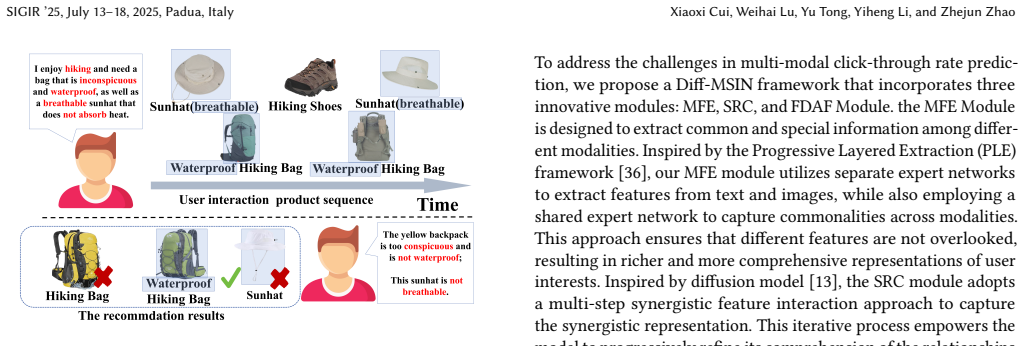
On its own terms, the paper establishes that Diff-MSIN, built from the Multi-modal Feature Enhancement, Synergistic Relationship Capture, and Feature Dynamic Adaptive Fusion modules, achieves the highest AUC on Rec-Tmall and the Amazon Home, Clothing, and Arts datasets among the compared methods, with relative improvement of at least 1.67% over the strongest multi-modal baseline. The mechanism is a decomposition of user interest into modality-common, modality-specific, and synergistic features, followed by a progressive, noise-injected cross-modal interaction and an ID-centered adaptive fusion that suppresses fusion noise. The paper also reports that the framework generalizes as a plugin: ad
What carries the argument
The central mechanism is a three-module pipeline. The MFE module uses separate expert networks for image, text, and ID plus shared experts to isolate common versus special knowledge, with a contrastive knowledge-decoupling loss that pushes modality-specific representations apart. The SRC module then runs a diffusion-inspired loop: at each of T steps it injects Gaussian noise into the interacted features and denoises them with cross-modal attention, producing a synergistic representation; this is the part that depends on an unresolved noising schedule (see weakest assumption). The FDAF module computes user- and item-dependent modality weights, runs a cross network over the weighted features,
Load-bearing premise
The reported gains rest on the SRC module being a genuine multi-step diffusion process, but Eq. (10) as written is circular (the same feature appears on both sides) and the schedule variable is never defined, so the actual noising schedule used in the experiments is unspecified.
What would settle it
Inspect the released code and identify the actual forward-noise schedule used for SRC. If Eq. (10) is implemented literally or the schedule variable is absent, the module is not the described diffusion process and the ablation gain attributed to SRC cannot be explained by it; separately, re-running the main comparison with T=12 instead of T=50 would show whether the headline improvement depends on the reported optimal setting.
If this is right
- If the AUC gains are real, multi-modal CTR models can be improved by explicitly separating common, special, and synergistic signals instead of concatenating embedding spaces.
- The plugin finding implies existing ID-based sequence models can adopt the modules without replacing their backbone.
- Because removing text or image modality lowers AUC on all datasets, both modalities carry predictive signal beyond IDs; the framework's decoupling may be what lets them coexist.
- The sensitivity analysis suggests a moderate number of diffusion interaction steps (around 10-15) is needed; too few or too many hurt AUC, so the iterative interaction, not the raw number of steps, drives the gain.
Where Pith is reading between the lines
- If the diffusion-style interaction indeed improves robustness, deliberately dropping entire modalities at test time should degrade Diff-MSIN less than baselines; the paper does not report this dropout test, making it a direct experimental extension.
- The framework's reliance on ID as the primary fusion anchor suggests its gains may shrink in cold-start or long-tail settings where ID embeddings are weakly learned; that is a boundary the paper does not address.
- The reported optimum T=12 while main experiments use T=50 suggests the published configuration may not match the analyzed configuration; before adopting the method, an independent check of the actual schedule is warranted.
Editorial analysis
A structured set of objections, weighed in public.
Referee Report
Summary. The paper proposes Diff-MSIN, a multi-modal plug-in for sequence-based CTR models. Its three modules are: MFE, which separates modality-specific and shared expert representations and applies a contrastive decoupling loss; SRC, which uses a diffusion-style multi-step cross-modal interaction to produce a synergistic feature; and FDAF, which gates and attentively fuses auxiliary modal features with the ID feature. Experiments on Rec-Tmall and three Amazon datasets report AUC gains over classical and multi-modal baselines, a generalizability study across DIN/ETA/TWIN/DPN backbones, ablations, sensitivity analyses, efficiency comparisons, and a case study.
Significance. If the reported gains are reproducible, the framework is a credible contribution: the MFE/FDAF design is well-motivated and the generalizability table (Table 3) is a useful result. The paper provides a code link and evaluates on four datasets with multiple backbones, which are strengths. However, the central SRC mechanism is described by an undefined equation, and the experimental section contains contradictions (T setting, ablation AUCs) that currently prevent verification. The strengths are real but the manuscript is not yet ready in its present form.
major comments (4)
- [Section 3.4.1, Eq. (10)-(11)] The forward diffusion update is not well-defined. Equation (10) defines \hat h^m_{t+1} in terms of h^m_{t+1} on the right-hand side, which is never defined by a preceding update. Equation (11) uses \bar\alpha_t, which is never introduced. The forward step increments t but the reverse step decrements from t to t-1 using \hat h^m_t, so the indexing is also inconsistent. As written, the SRC module cannot be implemented. Please provide a complete forward recursion and define \bar\alpha_t, and align the forward/reverse indices.
- [Sections 4.1.3/4.5, Table 2, Fig. 5] The implementation details set T=50, while the sensitivity study reports T=12 as optimal (AUC 0.7264) and T=20 as overfitting (AUC 0.7192). Main Table 2 reports Rec-Tmall AUC 0.7270 under T=50, which is higher than the stated T=12 optimum. The paper must state the exact T used for each reported result and reconcile the discrepancy; otherwise the sensitivity curve is not consistent with the main experiments.
- [Table 4 and Section 4.4] The ablation results are internally inconsistent. On Arts, the full model has AUC 0.7312, while w/o MFE and SRC = 0.7354, w/o FDAF = 0.7403, w/o SRC = 0.7399, and w/o MFE,SRC,FDAF = 0.7325; all ablated variants are higher than the full model. This contradicts the text that removing modules yields the lowest AUC on all datasets. The RelaImpr values also disagree with the AUCs (e.g., on Rec-Tmall, full vs w/o MFE and SRC is -1.35%, not -0.82%). Please correct or re-run the ablation.
- [Section 3.4.2, Eq. (13)] E_target is not defined. If E_target is the clicked target item's multimodal embedding, then L_syn is a supervised alignment loss conditioned on the same click label used in L_y, not an independently discovered synergy. This should be stated explicitly, and the paper should explain what the SRC module contributes beyond target-embedding matching, or provide an ablation that isolates L_syn from MFE/FDAF.
minor comments (5)
- [Table 2] The DIN row on Rec-Tmall reports RelaImpr 6.89%, but using the same baseline-relative formula as other rows gives 3.86% (DIN 0.6839 vs LR 0.6585). Please correct or state the formula.
- [Section 3.3.2] The text refers to 'five specific tensors' while Eq. (9) defines M={id, im, te}, i.e., three expert and three share tensors; the count is unclear.
- [Throughout] The dataset name is inconsistently spelled 'Rec-Tmal' in Table 2 and 'Rec-Tmall' elsewhere. Please unify.
- [Figure 2] The caption contains typos ('Mocule', 'inclued', 'MSSFI Module'). Please proofread.
- [Section 4.5, Fig. 5] The x-axis stops at T=20 although the implementation section states T=50. Extend the plot or explain the truncated range.
Circularity Check
SRC forward-diffusion equation is self-referential; the core 'synergy' module reduces to identity plus noise as written, while the reported AUC gains remain an external benchmark.
specific steps
-
self definitional
[Section 3.4.1 (SRC / MSSFI), Eq. (10)]
"Forward Diffusion Process To improve the model’s robustness against input noise and modality missingness, we inject random noise into each modality’s feature representation after interaction at each time step. The maximum time step is T. The noise injection updates at time step t are given by: ˆℎ𝑚 𝑡+1 =√𝛼𝑡ℎ𝑚 𝑡+1+√1−𝛼𝑡𝜖𝑚 𝑡 (10) where 𝜖𝑚𝑡 represents the noise vector injected into modality m’s feature at time step t."
The forward noising step defines \hat h^m_{t+1} as a function of h^m_{t+1}, the same time step's clean representation. No update rule for h^m_{t+1} from h^m_t is given anywhere in Section 3.4, so the only way to close the system is to identify h^m_{t+1} with \hat h^m_{t+1}; the update then degenerates to \hat h = sqrt(alpha) * \hat h + sqrt(1-alpha) * eps, i.e., an identity plus noise. Thus the claimed 'multi-step progressive refinement' of cross-modal synergy is self-definitional: the output is defined in terms of itself. In addition, Eq. (11) uses \bar\alpha_t without defining it, and Section 4.1.3 fixes T=50 while Section 4.5 reports T=12 as optimal and T=20 already overfits (AUC 0.7192 vs 0.7264); these make the module non-reproducible as written.
full rationale
The headline AUC comparison is an external benchmark against published baselines and is not derived from the model equations; the paper's self-citations in related work are not load-bearing. The main circularity concern is the SRC forward-diffusion equation: as written, it defines the noised state at t+1 in terms of the clean state at t+1, with no transition rule, making the claimed multi-step synergistic interaction self-referential rather than a derivation. Separately, the supervised synergy loss L_syn is a legitimate auxiliary objective, not a fitted parameter renamed as a prediction, and the T=50 vs T=12 discrepancy plus the undefined \bar\alpha_t are correctness/reproducibility issues rather than circularity. Because the core novelty's derivation reduces to a self-referential identity, but the final empirical claim still has independent experimental content, the circularity score is 6 rather than higher.
Axiom & Free-Parameter Ledger
free parameters (4)
- diffusion time steps T =
reported 50 in implementation, 12 in sensitivity analysis
- loss weights w1 and w2 =
searched in [0.001, 0.3] (text) and [0.0001, 0.05] (Fig. 6)
- noise schedule alpha_t =
linear from 0.999 to 0.98 over T steps
- expert feature dimension =
128
axioms (4)
- domain assumption CLIP embeddings of text and images encode complementary semantic information that improves CTR prediction
- ad hoc to paper Injecting Gaussian noise into modality embeddings during training improves robustness and enables cross-modal denoising without a dedicated reconstruction objective
- domain assumption User behavior sequences filtered to at least 5 interactions and truncated to 50 recent records remain representative
- ad hoc to paper The reverse cross-modal attention function CI can act as an effective denoiser
Cite this review
Pith. "Pith review of Diffusion-based Multi-modal Synergy Interest Network for Click-through Rate Prediction." pith.science (2026). https://pith.science/paper/CW6DHYM3
@misc{pith2026250821460,
  author       = {Pith},
  title        = {Pith review of: Diffusion-based Multi-modal Synergy Interest Network for Click-through Rate Prediction},
  year         = {2026},
  howpublished = {\url{https://pith.science/paper/CW6DHYM3}},
  note         = {Machine review of arXiv:2508.21460}
}
read the original abstract
In click-through rate prediction, click-through rate prediction is used to model users' interests. However, most of the existing CTR prediction methods are mainly based on the ID modality. As a result, they are unable to comprehensively model users' multi-modal preferences. Therefore, it is necessary to introduce multi-modal CTR prediction. Although it seems appealing to directly apply the existing multi-modal fusion methods to click-through rate prediction models, these methods (1) fail to effectively disentangle commonalities and specificities across different modalities; (2) fail to consider the synergistic effects between modalities and model the complex interactions between modalities. To address the above issues, this paper proposes the Diffusion-based Multi-modal Synergy Interest Network (Diff-MSIN) framework for click-through prediction. This framework introduces three innovative modules: the Multi-modal Feature Enhancement (MFE) Module Synergistic Relationship Capture (SRC) Module, and the Feature Dynamic Adaptive Fusion (FDAF) Module. The MFE Module and SRC Module extract synergistic, common, and special information among different modalities. They effectively enhances the representation of the modalities, improving the overall quality of the fusion. To encourage distinctiveness among different features, we design a Knowledge Decoupling method. Additionally, the FDAF Module focuses on capturing user preferences and reducing fusion noise. To validate the effectiveness of the Diff-MSIN framework, we conducted extensive experiments using the Rec-Tmall and three Amazon datasets. The results demonstrate that our approach yields a significant improvement of at least 1.67% compared to the baseline, highlighting its potential for enhancing multi-modal recommendation systems. Our code is available at the following link: https://github.com/Cxx-0/Diff-MSIN.
Figures


Reference graph
Works this paper leans on
-
[1]
Paul Baltescu, Haoyu Chen, Nikil Pancha, Andrew Zhai, Jure Leskovec, and Charles Rosenberg. 2022. ItemSage: Learning product embeddings for shopping recommendations at pinterest. InProceedings of the 28th ACM SIGKDD Conference on Knowledge Discovery and Data Mining . 2703–2711
work page 2022
-
[2]
Jianxin Chang, Chenbin Zhang, Zhiyi Fu, Xiaoxue Zang, Lin Guan, Jing Lu, Yiqun Hui, Dewei Leng, Yanan Niu, Yang Song, et al. 2023. TWIN: TWo-stage interest network for lifelong user behavior modeling in CTR prediction at kuaishou. In Proceedings of the 29th ACM SIGKDD Conference on Knowledge Discovery and Data Mining. 3785–3794
2023
-
[3]
Qiwei Chen, Changhua Pei, Shanshan Lv, Chao Li, Junfeng Ge, and Wenwu Ou
-
[4]
Qiwei Chen, Huan Zhao, Wei Li, Pipei Huang, and Wenwu Ou. 2019. Behavior sequence transformer for e-commerce recommendation in alibaba. InProceedings of the 1st international workshop on deep learning practice for high-dimensional sparse data. 1–4
2019
-
[5]
Heng-Tze Cheng, Levent Koc, Jeremiah Harmsen, Tal Shaked, Tushar Chandra, Hrishi Aradhye, Glen Anderson, Greg Corrado, Wei Chai, Mustafa Ispir, et al
-
[6]
Paul Covington, Jay Adams, and Emre Sargin. 2016. Deep neural networks for youtube recommendations. In Proceedings of the 10th ACM conference on recommender systems. 191–198
2016
-
[7]
Xiuqi Deng, Lu Xu, Xiyao Li, Jinkai Yu, Erpeng Xue, Zhongyuan Wang, Di Zhang, Zhaojie Liu, Guorui Zhou, Yang Song, et al. 2024. End-to-end training of Multimodal Model and ranking Model. arXiv preprint arXiv:2404.06078 (2024)
Pith/arXiv arXiv 2024
-
[8]
Jacob Devlin. 2018. Bert: Pre-training of deep bidirectional transformers for language understanding. arXiv preprint arXiv:1810.04805 (2018)
Pith/arXiv arXiv 2018
-
[9]
Tom Fawcett. 2006. An introduction to ROC analysis. Pattern recognition letters 27, 8 (2006), 861–874
2006
-
[10]
Yufei Feng, Fuyu Lv, Weichen Shen, Menghan Wang, Fei Sun, Yu Zhu, and Keping Yang. 2019. Deep session interest network for click-through rate prediction. arXiv preprint arXiv:1905.06482 (2019)
Pith/arXiv arXiv 2019
-
[11]
Huifeng Guo, Ruiming Tang, Yunming Ye, Zhenguo Li, and Xiuqiang He. 2017. DeepFM: a factorization-machine based neural network for CTR prediction.arXiv preprint arXiv:1703.04247 (2017)
Pith/arXiv arXiv 2017
-
[12]
Jiao He, Weihai Lu, and Jianjun Yuan. 2022. A Novel Efficient Unclick Behavior Modeling Framework for Click-Through Rate Prediction. In 2022 IEEE 34th Inter- national Conference on Tools with Artificial Intelligence (ICTAI) . IEEE, 112–121
work page 2022
-
[13]
Jonathan Ho, Ajay Jain, and Pieter Abbeel. 2020. Denoising diffusion probabilistic models. Advances in neural information processing systems 33 (2020), 6840–6851
2020
-
[14]
Yupeng Hou, Zhankui He, Julian McAuley, and Wayne Xin Zhao. 2023. Learning vector-quantized item representation for transferable sequential recommenders. In Proceedings of the ACM Web Conference 2023 . 1162–1171
work page 2023
-
[15]
Yupeng Hou, Shanlei Mu, Wayne Xin Zhao, Yaliang Li, Bolin Ding, and Ji-Rong Wen. 2022. Towards universal sequence representation learning for recommender systems. In Proceedings of the 28th ACM SIGKDD Conference on Knowledge Dis- covery and Data Mining . 585–593
work page 2022
-
[16]
Hengchang Hu, Wei Guo, Yong Liu, and Min-Yen Kan. 2023. Adaptive Multi- Modalities Fusion in Sequential Recommendation Systems. arXiv preprint arXiv:2308.15980 (2023)
work page internal anchor Pith review Pith/arXiv arXiv 2023
-
[17]
Wei Ji, Xiangyan Liu, An Zhang, Yinwei Wei, Yongxin Ni, and Xiang Wang
-
[18]
Yangqin Jiang, Yuhao Yang, Lianghao Xia, and Chao Huang. 2024. Diffkg: Knowl- edge graph diffusion model for recommendation. In Proceedings of the 17th ACM International Conference on Web Search and Data Mining . 313–321
work page 2024
-
[19]
Houyi Li, Zhihong Chen, Chenliang Li, Rong Xiao, Hongbo Deng, Peng Zhang, Yongchao Liu, and Haihong Tang. 2021. Path-based deep network for candidate item matching in recommenders. In Proceedings of the 44th International ACM SIGIR Conference on Research and Development in Information Retrieval . 1493– 1502
work page 2021
-
[20]
Honghao Li, Lei Sang, Yi Zhang, and Yiwen Zhang. 2024. SimCEN: Simple Contrast-enhanced Network for CTR Prediction. In Proceedings of the 32nd ACM International Conference on Multimedia . 2311–2320
work page 2024
-
[21]
Xiang Li, Chao Wang, Jiwei Tan, Xiaoyi Zeng, Dan Ou, Dan Ou, and Bo Zheng
-
[22]
Zihao Li, Aixin Sun, and Chenliang Li. 2023. Diffurec: A diffusion model for sequential recommendation. ACM Transactions on Information Systems 42, 3 (2023), 1–28
work page 2023
-
[23]
Jianxun Lian, Xiaohuan Zhou, Fuzheng Zhang, Zhongxia Chen, Xing Xie, and Guangzhong Sun. 2018. xdeepfm: Combining explicit and implicit feature in- teractions for recommender systems. In Proceedings of the 24th ACM SIGKDD international conference on knowledge discovery & data mining . 1754–1763
2018
-
[24]
Chang Liu, Xiaoguang Li, Guohao Cai, Zhenhua Dong, Hong Zhu, and Lifeng Shang. 2021. Noninvasive self-attention for side information fusion in sequential recommendation. In Proceedings of the AAAI Conference on Artificial Intelligence , Vol. 35. 4249–4256
work page 2021
-
[25]
Qidong Liu, Fan Yan, Xiangyu Zhao, Zhaocheng Du, Huifeng Guo, Ruiming Tang, and Feng Tian. 2023. Diffusion augmentation for sequential recommendation. In Proceedings of the 32nd ACM International Conference on Information and Knowledge Management. 1576–1586
work page 2023
-
[26]
Zhun Liu, Ying Shen, Varun Bharadhwaj Lakshminarasimhan, Paul Pu Liang, Amir Zadeh, and Louis-Philippe Morency. 2018. Efficient low-rank multimodal fusion with modality-specific factors. arXiv preprint arXiv:1806.00064 (2018)
Pith/arXiv arXiv 2018
-
[27]
Xinchen Luo, Jiangxia Cao, Tianyu Sun, Jinkai Yu, Rui Huang, Wei Yuan, Hezheng Lin, Yichen Zheng, Shiyao Wang, Qigen Hu, et al . 2024. QARM: Quantita- tive Alignment Multi-Modal Recommendation at Kuaishou. arXiv preprint arXiv:2411.11739 (2024)
Pith/arXiv arXiv 2024
-
[28]
H Brendan McMahan, Gary Holt, David Sculley, Michael Young, Dietmar Ebner, Julian Grady, Lan Nie, Todd Phillips, Eugene Davydov, Daniel Golovin, et al
-
[29]
Minghao Mo, Weihai Lu, Qixiao Xie, Xiang Lv, Zikai Xiao, Hong Yang, and Yanchun Zhang. 2024. MIN: Multi-stage Interactive Network for Multimodal Recommendation. In International Conference on Web Information Systems Engi- neering. Springer, 191–205
work page 2024
-
[30]
Minghao Mo, Weihai Lu, Qixiao Xie, Zikai Xiao, Xiang Lv, Hong Yang, and Yanchun Zhang. 2025. One multimodal plugin enhancing all: CLIP-based pre- training framework enhancing multimodal item representations in recommenda- tion systems. Neurocomputing (2025), 130059
work page 2025
-
[31]
Qi Pi, Guorui Zhou, Yujing Zhang, Zhe Wang, Lejian Ren, Ying Fan, Xiaoqiang Zhu, and Kun Gai. 2020. Search-based user interest modeling with lifelong sequential behavior data for click-through rate prediction. In Proceedings of the 29th ACM International Conference on Information & Knowledge Management . 2685–2692
2020
-
[32]
Alec Radford, Jong Wook Kim, Chris Hallacy, Aditya Ramesh, Gabriel Goh, Sandhini Agarwal, Girish Sastry, Amanda Askell, Pamela Mishkin, Jack Clark, et al. 2021. Learning transferable visual models from natural language supervision. In International conference on machine learning . PMLR, 8748–8763
2021
-
[33]
Steffen Rendle. 2010. Factorization machines. In2010 IEEE International conference on data mining. IEEE, 995–1000
2010
-
[34]
Xiang-Rong Sheng, Feifan Yang, Litong Gong, Biao Wang, Zhangming Chan, Yujing Zhang, Yueyao Cheng, Yong-Nan Zhu, Tiezheng Ge, Han Zhu, et al
-
[35]
Karen Simonyan and Andrew Zisserman. 2014. Very deep convolutional networks for large-scale image recognition. arXiv preprint arXiv:1409.1556 (2014)
Pith/arXiv arXiv 2014
-
[36]
Hongyan Tang, Junning Liu, Ming Zhao, and Xudong Gong. 2020. Progressive layered extraction (ple): A novel multi-task learning (mtl) model for personalized recommendations. In Proceedings of the 14th ACM Conference on Recommender Systems. 269–278
work page 2020
-
[37]
Zhulin Tao, Yinwei Wei, Xiang Wang, Xiangnan He, Xianglin Huang, and Tat- Seng Chua. 2020. Mgat: Multimodal graph attention network for recommendation. Information Processing & Management 57, 5 (2020), 102277
work page 2020
-
[38]
Ruoxi Wang, Bin Fu, Gang Fu, and Mingliang Wang. 2017. Deep & cross network for ad click predictions. In Proceedings of the ADKDD’17 . 1–7
2017
-
[39]
Tan Wang, Xing Xu, Yang Yang, Alan Hanjalic, Heng Tao Shen, and Jingkuan Song. 2019. Matching images and text with multi-modal tensor fusion and re- ranking. In Proceedings of the 27th ACM international conference on multimedia . 12–20
work page 2019
-
[40]
Wenjie Wang, Yiyan Xu, Fuli Feng, Xinyu Lin, Xiangnan He, and Tat-Seng Chua
-
[41]
Yu Wang, Zhiwei Liu, Liangwei Yang, and Philip S Yu. 2024. Conditional denoising diffusion for sequential recommendation. InPacific-Asia Conference on Knowledge Discovery and Data Mining . Springer, 156–169
work page 2024
-
[42]
Yinwei Wei, Wenqi Liu, Fan Liu, Xiang Wang, Liqiang Nie, and Tat-Seng Chua
-
[43]
Yinwei Wei, Xiang Wang, Liqiang Nie, Xiangnan He, Richang Hong, and Tat-Seng Chua. 2019. MMGCN: Multi-modal graph convolution network for personalized recommendation of micro-video. In Proceedings of the 27th ACM international conference on multimedia. 1437–1445
work page 2019
-
[44]
Chuhan Wu, Fangzhao Wu, Mingxiao An, Jianqiang Huang, Yongfeng Huang, and Xing Xie. 2019. Neural news recommendation with attentive multi-view learning. arXiv preprint arXiv:1907.05576 (2019)
Pith/arXiv arXiv 2019
-
[45]
Fangxiong Xiao, Lixi Deng, Jingjing Chen, Houye Ji, Xiaorui Yang, Zhuoye Ding, and Bo Long. 2022. From Abstract to Details: A Generative Multimodal Fusion Framework for Recommendation. In Proceedings of the 30th ACM International Conference on Multimedia. 258–267. Diffusion-based Multi-modal Synergy Interest Network for Click-through Rate Prediction SIGIR...
work page 2022
-
[46]
Yiyan Xu, Wenjie Wang, Fuli Feng, Yunshan Ma, Jizhi Zhang, and Xiangnan He
-
[47]
Diffusion recommender model. In Proceedings of the 46th International ACM SIGIR Conference on Research and Development in Information Retrieval . 832–841
-
[48]
Runlong Yu, Yuyang Ye, Qi Liu, Zihan Wang, Chunfeng Yang, Yucheng Hu, and Enhong Chen. 2021. Xcrossnet: Feature structure-oriented learning for click- through rate prediction. In Pacific-Asia Conference on Knowledge Discovery and Data Mining. Springer, 436–447
work page 2021
-
[49]
Hengyu Zhang, Junwei Pan, Dapeng Liu, Jie Jiang, and Xiu Li. 2024. Deep Pattern Network for Click-Through Rate Prediction. In Proceedings of the 47th International ACM SIGIR Conference on Research and Development in Information Retrieval. 1189–1199
work page 2024
-
[50]
LightGT: A Light Graph Transformer for Multimedia Recommendation. In Proceedings of the 46th International ACM SIGIR Conference on Research and Development in Information Retrieval . 1508–1517
-
[51]
Jujia Zhao, Wang Wenjie, Yiyan Xu, Teng Sun, Fuli Feng, and Tat-Seng Chua. 2024. Denoising diffusion recommender model. In Proceedings of the 47th International ACM SIGIR Conference on Research and Development in Information Retrieval . 1370–1379
work page 2024
-
[52]
Guorui Zhou, Na Mou, Ying Fan, Qi Pi, Weijie Bian, Chang Zhou, Xiaoqiang Zhu, and Kun Gai. 2019. Deep interest evolution network for click-through rate prediction. In Proceedings of the AAAI conference on artificial intelligence , Vol. 33. 5941–5948
2019
-
[53]
Guorui Zhou, Xiaoqiang Zhu, Chenru Song, Ying Fan, Han Zhu, Xiao Ma, Yanghui Yan, Junqi Jin, Han Li, and Kun Gai. 2018. Deep interest network for click-through rate prediction. In Proceedings of the 24th ACM SIGKDD international conference on knowledge discovery & data mining . 1059–1068
2018
-
[55]
Diffusion models for generative outfit recommendation. In Proceedings of the 47th International ACM SIGIR Conference on Research and Development in Information Retrieval. 1350–1359
-
[56]
Ling Yan, Wu-Jun Li, Gui-Rong Xue, and Dingyi Han. 2014. Coupled group lasso for web-scale ctr prediction in display advertising. In International conference on machine learning. PMLR, 802–810
work page 2014
-
[59]
Jinghao Zhang, Yanqiao Zhu, Qiang Liu, Shu Wu, Shuhui Wang, and Liang Wang
-
[60]
In Proceedings of the 29th ACM International Conference on Multimedia
Mining latent structures for multimedia recommendation. In Proceedings of the 29th ACM International Conference on Multimedia . 3872–3880
-
[2013]
In Proceedings of the 19th ACM SIGKDD international conference on Knowledge discovery and data mining
Ad click prediction: a view from the trenches. In Proceedings of the 19th ACM SIGKDD international conference on Knowledge discovery and data mining . 1222–1230
-
[2016]
In Proceedings of the 1st workshop on deep learning for recommender systems
Wide & deep learning for recommender systems. In Proceedings of the 1st workshop on deep learning for recommender systems . 7–10
-
[2020]
In Proceedings of The Web Conference 2020
Adversarial multimodal representation learning for click-through rate prediction. In Proceedings of The Web Conference 2020 . 827–836
work page 2020
-
[2021]
arXiv preprint arXiv:2108.04468 (2021)
End-to-end user behavior retrieval in click-through rateprediction model. arXiv preprint arXiv:2108.04468 (2021)
Pith/arXiv arXiv 2021
-
[2023]
Online Distillation-enhanced Multi-modal Transformer for Sequential Recommendation
Online Distillation-enhanced Multi-modal Transformer for Sequential Recommendation. arXiv preprint arXiv:2308.04067 (2023)
work page internal anchor Pith review Pith/arXiv arXiv 2023
-
[2024]
Enhancing Taobao Display Advertising with Multimodal Representations: Challenges, Approaches and Insights. arXiv preprint arXiv:2407.19467 (2024)
work page internal anchor Pith review Pith/arXiv arXiv 2024
This paper was first reviewed by deepseek-v4-flash on August 5, 2026.
discussion (0)
Sign in with ORCID, Apple, or X to comment. Anyone can read and Pith papers without signing in.