REVIEW 5 major objections 7 minor 1 cited by
Controllable 3D Molecular Generation for Structure-Based Drug Design Through Bayesian Flow Networks and Gradient Integration
T0 review · 5 major / 7 minor · reviewed 2026-08-05 · deepseek-v4-flash
Pith's one-line read Gradient-guided Bayesian Flow Networks, the paper claims, beat diffusion and optimization baselines on binding affinity, synthetic feasibility, and selectivity by steering 3D drug generation in parameter space, not sample space.
desk verdict Useful evaluation scheme and a plausible guidance idea, but the Tweedie derivation is wrong and the empirical gains are partly circular. read the letter →
The pith
A machine-rendered reading of the paper's core claim, the machinery that carries it, and where it could break.
The reading
What carries the argument
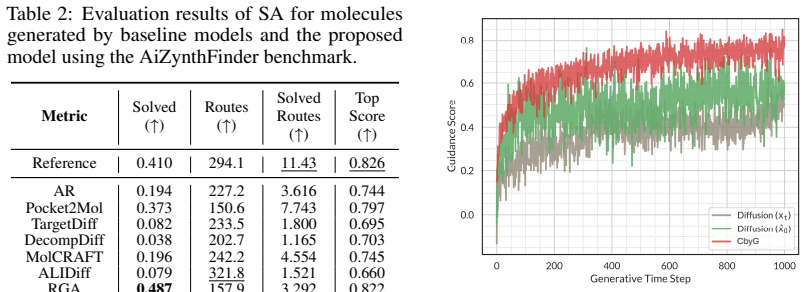
The load-bearing mechanism is the gradient-form Bayesian update: the BFN receiver update θ_i = h(θ_{i-1}, y, α) is rewritten as a score-gradient step (Eqs. 7 and 10) via Tweedie's formula, so conditioning on a property l reduces to adding ∇ log p(l | x) — the gradient of an external predictor — to the parameter update. Three supporting pieces carry the empirical argument: (1) the predictor is a Bayesian neural network outputting mean and variance, so the guidance signal is scaled by predicted uncertainty (confidence-weighted steering); (2) the predictor is trained on a composite label Score = DS/(−20 × SA), which fuses docking score and synthetic accessibility into one guidance signal; and (
What would settle it
Test CBYG-generated molecules with a scoring method that was never used in training or evaluation (for example, a different docking engine or a physics-based estimator such as free-energy perturbation), and compare against baseline-generated molecules; if the large affinity and selectivity gains do not survive under that independent scorer, the reported gains are an artifact of aligning the predictor with the evaluator. A second check targets the theory: run the guided sampling in a case where the conditional distribution p(m | l) is known exactly and verify that the gradient-updated parameter
Extended reading notes
Core claim
The core discovery is that the Bayesian update of a BFN is secretly a score-based update: for continuous variables (atom coordinates), the Gaussian sender–receiver structure makes the update equivalent to a step along the score ∇ log p(x) via Tweedie's formula; for categorical variables (atom types), the same identity holds after reparameterizing one-hot vectors through a Gaussian sender, so the update becomes a softmax of previous parameters exponentiated by the score. Conditioning on a property l replaces the unconditional score with the conditional score ∇ log p(l|x), splitting each update into an unconditional generation term plus a guidance term. Because updates live in a continuous par
Load-bearing premise
The empirical case rests on a single load-bearing premise: that the Bayesian neural network predictor trained on CrossDocked2020 with the composite label Score = DS/(−20 × SA) gives trustworthy, target-specific property estimates, and that adding its gradient to the BFN update steers sampled molecules toward the intended properties — while the same families of docking and scoring tools are then used to measure the improvement.
Editorial extensions
If this is right
- Property control moves to sampling time: adding a new objective (a different docking score, a toxicity filter, a selectivity target) means swapping or composing external predictors, not retraining the generative model.
- Joint guidance over coordinates and atom types becomes well-defined and stable, because both modalities are updated in the same continuous parameter space rather than through discrete argmax sampling, which should yield chemically coherent molecules.
- Multi-property optimization is expressible as a single composite label (as with Score = DS/(−20 × SA)), giving drug-discovery pipelines a direct handle on the affinity–synthesizability trade-off.
- Pre-docking affinity scores that already match post-docking scores of strong baselines imply the generated poses are natively favorable, reducing reliance on a separate docking stage.
- If the guidance stability claim generalizes, the same parameter-space steering should apply to other hybrid continuous/categorical generation tasks, not just molecules.
Reading between the lines
- Because the guidance signal is a swap-in predictor, an obvious next step the paper leaves implicit is to use the AiZynthFinder 'Solved' rate itself as a guidance label; the paper concedes that roughly half of generated molecules remain synthetically infeasible, so directly steering on retrosynthetic success would close that gap.
- The paper demonstrates sampling-time control for pairs of objectives (affinity + synthesizability, on-target affinity + off-target avoidance); composing all three into one guided run, and testing how independent gradients interact, is a direct extension.
- The gradient-form Bayesian update is not molecule-specific: any hybrid continuous/categorical generation task — protein sequence–structure co-design, for instance — faces the same modality-coupling problem, so the parameter-space guidance recipe has a natural neighboring application.
- The selectivity dataset construction (kinase panels, on/off-target pocket pairs) could serve as training signal rather than just evaluation; an off-target-aware predictor would let the framework steer explicitly to avoid side effects.
Editorial analysis
A structured set of objections, weighed in public.
Referee Report
Summary. The paper proposes CByG, a Bayesian Flow Network (BFN) extended with gradient-based property guidance for structure-based drug design. The authors claim a theoretical result: the Bayesian update for both continuous coordinates and categorical atom types can be reformulated as a score-based (Tweedie) update, enabling stable conditional generation in parameter space. They introduce a new evaluation scheme using multiple docking tools, AiZynthFinder retrosynthetic feasibility, and a kinase selectivity dataset, and report state-of-the-art results on CrossDocked2020 (Table 1). The central theoretical claim is in Section 4; the method is applied in Section 5; experiments span Sections 6 and appendices.
Significance. If the theoretical derivation and empirical claims held, this would be a significant contribution: it would provide a principled way to inject property guidance into BFN without retraining, handling continuous and discrete modalities uniformly, and it would broaden SBDD evaluation beyond single-tool docking scores. The proposed multi-docking evaluation and the retrosynthetic-feasibility benchmark are useful and address real limitations of current practice. However, the theoretical derivation is not sound: Tweedie's formula is applied to the wrong variable, and the conditional update is asserted rather than proved. The empirical evaluation also selects guidance scales on the test metrics and reports no error bars or significance tests. These issues directly undermine the paper's main claims, although the evaluation framework and the heuristic guidance idea could be valuable in a revised form.
major comments (5)
- [§4.2, Eq. (7)] Tweedie's formula is applied to the wrong variable. From Eq. (5), the noisy quantity is w = (ρ_i θ_i^x − ρ_{i−1}θ_{i−1}^x)/α, with x | w ~ N(w, α^{-1}I). Tweedie gives E[x|w] = w + α^{-1}∇_w log p(w), not w = x + α^{-1}∇_x log p(x) as used in Eq. (7). The score on the right is evaluated at the clean variable, while Tweedie's score is with respect to the noisy variable; the two coincide only in special limits. For a concrete counterexample, with p(x)=N(0,1), α=1, and ρ_i=ρ_{i−1}+1, Eq. (7) reduces θ_i to ρ_{i−1}θ_{i−1}/ρ_i, dropping the sender noise realization ε that is present in the reparameterized update two lines above. The appended Justification on p.29 states Tweedie for y and then substitutes ∇_x log p(x), so it does not repair the step.
- [§4.3, Eq. (10)] The discrete analogue repeats the continuous error and additionally mishandles the noise scale. With sender y = α(K e_x − 1) + sqrt(αK)ε, the reparameterized variable q = y/(αK) + 1/K has conditional mean e_x and variance (1/(αK))I. Tweedie would give E[e_x|q] = q + (1/(αK))∇_q log p(q). Instead, Eq. (10) writes y = α(K e_x − 1) + ∇_{e_x} log p(e_x), dropping the 1/(αK) factor and equating a scalar-scaled noise vector with a score vector. The gradient form of the discrete Bayesian update is therefore not derived.
- [§5.2, Eqs. (14)–(15) and Algorithm 1] Even if the Tweedie reformulation were correct, the conditional update is asserted by analogy to classifier guidance. Replacing ∇ log p(x) with ∇ log p(x|l) and then adding ∇ log p(l|x) is a heuristic; no theorem shows that iterating Eqs. (14)–(15) samples from the conditional BFN posterior p_ϕ(m|p,l) defined in Eq. (12). In addition, the uncertainty weighting in Algorithm 1 (σ^2_ϑ · λ · ∇ ...) is not derived from the stated theory and appears ad hoc. The manuscript's claim in Section 2 of 'rigorously establishes its theoretical foundations' is therefore unsupported.
- [§6.2, Table 4] The guidance scales λ_x=40, λ_v=40 used for the headline results in Table 1 are selected by comparing directly on the same evaluation metrics and test proteins in Table 4. No validation split or model-selection procedure is described. Tables 1–5 report no error bars, standard deviations, or significance tests. Under this protocol, the reported improvements may reflect selection on the test set rather than a genuine advantage of the method.
- [Appendix D.2] The property predictor is trained with label Score = DS/(-20*SA), where DS is a docking score and SA is the synthetic accessibility score. The evaluation in Section 6 measures docking scores (Vina, SMINA, GNINA) and SA, so the guidance is optimizing a fitted surrogate of the evaluator. This overlap does not by itself invalidate the experiments, but it substantially weakens the claim of general controllable generation. A held-out predictor, an independent evaluation oracle, or a prospective docking study would be needed to support the state-of-the-art claim.
minor comments (7)
- [General] The paper contains several typos and formatting inconsistencies, e.g., 'Yonei University' (should be Yonsei), 'CB YG' vs 'CBYG' vs 'CByG' vs 'CB Y G', and 'CbyG' in Table 2.
- [Definition 4.1, Eq. (6)] The statement of Tweedie's formula is imprecise: it uses E[μ_x|x] = x + Σ_x ∇_x log p(x), but the left-hand side should be a conditional expectation of the clean variable given the noisy observation, and the score should be with respect to the noisy variable. The notation also switches between x, z, and μ without clear definitions. The label 'Definition 5.1' should be 4.1.
- [§4.2] The sender distribution is written ambiguously as pS(y | X; αI) = N(X, α^{-1}I); it is not clear whether the variance is α^{-1}I or whether the mean/variance roles are as stated. This ambiguity propagates to Eqs. (5) and (7).
- [Eq. (15)] The Softmax expression is ambiguous: Softmax(e^{α(K·e_x−1)+∇_{e_x} log p(e_x|l)} · θ_{i−1}) mixes exponentiated vectors with a parameter vector in a way that is not clearly elementwise; the notation should be defined explicitly.
- [Appendix D.3, Algorithm 1] Line 17 uses h = σ^2_ϑ · λ_v · ∇_{e_v} log p_l(...) with e_v = GumbelSoftmax(v̂), but GumbelSoftmax is not described or justified in the main text or appendix. The relationship between e_v and the categorical sender variable y_v is unclear.
- [Appendix D.1, Eq. (34)] The predictive variance formula appears to have an index error: the last term should be the squared mean of the averaged means, not μ^2_{ϑ,i}(x). The current expression is dimensionally inconsistent.
- [Table 1] The header 'Score.' and 'Dock.' are visually ambiguous (periods are easily missed). The table would benefit from clearer column labels such as 'Pre-docking' and 'Post-docking'.
Circularity Check
Core theoretical 'gradient-based BFN' is produced by renaming sender noise as a score, and the headline affinity/SA results optimize a surrogate trained on the same evaluation scores; central claims partially reduce to their inputs.
-
self definitional
[Section 4.2, Eq. (7)]
"= αx + θx i−1 · ρi−1 ρi + √αi ρi · ϵ = α ρi · x + ρi−1 ρi · θx i−1 + 1 ρi ∇x log p(x) (7)"
The equality chain rewrites the sender-noise term √α_i/ρ_i · ε as (1/ρ_i)∇_x log p(x). But ε is an independent Gaussian noise realization in the sender pS(y|x;αI)=N(x,α^{-1}I), while ∇_x log p(x) is a deterministic function of the clean variable x. No Tweedie identity equates the two; Tweedie's formula gives E[x|y] = y + α^{-1}∇_y log p(y), not y + α^{-1}∇_x log p(x). Thus the 'gradient-based Bayesian update' is not derived: the score term is introduced by renaming the noise term. The later conditional update (Eq. 14) inherits this construction, so the claimed theoretical grounding of guidance is an ansatz presented as a derivation.
-
self definitional
[Section 4.3, Eq. (10)]
", where y = α (K · ex − 1) + √ αK · ϵ = α (K · ex − 1) + ∇ex log p(ex)"
The same reduction is performed for categorical variables: the sender noise √(αK)·ε is replaced by ∇_{ex} log p(ex). The resulting softmax update is exactly the original BFN categorical Bayesian update with the noise relabeled as a 'score'. Proposition 4.2 therefore does not establish a gradient-based reformulation; it asserts, by construction, that the noise term equals the score. The discrete guidance equation (15) is built on this asserted equality, so its theoretical status is no stronger than the renaming.
1 more flagged steps
-
fitted input called prediction
[Appendix D.2 and Section 6.2, Table 1]
"Finally, the property predictor’s scoring function is defined as Score = ( DS −20 × SA ), where DS means docking score and SA means synthetic accessibility score."
The Bayesian property predictor that provides the guidance signal is trained to predict a score constructed from docking score (DS) and synthetic accessibility (SA). The headline evaluation (Table 1) then measures generated molecules with SMINA/GNINA/Vina docking scores and SA. Therefore the reported 'High Affinity' and SA improvements are not independent predictions: they are the result of gradient-guided optimization against a fitted surrogate of the evaluation scoring function. The claim of substantial superiority over baselines is partly built into the setup, because the baselines are not given access to this fitted surrogate. Some independent content remains (selectivity benchmark, PoseBusters, comparisons that do not use the surrogate), so the circularity is partial rather than total
full rationale
The paper does not rely on a load-bearing self-citation chain: citations to Graves et al. and other prior work are external, and no uniqueness theorem is imported from the authors' own papers. The main circularity is internal. In §4.2–4.3, the supposedly derived score-based form of the BFN update is obtained by identifying the sender noise with ∇_x log p(x) (Eqs. 7 and 10). This is a definitional renaming, not a consequence of Tweedie's formula; the appended 'Justification' boxes state Tweedie for ∇_y log p(y), but the main derivation uses ∇_x log p(x), and the two are not equal in general. Consequently, the conditional guidance in Eqs. (14)–(15) is an asserted analogy to classifier guidance rather than a proved sampling rule. On the empirical side, the property predictor is trained on Score = DS/(-20·SA), and the evaluation table reports DS and SA, so the affinity/synthesizability gains are partly forced by optimizing a fitted surrogate of the evaluator. Baselines lack this surrogate, making the comparison favorable by construction to a degree. However, the paper also evaluates on selectivity, PoseCheck, and AiZynthFinder, which are not the training targets of the surrogate, so the empirical contribution is not entirely circular. Overall: partial circularity in both the theoretical and empirical central claims, warranting a score of 6.
Assumptions & free parameters
free parameters (4)
- Guidance scales lambda_x, lambda_v =
lambda_x=40, lambda_v=40
- Composite score normalization -20 in Score = DS/(-20*SA) =
-20
- beta-NLL hyperparameter beta =
not specified
- Selectivity dataset thresholds =
TM-score > 0.4, RMSD < 1 A, pocket radius 5 A
assumptions (6)
- ad hoc to paper Tweedie's formula can be applied to the rearranged BFN update with the score taken with respect to the clean predicted sample x.
- domain assumption The property predictor p(l|m,p) trained on CrossDocked-derived Score = DS/(-20*SA) is a reliable conditional density for affinity, SA, and selectivity across test proteins.
- domain assumption The pretrained MolCRAFT BFN output network remains a valid generative model under externally injected gradients.
- domain assumption The conditional distribution factorizes into independent coordinate and atom-type integrals (Eq. 12).
- domain assumption AlphaFold3-predicted structures of kinase pockets are accurate enough for selectivity evaluation.
- domain assumption Docking scores from Vina, SMINA, and GNINA are valid proxies for binding affinity and selectivity.
Cite this review
Pith. "Pith review of Controllable 3D Molecular Generation for Structure-Based Drug Design Through Bayesian Flow Networks and Gradient Integration." pith.science (2026). https://pith.science/paper/GPOL5IEH
@misc{pith2026250821468,
  author       = {Pith},
  title        = {Pith review of: Controllable 3D Molecular Generation for Structure-Based Drug Design Through Bayesian Flow Networks and Gradient Integration},
  year         = {2026},
  howpublished = {\url{https://pith.science/paper/GPOL5IEH}},
  note         = {Machine review of arXiv:2508.21468}
}
read the original abstract
Recent advances in Structure-based Drug Design (SBDD) have leveraged generative models for 3D molecular generation, predominantly evaluating model performance by binding affinity to target proteins. However, practical drug discovery necessitates high binding affinity along with synthetic feasibility and selectivity, critical properties that were largely neglected in previous evaluations. To address this gap, we identify fundamental limitations of conventional diffusion-based generative models in effectively guiding molecule generation toward these diverse pharmacological properties. We propose CByG, a novel framework extending Bayesian Flow Network into a gradient-based conditional generative model that robustly integrates property-specific guidance. Additionally, we introduce a comprehensive evaluation scheme incorporating practical benchmarks for binding affinity, synthetic feasibility, and selectivity, overcoming the limitations of conventional evaluation methods. Extensive experiments demonstrate that our proposed CByG framework significantly outperforms baseline models across multiple essential evaluation criteria, highlighting its effectiveness and practicality for real-world drug discovery applications.
Figures


Figures from the paper (5 more)




Forward citations
Cited by 1 Pith paper
-
Uncertainty-Calibrated Diffusion for Reliable 3D Molecular Graph Generation
UCD adjusts diffusion-based 3D molecular graph generation to handle epistemic uncertainty, improving sample quality and reaching new benchmark performance.
Reference graph
Works this paper leans on
-
[1]
Accurate structure prediction of biomolecular interactions with alphafold 3
Josh Abramson, Jonas Adler, Jack Dunger, Richard Evans, Tim Green, Alexander Pritzel, Olaf Ronneberger, Lindsay Willmore, Andrew J Ballard, Joshua Bambrick, et al. Accurate structure prediction of biomolecular interactions with alphafold 3. Nature, 630(8016):493–500, 2024
2024
-
[2]
Protein sequence modelling with bayesian flow networks
Timothy Atkinson, Thomas D Barrett, Scott Cameron, Bora Guloglu, Matthew Greenig, Char- lie B Tan, Louis Robinson, Alex Graves, Liviu Copoiu, and Alexandre Laterre. Protein sequence modelling with bayesian flow networks. Nature Communications, 16(1):3197, 2025
work page 2025
-
[3]
Geometric deep learning methods and applications in 3d structure-based drug design
Qifeng Bai, Tingyang Xu, Junzhou Huang, and Horacio Pérez-Sánchez. Geometric deep learning methods and applications in 3d structure-based drug design. Drug Discovery Today, page 104024, 2024
work page 2024
-
[4]
Equivariant energy-guided sde for inverse molecular design
Fan Bao, Min Zhao, Zhongkai Hao, Peiyao Li, Chongxuan Li, and Jun Zhu. Equivariant energy-guided sde for inverse molecular design. arXiv preprint arXiv:2209.15408, 2022
arXiv 2022
-
[5]
Martin Buttenschoen, Garrett M Morris, and Charlotte M Deane. Posebusters: Ai-based docking methods fail to generate physically valid poses or generalise to novel sequences. Chemical Science, 15(9):3130–3139, 2024
work page 2024
-
[6]
Pid- iff: Physics informed diffusion model for protein pocket-specific 3d molecular generation
Seungyeon Choi, Sangmin Seo, Byung Ju Kim, Chihyun Park, and Sanghyun Park. Pid- iff: Physics informed diffusion model for protein pocket-specific 3d molecular generation. Computers in Biology and Medicine, 180:108865, 2024
work page 2024
-
[7]
Diffusion posterior sampling for general noisy inverse problems
Hyungjin Chung, Jeongsol Kim, Michael Thompson Mccann, Marc Louis Klasky, and Jong Chul Ye. Diffusion posterior sampling for general noisy inverse problems. In The Eleventh Interna- tional Conference on Learning Representations
-
[8]
Uniprot: a worldwide hub of protein knowledge
UniProt Consortium. Uniprot: a worldwide hub of protein knowledge. Nucleic acids research, 47(D1):D506–D515, 2019
work page 2019
Show all 57 references
-
[9]
Multi-parameter optimization: identifying high quality compounds with a balance of properties
Matthew D Segall. Multi-parameter optimization: identifying high quality compounds with a balance of properties. Current pharmaceutical design, 18(9):1292–1310, 2012
2012
-
[10]
Comprehensive analysis of kinase inhibitor selectivity
Mindy I Davis, Jeremy P Hunt, Sanna Herrgard, Pietro Ciceri, Lisa M Wodicka, Gabriel Pallares, Michael Hocker, Daniel K Treiber, and Patrick P Zarrinkar. Comprehensive analysis of kinase inhibitor selectivity. Nature biotechnology, 29(11):1046–1051, 2011
2011
-
[11]
Diffusion models beat gans on image synthesis
Prafulla Dhariwal and Alexander Nichol. Diffusion models beat gans on image synthesis. Advances in neural information processing systems, 34:8780–8794, 2021
2021
-
[12]
Autodock vina 1.2
Jerome Eberhardt, Diogo Santos-Martins, Andreas F Tillack, and Stefano Forli. Autodock vina 1.2. 0: New docking methods, expanded force field, and python bindings. Journal of chemical information and modeling, 61(8):3891–3898, 2021
2021
-
[13]
Tweedie’s formula and selection bias
Bradley Efron. Tweedie’s formula and selection bias. Journal of the American Statistical Association, 106(496):1602–1614, 2011
2011
-
[14]
Estimation of synthetic accessibility score of drug-like molecules based on molecular complexity and fragment contributions
Peter Ertl and Ansgar Schuffenhauer. Estimation of synthetic accessibility score of drug-like molecules based on molecular complexity and fragment contributions. Journal of cheminfor- matics, 1:1–11, 2009
2009
-
[15]
Three-dimensional convolutional neural networks and a cross- docked data set for structure-based drug design
Paul G Francoeur, Tomohide Masuda, Jocelyn Sunseri, Andrew Jia, Richard B Iovanisci, Ian Snyder, and David R Koes. Three-dimensional convolutional neural networks and a cross- docked data set for structure-based drug design. Journal of chemical information and modeling, 60(9):...
2020
-
[16]
Reinforced genetic algorithm for structure-based drug design
Tianfan Fu, Wenhao Gao, Connor Coley, and Jimeng Sun. Reinforced genetic algorithm for structure-based drug design. Advances in Neural Information Processing Systems , 35: 12325–12338, 2022. 10
2022
-
[17]
Rethinking specificity in sbdd: Leveraging delta score and energy-guided diffusion
Bowen Gao, Minsi Ren, Yuyan Ni, Yanwen Huang, Bo Qiang, Zhi-Ming Ma, Wei-Ying Ma, and Yanyan Lan. Rethinking specificity in sbdd: Leveraging delta score and energy-guided diffusion. arXiv preprint arXiv:2403.12987, 2024
2024 arXiv
-
[18]
Bayesian flow networks
Alex Graves, Rupesh Kumar Srivastava, Timothy Atkinson, and Faustino Gomez. Bayesian flow networks. arXiv preprint arXiv:2308.07037, 2023
2023 arXiv
-
[19]
Aligning target-aware molecule diffusion models with exact energy optimization
Siyi Gu, Minkai Xu, Alexander Powers, Weili Nie, Tomas Geffner, Karsten Kreis, Jure Leskovec, Arash Vahdat, and Stefano Ermon. Aligning target-aware molecule diffusion models with exact energy optimization. Advances in Neural Information Processing Systems, 37:44040–44063, 2024
2024
-
[20]
3d equivariant diffusion for target-aware molecule generation and affinity prediction.arXiv preprint arXiv:2303.03543, 2023
Jiaqi Guan, Wesley Wei Qian, Xingang Peng, Yufeng Su, Jian Peng, and Jianzhu Ma. 3d equivariant diffusion for target-aware molecule generation and affinity prediction.arXiv preprint arXiv:2303.03543, 2023
2023 arXiv
-
[21]
Decompdiff: diffusion models with decomposed priors for structure- based drug design
Jiaqi Guan, Xiangxin Zhou, Yuwei Yang, Yu Bao, Jian Peng, Jianzhu Ma, Qiang Liu, Liang Wang, and Quanquan Gu. Decompdiff: diffusion models with decomposed priors for structure- based drug design. arXiv preprint arXiv:2403.07902, 2024
2024 arXiv
-
[22]
Gradient guidance for diffusion models: An optimization perspective
Yingqing Guo, Hui Yuan, Yukang Yang, Minshuo Chen, and Mengdi Wang. Gradient guidance for diffusion models: An optimization perspective. arXiv preprint arXiv:2404.14743, 2024
2024 arXiv
-
[23]
Training- free multi-objective diffusion model for 3d molecule generation
Xu Han, Caihua Shan, Yifei Shen, Can Xu, Han Yang, Xiang Li, and Dongsheng Li. Training- free multi-objective diffusion model for 3d molecule generation. In The Twelfth International Conference on Learning Representations, 2023
2023
-
[24]
Posecheck: Generative models for 3d structure-based drug design produce unrealistic poses
Charles Harris, Kieran Didi, Arian Jamasb, Chaitanya Joshi, Simon Mathis, Pietro Lio, and Tom Blundell. Posecheck: Generative models for 3d structure-based drug design produce unrealistic poses. In NeurIPS 2023 Generative AI and Biology (GenBio) Workshop
2023
-
[25]
Protein-ligand interaction prior for binding- aware 3d molecule diffusion models
Zhilin Huang, Ling Yang, Xiangxin Zhou, Zhilong Zhang, Wentao Zhang, Xiawu Zheng, Jie Chen, Yu Wang, CUI Bin, and Wenming Yang. Protein-ligand interaction prior for binding- aware 3d molecule diffusion models. In The Twelfth International Conference on Learning Representations, 2023
2023
-
[26]
Rational approaches to improving selectivity in drug design
David J Huggins, Woody Sherman, and Bruce Tidor. Rational approaches to improving selectivity in drug design. Journal of medicinal chemistry, 55(4):1424–1444, 2012
2012
-
[27]
A quantitative analysis of kinase inhibitor selectivity
Mazen W Karaman, Sanna Herrgard, Daniel K Treiber, Paul Gallant, Corey E Atteridge, Brian T Campbell, Katrina W Chan, Pietro Ciceri, Mindy I Davis, Philip T Edeen, et al. A quantitative analysis of kinase inhibitor selectivity. Nature biotechnology, 26(1):127–132, 2008
2008
-
[28]
Noise2score: tweedie’s approach to self-supervised image denoising without clean images
Kwanyoung Kim and Jong Chul Ye. Noise2score: tweedie’s approach to self-supervised image denoising without clean images. Advances in Neural Information Processing Systems , 34: 864–874, 2021
2021
-
[29]
Recent developments in structure-based drug design
Gerhard Klebe. Recent developments in structure-based drug design. Journal of molecular medicine, 78:269–281, 2000
2000
-
[30]
Lessons learned in empirical scoring with smina from the csar 2011 benchmarking exercise
David Ryan Koes, Matthew P Baumgartner, and Carlos J Camacho. Lessons learned in empirical scoring with smina from the csar 2011 benchmarking exercise. Journal of chemical information and modeling, 53(8):1893–1904, 2013
2011
-
[31]
A 3d generative model for structure-based drug design
Shitong Luo, Jiaqi Guan, Jianzhu Ma, and Jian Peng. A 3d generative model for structure-based drug design. Advances in Neural Information Processing Systems, 34:6229–6239, 2021
2021
-
[32]
Gnina 1.0: molecular docking with deep learning
Andrew T McNutt, Paul Francoeur, Rishal Aggarwal, Tomohide Masuda, Rocco Meli, Matthew Ragoza, Jocelyn Sunseri, and David Ryan Koes. Gnina 1.0: molecular docking with deep learning. Journal of cheminformatics, 13(1):43, 2021
2021
-
[33]
3d molecule generation by denoising voxel grids
Pedro O O Pinheiro, Joshua Rackers, Joseph Kleinhenz, Michael Maser, Omar Mahmood, Andrew Watkins, Stephen Ra, Vishnu Sresht, and Saeed Saremi. 3d molecule generation by denoising voxel grids. Advances in Neural Information Processing Systems, 36:69077–69097, 2023. 11
2023
-
[34]
Pocket2mol: Efficient molecular sampling based on 3d protein pockets
Xingang Peng, Shitong Luo, Jiaqi Guan, Qi Xie, Jian Peng, and Jianzhu Ma. Pocket2mol: Efficient molecular sampling based on 3d protein pockets. In International Conference on Machine Learning, pages 17644–17655. PMLR, 2022
2022
-
[35]
Moldiff: Addressing the atom-bond inconsistency problem in 3d molecule diffusion generation
Xingang Peng, Jiaqi Guan, Qiang Liu, and Jianzhu Ma. Moldiff: Addressing the atom-bond inconsistency problem in 3d molecule diffusion generation. arXiv preprint arXiv:2305.07508, 2023
2023 arXiv
-
[36]
Geometric deep learning for structure-based ligand design
Alexander Powers, Helen Yu, Patricia Suriana, Rohan Koodli, Tianyu Lu, Joseph Paggi, and Ron Dror. Geometric deep learning for structure-based ligand design. ACS Central Science, 2023
2023
-
[37]
Molcraft: Structure-based drug design in continuous parameter space
Yanru Qu, Keyue Qiu, Yuxuan Song, Jingjing Gong, Jiawei Han, Mingyue Zheng, Hao Zhou, and Wei-Ying Ma. Molcraft: Structure-based drug design in continuous parameter space. In International Conference on Machine Learning, pages 41749–41768. PMLR, 2024
2024
-
[38]
Generating 3d molecules con- ditional on receptor binding sites with deep generative models
Matthew Ragoza, Tomohide Masuda, and David Ryan Koes. Generating 3d molecules con- ditional on receptor binding sites with deep generative models. Chemical science, 13(9): 2701–2713, 2022
2022
-
[39]
Structure-based drug design with equivariant diffusion models, 2023
Arne Schneuing, Yuanqi Du, Charles Harris, Arian Jamasb, Ilia Igashov, Weitao Du, Tom Blundell, Pietro Lió, Carla Gomes, Max Welling, Michael Bronstein, and Bruno Correia. Structure-based drug design with equivariant diffusion models, 2023
2023
-
[40]
Structure-based drug design with equivariant diffusion models
Arne Schneuing, Charles Harris, Yuanqi Du, Kieran Didi, Arian Jamasb, Ilia Igashov, Weitao Du, Carla Gomes, Tom L Blundell, Pietro Lio, et al. Structure-based drug design with equivariant diffusion models. Nature Computational Science, 4(12):899–909, 2024
2024
-
[41]
On the pitfalls of heteroscedastic uncertainty estimation with probabilistic neural networks
Maximilian Seitzer, Arash Tavakoli, Dimitrije Antic, and Georg Martius. On the pitfalls of heteroscedastic uncertainty estimation with probabilistic neural networks. arXiv preprint arXiv:2203.09168, 2022
2022 arXiv
-
[42]
Tacogfn: Target-conditioned gflownet for structure-based drug design
Tony Shen, Seonghwan Seo, Grayson Lee, Mohit Pandey, Jason R Smith, Artem Cherkasov, Woo Youn Kim, and Martin Ester. Tacogfn: Target-conditioned gflownet for structure-based drug design. Transactions on Machine Learning Research
-
[43]
Tacogfn: Target-conditioned gflownet for structure-based drug design
Tony Shen, Seonghwan Seo, Grayson Lee, Mohit Pandey, Jason R Smith, Artem Cherkasov, Woo Youn Kim, and Martin Ester. Tacogfn: Target-conditioned gflownet for structure-based drug design. arXiv preprint arXiv:2310.03223, 2023
2023 arXiv
-
[44]
From target to drug: generative modeling for the multimodal structure-based ligand design.Molecular pharmaceutics, 16(10):4282–4291, 2019
Miha Skalic, Davide Sabbadin, Boris Sattarov, Simone Sciabola, and Gianni De Fabritiis. From target to drug: generative modeling for the multimodal structure-based ligand design.Molecular pharmaceutics, 16(10):4282–4291, 2019
2019
-
[45]
Score-based generative modeling through stochastic differential equations
Yang Song, Jascha Sohl-Dickstein, Diederik P Kingma, Abhishek Kumar, Stefano Ermon, and Ben Poole. Score-based generative modeling through stochastic differential equations. arXiv preprint arXiv:2011.13456, 2020
2011 arXiv
-
[46]
Unified generative modeling of 3d molecules with bayesian flow networks
Yuxuan Song, Jingjing Gong, Hao Zhou, Mingyue Zheng, Jingjing Liu, and Wei-Ying Ma. Unified generative modeling of 3d molecules with bayesian flow networks. In The Twelfth International Conference on Learning Representations, 2023
2023
-
[47]
Selective optimization of side activities: another way for drug discovery
Camille G Wermuth. Selective optimization of side activities: another way for drug discovery. Journal of medicinal chemistry, 47(6):1303–1314, 2004
2004
-
[48]
Learning subpocket prototypes for generalizable structure-based drug design
Zaixi Zhang and Qi Liu. Learning subpocket prototypes for generalizable structure-based drug design. In International Conference on Machine Learning, pages 41382–41398. PMLR, 2023
2023
-
[49]
Molecule generation for target pro- tein binding with structural motifs
Zaixi Zhang, Yaosen Min, Shuxin Zheng, and Qi Liu. Molecule generation for target pro- tein binding with structural motifs. In The Eleventh International Conference on Learning Representations, 2023
2023
-
[50]
A systematic survey in geometric deep learning for structure-based drug design
Zaixi Zhang, Jiaxian Yan, Qi Liu, Enhong Chen, and Marinka Zitnik. A systematic survey in geometric deep learning for structure-based drug design. arXiv preprint arXiv:2306.11768, 2023. 12
2023 arXiv
-
[51]
known unknown
Xiangxin Zhou, Xiwei Cheng, Yuwei Yang, Yu Bao, Liang Wang, and Quanquan Gu. Decom- popt: Controllable and decomposed diffusion models for structure-based molecular optimization. In The Twelfth International Conference on Learning Representations. 13 A Detail description of Ba...
-
[52]
Sample from output distribution: An intermediate sample m′ i is drawn from the output distribution m′ i ∼ pO(· |θi−1, ti) given the current parameter θi−1 and scheduled noise level ti
-
[53]
Sample from sender distribution: A noisy observation yi is then drawn from the sender distribution, conditional on m′ i, via y′ i ∼ pS(· |m′ i, αi), where αi is the accuracy (inverse noise variance) prescribed for step i
-
[54]
Here h(θi−1, yi, αi) computes the posterior parameter after observing yi with precision αi, given the prior θi−1
Bayesian parameter update: The distribution parameter is updated by incorporating the observation yi through the Bayesian update function: θi = h(θi−1, yi, αi). Here h(θi−1, yi, αi) computes the posterior parameter after observing yi with precision αi, given the prior θi−1. Re...
-
[55]
In contrast, diffusion models explicitly add random noise to samples at each step to maintain stochasticity
Implicit versus Explicit Noise Injection: BFN deterministically update parameters given noisy observations, implicitly capturing uncertainty. In contrast, diffusion models explicitly add random noise to samples at each step to maintain stochasticity
-
[56]
Parameter-space versus Sample-space Updates: Diffusion models perform both training and inference entirely within the sample space. Conversely, BFN operate fundamentally within the parameter space, integrating information from the sample space through occa- sional noisy observ...
-
[57]
Only Generation Type
and DrugGPS [48], integrated chemically meaningful fragments, thereby improving the structural realism of generated ligands. In parallel, diffusion-based generative methods have emerged, achieving remarkable success across various generative tasks such as image and text synthe...
Reviewed August 5, 2026 · model on record in the stance chip above.
Discussion (0). Sign in to comment.