Universal Precision Limits in General Open Quantum Systems
Pith reviewed 2026-05-18 20:40 UTC · model grok-4.3
The pith
In open quantum systems the relative fluctuation of time-antisymmetric currents is bounded by entropy production and process asymmetry.
A machine-rendered reading of the paper's core claim, the machinery that carries it, and where it could break.
Core claim
We show that the relative fluctuation of any time-antisymmetric current is constrained not only by entropy production but also by this asymmetry. For general observables, we further prove that their relative fluctuation is always bounded from below by a generalized activity term that characterizes environmental changes. These results establish a comprehensive framework for understanding the fundamental limits of precision in a broad class of open quantum systems, beyond the traditional Markovian setting.
What carries the argument
The asymmetry term that quantifies the disparity between forward and backward processes, which works with entropy production to bound current fluctuations, and the generalized activity term that sets the lower bound for general observables by tracking environmental changes.
If this is right
- Bounds apply to non-Markovian open quantum systems.
- Results hold for arbitrary coupling strengths between system and environment.
- Two-point measurements enable the definition of the necessary forward and backward processes.
- The framework generalizes thermodynamic uncertainty relations to strongly coupled quantum regimes.
Where Pith is reading between the lines
- These bounds could help in designing more precise quantum devices operating far from equilibrium.
- The asymmetry concept might link to time-reversal properties in quantum information processing.
- One could test the generalized activity bound in numerical simulations of quantum master equations with strong dissipation.
Load-bearing premise
Two-point measurements must capture the dynamics and forward and backward processes must be definable with a consistent asymmetry even for arbitrary couplings.
What would settle it
An explicit example or numerical simulation of an open quantum system under two-point measurements where the relative fluctuation of a time-antisymmetric current falls below the bound set by entropy production plus the asymmetry term.
Figures

read the original abstract
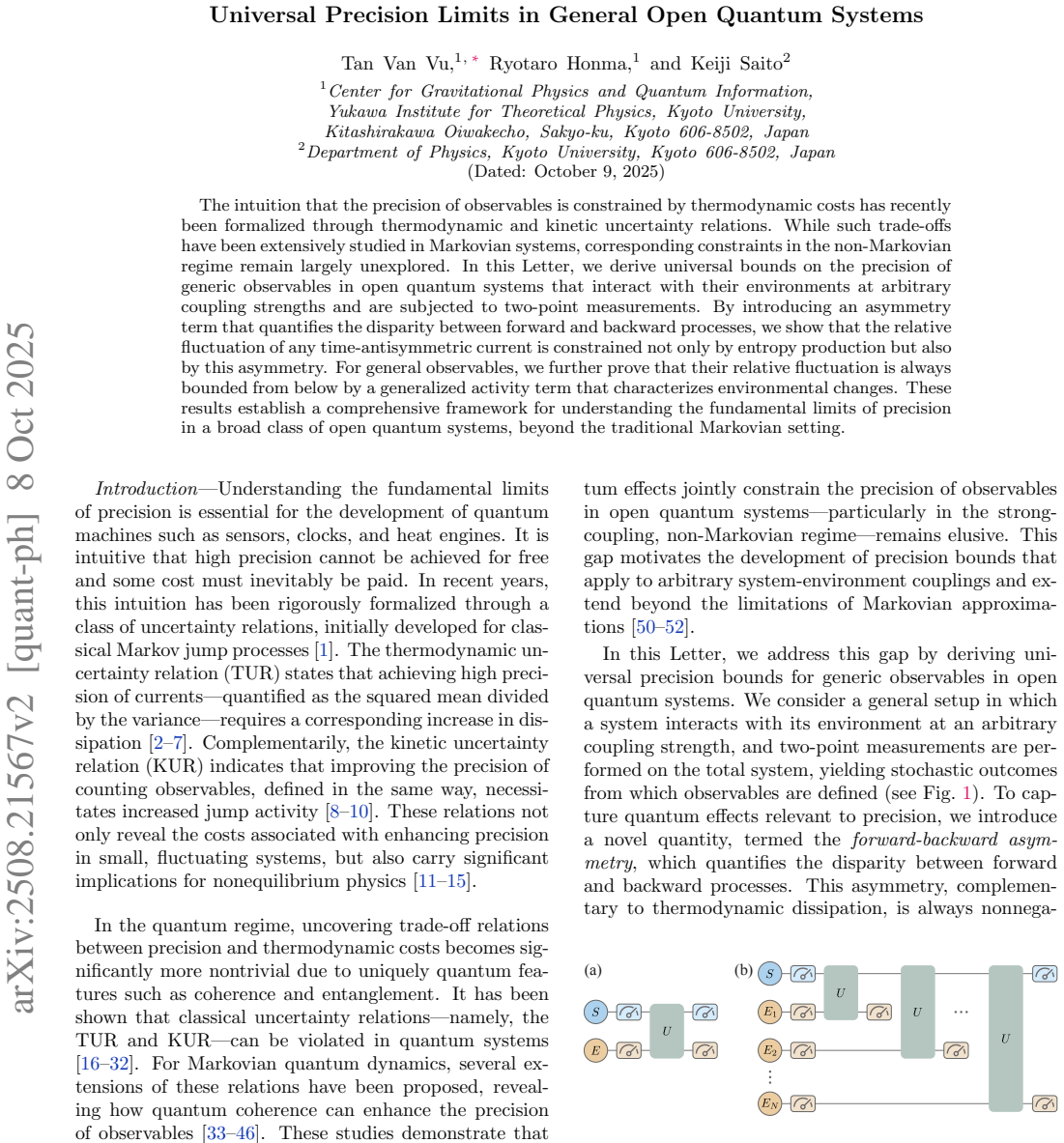
The intuition that the precision of observables is constrained by thermodynamic costs has recently been formalized through thermodynamic and kinetic uncertainty relations. While such trade-offs have been extensively studied in Markovian systems, corresponding constraints in the non-Markovian regime remain largely unexplored. In this Letter, we derive universal bounds on the precision of generic observables in open quantum systems that interact with their environments at arbitrary coupling strengths and are subjected to two-point measurements. By introducing an asymmetry term that quantifies the disparity between forward and backward processes, we show that the relative fluctuation of any time-antisymmetric current is constrained not only by entropy production but also by this asymmetry. For general observables, we further prove that their relative fluctuation is always bounded from below by a generalized activity term that characterizes environmental changes. These results establish a comprehensive framework for understanding the fundamental limits of precision in a broad class of open quantum systems, beyond the traditional Markovian setting.
Editorial analysis
A structured set of objections, weighed in public.
Referee Report
Summary. The manuscript derives universal bounds on the relative fluctuations of observables in general open quantum systems subjected to two-point measurements at arbitrary coupling strengths. It introduces an asymmetry term quantifying the disparity between forward and backward processes to bound the relative fluctuation of any time-antisymmetric current (in addition to entropy production) and proves that the relative fluctuation of general observables is bounded from below by a generalized activity term characterizing environmental changes.
Significance. If the derivations are valid, the results provide a significant extension of thermodynamic and kinetic uncertainty relations to non-Markovian regimes with strong couplings, offering a comprehensive framework for precision limits in open quantum systems. The asymmetry and generalized activity constructions are notable strengths that could enable new analyses in quantum thermodynamics.
major comments (2)
- [Main derivation of asymmetry term] The central claims rest on the consistent definition of forward and backward processes admitting a quantifiable asymmetry term for arbitrary system-environment couplings (see the derivation following the introduction of the asymmetry term). In non-Markovian regimes with strong coupling, persistent bath correlations can render the backward process ill-defined or non-unique without additional structure (e.g., specific initial bath states), which is load-bearing for the applicability of the bounds to generic observables.
- [Setup and two-point measurement protocol] The two-point measurement protocol is assumed to capture the relevant dynamics for all generic observables (see the section stating the setup for general open quantum systems). This assumption requires explicit justification or a concrete example showing how the protocol extends without weak-coupling or Markovian approximations, as it underpins both the asymmetry and generalized activity bounds.
minor comments (2)
- [Notation and definitions] Clarify the notation for the generalized activity term to ensure it is distinguished from standard activity measures in the literature.
- [Introduction] Add a brief discussion or reference to prior non-Markovian uncertainty relations to better contextualize the novelty.
Simulated Author's Rebuttal
We thank the referee for the positive evaluation of our work's significance and for the detailed major comments. We address each point below, providing clarifications and indicating planned revisions to the manuscript.
read point-by-point responses
-
Referee: [Main derivation of asymmetry term] The central claims rest on the consistent definition of forward and backward processes admitting a quantifiable asymmetry term for arbitrary system-environment couplings (see the derivation following the introduction of the asymmetry term). In non-Markovian regimes with strong coupling, persistent bath correlations can render the backward process ill-defined or non-unique without additional structure (e.g., specific initial bath states), which is load-bearing for the applicability of the bounds to generic observables.
Authors: We appreciate the referee's point on the operational definition of the backward process. In the manuscript, forward and backward processes are defined via the two-point measurement protocol on the system, with the environment initialized in a specified state (e.g., thermal equilibrium) and the full unitary dynamics of the combined system-environment Hamiltonian. The asymmetry term is then constructed from the ratio of the resulting forward and backward probability distributions of the measurement outcomes. While bath correlations are accounted for in the non-Markovian evolution, the protocol ensures the processes remain well-defined for the purpose of the bounds. We will revise the relevant section to explicitly discuss the role of the initial bath state and add a remark on why persistent correlations do not render the asymmetry ill-defined within this measurement-based framework. revision: partial
-
Referee: [Setup and two-point measurement protocol] The two-point measurement protocol is assumed to capture the relevant dynamics for all generic observables (see the section stating the setup for general open quantum systems). This assumption requires explicit justification or a concrete example showing how the protocol extends without weak-coupling or Markovian approximations, as it underpins both the asymmetry and generalized activity bounds.
Authors: The two-point measurement protocol is formulated without invoking weak-coupling or Markovian approximations: it consists of projective measurements on the system at initial and final times, with the intervening evolution governed by the exact system-environment unitary operator. This setup directly incorporates arbitrary couplings and non-Markovian effects through environmental correlations. To strengthen the presentation, we will add an explicit justification paragraph in the setup section, including a brief illustrative example (e.g., a two-level system coupled to a bosonic bath) demonstrating that the protocol yields the stated bounds for generic observables without those approximations. revision: yes
Circularity Check
Derivations rely on independent definitions of asymmetry and activity from forward/backward processes
full rationale
The paper introduces an asymmetry term quantifying disparity between forward and backward processes under two-point measurements and proves bounds on relative fluctuations for time-antisymmetric currents and general observables using a generalized activity term. These steps follow from standard quantum open-system dynamics and thermodynamic relations without reducing to fitted parameters, self-citations, or definitional equivalence. The central results are derived from first-principles considerations of entropy production and environmental changes rather than tautological constructions or load-bearing self-references. No equations or steps collapse the claimed bounds back to their inputs by construction.
Axiom & Free-Parameter Ledger
axioms (2)
- domain assumption Open quantum systems can be described with two-point measurements that allow definition of forward and backward processes.
- domain assumption Entropy production and environmental changes can be quantified independently of the specific system-bath details.
invented entities (2)
-
asymmetry term
no independent evidence
-
generalized activity term
no independent evidence
Lean theorems connected to this paper
-
IndisputableMonolith/Cost/FunctionalEquation.leanwashburn_uniqueness_aczel unclear?
unclearRelation between the paper passage and the cited Recognition theorem.
For general observables, we further prove that their relative fluctuation is always bounded from below by a generalized activity term that characterizes environmental changes.
What do these tags mean?
- matches
- The paper's claim is directly supported by a theorem in the formal canon.
- supports
- The theorem supports part of the paper's argument, but the paper may add assumptions or extra steps.
- extends
- The paper goes beyond the formal theorem; the theorem is a base layer rather than the whole result.
- uses
- The paper appears to rely on the theorem as machinery.
- contradicts
- The paper's claim conflicts with a theorem or certificate in the canon.
- unclear
- Pith found a possible connection, but the passage is too broad, indirect, or ambiguous to say the theorem truly supports the claim.
Reference graph
Works this paper leans on
-
[1]
can be interpreted as a generalized quantum TUR. It implies that achieving high precision in current-type observables necessarily requires either high dissipation or significant forward-backward asymmetry. In other words, both thermodynamic irre- versibility and dynamical asymmetry contribute to con- straining fluctuations in open quantum systems. The gener...
-
[2]
reduces to a TUR previously derived from the detailed fluctuation theorem [ 59–61]. This fluctuation-theorem TUR is known to be tight and saturable in certain cases, indicating that our general- ized result inherits this desirable property. It is worth noting that another TUR, derived from the fluctuation theorem, also holds in our setup [ 62]. However, this...
-
[3]
thus implies that achieving high precision requires correspondingly high activity. In the short-time limit of Markovian dynamics, the denominator P −1 −1 reduces exactly to the dynamical activity [ 57]. Therefore, the in- equality ( 11) can be regarded as a generalized quantum KUR. We provide several remarks on the result ( 11). First, the inequality is t...
-
[4]
generalizes and sharpens a pivotal re- sult previously reported in Ref. [ 50]. In particular, when the environment is initialized in the pure state ∣0⟩ ⟨0∣, it was shown that the precision of observables satisfies Var[ ϕ]/ ⟨ ϕ⟩2 ≥1/( A −1) , where A ∶= tr{ ( V † 0 V0) −1ϱS} is known as the survival activity [ 50] and V0 = M N
-
[5]
Using the inequality ∣tr( AB)∣2 ≤tr( A† A) tr( B† B) and noting that P = tr{ ( V † 0 V0) ϱS} , we obtain 1 ≤tr{ ( V † 0 V0) −1ϱS} tr{ ( V † 0 V0) ϱS} = A P , (12) which immediately yields P −1 ≤ A . Therefore, the bound ( 11) is strictly tighter than the previous find- ing, and more importantly, it naturally extends to ar- bitrary initial states of the env...
-
[6]
[ 65] using the Petrov inequality and in Ref
have been derived in Ref. [ 65] using the Petrov inequality and in Ref. [ 66] using a fluctuation theorem approach. Acknowledgments—T.V.V. was supported by JSPS KAKENHI Grant No. JP23K13032. K.S. was supported by JSPS KAKENHI Grant No. JP23K25796. Data availability —No data were created or analyzed in this Letter. ∗ tan.vu@yukawa.kyoto-u.ac.jp
-
[7]
J. M. Horowitz and T. R. Gingrich, Thermodynamic uncertainty relations constrain non-equilibrium fluctua- tions, Nat. Phys. 16, 15 (2020)
work page 2020
-
[8]
A. C. Barato and U. Seifert, Thermodynamic uncertainty relation for biomolecular processes, Phys. Rev. Lett. 114, 158101 (2015)
work page 2015
-
[9]
T. R. Gingrich, J. M. Horowitz, N. Perunov, and J. L. England, Dissipation bounds all steady-state current fluctuations, Phys. Rev. Lett. 116, 120601 (2016)
work page 2016
-
[10]
J. M. Horowitz and T. R. Gingrich, Proof of the finite- time thermodynamic uncertainty relation for steady- state currents, Phys. Rev. E 96, 020103(R) (2017)
work page 2017
-
[11]
Y. Hasegawa and T. Van Vu, Uncertainty relations in stochastic processes: An information inequality ap- proach, Phys. Rev. E 99, 062126 (2019)
work page 2019
-
[12]
T. Koyuk and U. Seifert, Thermodynamic uncertainty re- lation for time-dependent driving, Phys. Rev. Lett. 125, 260604 (2020)
work page 2020
-
[13]
V. T. Vo, T. Van Vu, and Y. Hasegawa, Unified thermodynamic-kinetic uncertainty relation, J. Phys. A 55, 405004 (2022)
work page 2022
-
[14]
J. P. Garrahan, Simple bounds on fluctuations and un- certainty relations for first-passage times of counting ob- servables, Phys. Rev. E 95, 032134 (2017)
work page 2017
-
[15]
I. Di Terlizzi and M. Baiesi, Kinetic uncertainty relation, J. Phys. A 52, 02LT03 (2019)
work page 2019
- [16]
-
[17]
P. Pietzonka and U. Seifert, Universal trade-off between power, efficiency, and constancy in steady-state heat en- gines, Phys. Rev. Lett. 120, 190602 (2018)
work page 2018
-
[18]
D. Hartich and A. c. v. Godec, Thermodynamic uncer- tainty relation bounds the extent of anomalous diffusion, Phys. Rev. Lett. 127, 080601 (2021)
work page 2021
-
[19]
J. Li, J. M. Horowitz, T. R. Gingrich, and N. Fakhri, Quantifying dissipation using fluctuating currents, Nat. Commun. 10, 1666 (2019) . 6
work page 2019
-
[20]
S. K. Manikandan, D. Gupta, and S. Krishnamurthy, In- ferring entropy production from short experiments, Phys. Rev. Lett. 124, 120603 (2020)
work page 2020
- [21]
-
[22]
B. K. Agarwalla and D. Segal, Assessing the validity of the thermodynamic uncertainty relation in quantum sys- tems, Phys. Rev. B 98, 155438 (2018)
work page 2018
-
[23]
Ptaszy´ nski, Coherence-enhanced constancy of a quan- tum thermoelectric generator, Phys
K. Ptaszy´ nski, Coherence-enhanced constancy of a quan- tum thermoelectric generator, Phys. Rev. B 98, 085425 (2018)
work page 2018
-
[24]
K. Brandner, T. Hanazato, and K. Saito, Thermody- namic bounds on precision in ballistic multiterminal transport, Phys. Rev. Lett. 120, 090601 (2018)
work page 2018
- [25]
- [26]
-
[27]
L. M. Cangemi, V. Cataudella, G. Benenti, M. Sassetti, and G. De Filippis, Violation of thermodynamics un- certainty relations in a periodically driven work-to-work converter from weak to strong dissipation, Phys. Rev. B 102, 165418 (2020)
work page 2020
-
[28]
H. M. Friedman, B. K. Agarwalla, O. Shein-Lumbroso, O. Tal, and D. Segal, Thermodynamic uncertainty rela- tion in atomic-scale quantum conductors, Phys. Rev. B 101, 195423 (2020)
work page 2020
-
[29]
A. A. S. Kalaee, A. Wacker, and P. P. Potts, Violating the thermodynamic uncertainty relation in the three-level maser, Phys. Rev. E 104, L012103 (2021)
work page 2021
-
[30]
P. Menczel, E. Loisa, K. Brandner, and C. Flindt, Ther- modynamic uncertainty relations for coherently driven open quantum systems, J. Phys. A 54, 314002 (2021)
work page 2021
-
[31]
A. Rignon-Bret, G. Guarnieri, J. Goold, and M. T. Mitchison, Thermodynamics of precision in quantum nanomachines, Phys. Rev. E 103, 012133 (2021)
work page 2021
-
[32]
M. F. Sacchi, Thermodynamic uncertainty relations for bosonic Otto engines, Phys. Rev. E 103, 012111 (2021)
work page 2021
-
[33]
J. Lu, Z. Wang, J. Peng, C. Wang, J.-H. Jiang, and J. Ren, Geometric thermodynamic uncertainty relation in a periodically driven thermoelectric heat engine, Phys. Rev. B 105, 115428 (2022)
work page 2022
-
[34]
M. Gerry and D. Segal, Absence and recovery of cost- precision tradeoff relations in quantum transport, Phys. Rev. B 105, 155401 (2022)
work page 2022
-
[35]
A. Das, S. Mahunta, B. K. Agarwalla, and V. Mukher- jee, Precision bound and optimal control in periodically modulated continuous quantum thermal machines, Phys. Rev. E 108, 014137 (2023)
work page 2023
-
[36]
G. Manzano and R. L´ opez, Quantum-enhanced perfor- mance in superconducting Andreev reflection engines, Phys. Rev. Res. 5, 043041 (2023)
work page 2023
- [37]
- [38]
-
[39]
G. Guarnieri, G. T. Landi, S. R. Clark, and J. Goold, Thermodynamics of precision in quantum nonequilib- rium steady states, Phys. Rev. Res. 1, 033021 (2019)
work page 2019
-
[40]
F. Carollo, R. L. Jack, and J. P. Garrahan, Unraveling the large deviation statistics of Markovian open quantum systems, Phys. Rev. Lett. 122, 130605 (2019)
work page 2019
-
[41]
Hasegawa, Quantum thermodynamic uncertainty re- lation for continuous measurement, Phys
Y. Hasegawa, Quantum thermodynamic uncertainty re- lation for continuous measurement, Phys. Rev. Lett. 125, 050601 (2020)
work page 2020
-
[42]
H. J. D. Miller, M. H. Mohammady, M. Perarnau-Llobet, and G. Guarnieri, Thermodynamic uncertainty relation in slowly driven quantum heat engines, Phys. Rev. Lett. 126, 210603 (2021)
work page 2021
-
[43]
T. Van Vu and K. Saito, Thermodynamics of precision in Markovian open quantum dynamics, Phys. Rev. Lett. 128, 140602 (2022)
work page 2022
- [44]
-
[45]
T. Van Vu, Fundamental bounds on precision and re- sponse for quantum trajectory observables, PRX Quan- tum 6, 010343 (2025)
work page 2025
-
[46]
K. Macieszczak, Ultimate kinetic uncertainty rela- tion and optimal performance of stochastic clocks, arXiv:2407.09839 (2024)
-
[47]
E. Kwon and J. S. Lee, A unified framework for classi- cal and quantum uncertainty relations using stochastic representations, arXiv:2412.04988 (2024)
-
[48]
S. V. Moreira, M. Radaelli, A. Candeloro, F. C. Binder, and M. T. Mitchison, Precision bounds for multiple cur- rents in open quantum systems, Phys. Rev. E 111, 064107 (2025)
work page 2025
-
[49]
H. Yunoki and Y. Hasegawa, Quantum speed limit and quantum thermodynamic uncertainty relation under feedback control, arXiv:2502.09081 (2025)
-
[50]
T. Nishiyama and Y. Hasegawa, Quantum thermody- namic uncertainty relations without quantum correc- tions: A coherent-incoherent correspondence approach, arXiv:2505.09973 (2025)
-
[51]
K. Yoshimura and R. Hamazaki, Quasiprobability thermodynamic uncertainty relation, arXiv:2508.14354 (2025)
-
[52]
G. T. Landi, M. J. Kewming, M. T. Mitchison, and P. P. Potts, Current fluctuations in open quantum sys- tems: Bridging the gap between quantum continuous measurements and full counting statistics, PRX Quan- tum 5, 020201 (2024)
work page 2024
-
[53]
D. Palmqvist, L. Tesser, and J. Splettstoesser, Ki- netic uncertainty relations for quantum transport, arXiv:2410.10793 (2024)
- [54]
-
[55]
K. Brandner and K. Saito, Thermodynamic uncertainty relations for coherent transport, Phys. Rev. Lett. 135, 046302 (2025)
work page 2025
-
[56]
Hasegawa, Thermodynamic uncertainty relation for general open quantum systems, Phys
Y. Hasegawa, Thermodynamic uncertainty relation for general open quantum systems, Phys. Rev. Lett. 126, 010602 (2021)
work page 2021
-
[57]
N. Ishida and Y. Hasegawa, Quantum-computer-based verification of quantum thermodynamic uncertainty re- lation, Phys. Rev. E 112, 034124 (2025)
work page 2025
-
[58]
S. Campbell, I. D’Amico, M. A. Ciampini, J. Anders, N. Ares, S. Artini, A. Auff` eves, L. B. Oftelie, L. P. Bettmann, M. V. S. Bonan¸ ca, T. Busch, M. Campisi, 7 M. F. Cavalcante, L. A. Correa, E. Cuestas, C. B. Dag, S. Dago, S. Deffner, A. Del Campo, A. Deutschmann- Olek, S. Donadi, E. Doucet, C. Elouard, K. Ensslin, P. Erker, N. Fabbri, F. Fedele, G. Fius...
-
[59]
Hasegawa, Irreversibility, Loschmidt echo, and ther- modynamic uncertainty relation, Phys
Y. Hasegawa, Irreversibility, Loschmidt echo, and ther- modynamic uncertainty relation, Phys. Rev. Lett. 127, 240602 (2021)
work page 2021
-
[60]
G. Manzano, J. M. Horowitz, and J. M. R. Parrondo, Quantum fluctuation theorems for arbitrary environ- ments: Adiabatic and nonadiabatic entropy production, Phys. Rev. X 8, 031037 (2018)
work page 2018
-
[61]
While we assume that the system interacts with a single thermal bath during each interaction for simplicity, the formulation extends straightforwardly to multiple heat baths at different temperatures
-
[62]
M. Esposito, K. Lindenberg, and C. V. den Broeck, Entropy production as correlation between system and reservoir, New J. Phys. 12, 013013 (2010)
work page 2010
-
[63]
See the Supplemental Material for further analytical cal- culations and the generalization of the main results
-
[64]
M. Campisi, P. H¨ anggi, and P. Talkner, Colloquium: Quantum fluctuation relations: Foundations and appli- cations, Rev. Mod. Phys. 83, 771 (2011)
work page 2011
-
[65]
Y. Hasegawa and T. Van Vu, Fluctuation theorem un- certainty relation, Phys. Rev. Lett. 123, 110602 (2019)
work page 2019
-
[66]
A. M. Timpanaro, G. Guarnieri, J. Goold, and G. T. Landi, Thermodynamic uncertainty relations from ex- change fluctuation theorems, Phys. Rev. Lett. 123, 090604 (2019)
work page 2019
-
[67]
T. Van Vu and Y. Hasegawa, Uncertainty relation under information measurement and feedback control, J. Phys. A 53, 075001 (2020)
work page 2020
-
[68]
P. P. Potts and P. Samuelsson, Thermodynamic uncer- tainty relations including measurement and feedback, Phys. Rev. E 100, 052137 (2019)
work page 2019
-
[69]
F. Ciccarello, S. Lorenzo, V. Giovannetti, and G. M. Palma, Quantum collision models: Open system dynam- ics from repeated interactions, Phys. Rep. 954, 1 (2022)
work page 2022
-
[70]
J. M. Horowitz and J. M. R. Parrondo, Entropy produc- tion along nonequilibrium quantum jump trajectories, New J. Phys. 15, 085028 (2013)
work page 2013
-
[71]
Y. Hasegawa, Fundamental precision limits in finite-dimensional quantum thermal machines, arXiv:2412.07271 (2024)
-
[72]
Universal Precision Limits in General Open Quantum Systems
A. S. Hegde, A. M. Timpanaro, and G. T. Landi, Explor- ing null-entropy events: What do we learn when nothing happens?, arXiv:2508.16528 (2025) . End Matter Appendix A: Proof of Eqs. (9) and (11)—For any ob- servable ϕ that satisfies the time-antisymmetry condi- tion, its first and second moments can be expressed as ⟨ϕ⟩= 1 2 ∑ γ ϕ( γ)[ P( γ) −P( ̃γ)] , (16)...
-
[73]
Short-time behavior of Σ ∗ 5
-
[74]
General lower bound of Σ ∗ 6 B. Generalized quantum KUR 7 S4. Generalization of the main result (9) to arbitrary initial states 8 S5. Generalized TUR for underdamped Langevin dynamics 10 A. Setup and generalized TUR 10 B. Derivation of Eqs. (S81) and (S83) 12 S6. Propositions 13 References 13 S1. EXPRESSION OF THE ENTROPY PRODUCTION Σ The average amount o...
-
[75]
In this regime, the asymmetry is dominated by paths with at most one jump
Short-time behavior of Σ ∗ We investigate the asymptotic behavior of Σ ∗ in the short-time limit T ≪ 1. In this regime, the asymmetry is dominated by paths with at most one jump. Therefore, Σ ∗ can be approximated as follows: Σ ∗= ∑ m,n pn∣ ⟨m∣Ueff ( T )∣n⟩ ∣2 ln ∣ ⟨m∣Ueff ( T )∣n⟩ ∣2 ∣ ⟨m∣Ueff ( T ) † ∣n⟩ ∣2 + ∑ m,n,k ∫ T 0 dt pn∣ ⟨m∣Ueff ( T −t) LkUeff ( t)∣...
-
[76]
General lower bound of Σ ∗ Here we derive a lower bound of Σ ∗for arbitrary finite times. To this end, let us recall that the backwar d probability can be calculated as follows: ̃P( γ) = ∣ ⟨m∣Ueff ( T −tN ) † JkN . . . Jk1 Ueff ( t1) † ∣n⟩ ∣2, (S40) 7 where Ueff ( t) † = e(iH−∑k≥1 L† kLk/2)t. By exploiting the data-processing inequality for the relative en tr...
-
[77]
Difference in force fields: The first source arises from the discre pancy between the force fields { Fi} in the forward dynamics and { F † i } in the backward dynamics. In the presence of time-reversal-odd par ameters (e.g., magnetic fields), these forces generally differ: Fi ≠F † i . This asymmetry leads to fundamentally distinct forward and backward trajector...
-
[78]
Difference in initial distributions: The second source stems fr om the difference in the initial probability distribu- tions. For each time-reversed trajectory ̃Γ, the forward process assigns the initial probability p0( x( T ) , −v( T )) , while the backward process uses pT ( x( T ) , v( T )) . This mismatch is captured in the second term of Eq. ( S83), whi...
-
[79]
Lindblad, On the generators of quantum dynamical semigro ups, Commun
G. Lindblad, On the generators of quantum dynamical semigro ups, Commun. Math. Phys. 48, 119 (1976) . 14
work page 1976
- [80]
discussion (0)
Sign in with ORCID, Apple, or X to comment. Anyone can read and Pith papers without signing in.