REVIEW 4 major objections 4 minor 89 references
Middo: Model-Informed Dynamic Data Optimization for Enhanced LLM Fine-Tuning via Closed-Loop Learning
T0 review · 4 major / 4 minor · reviewed 2026-08-05 · deepseek-v4-flash
Pith's one-line read Closed-loop data refinement lifts fine-tuned LLM accuracy 7.15% on average
desk verdict Middo is a plausible integration of known data-optimization signals, but the 7.15% headline is the best tuned iteration and the 'constant dataset size' claim is contradicted by the appendix. read the letter →
The pith
A machine-rendered reading of the paper's core claim, the machinery that carries it, and where it could break.
The reading
What carries the argument
The mechanism is the self-referential closed loop: a diagnostic stage that reads three model-produced signals — loss pattern for complexity, embedding-cluster sparsity for diversity, and self-alignment scores for quality — and an optimization stage that rewrites the flagged samples using the model's own generation capacity. The selection thresholds are dynamic (τ = μ + mσ), so as the model improves, the amount and composition of selected data shifts automatically. The loop is what carries the argument: each retrained model generates the signals that select the next round of data.
What would settle it
Run Middo on a dataset where the correct answers are written in a style the base model rarely produces. If the model's self-alignment scores systematically downgrade those correct samples, the quality module is rewarding stylistic familiarity rather than quality; the framework's gains should disappear or reverse when the self-scores are replaced by human or external-judge scores on the same samples.
Extended reading notes
Core claim
The central claim is that supervised fine-tuning data should not be treated as a fixed resource: a closed loop in which the model scores its own training samples, selects the weak ones, rewrites them, and retrains can improve downstream accuracy while roughly preserving dataset size. The paper identifies three axes of weakness using signals already available from the model: high pre- and post-training loss marks overly complex samples, low neighborhood cosine similarity in the embedding space marks sparse or underrepresented regions, and low self-alignment scores on factuality, clarity, and completeness mark low-quality samples. Each flagged subset is transformed — complex items are decompos
Load-bearing premise
The quality module assumes that the fine-tuned model can score its own training examples reliably on factuality, clarity, and completeness, and that those self-scores are an objective measure of data quality; if the model rewards its own current preferences, the loop can amplify them rather than fix them.
Editorial extensions
If this is right
- Fine-tuning gains can be obtained without increasing dataset size, so the method preserves the compute and memory footprint of SFT.
- Applying the loop to lower-quality seed data yields the largest gains; higher-quality datasets reach their peak in fewer iterations.
- The optimized models solve substantially more hard test questions on MATH and GPQA, not merely easier average tasks.
- Each of the three modules earns its place: ablations show removing any one of loss patterns, diversity extension, or self-alignment scores lowers average performance across iterations.
- The approach transfers across different 7B-scale base models, suggesting the loop is architecture-agnostic within that scale.
Reading between the lines
- If the self-alignment scores mainly reflect the model's current stylistic preferences, the quality module could reinforce those preferences instead of correcting factual errors; comparing self-scores against an external judge on a held-out quality set would isolate this effect.
- The dynamic threshold rule effectively creates an automatic curriculum — difficult samples are simplified early, subtler refinements remain later — which could be tested directly by comparing performance with versus without threshold adaptation across iterations.
- The diversity extension preferentially adds examples near cluster boundaries; a targeted test would feed the augmented samples to a downstream classifier to check whether they reduce errors on rare or out-of-distribution inputs.
- The reported gains might be partly attributable to retraining multiple times on slightly altered data rather than to the specific rewrites; an ablation rerunning the base training for the same number of epochs without data changes would quantify this.
Editorial analysis
A structured set of objections, weighed in public.
Referee Report
Summary. The paper proposes Middo, an iterative closed-loop data optimization framework for supervised fine-tuning of LLMs. Middo uses three model-derived signals to identify suboptimal training samples: loss patterns (complexity), embedding cluster dynamics (diversity), and self-alignment scores (quality). Selected samples are then either simplified, augmented, or rewritten by a synthesis LLM, and the resulting dataset is used to fine-tune the model for the next iteration. Experiments on Alpaca, Alpaca-4o-mini, and WizardLM with LLaMA-3.1-8B and Mistral-7B-v0.3 report average accuracy gains of 7.15% and 4.75% over the initial datasets, alongside ablations, sensitivity analyses, and comparisons to several data selection and augmentation baselines. The paper claims that these gains are achieved 'while maintaining the original dataset scale'.
Significance. If the reported gains are robust, Middo would be a useful contribution to the growing literature on model-aware, iterative data curation for LLM fine-tuning. The framework is clearly presented, the ablation study is informative, and the public release of datasets, models, and code is a concrete strength. The main claims are, however, currently supported by an evaluation protocol that is selection-heavy: threshold multipliers, the neighbor count, and the number of iterations are tuned on the same benchmarks used for the headline results, and the main table reports the best-performing iteration per dataset/model. The 'maintaining original dataset scale' claim is also directly contradicted by the paper's own Appendix Table 6. The underlying idea is plausible and the results are suggestive, but additional experiments and honest reporting are needed before the headline claims can be accepted.
major comments (4)
- [Appendix B (Tables 5, 7; Figure 7) and Section 4.2 (Table 1)] Hyperparameter selection leaks evaluation signal. The threshold multiplier m is chosen from a sensitivity analysis on the same Alpaca benchmarks (Table 7: 'performance peaks when the selected data proportion falls within this empirically determined optimal range'), k is chosen from Table 5, and the iteration count is chosen from Figure 7. Table 1 then reports the best iteration per dataset/model, e.g., Alpaca-4o-mini/LLaMA peaks at iter2 while Wizard/LLaMA peaks at iter1. With no seeds or error bars, the 7.15% headline is a selected maximum, not an estimate under a fixed protocol. Please report all iterations under a fixed rule, add at least 3-5 seeds with variance, or use a held-out tuning split.
- [Abstract, Section 4.2, Appendix Table 6] The claim of 'maintaining the original dataset scale' is contradicted by Table 6: dataset sizes grow from 52,002 to 57,636 (Alpaca/LLaMA), 52,002 to 65,324 (Alpaca-4o-mini/LLaMA), and 70,000 to 89,178 (Wizard/Mistral). The diversity module adds examples rather than replacing them, so total size increases by roughly 10-25%. Either control for data size (e.g., compare against adding the same number of random/unaltered samples) or revise the claim in the abstract, introduction, and conclusion.
- [Section 4.2, Table 1] The assertion that Middo 'consistently enhances model performance across all benchmarks' is not supported by the table. Counterexamples include Alpaca/LLaMA MMLU dropping from 50.13 (iter1) to 41.82 (iter2), Alpaca-4o-mini/LLaMA GPQA decreasing monotonically 24.24→21.72→19.70, and Mistral/Alpaca-4o-mini average at iter3 (32.86) falling below the initial value (34.56). The claim should be softened to an average improvement with explicit per-benchmark caveats.
- [Section 3.4, Appendix D, Table 3] The quality module relies on the fine-tuned model's own self-alignment scores as ground truth for data quality. Since the ablation in Table 3 shows that removing this module is often the largest performance drop, the method's effectiveness depends critically on these scores being valid. The paper does not validate the self-scores against an external judge (e.g., GPT-4 or human ratings) on a subset. Please add such a validation experiment, or explicitly discuss and test the risk that self-scoring reinforces the model's existing preferences rather than improving data quality.
minor comments (4)
- [Appendix B.3, Table 6] The m values used in the main experiments (e.g., Alpaca initial row: m=1, m=-1, m=-1.5) do not appear in the sensitivity table (Table 7), which lists combinations such as m=0, -1, -1.5 and m=1, -2, -1.5. This makes it difficult to see how the stated 'targeting the 15% mark' rule maps to the actual selected data sizes.
- [Appendix B.2, Figure 7] Figure 7 shows average score versus iteration with no error bars or multiple runs. The statement that performance 'peaks at three iterations' is based on a single trajectory and should be described as such.
- [Table 1, Mistral/Alpaca-4o-mini iter1] The value 41.32 appears twice (for both HumanEval and Hellaswag), which is likely a typo or copy-paste error. Please verify the reported numbers.
- [Title and running header] The title contains a typo: 'Fine-T uning' should be 'Fine-Tuning' (also 'T uning' in the running header).
Circularity Check
Headline 7.15% gain is partly selected from on-benchmark tuning of thresholds and iteration count; the self-alignment 'quality' improvement is self-referential.
-
self definitional
[Section 3.4 (Quality Selection) and Section 5.3 (Data Analysis, Quality)]
"Specifically, for each instruction-response pair (Xi, Yi) in D, the model generate scores Sπ ins.(Xi) for instruction and Sπ res.(Xi, Yi) for instruction-response pair based on three key metrics π from AlignBench [37]: Clarity, Completeness, and Factuality. The final quality score S(X i, Yi) is obtained by averaging these scores. These samples with scores below a similar dynamic threshold are identified as low-quality... As the self-alignment scores increase, it reflects that the refined data is not only more accurate but also more consistent with the model’s internal standards and expectation"
The 'quality' axis is defined by the model's own self-alignment scores. Low-scoring samples are selected and rewritten, then the same model is fine-tuned on the revised data and asked to score the data again. The average self-alignment score increase in Figure 6 is therefore partly guaranteed by the optimization loop: the data are being trained and then judged against the very rubric that drove the selection/rewriting. Presenting this increase as evidence that 'low-quality samples' were transformed into 'high-quality learning material' is circular as a quality validation. The external benchmarks are independent, but the internal quality-improvement claim reduces to the optimization target.
-
fitted input called prediction
[Appendix B.3 (The Impact of Thresholds) and Section 4.2 (Main Results)]
"To determine appropriate m values for each module, we conducted a sensitivity analysis, presented in Table 7. This table shows how different combinations of m for complexity, diversity, and quality impact the total percentage of unique data selected for refinement and the resulting average model performance on benchmarks... performance peaks when the selected data proportion falls within this empirically determined optimal range. For instance, the combination yielding 14.88% selected data achieved the best average score of 43.23... The actual data sizes selected in each iteration for the exper"
The m threshold multipliers that control which samples Middo refines were chosen by maximizing average performance on the same Alpaca benchmark suite later used for the headline claim of a 7.15% average accuracy increase. The main Table 1 numbers are generated with parameters fit to the evaluation set itself, so the reported gain is a selected optimum rather than an independent prediction. The sensitivity analysis explicitly reports 'the best average score of 43.23' on the same benchmark family used in Table 1, making the headline partly a fitted result.
1 more flagged steps
-
fitted input called prediction
[Appendix B.2 (The Impact of Iterations) and Section 4.2 (Main Results)]
"As shown in Figure 7, we tested the number of iterations on the Alpaca dataset and found that the model’s performance significantly declined after the third iteration. Therefore, we chose to optimize each dataset for three iterations."
The main paper reports the 7.15% gain 'over three iterations' on the Alpaca dataset, but the number of iterations was selected by inspecting the performance curve on that same Alpaca evaluation and stopping at the observed peak (iteration 3). Thus the headline improvement is the maximum of the tested trajectory, not a pre-registered or held-out result. The same iteration count is then applied to other datasets and models without independent validation, so the reported magnitude is partly an artifact of choosing the best-looking iteration count on the benchmark being reported.
full rationale
This paper is an empirical method paper, not a mathematical derivation, so there is no equation-level derivation chain to be circular. The most serious circularity-like issue is the self-referential quality signal: the model scores its own data on clarity/completeness/factuality, low-scoring data are rewritten, and then the same model's rising self-alignment scores are presented as evidence of quality improvement; that internal claim reduces to the optimization target. Additionally, the headline 7.15% average gain is not a clean held-out prediction: the threshold multipliers m and the iteration count (three) were selected by sensitivity analysis on the same Alpaca benchmark suite used to report the main results. This is selection-on-the-evaluation-set, which makes the headline partly a fitted maximum rather than an independent finding. I did not count the Appendix Table 6 dataset-size growth (52k to 57.6k/65.3k/89.2k) as circularity; that is a factual consistency/correctness issue about the 'maintaining the original dataset scale' claim. No load-bearing self-citation chain is present, and the external benchmark evaluations give the method some independent content, so the overall circularity score is moderate rather than severe.
Assumptions & free parameters
free parameters (6)
- threshold multiplier m for complexity selection =
e.g., 1.0 for Alpaca/LLaMA iter1, 0.5 for Alpaca/Mistral iter1
- threshold multiplier m for diversity selection =
-1.0 to -2.5 across datasets
- threshold multiplier m for quality selection =
-0.5 to -4 across datasets
- number of neighbors k =
2
- number of iteration rounds =
3
- fine-tuning loss thresholds tau_pre and tau_post =
derived from mean + m * std
assumptions (5)
- domain assumption The fine-tuned model's self-alignment scores on factuality, clarity, and completeness are valid measures of training data quality.
- domain assumption Loss before and after training above mean-plus-sigma thresholds identify samples that are too complex for the current model.
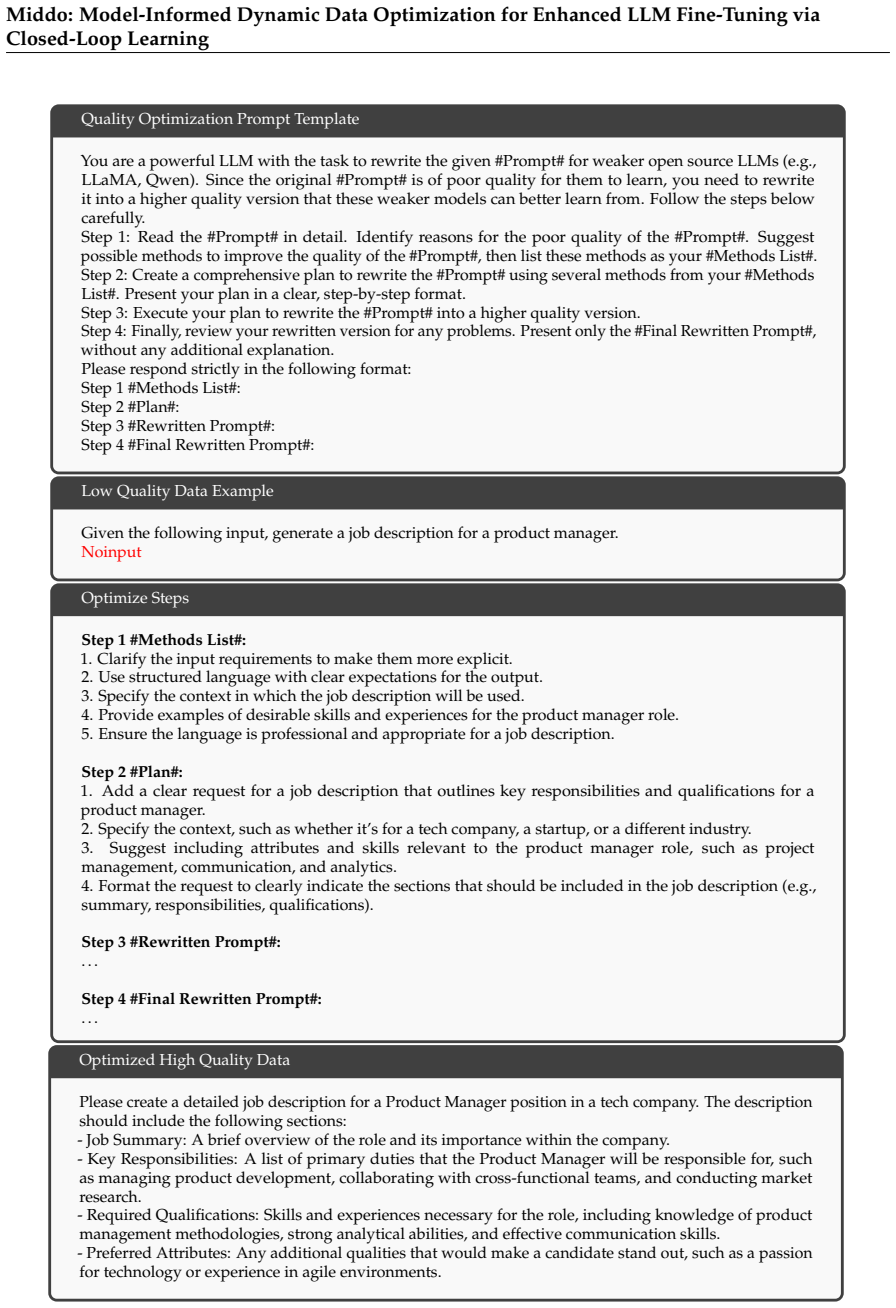
- domain assumption Low average cosine similarity to k-nearest neighbors in the last hidden layer indicates under-represented regions worth augmenting.
- domain assumption LLM rewriting with GPT-4o-mini preserves the learning value of the original sample while making it easier or higher quality.
- domain assumption One epoch of fine-tuning per iteration is enough to update model capability without overfitting.
Cite this review
Pith. "Pith review of Middo: Model-Informed Dynamic Data Optimization for Enhanced LLM Fine-Tuning via Closed-Loop Learning." pith.science (2026). https://pith.science/paper/6C554KTE
@misc{pith2026250821589,
  author       = {Pith},
  title        = {Pith review of: Middo: Model-Informed Dynamic Data Optimization for Enhanced LLM Fine-Tuning via Closed-Loop Learning},
  year         = {2026},
  howpublished = {\url{https://pith.science/paper/6C554KTE}},
  note         = {Machine review of arXiv:2508.21589}
}
read the original abstract
Supervised Fine-Tuning (SFT) Large Language Models (LLM) fundamentally rely on high-quality training data. While data selection and data synthesis are two common strategies to improve data quality, existing approaches often face limitations in static dataset curation that fail to adapt to evolving model capabilities. In this paper, we introduce Middo, a self-evolving Model-informed dynamic data optimization framework that uses model-aware data selection and context-preserving data refinement. Unlike conventional one-off filtering/synthesis methods, our framework establishes a closed-loop optimization system: (1) A self-referential diagnostic module proactively identifies suboptimal samples through tri-axial model signals - loss patterns (complexity), embedding cluster dynamics (diversity), and self-alignment scores (quality); (2) An adaptive optimization engine then transforms suboptimal samples into pedagogically valuable training points while preserving semantic integrity; (3) This optimization process continuously evolves with model capability through dynamic learning principles. Experiments on multiple benchmarks demonstrate that our Middo consistently enhances the quality of seed data and boosts LLM's performance with improving accuracy by 7.15% on average while maintaining the original dataset scale. This work establishes a new paradigm for sustainable LLM training through dynamic human-AI co-evolution of data and models. Our datasets, models, and code are publicly available at https://github.com/Word2VecT/Middo.
Figures


Figures from the paper (8 more)


Reference graph
Works this paper leans on
-
[1]
Gpt-4 technical report.arXiv preprint arXiv:2303.08774, 2023
Josh Achiam, Steven Adler, Sandhini Agarwal, Lama Ahmad, Ilge Akkaya, Florencia Leoni Aleman, Diogo Almeida, Janko Altenschmidt, Sam Altman, Shyamal Anadkat, et al. Gpt-4 technical report.arXiv preprint arXiv:2303.08774, 2023
arXiv 2023
-
[2]
Program synthesis with large language models,
Jacob Austin, Augustus Odena, Maxwell Nye, Maarten Bosma, Henryk Michalewski, David Dohan, Ellen Jiang, Carrie Cai, Michael Terry, Quoc Le, and Charles Sutton. Program synthesis with large language models,
-
[3]
Synthetic and natural noise both break neural machine translation
Yonatan Belinkov and Yonatan Bisk. Synthetic and natural noise both break neural machine translation. InIn- ternational Conference on Learning Representations, 2018. URLhttps://openreview.net/forum?id=BJ8vJebC-
2018
-
[4]
Instruction mining: Instruction data selection for tuning large language models
Yihan Cao, Yanbin Kang, Chi Wang, and Lichao Sun. Instruction mining: Instruction data selection for tuning large language models. InFirst Conference on Language Modeling, 2024. URL https://openreview. net/forum?id=wF6k0aWjAu
2024
-
[5]
Alpagasus: Training a better alpaca with fewer data
Lichang Chen, Shiyang Li, Jun Yan, Hai Wang, Kalpa Gunaratna, Vikas Yadav, Zheng Tang, Vijay Srinivasan, Tianyi Zhou, Heng Huang, and Hongxia Jin. Alpagasus: Training a better alpaca with fewer data. InThe 10 Middo: Model-Informed Dynamic Data Optimization for Enhanced LLM Fine-T uning via Closed-Loop Learning Twelfth International Conference on Learning ...
2024
-
[6]
Mark Chen, Jerry Tworek, Heewoo Jun, Qiming Yuan, Henrique Ponde de Oliveira Pinto, Jared Kaplan, Harri Edwards, Yuri Burda, Nicholas Joseph, Greg Brockman, Alex Ray, Raul Puri, Gretchen Krueger, Michael Petrov, Heidy Khlaaf, Girish Sastry, Pamela Mishkin, Brooke Chan, Scott Gray, Nick Ryder, Mikhail Pavlov, Alethea Power, Lukasz Kaiser, Mohammad Bavarian...
arXiv 2021
-
[7]
Training verifiers to solve math word problems, 2021
Karl Cobbe, Vineet Kosaraju, Mohammad Bavarian, Mark Chen, Heewoo Jun, Lukasz Kaiser, Matthias Plappert, Jerry Tworek, Jacob Hilton, Reiichiro Nakano, Christopher Hesse, and John Schulman. Training verifiers to solve math word problems, 2021. URLhttps://arxiv.org/abs/2110.14168
arXiv 2021
-
[8]
Pierre Colombo, Telmo Pessoa Pires, Malik Boudiaf, Dominic Culver, Rui Melo, Caio Corro, Andre F. T. Martins, Fabrizio Esposito, Vera L´ucia Raposo, Sofia Morgado, and Michael Desa. Saullm-7b: A pioneering large language model for law, 2024. URLhttps://arxiv.org/abs/2403.03883
arXiv 2024
Show all 89 references
-
[9]
Opencompass: A universal evaluation platform for foundation models
OpenCompass Contributors. Opencompass: A universal evaluation platform for foundation models. https://github.com/open-compass/opencompass, 2023
2023
-
[10]
Auggpt: Leveraging chatgpt for text data augmentation.IEEE Transactions on Big Data, 2025
Haixing Dai, Zhengliang Liu, Wenxiong Liao, Xiaoke Huang, Yihan Cao, Zihao Wu, Lin Zhao, Shaochen Xu, Fang Zeng, Wei Liu, et al. Auggpt: Leveraging chatgpt for text data augmentation.IEEE Transactions on Big Data, 2025
2025
-
[11]
Mods: Model-oriented data selection for instruction tuning, 2023
Qianlong Du, Chengqing Zong, and Jiajun Zhang. Mods: Model-oriented data selection for instruction tuning, 2023. URLhttps://arxiv.org/abs/2311.15653
2023 arXiv
-
[12]
The llama 3 herd of models.arXiv preprint arXiv:2407.21783, 2024
Abhimanyu Dubey, Abhinav Jauhri, Abhinav Pandey, Abhishek Kadian, Ahmad Al-Dahle, Aiesha Letman, Akhil Mathur, Alan Schelten, Amy Yang, Angela Fan, et al. The llama 3 herd of models.arXiv preprint arXiv:2407.21783, 2024
2024 arXiv
-
[13]
Understanding back-translation at scale
Sergey Edunov, Myle Ott, Michael Auli, and David Grangier. Understanding back-translation at scale. In Proceedings of the 2018 Conference on Empirical Methods in Natural Language Processing, pages 489–500, 2018
2018
-
[14]
A strategic coordination framework of small LMs matches large LMs in data synthesis
Xin Gao, Qizhi Pei, Zinan Tang, Yu Li, Honglin Lin, Jiang Wu, Lijun Wu, and Conghui He. A strategic coordination framework of small LMs matches large LMs in data synthesis. In Wanxiang Che, Joyce Nabende, Ekaterina Shutova, and Mohammad Taher Pilehvar, editors,Proceedings of t...
2025
-
[15]
Surveying the effects of quality, diversity, and complexity in synthetic data from large language models.arXiv preprint arXiv:2412.02980, 2024
Alex Havrilla, Andrew Dai, Laura O’Mahony, Koen Oostermeijer, Vera Zisler, Alon Albalak, Fabrizio Milo, Sharath Chandra Raparthy, Kanishk Gandhi, Baber Abbasi, et al. Surveying the effects of quality, diversity, and complexity in synthetic data from large language models.arXiv...
2024 arXiv
-
[16]
Measuring massive multitask language understanding
Dan Hendrycks, Collin Burns, Steven Basart, Andy Zou, Mantas Mazeika, Dawn Song, and Jacob Steinhardt. Measuring massive multitask language understanding. InInternational Conference on Learning Representations,
-
[17]
Measuring mathematical problem solving with the MATH dataset
Dan Hendrycks, Collin Burns, Saurav Kadavath, Akul Arora, Steven Basart, Eric Tang, Dawn Song, and Jacob Steinhardt. Measuring mathematical problem solving with the MATH dataset. InThirty-fifth Conference on Neural Information Processing Systems Datasets and Benchmarks Track (...
2021
-
[18]
URLhttps://openreview.net/forum?id=d7KBjmI3GmQ
-
[19]
Boosting llm via learning from data iteratively and selectively, 2024
Qi Jia, Siyu Ren, Ziheng Qin, Fuzhao Xue, Jinjie Ni, and Yang You. Boosting llm via learning from data iteratively and selectively, 2024. URLhttps://arxiv.org/abs/2412.17365
2024 arXiv
-
[20]
Gpt-4o system card.arXiv preprint arXiv:2410.21276, 2024
Aaron Hurst, Adam Lerer, Adam P Goucher, Adam Perelman, Aditya Ramesh, Aidan Clark, AJ Ostrow, Akila Welihinda, Alan Hayes, Alec Radford, et al. Gpt-4o system card.arXiv preprint arXiv:2410.21276, 2024. 11 Middo: Model-Informed Dynamic Data Optimization for Enhanced LLM Fine-T...
2024 arXiv
-
[21]
Impossible distillation for paraphrasing and summarization: How to make high-quality lemonade out of small, low-quality model
Jaehun Jung, Peter West, Liwei Jiang, Faeze Brahman, Ximing Lu, Jillian Fisher, Taylor Sorensen, and Yejin Choi. Impossible distillation for paraphrasing and summarization: How to make high-quality lemonade out of small, low-quality model. InProceedings of the 2024 Conference ...
2024
-
[22]
Albert Q. Jiang, Alexandre Sablayrolles, Arthur Mensch, Chris Bamford, Devendra Singh Chaplot, Diego de las Casas, Florian Bressand, Gianna Lengyel, Guillaume Lample, Lucile Saulnier, L´elio Renard Lavaud, Marie-Anne Lachaux, Pierre Stock, Teven Le Scao, Thibaut Lavril, Thomas...
2023 arXiv
-
[23]
Active instruction tuning: Improving cross-task generalization by training on prompt sensitive tasks
Po-Nien Kung, Fan Yin, Di Wu, Kai-Wei Chang, and Nanyun Peng. Active instruction tuning: Improving cross-task generalization by training on prompt sensitive tasks. InProceedings of the 2023 Conference on Empirical Methods in Natural Language Processing, pages 1813–1829, 2023
2023
-
[24]
Dataenvgym: Data generation agents in teacher environments with student feedback
Zaid Khan, Elias Stengel-Eskin, Jaemin Cho, and Mohit Bansal. Dataenvgym: Data generation agents in teacher environments with student feedback. InThe Thirteenth International Conference on Learning Representa- tions, 2025. URLhttps://openreview.net/forum?id=00SnKBGTsz
2025
-
[25]
The bigscience roots corpus: A 1.6 tb composite multilingual dataset.Advances in Neural Information Processing Systems, 35:31809–31826, 2022
Hugo Laurenc ¸on, Lucile Saulnier, Thomas Wang, Christopher Akiki, Albert Villanova del Moral, Teven Le Scao, Leandro Von Werra, Chenghao Mou, Eduardo Gonz ´alez Ponferrada, Huu Nguyen, et al. The bigscience roots corpus: A 1.6 tb composite multilingual dataset.Advances in Neu...
2022
-
[26]
Efficient memory management for large language model serving with pagedattention
Woosuk Kwon, Zhuohan Li, Siyuan Zhuang, Ying Sheng, Lianmin Zheng, Cody Hao Yu, Joseph Gonza- lez, Hao Zhang, and Ion Stoica. Efficient memory management for large language model serving with pagedattention. InProceedings of the 29th symposium on operating systems principles, ...
2023
-
[27]
Synthetic data (almost) from scratch: Generalized instruction tuning for language models.Transactions on Machine Learning Research, 2025
Haoran Li, Qingxiu Dong, Zhengyang Tang, Chaojun Wang, Xingxing Zhang, Haoyang Huang, Shaohan Huang, Xiaolong Huang, Zeqiang Huang, Dongdong Zhang, Yuxian Gu, Xin Cheng, Xun Wang, Si-Qing Chen, Li Dong, Wei Lu, Zhifang Sui, Benyou Wang, Wai Lam, and Furu Wei. Synthetic data (a...
2025
-
[28]
Llm2llm: Boosting llms with novel iterative data enhancement
Nicholas Lee, Thanakul Wattanawong, Sehoon Kim, Karttikeya Mangalam, Sheng Shen, Gopala Anu- manchipalli, Michael Mahoney, Kurt Keutzer, and Amir Gholami. Llm2llm: Boosting llms with novel iterative data enhancement. InFindings of the Association for Computational Linguistics ...
2024
-
[29]
Superfiltering: Weak-to-strong data filtering for fast instruction-tuning
Ming Li, Yong Zhang, Shwai He, Zhitao Li, Hongyu Zhao, Jianzong Wang, Ning Cheng, and Tianyi Zhou. Superfiltering: Weak-to-strong data filtering for fast instruction-tuning. InProceedings of the 62nd Annual Meeting of the Association for Computational Linguistics (Volume 1: Lo...
2024
-
[30]
Selective reflection-tuning: Student-selected data recycling for llm instruction-tuning
Ming Li, Lichang Chen, Jiuhai Chen, Shwai He, Jiuxiang Gu, and Tianyi Zhou. Selective reflection-tuning: Student-selected data recycling for llm instruction-tuning. InFindings of the Association for Computational Linguistics ACL 2024, pages 16189–16211, 2024
2024
-
[31]
Self-alignment with instruction backtranslation
Xian Li, Ping Yu, Chunting Zhou, Timo Schick, Omer Levy, Luke Zettlemoyer, Jason E Weston, and Mike Lewis. Self-alignment with instruction backtranslation. InThe Twelfth International Conference on Learning Representations, 2024. URLhttps://openreview.net/forum?id=1oijHJBRsT
2024
-
[32]
From quantity to quality: Boosting llm performance with self-guided data selection for instruction tuning
Ming Li, Yong Zhang, Zhitao Li, Jiuhai Chen, Lichang Chen, Ning Cheng, Jianzong Wang, Tianyi Zhou, and Jing Xiao. From quantity to quality: Boosting llm performance with self-guided data selection for instruction tuning. InProceedings of the 2024 Conference of the North Americ...
2024
-
[33]
Learning from committee: Reasoning distillation from a mixture of teachers with peer-review, 2024
Zhuochun Li, Yuelyu Ji, Rui Meng, and Daqing He. Learning from committee: Reasoning distillation from a mixture of teachers with peer-review, 2024. URLhttps://arxiv.org/abs/2410.03663
2024 arXiv
-
[34]
One-shot learning as instruction data prospector for large language models
Yunshui Li, Binyuan Hui, Xiaobo Xia, Jiaxi Yang, Min Yang, Lei Zhang, Shuzheng Si, Ling-Hao Chen, Junhao Liu, Tongliang Liu, et al. One-shot learning as instruction data prospector for large language models. In Proceedings of the 62nd Annual Meeting of the Association for Comp...
2024
-
[35]
Ruibo Liu, Jerry Wei, Fangyu Liu, Chenglei Si, Yanzhe Zhang, Jinmeng Rao, Steven Zheng, Daiyi Peng, Diyi Yang, Denny Zhou, and Andrew M. Dai. Best practices and lessons learned on synthetic data. InFirst Conference on Language Modeling, 2024. URLhttps://openreview.net/forum?id...
2024
-
[36]
I-SHEEP: Self-alignment of LLM from scratch through an iterative self-enhancement paradigm
Yiming Liang, Ge Zhang, Xingwei Qu, Tianyu Zheng, Xeron Du, Jiawei Guo, Zhenzhu Yang, Jiaheng Liu, Chenghua Lin, Lei Ma, Stephen Huang, and Jiajun Zhang. I-SHEEP: Self-alignment of LLM from scratch through an iterative self-enhancement paradigm. InScaling Self-Improving Founda...
2025
-
[37]
Alignbench: Benchmarking chinese alignment of large language models
Xiao Liu, Xuanyu Lei, Shengyuan Wang, Yue Huang, Andrew Feng, Bosi Wen, Jiale Cheng, Pei Ke, Yifan Xu, Weng Lam Tam, et al. Alignbench: Benchmarking chinese alignment of large language models. In Proceedings of the 62nd Annual Meeting of the Association for Computational Lingu...
2024
-
[38]
What makes good data for alignment? a comprehensive study of automatic data selection in instruction tuning
Wei Liu, Weihao Zeng, Keqing He, Yong Jiang, and Junxian He. What makes good data for alignment? a comprehensive study of automatic data selection in instruction tuning. InThe Twelfth International Conference on Learning Representations, 2024. URLhttps://openreview.net/forum?i...
2024
-
[39]
Condor: Enhance llm alignment with knowledge-driven data synthesis and refinement
Maosongcao Maosongcao, Taolin Zhang, Mo Li, Chuyu Zhang, Yunxin Liu, Conghui He, Haodong Duan, Songyang Zhang, and Kai Chen. Condor: Enhance llm alignment with knowledge-driven data synthesis and refinement. InProceedings of the 63rd Annual Meeting of the Association for Compu...
2025
-
[40]
#instag: Instruction tagging for analyzing supervised fine-tuning of large language models
Keming Lu, Hongyi Yuan, Zheng Yuan, Runji Lin, Junyang Lin, Chuanqi Tan, Chang Zhou, and Jingren Zhou. #instag: Instruction tagging for analyzing supervised fine-tuning of large language models. InThe Twelfth International Conference on Learning Representations, 2024. URL http...
2024
-
[41]
Llamaduo: Llmops pipeline for seamless migration from service llms to small-scale local llms, 2024
Chansung Park, Juyong Jiang, Fan Wang, Sayak Paul, and Jing Tang. Llamaduo: Llmops pipeline for seamless migration from service llms to small-scale local llms, 2024. URLhttps://arxiv.org/abs/2408.13467
2024 arXiv
-
[42]
Orca: Progressive learning from complex explanation traces of gpt-4, 2023
Subhabrata Mukherjee, Arindam Mitra, Ganesh Jawahar, Sahaj Agarwal, Hamid Palangi, and Ahmed Awadallah. Orca: Progressive learning from complex explanation traces of gpt-4, 2023. URL https://arxiv. org/abs/2306.02707
2023 arXiv
-
[43]
Instruction tuning with gpt-4
Baolin Peng, Chunyuan Li, Pengcheng He, Michel Galley, and Jianfeng Gao. Instruction tuning with gpt-4. arXiv preprint arXiv:2304.03277, 2023
2023 arXiv
-
[44]
Datadreamer: A tool for synthetic data generation and reproducible llm workflows
Ajay Patel, Colin Raffel, and Chris Callison-Burch. Datadreamer: A tool for synthetic data generation and reproducible llm workflows. InProceedings of the 62nd Annual Meeting of the Association for Computational Linguistics (Volume 1: Long Papers), pages 3781–3799, 2024
2024
-
[45]
Gpqa: A graduate-level google-proof q&a benchmark
David Rein, Betty Li Hou, Asa Cooper Stickland, Jackson Petty, Richard Yuanzhe Pang, Julien Dirani, Julian Michael, and Samuel R Bowman. Gpqa: A graduate-level google-proof q&a benchmark. InFirst Conference on Language Modeling, 2024
2024
-
[46]
Exploring the limits of transfer learning with a unified text-to-text transformer
Colin Raffel, Noam Shazeer, Adam Roberts, Katherine Lee, Sharan Narang, Michael Matena, Yanqi Zhou, Wei Li, and Peter J Liu. Exploring the limits of transfer learning with a unified text-to-text transformer. Journal of machine learning research, 21(140):1–67, 2020
2020
-
[47]
On efficient training of large-scale deep learning models.ACM Computing Surveys, 57(3):1–36, 2024
Li Shen, Yan Sun, Zhiyuan Yu, Liang Ding, Xinmei Tian, and Dacheng Tao. On efficient training of large-scale deep learning models.ACM Computing Surveys, 57(3):1–36, 2024
2024
-
[48]
GitHub - gururise/AlpacaDataCleaned: Alpaca dataset from Stanford, cleaned and curated — github.com.https://github.com/gururise/AlpacaDataCleaned, 2023
Gene Ruebsamen. GitHub - gururise/AlpacaDataCleaned: Alpaca dataset from Stanford, cleaned and curated — github.com.https://github.com/gururise/AlpacaDataCleaned, 2023
2023
-
[49]
Hashimoto
Rohan Taori, Ishaan Gulrajani, Tianyi Zhang, Yann Dubois, Xuechen Li, Carlos Guestrin, Percy Liang, and Tatsunori B. Hashimoto. Stanford alpaca: An instruction-following llama model. https://github.com/ tatsu-lab/stanford alpaca, 2023
2023
-
[50]
Cox, and Akash Srivastava
Shivchander Sudalairaj, Abhishek Bhandwaldar, Aldo Pareja, Kai Xu, David D. Cox, and Akash Srivastava. Lab: Large-scale alignment for chatbots, 2024. URLhttps://arxiv.org/abs/2403.01081. 13 Middo: Model-Informed Dynamic Data Optimization for Enhanced LLM Fine-T uning via Close...
2024 arXiv
-
[51]
Let’s synthesize step by step: Iterative dataset synthesis with large language models by extrapolating errors from small models
Ruida Wang, Wangchunshu Zhou, and Mrinmaya Sachan. Let’s synthesize step by step: Iterative dataset synthesis with large language models by extrapolating errors from small models. InFindings of the Association for Computational Linguistics: EMNLP 2023, pages 11817–11831, 2023
2023
-
[52]
Visualizing data using t-sne.Journal of machine learning research, 9(11), 2008
Laurens Van der Maaten and Geoffrey Hinton. Visualizing data using t-sne.Journal of machine learning research, 9(11), 2008
2008
-
[53]
Eda: Easy data augmentation techniques for boosting performance on text classifica- tion tasks
Jason Wei and Kai Zou. Eda: Easy data augmentation techniques for boosting performance on text classifica- tion tasks. InProceedings of the 2019 Conference on Empirical Methods in Natural Language Processing and the 9th International Joint Conference on Natural Language Proces...
2019
-
[54]
Self-instruct: Aligning language models with self-generated instructions
Yizhong Wang, Yeganeh Kordi, Swaroop Mishra, Alisa Liu, Noah A Smith, Daniel Khashabi, and Hannaneh Hajishirzi. Self-instruct: Aligning language models with self-generated instructions. InProceedings of the 61st Annual Meeting of the Association for Computational Linguistics (...
2023
-
[55]
WizardLM: Empowering large pre-trained language models to follow complex instructions
Can Xu, Qingfeng Sun, Kai Zheng, Xiubo Geng, Pu Zhao, Jiazhan Feng, Chongyang Tao, Qingwei Lin, and Daxin Jiang. WizardLM: Empowering large pre-trained language models to follow complex instructions. In The Twelfth International Conference on Learning Representations, 2024. UR...
2024
-
[56]
Paranmt-50m: Pushing the limits of paraphrastic sentence embeddings with millions of machine translations
John Wieting and Kevin Gimpel. Paranmt-50m: Pushing the limits of paraphrastic sentence embeddings with millions of machine translations. InProceedings of the 56th Annual Meeting of the Association for Computational Linguistics (Volume 1: Long Papers), pages 451–462, 2018
2018
-
[57]
Magpie: Alignment data synthesis from scratch by prompting aligned LLMs with nothing
Zhangchen Xu, Fengqing Jiang, Luyao Niu, Yuntian Deng, Radha Poovendran, Yejin Choi, and Bill Yuchen Lin. Magpie: Alignment data synthesis from scratch by prompting aligned LLMs with nothing. InThe Thirteenth International Conference on Learning Representations, 2025. URL http...
2025
-
[58]
Rethinking the instruction quality: Lift is what you need, 2023
Yang Xu, Yongqiang Yao, Yufan Huang, Mengnan Qi, Maoquan Wang, Bin Gu, and Neel Sundaresan. Rethinking the instruction quality: Lift is what you need, 2023. URLhttps://arxiv.org/abs/2312.11508
2023 arXiv
-
[59]
Hellaswag: Can a machine really finish your sentence? InProceedings of the 57th Annual Meeting of the Association for Computational Linguistics, pages 4791–4800, 2019
Rowan Zellers, Ari Holtzman, Yonatan Bisk, Ali Farhadi, and Yejin Choi. Hellaswag: Can a machine really finish your sentence? InProceedings of the 57th Annual Meeting of the Association for Computational Linguistics, pages 4791–4800, 2019
2019
-
[60]
Wavecoder: Widespread and versatile enhancement for code large language models by instruction tuning
Zhaojian Yu, Xin Zhang, Ning Shang, Yangyu Huang, Can Xu, Yishujie Zhao, Wenxiang Hu, and Qiufeng Yin. Wavecoder: Widespread and versatile enhancement for code large language models by instruction tuning. InProceedings of the 62nd Annual Meeting of the Association for Computat...
2024
-
[61]
Long is more for alignment: a simple but tough-to-beat baseline for instruction fine-tuning
Hao Zhao, Maksym Andriushchenko, Francesco Croce, and Nicolas Flammarion. Long is more for alignment: a simple but tough-to-beat baseline for instruction fine-tuning. InProceedings of the 41st International Conference on Machine Learning, pages 60674–60703, 2024
2024
-
[62]
Automatic instruction evolving for large language models
Weihao Zeng, Can Xu, Yingxiu Zhao, Jian-Guang Lou, and Weizhu Chen. Automatic instruction evolving for large language models. InProceedings of the 2024 Conference on Empirical Methods in Natural Language Processing, pages 6998–7018, 2024
2024
-
[63]
Llamafactory: Unified efficient fine-tuning of 100+ language models
Yaowei Zheng, Richong Zhang, Junhao Zhang, YeYanhan YeYanhan, and Zheyan Luo. Llamafactory: Unified efficient fine-tuning of 100+ language models. InProceedings of the 62nd Annual Meeting of the Association for Computational Linguistics (Volume 3: System Demonstrations), pages...
2024
-
[64]
Tree-instruct: A preliminary study of the intrinsic relationship between complexity and alignment
Yingxiu Zhao, Bowen Yu, Binyuan Hui, Haiyang Yu, Minghao Li, Fei Huang, Nevin L Zhang, and Yongbin Li. Tree-instruct: A preliminary study of the intrinsic relationship between complexity and alignment. InProceedings of the 2024 Joint International Conference on Computational L...
2024
-
[65]
Dataset quantization
Daquan Zhou, Kai Wang, Jianyang Gu, Xiangyu Peng, Dongze Lian, Yifan Zhang, Yang You, and Jiashi Feng. Dataset quantization. InProceedings of the IEEE/CVF International Conference on Computer Vision, pages 17205–17216, 2023
2023
-
[66]
Lima: Less is more for alignment.Advances in Neural Information Processing Systems, 36: 55006–55021, 2023
Chunting Zhou, Pengfei Liu, Puxin Xu, Srinivasan Iyer, Jiao Sun, Yuning Mao, Xuezhe Ma, Avia Efrat, Ping Yu, Lili Yu, et al. Lima: Less is more for alignment.Advances in Neural Information Processing Systems, 36: 55006–55021, 2023
2023
-
[67]
Instruction-following evaluation for large language models, 2023
Jeffrey Zhou, Tianjian Lu, Swaroop Mishra, Siddhartha Brahma, Sujoy Basu, Yi Luan, Denny Zhou, and Le Hou. Instruction-following evaluation for large language models, 2023. URL https://arxiv.org/abs/ 2311.07911. 15 Middo: Model-Informed Dynamic Data Optimization for Enhanced L...
2023 arXiv
-
[68]
Davir: Data selection via implicit reward for large language models
Haotian Zhou, Tingkai Liu, Qianli Ma, Yufeng Zhang, Jianbo Yuan, Pengfei Liu, Yang You, and Hongxia Yang. Davir: Data selection via implicit reward for large language models. InProceedings of the 63rd Annual Meeting of the Association for Computational Linguistics (Volume 1: L...
2025
-
[70]
Figure 9: Self-Alignment instruction score example
The prompt is clear and understandable, but it could be more concise. Figure 9: Self-Alignment instruction score example. Self-Alignment Response Score Prompt Template We would like to request your feedback on the{dimension}of the prompt displayed below. Prompt: What are the t...
-
[71]
Simplify the language used in the prompt
-
[72]
Break down the instructions into simpler steps
-
[73]
Provide examples to clarify the concept of mode
-
[74]
Use smaller numbers or more relatable contexts
-
[75]
Step 2 #Plan#:
Ask the question in a more direct manner. Step 2 #Plan#:
-
[76]
Change complex terminology like “mode” to a more descriptive explanation
-
[77]
Use a familiar context, like favorite fruits or animals
-
[78]
Clearly outline the steps needed to find the most common number, potentially using a smaller set
-
[79]
Offer a simple example to illustrate the mode calculation
-
[80]
Step 3 #Rewritten Prompt#: Find the most frequent number in this list: 3, 7, 2, 3, 5, 7
Keep the structure straightforward and direct. Step 3 #Rewritten Prompt#: Find the most frequent number in this list: 3, 7, 2, 3, 5, 7. What number appears the most?’ Step 4 #Final Rewritten Prompt#: Find the number that appears the most in this list: 3, 7, 2, 3, 5, 7. What is...
-
[81]
Clarify the input requirements to make them more explicit
-
[82]
Use structured language with clear expectations for the output
-
[83]
Specify the context in which the job description will be used
-
[84]
Provide examples of desirable skills and experiences for the product manager role
-
[85]
Step 2 #Plan#:
Ensure the language is professional and appropriate for a job description. Step 2 #Plan#:
-
[86]
Add a clear request for a job description that outlines key responsibilities and qualifications for a product manager
-
[87]
Specify the context, such as whether it’s for a tech company, a startup, or a different industry
-
[88]
Suggest including attributes and skills relevant to the product manager role, such as project management, communication, and analytics
-
[89]
Step 3 #Rewritten Prompt#:
Format the request to clearly indicate the sections that should be included in the job description (e.g., summary, responsibilities, qualifications). Step 3 #Rewritten Prompt#: . . . Step 4 #Final Rewritten Prompt#: . . . Optimized High Quality Data Please create a detailed jo...
-
[2021]
URLhttps://arxiv.org/abs/2108.07732
Reviewed August 5, 2026 · model on record in the stance chip above.
Discussion (0). Sign in to comment.