REVIEW 4 major objections 5 minor 28 references
Detecting Stealthy Data Poisoning Attacks in AI Code Generators
T0 review · 4 major / 5 minor · reviewed 2026-08-05 · deepseek-v4-flash
Pith's one-line read Existing poisoning defenses fail against triggerless attacks on AI code generators.
desk verdict The negative result is plausible but unproven: the paper never verifies that the poisoning attack actually changed model behavior, so the detector failures could be vacuous. read the letter →
The pith
A machine-rendered reading of the paper's core claim, the machinery that carries it, and where it could break.
The reading
What carries the argument
The load-bearing object is the triggerless poisoned training pair: same natural-language prompt, different code body—one that is semantically equivalent to the original but vulnerable. Because the prompt is unmodified and the code is plausible, poisoned samples occupy the same token and representation space as clean data. That absence of an explicit trigger is the mechanism that disables the two representation-based defenses, which look for anomalous directions or clusters in latent space, and it also limits static analysis, which can only catch vulnerabilities expressible as syntactic patterns. The paper operationalizes this by applying SVD-based outlier scoring, activation clustering with
What would settle it
Run the three poisoned models on the 100 targeted test prompts and compare outputs to the clean models: count how many times a poisoned model generates a vulnerable implementation for a targeted prompt while the clean model generates the secure one. If that count is near zero, the detection failure is trivial—the models never learned the hidden mapping—rather than evidence of detector blindness.
Extended reading notes
Core claim
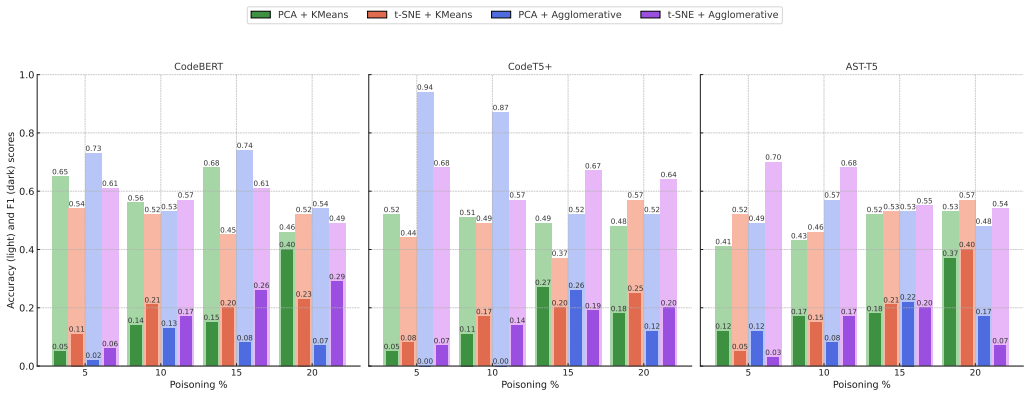
A targeted data-poisoning attack that leaves the natural-language prompt untouched and replaces secure code with a semantically equivalent vulnerable implementation defeats all tested detection methods. On CodeBERT, CodeT5+, and AST-T5, spectral signatures peaks at F1 0.34 for poisoned samples; activation clustering peaks at 0.40; static analysis reaches 0.70 but only at an unrealistically high 20% poisoning rate and still produces false positives on clean data. The paper's claim is not that one method underperforms, but that the entire current detection toolbox is mismatched with the threat model: because triggerless poisoned samples are statistically and syntactically indistinguishable fro
Load-bearing premise
The load-bearing premise is that the triggerless poisoning attack actually changed model behavior, i.e., poisoned models emit vulnerable code for targeted prompts while behaving normally elsewhere; this is never directly verified, since the paper reports only global edit-distance and BLEU scores and no attack success rate.
Editorial extensions
If this is right
- A low-rate triggerless attack can implant targeted vulnerabilities in AI-generated code without leaving a detectable trace in training data.
- Spectral-signature and activation-clustering defenses should not be assumed to transfer from trigger-based backdoor settings to triggerless ones.
- Static analysis is the most viable first-line filter but cannot be the only defense; at realistic 5–10% poisoning rates its F1 stays between 0.40 and 0.57.
- The choice of base model matters: representation-based detection is even less effective on a model with weak generation and representation quality.
- Future defenses must be trigger-independent, such as pipelines that penalize insecure generations or multi-layered static and dynamic analysis.
Reading between the lines
- The paper never directly measures whether the poisoned models actually produce vulnerable code for targeted prompts; if the attack failed to take hold, the detection failure would be trivial. A direct attack-success measurement is the natural next check.
- Because the dataset is limited to 1,610 pairs and three encoder-decoder models, whether the conclusion extends to large decoder-only models used in real assistants is open and testable with the same method.
- A cheap defense not tested here is near-duplicate detection of code bodies: triggerless poisoning reuses vulnerable implementations across prompts, so exact or semantic code-similarity filtering might catch many poisoned samples even if representation-based methods cannot.
- The static-analysis false positives at 0% poisoning suggest that tuning rulepacks to the dataset domain could reduce noise, but the paper does not explore whether that improves overall detection.
Signed reviews
Editorial analysis
A structured set of objections, weighed in public.
Referee Report
Summary. The paper studies triggerless targeted data poisoning of three code generation models (CodeBERT, CodeT5+, AST-T5) using an extended dataset built on Cotroneo et al.'s attack, and evaluates three families of defenses: spectral signatures analysis, activation clustering, and static analysis with Semgrep. The central claim, stated in the abstract and conclusion, is that none of these methods can reliably detect poisoning in the absence of explicit triggers, with representation-based defenses failing to separate poisoned from clean samples and static analysis suffering false positives and false negatives. The paper reports F1 scores mostly below 0.4 for representation-based methods and up to 0.70 for static analysis at unrealistically high poisoning rates.
Significance. If the negative result is valid, the paper makes a useful contribution by highlighting a gap in current defenses against stealthy, triggerless poisoning of code generation models. The study is systematic in covering three representative encoder-decoder models and multiple detection configurations, and the dataset is released. However, the central conclusion depends on two unverified premises: that the poisoning attack actually altered model behavior on targeted prompts, and that the detection implementations are effective in settings where they should work. The current manuscript does not supply either control, so the significance of the empirical findings is not yet established.
major comments (4)
- [Section V, Fig. 1] The load-bearing negative result is unsupported because the paper never verifies that the poisoning attack actually worked. Section III-A defines the attack as making the model 'generate deliberately vulnerable code snippets for prompts resembling the targeted descriptions,' but Section V only reports global edit distance and BLEU-4 scores averaged over the full test set and across poisoning rates. These aggregate metrics can remain stable even if the model never learned the targeted vulnerable mapping, especially since the targeted subset is small. The paper must report attack success directly: e.g., the fraction of targeted prompts for which the poisoned model outputs insecure code, a per-prompt comparison against the clean model, and evidence that non-targeted behavior is preserved. Without this, the near-zero F1 scores of the detectors are vacuous.
- [Sections IV-A and IV-B, Table II] The detector implementations are under-specified and there is no positive control. For spectral signatures, the paper does not state the number of top singular vectors k or the threshold used to mark points as poisoned; for activation clustering, the number of PCA components, t-SNE settings, and agglomerative threshold are not given. More importantly, neither method is validated on a known trigger-based attack or on a synthetic setting where separation is expected. Low F1 scores could therefore reflect implementation issues rather than a fundamental limitation of triggerless settings. A positive-control experiment should be added before concluding that these methods 'fail' specifically because no explicit triggers are present.
- [Section III-B, Table I, Section V-C] The dataset size is reported inconsistently. Table I states a dataset size of 1,335 (with 960 safe and 375 unsafe code samples), while Section III-B states 'The resulting dataset comprises 1,610 NL-to-code pairs.' Section V-C refers to 1,200 samples and the poisoning schedule of 60 samples per 5% also implies a total of 1,200. These numbers cannot all be correct. The exact composition of the dataset, including the number of unique NL descriptions, the number of safe-only and dual safe/unsafe samples, and the split of 100 test prompts, must be reconciled because all poisoning rates and detection statistics depend on it.
- [Section III-A and III-B] The attack construction is not reproducible. The paper says it extends the dataset and follows Cotroneo et al.'s attack, but it does not specify how many target prompts are used, how poisoned samples are selected and injected, whether the original secure version of a poisoned sample also remains in the training set, or how NL descriptions are 'only subtly modified' in practice. These details are essential for understanding the poisoning rates and for anyone attempting to replicate the attack and the detection results.
minor comments (5)
- [Section IV-D, Fig. 1] The metric descriptions conflict with the reported numbers. Edit distance is said to range from 0 to 1, but Fig. 1 reports values of 10.14, 48.12, and 46.10; BLEU-4 is said to range from 0 to 1, but reported values are about 38-39. Clarify whether normalized or raw edit distance and BLEU on a 0-100 scale are used.
- [Section V-B, Fig. 2] Some textual claims are hard to verify from the figure. For example, the text says AST-T5 F1 peaks at 0.40, but the figure labels are small and partially overlapping; adding a small table or larger annotations would improve readability.
- [Section V-C, Table III] At 0% poisoning, the paper reports accuracy of 0.92 with 91 false positives among 1,200 samples, but the dataset size is elsewhere given as 1,335 or 1,610. This inconsistency should be fixed and the exact false-positive definition stated.
- [Section VII] The threats-to-validity section does not mention the absence of repeated runs with different random seeds. Given that activation clustering results vary considerably across configurations, reporting a single run per setting makes it difficult to assess whether the observed differences are meaningful.
- [References] Minor typos: 'OW ASP' in reference [26] should be 'OWASP', and the citation for the activation clustering paper [11] is an arXiv preprint; an updated reference would be helpful.
Circularity Check
No circular derivation; the evaluation is empirical and self-contained, with only non-load-bearing self-citations and a missing attack-success check that is a validity concern, not circularity.
full rationale
The paper reports an empirical evaluation. The central claim that spectral signatures, activation clustering, and static analysis fail to detect triggerless poisoning follows from measured F1/precision/recall values on constructed poisoned training sets, not from any equation that reduces to its inputs. Detection labels are compared against ground-truth dataset annotations generated by the manual poisoning process, which is a standard evaluation setup rather than a self-definitional loop. The only self-citations are [4] (attack strategy/dataset) and [28] (metric reference); these are not used to justify the detection-failure conclusion. One can question whether the attack actually changed model behavior on targeted prompts: Section V and Figure 1 report only global averaged edit distance and BLEU-4 scores, with no attack success rate or per-target vulnerable-output measurement. If the models did not learn the targeted mapping, the low detection scores would be trivial. However, this is an omitted-evidence/correctness risk, not circularity: there is no fitted parameter renamed as prediction, no uniqueness theorem imported from the authors, and no definition that contains the conclusion. The paper itself notes in the Threats to Validity section that metrics may not fully capture downstream security risks, but that is a limitation statement, not a circular step. Therefore no circular step is exhibited, and the score reflects only a minor non-load-bearing self-citation chain.
Assumptions & free parameters
free parameters (4)
- Number of clusters k =
2
- Number of top singular vectors in spectral signatures =
not reported
- PCA components =
not reported
- Semgrep rule set =
curated OWASP/CWE rules
assumptions (4)
- domain assumption The triggerless poisoning attack of Cotroneo et al. [4] is effective on CodeBERT, CodeT5+, and AST-T5.
- domain assumption Poisoned samples are semantically equivalent to clean samples and free of detectable artifacts.
- domain assumption Detection methods are correctly re-implemented from [5], [7].
- domain assumption The three models are representative of AI code generators.
Cite this review
Pith. "Pith review of Detecting Stealthy Data Poisoning Attacks in AI Code Generators." pith.science (2026). https://pith.science/paper/TSBBA4AX
@misc{pith2026250821636,
  author       = {Pith},
  title        = {Pith review of: Detecting Stealthy Data Poisoning Attacks in AI Code Generators},
  year         = {2026},
  howpublished = {\url{https://pith.science/paper/TSBBA4AX}},
  note         = {Machine review of arXiv:2508.21636}
}
read the original abstract
Deep learning (DL) models for natural language-to-code generation have become integral to modern software development pipelines. However, their heavy reliance on large amounts of data, often collected from unsanitized online sources, exposes them to data poisoning attacks, where adversaries inject malicious samples to subtly bias model behavior. Recent targeted attacks silently replace secure code with semantically equivalent but vulnerable implementations without relying on explicit triggers to launch the attack, making it especially hard for detection methods to distinguish clean from poisoned samples. We present a systematic study on the effectiveness of existing poisoning detection methods under this stealthy threat model. Specifically, we perform targeted poisoning on three DL models (CodeBERT, CodeT5+, AST-T5), and evaluate spectral signatures analysis, activation clustering, and static analysis as defenses. Our results show that all methods struggle to detect triggerless poisoning, with representation-based approaches failing to isolate poisoned samples and static analysis suffering false positives and false negatives, highlighting the need for more robust, trigger-independent defenses for AI-assisted code generation.
Figures

Reference graph
Works this paper leans on
-
[1]
Quality in, quality out: Investigating training data’s role in ai code generation,
C. Improta, R. Tufano, P. Liguori, D. Cotroneo, and G. Bavota, “Quality in, quality out: Investigating training data’s role in ai code generation,” in 2025 IEEE/ACM 33rd International Conference on Program Com- prehension (ICPC), 2025, pp. 454–465
work page 2025
-
[2]
Poisoning programs by un-repairing code: Security con- cerns of ai-generated code,
C. Improta, “Poisoning programs by un-repairing code: Security con- cerns of ai-generated code,” in 2023 IEEE 34th International Symposium on Software Reliability Engineering Workshops (ISSREW). IEEE, 2023
work page 2023
-
[3]
Backdooring neural code search,
W. Sun, Y . Chen, G. Tao, C. Fang, X. Zhang, Q. Zhang, and B. Luo, “Backdooring neural code search,” in The 61st Annual Meeting Of The Association For Computational Linguistics , 2023
work page 2023
-
[4]
Vulnerabilities in AI Code Generators: Exploring Targeted Data Poisoning Attacks,
D. Cotroneo, C. Improta, P. Liguori, and R. Natella, “Vulnerabilities in AI Code Generators: Exploring Targeted Data Poisoning Attacks,” in Proceedings of the 32nd IEEE/ACM International Conference on Program Comprehension, 2024, pp. 280–292
work page 2024
-
[5]
Backdoors in neural models of source code,
G. Ramakrishnan and A. Albarghouthi, “Backdoors in neural models of source code,” in 2022 26th International Conference on Pattern Recognition (ICPR). IEEE, 2022, pp. 2892–2899
work page 2022
-
[6]
A. Hussain, M. R. I. Rabin, and M. A. Alipour, “Measuring impacts of poisoning on model parameters and embeddings for large language mod- els of code,” in Proceedings of the 1st ACM International Conference on AI-Powered Software, 2024, pp. 59–64
work page 2024
-
[7]
Stealthy backdoor attack for code models,
Z. Yang, B. Xu, J. M. Zhang, H. J. Kang, J. Shi, J. He, and D. Lo, “Stealthy backdoor attack for code models,” IEEE Transactions on Software Engineering, vol. 50, no. 4, pp. 721–741, 2024
work page 2024
-
[8]
Poison attack and poison detection on deep source code processing models,
J. Li, Z. Li, H. Zhang, G. Li, Z. Jin, X. Hu, and X. Xia, “Poison attack and poison detection on deep source code processing models,” ACM Transactions on Software Engineering and Methodology , 2024
work page 2024
Show all 28 references
-
[9]
Trojanpuzzle: Covertly poisoning code-suggestion models,
H. Aghakhani, W. Dai, A. Manoel, X. Fernandes, A. Kharkar, C. Kruegel, G. Vigna, D. Evans, B. Zorn, and R. Sim, “Trojanpuzzle: Covertly poisoning code-suggestion models,” in 2024 IEEE Symposium on Security and Privacy (SP) . IEEE, 2024, pp. 1122–1140
2024
-
[10]
Spectral signatures in backdoor attacks,
B. Tran, J. Li, and A. Madry, “Spectral signatures in backdoor attacks,” Advances in neural information processing systems , vol. 31, 2018
2018
-
[11]
Detecting backdoor attacks on deep neural networks by activation clustering,
B. Chen, W. Carvalho, N. Baracaldo, H. Ludwig, B. Edwards, T. Lee, I. Molloy, and B. Srivastava, “Detecting backdoor attacks on deep neural networks by activation clustering,” arXiv preprint arXiv:1811.03728 , 2018
2018 arXiv
-
[12]
Poison forensics: Traceback of data poisoning attacks in neural networks,
S. Shan, A. N. Bhagoji, H. Zheng, and B. Y . Zhao, “Poison forensics: Traceback of data poisoning attacks in neural networks,” in31st USENIX Security Symposium (USENIX Security 22) , 2022, pp. 3575–3592
2022
-
[13]
Spectre: Defending against backdoor attacks using robust statistics,
J. Hayase, W. Kong, R. Somani, and S. Oh, “Spectre: Defending against backdoor attacks using robust statistics,” in International Conference on Machine Learning. PMLR, 2021, pp. 4129–4139
2021
-
[14]
Securityeval dataset: mining vulner- ability examples to evaluate machine learning-based code generation techniques,
M. L. Siddiq and J. C. Santos, “Securityeval dataset: mining vulner- ability examples to evaluate machine learning-based code generation techniques,” in Proceedings of the 1st International Workshop on Mining Software Repositories Applications for Privacy and Security , 2022
2022
-
[15]
Llmseceval: A dataset of natural language prompts for security evaluations,
C. Tony, M. Mutas, N. E. D. Ferreyra, and R. Scandariato, “Llmseceval: A dataset of natural language prompts for security evaluations,” in 2023 IEEE/ACM 20th International Conference on Mining Software Repositories (MSR). IEEE, 2023, pp. 588–592
2023
-
[16]
Codebert: A pre-trained model for programming and natural languages,
Z. Feng, D. Guo, D. Tang, N. Duan, X. Feng, M. Gong, L. Shou, B. Qin, T. Liu, D. Jiang et al., “Codebert: A pre-trained model for programming and natural languages,” arXiv preprint arXiv:2002.08155 , 2020
2002 arXiv
-
[17]
Codet5+: Open code large language models for code understanding and generation,
Y . Wang, H. Le, A. Gotmare, N. Bui, J. Li, and S. Hoi, “Codet5+: Open code large language models for code understanding and generation,” in Proceedings of the 2023 Conference on Empirical Methods in Natural Language Processing, 2023, pp. 1069–1088
2023
-
[18]
Ast-t5: structure-aware pretrain- ing for code generation and understanding,
L. Gong, M. Elhoushi, and A. Cheung, “Ast-t5: structure-aware pretrain- ing for code generation and understanding,” in Proceedings of the 41st International Conference on Machine Learning , 2024
2024
-
[19]
Principal component analysis,
H. Abdi and L. J. Williams, “Principal component analysis,” Wiley interdisciplinary reviews: computational statistics , vol. 2, no. 4, 2010
2010
-
[20]
Visualizing data using t-sne
L. Van der Maaten and G. Hinton, “Visualizing data using t-sne.” Journal of machine learning research , vol. 9, no. 11, 2008
2008
-
[21]
The k-means algorithm: A comprehensive survey and performance evaluation,
M. Ahmed, R. Seraj, and S. M. S. Islam, “The k-means algorithm: A comprehensive survey and performance evaluation,” Electronics, 2020
2020
-
[22]
Analysis of agglomerative clustering,
M. R. Ackermann, J. Bl ¨omer, D. Kuntze, and C. Sohler, “Analysis of agglomerative clustering,” Algorithmica, vol. 69, pp. 184–215, 2014
2014
-
[23]
Static Code Analyzer,
Semgrep, “Static Code Analyzer,” https://github.com/semgrep/semgrep
-
[24]
PyCQA, “Bandit,” https://github.com/PyCQA/bandit
-
[25]
GitHub, “CodeQL,” https://github.com/github/codeql
-
[26]
2021 OW ASP Top 10,
OW ASP, “2021 OW ASP Top 10,” https://owasp.org/Top10/
2021
-
[27]
MITRE, “Top 25,” https://cwe.mitre.org/top25/
-
[28]
Who evaluates the evaluators? on automatic metrics for assessing ai-based offensive code generators,
P. Liguori, C. Improta, R. Natella, B. Cukic, and D. Cotroneo, “Who evaluates the evaluators? on automatic metrics for assessing ai-based offensive code generators,” Expert Systems with Applications , vol. 225, p. 120073, 2023. 8
2023
Reviewed August 5, 2026 · model on record in the stance chip above.
Discussion (0). Continue with ORCID to comment.