REVIEW 4 major objections 5 minor 1 cited by
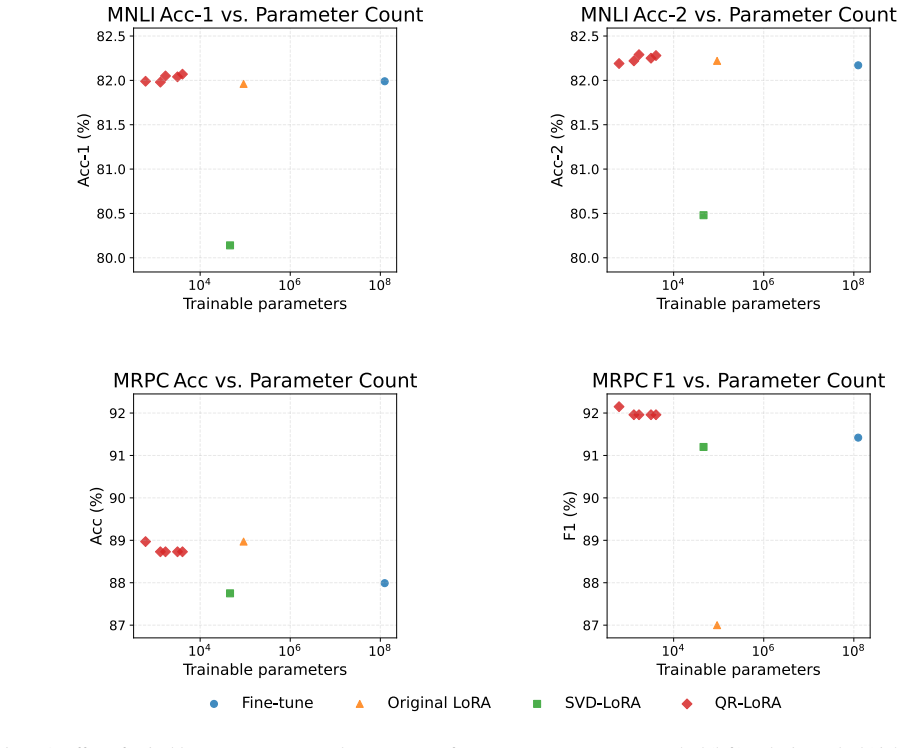
QR-LoRA matches or exceeds full fine-tuning on GLUE while training as few as 601 parameters on RoBERTa-base.
Reviewed by Pith at T0; open to challenge. T0 means a machine referee read the full paper against a public rubric. the ladder, T0–T4 →
QR-LoRA trains only scalar coefficients on a pivoted QR basis of pretrained weights, reportedly matching full fine-tuning on GLUE with 601 parameters.
T0 review reviewed 2026-08-05 challenge →
load-bearing objection Plausible scalar-on-QR-basis idea with clear writing — but '601 parameters' and 'pretrained basis' only hold after a 3-epoch full-model warm-up, so the headline overclaims. the 4 major comments →
QR-LoRA: QR-Based Low-Rank Adaptation for Efficient Fine-Tuning of Large Language Models
The pith
A machine-rendered reading of the paper's core claim, the machinery that carries it, and where it could break.
The reading
Core claim
QR-LoRA replaces LoRA's learned low-rank factors A and B with a fixed orthonormal basis Q extracted from the frozen weight matrix W0 by pivoted QR decomposition, W0 = QR, in which column pivoting orders the diagonal of R by decreasing magnitude. The update is written as a linear combination ΔW = Σ_{i=1..r} λ_i Q_i R_i^T, where Q_i is the i-th column of Q and R_i^T the i-th row of R, and the only trainable parameters are the scalar coefficients λ_i. The rank r is selected by a cumulative-energy threshold on the squared diagonal entries of R. In experiments on GLUE with RoBERTa-base, QR-LoRA variants (e.g., adapting only the query projection in the last four layers, with threshold τ=0.5) train
What carries the argument
The central object is the pivoted QR decomposition of each frozen weight matrix, W0 = QR, with column pivoting reordering columns so that the diagonal entries of R are non-increasing. This yields an orthonormal basis Q whose directions are ranked by importance via |R_ii|, and the low-rank adaptation is parameterized as a linear combination of the outer products Q_i R_i^T with trainable scalar coefficients λ_i. The mechanism carries the argument because it fixes the adaptation subspace once, reduces the learning problem to a handful of scalars, and provides a principled threshold τ for choosing the rank r.
Load-bearing premise
The central claim depends on the premise that a fixed orthonormal basis from the pretrained weights, with only scalar coefficients trained, is enough to recover task-specific adaptation—but the paper's evidence for that premise comes from a model already fully fine-tuned for three epochs before the 601-parameter adapter is added.
What would settle it
Run QR-LoRA from the original RoBERTa-base checkpoint with no three-epoch warm-up on MNLI, adapting only Wq in the last four layers with τ=0.5; if matched accuracy falls materially below the reported 82.09, the warm-up, not the basis, is carrying the adaptation.
If this is right
- QR-LoRA reduces the trainable-parameter count for adapting RoBERTa-base to as few as 601, a 1000x reduction over full fine-tuning and 77x over standard LoRA, while the paper reports performance matching or exceeding those baselines on the GLUE tasks tested.
- Because the orthonormal basis is extracted once from frozen weights and reused, the adaptation cost per task drops to training a handful of scalar coefficients, which the paper argues improves interpretability and numerical conditioning.
- Pivoted QR provides an ordered basis—ranked by the magnitudes of R's diagonal—enabling a principled, threshold-based rank selection that avoids manual rank search.
- The fixed-basis formulation acts as a regularizer, and the paper's ablation suggests the benefit grows with training-set size, with QR-LoRA surpassing full fine-tuning at 50,000 MNLI examples.
Where Pith is reading between the lines
- The 601-parameter count omits the three-epoch full-model warm-up that all methods receive before the adapter is applied; a fair comparison should run QR-LoRA from the original pretrained checkpoint and count the warm-up in the total parameter budget.
- If the warm-up is necessary, the paper's headline reduction is overstated; if QR-LoRA works from the original checkpoint, the result would be a strong demonstration of intrinsic low-dimensional structure in fine-tuning.
- The ablation's finding that full fine-tuning beats QR-LoRA at 2,000 examples suggests the method's advantage is confined to moderate- and high-resource regimes; testing with a larger coefficient set or learned basis could close the low-resource gap.
- The paper's success with only Wq in the last four layers hints that attention query projections carry much of the task-specific signal in RoBERTa; checking this on decoder-only or multimodal transformers would test the generality of the locality.
Editorial analysis
A structured set of objections, weighed in public.
Referee Report
Summary. The paper proposes QR-LoRA, a parameter-efficient fine-tuning method that performs pivoted QR decomposition of a frozen weight matrix W0 and learns only scalar coefficients on the resulting orthonormal basis, i.e., ΔW = Σ λ_i Q_i R_i^T. It reports experiments on GLUE with RoBERTa-base, claiming that a 601-parameter variant matches or exceeds full fine-tuning, standard LoRA, and SVD-LoRA. The paper also includes ablations over threshold, layer scope, projection set, and training-set size.
Significance. The underlying idea is appealing: if a fixed basis extracted from pretrained weights can support task adaptation with only a handful of scalar coefficients, that would be a striking parameter-efficiency result and a useful bridge to intrinsic-dimension analyses. The paper is clearly organized and includes several ablations (threshold, layer scope, projection set, data size) that go beyond a single configuration. However, the experimental protocol in §4.1 severely undercuts the headline: a 3-epoch full-model warm-up precedes the adapter in all experiments, so the '601 parameters' are not the total number of updated parameters, and the basis is computed from task-fine-tuned rather than pretrained weights. Combined with single-run results and inconsistencies between tables, the current evidence does not establish the paper's central claim.
major comments (4)
- [§4.1] The experimental protocol states that all methods start from RoBERTa-base 'which is first warm-up fine-tuned for three epochs.' Consequently the QR-LoRA adapter is trained after 125M parameters have already been updated on the target task; the '601 parameters' counted in Table 3 are only the post-warm-up scalars. The basis computed in §3.1 is therefore not a basis of the pretrained W0 but of a task-fine-tuned matrix. This contradicts the abstract's claim that QR-LoRA 'matches or exceeds ... with as few as 601 parameters' and invalidates the advertised parameter-efficiency comparison against full fine-tuning and standard LoRA, which are normally evaluated from the original pretrained checkpoint. The paper would need to rerun the experiments without the warm-up (or count its 125M updated parameters in the budget) to support its headline.
- [Table 3] All reported numbers appear to come from a single run, with no error bars or seeds. This is a serious issue because the claimed improvements over FT/LoRA are often <0.3 percentage points (e.g., QR-LoRA2 MNLI 82.09 vs FT 81.67 in Table 3) and could easily be noise. Moreover, the FT MNLI matched accuracy is 81.99 in Table 1 but 81.67 in Table 3 for the same setup; no explanation is given for the discrepancy. Without variance estimates or at least multiple seeds, the central 'matches or exceeds' claim is not supported.
- [Eq. (4) vs §4.1] The rank-selection rule is defined inconsistently. Eq. (4) selects the smallest r such that the cumulative squared diagonal captures fraction τ of the total, while §4.1 defines r as the number of diagonal entries with |R_ii| > τ R_11. These rules give different ranks and hence different parameter counts (e.g., the reported r=150 for τ=0.5 in §3.1). Since the 601-parameter number is load-bearing, the authors must state which rule was used and report the resulting r per matrix.
- [Table 3 metrics] Table 3 labels every column 'Accuracy (%)', but for MRPC, QQP, and STS-B the standard GLUE metrics are F1, F1/accuracy, and Spearman correlation, respectively. Table 2 reports both Accuracy and F1 for MRPC, so it is unclear which number appears in Table 3. Without precise metric definitions, the cross-task comparison in Table 3 cannot be reproduced or interpreted.
minor comments (5)
- [Abstract] The abstract says '77× fewer than typical LoRA setups,' but Section 4.2 states '≈ 77× fewer than SVD-LoRA, and ≈ 153× fewer than LoRA.' The abstract's number appears to refer to SVD-LoRA, not LoRA.
- [§4.2] The text says QR-LoRA1 outperforms FT on SST-2 by 1.72 points and later lists SST-2 as a task where QR-LoRA1 does not do better than FT; from Table 3, QR-LoRA1 is actually better on SST-2. Also, the MRPC difference is 0.74 points, not 1.72. Please correct the contradictory sentences.
- [Eq. (1)] The notation Q ∈ R^{L×L}, R ∈ R^{L×M} corresponds to the full QR decomposition; if M < L, the reduced QR would have Q ∈ R^{L×M}. Clarify which form is used for the weight matrices.
- [Figure 1] Figure 1 is placed after the references and is referenced as 'In Figure 1' in the main text, but it is described as appearing in Appendix B.1. Check placement and ensure it is callable from the main text.
- [Reproducibility] No code, seeds, or detailed hyperparameters (e.g., learning rate, optimizer, adapter training epochs) are provided. This makes it difficult to reproduce or verify the reported numbers, especially given the unresolved Table 1/Table 3 inconsistency.
Circularity Check
No significant circularity found; the warm-up protocol is an experimental attribution concern, not a circular derivation.
full rationale
The paper's derivation chain is not circular under the definitions of this review. Section 3.1 defines the QR-LoRA update as a trainable linear combination of a fixed orthonormal basis obtained by standard pivoted QR decomposition (Eqs. 2 and 3), with scalar coefficients fitted to task data. No equation defines the reported GLUE accuracy in terms of the fitted coefficients by construction, and no prediction is made by reinserting the fitted values. The reference list contains no works by the authors, so there is no load-bearing self-citation or imported uniqueness theorem. The only notable concern is in §4.1: 'All methods use RoBERTa-base (125M parameters) as the starting point, which is first warm-up fine-tuned for three epochs.' This means the weight matrix decomposed in §3.1 is not actually the original pretrained matrix but a task-fine-tuned one, and the advertised 601-parameter count excludes the 125M warm-up parameters. This is a serious experimental validity and attribution problem—the basis is task-dependent and the parameter count is incomplete—but it is not a circular step: the adapter coefficients are still genuinely learned, and the reported accuracies are not identical to any fitted quantity. Therefore the circularity score is 0.
Axiom & Free-Parameter Ledger
free parameters (4)
- threshold tau =
0.5, 0.7, 0.8
- adapter scope =
last 4 or all 12 layers; Wq, Wv, Wo
- warm-up epochs =
3
- trainable coefficients lambda_i =
learned
axioms (3)
- domain assumption The task-specific update is well-represented in the subspace spanned by the top columns of the pivoted QR decomposition of the pretrained weight matrix.
- domain assumption Orthonormal basis directions are independent and non-redundant, improving conditioning and stability.
- ad hoc to paper The rank-selection rule (entries with |R_ii| > tau * R_11) captures the important directions.
Cite this review
Pith. "Pith review of QR-LoRA: QR-Based Low-Rank Adaptation for Efficient Fine-Tuning of Large Language Models." pith.science (2026). https://pith.science/paper/SWOJYZRK
@misc{pith2026250821810,
  author       = {Pith},
  title        = {Pith review of: QR-LoRA: QR-Based Low-Rank Adaptation for Efficient Fine-Tuning of Large Language Models},
  year         = {2026},
  howpublished = {\url{https://pith.science/paper/SWOJYZRK}},
  note         = {Machine review of arXiv:2508.21810}
}
read the original abstract
The growing scale of Large Language Models (LLMs) has necessitated the development of parameter-efficient fine-tuning techniques. Low-Rank Adaptation (LoRA) has emerged as a promising approach, reducing the number of trainable parameters by applying low-rank updates to pretrained weights. While standard LoRA learns both update factors directly, several recent variants first initialize those matrices via an SVD of the pretrained weights -- an operation that can be expensive on large models and yields singular vectors that are not always easy to interpret. In this work, we extract an orthonormal basis from the pretrained weight matrix using QR decomposition with column pivoting, and then express the LoRA update as a linear combination of these basis vectors -- training only the scalar coefficients, which imposes clear structure on adaptation and drastically reduces parameter count. Experiments across GLUE tasks show that QR-LoRA matches or exceeds the performance of full fine-tuning, standard LoRA, and SVD-LoRA (LoRA with update matrices initialized via singular value decomposition) with as few as 601 parameters -- a reduction of over 1000x compared to full fine-tuning and 77x fewer than typical LoRA setups.
Figures
Forward citations
Cited by 1 Pith paper
-
A Vision Toward Energy-Efficient Domain-Specific Artificial Intelligence Models and Agents
A position paper proposing compact, domain-specific AI agents as the path to ≥1000× energy efficiency, without demonstrating the claim.
Reference graph
Works this paper leans on
-
[1]
In- trinsic dimensionality explains the effectiveness of language model fine-tuning, 2020
Armen Aghajanyan, Luke Zettlemoyer, and Sonal Gupta. In- trinsic dimensionality explains the effectiveness of language model fine-tuning, 2020. 2, 6
work page 2020
-
[2]
Lora-xs: Low-rank adaptation with ex- tremely small number of parameters
Klaudia Bałazy, Mohammadreza Banaei, Karl Aberer, and Jacek Tabor. Lora-xs: Low-rank adaptation with ex- tremely small number of parameters. arXiv preprint arXiv:2405.17604, 2024. 6
Pith/arXiv arXiv 2024
-
[3]
Olora: Orthonormal low-rank adaptation of large language models
Kerim B ¨uy¨ukaky¨uz. Olora: Orthonormal low-rank adaptation of large language models. arXiv preprint arXiv:2406.01775, 2024. 6
Pith/arXiv arXiv 2024
-
[4]
Robust principal component analysis? Journal of the ACM (JACM), 58(3):1–37, 2011
Emmanuel J Cand `es, Xiaodong Li, Yi Ma, and John Wright. Robust principal component analysis? Journal of the ACM (JACM), 58(3):1–37, 2011. 2, 6
work page 2011
-
[5]
Qlora: Efficient finetuning of quantized llms
Tim Dettmers, Artidoro Pagnoni, Ari Holtzman, and Luke Zettlemoyer. Qlora: Efficient finetuning of quantized llms. arXiv preprint arXiv:2305.14314, 2023. 6
Pith/arXiv arXiv 2023
-
[6]
Gene H Golub and Charles F Van Loan. Matrix computa- tions. JHU press, 2013. 2, 6
work page 2013
-
[7]
Nlora: Nystr ¨om- initiated low-rank adaptation for large language models,
Chenlu Guo, Yuan Wu, and Yi Chang. Nlora: Nystr ¨om- initiated low-rank adaptation for large language models,
-
[8]
Sparseadapter: An easy approach for improv- ing the parameter-efficiency of adapters, 2022
Shwai He, Liang Ding, Daize Dong, Miao Zhang, and Dacheng Tao. Sparseadapter: An easy approach for improv- ing the parameter-efficiency of adapters, 2022. 6
work page 2022
-
[9]
Lora: Low-rank adaptation of large language models
Edward J Hu, Yelong Shen, Phillip Wallis, Zeyuan Allen- Zhu, Yuanzhi Li, Shean Wang, Lu Wang, Weizhu Chen, et al. Lora: Low-rank adaptation of large language models. ICLR,
-
[10]
T-net: Parametrizing fully convolutional nets with a single high-order tensor, 2019
Jean Kossaifi, Adrian Bulat, Georgios Tzimiropoulos, and Maja Pantic. T-net: Parametrizing fully convolutional nets with a single high-order tensor, 2019. 6
work page 2019
-
[11]
Speeding-up convolutional neural networks using fine-tuned cp-decomposition, 2015
Vadim Lebedev, Yaroslav Ganin, Maksim Rakhuba, Ivan Os- eledets, and Victor Lempitsky. Speeding-up convolutional neural networks using fine-tuned cp-decomposition, 2015. 6
work page 2015
-
[12]
Measuring the intrinsic dimension of objective landscapes
Chunyuan Li, Heerad Farkhoor, Rosanne Liu, and Jason Yosinski. Measuring the intrinsic dimension of objective landscapes. arXiv preprint arXiv:1804.08838, 2018. 2, 6
Pith/arXiv arXiv 2018
-
[13]
Tracking meets lora: Faster training, larger model, stronger performance, 2024
Liting Lin, Heng Fan, Zhipeng Zhang, Yaowei Wang, Yong Xu, and Haibin Ling. Tracking meets lora: Faster training, larger model, stronger performance, 2024. 6
work page 2024
-
[14]
Dora: Weight-decomposed low-rank adaptation, 2024
Shih-Yang Liu, Chien-Yi Wang, Hongxu Yin, Pavlo Molchanov, Yu-Chiang Frank Wang, Kwang-Ting Cheng, and Min-Hung Chen. Dora: Weight-decomposed low-rank adaptation, 2024. 6
work page 2024
-
[15]
Alora: Allocating low-rank adaptation for fine-tuning large language models
Zequan Liu, Jiawen Lyn, Wei Zhu, Xing Tian, and Yvette Graham. Alora: Allocating low-rank adaptation for fine-tuning large language models. arXiv preprint arXiv:2403.16187, 2024. 6
Pith/arXiv arXiv 2024
-
[16]
Stable low- rank tensor decomposition for compression of convolutional neural network, 2020
Anh-Huy Phan, Konstantin Sobolev, Konstantin Sozykin, Dmitry Ermilov, Julia Gusak, Petr Tichavsky, Valeriy Glukhov, Ivan Oseledets, and Andrzej Cichocki. Stable low- rank tensor decomposition for compression of convolutional neural network, 2020. 6
work page 2020
-
[17]
Introduction to linear algebra
Gilbert Strang. Introduction to linear algebra. SIAM, 2022. 2, 6
work page 2022
-
[18]
Lloyd N. Trefethen and David Bau. Numerical Linear Alge- bra. SIAM, 1997. 2, 6
work page 1997
-
[19]
Alex Wang, Amanpreet Singh, Julian Michael, Felix Hill, Omer Levy, and Samuel R. Bowman. Glue: A multi-task benchmark and analysis platform for natural language un- derstanding, 2019. 1, 2
work page 2019
-
[20]
Adaptive budget allocation for parameter-efficient fine- tuning
Qingru Zhang, Minshuo Chen, Alexander Bukharin, Pengcheng He, Yu Cheng, Weizhu Chen, and Tuo Zhao. Adaptive budget allocation for parameter-efficient fine- tuning. In The Eleventh International Conference on Learn- ing Representations, 2023. 6 A. Related Work Adapter and Low-Rank Fine-Tuning. Parameter- efficient fine-tuning has rapidly advanced in respon...
work page 2023
This paper was first reviewed by deepseek-v4-flash on August 5, 2026.
discussion (0)
Sign in with ORCID, Apple, or X to comment. Anyone can read and Pith papers without signing in.