REVIEW 4 major objections 5 minor 48 references
The Demon is in Ambiguity: Revisiting Situation Recognition with Single Positive Multi-Label Learning
T0 review · 4 major / 5 minor · reviewed 2026-08-05 · deepseek-v4-flash
Pith's one-line read Verb classification in situation recognition is inherently multi-label — one image can show several valid events — and a new benchmark plus GE-VerbMLP model lift multi-label MAP by over 3 points without sacrificing single-label accuracy.
desk verdict The multi-label reformulation of situation-recognition verbs is a legitimate, well-motivated idea, but the new benchmark's construction—especially the re-annotation step that pulls labels back toward the original single-label distribution—means the headline MAP gain is not yet established. read the letter →
The pith
A machine-rendered reading of the paper's core claim, the machinery that carries it, and where it could break.
The reading
What carries the argument
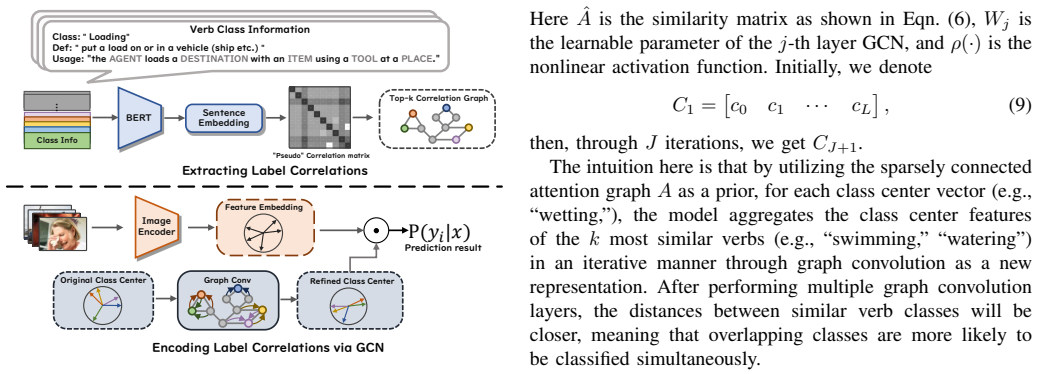
The work is carried by two pieces of machinery. Formulation-wise, SPMLL (single positive multi-label learning) turns the single-label verb labels into partially-observed multi-label labels, with the empirical risk defined over the one positive label plus implicit negatives. Model-wise, GE-VerbMLP freezes a CLIP image encoder, trains an MLP to get image embeddings, and computes cosine-similarity logits against class-center vectors; a graph convolutional network refines those centers using a 'pseudo' label-correlation graph built from cosine similarities of BERT sentence embeddings of FrameNet verb definitions (sparsified by k-nearest neighbours and smoothed), and adversarial training with PGD
What would settle it
Randomly sample images from the new 25,200-image benchmark and have independent annotators list every verb that applies with no candidate restriction and no distribution-alignment re-annotation; then compare the resulting label sets to the benchmark's. If a substantial share of images contain valid verbs absent from the benchmark's ~20.7-candidate set, or if the re-annotation removed labels that independent annotators keep, the benchmark is not a complete ground truth and the MAP improvements are not measuring what they claim.
Extended reading notes
Core claim
Verb classification in situation recognition is, the paper argues, a multi-label problem: because verb categories overlap semantically, one image can reasonably be labeled with several verbs at once (a classroom scene may show teaching, lecturing, studying, and writing). Single-label training and evaluation thus ignore valid alternative interpretations. The paper formulates verb classification as single positive multi-label learning (SPMLL) and builds a 25,200-image multi-label benchmark on imSitu via a VLM-LLM pre-annotation pipeline with human verification and re-annotation. It presents GE-VerbMLP, which uses a graph convolutional network over semantic label correlations from FrameNet defi
Load-bearing premise
The new benchmark's ground truth is only as complete as the VLM-LLM candidate list (about 20.7 verbs per image, with 85% coverage measured on a 500-image mini-set) and the re-annotation pass that trims labels to match the original single-label distribution; if valid event labels fall outside that list or get trimmed away, the reported MAP numbers do not measure true multi-label performance.
Editorial extensions
If this is right
- Multi-label evaluation (MAP) becomes a standard companion to top-1/top-5 accuracy for situation recognition, so a model that ranks the true alternative verbs highly is no longer penalized for not matching the single ground-truth choice.
- Existing SPMLL losses and model designs can be ported to verb classification: the paper benchmarks nine SPMLL methods and shows several already improve MAP over the single-label cross-entropy baseline, with GE-VerbMLP going furthest.
- Semantic definitions of the label set can stand in for co-occurrence statistics when multi-label annotations are unavailable, which makes the graph-correlation approach applicable to other fine-grained classification tasks.
- The 3+ point MAP gain, achieved without sacrificing top-1/top-5 accuracy, implies that single-label training is leaving real performance on the table in situation recognition.
Reading between the lines
- If the benchmark's label completeness is not independently verified on a larger sample, the reported MAP gains could partly reflect the restricted candidate set rather than genuine multi-label understanding; exhaustive annotation of a random subsample would settle this.
- The same SPMLL framing could be applied to semantic role labeling and grounding, where roles and entities also overlap in meaning across situations.
- The recipe of 'semantic definitions -> correlation graph -> GCN refinement -> adversarial boundary smoothing' is transferable to other domains with overlapping fine-grained categories, such as video action recognition.
Editorial analysis
A structured set of objections, weighed in public.
Referee Report
Summary. The paper argues that verb classification in situation recognition is inherently multi-label, because semantically overlapping verb categories can all validly describe an image. It reformulates the task as Single Positive Multi-Label Learning (SPMLL), constructs a 25,200-image multi-label evaluation benchmark from the imSitu test set using a VLM-LLM pre-annotation pipeline plus human annotation, and proposes GE-VerbMLP, which combines a frozen CLIP encoder with a GCN-refined class-center classifier and adversarial training. On the new benchmark, GE-VerbMLP reports MAP 57.0% versus 53.8% for a standard cross-entropy ClipSitu baseline, a >3% improvement, while roughly matching top-1/top-5 accuracy.
Significance. If the benchmark is valid, this is the first large-scale multi-label evaluation resource for situation recognition and provides a new way to assess whether models capture valid alternative event interpretations. The paper also contributes a reasonable SPMLL formulation and a clearly described method. The qualitative claim of ambiguity is independently supported by the 500-image human mini-benchmark and by FrameNet-based semantic similarity priors, which are strengths. However, the headline quantitative claim rests entirely on the new benchmark's integrity, and the current validation is too weak to establish that integrity. The benchmark may systematically undercount true multi-labels, which would make the reported MAP numbers unreliable as a measure of multi-label performance.
major comments (4)
- [§IV-B, §IV-C] The benchmark restricts annotations to a candidate set of ~20.73 verbs per image, generated by a single-positive-label-trained verb classifier plus VLM-LLM. Coverage of human labels is reported as 85% (and 98% after the top-100 stage), but this was measured only on the 500-image mini-benchmark, which was itself used to tune the pipeline. A systematic 15% recall gap is not ruled out. The authors should validate final benchmark recall on a random subset of the 25,200 images with full 504-class annotation, and report per-category and per-image recall, not just an aggregate.
- [§IV-C] The re-annotation step 'remov[es] inconsistent labels to align the new annotations with the original label distribution'. The original single-label annotation is the very assumption the paper argues is wrong, so using it as the reference distribution can delete valid alternative verbs that conflict with the original label. This biases the benchmark toward the single-label view and undercounts ambiguity. The authors should quantify how many and which labels were removed, and compare the resulting labels against independent full-504 human annotation on a held-out subset.
- [§VI-B, Table III] The headline >3% MAP improvement (53.8% to 57.0%) is computed on the new benchmark. Because the candidate-generation pipeline starts from a single-positive-trained classifier and the same pipeline was tuned on the 500-image mini-benchmark, the MAP values are not independent of the models being compared. At minimum, the authors should report MAP under a setting where true labels are obtained by full 504-class annotation on a random sample, and show that the relative ordering of methods is stable. Without this, the central empirical claim is not yet established.
- [§V.A.3, Eq. (9)] The text says the class center c_j is randomly initialized, but Eqs. (4), (5), and (9) use c_i = BERT(s_i) as the initial class center. This is internally inconsistent. If C1 is random, the semantic-similarity prior does not enter the model as claimed; if C1 uses BERT embeddings, the text should say so. This is load-bearing for the method's explanation and should be corrected.
minor comments (5)
- [Abstract and §I] Typo: 'futher' should be 'further'; 'the formulate, solving, and evaluating' is ungrammatical.
- [§IV-D, Table I] The text says 119,272 total annotations, Table I says 119,372. Also Table I reports max labels per image as 21 while Fig. 7 shows a label-count distribution with max 13. These numerical inconsistencies need correction.
- [§V.B] Section title 'Incoporating Adversarial Training' should be 'Incorporating Adversarial Training'.
- [§VII] Conclusion says 'single forward multi-label learning (SPMLL)'; should be 'single positive multi-label learning'.
- [§II.A] Reference formatting: 'Pratt et al. .' has an extra period before the citation; please clean up citation typos throughout.
Circularity Check
No significant circularity; the central derivation is independent, with benchmark validity as a separate concern.
full rationale
The paper's central claims—that verb classification is inherently multi-label and that GE-VerbMLP improves MAP—are grounded in external evidence rather than in self-referential equations. The ambiguity claim rests on a 500-image mini-benchmark where human annotators could select from all 504 classes (Sec IV-A), and on t-SNE visualizations of CLIP embeddings. The method uses FrameNet semantic similarities (Sec V-A1) as an external prior for label correlations, and adversarial training via standard FGSM/PGD (Sec V-B), sourced from references [3,4] rather than from the authors' own survey [2]. The MAP evaluation is performed on a human-verified multi-label benchmark; although the benchmark's candidate set is restricted by a VLM-LLM pipeline and a re-annotation step aligns labels with the original single-label distribution (Sec IV-C), these are benchmark-validity concerns, not circular reductions. No equation in the paper equates the model's outputs to the benchmark labels, and the human annotations are not generated by the model being evaluated. The paper's self-citation ([2]) is not load-bearing because the adversarial methods are cited to their original sources. The reported 85% coverage of the VLM-LLM candidate set on the mini-benchmark is a missing-support point for the final benchmark's completeness, but that affects correctness and generalizability, not circularity. Therefore, the paper does not exhibit the specific reduction required to claim circularity.
Assumptions & free parameters
free parameters (5)
- temperature tau =
10
- graph smoothing hyperparameter s =
not stated
- K nearest neighbors for label graph =
small value (best low K per Fig. 10)
- GCN depth J =
2 (best per Fig. 10)
- Adversarial training epsilon / PGD iterations =
not reported
assumptions (5)
- domain assumption An image can legitimately contain multiple visual events, so a single positive label is one sample from a set of valid labels.
- domain assumption Semantic similarity of FrameNet definitions is a valid proxy for true label co-occurrence.
- domain assumption VLM-LLM candidate generation covers nearly all true labels on the full 25,200-image benchmark.
- domain assumption Re-annotation that removes labels to align with the original distribution does not discard valid labels.
- standard math GCN message passing, cosine similarity, BCE/focal losses, and FGSM/PGD provide valid optimization machinery.
Cite this review
Pith. "Pith review of The Demon is in Ambiguity: Revisiting Situation Recognition with Single Positive Multi-Label Learning." pith.science (2026). https://pith.science/paper/AW6IMHRS
@misc{pith2026250821816,
  author       = {Pith},
  title        = {Pith review of: The Demon is in Ambiguity: Revisiting Situation Recognition with Single Positive Multi-Label Learning},
  year         = {2026},
  howpublished = {\url{https://pith.science/paper/AW6IMHRS}},
  note         = {Machine review of arXiv:2508.21816}
}
read the original abstract
Context recognition (SR) is a fundamental task in computer vision that aims to extract structured semantic summaries from images by identifying key events and their associated entities. Specifically, given an input image, the model must first classify the main visual events (verb classification), then identify the participating entities and their semantic roles (semantic role labeling), and finally localize these entities in the image (semantic role localization). Existing methods treat verb classification as a single-label problem, but we show through a comprehensive analysis that this formulation fails to address the inherent ambiguity in visual event recognition, as multiple verb categories may reasonably describe the same image. This paper makes three key contributions: First, we reveal through empirical analysis that verb classification is inherently a multi-label problem due to the ubiquitous semantic overlap between verb categories. Second, given the impracticality of fully annotating large-scale datasets with multiple labels, we propose to reformulate verb classification as a single positive multi-label learning (SPMLL) problem - a novel perspective in SR research. Third, we design a comprehensive multi-label evaluation benchmark for SR that is carefully designed to fairly evaluate model performance in a multi-label setting. To address the challenges of SPMLL, we futher develop the Graph Enhanced Verb Multilayer Perceptron (GE-VerbMLP), which combines graph neural networks to capture label correlations and adversarial training to optimize decision boundaries. Extensive experiments on real-world datasets show that our approach achieves more than 3\% MAP improvement while remaining competitive on traditional top-1 and top-5 accuracy metrics.
Figures


Figures from the paper (6 more)




Reference graph
Works this paper leans on
-
[1]
Multi-Label Learning from Single Positive Labels
E. Cole, O. M. Aodha, T. Lorieul, P. Perona, D. Morris, and N. Jojic, “Multi-label learning from single positive labels,” 2021. [Online]. Available: https://arxiv.org/abs/2106.09708
work page Pith review arXiv 2021
-
[2]
Z. Qian, K. Huang, Q.-F. Wang, and X.-Y . Zhang, “A survey of robust adversarial training in pattern recognition: Fundamental, theory, and methodologies,” Pattern Recognition, vol. 131, p. 108889, 2022
work page 2022
-
[3]
Explaining and harnessing adversarial examples,
I. J. Goodfellow, J. Shlens, and C. Szegedy, “Explaining and harnessing adversarial examples,” arXiv preprint arXiv:1412.6572 , 2014
arXiv 2014
-
[4]
Towards deep learning models resistant to adversarial attacks,
A. Madry, A. Makelov, L. Schmidt, D. Tsipras, and A. Vladu, “Towards deep learning models resistant to adversarial attacks,” arXiv preprint arXiv:1706.06083, 2017
arXiv 2017
-
[5]
Generative adversarial nets,
I. Goodfellow, J. Pouget-Abadie, M. Mirza, B. Xu, D. Warde-Farley, S. Ozair, A. Courville, and Y . Bengio, “Generative adversarial nets,” Advances in Neural Information Processing Systems , vol. 27, 2014
2014
-
[6]
Gandef: A gan based adversarial training defense for neural network classifier,
G. Liu, I. Khalil, and A. Khreishah, “Gandef: A gan based adversarial training defense for neural network classifier,” in ICT Systems Security and Privacy Protection: 34th IFIP TC 11 International Conference, SEC 2019, Lisbon, Portugal, June 25-27, 2019, Proceedings 34 . Springer, 2019, pp. 19–32
work page 2019
-
[7]
Denoising diffusion probabilistic models,
J. Ho, A. Jain, and P. Abbeel, “Denoising diffusion probabilistic models,” Advances in Neural Information Processing Systems , vol. 33, pp. 6840– 6851, 2020
2020
-
[8]
Weakly supervised multi-label learning via label enhancement
J. Lv, N. Xu, R. Zheng, and X. Geng, “Weakly supervised multi-label learning via label enhancement.” in IJCAI, 2019, pp. 3101–3107
work page 2019
Show all 48 references
-
[9]
Multi-label learning from single positive labels,
E. Cole, O. Mac Aodha, T. Lorieul, P. Perona, D. Morris, and N. Jojic, “Multi-label learning from single positive labels,” in Proceedings of the IEEE/CVF Conference on Computer Vision and Pattern Recognition , 2021, pp. 933–942
2021
-
[10]
When does label smoothing help?
R. M ¨uller, S. Kornblith, and G. E. Hinton, “When does label smoothing help?” Advances in Neural Information Processing Systems , vol. 32, 2019
2019
-
[11]
Simple and robust loss design for multi-label learning with missing labels,
Y . Zhang, Y . Cheng, X. Huang, F. Wen, R. Feng, Y . Li, and Y . Guo, “Simple and robust loss design for multi-label learning with missing labels,” arXiv preprint arXiv:2112.07368 , 2021
2021 arXiv
-
[12]
Large loss matters in weakly supervised multi-label classification,
Y . Kim, J. M. Kim, Z. Akata, and J. Lee, “Large loss matters in weakly supervised multi-label classification,” in Proceedings of the IEEE/CVF Conference on Computer Vision and Pattern Recognition , 2022, pp. 14 156–14 165
2022
-
[13]
Bridging the gap between model explanations in partially annotated multi-label classification,
Y . Kim, J. M. Kim, J. Jeong, C. Schmid, Z. Akata, and J. Lee, “Bridging the gap between model explanations in partially annotated multi-label classification,” in Proceedings of the IEEE/CVF Conference on Computer Vision and Pattern Recognition , 2023, pp. 3408–3417
2023
-
[14]
Exploring structured semantic prior for multi label recognition with incomplete labels,
Z. Ding, A. Wang, H. Chen, Q. Zhang, P. Liu, Y . Bao, W. Yan, and J. Han, “Exploring structured semantic prior for multi label recognition with incomplete labels,” in Proceedings of the IEEE/CVF Conference on Computer Vision and Pattern Recognition , 2023, pp. 3398–3407
2023
-
[15]
Revisiting pseudo-label for single- positive multi-label learning,
B. Liu, N. Xu, J. Lv, and X. Geng, “Revisiting pseudo-label for single- positive multi-label learning,” in International Conference on Machine Learning. PMLR, 2023, pp. 22 249–22 265
2023
-
[16]
Hierarchical prompt learning using clip for multi-label classification with single positive labels,
A. Wang, H. Chen, Z. Lin, Z. Ding, P. Liu, Y . Bao, W. Yan, and G. Ding, “Hierarchical prompt learning using clip for multi-label classification with single positive labels,” in Proceedings of the 31st ACM Interna- tional Conference on Multimedia , 2023, pp. 5594–5604
2023
-
[17]
Clipsitu: Effectively leveraging clip for conditional predictions in situation recognition,
D. Roy, D. Verma, and B. Fernando, “Clipsitu: Effectively leveraging clip for conditional predictions in situation recognition,” in Proceedings of the IEEE/CVF Winter Conference on Applications of Computer Vision, 2024, pp. 444–453
2024
-
[18]
Clip-event: Connecting text and images with event structures,
M. Li, R. Xu, S. Wang, L. Zhou, X. Lin, C. Zhu, M. Zeng, H. Ji, and S.-F. Chang, “Clip-event: Connecting text and images with event structures,” in 2022 IEEE/CVF Conference on Computer Vision and Pattern Recognition (CVPR). IEEE, 2022, pp. 16 399–16 408
2022
-
[19]
Recurrent models for situation recognition,
A. Mallya and S. Lazebnik, “Recurrent models for situation recognition,” in Proceedings of the IEEE International Conference on Computer Vision, 2017, pp. 455–463
2017
-
[20]
Situation recognition with graph neural networks,
R. Li, M. Tapaswi, R. Liao, J. Jia, R. Urtasun, and S. Fidler, “Situation recognition with graph neural networks,” in Proceedings of the IEEE International Conference on Computer Vision , 2017, pp. 4173–4182
2017
-
[21]
Mixture-kernel graph attention network for situation recognition,
M. Suhail and L. Sigal, “Mixture-kernel graph attention network for situation recognition,” in Proceedings of the IEEE/CVF International Conference on Computer Vision , 2019, pp. 10 363–10 372
2019
-
[22]
Attention-based context aware reasoning for situation recognition,
T. Cooray, N.-M. Cheung, and W. Lu, “Attention-based context aware reasoning for situation recognition,” in Proceedings of the IEEE/CVF Conference on Computer Vision and Pattern Recognition , 2020, pp. 4736–4745
2020
-
[23]
Collaborative transformers for grounded situation recognition,
J. Cho, Y . Yoon, and S. Kwak, “Collaborative transformers for grounded situation recognition,” in Proceedings of the IEEE/CVF Conference on Computer Vision and Pattern Recognition , 2022, pp. 19 659–19 668
2022
-
[24]
Ambiguous images with human judgments for robust visual event classification,
K. Sanders, R. Kriz, A. Liu, and B. Van Durme, “Ambiguous images with human judgments for robust visual event classification,” Advances in Neural Information Processing Systems , vol. 35, pp. 2637–2650, 2022
2022
-
[25]
Situation recognition: Visual semantic role labeling for image understanding,
M. Yatskar, L. Zettlemoyer, and A. Farhadi, “Situation recognition: Visual semantic role labeling for image understanding,” in Proceedings of the IEEE Conference on Computer Vision and Pattern Recognition , 2016, pp. 5534–5542
2016
-
[26]
Grounded situation recognition,
S. Pratt, M. Yatskar, L. Weihs, A. Farhadi, and A. Kembhavi, “Grounded situation recognition,” in Computer Vision–ECCV 2020: 16th European Conference, Glasgow, UK, August 23–28, 2020, Proceedings, Part IV
2020
-
[27]
Springer, 2020, pp. 314–332
2020
-
[28]
Grounded situation recognition with transformers,
J. Cho, Y . Yoon, H. Lee, and S. Kwak, “Grounded situation recognition with transformers,” arXiv preprint arXiv:2111.10135 , 2021
2021 arXiv
-
[29]
Visualizing data using t-sne
L. Van der Maaten and G. Hinton, “Visualizing data using t-sne.” Journal of Machine Learning Research , vol. 9, no. 11, 2008
2008
-
[30]
Semi-supervised classification with graph convolutional networks,
T. N. Kipf and M. Welling, “Semi-supervised classification with graph convolutional networks,” arXiv preprint arXiv:1609.02907 , 2016
2016 arXiv
-
[31]
Learning transferable visual models from natural language supervision,
A. Radford, J. W. Kim, C. Hallacy, A. Ramesh, G. Goh, S. Agarwal, G. Sastry, A. Askell, P. Mishkin, J. Clark et al., “Learning transferable visual models from natural language supervision,” in International Conference on Machine Learning . PMLR, 2021, pp. 8748–8763
2021
-
[32]
The framenet database and software tools
C. J. Fillmore, C. F. Baker, and H. Sato, “The framenet database and software tools.” in LREC. Citeseer, 2002
2002
-
[33]
Sentence-bert: Sentence embeddings using siamese bert-networks,
N. Reimers and I. Gurevych, “Sentence-bert: Sentence embeddings using siamese bert-networks,” arXiv preprint arXiv:1908.10084 , 2019
1908 arXiv
-
[34]
Focal loss for dense object detection,
T.-Y . Lin, P. Goyal, R. Girshick, K. He, and P. Doll ´ar, “Focal loss for dense object detection,” in Proceedings of the IEEE International Conference on Computer Vision , 2017, pp. 2980–2988
2017
-
[35]
Learning deep features for discriminative localization,
B. Zhou, A. Khosla, A. Lapedriza, A. Oliva, and A. Torralba, “Learning deep features for discriminative localization,” inProceedings of the IEEE Conference on Computer Vision and Pattern Recognition , 2016, pp. 2921–2929
2016
-
[36]
The cityscapes dataset for semantic urban scene understanding,
M. Cordts, M. Omran, S. Ramos, T. Rehfeld, M. Enzweiler, R. Be- nenson, U. Franke, S. Roth, and B. Schiele, “The cityscapes dataset for semantic urban scene understanding,” in Proceedings of the IEEE Conference on Computer Vision and Pattern Recognition , 2016, pp. 3213–3223
2016
-
[37]
Activitynet: A large-scale video benchmark for human activity under- standing,
F. Caba Heilbron, V . Escorcia, B. Ghanem, and J. Carlos Niebles, “Activitynet: A large-scale video benchmark for human activity under- standing,” in Proceedings of the IEEE Conference on Computer Vision and Pattern Recognition, 2015, pp. 961–970
2015
-
[38]
A survey on deep learning-driven remote sensing image scene understanding: Scene classification, scene retrieval and scene-guided object detection,
Y . Gu, Y . Wang, and Y . Li, “A survey on deep learning-driven remote sensing image scene understanding: Scene classification, scene retrieval and scene-guided object detection,” Applied Sciences, vol. 9, no. 10, p. 2110, 2019
2019
-
[39]
Learning and understanding dynamic scene activity: a review,
H. Buxton, “Learning and understanding dynamic scene activity: a review,”Image and Vision Computing, vol. 21, no. 1, pp. 125–136, 2003
2003
-
[40]
Acknowledging the unknown for multi-label learning with single positive labels,
D. Zhou, P. Chen, Q. Wang, G. Chen, and P.-A. Heng, “Acknowledging the unknown for multi-label learning with single positive labels,” in European Conference on Computer Vision . Springer, 2022, pp. 423– 440
2022
-
[41]
One positive label is sufficient: Single-positive multi-label learning with label enhance- ment,
N. Xu, C. Qiao, J. Lv, X. Geng, and M.-L. Zhang, “One positive label is sufficient: Single-positive multi-label learning with label enhance- ment,” Advances in Neural Information Processing Systems , vol. 35, pp. 21 765–21 776, 2022
2022
-
[42]
Qwen2.5-vl technical report,
S. Bai and K. C. et al., “Qwen2.5-vl technical report,” 2025. [Online]. Available: https://arxiv.org/abs/2502.13923
2025 arXiv
-
[43]
Deepseek-vl2: Mixture-of-experts vision- language models for advanced multimodal understanding,
Z. Wu and X. C. et al., “Deepseek-vl2: Mixture-of-experts vision- language models for advanced multimodal understanding,” 2024. [Online]. Available: https://arxiv.org/abs/2412.10302
2024 arXiv
-
[44]
Deepseek-v3 technical report,
DeepSeek-AI, A. Liu, and B. F. et al., “Deepseek-v3 technical report,”
-
[45]
Co-pseudo labeling and active selection for fundus single-positive multi-label learning,
T. Hu, W. Zhang, J. Guo, and H. Li, “Co-pseudo labeling and active selection for fundus single-positive multi-label learning,” IEEE Trans- actions on Medical Imaging , 2025
2025
-
[46]
Semantic-guided representation learning for multi-label recognition,
R. Zhang, H. Qiao, P. Xu, M. Shang, and L. Chen, “Semantic-guided representation learning for multi-label recognition,” arXiv preprint arXiv:2504.03801, 2025
2025 arXiv
-
[48]
Splicemix: A cross-scale and semantic blending augmentation strategy for multi-label image classification,
L. Wang, Y . Zhan, L. Ma, D. Tao, L. Ding, and C. Gong, “Splicemix: A cross-scale and semantic blending augmentation strategy for multi-label image classification,” IEEE Transactions on Multimedia , 2025
2025
-
[2025]
Available: https://arxiv.org/abs/2412.19437
[Online]. Available: https://arxiv.org/abs/2412.19437
Reviewed August 5, 2026 · model on record in the stance chip above.
Discussion (0). Continue with ORCID to comment.