REVIEW 4 major objections 4 minor 61 references
The paper claims that the type of interaction between two bacteria—competition or one of four forms of cooperation—can be predicted from the set of chemical compounds in the shared environment, and backs this with a 64-dataset compendium of
Reviewed by Pith at T0; open to challenge. T0 means a machine referee read the full paper against a public rubric. the ladder, T0–T4 →
Friend or Foe is a 64-dataset compendium of 26M+ simulated bacterial interaction environments, with benchmarks showing deep tabular models classify interaction type with mean MCC of about 0.64.
T0 review reviewed 2026-08-05 challenge →
load-bearing objection A genuinely large, publicly available FBA-based interaction benchmark; the biological claims outrun the evidence, but the resource deserves a serious referee. the 4 major comments →
Friend or Foe
The pith
A machine-rendered reading of the paper's core claim, the machinery that carries it, and where it could break.
The reading
Core claim
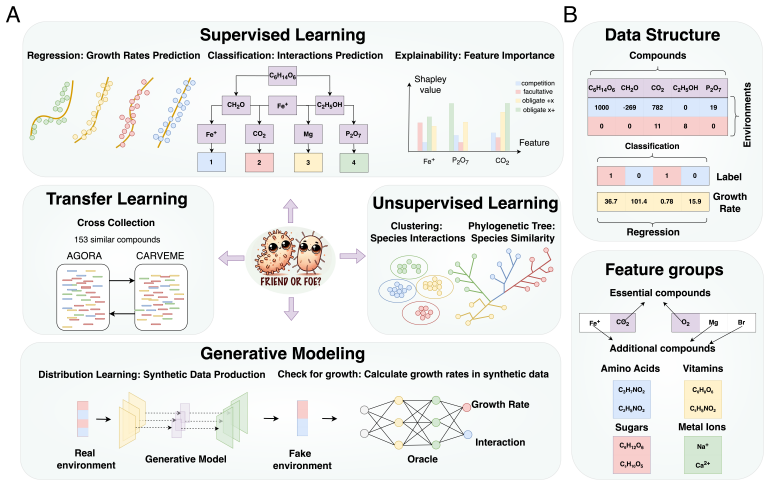
The central discovery is empirical: across 48 supervised datasets built from flux-balance simulations, machine-learning models trained only on presence/absence of chemical compounds recover the simulated interaction class of a bacterial pair, with the top model (TabM) achieving mean MCC 0.64±0.03 and accuracy 0.84±0.02. The same models predict growth rates in regression tasks, transfer learning across the AGORA and CARVEME collections gives positive results, generative models synthesize environments of competitive interactions with quality scores above 0.7, and clustering of environments reflects taxonomic relatedness in a proof-of-concept setting. The paper presents Friend or Foe as the ena
What carries the argument
The load-bearing machinery is the pairwise flux balance analysis in Algorithm 1: for each pair of metabolic models, growth rates are computed as linear-programming biomass optima, subject to the constraint that neither species does worse in co-culture than alone up to a tolerance epsilon. Comparing solo and co-culture growth rates then assigns one of five interaction classes—competition, facultative cooperation, obligate (+×) cooperation, obligate (×+) cooperation, or obligate (××) cooperation—via Algorithm 2. Random sampling of usable compounds with essential compounds always present generates the environments that become rows of tabular datasets. This pipeline turns the vague question 'do
Load-bearing premise
The argument rests on the assumption that a bacterium's growth—and therefore whether a pair competes or cooperates—is faithfully captured by flux balance analysis maximizing biomass under the simulated compound exchanges, with no gene regulation or kinetics; the authors note models show what is possible, not necessarily what is realized.
What would settle it
Grow a set of the modeled bacterial pairs in defined liquid media whose compound sets match sampled environments, measure each species' monoculture and co-culture growth rates, and compare the sign of the growth-rate differences to the interaction labels assigned by Algorithm 2; systematic mismatches would falsify the claim that the labels capture realized interactions.
If this is right
- Tabular ML models trained only on compound presence/absence can classify bacterial interactions, with TabM reaching mean MCC 0.64±0.03 and accuracy 0.84±0.02 across the interaction-classification datasets.
- Growth-rate regression tasks (GR-I, GR-II, GR-III) are learnable from environmental composition, so the same features that predict interaction type also carry quantitative growth information.
- Transfer learning across the AGORA and CARVEME collections yields positive results, suggesting interaction-relevant features generalize across model collections and species sets.
- Generative models consistently achieve quality scores Fα,β > 0.7, meaning synthetic competitive environments can be produced to supplement the rare competitive samples found by random sampling.
- Unsupervised clustering of environments reflects taxonomic relatedness in the proof-of-concept datasets, supporting the idea that pairwise assembly rules may structure larger communities.
Where Pith is reading between the lines
- Inference: If the simulated labels reflect real biology, feature-importance analyses on these datasets could nominate specific compounds that bacteria might use as cheap sensory cues for whether another species is a friend or foe.
- Inference: Because environments are encoded as presence/absence of compounds, the benchmark implicitly measures how much information is lost by ignoring concentrations; a testable extension is to include concentration levels and check whether classification accuracy rises.
- Inference: The compendium could support a mechanistic baseline—for example, counting shared essential compounds—against which deep models can be compared, helping to reveal whether the learned signal is simple resource overlap or something more subtle.
- Inference: The transfer-learning success across two independently built model collections suggests that a single model trained on one large collection might be used to screen interactions in newly reconstructed metabolic models without regenerating the compendium.
Editorial analysis
A structured set of objections, weighed in public.
Referee Report
Summary. The paper introduces Friend or Foe, a compendium of 64 tabular datasets built from AGORA and CARVEME genome-scale metabolic models. Environments are generated by sampling usable compounds, flux balance analysis (FBA) is used to compute solo and pair growth rates, and Algorithm 2 maps the comparison of these growth rates to five interaction classes (competition, facultative cooperation, and three obligate cooperation types). The authors benchmark tabular machine learning models for interaction classification (binary and multiclass), growth-rate regression, transfer learning across the two model collections, unsupervised clustering, and generative modeling. They report the best classification model (TabM) with mean MCC 0.64 ± 0.03 and accuracy 0.84 ± 0.02, and conclude that machine learning can be successful in this application to microbial ecology.
Significance. If the simulation pipeline is sound, Friend or Foe is a large-scale public resource—more than 26M environments and 10K+ pairs—with potential value for studying environmental dependence of microbial interactions and for benchmarking tabular ML methods. The paper's strengths include the public data and code links, the breadth of tasks (classification, regression, transfer, clustering, generation), and the use of current state-of-the-art tabular models. The transfer-learning results across AGORA and CARVEME are especially interesting. However, the central claim as stated is broader than what the evidence supports: the labels and features are both generated by the same FBA pipeline, and several load-bearing simulation parameters are not specified, so the benchmark numbers cannot currently be independently reproduced or interpreted as evidence about real microbial interactions.
major comments (4)
- [Section 3, Algorithms 1 and 2] The pseudocode leaves two quantitative parameters unspecified: the tolerance ε in Algorithm 1 (constraint λ(Mj,i) ≥ λ†(Mj) − ε) and the sampled compound concentration c in Algorithm 2 (line 6). These parameters determine which environments are labeled competitive versus cooperative and define the numerical feature distribution. The main text gives no values for either, and the reference to Supplementary D does not make the compendium reproducible or permit a sensitivity analysis. Because these labels are the ground truth for every downstream benchmark, the MCC/accuracy values in Table 4 cannot be assessed without the exact configuration. Please report the values, perform a sensitivity analysis over ε and c (e.g., how often class assignments change), and include the settings in the companion repository.
- [Section 4.2 and Table 4] The central claim that machine learning 'can be successful in this application to microbial ecology' is not supported by an independent test: the features (compound presence) and labels (FBA-derived interaction class) are both outputs of the same computational pipeline, so the high MCC/accuracy may simply reflect learning the deterministic rule in Algorithms 1–2. Section 4.2 itself notes that metabolic models 'can only highlight what is possible, not necessarily what is realized.' To support the biological framing, either (a) restrict the claim to prediction of FBA-simulated interaction classes, or (b) validate a subset of labels against experimentally characterized co-cultures or an independent interaction database and report agreement. Without such validation, the abstract's wording overstates what the benchmark demonstrates.
- [Section 4.1, Table 4] No chance baseline or majority-class baseline is reported. The classification datasets in Table 3 include binary (2-class) and multiclass (3- and 5-class) tasks with different class balances; averaging accuracy across these tasks is hard to interpret, and an MCC of 0.64 is meaningful only when compared with a null model. Please report per-dataset accuracy and MCC, the majority-class accuracy for each task, and a simple feature-based baseline (e.g., logistic regression or random forest on compound presence). This is necessary to support the statement that all algorithms 'achieve meaningful predictive performance.'
- [Section 3, Algorithm 1] Algorithm 1, as written, is incomplete. It shows the LP that maximizes λ*_{Mi,j} subject to λ(Mj,i) ≥ λ†(Mj) − ε and the LP for λ†(Mj), but the return statement also includes λ†(Mi) and λ*_{Mj,i} without showing the corresponding optimization problems or the order in which the two species' growth rates are optimized. Since Algorithm 2 compares all four growth rates to assign interaction classes, the pseudocode should be completed or explicitly deferred to the released code so that the interaction definitions are unambiguous and reproducible. This is not merely cosmetic: the optimization order can change the Pareto-optimal solution and therefore the resulting label.
minor comments (4)
- [Table 3] The table's notation is confusing. The 'Samples' column contains entries such as '326 331 / 89 500' while the 'Group' column also contains '100 / 50', and the text says there are 64 datasets but only 32 rows appear per collection. Please clarify how the 64 datasets and the '26M+ environments' total are counted, use unambiguous numeric separators, and separate the two group-size variants (100 and 50 compounds) into distinct rows or clearly label them.
- [Algorithm 1, line 1] Typo: the required S-matrix for microbe j is written as SMj = [SEi, SIj]; it should presumably be [SEj, SIj].
- [Section 4.1] Figure 4, referenced as a ranking plot of algorithm performance per dataset, is not included in the submitted text. Please include the figure or describe the ranking procedure and results in the text, since Table 4 only reports aggregated means.
- [Section 4.1 and Supplementary M] The generative-model section states that diversity and novelty metrics were calculated following [57], but Table 6 reports only quality metrics (α-Precision, β-Recall, Fα,β). Please report the diversity and novelty numbers in the main text or clearly state where they can be found.
Circularity Check
No significant circularity: the ML benchmarks are supervised evaluations on a simulated ground truth, not reductions to the training inputs.
full rationale
The paper's derivation chain is: (1) Algorithm 1 uses flux balance analysis (FBA) to compute growth rates from stoichiometric models and environmental compound bounds; (2) Algorithm 2 maps these growth-rate comparisons to interaction classes (Table 1); (3) supervised models are trained and tested on random splits of the resulting D(X, y) datasets. No step defines the predictor in terms of the target or fits a parameter to the held-out labels. Held-out environments are not used in training, so the reported MCC of 0.64 for TabM is an honest measure of generalization to unseen simulated environments, not a fitted value renamed as a prediction. The citation to [52] is to prior work by some of the same authors, but the method is reproduced in Algorithms 1 and 2 rather than imported as an external black box, so the central claim does not rest on an unverified self-citation. The paper's own Section 4.2 concedes that metabolic models 'can only highlight what is possible, not necessarily what is realized' and that real-world applicability 'remains unverified'; these are external-validity limitations, and the unspecified epsilon in Algorithm 1 is a robustness concern, but neither makes the benchmark circular. Because the labels are synthetic, the conclusions about real microbial ecology are only as strong as the FBA assumptions, but that is a correctness/validity issue, not a circularity of the kind where a prediction reduces by construction to its inputs.
Axiom & Free-Parameter Ledger
free parameters (4)
- Sampled compound concentration c =
not stated in main text
- Growth comparison tolerance epsilon =
not stated
- Environment sampling search threshold =
implied by observed average 414 samples per pair; explicit threshold not stated
- Essential compound (CE) identification criterion =
not stated
axioms (5)
- domain assumption Bacteria maximize biomass production (FBA optimality)
- domain assumption Internal compounds must be balanced; only extracellular exchange bounds define the environment
- domain assumption The five interaction classes are defined by comparing optimized solo and co-culture growth rates
- domain assumption AGORA and CARVEME reconstructions approximate the metabolic capabilities of the sampled species
- domain assumption Environments within a dataset are exchangeable for train/val/test purposes
Cite this review
Pith. "Pith review of Friend or Foe." pith.science (2026). https://pith.science/paper/3IB3QLQO
@misc{pith2026250900123,
  author       = {Pith},
  title        = {Pith review of: Friend or Foe},
  year         = {2026},
  howpublished = {\url{https://pith.science/paper/3IB3QLQO}},
  note         = {Machine review of arXiv:2509.00123}
}
read the original abstract
A fundamental challenge in microbial ecology is determining whether bacteria compete or cooperate in different environmental conditions. With recent advances in genome-scale metabolic models, we are now capable of simulating interactions between thousands of pairs of bacteria in thousands of different environmental settings at a scale infeasible experimentally. These approaches can generate tremendous amounts of data that can be exploited by state-of-the-art machine learning algorithms to uncover the mechanisms driving interactions. Here, we present Friend or Foe, a compendium of 64 tabular environmental datasets, consisting of more than 26M shared environments for more than 10K pairs of bacteria sampled from two of the largest collections of metabolic models. The Friend or Foe datasets are curated for a wide range of machine learning tasks -- supervised, unsupervised, and generative -- to address specific questions underlying bacterial interactions. We benchmarked a selection of the most recent models for each of these tasks and our results indicate that machine learning can be successful in this application to microbial ecology. Going beyond, analyses of the Friend or Foe compendium can shed light on the predictability of bacterial interactions and highlight novel research directions into how bacteria infer and navigate their relationships.
Figures


Reference graph
Works this paper leans on
-
[1]
Aguilar-Salinas, B. and Olmedo-Álvarez, G. A three-species synthetic community model whose rapid response to antagonism allows the study of higher-order dynamics and emergent properties in minutes. Frontiers in Microbiology, 14:521–533, 2023. doi: https://doi.org/10.3389/fmicb.2023.1057883
-
[2]
Arik, S. O. and Pfister, T. Tabnet: Attentive interpretable tabular learning, 2020. URL https:// openreview.net/forum?id=BylRkAEKDH
work page 2020
-
[3]
Chen, T. and Guestrin, C. Xgboost: A scalable tree boosting system. In Proceedings of the 22nd ACM SIGKDD International Conference on Knowledge Discovery and Data Mining , KDD ’16, pp. 785–794. ACM, August 2016. doi: 10.1145/2939672.2939785. URL http://dx.doi.org/10.1145/2939672. 2939785
arXiv 2016
-
[4]
Domeignoz-Horta, L. A., Pold, G., Liu, X.-J. A., Frey, S. D., Melillo, J. M., and DeAngelis, K. M. Microbial diversity drives carbon use efficiency in a model soil. Nature communications, 11(1):3684, 2020
work page 2020
-
[5]
V ., Ershov, V ., and Gulin, A
Dorogush, A. V ., Ershov, V ., and Gulin, A. Catboost: gradient boosting with categorical features support,
-
[6]
Drew, G. C., Stevens, E. J., and King, K. C. Microbial evolution and transitions along the parasite–mutualist continuum. Nature Reviews Microbiology, 19(10):623–638, 2021
work page 2021
-
[7]
Ecology and evolution of metabolic cross-feeding interactions in bacteria
D’Souza, G., Shitut, S., Preussger, D., Yousif, G., Waschina, S., and Kost, C. Ecology and evolution of metabolic cross-feeding interactions in bacteria. Natural product reports, 35(5):455–488, 2018
work page 2018
-
[8]
Elston, R., Mulligan, C., and Thomas, G. H. Flipping the switch: dynamic modulation of membrane transporter activity in bacteria. Microbiology, 169(11):001412, 2023
work page 2023
-
[9]
A density-based algorithm for discovering clusters in large spatial databases with noise
Ester, M., Kriegel, H.-P., Sander, J., and Xu, X. A density-based algorithm for discovering clusters in large spatial databases with noise. In Proceedings of the Second International Conference on Knowledge Discovery and Data Mining , KDD’96, pp. 226–231. AAAI Press, 1996
work page 1996
-
[10]
Friedman, J., Higgins, L. M., and Gore, J. Community structure follows simple assembly rules in microbial microcosms. Nature ecology & evolution, 1(5):0109, 2017
work page 2017
-
[11]
Metabolic modelling approaches for describing and engineering microbial communities
García-Jiménez, B., Torres-Bacete, J., and Nogales, J. Metabolic modelling approaches for describing and engineering microbial communities. Computational and Structural Biotechnology Journal , 19:226–246, 2021
work page 2021
-
[12]
DCSI -- An improved measure of cluster separability based on separation and connectedness
Gauss, J., Scheipl, F., and Herrmann, M. Dcsi – an improved measure of cluster separability based on separation and connectedness, 2025. URL https://arxiv.org/abs/2310.12806
work page internal anchor Pith review Pith/arXiv arXiv 2025
-
[13]
Ghadermazi, P. and Chan, S. H. J. Microbial interactions from a new perspective: reinforcement learning reveals new insights into microbiome evolution. Bioinformatics, 40(1):btae003, 01 2024. ISSN 1367-4811. doi: 10.1093/bioinformatics/btae003. URL https://doi.org/10.1093/bioinformatics/btae003
-
[14]
Ghoul, M. and Mitri, S. The ecology and evolution of microbial competition. Trends in microbiology, 24 (10):833–845, 2016. 10
work page 2016
-
[15]
Ghoul, M. and Mitri, S. The Ecology and Evolution of Microbial Competition. Trends in Microbiology, 24(10):833–845, October 2016. ISSN 0966-842X. doi: 10.1016/j.tim.2016.06.011. URL https://www. sciencedirect.com/science/article/pii/S0966842X16300749
-
[16]
On embeddings for numerical features in tabular deep learning
Gorishniy, Y ., Rubachev, I., and Babenko, A. On embeddings for numerical features in tabular deep learning. In Oh, A. H., Agarwal, A., Belgrave, D., and Cho, K. (eds.), Advances in Neural Information Processing Systems, 2022. URL https://openreview.net/forum?id=pfI7u0eJAIr
work page 2022
-
[17]
Tabm: Advancing tabular deep learning with parameter- efficient ensembling
Gorishniy, Y ., Kotelnikov, A., and Babenko, A. Tabm: Advancing tabular deep learning with parameter- efficient ensembling. In The Thirteenth International Conference on Learning Representations , 2025. URL https://openreview.net/forum?id=Sd4wYYOhmY
work page 2025
-
[18]
Granato, E. T., Meiller-Legrand, T. A., and Foster, K. R. The evolution and ecology of bacterial warfare. Current biology, 29(11):R521–R537, 2019
work page 2019
-
[19]
Hammarlund, S. P., Chacón, J. M., and Harcombe, W. R. A shared limiting resource leads to competitive exclusion in a cross-feeding system. Environmental Microbiology, 21(2):759–771, 2019
work page 2019
-
[20]
Harapanahalli, A. K., Younes, J. A., Allan, E., van der Mei, H. C., and Busscher, H. J. Chemical signals and mechanosensing in bacterial responses to their environment. PLoS pathogens, 11(8):e1005057, 2015
work page 2015
-
[21]
Harcombe, W. R., Riehl, W. J., Dukovski, I., Granger, B. R., Betts, A., Lang, A. H., Bonilla, G., Kar, A., Leiby, N., Mehta, P., et al. Metabolic resource allocation in individual microbes determines ecosystem interactions and spatial dynamics. Cell reports, 7(4):1104–1115, 2014
work page 2014
-
[22]
Harcombe, W. R., Chacón, J. M., Adamowicz, E. M., Chubiz, L. M., and Marx, C. J. Evolution of bidirectional costly mutualism from byproduct consumption. Proceedings of the National Academy of Sciences, 115(47):12000–12004, 2018
work page 2018
-
[23]
Heinken, A. and Thiele, I. Anoxic Conditions Promote Species-Specific Mutualism between Gut Microbes In Silico. Applied and Environmental Microbiology , 81(12):4049–4061, June 2015. doi: 10.1128/ AEM.00101-15. URL https://journals.asm.org/doi/full/10.1128/AEM.00101-15. Publisher: American Society for Microbiology
-
[24]
Hibbing, M. E., Fuqua, C., Parsek, M. R., and Peterson, S. B. Bacterial competition: surviving and thriving in the microbial jungle. Nature reviews microbiology, 8(1):15–25, 2010
work page 2010
-
[25]
Lightgbm: A highly efficient gradient boosting decision tree
Ke, G., Meng, Q., Finley, T., Wang, T., Chen, W., Ma, W., Ye, Q., and Liu, T.-Y . Lightgbm: A highly efficient gradient boosting decision tree. In Guyon, I., Luxburg, U. V ., Bengio, S., Wallach, H., Fergus, R., Vishwanathan, S., and Garnett, R. (eds.), Advances in Neural Information Processing Systems , volume 30. Curran Associates, Inc., 2017. URL https...
work page 2017
-
[26]
Guarantees for spectral clustering with fairness constraints, 2019
Kleindessner, M., Samadi, S., Awasthi, P., and Morgenstern, J. Guarantees for spectral clustering with fairness constraints, 2019. URL https://arxiv.org/abs/1901.08668
Pith/arXiv arXiv 2019
-
[27]
Klitgord, N. and Segrè, D. Environments that Induce Synthetic Microbial Ecosystems. PLOS Com- putational Biology , 6(11):e1001002, November 2010. ISSN 1553-7358. doi: 10.1371/journal.pcbi. 1001002. URL https://journals.plos.org/ploscompbiol/article?id=10.1371/journal. pcbi.1001002. Publisher: Public Library of Science
-
[28]
Kost, C., Patil, K. R., Friedman, J., Garcia, S. L., and Ralser, M. Metabolic exchanges are ubiquitous in natural microbial communities. Nature Microbiology, pp. 1–9, November 2023. ISSN 2058-5276. doi: 10.1038/s41564-023-01511-x. URL https://www.nature.com/articles/s41564-023-01511-x . Publisher: Nature Publishing Group
-
[29]
TabDDPM: Modelling tabular data with diffusion models, 2023
Kotelnikov, A., Baranchuk, D., Rubachev, I., and Babenko, A. TabDDPM: Modelling tabular data with diffusion models, 2023. URL https://openreview.net/forum?id=EJka_dVXEcr. 11
work page 2023
-
[30]
Krieger, L., Beer, A., Matthews, P., Thiesson, A. M., and Assent, I. Fairden: Fair density-based clustering. In The Thirteenth International Conference on Learning Representations , 2025. URL https://openreview.net/forum?id=aPHHhnZktB
work page 2025
-
[31]
Levine, J. M., Bascompte, J., Adler, P. B., and Allesina, S. Beyond pairwise mechanisms of species coexistence in complex communities. Nature, 1:56–64, 2017. doi: https://doi.org/10.1038/nature22898. URL https://www.nature.com/articles/nature22898
-
[32]
Levy, R. and Borenstein, E. Metabolic modeling of species interaction in the human microbiome elucidates community-level assembly rules. Proceedings of the National Academy of Sciences , 110(31):12804–12809, July 2013. doi: 10.1073/pnas.1300926110. URL https://www.pnas.org/doi/full/10.1073/pnas. 1300926110. Publisher: Proceedings of the National Academy o...
-
[33]
Libby, E., Perkins, T. J., and Swain, P. S. Noisy information processing through transcriptional regulation. Proceedings of the National Academy of Sciences , 104(17):7151–7156, 2007
work page 2007
-
[34]
Syntrophy emerges spontaneously in complex metabolic systems
Libby, E., Hébert-Dufresne, L., Hosseini, S.-R., and Wagner, A. Syntrophy emerges spontaneously in complex metabolic systems. PLoS computational biology, 15(7):e1007169, 2019
work page 2019
-
[36]
Libby, E., Kempes, C. P., and Okie, J. G. Metabolic compatibility and the rarity of prokaryote endosym- bioses. Proceedings of the National Academy of Sciences , 120(17):e2206527120, April 2023. doi: 10.1073/pnas.2206527120. URL https://www.pnas.org/doi/abs/10.1073/pnas.2206527120. Publisher: Proceedings of the National Academy of Sciences
-
[37]
Machado, D., Andrejev, S., Tramontano, M., and Patil, K. Fast automated reconstruction of genome- scale metabolic models for microbial species and communities. Nucleic Acids Res , 46(15), 2018. doi: https://doi:10.1093/nar/gky537
-
[38]
M., Andrejev, S., Kim, Y ., Bork, P., Patil, K
Machado, D., Maistrenko, O. M., Andrejev, S., Kim, Y ., Bork, P., Patil, K. R., and Patil, K. R. Polarization of microbial communities between competitive and cooperative metabolism. Nature Ecology & Evolution, 5(2):195–203, February 2021. ISSN 2397-334X. doi: 10.1038/s41559-020-01353-4. URL https://www. nature.com/articles/s41559-020-01353-4 . Number: 2 ...
-
[39]
Generation of genome-scale metabolic reconstructions for 773 members of the human gut microbiota
Magnúsdóttir, S., Heinken, A., Kutt, L., Ravcheev, D., Bauer, E., Noronha, A., Greenhalgh, K., Jäger, C., Baginska, J., Wilmes, P., Fleming, R., and Thiele, I. Generation of genome-scale metabolic reconstructions for 773 members of the human gut microbiota. Nat Biotechnol, 35(1), 2017. doi: https://doi:10.1038/nbt. 3703
work page doi:10.1038/nbt 2017
-
[40]
A., Bauer, E., Noronha, A., Greenhalgh, K., Jäger, C., Baginska, J., Wilmes, P., Fleming, R
Magnúsdóttir, S., Heinken, A., Kutt, L., Ravcheev, D. A., Bauer, E., Noronha, A., Greenhalgh, K., Jäger, C., Baginska, J., Wilmes, P., Fleming, R. M. T., and Thiele, I. Generation of genome-scale metabolic reconstructions for 773 members of the human gut microbiota.Nature Biotechnology, 35(1):81–89, January
-
[41]
Martino, R. D., Picot, A., and Mitri, S. Oxidative stress changes interactions between 2 bacterial species from competitive to facilitative. PLOS Biology, 22(2):e3002482, February 2024. ISSN 1545-7885. doi: 10.1371/journal.pbio.3002482. URL https://journals.plos.org/plosbiology/article?id=10. 1371/journal.pbio.3002482. Publisher: Public Library of Science
-
[42]
Mickalide, H. and Kuehn, S. Higher-order interaction between species inhibits bacterial invasion of a phototroph-predator microbial community. Cell, 9:521–533, 2019. doi: doi.org/10.1016/j.cels.2019.11.004. URL https://www.cell.com/cell-systems/fulltext/S2405-4712(19)30390-4
-
[43]
Palmer, J. D. and Foster, K. R. Bacterial species rarely work together. Science, 376(6593):581–582, May
-
[44]
Pande, S. and Kost, C. Bacterial unculturability and the formation of intercellular metabolic networks. Trends in microbiology, 25(5):349–361, 2017
work page 2017
-
[45]
Piccardi, P., Vessman, B., and Mitri, S. Toxicity drives facilitation between 4 bacterial species.Proceedings of the National Academy of Sciences , 116(32):15979–15984, August 2019. doi: 10.1073/pnas.1906172116. URL https://www.pnas.org/doi/full/10.1073/pnas.1906172116. Publisher: Proceedings of the National Academy of Sciences
-
[46]
Transporters as information processors in bacterial signalling pathways
Piepenbreier, H., Fritz, G., and Gebhard, S. Transporters as information processors in bacterial signalling pathways. Molecular Microbiology, 104(1):1–15, 2017
work page 2017
-
[47]
D., Tatusova, T., and Maglott, D
Pruitt, K. D., Tatusova, T., and Maglott, D. R. NCBI reference sequences (RefSeq): a curated non-redundant sequence database of genomes, transcripts and proteins. Nucleic Acids Research, 35(suppl_1):D61–D65, January 2007. ISSN 0305-1048. doi: 10.1093/nar/gkl842. URL https://doi.org/10.1093/nar/ gkl842
-
[48]
Synthcity: a benchmark framework for diverse use cases of tabular synthetic data
Qian, Z., Davis, R., and van der Schaar, M. Synthcity: a benchmark framework for diverse use cases of tabular synthetic data. In Thirty-seventh Conference on Neural Information Processing Systems Datasets and Benchmarks Track, 2023. URL https://openreview.net/forum?id=uIppiU2JKP
work page 2023
-
[49]
Nutrient status changes bacterial interactions in a synthetic community
Qiao, Y ., Huang, Q., Guo, H., Qi, M., Zhang, H., Xu, Q., Shen, Q., and Ling, N. Nutrient status changes bacterial interactions in a synthetic community. Applied and Environmental Microbiology, 90(1):e01566– 23, December 2023. doi: 10.1128/aem.01566-23. URL https://journals.asm.org/doi/full/10. 1128/aem.01566-23. Publisher: American Society for Microbiology
-
[50]
Tabdiff: a mixed-type diffusion model for tabular data generation
Shi, J., Xu, M., Hua, H., Zhang, H., Ermon, S., and Leskovec, J. Tabdiff: a mixed-type diffusion model for tabular data generation. In The Thirteenth International Conference on Learning Representations , 2025. URL https://openreview.net/forum?id=swvURjrt8z
work page 2025
-
[51]
Smith, H. B., Drew, A., Malloy, J. F., and Walker, S. I. Seeding biochemistry on other worlds: Enceladus as a case study. Astrobiology, 21(2):177–190, 2021
work page 2021
-
[52]
Solowiej-Wedderburn, J., Pentz, J. T., Lizana, L., Schroeder, B. O., Lind, P. A., and Libby, E. Competition and cooperation: The plasticity of bacterial interactions across environments. PLoS Comput. Biol., 21(7): e1013213, July 2025
work page 2025
-
[53]
S., Solowiej-Wedderburn, J., Bonforti, A., and Libby, E
Souza, L. S., Solowiej-Wedderburn, J., Bonforti, A., and Libby, E. Modeling endosymbioses: Insights and hypotheses from theoretical approaches. PLoS biology, 22(4):e3002583, 2024
work page 2024
-
[54]
Vasse, M., Fiegna, F., Kriesel, B., and Velicer, G. J. Killer prey: Ecology reverses bacterial predation. PLoS Biology, 22(1):e3002454, 2024
work page 2024
-
[55]
Venturelli, O. S., Carr, A. V ., Fisher, G., Hsu, R. H., Lau, R., Bowen, B. P., Hromada, S., Northen, T., and Arkin, A. P. Deciphering microbial interactions in synthetic human gut microbiome communities. Molecular Systems Biology , 14(6):e8157, June 2018. ISSN 1744-4292. doi: 10.15252/msb.20178157. URL https://www.embopress.org/doi/full/10.15252/msb.2017...
-
[56]
Wintermute, E. H. and Silver, P. A. Emergent cooperation in microbial metabolism. Molecular systems biology, 6(1):407, 2010
work page 2010
-
[57]
Tackling the generative learning trilemma with denoising diffusion gans, 2022
Xiao, Z., Kreis, K., and Vahdat, A. Tackling the generative learning trilemma with denoising diffusion gans, 2022. URL https://arxiv.org/abs/2112.07804
Pith/arXiv arXiv 2022
-
[58]
Modeling tabular data using conditional GAN
Xu, L., Skoularidou, M., Cuesta-Infante, A., and Veeramachaneni, K. Modeling tabular data using conditional GAN. CoRR, abs/1907.00503, 2019. URL http://arxiv.org/abs/1907.00503. 13
Pith/arXiv arXiv 1907
-
[59]
Zelezniak, A., Andrejev, S., Ponomarova, O., Mende, D. R., Bork, P., and Patil, K. R. Metabolic dependencies drive species co-occurrence in diverse microbial communities. Proceedings of the National Academy of Sciences, 112(20):6449–6454, May 2015. doi: 10.1073/pnas.1421834112. URLhttps://www. pnas.org/doi/abs/10.1073/pnas.1421834112. Publisher: Proceedin...
-
[2017]
ISSN 1546-1696. doi: 10.1038/nbt.3703. URL https://www.nature.com/articles/nbt.3703. Number: 1 Publisher: Nature Publishing Group
-
[2018]
URL https://arxiv.org/abs/1810.11363
-
[2022]
ISSN 0036-8075, 1095-9203. doi: 10.1126/science.abn5093. URL https://www.science.org/ doi/10.1126/science.abn5093. 12
This paper was first reviewed by deepseek-v4-flash on August 5, 2026.
discussion (0)
Sign in with ORCID, Apple, or X to comment. Anyone can read and Pith papers without signing in.