REVIEW 3 major objections 5 minor 81 references
Turning a category name into generated images beats text-only retrieval on 15 benchmarks.
Reviewed by Pith at T0; open to challenge. T0 means a machine referee read the full paper against a public rubric. the ladder, T0–T4 →
Category-level retrieval improves when text queries are converted into multiple generated images, aggregated with a learned attention module, and fused with CLIP text similarity.
T0 review reviewed 2026-08-05 challenge →
load-bearing objection Sound empirical recipe for improving text-only category retrieval with generated visual queries; average gains are real, but 'consistently outperforms' overstates the per-dataset evidence. the 3 major comments →
Category-level Text-to-Image Retrieval Improved: Bridging the Domain Gap with Diffusion Models and Vision Encoders
The pith
A machine-rendered reading of the paper's core claim, the machinery that carries it, and where it could break.
The reading
Core claim
Using a text-only VLM as baseline, the paper demonstrates that replacing pure cross-modal search with a hybrid similarity—one term from text-to-image (CLIP/SigLIP) and one from image-to-image (DINOv2) over diffusion-generated queries—consistently improves category retrieval. With class-name queries, the hybrid reaches 67.9 average mAP with CLIP+DINOv2 versus 62.7 for text-only CLIP, and 72.9 with SigLIP+DINOv2 versus 70.3 for text-only SigLIP, averaged over 15 datasets. The improvement also holds when the query is a class description that omits the class name (+6.4 over CLIP, +3.6 over SigLIP) and when description and name are joined. The paper attributes the gain to replacing cross-modal co
What carries the argument
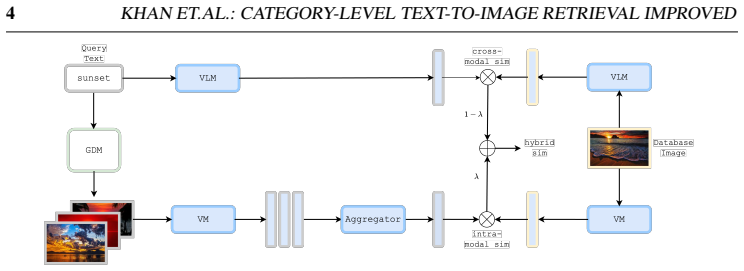
The machinery that carries the argument is the aggregator plus the modality split. The aggregator is a sequence of symmetric self-attention layers: query and key projections are shared, value projections are identity, and the CLS token starts as the average of the generated-image features and is the only token updated across layers. Because the values are identities, the output stays in the same DINOv2 feature space as the database images, so the aggregated query can be compared directly to database images. Around this sits the hybrid score s = (1 − λ) sc + λ si, where sc is VLM text-image similarity, si is DINOv2 image-image similarity between the aggregated generated query and the database
Load-bearing premise
The whole gain rests on generated images being close enough to real category appearance in DINOv2 feature space; when a generator drops a class's defining visual cue, the hybrid score can rank distractors above true images and underperform text-only retrieval.
What would settle it
Take a class whose generated queries are visibly off, such as hammerhead shark, where the generator omits the hammer-shaped head, and compute the per-class difference between the hybrid mAP and the text-only mAP. If removing the misleading generated image or improving only that class's generation fidelity does not change retrieval, or if classes with poor generation fidelity still improve, then the modality-gap explanation fails. A systematic correlation across all ImageNet classes between generation fidelity (measured, for example, by the CLIPScore of the generated image against the class nam
If this is right
- Any text-only open-vocabulary retrieval pipeline can be upgraded without retraining the VLM or vision encoder; only the small aggregator and λ are trained, on synthetic images.
- Retrieval quality is bounded by the generator: the paper's upper-bound experiment with real query images shows an average gain of about 11.3 mAP over the text-only baseline, so better diffusion models should translate directly into better retrieval.
- Class-description-only retrieval becomes practical, letting users find images by appearance or properties when they do not know the category name.
- Using several complementary generators together (SD, SD-Turbo, FLUX) yields more gains than using one generator, and the method continues to improve as more query images are added.
- The hybrid is more resistant to image corruption than the text-only baseline, with a smaller drop in mAP as ImageNet-C severity increases.
Where Pith is reading between the lines
- Because the method works by translating the query into the visual domain rather than by aligning text and image more tightly, I infer the same recipe should transfer to other cross-modal retrieval tasks—audio-to-image, sketch-to-image, or video retrieval—wherever a generative model can produce a query in the target modality.
- The global scalar λ learned once may leave per-class gains on the table; a query-specific or class-specific λ could adapt to how reliable the generated images are for that class, which the paper's failure cases (e.g., hammerhead shark) suggest would help.
- I infer that the aggregator could be trained iteratively with the generator: if a diffusion model is fine-tuned to produce queries that maximize the aggregator's retrieval rank, rather than just visual realism, the modality-gap bypass could improve further.
- The description-only benchmark built with an LLM opens a measurable new task, but its quality depends on the description generator; as LLMs improve, so should this retrieval setting.
Editorial analysis
A structured set of objections, weighed in public.
Referee Report
Summary. The paper proposes CLETIR, a training-light approach to category-level text-to-image retrieval. Given a text query naming a class, it (1) generates multiple query images with text-to-image diffusion models, (2) encodes them with a vision model (DINOv2) and aggregates the resulting descriptors with a small learned symmetric self-attention network, and (3) fuses the resulting image-to-image similarity with the VLM's text-to-image similarity using a learned scalar lambda. The aggregator and lambda are trained on synthetic images generated from OpenImages class names, with benchmark classes removed. The method is evaluated on 15 datasets under three query types (class name, class description, and both), with CLIP, SigLIP, MetaCLIP, OpenCLIP, and EVA-02-CLIP as VLMs. The main reported result is that on class-name queries the method improves average mAP over text-only CLIP (67.9 vs 62.7) and over text-only SigLIP (72.9 vs 70.3). The paper also reports gains for description-based queries, a small Flickr30k experiment, and robustness results on ImageNet-C.
Significance. If the average improvements are robust, the paper offers a simple and modular way to improve open-vocabulary retrieval by converting text queries into generated visual queries and using a strong vision encoder for intra-modal comparison. A notable strength is that the aggregator and fusion weight are trained on synthetic data with the evaluation benchmarks held out, so the reported retrieval numbers are not fitted. The paper also ships source code and evaluates multiple VLMs and generators, which strengthens reproducibility. The main limitation is that the headline claim of 'consistently outperforming' text-only retrieval is not supported at the per-dataset level, and no uncertainty or per-class analysis is provided. The idea is still valuable if the claim is calibrated to average performance with appropriate statistical support.
major comments (3)
- [Section 5.2, Table 1] The abstract and Section 1 state that the approach 'consistently outperforms' retrieval methods that rely only on text queries. Table 1 does not support this at the per-dataset level. For class-name queries, Ours (S,D) is below text-only SigLIP on Stanford Cars (88.2 vs 89.2), Food (92.9 vs 93.1), and FGVC Aircraft (44.1 vs 45.6). Larger drops appear in the description+class rows, e.g., Stanford Cars 85.5 vs 88.5 and FGVC Aircraft 45.3 vs 48.3. The claim is only supported at the level of the 15-dataset average. Please revise the wording to 'on average' or, preferably, augment the evaluation with per-dataset significance tests and a discussion of the exceptions.
- [Table 1 and Section 5.2] No variance, confidence intervals, or per-class statistical tests are reported. Several per-dataset differences are small (e.g., Food 92.9 vs 93.1, DTD 50.1 vs 49.9 for CLIP description+class, and Stanford Cars 12.1 vs 12.3 for SigLIP description-only), so the reader cannot tell whether the average improvement is robust or driven by a few large gains. Report bootstrap confidence intervals over classes or datasets, or paired per-class tests, to support the claim that the method improves over the text-only baseline.
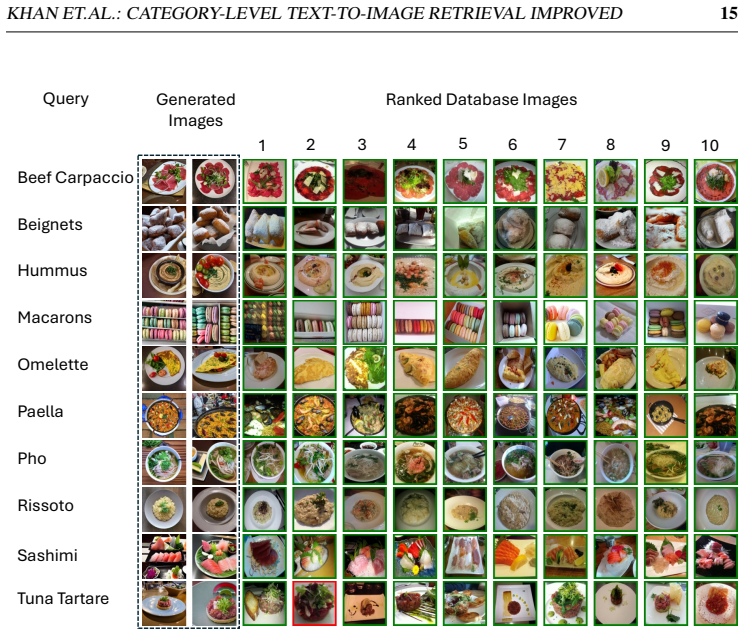
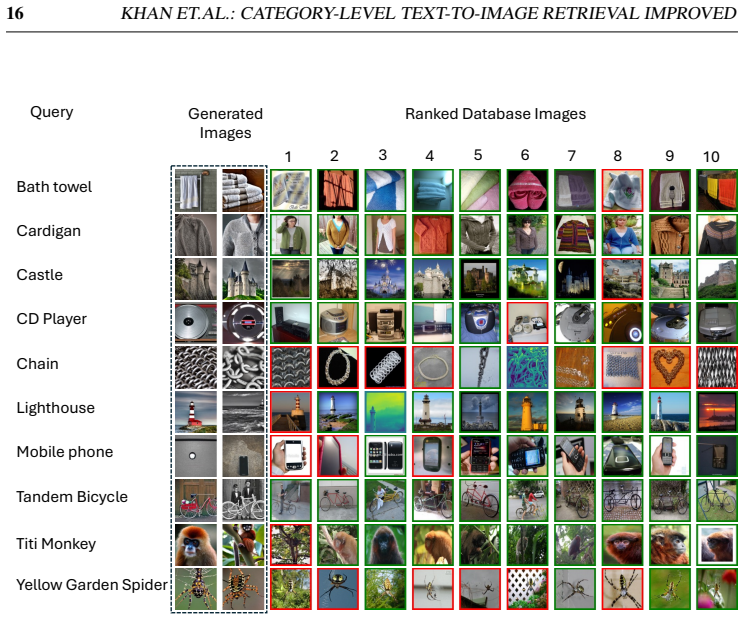
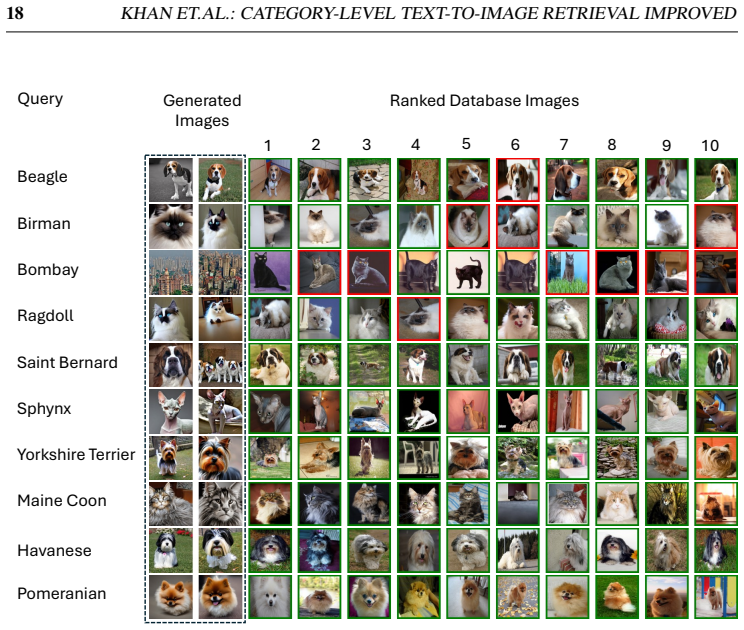
- [Section 5.5, Table 4, Supplementary Figure 5] The paper's own analysis shows that generator fidelity is a load-bearing factor. Supplementary Figure 5 reports an 11.6% mAP gap between SD-generated image queries and 'perfect' real image queries in the image-only setting, and Table 4 documents classes where the generator misses key cues (e.g., hammerhead shark's hammer-shaped head) and the hybrid score degrades. This does not contradict an average-performance claim, but it directly undermines the word 'consistently' in the abstract. I ask for a per-class or per-dataset success/failure analysis: how often does the hybrid score fall below text-only, and is the drop correlated with generation fidelity or with the number of generated images? This would let the reader assess the practical scope of the method.
minor comments (5)
- [Section 4.2, aggregator equation] The definition of the attention layer Al(u) = softmax(phi(u)^T phi(u)) u^T is hard to parse. Please specify the dimensions of u, the softmax axis, and whether the query/key projection is applied per column or per token. The notation u1,i for both input tokens and layer outputs should be disambiguated.
- [Section 4.3] The procedure for removing benchmark classes from OpenImages using CLIP nearest neighbors should be described more precisely. Is a threshold used, or is it a nearest-neighbor match? This matters for reproducibility and for assessing potential label leakage through the filtering step.
- [Section 4.3, training trick] Fixing the cross-modal similarity of positives to 1 is an ad hoc assumption. Please add an ablation or sensitivity analysis showing the learned lambda values and how the final result changes if this positive-similarity target is varied (e.g., 0.9 or 1.0). This would clarify whether the trick is critical or mostly a stabilizer.
- [Supplementary Figure 5] The figure reports results on 14 benchmarks (RESISC45 is excluded). Please state this explicitly in the main text or figure caption, as a reader might otherwise expect 15 datasets.
- [Table 4] The column header 'Ground Truth' is slightly misleading; it appears to be a real example image from the class rather than a ground-truth label. Consider renaming it 'Real example' or 'Example database image'.
Circularity Check
No significant circularity: aggregator and lambda are trained on synthetic OpenImages classes with benchmark classes removed, and evaluation is held out on real benchmark databases.
full rationale
The paper's derivation chain is self-contained with respect to its empirical claims. The text query is converted into generated image queries by a GDM, then DINOv2 representations are aggregated by a learned attention module and combined with the VLM text similarity via a learned lambda. The aggregator and lambda are trained only on synthetic images generated from OpenImages class names, and the paper explicitly removes classes matching the fifteen test benchmarks ('we remove classes from this corpus that match those of the benchmark datasets'), so no benchmark labels or retrieval results are used to fit the model. The reported evaluation measures retrieval on real benchmark databases, which is a held-out setting. The trick of fixing positive cross-modal similarity to 1 during training affects training dynamics only, not the evaluation labels or the test-time similarity computation. Self-citations to the authors' prior work ([61,62]) appear only in the related-work review as examples of VMs enhancing multimodal tasks; they are not load-bearing and no uniqueness theorem or derivation is imported from them. The paper's own Table 4 and per-dataset drops in Table 1 (e.g., Ours(S,D) below text-only SigLIP on Stanford Cars, Food, and FGVC Aircraft) are correctness/robustness concerns about the 'consistently outperforms' wording, not instances of circular reasoning. No equation is defined in terms of its target, no fitted quantity is renamed as a prediction, and no benchmark result is fed back into the training or model-selection procedure. Accordingly, the appropriate circularity score is 0.
Axiom & Free-Parameter Ledger
free parameters (3)
- Lambda (modality fusion weight) =
learned, not reported
- Aggregator parameters theta =
learned, 2 attention layers, not enumerated
- Contrastive temperature tau =
not reported
axioms (5)
- domain assumption Generated images from a text-to-image model are a sufficient proxy for real images of the same category in DINOv2 feature space.
- domain assumption DINOv2 descriptors are a better intra-modal ranking signal than CLIP visual descriptors.
- domain assumption Training on synthetic OpenImages classes transfers to unseen benchmark classes after CLIP-based removal of test class names.
- ad hoc to paper Fixing cross-modal similarity of positives to 1 during training is a valid proxy for perfect text-to-image alignment.
- domain assumption Symmetric attention with shared query/key projections and identity value projections preserves compatibility with the database embedding space.
Cite this review
Pith. "Pith review of Category-level Text-to-Image Retrieval Improved: Bridging the Domain Gap with Diffusion Models and Vision Encoders." pith.science (2026). https://pith.science/paper/NY24W544
@misc{pith2026250900177,
  author       = {Pith},
  title        = {Pith review of: Category-level Text-to-Image Retrieval Improved: Bridging the Domain Gap with Diffusion Models and Vision Encoders},
  year         = {2026},
  howpublished = {\url{https://pith.science/paper/NY24W544}},
  note         = {Machine review of arXiv:2509.00177}
}
read the original abstract
This work explores text-to-image retrieval for queries that specify or describe a semantic category. While vision-and-language models (VLMs) like CLIP offer a straightforward open-vocabulary solution, they map text and images to distant regions in the representation space, limiting retrieval performance. To bridge this modality gap, we propose a two-step approach. First, we transform the text query into a visual query using a generative diffusion model. Then, we estimate image-to-image similarity with a vision model. Additionally, we introduce an aggregation network that combines multiple generated images into a single vector representation and fuses similarity scores across both query modalities. Our approach leverages advancements in vision encoders, VLMs, and text-to-image generation models. Extensive evaluations show that it consistently outperforms retrieval methods relying solely on text queries. Source code is available at: https://github.com/faixan-khan/cletir
Figures







Reference graph
Works this paper leans on
-
[1]
Unicom: Universal and compact representation learning for image retrieval
Xiang An, Jiankang Deng, Kaicheng Yang, Jaiwei Li, Ziyong Feng, Jia Guo, Jing Yang, and Tongliang Liu. Unicom: Universal and compact representation learning for image retrieval. In ICLR, 2023
2023
-
[2]
Shekoofeh Azizi, Simon Kornblith, Chitwan Saharia, Mohammad Norouzi, and David J. Fleet. Synthetic data from diffusion models improves imagenet classification. TMLR, 2023
work page 2023
-
[3]
Food-101 – mining discrim- inative components with random forests
Lukas Bossard, Matthieu Guillaumin, and Luc Van Gool. Food-101 – mining discrim- inative components with random forests. In ECCV, 2014
work page 2014
-
[4]
Coyo-700m: Image-text pair dataset
Minwoo Byeon, Beomhee Park, Haecheon Kim, Sungjun Lee, Woonhyuk Baek, and Saehoon Kim. Coyo-700m: Image-text pair dataset. https://github.com/ kakaobrain/coyo-dataset, 2022
work page 2022
-
[5]
Emerging properties in self-supervised vision trans- formers
Mathilde Caron, Hugo Touvron, Ishan Misra, Hervé Jégou, Julien Mairal, Piotr Bo- janowski, and Armand Joulin. Emerging properties in self-supervised vision trans- formers. In ICCV, 2021
work page 2021
-
[6]
A short note on the kinetics-700 human action dataset
Joao Carreira, Eric Noland, Chloe Hillier, and Andrew Zisserman. A short note on the kinetics-700 human action dataset. arXiv preprint arXiv:1907.06987, 2019
Pith/arXiv arXiv 1907
-
[7]
VISOR: towards on-the-fly large-scale object category retrieval
Ken Chatfield and Andrew Zisserman. VISOR: towards on-the-fly large-scale object category retrieval. In ACCV, 2012
work page 2012
-
[8]
Efficient on-the-fly category retrieval using convnets and gpus
Ken Chatfield, Karen Simonyan, and Andrew Zisserman. Efficient on-the-fly category retrieval using convnets and gpus. In ACCV, 2014
work page 2014
-
[9]
Ken Chatfield, Relja Arandjelovic, Omkar M. Parkhi, and Andrew Zisserman. On-the- fly learning for visual search of large-scale image and video datasets. International Journal of Multimedia Information Retrieval , 2015
work page 2015
-
[10]
Learning the best pooling strategy for visual semantic embedding
Jiacheng Chen, Hexiang Hu, Hao Wu, Yuning Jiang, and Changhu Wang. Learning the best pooling strategy for visual semantic embedding. In CVPR, 2021
work page 2021
-
[11]
Bakker, Theodoros Georgiou, Paul W
Wei Chen, Yu Liu, Weiping Wang, Erwin M. Bakker, Theodoros Georgiou, Paul W. Fieguth, Li Liu, and Michael S. Lew. Deep learning for instance retrieval: A survey. PAMI, 2023
work page 2023
-
[12]
Remote sensing image scene classifica- tion: Benchmark and state of the art
Gong Cheng, Junwei Han, and Xiaoqiang Lu. Remote sensing image scene classifica- tion: Benchmark and state of the art. Proceedings of the IEEE, 2017. 12 KHAN ET.AL.: CA TEGORY -LEVEL TEXT-TO-IMAGE RETRIEV AL IMPROVED
work page 2017
-
[13]
Repro- ducible scaling laws for contrastive language-image learning
Mehdi Cherti, Romain Beaumont, Ross Wightman, Mitchell Wortsman, Gabriel Il- harco, Cade Gordon, Christoph Schuhmann, Ludwig Schmidt, and Jenia Jitsev. Repro- ducible scaling laws for contrastive language-image learning. In CVPR, 2023
work page 2023
-
[14]
Probabilistic embeddings for cross-modal retrieval
Sanghyuk Chun, Seong Joon Oh, Rafael Sampaio De Rezende, Yannis Kalantidis, and Diane Larlus. Probabilistic embeddings for cross-modal retrieval. In CVPR, 2021
work page 2021
-
[15]
Describing textures in the wild
Mircea Cimpoi, Subhransu Maji, Iasonas Kokkinos, Sammy Mohamed, and Andrea Vedaldi. Describing textures in the wild. In CVPR, 2014
work page 2014
-
[16]
An image is worth 16x16 words: Trans- formers for image recognition at scale
Alexey Dosovitskiy, Lucas Beyer, Alexander Kolesnikov, Dirk Weissenborn, Xiaohua Zhai, Thomas Unterthiner, Mostafa Dehghani, Matthias Minderer, Georg Heigold, Syl- vain Gelly, Jakob Uszkoreit, and Neil Houlsby. An image is worth 16x16 words: Trans- formers for image recognition at scale. In ICLR, 2021
work page 2021
- [17]
-
[18]
M. Everingham, L. Van Gool, C. K. I. Williams, J. Winn, and A. Zisserman. The PAS- CAL Visual Object Classes Challenge 2007 (VOC2007) Results. http://www.pascal- network.org/challenges/VOC/voc2007/workshop/index.html, 2007
work page 2007
-
[19]
Vse++: Improving visual-semantic embeddings with hard negatives
Fartash Faghri, David J Fleet, Jamie Ryan Kiros, and Sanja Fidler. Vse++: Improving visual-semantic embeddings with hard negatives. In BMVC, 2017
work page 2017
-
[20]
EV A: exploring the limits of masked visual representation learning at scale
Yuxin Fang, Wen Wang, Binhui Xie, Quan Sun, Ledell Wu, Xinggang Wang, Tiejun Huang, Xinlong Wang, and Yue Cao. EV A: exploring the limits of masked visual representation learning at scale. In CVPR, 2023
work page 2023
-
[21]
Li Fei-Fei, Rob Fergus, and Pietro Perona. Learning generative visual models from few training examples: An incremental bayesian approach tested on 101 object categories. In CVPRW, 2004
work page 2004
-
[22]
Samir Yitzhak Gadre, Gabriel Ilharco, Alex Fang, Jonathan Hayase, Georgios Smyrnis, Thao Nguyen, Ryan Marten, Mitchell Wortsman, Dhruba Ghosh, Jieyu Zhang, Eyal Orgad, Rahim Entezari, Giannis Daras, Sarah M. Pratt, Vivek Ramanujan, Yonatan Bitton, Kalyani Marathe, Stephen Mussmann, Richard Vencu, Mehdi Cherti, Ranjay Krishna, Pang Wei Koh, Olga Saukh, Ale...
work page 2023
-
[23]
Albert Gordo and Diane Larlus. Beyond instance-level image retrieval: Leveraging captions to learn a global visual representation for semantic retrieval. In CVPR, 2017
work page 2017
-
[24]
Benchmarking neural network robustness to common corruptions and perturbations
Dan Hendrycks and Thomas Dietterich. Benchmarking neural network robustness to common corruptions and perturbations. ICLR, 2019
work page 2019
-
[25]
Learning semantic concepts and order for image and sentence matching
Yan Huang, Qi Wu, Chunfeng Song, and Liang Wang. Learning semantic concepts and order for image and sentence matching. In CVPR, 2018. KHAN ET.AL.: CA TEGORY -LEVEL TEXT-TO-IMAGE RETRIEV AL IMPROVED 13
work page 2018
-
[26]
Gabriel Ilharco, Mitchell Wortsman, Ross Wightman, Cade Gordon, Nicholas Car- lini, Rohan Taori, Achal Dave, Vaishaal Shankar, Hongseok Namkoong, John Miller, Hannaneh Hajishirzi, Ali Farhadi, and Ludwig Schmidt. Openclip, July 2021. URL https://doi.org/10.5281/zenodo.5143773
-
[27]
Retrieval-enhanced contrastive vision-text models
Ahmet Iscen, Mathilde Caron, Alireza Fathi, and Cordelia Schmid. Retrieval-enhanced contrastive vision-text models. In ICLR, 2024
work page 2024
-
[28]
Le, Yun-Hsuan Sung, Zhen Li, and Tom Duerig
Chao Jia, Yinfei Yang, Ye Xia, Yi-Ting Chen, Zarana Parekh, Hieu Pham, Quoc V . Le, Yun-Hsuan Sung, Zhen Li, and Tom Duerig. Scaling up visual and vision-language representation learning with noisy text supervision. In ICML, 2021
work page 2021
-
[29]
In defense of lazy visual grounding for open-vocabulary semantic segmentation
Dahyun Kang and Minsu Cho. In defense of lazy visual grounding for open-vocabulary semantic segmentation. In ECCV, 2024
work page 2024
-
[30]
3d object representations for fine-grained categorization
Jonathan Krause, Michael Stark, Jia Deng, and Li Fei-Fei. 3d object representations for fine-grained categorization. In ICCVW, 2013
work page 2013
-
[31]
Learning multiple layers of features from tiny images
Alex Krizhevsky. Learning multiple layers of features from tiny images. 2009
2009
-
[32]
Alina Kuznetsova, Hassan Rom, Neil Alldrin, Jasper Uijlings, Ivan Krasin, Jordi Pont- Tuset, Shahab Kamali, Stefan Popov, Matteo Malloci, Alexander Kolesnikov, Tom Duerig, and Vittorio Ferrari. The open images dataset v4: Unified image classifica- tion, object detection, and visual relationship detection at scale. IJCV, 2020
work page 2020
- [33]
-
[34]
Proxyclip: Proxy attention improves clip for open-vocabulary segmentation
Mengcheng Lan, Chaofeng Chen, Yiping Ke, Xinjiang Wang, Litong Feng, and Wayne Zhang. Proxyclip: Proxy attention improves clip for open-vocabulary segmentation. In ECCV, 2024
work page 2024
-
[35]
Junnan Li, Dongxu Li, Caiming Xiong, and Steven C. H. Hoi. BLIP: bootstrapping language-image pre-training for unified vision-language understanding and generation. In ICML, 2022
work page 2022
-
[36]
Visual semantic reason- ing for image-text matching
Kunpeng Li, Yulun Zhang, Kai Li, Yuanyuan Li, and Yun Fu. Visual semantic reason- ing for image-text matching. In CVPR, 2019
work page 2019
-
[37]
Weixin Liang, Yuhui Zhang, Yongchan Kwon, Serena Yeung, and James Y . Zou. Mind the gap: Understanding the modality gap in multi-modal contrastive representation learning. In NeurIPS, 2022
work page 2022
-
[38]
Learning customized visual models with retrieval-augmented knowledge
Haotian Liu, Kilho Son, Jianwei Yang, Ce Liu, Jianfeng Gao, Yong Jae Lee, and Chun- yuan Li. Learning customized visual models with retrieval-augmented knowledge. In CVPR, 2023
work page 2023
-
[39]
Mode: Clip data experts via clustering
Jiawei Ma, Po-Yao Huang, Saining Xie, Shang-Wen Li, Luke Zettlemoyer, Shih-Fu Chang, Wen-Tau Yih, and Hu Xu. Mode: Clip data experts via clustering. In CVPR, 2024
work page 2024
-
[40]
Subhransu Maji, Esa Rahtu, Juho Kannala, Matthew B. Blaschko, and Andrea Vedaldi. Fine-grained visual classification of aircraft. arXiv preprint arXiv:1306.5151, 2013. 14 KHAN ET.AL.: CA TEGORY -LEVEL TEXT-TO-IMAGE RETRIEV AL IMPROVED
Pith/arXiv arXiv 2013
-
[41]
Quang Nguyen, Truong Vu, Anh Tran, and Khoi Nguyen. Dataset diffusion: Diffusion- based synthetic dataset generation for pixel-level semantic segmentation. In NeurIPS, 2023
work page 2023
-
[42]
Automated flower classification over a large number of classes
Maria-Elena Nilsback and Andrew Zisserman. Automated flower classification over a large number of classes. In Indian Conference on Computer Vision, Graphics and Image Processing, 2008
work page 2008
-
[43]
OpenAI. Gpt-3.5-turbo-instruct. https://openai.com/gpt, 2024. Accessed on August 1, 2024
work page 2024
-
[44]
Maxime Oquab, Timothée Darcet, Théo Moutakanni, Huy V o, Marc Szafraniec, Vasil Khalidov, Pierre Fernandez, Daniel Haziza, Francisco Massa, Alaaeldin El-Nouby, Mahmoud Assran, Nicolas Ballas, Wojciech Galuba, Russell Howes, Po-Yao Huang, Shang-Wen Li, Ishan Misra, Michael G. Rabbat, Vasu Sharma, Gabriel Synnaeve, Hu Xu, Hervé Jégou, Julien Mairal, Patrick...
work page 2023
-
[45]
Frozen transformers in lan- guage models are effective visual encoder layers
Ziqi Pang, Ziyang Xie, Yunze Man, and Yu-Xiong Wang. Frozen transformers in lan- guage models are effective visual encoder layers. In ICLR, 2024
work page 2024
-
[46]
Parkhi, Andrea Vedaldi, Andrew Zisserman, and C
Omkar M. Parkhi, Andrea Vedaldi, Andrew Zisserman, and C. V . Jawahar. Cats and dogs. In CVPR, 2012
2012
-
[47]
TIGer: Unifying text-to-image generation and retrieval with large multimodal models
Leigang Qu, Haochuan Li, Tan Wang, Wenjie Wang, Yongqi Li, Liqiang Nie, and Tat-Seng Chua. TIGer: Unifying text-to-image generation and retrieval with large multimodal models. In ICLR, 2025
work page 2025
-
[48]
Learning transferable visual models from natural lan- guage supervision
Alec Radford, Jong Wook Kim, Chris Hallacy, Aditya Ramesh, Gabriel Goh, Sand- hini Agarwal, Girish Sastry, Amanda Askell, Pamela Mishkin, Jack Clark, Gretchen Krueger, and Ilya Sutskever. Learning transferable visual models from natural lan- guage supervision. In ICML, 2021
work page 2021
-
[49]
Zero-shot text-to-image generation
Aditya Ramesh, Mikhail Pavlov, Gabriel Goh, Scott Gray, Chelsea V oss, Alec Radford, Mark Chen, and Ilya Sutskever. Zero-shot text-to-image generation. In ICML, 2021
2021
-
[50]
High-resolution image synthesis with latent diffusion models
Robin Rombach, Andreas Blattmann, Dominik Lorenz, Patrick Esser, and Björn Om- mer. High-resolution image synthesis with latent diffusion models. In CVPR, 2022
work page 2022
-
[51]
Olga Russakovsky, Jia Deng, Hao Su, Jonathan Krause, Sanjeev Satheesh, Sean Ma, Zhiheng Huang, Andrej Karpathy, Aditya Khosla, Michael S. Bernstein, Alexander C. Berg, and Li Fei-Fei. Imagenet large scale visual recognition challenge. IJCV, 2015
work page 2015
-
[52]
Chitwan Saharia, William Chan, Saurabh Saxena, Lala Li, Jay Whang, Emily L. Den- ton, Seyed Kamyar Seyed Ghasemipour, Raphael Gontijo Lopes, Burcu Karagol Ayan, Tim Salimans, Jonathan Ho, David J. Fleet, and Mohammad Norouzi. Photorealistic text-to-image diffusion models with deep language understanding. In NeurIPS, 2022
work page 2022
-
[53]
Fake it till you make it: Learning transferable representations from synthetic imagenet clones
Mert Bülent Sariyildiz, Karteek Alahari, Diane Larlus, and Yannis Kalantidis. Fake it till you make it: Learning transferable representations from synthetic imagenet clones. In CVPR, 2023. KHAN ET.AL.: CA TEGORY -LEVEL TEXT-TO-IMAGE RETRIEV AL IMPROVED 15
work page 2023
-
[54]
Adversarial diffusion distillation
Axel Sauer, Dominik Lorenz, Andreas Blattmann, and Robin Rombach. Adversarial diffusion distillation. arXiv preprint arXiv:2311.17042, 2023
Pith/arXiv arXiv 2023
-
[55]
Hoffmann, Max Argus, V olker Fischer, and Thomas Brox
Simon Schrodi, David T. Hoffmann, Max Argus, V olker Fischer, and Thomas Brox. Two effects, one trigger: On the modality gap, object bias, and information imbalance in contrastive vision-language representation learning. In ICLR, 2025
work page 2025
-
[56]
LAION-5B: an open large-scale dataset for training next generation image-text models
Christoph Schuhmann, Romain Beaumont, Richard Vencu, Cade Gordon, Ross Wight- man, Mehdi Cherti, Theo Coombes, Aarush Katta, Clayton Mullis, Mitchell Worts- man, Patrick Schramowski, Srivatsa Kundurthy, Katherine Crowson, Ludwig Schmidt, Robert Kaczmarczyk, and Jenia Jitsev. LAION-5B: an open large-scale dataset for training next generation image-text mod...
work page 2022
-
[57]
Kim, Bilge Soran, Raghuraman Krishnamoorthi, Mohamed El- hoseiny, and Vikas Chandra
Xiaoqian Shen, Yunyang Xiong, Changsheng Zhao, Lemeng Wu, Jun Chen, Chenchen Zhu, Zechun Liu, Fanyi Xiao, Balakrishnan Varadarajan, Florian Bordes, Zhuang Liu, Hu Xu, Hyunwoo J. Kim, Bilge Soran, Raghuraman Krishnamoorthi, Mohamed El- hoseiny, and Vikas Chandra. Longvu: Spatiotemporal adaptive compression for long video-language understanding. arXiv prepr...
Pith/arXiv arXiv 2024
-
[58]
Welle, Mårten Björkman, and Danica Kragic
Peiyang Shi, Michael C. Welle, Mårten Björkman, and Danica Kragic. Towards under- standing the modality gap in CLIP. In ICLR Workshop on Multimodal Representation Learning: Perks and Pitfalls , 2023
work page 2023
-
[59]
Polysemous visual-semantic embedding for cross-modal retrieval
Yale Song and Mohammad Soleymani. Polysemous visual-semantic embedding for cross-modal retrieval. In CVPR, 2019
work page 2019
-
[60]
Ucf101: A dataset of 101 human actions classes from videos in the wild
Khurram Soomro, Amir Roshan Zamir, and Mubarak Shah. Ucf101: A dataset of 101 human actions classes from videos in the wild. arXiv preprint arXiv:1212.0402, 2012
Pith/arXiv arXiv 2012
-
[61]
Label propagation for zero-shot classification with vision-language models
Vladan Stojni ´c, Yannis Kalantidis, and Giorgos Tolias. Label propagation for zero-shot classification with vision-language models. In CVPR, 2024
work page 2024
-
[62]
Lposs: Label prop- agation over patches and pixels for open-vocabulary semantic segmentation
Vladan Stojni ´c, Yannis Kalantidis, Jiˇrí Matas, and Giorgos Tolias. Lposs: Label prop- agation over patches and pixels for open-vocabulary semantic segmentation. In CVPR, 2025
work page 2025
-
[63]
EV A-CLIP-18B: scaling CLIP to 18 billion parameters.arXiv preprint arXiv:2402.04252, 2024
Quan Sun, Jinsheng Wang, Qiying Yu, Yufeng Cui, Fan Zhang, Xiaosong Zhang, and Xinlong Wang. EV A-CLIP-18B: scaling CLIP to 18 billion parameters.arXiv preprint arXiv:2402.04252, 2024
Pith/arXiv arXiv 2024
-
[64]
Cambrian-1: A fully open, vision-centric exploration of multimodal llms
Peter Tong, Ellis Brown, Penghao Wu, Sanghyun Woo, Adithya Iyer, Sai Charitha Akula, Shusheng Yang, Jihan Yang, Manoj Middepogu, Ziteng Wang, Xichen Pan, Rob Fergus, Yann LeCun, and Saining Xie. Cambrian-1: A fully open, vision-centric exploration of multimodal llms. In NeurIPS, 2024
work page 2024
-
[65]
Eyes wide shut? exploring the visual shortcomings of multimodal llms
Shengbang Tong, Zhuang Liu, Yuexiang Zhai, Yi Ma, Yann LeCun, and Saining Xie. Eyes wide shut? exploring the visual shortcomings of multimodal llms. In CVPR, 2024
work page 2024
-
[66]
Sus-x: Training-free name- only transfer of vision-language models
Vishaal Udandarao, Ankush Gupta, and Samuel Albanie. Sus-x: Training-free name- only transfer of vision-language models. In ICCV, 2023. 16 KHAN ET.AL.: CA TEGORY -LEVEL TEXT-TO-IMAGE RETRIEV AL IMPROVED
work page 2023
-
[67]
Set2Model Networks: Learning Discriminatively To Learn Generative Models
Alexander Vakhitov, Andrey Kuzmin, and Victor S. Lempitsky. Internet-based image retrieval using end-to-end trained deep distributions. arXiv preprint arXiv:1612.07697, 2016
work page internal anchor Pith review Pith/arXiv arXiv 2016
-
[68]
Ashish Vaswani, Noam Shazeer, Niki Parmar, Jakob Uszkoreit, Llion Jones, Aidan N Gomez, Łukasz Kaiser, and Illia Polosukhin. Attention is all you need. NeurIPS, 2017
work page 2017
-
[69]
Diffusion feedback helps CLIP see better
Wenxuan Wang, Quan Sun, Fan Zhang, Yepeng Tang, Jing Liu, and Xinlong Wang. Diffusion feedback helps CLIP see better. In ICLR, 2025
work page 2025
-
[70]
Clip-dinoiser: Teaching CLIP a few DINO tricks
Monika Wysoczanska, Oriane Siméoni, Michaël Ramamonjisoa, Andrei Bursuc, Tomasz Trzcinski, and Patrick Pérez. Clip-dinoiser: Teaching CLIP a few DINO tricks. In ECCV, 2024
work page 2024
-
[71]
Ehinger, Aude Oliva, and Antonio Torralba
Jianxiong Xiao, James Hays, Krista A. Ehinger, Aude Oliva, and Antonio Torralba. Sun database: Large-scale scene recognition from abbey to zoo. In CVPR, 2010
work page 2010
-
[72]
Hu Xu, Saining Xie, Xiaoqing Tan, Po-Yao Huang, Russell Howes, Vasu Sharma, Shang-Wen Li, Gargi Ghosh, Luke Zettlemoyer, and Christoph Feichtenhofer. De- mystifying CLIP data. In ICLR, 2024
work page 2024
-
[73]
Freemask: Synthetic images with dense annotations make stronger segmentation mod- els
Lihe Yang, Xiaogang Xu, Bingyi Kang, Yinghuan Shi, and Hengshuang Zhao. Freemask: Synthetic images with dense annotations make stronger segmentation mod- els. In NeurIPS, 2023
work page 2023
-
[74]
Peter Young, Alice Lai, Micah Hodosh, and Julia Hockenmaier. From image descrip- tions to visual denotations: New similarity metrics for semantic inference over event descriptions. Transactions of the Association for Computational Linguistics , 2014
work page 2014
-
[75]
Coca: Contrastive captioners are image-text foundation models
Jiahui Yu, Zirui Wang, Vijay Vasudevan, Legg Yeung, Mojtaba Seyedhosseini, and Yonghui Wu. Coca: Contrastive captioners are image-text foundation models. TMLR, 2022
2022
-
[76]
Florence: A new foundation model for computer vision
Lu Yuan, Dongdong Chen, Yi-Ling Chen, Noel Codella, Xiyang Dai, Jianfeng Gao, Houdong Hu, Xuedong Huang, Boxin Li, Chunyuan Li, Ce Liu, Mengchen Liu, Zicheng Liu, Yumao Lu, Yu Shi, Lijuan Wang, Jianfeng Wang, Bin Xiao, Zhen Xiao, Jianwei Yang, Michael Zeng, Luowei Zhou, and Pengchuan Zhang. Florence: A new foundation model for computer vision. arXiv prepr...
Pith/arXiv arXiv 2021
-
[77]
Sigmoid loss for language image pre-training
Xiaohua Zhai, Basil Mustafa, Alexander Kolesnikov, and Lucas Beyer. Sigmoid loss for language image pre-training. In ICCV, 2023
2023
-
[78]
Tip-adapter: Training-free clip-adapter for better vision- language modeling
Renrui Zhang, Rongyao Fang, Peng Gao, Wei Zhang, Kunchang Li, Jifeng Dai, Yu Qiao, and Hongsheng Li. Tip-adapter: Training-free clip-adapter for better vision- language modeling. arXiv preprint arXiv:2111.03930, 2021
Pith/arXiv arXiv 2021
-
[79]
Prompt, generate, then cache: Cascade of foundation models makes strong few-shot learners
Renrui Zhang, Xiangfei Hu, Bohao Li, Siyuan Huang, Hanqiu Deng, Yu Qiao, Peng Gao, and Hongsheng Li. Prompt, generate, then cache: Cascade of foundation models makes strong few-shot learners. In CVPR, 2023
work page 2023
-
[80]
Places: A 10 million image database for scene recognition
Bolei Zhou, Agata Lapedriza, Aditya Khosla, Aude Oliva, and Antonio Torralba. Places: A 10 million image database for scene recognition. PAMI, 2017
work page 2017
This paper was first reviewed by deepseek-v4-flash on August 5, 2026.
discussion (0)
Sign in with ORCID, Apple, or X to comment. Anyone can read and Pith papers without signing in.