REVIEW 4 major objections 6 minor 73 references
Face-MoGLE claims that decoupling semantic masks into binary regions and routing them through global and local experts inside a diffusion transformer yields state-of-the-art controllable face generation.
Reviewed by Pith at T0; open to challenge. T0 means a machine referee read the full paper against a public rubric. the ladder, T0–T4 →
Face-MoGLE improves controllable face generation by feeding decoupled binary masks through global and local experts with time- and space-dependent gating in a diffusion transformer.
T0 review reviewed 2026-08-05 challenge →
load-bearing objection A novel mask-conditioned DiT face generator with strong results, but the central architecture claim lacks a same-backbone control; the gains over prior art may be mostly the FLUX backbone. the 4 major comments →
Mixture of Global and Local Experts with Diffusion Transformer for Controllable Face Generation
The pith
A machine-rendered reading of the paper's core claim, the machinery that carries it, and where it could break.
The reading
Core claim
The paper claims that controllable face generation is best served by decoupling semantic masks into binary region masks, encoding each through a shared frozen VAE, and recombining the region tokens with a diffusion-aware mixture of global and local experts inside a DiT backbone. The global expert preserves whole-face layout coherence, local experts refine region-specific detail, and a dynamic gating network assigns spatially varying, time-dependent weights so the influence of each region shifts as denoising progresses. Trained with LoRA on a frozen FLUX.1-dev backbone, the resulting Face-MoGLE model reports the best FID/KID/CMMD and mask alignment on MM-CelebA-HQ multimodal generation while
What carries the argument
The central object is the MoGLE mask-encoding module. Each semantic region is converted to a binary mask, passed through one shared frozen VAE encoder to produce region tokens; a global expert sees the full mask while local experts see individual regions; a gating network consumes the noisy image tokens, the timestep embedding, and the global mask token to output spatial weight maps that sum to one; the final mask condition is the weighted sum of expert outputs (Eq. 7-8). This module carries the argument because it replaces raw mask concatenation with a learned, time- and position-adaptive recombination of decoupled region semantics.
Load-bearing premise
The load-bearing premise is that a frozen VAE encoder applied separately to each binary mask preserves the mask's region boundaries and class semantics well enough for learned gating weights to recombine them into a faithful control signal; if those latent tokens lose spatial structure, the condition path degrades.
What would settle it
Erase one semantic region, say the nose, from the input mask at inference and compare the output with the full-mask output while monitoring that region's local-expert gating weight; if the weight does not drop locally and the generated nose is not visibly altered, the claim of region-specific local-expert control is falsified.
If this is right
- The same trained model can switch between multimodal, mask-only, and text-only generation because text and mask conditions are independently dropped during training; no retraining or architectural change is needed.
- Because the gating weights are time- and position-dependent, the denoising process can emphasize global layout early and local detail later, so control and fidelity do not have to trade off as sharply as under static fusion.
- The reported zero-shot gains on MM-FFHQ-Female imply the mask-decoupling and expert-routing scheme generalizes to unseen data and unseen semantic combinations without task-specific fine-tuning.
- Ablations indicate that neither global nor local experts alone reach the combined model's quality; the shared VAE encoding of binary masks plus dynamic gating is what the reported improvements rest on.
Where Pith is reading between the lines
- Editorial extension: The binary-mask/expert pattern is not face-specific; decoupling a structured condition into atomic channels, encoding each with a shared frozen encoder, and routing through global/local experts could apply to layout, pose, or part-segmentation control in other DiT generators, but the paper demonstrates this only for faces.
- Editorial extension: The time-dependent gating weights invite a diagnostic use; probing when each region's expert is most active could reveal the denoising stage at which mask errors are baked in, which could guide better masks or schedule-aware regularization.
- Editorial extension: The report of near-random deepfake-detection AUC, together with the appendix's suggestion to train forgery detectors on generated faces, points to a concrete follow-up: whether detector generalization actually improves with Face-MoGLE images is promising but not established in this paper.
Editorial analysis
A structured set of objections, weighed in public.
Referee Report
Summary. The paper proposes Face-MoGLE, a controllable face generation framework built on the FLUX.1-dev diffusion transformer. Semantic masks are decomposed into binary per-region masks, each encoded by a shared frozen VAE encoder, then processed by global and local experts whose outputs are fused by a spatiotemporal gating network conditioned on timestep and noisy latent. The model is trained with LoRA on MM-CelebA-HQ and evaluated for multimodal, mask-to-face, and text-to-face generation, plus zero-shot generalization on MM-FFHQ-Female. The paper reports state-of-the-art FID, KID, CMMD, mask alignment, and text alignment on MM-CelebA-HQ and strong zero-shot results on MM-FFHQ-Female.
Significance. If the architectural claims hold, Face-MoGLE would be a meaningful step toward using modern DiT backbones for fine-grained, multimodal face generation. The design is modular, uses efficient LoRA fine-tuning, and addresses an underexplored problem: injecting structured semantic masks into a large pretrained DiT. The paper also provides extensive ablations of the expert and gating components and releases a dataset extension. However, the main empirical claim is currently weakened by the absence of same-backbone control baselines: all SOTA comparisons use older GAN/U-Net/small-transformer systems, so the reported gains cannot be attributed to MoGLE rather than to the FLUX pretrained prior.
major comments (4)
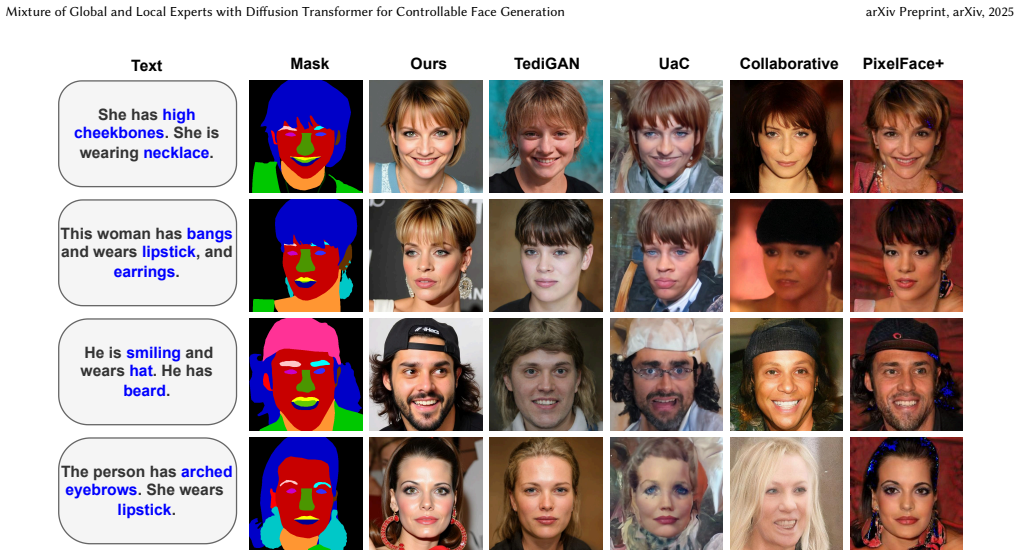
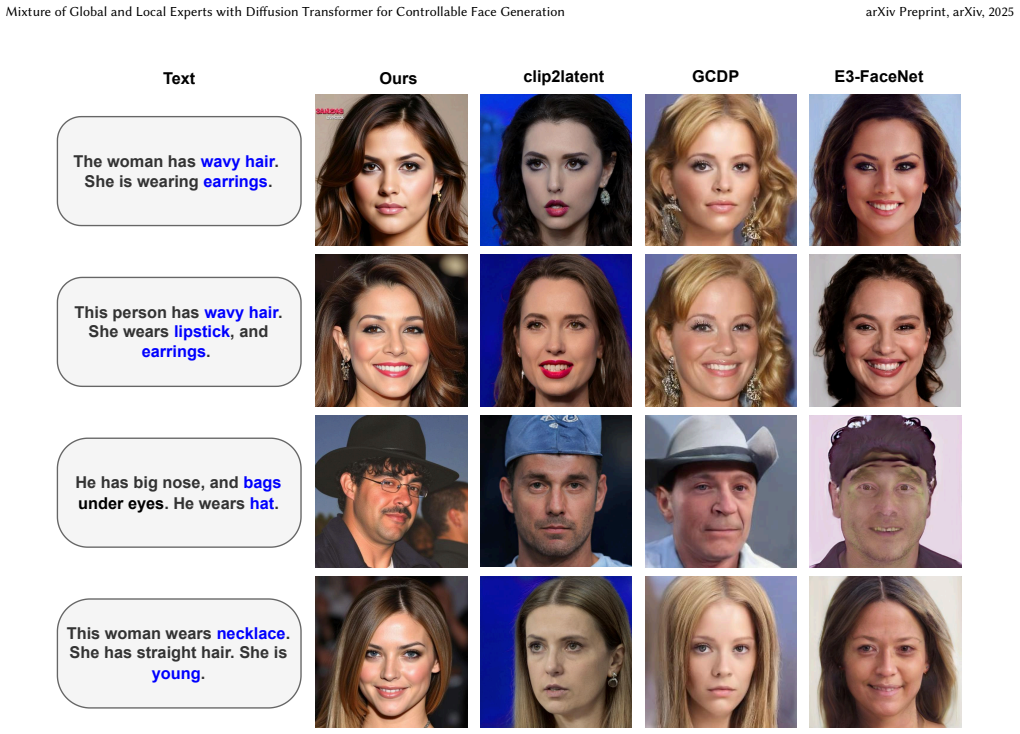
- [§4.4, Tables 1–2] The SOTA comparisons are confounded by backbone choice. Face-MoGLE LoRA-fine-tunes FLUX.1-dev, a 12B-parameter DiT pretrained on internet-scale data, while TediGAN, Collaborative, UaC, PixelFace+, and DDGI use older GANs, U-Nets, or smaller transformers. The 20+ point FID improvement on MM-CelebA-HQ and 27% FID reduction on MM-FFHQ-Female may reflect the base model’s prior rather than the proposed gating/expert architecture. Please add same-backbone controls: FLUX+LoRA with the mask injected through a standard mechanism (e.g., cross-attention adapter, ControlNet-style conditioning, or simple concatenation) under identical training data, steps, and seed. The '× ×' row of Table 5 could serve this role, but its mask-conditioning mechanism is not described. Without such a control, the central claim of architectural superiority is not established.
- [§3.2, Eq. (5)–(8); Table 5] The benefit of mask decoupling into binary components is not isolated. The ablations compare 'Only Global', 'Only Local', and 'Global & Local', but not a full-mask conditioning baseline that feeds the entire semantic mask through the same VAE encoder and the same expert/gating machinery without binary decomposition. The observed gain of the full model over 'Only Global' and 'Only Local' could come from increased condition capacity or token multiplicity rather than from semantic decoupling per se. The assumption that VAE-encoded binary masks are linearly combinable via learned gating weights is also untested. Please include a baseline that encodes the full mask as a single token sequence and applies the same gating/expert fusion, and visualize or quantitatively verify that the VAE latent preserves the binary mask’s class/spatial structure.
- [§4.3, Table 1, Table 2] The mask-consistency metric is not sufficient to support the controllability claim. 'Mask↓' is DINO Structure Distance, a self-similarity measure that does not directly assess whether the generated image respects the semantic class of each input mask region. The reported improvements (e.g., 2.44 vs. 3.22) may not reflect true semantic alignment. Please report a pixel-level mask-consistency metric such as mIoU or pixel accuracy between the input mask and the segmentation of the generated image. In addition, all FID/KID numbers come from a single fixed seed; on the 760-image MM-FFHQ-Female set FID is noisy. Report multiple seeds or bootstrap confidence intervals.
- [§3.1–3.2, Eq. (3), (7), (8)] The architecture is underspecified in ways that block reproduction. Eq. (3) lists C_m as an input to the denoiser, but the text never states how C_m enters each DiT block: cross-attention, concat with image tokens, or an additive token stream? Eq. (7) says the gating network outputs 'spatial weight maps', but their tensor shape, how softmax is applied over the n+1 experts at each spatial location, and how the maps align with the L×d token grid are not defined. The expert modules Expert_i are also not specified (MLP? attention? shared or separate parameters?). Please provide a precise forward-pass description with tensor dimensions.
minor comments (6)
- [§3.1, Eq. (1)] M is declared as R^{H×W×3}, which is unusual for a semantic mask. If it is a color-coded RGB rendering of labels, state that; if it is a class-index map, the dimensions should be H×W×C or H×W×1.
- [§3.1, text] The text encoder is said to jointly use 'CLIP and H5'; H5 is likely a typo for T5. Please correct and cite the exact T5 variant used (e.g., FLUX.1-dev’s T5-XXL).
- [§4.5.2, Table 4] The row labeled 'w/o Diffusion' is described in the text as 'static weights'; the table label is confusing. Rename to 'Static Gating' or similar.
- [Table 1, DDGI row] DDGI has missing entries for KID, CMMD, Mask, and Text. If results are copied from the original paper, state explicitly which metrics are unavailable and avoid citing an incomplete row as a comparison.
- [References] Reference [26] cites a GitHub repository without a version/commit identifier. Since FLUX is central to the method, please cite the relevant arXiv/technical report and specify the exact checkpoint and revision.
- [Figure 2] Figure 2 is captioned 'Diffusion Transformer Block' but does not show how the mask tokens, text tokens, or timestep interact with the block. A more detailed diagram would improve clarity.
Circularity Check
No significant circularity: Face-MoGLE is an empirical architecture paper whose claims rest on held-out evaluation, not on derivation-from-inputs.
full rationale
Face-MoGLE does not derive a prediction from first principles; it trains a diffusion transformer with a standard noise-prediction loss (Eq. 4) and reports metrics on held-out data. The gating network and experts are learned modules; their weights are optimized by the MSE objective, not fitted to the reported FID/KID/CMMD/mask/text metrics. The zero-shot evaluation on MM-FFHQ-Female uses a dataset not seen in training, and the ablation tables compare independently trained variants. No equation in the paper defines a predicted quantity in terms of the quantity it is supposed to validate, and no parameter is renamed as a prediction. Citations to FLUX, LoRA, and prior baselines are external works and are not used as a self-citation chain to justify the central architectural claim. Potential concerns about backbone mismatch with baselines are experimental confounds, not circularity. Therefore the paper is self-contained with respect to circularity.
Axiom & Free-Parameter Ledger
free parameters (2)
- Mask annotation threshold (OA=0.8) =
0.8
- FaRL/SegFace sampling ratio =
90% FaRL / 10% SegFace
axioms (4)
- domain assumption Pretrained FLUX.1-dev and its VAE are reliable base models for high-fidelity face synthesis.
- domain assumption Semantic masks provide a sufficient and accurate spatial control signal for face structure.
- ad hoc to paper Binary masks, when passed through the shared frozen VAE encoder, yield tokens that are linearly combinable with each other and with the image latent tokens.
- domain assumption The gating network can learn to produce appropriate spatial-temporal weights from noisy latents and the global mask token.
Cite this review
Pith. "Pith review of Mixture of Global and Local Experts with Diffusion Transformer for Controllable Face Generation." pith.science (2026). https://pith.science/paper/CIFKALGH
@misc{pith2026250900428,
  author       = {Pith},
  title        = {Pith review of: Mixture of Global and Local Experts with Diffusion Transformer for Controllable Face Generation},
  year         = {2026},
  howpublished = {\url{https://pith.science/paper/CIFKALGH}},
  note         = {Machine review of arXiv:2509.00428}
}
read the original abstract
Controllable face generation poses critical challenges in generative modeling due to the intricate balance required between semantic controllability and photorealism. While existing approaches struggle with disentangling semantic controls from generation pipelines, we revisit the architectural potential of Diffusion Transformers (DiTs) through the lens of expert specialization. This paper introduces Face-MoGLE, a novel framework featuring: (1) Semantic-decoupled latent modeling through mask-conditioned space factorization, enabling precise attribute manipulation; (2) A mixture of global and local experts that captures holistic structure and region-level semantics for fine-grained controllability; (3) A dynamic gating network producing time-dependent coefficients that evolve with diffusion steps and spatial locations. Face-MoGLE provides a powerful and flexible solution for high-quality, controllable face generation, with strong potential in generative modeling and security applications. Extensive experiments demonstrate its effectiveness in multimodal and monomodal face generation settings and its robust zero-shot generalization capability. Project page is available at https://github.com/XavierJiezou/Face-MoGLE.
Figures





Reference graph
Works this paper leans on
-
[1]
Lalith Bharadwaj Baru, Rohit Boddeda, Shilhora Akshay Patel, and Sai Mohan Gajapaka. 2025. Wavelet-Driven Generalizable Framework for Deepfake Face Forgery Detection. In W ACV. 1661–1669
work page 2025
-
[2]
Sutherland, Michael Arbel, and Arthur Gretton
Mikołaj Bińkowski, Dougal J. Sutherland, Michael Arbel, and Arthur Gretton
-
[3]
Bocheng, YuhangMa, wuliebucha, Shanyuan Liu, Ao Ma, Xiaoyu Wu, Dawei Leng, and Yuhui Yin. 2024. HiCo: Hierarchical Controllable Diffusion Model for Layout-to-image Generation. In NeurIPS
work page 2024
-
[4]
Tim Brooks, Aleksander Holynski, and Alexei A Efros. 2023. Instructpix2pix: Learning to follow image editing instructions. In CVPR. 18392–18402
work page 2023
-
[5]
Mathilde Caron, Hugo Touvron, Ishan Misra, Hervé Jégou, Julien Mairal, Piotr Bojanowski, and Armand Joulin. 2021. Emerging Properties in Self-Supervised Vision Transformers. In ICCV. 9650–9660
work page 2021
-
[6]
Prafulla Dhariwal and Alexander Nichol. 2021. Diffusion models beat gans on image synthesis. In NeurIPS, Vol. 34. 8780–8794
work page 2021
-
[7]
Alexey Dosovitskiy, Lucas Beyer, Alexander Kolesnikov, Dirk Weissenborn, Xi- aohua Zhai, Thomas Unterthiner, Mostafa Dehghani, Matthias Minderer, Georg Heigold, Sylvain Gelly, Jakob Uszkoreit, and Neil Houlsby. 2021. An Image is Worth 16x16 Words: Transformers for Image Recognition at Scale. InICLR. 1–21
work page 2021
-
[8]
Xiaoxiong Du, Jun Peng, Yiyi Zhou, Jinlu Zhang, Siting Chen, Guannan Jiang, Xiaoshuai Sun, and Rongrong Ji. 2023. PixelFace+: Towards Controllable Face Generation and Manipulation with Text Descriptions and Segmentation Masks. In ACM MM. 4666–4677
work page 2023
-
[9]
Patrick Esser, Sumith Kulal, Andreas Blattmann, Rahim Entezari, Jonas Müller, Harry Saini, Yam Levi, Dominik Lorenz, Axel Sauer, Frederic Boesel, Dustin Podell, Tim Dockhorn, Zion English, and Robin Rombach. 2024. Scaling rectified flow transformers for high-resolution image synthesis. In ICML. 28 pages
work page 2024
-
[10]
William Fedus, Barret Zoph, and Noam Shazeer. 2022. Switch Transformers: Scaling to Trillion Parameter Models with Simple and Efficient Sparsity. JMLR 23, 120 (2022), 1–39
work page 2022
-
[11]
Erik Härkönen, Aaron Hertzmann, Jaakko Lehtinen, and Sylvain Paris. 2020. Ganspace: Discovering interpretable gan controls. InNeurIPS, Vol. 33. 9841–9850
work page 2020
-
[12]
Martin Heusel, Hubert Ramsauer, Thomas Unterthiner, Bernhard Nessler, and Sepp Hochreiter. 2017. GANs trained by a two time-scale update rule converge to a local nash equilibrium. In NeurIPS. 6629–6640
work page 2017
-
[13]
Jonathan Ho, Ajay Jain, and Pieter Abbeel. 2020. Denoising diffusion probabilistic models. In NeurIPS, Vol. 33. 6840–6851
work page 2020
-
[14]
Jonathan Ho and Tim Salimans. 2021. Classifier-Free Diffusion Guidance. In NeurIPS. 1–8
work page 2021
-
[15]
Fangzhou Hong, Mingyuan Zhang, Liang Pan, Zhongang Cai, Lei Yang, and Ziwei Liu. 2022. AvatarCLIP: Zero-Shot Text-Driven Generation and Animation of 3D Avatars. TOG 41, 4, Article 161 (2022), 19 pages
work page 2022
-
[16]
Edward J Hu, Yelong Shen, Phillip Wallis, Zeyuan Allen-Zhu, Yuanzhi Li, Shean Wang, Lu Wang, and Weizhu Chen. 2022. LoRA: Low-Rank Adaptation of Large Language Models. In ICLR. 1–13
work page 2022
-
[17]
Ziqi Huang, Kelvin CK Chan, Yuming Jiang, and Ziwei Liu. 2023. Collaborative diffusion for multi-modal face generation and editing. In CVPR. 6080–6090
work page 2023
-
[18]
Robert A Jacobs, Michael I Jordan, Steven J Nowlan, and Geoffrey E Hinton. 1991. Adaptive mixtures of local experts. Neural computation 3, 1 (1991), 79–87
1991
-
[19]
Sadeep Jayasumana, Srikumar Ramalingam, Andreas Veit, Daniel Glasner, Ayan Chakrabarti, and Sanjiv Kumar. 2024. Rethinking FID: Towards a Better Evalua- tion Metric for Image Generation . In CVPR. 9307–9315
work page 2024
-
[20]
Tero Karras, Timo Aila, Samuli Laine, and Jaakko Lehtinen. 2018. Progressive Growing of GANs for Improved Quality, Stability, and Variation. InICLR
work page 2018
-
[21]
Tero Karras, Samuli Laine, and Timo Aila. 2019. A style-based generator archi- tecture for generative adversarial networks. In CVPR. 4401–4410
work page 2019
-
[22]
Tero Karras, Samuli Laine, and Timo Aila. 2019. A Style-Based Generator Archi- tecture for Generative Adversarial Networks. In CVPR. 4401–4410
work page 2019
-
[23]
Jihyun Kim, Changjae Oh, Hoseok Do, Soohyun Kim, and Kwanghoon Sohn
-
[24]
Durk P Kingma and Prafulla Dhariwal. 2018. Glow: Generative flow with invert- ible 1x1 convolutions. In NeurIPS, Vol. 31. 1–10
work page 2018
-
[25]
Diederik P Kingma and Max Welling. 2014. Auto-encoding variational{Bayes}. In ICLR. 1–14
work page 2014
-
[26]
Black Forest Labs. 2024. FLUX. https://github.com/black-forest-labs/flux
2024
-
[27]
Cheng-Han Lee, Ziwei Liu, Lingyun Wu, and Ping Luo. 2020. Maskgan: Towards diverse and interactive facial image manipulation. In CVPR. 5549–5558
work page 2020
-
[28]
Dmitry Lepikhin, HyoukJoong Lee, Yuanzhong Xu, Dehao Chen, Orhan Firat, Yanping Huang, Maxim Krikun, Noam Shazeer, and Zhifeng Chen. 2021. {GS}hard: Scaling Giant Models with Conditional Computation and Automatic Sharding. In ICLR. 1–23
work page 2021
-
[29]
Fang Liu, Xiaoming Deng, Yu-Kun Lai, Yong-Jin Liu, Cuixia Ma, and Hongan Wang. 2019. SketchGAN: Joint Sketch Completion and Recognition With Gener- ative Adversarial Network. In CVPR
work page 2019
-
[30]
Debin Meng, Christos Tzelepis, Ioannis Patras, and Georgios Tzimiropoulos
-
[31]
Konstantin Mishchenko and Aaron Defazio. 2024. Prodigy: An Expeditiously Adaptive Parameter-Free Learner. In ICML. 35779–35804
work page 2024
-
[32]
Chong Mou, Xintao Wang, Liangbin Xie, Yanze Wu, Jian Zhang, Zhongang Qi, and Ying Shan. 2024. T2i-adapter: Learning adapters to dig out more controllable ability for text-to-image diffusion models. In AAAI, Vol. 38. 4296–4304
work page 2024
-
[33]
MM2Latent: Text-to-facial image generation and editing in GANs with multimodal assistance. In ECCV. 1–20
-
[34]
Kartik Narayan, Vibashan VS, and Vishal M Patel. 2024. Segface: Face segmenta- tion of long-tail classes. arXiv preprint arXiv:2412.08647 (2024)
Pith/arXiv arXiv 2024
-
[35]
Alexander Quinn Nichol and Prafulla Dhariwal. 2021. Improved denoising diffu- sion probabilistic models. In ICML. 8162–8171
work page 2021
-
[36]
Nithin Gopalakrishnan Nair, Wele Gedara Chaminda Bandara, and Vishal M Patel
-
[37]
Or Patashnik, Zongze Wu, Eli Shechtman, Daniel Cohen-Or, and Dani Lischinski
-
[38]
William Peebles and Saining Xie. 2023. Scalable diffusion models with transform- ers. In ICCV. 4195–4205
work page 2023
-
[39]
Justin N. M. Pinkney and Chuan Li. 2022. clip2latent: Text driven sampling of a pre-trained StyleGAN using denoising diffusion and CLIP. In BMVC. 1–12
work page 2022
-
[40]
Minho Park, Jooyeol Yun, Seunghwan Choi, and Jaegul Choo. 2023. Learning to generate semantic layouts for higher text-image correspondence in text-to-image synthesis. In ICCV. 7591–7600
work page 2023
-
[41]
Alec Radford, Jong Wook Kim, Chris Hallacy, Aditya Ramesh, Gabriel Goh, Sandhini Agarwal, Girish Sastry, Amanda Askell, Pamela Mishkin, Jack Clark, Gretchen Krueger, and Ilya Sutskever. 2021. Learning Transferable Visual Models From Natural Language Supervision. In ICML, Vol. 139. 8748–8763
work page 2021
-
[42]
Colin Raffel, Noam Shazeer, Adam Roberts, Katherine Lee, Sharan Narang, Michael Matena, Yanqi Zhou, Wei Li, and Peter J. Liu. 2020. Exploring the Limits of Transfer Learning with a Unified Text-to-Text Transformer.JMLR 21, 140 (2020), 1–67
work page 2020
-
[43]
Carlos Riquelme, Joan Puigcerver, Basil Mustafa, Maxim Neumann, Rodolphe Jenatton, André Susano Pinto, Daniel Keysers, and Neil Houlsby. 2021. Scaling vision with sparse mixture of experts. In NeurIPS, Vol. 34. 8583–8595
work page 2021
-
[44]
Robin Rombach, Andreas Blattmann, Dominik Lorenz, Patrick Esser, and Björn Ommer. 2022. High-Resolution Image Synthesis With Latent Diffusion Models. In CVPR. 10684–10695
work page 2022
-
[45]
Namboodiri, and C.V
K R Prajwal, Rudrabha Mukhopadhyay, Vinay P. Namboodiri, and C.V. Jawahar
-
[46]
Noam Shazeer, *Azalia Mirhoseini, *Krzysztof Maziarz, Andy Davis, Quoc Le, Geoffrey Hinton, and Jeff Dean. 2017. Outrageously Large Neural Networks: The Sparsely-Gated Mixture-of-Experts Layer. In ICLR. 1–19
work page 2017
-
[47]
Jascha Sohl-Dickstein, Eric Weiss, Niru Maheswaranathan, and Surya Ganguli
-
[48]
Jiaming Song, Chenlin Meng, and Stefano Ermon. 2021. Denoising Diffusion Implicit Models. In ICLR. 1–20
work page 2021
-
[49]
Chuangchuang Tan, Yao Zhao, Shikui Wei, Guanghua Gu, Ping Liu, and Yunchao Wei. 2024. Rethinking the up-sampling operations in cnn-based generative network for generalizable deepfake detection. In CVPR. 28130–28139
work page 2024
-
[50]
Zhentao Tan, Menglei Chai, Dongdong Chen, Jing Liao, Qi Chu, Bin Liu, Gang Hua, and Nenghai Yu. 2021. Diverse semantic image synthesis via probability distribution modeling. In CVPR. 7962–7971
work page 2021
-
[51]
Olaf Ronneberger, Philipp Fischer, and Thomas Brox. 2015. U-net: Convolutional networks for biomedical image segmentation. In MICCAI. 234–241
work page 2015
-
[52]
Hao Tang, Dan Xu, Yan Yan, Philip H.S. Torr, and Nicu Sebe. 2020. Local Class- Specific and Global Image-Level Generative Adversarial Networks for Semantic- Guided Scene Generation. In CVPR. 7870–7879
work page 2020
-
[53]
Aaron van den Oord, Oriol Vinyals, and Koray Kavukcuoglu. 2017. Neural discrete representation learning. In NeurIPS. 6309–6318
work page 2017
-
[54]
Chaoyang Wang, Xiangtai Li, Lu Qi, Henghui Ding, Yunhai Tong, and Ming- Hsuan Yang. 2024. Semflow: Binding semantic segmentation and image synthesis via rectified flow. In NeurIPS, Vol. 37. 138981–139001
work page 2024
-
[55]
Tianyi Wei, Dongdong Chen, Wenbo Zhou, Jing Liao, Weiming Zhang, Lu Yuan, Gang Hua, and Nenghai Yu. 2022. E2Style: Improve the efficiency and effective- ness of StyleGAN inversion. TIP 31 (2022), 3267–3280
work page 2022
-
[56]
Weihao Xia, Yujiu Yang, Jing-Hao Xue, and Baoyuan Wu. 2021. Tedigan: Text- guided diverse face image generation and manipulation. In CVPR. 2256–2265
work page 2021
-
[57]
Jiazheng Xu, Xiao Liu, Yuchen Wu, Yuxuan Tong, Qinkai Li, Ming Ding, Jie Tang, and Yuxiao Dong. 2023. ImageReward: Learning and Evaluating Human Preferences for Text-to-Image Generation. In NeurIPS, Vol. 36. 15903–15935. arXiv Preprint, arXiv, 2025 Zou et al
work page 2023
-
[58]
Zhenxiong Tan, Songhua Liu, Xingyi Yang, Qiaochu Xue, and Xinchao Wang
-
[59]
arXiv preprint arXiv:2411.15098 3 (2024)
Ominicontrol: Minimal and universal control for diffusion transformer. arXiv preprint arXiv:2411.15098 3 (2024)
Pith/arXiv arXiv 2024
-
[60]
Jinlu Zhang, Yiyi Zhou, Qiancheng Zheng, Xiaoxiong Du, Gen Luo, Jun Peng, Xiaoshuai Sun, and Rongrong Ji. 2024. Fast text-to-3D-aware face generation and manipulation via direct cross-modal mapping and geometric regularization. In ICML. 60605–60625
work page 2024
-
[61]
Kai Zhang, Yawei Li, Wangmeng Zuo, Lei Zhang, Luc Van Gool, and Radu Timofte
-
[62]
Lvmin Zhang, Anyi Rao, and Maneesh Agrawala. 2023. Adding conditional control to text-to-image diffusion models. In ICCV. 3836–3847
2023
-
[63]
Yinglin Zheng, Hao Yang, Ting Zhang, Jianmin Bao, Dongdong Chen, Yangyu Huang, Lu Yuan, Dong Chen, Ming Zeng, and Fang Wen. 2022. General facial representation learning in a visual-linguistic manner. In CVPR. 18697–18709
work page 2022
-
[64]
Yutong Zhou. 2021. Generative adversarial network for text-to-face synthesis and manipulation. In ACM MM. 2940–2944. A Societal Impacts and Responsible AI Our research focuses on controllable face generation, based on a diffusion transformer architecture combined with a mixture of global and local experts, aiming to support a variety of optimistic applica...
work page 2021
-
[66]
Sicheng Xu, Guojun Chen, Yu-Xiao Guo, Jiaolong Yang, Chong Li, Zhenyu Zang, Yizhong Zhang, Xin Tong, and Baining Guo. 2024. Vasa-1: Lifelike audio-driven talking faces generated in real time. In NeurIPS, Vol. 37. 660–684
work page 2024
-
[67]
Hu Ye, Jun Zhang, Sibo Liu, Xiao Han, and Wei Yang. 2023. Ip-adapter: Text compatible image prompt adapter for text-to-image diffusion models. arXiv preprint arXiv:2308.06721 (2023)
Pith/arXiv arXiv 2023
-
[2015]
Deep unsupervised learning using nonequilibrium thermodynamics. In ICML. 2256–2265
-
[2018]
Demystifying MMD GANs. In ICLR. 1–36
- [2020]
-
[2021]
Styleclip: Text-driven manipulation of stylegan imagery. In ICCV. 2085– 2094
work page 2085
-
[2022]
TPAMI 44, 10 (2022), 6360–6376
Plug-and-Play Image Restoration With Deep Denoiser Prior. TPAMI 44, 10 (2022), 6360–6376
work page 2022
-
[2023]
Unite and conquer: Plug & play multi-modal synthesis using diffusion models. In CVPR. 6070–6079
-
[2024]
Diffusion-driven gan inversion for multi-modal face image generation. In CVPR. 10403–10412
This paper was first reviewed by deepseek-v4-flash on August 5, 2026.
discussion (0)
Sign in with ORCID, Apple, or X to comment. Anyone can read and Pith papers without signing in.