REVIEW 3 major objections 6 minor 35 references
TECP: Token-Entropy Conformal Prediction for LLMs
T0 review · 3 major / 6 minor · reviewed 2026-08-05 · deepseek-v4-flash
Pith's one-line read TECP claims that token entropy, calibrated with conformal quantiles, constructs LLM answer sets whose coverage is at least 1−α.
desk verdict The TECP coverage guarantee doesn't survive contact with the paper's own procedure: the calibration scores are not one per exchangeable unit, so the split-CP quantile controls the wrong event, and the 'logit-free' claim is contradicted by Eq. (4). read the letter →
The pith
A machine-rendered reading of the paper's core claim, the machinery that carries it, and where it could break.
The reading
What carries the argument
The central object is the token-entropy nonconformity score, U(ŷ_m) = −Σ_t Σ_v p_t(v) log p_t(v), combined with the split-conformal quantile threshold of Eq. (6). The score ranks candidate answers by the model's internal predictive uncertainty, and the quantile calibration converts that ranking into a set with an error-rate interpretation. The paper claims this machinery is logit-free and reference-free, though Eq. (4) actually requires access to the token predictive distribution.
What would settle it
Run TECP on a benchmark where the proportion of questions with no semantically correct candidate differs sharply between calibration and test splits, and compare realized coverage to 1−α. If coverage falls below 1−α when test questions without a correct candidate are included, the stated unconditional guarantee is false; if coverage only holds after filtering those test questions out, the guarantee is conditional, not the nominal one claimed.
Extended reading notes
Core claim
The paper's central claim is that token-level cumulative entropy is a better nonconformity score for LLM prediction sets than frequency-based semantic consistency, and that plugging it into split conformal prediction gives formal coverage guarantees. Concretely, for each sampled candidate ŷ_m the uncertainty score is U(ŷ_m) = −Σ_t Σ_v p_t(v) log p_t(v), the summed entropy of the model's predictive distribution over tokens. The calibration set contributes one entropy score per semantically correct candidate, the threshold q̂_α is the higher-interpolated ⌈(1−α)(n+1)⌉-th order statistic, and a test candidate enters the prediction set when its entropy is at most q̂_α. The paper asserts that by c
Load-bearing premise
The coverage guarantee holds only if the empirical quantile of per-candidate entropy scores from calibration examples that passed the semantic filter controls the probability that a test prediction set contains at least one correct candidate; the paper asserts this by construction without deriving it from the standard split-conformal exchangeability condition.
Editorial extensions
If this is right
- A user can set an allowable error rate α and receive a set of candidate answers whose miscoverage is nominally at most α, under the stated exchangeability and filtering assumptions.
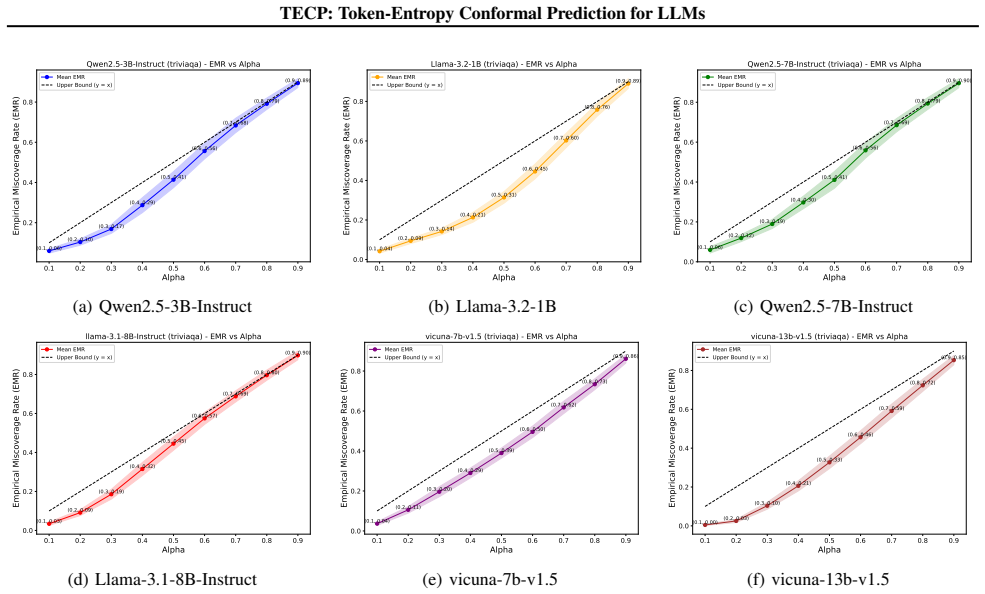
- Prediction-set size becomes a meaningful uncertainty signal: larger sets signal lower confidence, smaller sets signal higher confidence, and the size shrinks monotonically with α in the reported results.
- The method transfers across model families and scales without retraining or internal hidden-state access, as long as token-level probabilities are obtainable.
- TECP's empirical coverage is more stable across random calibration-test splits than the ConU baseline, which the paper attributes to token entropy avoiding the hallucination bias of frequency-based scores.
- In high-stakes QA applications, TECP would replace heuristic confidence scores with a threshold that carries a statistical coverage guarantee.
Reading between the lines
- Because calibration collects one score per semantically correct candidate while the test event is 'the set contains at least one correct candidate,' the coverage argument is not the standard split-conformal one; a rigorous exchangeability-based guarantee would require one score per example, and the paper does not supply that derivation.
- A genuinely logit-free implementation would need to estimate token entropy from sampling statistics rather than from p_t(v); the paper's Eq. (4) does not provide such an estimate.
- The calibration set is filtered to 'assessable' samples via a semantic threshold τ, which makes the guarantee conditional on a question having a correct candidate; applying the same quantile to test questions that may be unassessable is an extrapolation worth testing explicitly.
- A testable extension would apply TECP under distribution shift or non-exchangeable data and check whether weighted conformal corrections, as developed in the beyond-exchangeability literature, are needed to preserve coverage.
Editorial analysis
A structured set of objections, weighed in public.
Referee Report
Summary. TECP proposes to build prediction sets for open-ended LLM question answering by combining token-level entropy as a nonconformity score with split conformal prediction. For each input, M candidate outputs are generated; the uncertainty score U(ŷ_m) is defined either as a semantic-consistency combination (Eq. 3) or as cumulative token entropy (Eq. 4). Calibration examples are first filtered to those containing at least one semantically correct candidate, the nonconformity multiset R in Eq. (5) collects the scores of all semantically correct candidates, and the threshold q̂_α is the empirical quantile of R (Eq. 6). A test prediction set Γ(x) consists of all candidates whose score is at most q̂_α (Eq. 7). The paper claims that, by construction, Γ(x) has nominal coverage at least 1−α under standard exchangeability assumptions. Experiments on TriviaQA and CoQA with six open LLMs compare TECP with ConU in terms of empirical miscoverage rate and average prediction set size.
Significance. The paper targets a real problem: providing finite-sample risk control for free-form LLM outputs rather than relying on heuristic uncertainty scores. The experimental scope—six models, two QA benchmarks, comparison to a recent conformal baseline—is commendable, and the authors correctly identify that held-out calibration, rather than test-set reuse, is needed. However, the central formal claim is not established. The construction in §3.3 is not a valid split-conformal argument: the calibration multiset contains multiple dependent scores per unit, and the filtering step conditions on ground truth. In addition, the abstract's logit-free/black-box claim is contradicted by Eq. (4), which requires the model's full per-token predictive distribution. Because the coverage guarantee is the paper's main selling point, the current manuscript does not support its stated contribution.
major comments (3)
- [§3.3, Eqs (5)–(7)] The nominal coverage claim does not follow from split conformal prediction. R in Eq. (5) contains one score for every semantically correct candidate, so a calibration unit (x_i, y*_i) contributes K_i dependent scores that share both the input and the ground truth; n=|R| is not the number of exchangeable units. The standard split-CP quantile lemma requires one exchangeable score per calibration unit and controls a single-score event. In contrast, Eq. (7) requires the union event 'at least one correct candidate has U ≤ q̂_α' over K_test dependent scores, and the filtering step into D_filtered conditions on ground truth via τ. A concrete failure shows the threshold can be biased: exchangeable units with two correct candidates of score 0.4 with probability 0.4 and one correct candidate of score 0.6 with probability 0.6 yield R with about 57% scores 0.4, so q̂=0.4 at α=0.5, but only 40% of te
- [§3.1 Eq. (2) vs §3.3 Eq. (7)] There is a mismatch between the formal coverage event and the evaluated event. Eq. (2) promises P(y* ∈ Γ(x)) ≥ 1−α, but Γ(x) in Eq. (7) is a subset of sampled candidates, and the reference answer y* is not itself a generated candidate. The experiments instead evaluate EMR, defined as containment of at least one output whose semantic similarity to y* exceeds a threshold (0.7 in §4.1), while the calibration multiset in Eq. (5) uses 'semantically correct' candidates with an unspecified matching threshold. These are different events, and the guarantee in Eq. (2) is therefore vacuous or misstated. The paper should define the target event explicitly and state any conditioning, e.g., restriction to assessable test examples.
- [Abstract/§3.2 Eq. (4)/Limitations] The paper's headline claim that token entropy is 'logit-free' and suitable for black-box LLM access is contradicted by Eq. (4), which requires p_t(v), the model's predictive distribution over the vocabulary at every token position. That is exactly the kind of internal probability signal the abstract says is inaccessible. The Limitations section concedes this: it describes the approach as a 'white-box conformal prediction framework' relying on 'uncertainty scores derived from model output probabilities.' This contradiction undermines the stated contribution; either the black-box/logit-free claim must be removed, or the scoring function must be replaced with one computable from sampled text alone.
minor comments (6)
- [Abstract] The first sentence says 'internal model signals are accessible' under black-box constraints; this should presumably read 'inaccessible.' Also, 'episodic uncertainty' in the abstract appears to be a typo for 'epistemic uncertainty.'
- [§3.2, Eqs (3)–(4)] U(ŷ_m) is defined twice with different meanings: Eq. (3) is a convex combination of semantic-consistency frequency and average similarity, while Eq. (4) is cumulative token entropy. The relationship between these definitions and which one is used in the experiments should be clarified.
- [§4.3] The ablation study is described as varying the calibration–test split ratio (0.3, 0.5, 0.7), but the text refers to Figures 1 and 3, which show alpha variation rather than split-ratio variation. The actual ablation results appear to be missing or unreferenced.
- [§4.1 and Figures 1–4] The acronym EMR is defined as 'Expected Metric Recall' in the metrics list but labeled 'Empirical Miscoverage Rate' in the figures. These are different quantities; the notation should be made consistent.
- [§4.1, Table 1] Table 1 reports average prediction set sizes without standard deviations, confidence intervals, or the number of test examples, despite the text claiming stability across random seeds. This weakens the empirical comparison.
- [§4.1] Reproducibility details are incomplete: the sampling size M=10 is mentioned, but temperature, top-p, number of calibration samples, and the exact split ratios used in the main experiments are not specified.
Circularity Check
No significant circularity: TECP follows the standard split-CP calibration protocol, and its central coverage claim, while statistically unsupported, does not reduce to its inputs by construction.
full rationale
The paper's threshold is computed on a held-out calibration split and applied to a separate test split, with coverage evaluated on test data. This is the standard conformal prediction protocol, not a circular reuse of the test set or a fitted parameter renamed as a prediction. The main formal problem is that Eq. (5) pools multiple dependent nonconformity scores per calibration unit and conditions on ground-truth correctness via the threshold τ, so the exchangeability argument for the stated coverage guarantee is not valid; however, this is a statistical flaw, not a circularity. Additional inconsistencies — Eq. (3) defining uncertainty via semantic consistency versus Eq. (4) using token-level entropy, and the abstract's 'logit-free' claim contradicted by Eq. (4) and the Limitations section's admission of white-box reliance on output probabilities — are internal contradictions rather than circular reductions. No load-bearing self-citations or imported uniqueness theorems appear. Under the specified rules, a non-circular but flawed derivation should receive a low circularity score.
Assumptions & free parameters
free parameters (4)
- lambda (Eq 3)
- tau_filter (Section 3.3 step 1) =
0.8-0.9
- tau_correct (Section 4.1) =
0.7
- M (Section 3.1) =
10
assumptions (5)
- standard math Calibration and test examples are exchangeable
- domain assumption Token-level predictive distribution p_t(v) is available
- ad hoc to paper Quantile of correct-candidate scores yields coverage of a correct candidate in the test set
- domain assumption Filtering to assessable samples preserves the coverage guarantee
- domain assumption DistillRoBERTa cross-encoder at threshold 0.7 correctly identifies semantic correctness
Cite this review
Pith. "Pith review of TECP: Token-Entropy Conformal Prediction for LLMs." pith.science (2026). https://pith.science/paper/FT7VHKTE
@misc{pith2026250900461,
  author       = {Pith},
  title        = {Pith review of: TECP: Token-Entropy Conformal Prediction for LLMs},
  year         = {2026},
  howpublished = {\url{https://pith.science/paper/FT7VHKTE}},
  note         = {Machine review of arXiv:2509.00461}
}
read the original abstract
Uncertainty quantification (UQ) for open-ended language generation remains a critical yet underexplored challenge, especially under black-box constraints where internal model signals are inaccessible. In this paper, we introduce Token-Entropy Conformal Prediction (TECP), a novel framework that leverages token-level entropy as a logit-free, reference-free uncertainty measure and integrates it into a split conformal prediction (CP) pipeline to construct prediction sets with formal coverage guarantees. Unlike existing approaches that rely on semantic consistency heuristics or white-box features, TECP directly estimates epistemic uncertainty from the token entropy structure of sampled generations and calibrates uncertainty thresholds via CP quantiles to ensure provable error control. Empirical evaluations across six large language models and two benchmarks (CoQA and TriviaQA) demonstrate that TECP consistently achieves reliable coverage and compact prediction sets, outperforming prior self-consistency-based UQ methods. Our method provides a principled and efficient solution for trustworthy generation in black-box LLM settings.
Figures


Figures from the paper (2 more)


Reference graph
Works this paper leans on
-
[1]
write newline
" write newline "" before.all 'output.state := FUNCTION n.dashify 't := "" t empty not t #1 #1 substring "-" = t #1 #2 substring "--" = not "--" * t #2 global.max substring 't := t #1 #1 substring "-" = "-" * t #2 global.max substring 't := while if t #1 #1 substring * t #2 global.max substring 't := if while FUNCTION format.date year duplicate empty "emp...
-
[2]
Angelopoulos, A. N., Bates, S., et al. Conformal prediction: A gentle introduction. Foundations and trends in machine learning , 2023
work page 2023
-
[3]
Barber, R. F., Candes, E. J., Ramdas, A., and Tibshirani, R. J. Conformal prediction beyond exchangeability. The Annals of Statistics, 2023
work page 2023
-
[4]
Does machine unlearning truly remove model knowledge? a framework for auditing unlearning in llms
Chen, H., Zhang, Y., Bi, Y., Zhang, Y., Liu, T., Bi, J., Lan, J., Gu, J., Grosser, C., Krompass, D., et al. Does machine unlearning truly remove model knowledge? a framework for auditing unlearning in llms. arXiv preprint arXiv:2505.23270, 2025
-
[5]
Can llms’ tuning methods work in medical multimodal domain? In MICCAI, 2024 a
Chen, J., Jiang, Y., Yang, D., Li, M., Wei, J., Qian, Z., and Zhang, L. Can llms’ tuning methods work in medical multimodal domain? In MICCAI, 2024 a
work page 2024
-
[6]
Miss: A generative pre-training and fine-tuning approach for med-vqa
Chen, J., Yang, D., Jiang, Y., Lei, Y., and Zhang, L. Miss: A generative pre-training and fine-tuning approach for med-vqa. In International Conference on Artificial Neural Networks, 2024 b
work page 2024
-
[7]
Detecting and evaluating medical hallucinations in large vision language models
Chen, J., Yang, D., Wu, T., Jiang, Y., Hou, X., Li, M., Wang, S., Xiao, D., Li, K., and Zhang, L. Detecting and evaluating medical hallucinations in large vision language models. arXiv preprint arXiv:2406.10185, 2024 c
arXiv 2024
-
[8]
Duan, J., Cheng, H., Wang, S., Zavalny, A., Wang, C., Xu, R., Kailkhura, B., and Xu, K. Shifting attention to relevance: Towards the predictive uncertainty quantification of free-form large language models. In Proceedings of the 62nd Annual Meeting of the Association for Computational Linguistics (Volume 1: Long Papers), 2024
work page 2024
Show all 35 references
-
[9]
Detecting hallucinations in large language models using semantic entropy
Farquhar, S., Kossen, J., Kuhn, L., and Gal, Y. Detecting hallucinations in large language models using semantic entropy. Nature, 2024
2024
-
[10]
A survey on hallucination in large language models: Principles, taxonomy, challenges, and open questions
Huang, L., Yu, W., Ma, W., Zhong, W., Feng, Z., Wang, H., Chen, Q., Peng, W., Feng, X., Qin, B., et al. A survey on hallucination in large language models: Principles, taxonomy, challenges, and open questions. ACM Transactions on Information Systems, 2025
2025
-
[11]
and Mazoyer, A
Iutzeler, F. and Mazoyer, A. Risk-controlling prediction with distributionally robust optimization. Transactions on Machine Learning Research, 2025. ISSN 2835-8856
2025
-
[12]
Comt: Chain-of-medical-thought reduces hallucination in medical report generation
Jiang, Y., Chen, J., Yang, D., Li, M., Wang, S., Wu, T., Li, K., and Zhang, L. Comt: Chain-of-medical-thought reduces hallucination in medical report generation. In ICASSP 2025-2025 IEEE International Conference on Acoustics, Speech and Signal Processing (ICASSP). IEEE
2025
-
[13]
R., Showk, S., et al
Kadavath, S., Conerly, T., Askell, A., Henighan, T., Drain, D., Perez, E., Schiefer, N., Dodds, Z., German, M., Johnston, S., Kravec, S., Lovitt, L. R., Showk, S., et al. Language models (mostly) know what they know. arXiv preprint arXiv:2207.05221, 2022
2022 arXiv
-
[14]
Semantic uncertainty: Linguistic invariances for uncertainty estimation in natural language generation
Kuhn, L., Gal, Y., and Farquhar, S. Semantic uncertainty: Linguistic invariances for uncertainty estimation in natural language generation. In The Eleventh International Conference on Learning Representations, 2023
2023
-
[15]
Knowledge graphs, large language models, and hallucinations: An nlp perspective
Lavrinovics, E., Biswas, R., Bjerva, J., and Hose, K. Knowledge graphs, large language models, and hallucinations: An nlp perspective. Journal of Web Semantics, 2025
2025
-
[16]
Truthfulqa: Measuring how models mimic human falsehoods
Lin, S., Hilton, J., and Evans, O. Truthfulqa: Measuring how models mimic human falsehoods. In Proceedings of the 60th Annual Meeting of the Association for Computational Linguistics (Volume 1: Long Papers), 2022
2022
-
[17]
Mv-debate: Multi-view agent debate with dynamic reflection gating for multimodal harmful content detection in social media
Lu, R., Bi, J., Ma, Y., Xiao, F., Du, Y., and Tian, Y. Mv-debate: Multi-view agent debate with dynamic reflection gating for multimodal harmful content detection in social media. arXiv preprint arXiv:2508.05557, 2025
2025 arXiv
-
[18]
and Gales, M
Malinin, A. and Gales, M. Uncertainty estimation in autoregressive structured prediction. In International Conference on Learning Representations, 2021
2021
-
[19]
and Calderon-Ramirez, S
Mora-Cross, M. and Calderon-Ramirez, S. Uncertainty estimation in large language models to support biodiversity conservation. In Proceedings of the 2024 Conference of the North American Chapter of the Association for Computational Linguistics: Human Language Technologies (Volu...
2024
-
[20]
Conformal prediction with cellwise outliers: A detect-then-impute approach
Peng, Q., Bao, Y., Ren, H., Wang, Z., and Zou, C. Conformal prediction with cellwise outliers: A detect-then-impute approach. In Forty-second International Conference on Machine Learning, 2025
2025
-
[21]
and Miikkulainen, R
Qiu, X. and Miikkulainen, R. Semantic density: Uncertainty quantification for large language models through confidence measurement in semantic space. Advances in neural information processing systems, 2024
2024
-
[22]
Backdoor cleaning without external guidance in mllm fine-tuning
Rong, X., Huang, W., Liang, J., Bi, J., Xiao, X., Li, Y., Du, B., and Ye, M. Backdoor cleaning without external guidance in mllm fine-tuning. arXiv preprint arXiv:2505.16916, 2025
2025 arXiv
-
[23]
Snell, J. C. and Griffiths, T. L. Conformal prediction as bayesian quadrature. In Forty-second International Conference on Machine Learning, 2025
2025
-
[24]
Large language models: A comprehensive survey on architectures, applications, and challenges
Veeramachaneni, V. Large language models: A comprehensive survey on architectures, applications, and challenges. Advanced Innovations in Computer Programming Languages, 2025
2025
-
[25]
Uncertainty quantification for safe and reliable autonomous vehicles: A review of methods and applications
Wang, K., Shen, C., Li, X., and Lu, J. Uncertainty quantification for safe and reliable autonomous vehicles: A review of methods and applications. IEEE Transactions on Intelligent Transportation Systems, 2025 a
2025
-
[26]
Sample then identify: A general framework for risk control and assessment in multimodal large language models
Wang, Q., Geng, T., Wang, Z., Wang, T., Fu, B., and Zheng, F. Sample then identify: A general framework for risk control and assessment in multimodal large language models. In The Thirteenth International Conference on Learning Representations, 2025 b
2025
-
[27]
Ascd: Attention-steerable contrastive decoding for reducing hallucination in mllm
Wang, Y., Bi, J., Ma, Y., and Pirk, S. Ascd: Attention-steerable contrastive decoding for reducing hallucination in mllm. arXiv preprint arXiv:2506.14766, 2025 c
2025 arXiv
-
[28]
Machinery multimodal uncertainty-aware rul prediction: A stochastic modeling framework for uncertainty quantification and informed fusion
Wang, Y., Lei, Y., Li, N., Feng, K., Wang, Z., Tan, Y., and Li, H. Machinery multimodal uncertainty-aware rul prediction: A stochastic modeling framework for uncertainty quantification and informed fusion. IEEE Internet of Things Journal, 2025 d
2025
-
[29]
T., and Zhu, X
Wang, Z., Duan, J., Cheng, L., Zhang, Y., Wang, Q., Shi, X., Xu, K., Shen, H. T., and Zhu, X. C on U : Conformal uncertainty in large language models with correctness coverage guarantees. In Findings of the Association for Computational Linguistics: EMNLP 2024, 2024
2024
-
[30]
Coin: Uncertainty-guarding selective question answering for foundation models with provable risk guarantees
Wang, Z., Duan, J., Wang, Q., Zhu, X., Chen, T., Shi, X., and Xu, K. Coin: Uncertainty-guarding selective question answering for foundation models with provable risk guarantees. arXiv preprint arXiv:2506.20178, 2025 e
2025 arXiv
-
[31]
Word-sequence entropy: Towards uncertainty estimation in free-form medical question answering applications and beyond
Wang, Z., Duan, J., Yuan, C., Chen, Q., Chen, T., Zhang, Y., Wang, R., Shi, X., and Xu, K. Word-sequence entropy: Towards uncertainty estimation in free-form medical question answering applications and beyond. Engineering Applications of Artificial Intelligence, 2025 f
2025
-
[32]
SC on U : Selective conformal uncertainty in large language models
Wang, Z., Wang, Q., Zhang, Y., Chen, T., Zhu, X., Shi, X., and Xu, K. SC on U : Selective conformal uncertainty in large language models. In Proceedings of the 63rd Annual Meeting of the Association for Computational Linguistics (Volume 1: Long Papers), 2025 g
2025
-
[33]
Pediatricsgpt: Large language models as chinese medical assistants for pediatric applications
Yang, D., Wei, J., Xiao, D., Wang, S., Wu, T., Li, G., Li, M., Wang, S., Chen, J., Jiang, Y., et al. Pediatricsgpt: Large language models as chinese medical assistants for pediatric applications. Advances in Neural Information Processing Systems, 2024
2024
-
[34]
Spot! revisiting video-language models for event understanding
Zhang, G., Bi, J., Gu, J., Chen, Y., and Tresp, V. Spot! revisiting video-language models for event understanding. arXiv preprint arXiv:2311.12919, 2023
2023 arXiv
-
[35]
Hademif: Hallucination detection and mitigation in large language models
Zhou, X., Zhang, M., Lee, Z., Ye, W., and Zhang, S. Hademif: Hallucination detection and mitigation in large language models. In The Thirteenth International Conference on Learning Representations, 2025
2025
Reviewed August 5, 2026 · model on record in the stance chip above.
Discussion (0). Sign in to comment.