REVIEW 3 major objections 4 minor 96 references
The PASSAGE survey has obtained more than ten thousand grism spectra in 63 unselected high-latitude fields, extending emission-line galaxy studies down to about 10 million solar masses at z~2.
Reviewed by Pith at T0; open to challenge. T0 means a machine referee read the full paper against a public rubric. the ladder, T0–T4 →
The PASSAGE survey delivers over 10,000 JWST/NIRISS slitless spectra in 63 fields, pushing studies of star formation, metallicity, and dust down to very low-mass, high-redshift galaxies.
T0 review reviewed 2026-08-05 challenge →
load-bearing objection Solid survey overview; the 'unbiased' and low-mass claims need a completeness analysis in a companion paper. the 3 major comments →
Parallel Application of Slitless Spectroscopy to Analyze Galaxy Evolution (PASSAGE): Survey Overview
The pith
A machine-rendered reading of the paper's core claim, the machinery that carries it, and where it could break.
The reading
Core claim
The paper establishes that the PASSAGE program, despite receiving only about two thirds of its scheduled 591 hours, observed 63 high-latitude fields in pure-parallel mode with the NIRISS grisms, producing more than ten thousand grism spectrograms covering roughly 1.0 to 2.3 micrometers. Because slitless spectroscopy disperses every object in the field, the resulting galaxy sample is line-flux-limited rather than continuum-flux-limited, so it includes extreme emission-line galaxies with very faint continua and stellar masses down to about 10^7 solar masses at z~2. The authors report that this is by far the largest such sample assembled, and they demonstrate its use by measuring the star-forma
What carries the argument
The central object is NIRISS slitless grism spectroscopy in pure-parallel mode: the GR150R and GR150C grisms disperse light from the full field along two orthogonal directions, through the F115W, F150W, and F200W blocking filters, so every source in the field receives a spectrum with no target preselection. The Grizli software models and removes overlapping spectra to extract one-dimensional spectra, and the orthogonal grism orientations reduce contamination. The method's power is that emission lines are detected independently of continuum brightness, which is what lets the survey find very faint, low-mass, high-equivalent-width emitters.
Load-bearing premise
The unbiased nature of the sample rests on the unproven assumption that the roughly one-third of planned observations that never executed, plus the manual removal of spurious detections, left no systematic bias in which galaxies were included.
What would settle it
Inject simulated emission-line galaxies with known line fluxes, sizes, and redshifts into copies of the PASSAGE grism exposures, run the full reduction and human artifact-removal pipeline, and measure the recovery fraction as a function of line flux, stellar mass, and field depth; if recovery differs strongly between shallow and deep fields or between executed and unexecuted scheduling opportunities, the claim of an unbiased sample fails.
If this is right
- The sample of roughly ten thousand emission-line galaxies will let astronomers map the star-formation main sequence and the gas-phase mass-metallicity relation at z~1 to 3.5 in individual low-mass galaxies, without requiring spectral stacking.
- The 63 independent fields average over cosmic variance, making statistical statements about galaxy populations more representative than single-field surveys.
- Balmer-decrement measurements in hundreds to thousands of low-mass galaxies will test whether the dust-attenuation versus stellar-mass relation continues below 10^9 solar masses, where past data were mostly stacks.
- Hundreds of extreme emission-line galaxies found per field provide bright targets for detailed follow-up, including the [OIII] lambda4363 line that can check metallicity calibrations at high redshift.
- Public fully processed data products allow the community to reuse the spectroscopy, complementing deeper but narrower JWST surveys.
Where Pith is reading between the lines
- If the missing third of the planned parallel time had been executed, the sample would grow by roughly half, suggesting that scheduling constraints, not telescope sensitivity, are the main limit on pure-parallel grism surveys.
- The pipeline's reliance on human inspection to remove Grizli artifacts means the sample's selection function is not yet fully quantified; injecting synthetic emission-line galaxies through the same reduction and inspection path would yield completeness corrections and could shift the faint end of measured line luminosity functions.
- PASSAGE grism metallicities could be cross-calibrated against JWST/NIRSpec follow-up of the brightest extreme emitters, testing whether low-redshift strong-line calibrations remain valid at z~2 to 3.5 and low stellar mass.
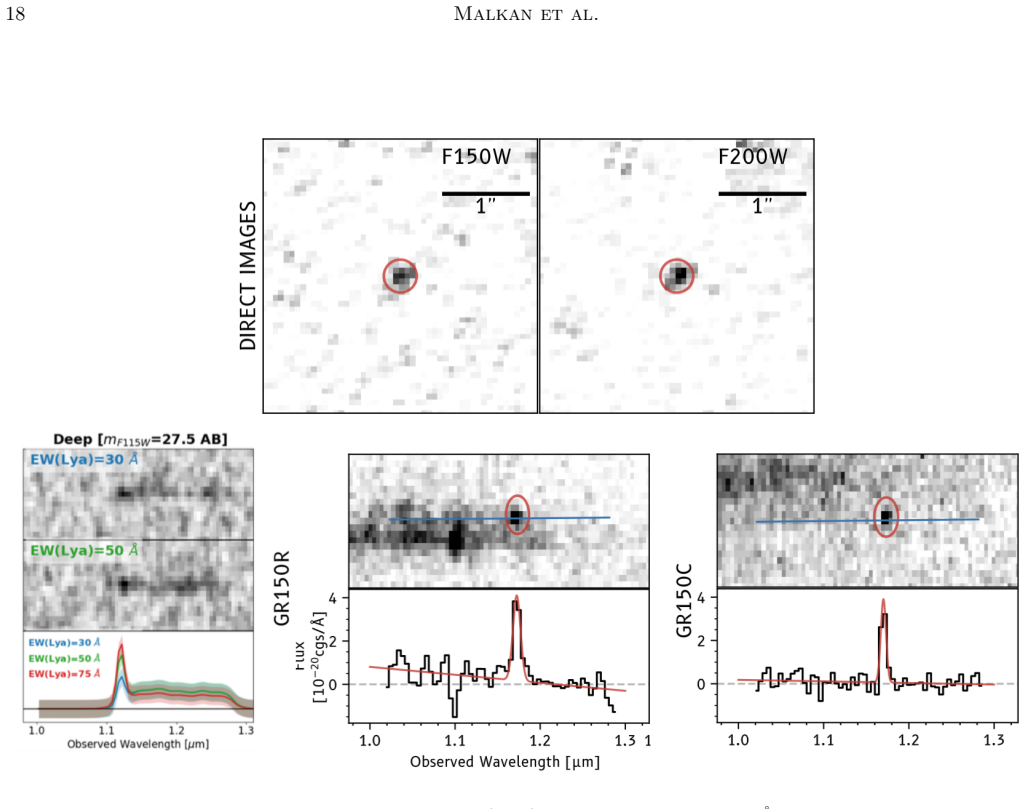
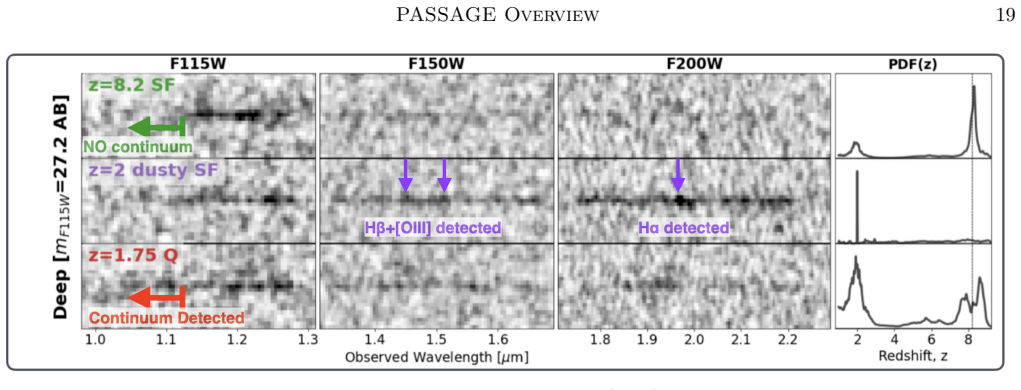
- The deep F115W spectra also contain Lyman-break information at z>8, so even without detected emission lines the survey may contribute to the high-redshift galaxy census, as the paper's simulations suggest.
Editorial analysis
A structured set of objections, weighed in public.
Referee Report
Summary. This paper presents the Cycle 1 JWST/NIRISS pure-parallel slitless spectroscopy survey PASSAGE: a 591-hour allocation of which about two-thirds was executed, yielding 63 high-latitude fields and more than ten thousand near-infrared grism spectrograms of faint galaxies. The authors describe the observing strategy, the Grizli-based reduction, sensitivity estimates, and several illustrative science applications (star-forming main sequence at z~1-2, Balmer-decrement dust measurements, extreme emission-line galaxies, gas-phase mass-metallicity relation, and high-redshift Ly-alpha/Lyman-break searches). The survey's stated advantages are unbiased spectroscopic selection without photometric preselection, many independent fields to beat cosmic variance, full 1.0-2.3 micron coverage, and public data with promised high-level products.
Significance. If the survey performs as described, PASSAGE will be a major community resource: it is the largest NIRISS grism survey of faint galaxies, provides unbiased (modulo source detection) selection, and covers a wide redshift range with multiple rest-frame optical diagnostics. The paper's sensitivity predictions are checked against the ETC and against published NIRISS grism data, which is a concrete strength. The public-data commitment and planned HLSP release add legacy value. However, the headline claims of unbiased selection and extension to M* ~ 10^7 Msun at z~2 are not yet backed by a quantified selection function; the paper's own Figure 6 admits incompleteness at M* ~ 10^8. This is a load-bearing gap for a survey-overview paper making those claims, and it should be addressed before acceptance.
major comments (3)
- [§3 and §4.3] The claim that PASSAGE 'selects an emission-line flux-limited sample of galaxies, rather than a continuum-flux limited sample' (§4.3) is not yet supported. Section 3 states that Grizli identifies sources by running SEP on direct images with detection thresholds mAB = 26-30 and models spectra only for those detected sources. Thus genuinely high-EW galaxies whose continuum plus line flux falls below the direct-image threshold are not present in the standard products; the survey is jointly line- and continuum-flux limited. Please provide injection/recovery simulations that quantify selection as a function of emission-line flux, rest-frame EW, stellar mass, and local crowding, or explicitly reframe the survey claim as 'unbiased modulo direct-source detection.'
- [§3, final paragraph] The reduction depends on human intervention: Grizli 'picks up a significant number of artifacts ... which must be removed by (our) human intervention,' and overlapping spectra are often over-subtracted to negative flux. This undocumented editing step can in principle remove real objects, especially in crowded fields such as the 18 COSMOS fields. No inter-rater test, artifact rate, or recovery fraction is given. Please quantify the completeness/reliability of the human-edited sample, or state explicitly that the current high-level products are not selection-function corrected. This is needed before the 'unbiased' language in the Abstract and §5 is used.
- [§4.1, Figure 6] The caption of Figure 6 states that 'flux incompleteness at low masses (M* ~ 10^8 M_sun) flattens the slope of the relation,' yet the Abstract and §4.1-4.2 claim that PASSAGE 'extends the mass regimes down to 10^7 M_sun at z~2.' As presented, the low-mass extension is an uncorrected detection, not a measurement; without completeness corrections the SFMS slope and dust-attenuation trends below ~10^9 M_sun are not secure. Please separate the survey-forecast reach from the currently demonstrated sample, and either apply completeness corrections or clearly identify which statements are predictions.
minor comments (4)
- [Throughout] There are several typographical errors: 'timscale' (§4.1), 'redenning' (§4.1), 'ration' (Figure 15), and the title appears as 'P ASSAGE' in the full text. These should be corrected.
- [References] The reference list contains duplicate entries: Atek et al. 2014a and 2014b appear to be the same paper, and He et al. 2024 is listed twice with identical bibliographic data. Please consolidate.
- [§2 and Figures 1-3] The text says the survey covers 'several dozen independent fields,' but 18 of the 63 fields lie within the COSMOS footprint and overlap on the sky. This should be qualified as 'independent sight lines' rather than fully independent fields, and the implications for cosmic-variance estimates should be stated.
- [Figure 4] The sensitivity figure would benefit from explicit labels of the representative fields and exposure times in the caption; currently the reader must infer which curves correspond to which integration times from the text.
Circularity Check
No significant circularity: PASSAGE is an observational survey overview; the quoted sensitivity predictions, line-flux forecasts, and science examples rest on external calibrations and forward-modeled sensitivity, not on fitted inputs or self-citation chains.
full rationale
This paper is a survey overview rather than a derivation chain. The central claims are observational counts (more than ten thousand grism spectrograms), survey design properties (63 high-latitude fields, no photometric pre-selection), and forward-modeled sensitivity estimates. The sensitivity limits in Section 2 and Figure 4 are derived from the JWST Exposure Time Calculator and are independently checked against published NIRISS grism spectroscopy (Boyett et al. 2022), not against PASSAGE's own fitted values. The yield prediction in Figure 5 is a survey-sensitivity extrapolation, and the paper states it is "confirmed by our detailed inspection of the first PASSAGE fields," which is an empirical check rather than a circular validation. Science quantities are anchored to external calibrations: SFRs are computed with Kennicutt & Evans (2012), metallicities with Curti et al. (2017), and dust attenuation with Cardelli et al. (1989) and Gordon et al. (2003). None of these external inputs is derived from the PASSAGE results being presented. Self-citations to WISP and related prior work (e.g., Malkan & WISP Team 2013; Henry et al. 2021; Battisti et al. 2022) are used as comparison samples or literature context, not as load-bearing proof of PASSAGE's own claims. The paper itself flags genuine limitations: about two-thirds of the planned time was executed, Grizli artifacts require human intervention and removal (Section 3), and the Figure 6 caption admits flux incompleteness near M* ~ 10^8 Msun. These are completeness and selection-function risks that may affect the scientific interpretation, but they are not instances of a prediction reducing to its input by construction or of a fitted parameter being renamed a prediction. No equation in the paper is shown to be equivalent to another by definition, and no central claim is supported solely by a self-citation. Under the standard that circularity requires a demonstrated reduction or equivalence, the appropriate finding is no significant circularity.
Axiom & Free-Parameter Ledger
axioms (3)
- domain assumption NIRISS grism sensitivity, transmission, and flux calibration as delivered by the ETC and NGDEEP calibration files are correct.
- domain assumption External calibrations relating emission lines to physical properties (Kennicutt & Evans 2012 for SFR, Curti et al. 2017 for metallicity, Faisst et al. 2018 for [NII]/H-alpha, Cardelli et al. 1989 for extinction) are valid for this galaxy population.
- domain assumption Flat Lambda CDM cosmology with H0=70 km/s/Mpc and Omega_m=0.3.
Cite this review
Pith. "Pith review of Parallel Application of Slitless Spectroscopy to Analyze Galaxy Evolution (PASSAGE): Survey Overview." pith.science (2026). https://pith.science/paper/CCU6YNFK
@misc{pith2026250900596,
  author       = {Pith},
  title        = {Pith review of: Parallel Application of Slitless Spectroscopy to Analyze Galaxy Evolution (PASSAGE): Survey Overview},
  year         = {2026},
  howpublished = {\url{https://pith.science/paper/CCU6YNFK}},
  note         = {Machine review of arXiv:2509.00596}
}
abstract
During the second half of Cycle 1 of the James Webb Space Telescope (JWST), we conducted the Parallel Application of Slitless Spectroscopy to Analyze Galaxy Evolution (PASSAGE) program. PASSAGE received the largest allocation of JWST observing time in Cycle 1, 591 hours of NIRISS observations to obtain direct near-IR imaging and slitless spectroscopy. About two thirds of these were ultimately executed, to observe 63 high-latitude fields in Pure Parallel mode. These have provided more than ten thousand near-infrared grism spectrograms of faint galaxies. PASSAGE brings unique advantages in studying galaxy evolution: A) Unbiased spectroscopic search, without prior photometric pre-selection. By including the most numerous galaxies, with low masses and strong emission lines, slitless spectroscopy is the indispensable complement to any pre-targeted spectroscopy; B) The combination of several dozen independent fields to overcome cosmic variance; C) Near-infrared spectral coverage, often spanning the full range from 1.0--2.3 $\mu$m, with minimal wavelength gaps, to measure multiple diagnostic rest-frame optical lines, minimizing sensitivity to dust reddening; D) JWST's unprecedented spatial resolution, in some cases using two orthogonal grism orientations, to overcome contamination due to blending of overlapping spectra; E) Discovery of rare bright objects especially for detailed JWST followup. PASSAGE data are public immediately, and our team plans to deliver fully-processed high-level data products. In this PASSAGE overview, we describe the survey and data quality, and present examples of these accomplishments in several areas of current interest in the evolution of emission-line galaxy properties, particularly at low masses.
Figures


Reference graph
Works this paper leans on
-
[1]
Alavi, A., Siana, B., Richard, J., et al. 2016, ApJ, 832, 56, doi: 10.3847/0004-637X/832/1/56 Amor ´ ın, R., Fontana, A., P´ erez-Montero, E., et al. 2017, Nature Astronomy, 1, 0052, doi: 10.1038/s41550-017-0052
-
[2]
2010, ApJ, 723, 104, doi: 10.1088/0004-637X/723/1/104
Atek, H., Malkan, M., McCarthy, P., et al. 2010, ApJ, 723, 104, doi: 10.1088/0004-637X/723/1/104
-
[3]
2011, ApJ, 743, 121, doi: 10.1088/0004-637X/743/2/121
Atek, H., Siana, B., Scarlata, C., et al. 2011, ApJ, 743, 121, doi: 10.1088/0004-637X/743/2/121
-
[4]
2014a, ApJ, 789, 96, doi: 10.1088/0004-637X/789/2/96 —
Atek, H., Kneib, J.-P., Pacifici, C., et al. 2014a, ApJ, 789, 96, doi: 10.1088/0004-637X/789/2/96 —. 2014b, ApJ, 789, 96, doi: 10.1088/0004-637X/789/2/96
-
[5]
Backhaus, B. E., Trump, J. R., Pirzkal, N., et al. 2024, ApJ, 962, 195, doi: 10.3847/1538-4357/ad1520
-
[6]
B., Scarlata, C., Henry, A., et al
Bagley, M. B., Scarlata, C., Henry, A., et al. 2017, ApJ, 837, 11, doi: 10.3847/1538-4357/837/1/11
-
[7]
B., Scarlata, C., Mehta, V., et al
Bagley, M. B., Scarlata, C., Mehta, V., et al. 2020, ApJ, 897, 98, doi: 10.3847/1538-4357/ab9828 20 Malkan et al
-
[8]
M., Maiolino, R., Belfiore, F., et al
Baker, W. M., Maiolino, R., Belfiore, F., et al. 2023, MNRAS, 519, 1149, doi: 10.1093/mnras/stac3594
-
[9]
2016, Journal of Open Source Software, 1, 58, doi: 10.21105/joss.00058
Barbary, K. 2016, Journal of Open Source Software, 1, 58, doi: 10.21105/joss.00058
-
[10]
J., da Cunha, E., Shivaei, I., & Calzetti, D
Battisti, A. J., da Cunha, E., Shivaei, I., & Calzetti, D. 2020, ApJ, 888, 108, doi: 10.3847/1538-4357/ab5fdd
-
[11]
Battisti, A. J., Bagley, M. B., Baronchelli, I., et al. 2022, MNRAS, 513, 4431, doi: 10.1093/mnras/stac1052
-
[12]
Battisti, A. J., Bagley, M. B., Rafelski, M., et al. 2024, MNRAS, 530, 894, doi: 10.1093/mnras/stae911
-
[13]
Becker, G. D., Davies, F. B., Furlanetto, S. R., et al. 2018, ApJ, 863, 92, doi: 10.3847/1538-4357/aacc73
-
[14]
1996, A&AS, 117, 393, doi: 10.1051/aas:1996164
Bertin, E., & Arnouts, S. 1996, A&AS, 117, 393, doi: 10.1051/aas:1996164
-
[15]
2022, ApJL, 940, L52, doi: 10.3847/2041-8213/ac9f17
Boyett, K., Mascia, S., Pentericci, L., et al. 2022, ApJL, 940, L52, doi: 10.3847/2041-8213/ac9f17
-
[16]
Boyett, K., Bunker, A. J., Curtis-Lake, E., et al. 2024, MNRAS, doi: 10.1093/mnras/stae2430 Bradaˇ c, M., Strait, V., Mowla, L., et al. 2024, ApJL, 961, L21, doi: 10.3847/2041-8213/ad0e73
-
[17]
2023, grizli, 1.9.11, Zenodo, doi: 10.5281/zenodo.1146904
Brammer, G. 2023, grizli, 1.9.11, Zenodo, doi: 10.5281/zenodo.1146904
-
[18]
Bunker, A. J., Warren, S. J., Hewett, P. C., & Clements, D. L. 1995, On Near-Infrared H-Alpha Searches for High-Redshift Galaxies, doi: https://doi.org/10.1093/mnras/273.2.513
-
[19]
Calzetti, D., Kinney, A. L., & Storchi-Bergmann, T. 1994, ApJ, 429, 582, doi: 10.1086/174346
doi:10.1086/174346 1994
-
[20]
Cardelli, J. A., Clayton, G. C., & Mathis, J. S. 1989, ApJ, 345, 245, doi: 10.1086/167900
doi:10.1086/167900 1989
-
[21]
Carnall, A. C., McLure, R. J., Dunlop, J. S., & Dav´ e, R. 2018, MNRAS, 480, 4379, doi: 10.1093/mnras/sty2169
-
[22]
Casey, C. M., Kartaltepe, J. S., Drakos, N. E., et al. 2023, ApJ, 954, 31, doi: 10.3847/1538-4357/acc2bc
-
[23]
2024, ApJ, 964, 5, doi: 10.3847/1538-4357/ad20cc
Chen, N., Motohara, K., Spitler, L., et al. 2024, ApJ, 964, 5, doi: 10.3847/1538-4357/ad20cc
-
[24]
2024, in American Astronomical Society Meeting Abstracts, Vol
Colbert, J., Mehta, V., Alavi, A., et al. 2024, in American Astronomical Society Meeting Abstracts, Vol. 56, American Astronomical Society Meeting Abstracts, 325.02
2024
-
[25]
2017, MNRAS, 465, 1384, doi: 10.1093/mnras/stw2766
Curti, M., Cresci, G., Mannucci, F., et al. 2017, MNRAS, 465, 1384, doi: 10.1093/mnras/stw2766
-
[26]
2023, MNRAS, 518, 425, doi: 10.1093/mnras/stac2737 da Cunha, E., Charlot, S., & Elbaz, D
Curti, M., D’Eugenio, F., Carniani, S., et al. 2023, MNRAS, 518, 425, doi: 10.1093/mnras/stac2737 da Cunha, E., Charlot, S., & Elbaz, D. 2008, MNRAS, 388, 1595, doi: 10.1111/j.1365-2966.2008.13535.x Dav´ e, R., Angl´ es-Alc´ azar, D., Narayanan, D., et al. 2019, MNRAS, 486, 2827, doi: 10.1093/mnras/stz937 Dav´ e, R., Rafieferantsoa, M. H., Thompson, R. J., &
arXiv 2023
-
[27]
Hopkins, P. F. 2017, MNRAS, 467, 115, doi: 10.1093/mnras/stx108
-
[28]
2024, snowblind, 0.2.1
Davies, J. 2024, snowblind, 0.2.1. https://github.com/mpi-astronomy/snowblind De Rossi, M. E., Bower, R. G., Font, A. S., Schaye, J., &
2024
-
[29]
2017, MNRAS, 472, 3354, doi: 10.1093/mnras/stx2158
Theuns, T. 2017, MNRAS, 472, 3354, doi: 10.1093/mnras/stx2158
-
[30]
Dey, A., Schlegel, D. J., Lang, D., et al. 2019, AJ, 157, 168, doi: 10.3847/1538-3881/ab089d Dom ´ ınguez, A., Siana, B., Brooks, A. M., et al. 2015, MNRAS, 451, 839, doi: 10.1093/mnras/stv1001 Dom ´ ınguez, A., Siana, B., Henry, A. L., et al. 2013, ApJ, 763, 145, doi: 10.1088/0004-637X/763/2/145
-
[31]
Doyon, R., Willott, C. J., Hutchings, J. B., et al. 2023, PASP, 135, 098001, doi: 10.1088/1538-3873/acd41b
-
[32]
Ellison, S. L., Patton, D. R., Simard, L., & McConnachie, A. W. 2008, ApJL, 672, L107, doi: 10.1086/527296
doi:10.1086/527296 2008
-
[33]
Estrada-Carpenter, V., Sawicki, M., Brammer, G., et al. 2024, MNRAS, 532, 577, doi: 10.1093/mnras/stae1368 Euclid Collaboration, Gabarra, L., Mancini, C., et al. 2023, A&A, 676, A34, doi: 10.1051/0004-6361/202346177
-
[34]
L., Masters, D., Wang, Y., et al
Faisst, A. L., Masters, D., Wang, Y., et al. 2018, ApJ, 855, 132, doi: 10.3847/1538-4357/aab1fc
-
[36]
2019, ApJ, 887, 168, doi: 10.3847/1538-4357/ab5713
Gburek, T., Siana, B., Alavi, A., et al. 2019, ApJ, 887, 168, doi: 10.3847/1538-4357/ab5713
-
[37]
Gordon, K. D., Clayton, G. C., Misselt, K. A., Landolt, A. U., & Wolff, M. J. 2003, ApJ, 594, 279, doi: 10.1086/376774
doi:10.1086/376774 2003
-
[38]
Grogin, N. A., Kocevski, D. D., Faber, S. M., et al. 2011, ApJS, 197, 35, doi: 10.1088/0067-0049/197/2/35
-
[40]
2024, The Astrophysical Journal Letters, 960, L13, doi: 10.3847/2041-8213/ad12cd
He, X., Wang, X., Jones, T., et al. 2024, The Astrophysical Journal Letters, 960, L13, doi: 10.3847/2041-8213/ad12cd
-
[41]
2013, ApJL, 776, L27, doi: 10.1088/2041-8205/776/2/L27
Henry, A., Scarlata, C., Dom ´ ınguez, A., et al. 2013, ApJL, 776, L27, doi: 10.1088/2041-8205/776/2/L27
-
[42]
2021, ApJ, 919, 143, doi: 10.3847/1538-4357/ac1105
Henry, A., Rafelski, M., Sunnquist, B., et al. 2021, ApJ, 919, 143, doi: 10.3847/1538-4357/ac1105
-
[43]
Hicks, E. K. S., Malkan, M. A., Teplitz, H. I., McCarthy, P. J., & Yan, L. 2002, ApJ, 581, 205, doi: 10.1086/344224
-
[44]
Kashikawa, N., Shimasaku, K., Malkan, M. A., et al. 2006, ApJ, 648, 7, doi: 10.1086/504966
-
[45]
2011, ApJ, 734, 119, doi: 10.1088/0004-637X/734/2/119
Kashikawa, N., Shimasaku, K., Matsuda, Y., et al. 2011, ApJ, 734, 119, doi: 10.1088/0004-637X/734/2/119
-
[46]
Kennicutt, R. C., J. 1983, ApJ, 272, 54, doi: 10.1086/161261 PASSAGE Overview 21
doi:10.1086/161261 1983
-
[47]
1998, ARA&A, 36, 189, doi: 10.1146/annurev.astro.36.1.189
Kennicutt, Robert C., J. 1998, ARA&A, 36, 189, doi: 10.1146/annurev.astro.36.1.189
-
[48]
Kennicutt, R. C., & Evans, N. J. 2012, ARA&A, 50, 531, doi: 10.1146/annurev-astro-081811-125610
-
[49]
M., Aussel, H., Calzetti, D., et al
Koekemoer, A. M., Aussel, H., Calzetti, D., et al. 2007, ApJS, 172, 196, doi: 10.1086/520086
doi:10.1086/520086 2007
-
[50]
Koekemoer, A. M., Faber, S. M., Ferguson, H. C., et al. 2011, ApJS, 197, 36, doi: 10.1088/0067-0049/197/2/36
-
[51]
Speagle, J. S. 2019, ApJ, 876, 3, doi: 10.3847/1538-4357/ab133c
-
[52]
2022, arXiv e-prints, arXiv:2211.01382, doi: 10.48550/arXiv.2211.01382
Li, M., Cai, Z., Bian, F., et al. 2022, arXiv e-prints, arXiv:2211.01382, doi: 10.48550/arXiv.2211.01382
-
[53]
Lilly, S. J., Carollo, C. M., Pipino, A., Renzini, A., & Peng, Y. 2013, ApJ, 772, 119, doi: 10.1088/0004-637X/772/2/119
-
[54]
Lorenz, B., Kriek, M., Shapley, A. E., et al. 2024, ApJ, 975, 187, doi: 10.3847/1538-4357/ad7de8
-
[55]
Ly, C., Malkan, M. A., Kashikawa, N., et al. 2012, ApJ, 757, 63, doi: 10.1088/0004-637X/757/1/63 —. 2007, ApJ, 657, 738, doi: 10.1086/510828
-
[56]
Ly, C., Malkan, M. A., Treu, T., et al. 2009, ApJ, 697, 1410, doi: 10.1088/0004-637X/697/2/1410
-
[57]
F., Faucher-Gigu` ere, C.-A., et al
Ma, X., Hopkins, P. F., Faucher-Gigu` ere, C.-A., et al. 2016, MNRAS, 456, 2140, doi: 10.1093/mnras/stv2659
-
[58]
2014, ARA&A, 52, 415, doi: 10.1146/annurev-astro-081811-125615
Madau, P., & Dickinson, M. 2014, ARA&A, 52, 415, doi: 10.1146/annurev-astro-081811-125615
-
[59]
2024, MNRAS, 527, 8213, doi: 10.1093/mnras/stad3685
Maheson, G., Maiolino, R., Curti, M., et al. 2024, MNRAS, 527, 8213, doi: 10.1093/mnras/stad3685
-
[60]
2019, A&A Rv, 27, 3, doi: 10.1007/s00159-018-0112-2
Maiolino, R., & Mannucci, F. 2019, A&A Rv, 27, 3, doi: 10.1007/s00159-018-0112-2
-
[61]
2013, in Astronomical Society of the Pacific Conference Series, Vol
Malkan, M., & WISP Team. 2013, in Astronomical Society of the Pacific Conference Series, Vol. 477, Galaxy Mergers in an Evolving Universe, ed. W. H. Sun, C. K
2013
-
[62]
2010, MNRAS, 408, 2115, doi: 10.1111/j.1365-2966.2010.17291.x
Gnerucci, A. 2010, MNRAS, 408, 2115, doi: 10.1111/j.1365-2966.2010.17291.x
arXiv 2010
-
[63]
J., Yan, L., Freudling, W., et al
McCarthy, P. J., Yan, L., Freudling, W., et al. 1999, ApJ, 520, 548, doi: 10.1086/307491
doi:10.1086/307491 1999
-
[64]
J., Milvang-Jensen, B., Dunlop, J., et al
McCracken, H. J., Milvang-Jensen, B., Dunlop, J., et al. 2012, A&A, 544, A156, doi: 10.1051/0004-6361/201219507
-
[65]
V., H¨ außler, B., Marchesini, D., et al
Nedkova, K. V., H¨ außler, B., Marchesini, D., et al. 2021, MNRAS, 506, 928, doi: 10.1093/mnras/stab1744
-
[66]
Noeske, K. G., Weiner, B. J., Faber, S. M., et al. 2007, ApJL, 660, L43, doi: 10.1086/517926
doi:10.1086/517926 2007
-
[67]
Pagel, B. E. J., Edmunds, M. G., Blackwell, D. E., Chun, M. S., & Smith, G. 1979, MNRAS, 189, 95, doi: 10.1093/mnras/189.1.95
-
[68]
2024, ApJ, 969, 90, doi: 10.3847/1538-4357/ad429c
Pirzkal, N., Rothberg, B., Papovich, C., et al. 2024, ApJ, 969, 90, doi: 10.3847/1538-4357/ad429c
-
[69]
2023, NIRISS Commissioning Results: NIS-015 – NIRISS GR150C R Flux Calibration (NGAS CAR-699, APT 1089), Technical Report JWST-STScI-008328, STScI, Baltimore
Ravindranath, S., et al. 2023, NIRISS Commissioning Results: NIS-015 – NIRISS GR150C R Flux Calibration (NGAS CAR-699, APT 1089), Technical Report JWST-STScI-008328, STScI, Baltimore
2023
-
[70]
Reddy, N. A., Kriek, M., Shapley, A. E., et al. 2015, ApJ, 806, 259, doi: 10.1088/0004-637X/806/2/259
-
[71]
Reddy, N. A., Shapley, A. E., Kriek, M., et al. 2020, ApJ, 902, 123, doi: 10.3847/1538-4357/abb674
-
[72]
Revalski, M., Rafelski, M., Henry, A., et al. 2024, ApJ, 966, 228, doi: 10.3847/1538-4357/ad382c Rihtarˇ siˇ c, G., Bradaˇ c, M., Desprez, G., et al. 2025, A&A, 696, A15, doi: 10.1051/0004-6361/202451117
-
[73]
2022, The Astrophysical Journal Letters, 938, L13, doi: 10.3847/2041-8213/ac8e6e
Roberts-Borsani, G., Morishita, T., Treu, T., et al. 2022, The Astrophysical Journal Letters, 938, L13, doi: 10.3847/2041-8213/ac8e6e
-
[74]
Roberts-Borsani, G., Bagley, M., Rojas-Ruiz, S., et al. 2024, arXiv e-prints, arXiv:2407.17551, doi: 10.48550/arXiv.2407.17551
work page internal anchor Pith review Pith/arXiv arXiv doi:10.48550/arxiv.2407.17551 2024
-
[75]
Runnholm, A., Hayes, M. J., Mehta, V., et al. 2025, ApJ, 984, 95, doi: 10.3847/1538-4357/adc008
-
[76]
2011, MNRAS, 415, 61, doi: 10.1111/j.1365-2966.2011.18823.x
Saintonge, A., Kauffmann, G., Wang, J., et al. 2011, MNRAS, 415, 61, doi: 10.1111/j.1365-2966.2011.18823.x
arXiv 2011
-
[77]
C., Dav´ e, R., & Dickinson, M
Salim, S., Lee, J. C., Dav´ e, R., & Dickinson, M. 2015, ApJ, 808, 25, doi: 10.1088/0004-637X/808/1/25
-
[78]
Sanders, R. L., Shapley, A. E., Kriek, M., et al. 2018, ApJ, 858, 99, doi: 10.3847/1538-4357/aabcbd
-
[79]
Sanders, R. L., Jones, T., Shapley, A. E., et al. 2020, ApJL, 888, L11, doi: 10.3847/2041-8213/ab5d40
-
[80]
Sanders, R. L., Shapley, A. E., Jones, T., et al. 2021, ApJ, 914, 19, doi: 10.3847/1538-4357/abf4c1
-
[81]
2007, ApJS, 172, 1, doi: 10.1086/516585
Scoville, N., Aussel, H., Brusa, M., et al. 2007, ApJS, 172, 1, doi: 10.1086/516585
doi:10.1086/516585 2007
-
[82]
Shapley, A. E., Sanders, R. L., Reddy, N. A., Topping, M. W., & Brammer, G. B. 2023, arXiv e-prints, arXiv:2301.03241, doi: 10.48550/arXiv.2301.03241
This paper was first reviewed by deepseek-v4-flash on August 5, 2026.
discussion (0)
Sign in with ORCID, Apple, or X to comment. Anyone can read and Pith papers without signing in.