REVIEW 4 major objections 5 minor 1 cited by
LLM-HyPZ: Hardware Vulnerability Discovery using an LLM-Assisted Hybrid Platform for Zero-Shot Knowledge Extraction and Refinement
T0 review · 4 major / 5 minor · reviewed 2026-08-05 · deepseek-v4-flash
Pith's one-line read This paper claims that an LLM pipeline can systematically discover hardware vulnerabilities from a large vulnerability corpus without labeled training data.
desk verdict A useful pipeline idea, but the headline 1,742-CVE count rests on a 200-sample hand-picked validation set that cannot carry it. read the letter →
The pith
A machine-rendered reading of the paper's core claim, the machinery that carries it, and where it could break.
The reading
What carries the argument
The engine is the zero-shot classification prompt: a fixed instruction that casts a language model as a cybersecurity expert and asks for a binary hardware-versus-software label for each report. This prompt is load-bearing because it filters more than 100,000 entries without any labeled training data. Around it, the pipeline uses contextualized embeddings (the paper uses a 3072-dimensional commercial embedding model), K-means clustering with the elbow rule to choose K=5, and a summarization prompt that consumes each cluster's top n-grams and returns a concise domain-precise topic name.
What would settle it
Take a random sample of 500 reports the model flagged as hardware and 500 it called software; have hardware-security engineers independently verify each against vendor documentation and chip errata. If the confirmed hardware rate in the first sample or the missed hardware rate in the second materially contradicts the 99.5 percent validation accuracy, the 1,742 count and the five themes do not hold.
Extended reading notes
Core claim
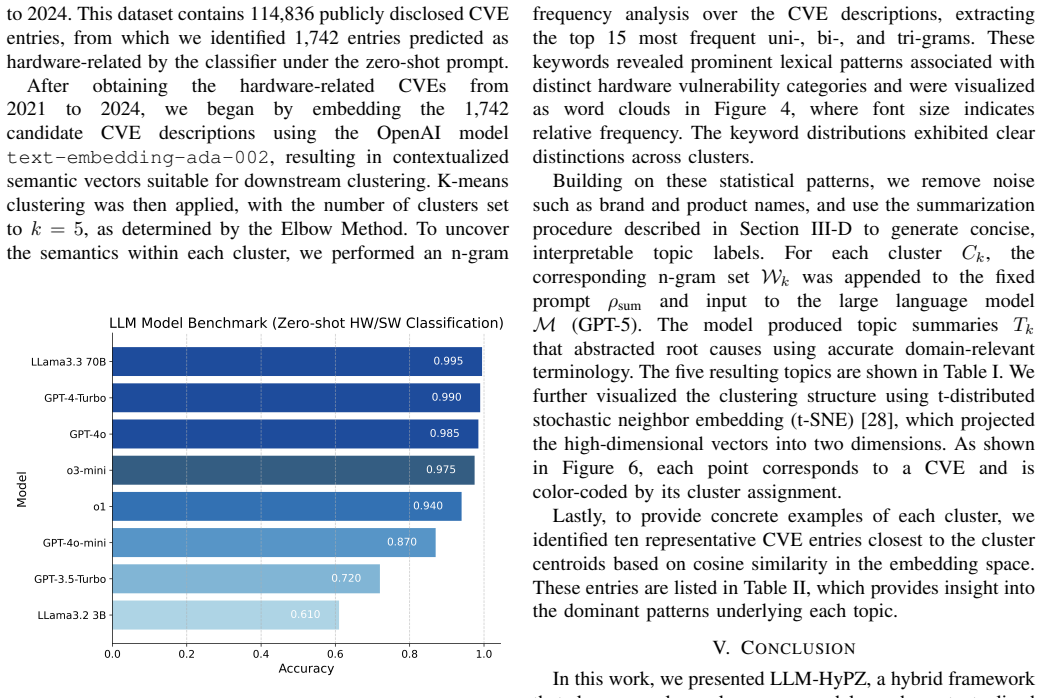
The paper aims to establish LLM-HyPZ as the first data-driven, scalable way to find hardware vulnerabilities in vulnerability reports. The experimental claim is that the best of seven zero-shot language models achieves 99.5 percent accuracy on a curated 200-report validation set; applying that model to the full 2021-2024 corpus of 114,836 reports yields 1,742 hardware-related reports; K-means on high-dimensional embeddings splits those into five clusters; and n-gram frequency plus an LLM summarizer labels the clusters as firmware/BIOS privilege escalation, IoT and mobile memory corruption, insecure physical and firmware access, memory access corruption leading to code execution or disclosure
Load-bearing premise
If the 200 hand-picked validation examples—which contain duplicate IDs and are not a temporal holdout—do not represent the full 114,836-report corpus, the reported 99.5 percent accuracy and every downstream number (1,742, five themes, 411 contributed reports) inherit the error.
Editorial extensions
If this is right
- If the 1,742 count is correct, researchers gain a concrete machine-readable set of hardware-related vulnerability reports to mine for recurring failure modes.
- If the 99.5 percent accuracy transfers to unseen reports, the same zero-shot prompt can be re-run each year to track how hardware vulnerability themes evolve without manual labeling.
- The 411 contributed reports show a data-driven pipeline can shrink a human expert review from tens of thousands of candidates to a few hundred, making future hardware weakness list updates faster.
- Because the method needs no training labels, it can be pointed at other unlabeled advisory corpora, such as firmware changelogs and device errata, to surface hardware issues outside the main vulnerability database.
Reading between the lines
- A direct extension the paper does not run: treat the final 1,026 expert-selected reports from the 2025 update as a gold standard and report precision and recall of the 1,742 flagged set against it; the paper only reports the overlap count of 411.
- Because the binary classifier counts firmware and BIOS issues as hardware, a multi-label version separating hardware, firmware, and software would likely split the five clusters and reveal whether BIOS privilege escalation belongs in the hardware taxonomy.
- The validation set is not a temporal holdout, so the most informative next experiment is to test the same prompt on reports published after 2024; if accuracy drops, the method needs periodic re-validation rather than true zero-shot generalization.
- Applying the pipeline to reports from before 2021 would test whether the five themes are stable across older descriptions, which used different language and less standardized metadata.
Editorial analysis
A structured set of objections, weighed in public.
Referee Report
Summary. The paper proposes LLM-HyPZ, a three-stage pipeline for hardware-vulnerability discovery in CVE text: zero-shot LLM binary classification of CVE descriptions into hardware/software, contextualized embedding of the hardware-flagged records, K-means clustering, and LLM-based cluster summarization. The authors benchmark seven LLMs on a 200-entry validation set, report 99.5% accuracy for LLaMA 3.3 70B, apply the pipeline to the 2021–2024 CVE corpus (114,836 entries), and report 1,742 hardware-related CVEs organized into five themes. They also state that the pipeline surfaced 411 of 1,026 CVEs used in the MITRE MIHW 2025 effort.
Significance. If the central quantitative claim is reliable, a scalable, zero-shot, data-driven method for discovering hardware-related vulnerabilities from unstructured CVE descriptions would be a useful contribution to hardware security and CWE/MIHW practice. The pipeline is clearly specified in Algorithm 1, and the classification prompt and validation list are given in the paper, which aids reproducibility. However, the reported 1,742 count and the five themes inherit an unsupported validation assumption: the only reported classification metric is accuracy on a small, balanced, hand-picked set, which does not estimate precision or recall on the imbalanced full corpus. The secondary MIHW claim is also self-reported and difficult to verify independently. The idea is promising, but the current evidence is insufficient for the paper's central claims.
major comments (4)
- [§IV-A, Eq. (4), Appendix A] The validation methodology does not support the corpus-level claim of 1,742 hardware-related CVEs. The 200-entry set is hand-picked and balanced 50/50, contains duplicate IDs (e.g., CVE-2021-26312, CVE-2021-26351, CVE-2021-26393), and includes 2020 entries outside the 2021–2024 target corpus. Accuracy on a balanced set cannot be translated to precision/recall when the target prevalence is ~1.5%; even a small false-positive rate would produce a large number of false positives among 114,836 entries. Moreover, many validation CVEs are well-known hardware issues and likely overlap with LLM pretraining data, so the high accuracy may reflect memorization rather than generalization. The authors should label a random sample of full-corpus predictions (ideally a temporal holdout) and report precision, recall, F1, and confidence intervals; until then, the 1,742 count is unsupported.
- [§III-B vs. §IV-B] The embedding model is inconsistent: §III-B states that text-embedding-3-large with 3072 dimensions is used, while §IV-B says text-embedding-ada-002 was used for the 1,742 CVEs. These are different models with different dimensionalities, and the choice affects clustering and all downstream results. The paper should state which model was actually used, with version and dimensionality, and explain the discrepancy. Also, the Elbow method result K=5 is mentioned but no elbow curve or quantitative criterion is shown, making the choice of K unreproducible.
- [§V, MIHW 2025 claim] The claim that the pipeline 'surfaced 411 of the 1,026 CVEs' used in the MITRE MIHW 2025 update is presented as validation of the method, but it is self-reported and not independently verifiable from the manuscript. The acknowledgment indicates the authors participated in the MIHW working group, and the paper does not define the protocol by which the 1,026 CVEs were selected, how the candidate list was transferred, or how the 411 contribution was audited. This is not independent evidence of precision. Please either provide an external audit, the exact selection protocol, or clearly downgrade this statement from validation evidence to an application anecdote.
- [§IV-B, Table I, Figure 6] The meaningfulness of the 'five recurring themes' claim needs more than t-SNE visualization. No clustering validity metrics (e.g., silhouette score, cluster stability, or comparison against a null model) are reported, and the elbow criterion is not documented. Since the cluster topics are the main qualitative output, the authors should justify that K=5 is not an artifact of the particular embedding run and that the clusters are stable under subsampling or different random seeds.
minor comments (5)
- [§III-A] Minor text issue: 'This Figure 3 illustrates a comparative view' should be 'Figure 3 illustrates...' for style consistency.
- [§V] The sentence 'Our method filtered and candidate CVEs' is incomplete; it should say something like 'filtered and ranked candidate CVEs.'
- [§III-D] The summarizer is referred to as 'GPT5' in one place and 'GPT-5' in another; please specify the exact model and version used for cluster summarization, as this affects reproducibility.
- [§II-B] Reference [21] is cited as 'Mallen et al.' but the reference list entry [21] is Zhang et al.; please reconcile the citation-author mismatch.
- [General] There is no data or code availability statement. Given that the paper makes claims about a specific CVE corpus and a validation set, releasing the deduplicated validation set with labels, the exact model outputs, and the clustering code would substantially improve reproducibility.
Circularity Check
No significant circularity: the pipeline applies a zero-shot classifier and unsupervised clustering; the 1,742-count and five themes are outputs, not re-statements of the validation labels or of any self-cited prior result.
full rationale
The paper's derivation chain is an empirical pipeline rather than a formal derivation. Stage 1 uses a prompt-conditioned LLM to label CVEs; Stage 2 embeds and clusters the positively labeled descriptions; Stage 3 summarizes cluster n-grams. The central quantitative claim (1,742 hardware CVEs) is the output of the classifier on the full 2021-2024 corpus, and the validation set in Appendix A is used only to benchmark model accuracy, not to define the hardware/software label or to fit a parameter that then generates the 1,742 count. The validation set's representativeness (balanced 200 hand-picked samples, duplicates, no temporal holdout) is a legitimate statistical concern, but it does not make the classifier's output equivalent to the validation labels by construction. The five cluster themes are GPT-5 summaries of the clusters' n-grams; this is descriptive summarization, not a prediction claimed to be independent of the clustered data. The MIHW 2025 contribution (411 of 1,026 CVEs) is self-reported and would benefit from external confirmation, but it is a contribution claim, not an input to the pipeline. The only self-citations (refs [14]-[16]) are for standard n-gram frequency analysis and are not load-bearing. No uniqueness theorem, ansatz-by-citation, or fitted-input-called-prediction step reduces the paper's conclusions to its assumptions. The limitations stated in the Conclusion (borderline cases requiring human validation, fixed K, computational overhead) further confirm that the authors do not present the cluster labels or counts as forced by an earlier fitted result.
Assumptions & free parameters
free parameters (3)
- Number of clusters K =
5
- Top-r n-grams per cluster =
15
- LLM sampling parameters =
default
assumptions (6)
- domain assumption CVE descriptions contain enough lexical and semantic signal to distinguish hardware from software in zero-shot classification.
- domain assumption The manually labeled validation set in Appendix A is correct ground truth and representative of the corpus distribution.
- domain assumption Euclidean similarity in the chosen embedding space corresponds to semantic relatedness of vulnerabilities.
- domain assumption LLM performance on the validation set transfers to the full 114,836 corpus, including unseen and future CVE descriptions.
- domain assumption The MITRE MIHW 2025 process and its 1,026 CVE set are a valid external benchmark.
- standard math K-means clustering with K=5 yields stable, meaningful clusters.
Cite this review
Pith. "Pith review of LLM-HyPZ: Hardware Vulnerability Discovery using an LLM-Assisted Hybrid Platform for Zero-Shot Knowledge Extraction and Refinement." pith.science (2026). https://pith.science/paper/QHR2OGET
@misc{pith2026250900647,
  author       = {Pith},
  title        = {Pith review of: LLM-HyPZ: Hardware Vulnerability Discovery using an LLM-Assisted Hybrid Platform for Zero-Shot Knowledge Extraction and Refinement},
  year         = {2026},
  howpublished = {\url{https://pith.science/paper/QHR2OGET}},
  note         = {Machine review of arXiv:2509.00647}
}
read the original abstract
The rapid growth of hardware vulnerabilities has created an urgent need for systematic and scalable analysis methods. Unlike software flaws, which are often patchable post-deployment, hardware weaknesses remain embedded across product lifecycles, posing persistent risks to processors, embedded devices, and IoT platforms. Existing efforts such as the MITRE CWE Hardware List (2021) relied on expert-driven Delphi surveys, which lack statistical rigor and introduce subjective bias, while large-scale data-driven foundations for hardware weaknesses have been largely absent. In this work, we propose LLM-HyPZ, an LLM-assisted hybrid framework for zero-shot knowledge extraction and refinement from vulnerability corpora. Our approach integrates zero-shot LLM classification, contextualized embeddings, unsupervised clustering, and prompt-driven summarization to mine hardware-related CVEs at scale. Applying LLM-HyPZ to the 2021-2024 CVE corpus (114,836 entries), we identified 1,742 hardware-related vulnerabilities. We distilled them into five recurring themes, including privilege escalation via firmware and BIOS, memory corruption in mobile and IoT systems, and physical access exploits. Benchmarking across seven LLMs shows that LLaMA 3.3 70B achieves near-perfect classification accuracy (99.5%) on a curated validation set. Beyond methodological contributions, our framework directly supported the MITRE CWE Most Important Hardware Weaknesses (MIHW) 2025 update by narrowing the candidate search space. Specifically, our pipeline surfaced 411 of the 1,026 CVEs used for downstream MIHW analysis, thereby reducing expert workload and accelerating evidence gathering. These results establish LLM-HyPZ as the first data-driven, scalable approach for systematically discovering hardware vulnerabilities, thereby bridging the gap between expert knowledge and real-world vulnerability evidence.
Figures


Figures from the paper (3 more)


Forward citations
Cited by 1 Pith paper
-
Exploring Silicon-Based Societies: An Early Study of the Moltbook Agent Community
Clustering of Moltbook submolt descriptions shows agent-created communities organize into human-mimetic, silicon-centric, and proto-economic themes, but the categories were partly prescribed by the analysis prompt.
Reference graph
Works this paper leans on
-
[1]
Hardware security in practice: Challenges and opportunities,
N. Potlapally, “Hardware security in practice: Challenges and opportunities,” in 2011 IEEE International Symposium on Hardware-Oriented Security and Trust . IEEE, 2011, pp. 93–98
work page 2011
-
[2]
Attacks and defenses for jtag,
K. Rosenfeld and R. Karri, “Attacks and defenses for jtag,” IEEE Design & Test of Computers , vol. 27, no. 1, pp. 36–47, 2010
work page 2010
-
[3]
I. Bojanova, “Comprehensively labeled weakness and vulnerability datasets via unambiguous formal bugs framework specifications,” IT Professional, vol. 26, no. 1, pp. 60–68, 2024
work page 2024
-
[4]
2021 cwe most important hardware weaknesses,
MITRE, “2021 cwe most important hardware weaknesses,” Aug
work page 2021
-
[5]
{HardFails}: insights into {software-exploitable} hardware bugs,
G. Dessouky, D. Gens, P. Haney, G. Persyn, A. Kanuparthi, H. Khattri, J. M. Fung, A.-R. Sadeghi, and J. Rajendran, “ {HardFails}: insights into {software-exploitable} hardware bugs,” in 28th USENIX Security Symposium (USENIX Security 19) , 2019, pp. 213–230
work page 2019
-
[6]
Categorizing and predicting invalid vulnerabilities on common vulnerabilities and exposures,
Q. Chen, L. Bao, L. Li, X. Xia, and L. Cai, “Categorizing and predicting invalid vulnerabilities on common vulnerabilities and exposures,” in 2018 25th Asia-Pacific Software Engineering Conference (APSEC) . IEEE, 2018, pp. 345–354
work page 2018
-
[7]
Automated cpe labeling of cve summaries with machine learning,
E. W ˚areus and M. Hell, “Automated cpe labeling of cve summaries with machine learning,” in Detection of Intrusions and Malware, and Vulnerability Assessment: 17th International Conference, DIMVA 2020, Lisbon, Portugal, June 24–26, 2020, Proceedings 17 . Springer, 2020, pp. 3–22
work page 2020
-
[8]
Unsupervised labeling and extraction of phrase-based concepts in vulnerability descriptions,
S. Yitagesu, Z. Xing, X. Zhang, Z. Feng, X. Li, and L. Han, “Unsupervised labeling and extraction of phrase-based concepts in vulnerability descriptions,” in 2021 36th IEEE/ACM International Conference on Automated Software Engineering (ASE) . IEEE, 2021, pp. 943–954
work page 2021
Show all 31 references
-
[9]
Data mining: an overview from a database perspective,
M.-S. Chen, J. Han, and P. S. Yu, “Data mining: an overview from a database perspective,” IEEE Transactions on Knowledge and data Engineering, vol. 8, no. 6, pp. 866–883, 2002
2002
-
[10]
Large language models are zero-shot reasoners,
T. Kojima, S. S. Gu, M. Reid, Y . Matsuo, and Y . Iwasawa, “Large language models are zero-shot reasoners,” Advances in neural information processing systems , vol. 35, pp. 22 199–22 213, 2022
2022
-
[11]
Potential of chatgpt and gpt-4 for data mining of free-text ct reports on lung cancer,
M. A. Fink, A. Bischoff, C. A. Fink, M. Moll, J. Kroschke, L. Dulz, C. P. Heußel, H.-U. Kauczor, and T. F. Weber, “Potential of chatgpt and gpt-4 for data mining of free-text ct reports on lung cancer,” Radiology, vol. 308, no. 3, p. e231362, 2023
2023
-
[12]
Does synthetic data generation of llms help clinical text mining?
R. Tang, X. Han, X. Jiang, and X. Hu, “Does synthetic data generation of llms help clinical text mining?” arXiv preprint arXiv:2303.04360 , 2023
2023 arXiv
-
[13]
An analysis of the use of cves by iot malware,
R. Khoury, B. Vignau, S. Hall ´e, A. Hamou-Lhadj, and A. Razgallah, “An analysis of the use of cves by iot malware,” in Foundations and Practice of Security: 13th International Symposium, FPS 2020, Montreal, QC, Canada, December 1–3, 2020, Revised Selected Papers 13 . Springer...
2020
-
[14]
Wids: An anomaly based intrusion detection system for wi-fi (ieee 802.11) protocol,
P. Satam and S. Hariri, “Wids: An anomaly based intrusion detection system for wi-fi (ieee 802.11) protocol,” IEEE Transactions on Network and Service Management , vol. 18, no. 1, pp. 1077–1091, 2020
2020
-
[15]
Bluetooth intrusion detection system (bids),
P. Satam, S. Satam, and S. Hariri, “Bluetooth intrusion detection system (bids),” in 2018 IEEE/ACS 15th International Conference on Computer Systems and Applications (AICCSA) . IEEE, 2018, pp. 1–7
2018
-
[16]
Anomaly behavior analysis of dns protocol
P. Satam, H. R. Alipour, Y . B. Al-Nashif, and S. Hariri, “Anomaly behavior analysis of dns protocol.” J. Internet Serv. Inf. Secur. , vol. 5, no. 4, pp. 85–97, 2015
2015
-
[17]
Unveiling the landscape of operating system vulnerabilities,
M. Bhurtel and D. B. Rawat, “Unveiling the landscape of operating system vulnerabilities,” Future Internet, vol. 15, no. 7, p. 248, 2023
2023
-
[18]
Security trend analysis with cve topic models,
S. Neuhaus and T. Zimmermann, “Security trend analysis with cve topic models,” in 2010 IEEE 21st International Symposium on Software Reliability Engineering. IEEE, 2010, pp. 111–120
2010
-
[19]
A survey on deep learning for named entity recognition,
J. Li, A. Sun, J. Han, and C. Li, “A survey on deep learning for named entity recognition,” IEEE transactions on knowledge and data engineering, vol. 34, no. 1, pp. 50–70, 2020
2020
-
[20]
An introduction to conditional random fields,
C. Sutton, A. McCallum et al., “An introduction to conditional random fields,” Foundations and Trends® in Machine Learning , vol. 4, no. 4, pp. 267–373, 2012
2012
-
[21]
Teleclass: Taxonomy enrichment and llm-enhanced hierarchical text classification with minimal supervision,
Y . Zhang, R. Yang, X. Xu, R. Li, J. Xiao, J. Shen, and J. Han, “Teleclass: Taxonomy enrichment and llm-enhanced hierarchical text classification with minimal supervision,” in Proceedings of the ACM on Web Conference 2025, 2025, pp. 2032–2042
2025
-
[22]
Tnt-llm: Text mining at scale with large language models,
M. Wan, T. Safavi, S. K. Jauhar, Y . Kim, S. Counts, J. Neville, S. Suri, C. Shah, R. W. White, L. Yang et al. , “Tnt-llm: Text mining at scale with large language models,” in Proceedings of the 30th ACM SIGKDD conference on knowledge discovery and data mining , 2024, pp. 5836–5847
2024
-
[23]
What should we engineer in prompts? training humans in requirement-driven llm use,
Q. Ma, W. Peng, C. Yang, H. Shen, K. Koedinger, and T. Wu, “What should we engineer in prompts? training humans in requirement-driven llm use,” ACM Transactions on Computer-Human Interaction , 2025
2025
-
[24]
Multi-view k-means clustering on big data
X. Cai, F. Nie, and H. Huang, “Multi-view k-means clustering on big data.” in IJCAI, vol. 13, 2013, pp. 2598–2604
2013
-
[25]
A prompt pattern catalog to enhance prompt engineering with chatgpt,
J. White, Q. Fu, S. Hays, M. Sandborn, C. Olea, H. Gilbert, A. Elnashar, J. Spencer-Smith, and D. C. Schmidt, “A prompt pattern catalog to enhance prompt engineering with chatgpt,” arXiv preprint arXiv:2302.11382, 2023
2023 arXiv
-
[26]
Openai python sdk
OpenAI, “Openai python sdk.” [Online]. Available: https://platform. openai.com/docs/api-reference/introduction?lang=python
-
[27]
Ai-verde: A gateway for egalitarian access to large language model-based resources for educational institutions,
P. Mithun, E. Noriega-Atala, N. Merchant, and E. Skidmore, “Ai-verde: A gateway for egalitarian access to large language model-based resources for educational institutions,” arXiv preprint arXiv:2502.09651, 2025
2025 arXiv
-
[28]
Visualizing data using t-sne
L. Van der Maaten and G. Hinton, “Visualizing data using t-sne.” Journal of machine learning research , vol. 9, no. 11, 2008
2008
-
[29]
2025 cwe most important hardware weaknesses,
MITRE, “2025 cwe most important hardware weaknesses,” Aug
2025
-
[2021]
Available: https://cwe.mitre.org/topHW/archive/2021/ 2021 CWE MIHW.html
[Online]. Available: https://cwe.mitre.org/topHW/archive/2021/ 2021 CWE MIHW.html
2021
-
[2025]
[Online]. Available: https://cwe.mitre.org/topHW/archive/2025/ 2025 CWE MIHW.html APPENDIX A VALIDATION DATASET (DCVE VALIDATION ) FOR ZERO-SHOT HW/SW C LASSFICATION TASK The hardware and software CVE entries for validation are shown in Table III. APPENDIX B The Table IV prese...
2025
Reviewed August 5, 2026 · model on record in the stance chip above.
Discussion (0). Continue with ORCID to comment.