REVIEW 4 major objections 5 minor 1 cited by
Attention-head routers beat vanilla upcycling by 2.05 points
Reviewed by Pith at T0; open to challenge. T0 means a machine referee read the full paper against a public rubric. the ladder, T0–T4 →
Router Upcycling initializes MoE routers from the dense model's attention heads, achieving about 2% higher average zero-shot accuracy than vanilla upcycling on small Qwen 8x0.5B models.
T0 review reviewed 2026-08-05 challenge →
load-bearing objection Attention-head initialization for upcycled routers is a reasonable trick worth an ablation, but the 'mixture-of-routers' mechanism is mathematically just a linear gate, and the paper's gains aren't isolated from baseline confounds. the 4 major comments →
Router Upcycling: Leveraging Mixture-of-Routers in Mixture-of-Experts Upcycling
The pith
A machine-rendered reading of the paper's core claim, the machinery that carries it, and where it could break.
The reading
Core claim
The paper's central claim is that MoE upcycling can be improved by upcycling the router together with the experts. Instead of starting from a randomly initialized linear gate, the authors initialize multiple routers from the query projections and average key vectors of the attention heads in the dense checkpoint, pairing heads greedily to reach the desired router count. Each token is then represented by several queries, one per router, and each expert by a fixed key; routing scores are the sum of scaled dot products between queries and keys, followed by softmax over the top-k. The authors claim this is the first router-specific method for upcycling, that it adds negligible overhead (about 1M
What carries the argument
The central mechanism is Mixture-of-Routers attention scoring. An upcycled MoE layer is given m routers, one per concatenated pair of attention heads from the layer immediately before the feed-forward network, and n experts, each with one fixed key vector. Router j projects every token into a low-dimensional query Q_j using the initialized query weight W_j; expert i holds key K_i computed as the average attention key of the dense model. The routing score for expert i is the sum over j of (Q_j · K_i)/sqrt(d'), and a softmax over the top-k of these sums selects the experts. By keeping keys token-independent and letting multiple attention-derived queries score the same token, the mechanism is d
Load-bearing premise
The method assumes that average attention key vectors computed from only 10 iterations of the frozen dense checkpoint give stable, transferable expert features; if those keys are noisy or do not transfer after the feed-forward network is duplicated, the routing gains would vanish.
What would settle it
Run Router Upcycling with the same setup but replace the estimated expert keys with random vectors (or with keys from a different 10-iteration sample) and compare zero-shot averages; if the 2-point gain over Vanilla Upcycling disappears or routing collapses to uniform, the key-estimation step is the cause. Also vary key estimation from 1 to 100 iterations to see whether routing scores and downstream scores stabilize.
If this is right
- Upcycling can be extended from experts to the router: with this method, no part of the sparse model needs to start from a random router.
- The 2.05-point average gain on the 8x0.5B model persists when the backbone is scaled to 8x1.8B (1.66 points), so the benefit is not tied to a single model size.
- Because the router adds only about 1M parameters per layer, the method can be dropped into existing upcycling pipelines without meaningful compute or memory cost.
- Routing-weight analyses show more domain-skewed expert utilization (e.g., a math-specialist expert reaching weight 0.28) and lower pairwise expert output similarity, which the paper ties to expert specialization.
- The 16-expert configuration shows that adding experts without increasing attention-head dimension hurts both baselines and the proposed method, pointing to head dimensionality as a routing-capacity bottleneck.
Where Pith is reading between the lines
- The method assumes that the frozen dense checkpoint's average attention keys are a good prior for expert identity; a testable extension would be to compare keys estimated from 1, 10, and 100 iterations to see when routing gains stabilize.
- Because the router transfers attention statistics, it may benefit more from high-quality dense checkpoints; poor checkpoints with noisy attention maps could erode the gain, which the paper does not test.
- The multi-query formulation is not tied to token-choice top-k routing; it could be combined with expert-choice or dynamic token dropping, though those combinations are outside the paper's scope.
- A broader principle suggested by the result is that any upcycled component that can be initialized from frozen-checkpoint features may beat random initialization, and routers are only one instance.
Editorial analysis
A structured set of objections, weighed in public.
Referee Report
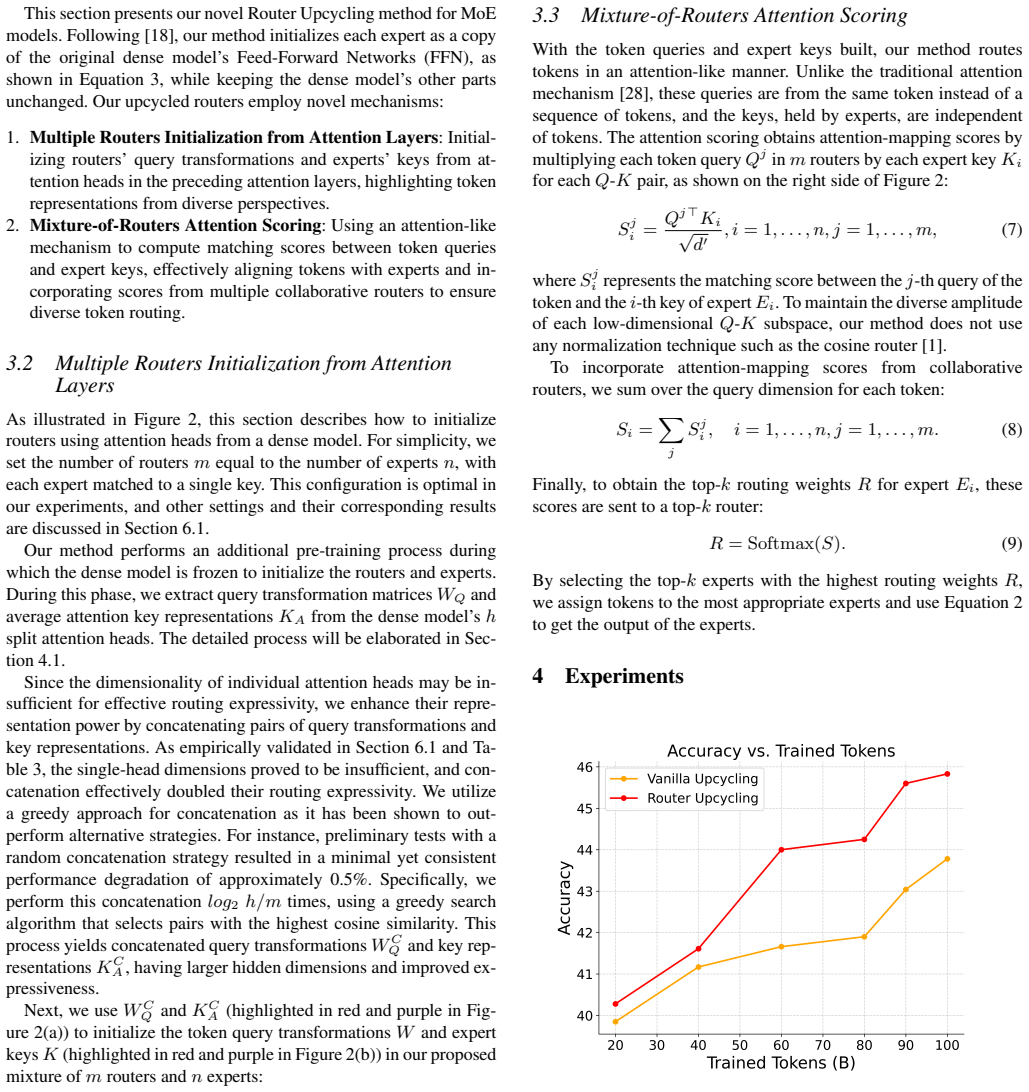
Summary. The paper proposes Router Upcycling, a method for initializing and structuring the routers in Mixture-of-Experts (MoE) upcycling. Instead of a randomly initialized linear router, the authors initialize multiple routers from the attention-head query projections of the frozen dense checkpoint, and initialize expert keys as average attention key vectors computed over 10 training iterations. Routing scores are computed as the sum of attention-like inner products between token queries and expert keys, followed by top-k softmax selection. Experiments on an upcycled Qwen 8x0.5B model (100B tokens) report an average zero-shot score of 45.83 across 10 benchmarks, 2.05 points above the Vanilla Upcycling baseline. The paper also reports scaling experiments (8x1.8B, 16x0.5B), routing-diversity and expert-specialization analyses, and ablations over the number of routers and mixture methods.
Significance. If the reported gains are reliable and attributable to the proposed mechanism, the paper would offer a practical, low-overhead improvement for MoE upcycling and would be the first to explicitly optimize the router in the upcycling setting. The attention-derived initialization idea is simple and plausible, and the reported gains are consistently positive across scales and benchmarks. However, the paper's central framing — that a 'mixture of routers' with an 'attention-like mechanism' provides a more expressive or diverse routing decision surface — is weakened by the mathematical form of the scoring function, which is linear in the token representation before the final softmax. The empirical contribution may still be valuable, but it currently rests on a single run and on comparisons that do not isolate the proposed mechanism. The analysis of routing diversity and expert specialization is a useful step, though it is descriptive rather than causal.
major comments (4)
- [Sections 3.2 and 3.3, Eqs. (6)-(8)] The routing score is S_i = x^T (sum_j W_j^T K_i) / sqrt(d'). This is a linear function of x; summing over j before the softmax means the m 'routers' are mathematically equivalent to a single linear router with effective column vectors a_i = sum_j W_j^T K_i / sqrt(d'). Consequently, the claimed 'mixture-of-routers' and 'attention-like' mechanism does not create a richer decision surface than a vanilla linear router; it is a low-rank factorization of a linear map with attention-derived initializations. The reported gains could therefore come entirely from the initialization or from the low-rank structure, not from the multi-query mechanism the paper emphasizes. A controlled ablation is needed: (a) the same architecture with randomly initialized W_j and K_i; (b) a single linear router initialized to the same effective A matrix, so initial decisions are identical. Without such ablations, the
- [Section 4.1 and Table 1] All results, including the main 2.05-point average gain and the scaling and ablation tables, are from a single training run with no error bars or multiple seeds. At this scale, run-to-run variance can easily be on the order of a point or more on average zero-shot accuracy, so the headline improvement may be within noise. The paper should report at least 2-3 seeds for the main comparison, or otherwise justify the stability of the reported differences. This is directly load-bearing because every positive claim in Sections 5.1, 5.2, and 6 rests on these point estimates.
- [Section 4.3 and Table 1] The Switch Upcycling baseline uses the Switch Transformer top-1 router, as stated in Section 4.1 ('we do not drop any tokens during training except for the Switch Transformer'), while Router Upcycling uses top-2 selection. The paper does not state whether the auxiliary loss (0.02) and router z-loss (0.001) are applied to all baselines or only to Router Upcycling. These differences alone could explain part of the 2.05-point gap. The baselines should be compared under the same top-k, the same auxiliary-loss settings, and the same token-dropping policy, or the paper should explicitly control for these factors.
- [Section 3.2 and Section 4.1] The expert keys are estimated as average attention keys over only 10 iterations of the frozen dense model (batch size 1024, sequence length 4096). This is a small fraction of the training data and the paper provides no sensitivity analysis for this number, nor for the greedy cosine-similarity concatenation procedure. The method's entire routing behavior depends on these keys; if they are noisy or unstable, the reported gains may be specific to the chosen estimation schedule. An ablation varying the number of key-estimation iterations (e.g., 1, 10, 100, 1000) and a comparison against random concatenation is necessary to support the claim that attention-derived initialization is the cause of improvement.
minor comments (5)
- [Abstract and Section 5.1] The paper says 'over 2%' improvement, but the reported difference is 2.05 absolute points (45.83 vs 43.78), which is about 4.7% relative. Please use 'points' or 'relative %' consistently to avoid ambiguity.
- [Section 1, Figure 1] Figure 1 is cited as 'preliminary experiments' but no details are given about the setup, the dense checkpoint, the number of training tokens, or the baselines. Add a short description or a reference to Section 4.
- [Section 6.1, Table 3] The claim 'we have conducted all possible ablation studies on the numbers' is too strong and is not accompanied by error bars. Also, when m > n and each expert holds multiple keys, the selection rule ('selected based on the top-k score of any of its keys') is underspecified; clarify how scores are aggregated for an expert with multiple keys.
- [Section 5.2] The drop in performance for 16x0.5B is attributed to 'limited head dimensions that constrain routing capacity,' but this is a post-hoc explanation not supported by the presented experiments. A controlled study that varies head dimension while keeping expert count fixed would be needed.
- [References and notation] Some references have inconsistent formatting (e.g., [23] contains a raw URL in the author field), and the notation for d' (router dimension) is introduced only after Eq. (5) without an explicit definition before Eq. (6). Please polish these presentation issues.
Circularity Check
Mixture-of-routers scoring reduces to a linear gating map; benchmark results remain external evidence.
specific steps
-
renaming known result
[Section 3.3, Equations 7–8]
"To incorporate attention-mapping scores from collaborative routers, we sum over the query dimension for each token: Si = P j S j i , i = 1, . . . , n, j= 1, . . . , m. (8)"
By Equations 6–8, Si = Σj (Wj x)ᵀ Ki / √d' = xᵀ (Σj Wjᵀ Ki) / √d'. This is exactly a linear gating score with effective weight vector ai = Σj Wjᵀ Ki / √d'. Summing over routers before any nonlinearity collapses the 'mixture-of-routers' into a single linear map, which is the same functional form as the vanilla linear router the paper compares against. The claimed attention-like multi-query mechanism is thus a reparameterization (low-rank factorization) of a known linear router, renamed as a novel 'mixture-of-routers' method. The paper's architectural novelty claim and its causal explanation of improved routing diversity are therefore not supported by a distinct mechanism; any empirical gains must come from the initialization or factorization, not from the 'mixture' itself.
full rationale
The paper's experimental core is self-contained: Router Upcycling is trained on an external corpus and evaluated on held-out zero-shot benchmarks, so the reported scores are not fitted parameters renamed as predictions. The expert keys are estimated over 10 frozen-model iterations as an initialization, not as a target of prediction, and no equation reduces the final average score to the key-estimation procedure. There is no load-bearing self-citation or imported uniqueness theorem. However, one central derivation step deserves a partial circularity flag: the 'mixture-of-routers attention scoring' in Eqs. 7–8 is, by construction, a single linear function of the token embedding, because the per-router scores are summed before the softmax. This makes the mechanism functionally a low-rank linear router, a known baseline, presented under the new name 'Mixture-of-Routers.' This does not force the empirical benchmark outcomes, but it does undermine the paper's architectural novelty and the claim that the attention-like multi-router design itself drives diversity and gains. Thus the overall circularity is moderate, not absent.
Axiom & Free-Parameter Ledger
free parameters (6)
- m (number of routers) =
8
- d' (router hidden dimension) =
128
- auxiliary loss weight =
0.02
- router z-loss weight =
0.001
- expert key initialization =
average attention keys over 10 iterations, batch size 1024, seq len 4096
- greedy concatenation pairing =
pairs selected by highest cosine similarity
axioms (4)
- domain assumption MoE upcycling initialized by duplicating FFN weights is a valid starting point.
- domain assumption Attention query-key inner products are a useful routing signal for expert assignment.
- ad hoc to paper Average attention keys computed on a small sample of the training corpus provide stable expert keys.
- ad hoc to paper The greedy cosine-similarity concatenation of attention heads improves routing expressivity.
invented entities (2)
-
Expert key embeddings K_i
no independent evidence
-
Mixture-of-Routers mechanism
no independent evidence
Cite this review
Pith. "Pith review of Router Upcycling: Leveraging Mixture-of-Routers in Mixture-of-Experts Upcycling." pith.science (2026). https://pith.science/paper/JRYBNW4S
@misc{pith2026250900679,
  author       = {Pith},
  title        = {Pith review of: Router Upcycling: Leveraging Mixture-of-Routers in Mixture-of-Experts Upcycling},
  year         = {2026},
  howpublished = {\url{https://pith.science/paper/JRYBNW4S}},
  note         = {Machine review of arXiv:2509.00679}
}
read the original abstract
The Mixture-of-Experts (MoE) models have gained significant attention in deep learning due to their dynamic resource allocation and superior performance across diverse tasks. However, efficiently training these models remains challenging. The MoE upcycling technique has been proposed to reuse and improve existing model components, thereby minimizing training overhead. Despite this, simple routers, such as linear routers, often struggle with complex routing tasks within MoE upcycling. In response, we propose a novel routing technique called Router Upcycling to enhance the performance of MoE upcycling models. Our approach initializes multiple routers from the attention heads of preceding attention layers during upcycling. These routers collaboratively assign tokens to specialized experts in an attention-like manner. Each token is processed into diverse queries and aligned with the experts' features (serving as keys). Experimental results demonstrate that our method achieves state-of-the-art (SOTA) performance, outperforming other upcycling baselines.
Figures




Forward citations
Cited by 1 Pith paper
-
L2R: Low-Rank and Lipschitz-Controlled Routing for Mixture-of-Experts
L2R improves MoE performance by routing in a low-rank space with Lipschitz-controlled saturated inner-product scoring and multi-anchor mechanisms.
Reference graph
Works this paper leans on
-
[1]
Z. Chi, L. Dong, S. Huang, D. Dai, S. Ma, B. Patra, S. Singhal, P. Bajaj, X. Song, X.-L. Mao, H. Huang, and F. Wei. On the Representation Collapse of Sparse Mixture of Experts, Oct. 2022
work page 2022
-
[2]
C. Clark, K. Lee, M.-W. Chang, T. Kwiatkowski, M. Collins, and K. Toutanova. Boolq: Exploring the surprising difficulty of natural yes/no questions, 2019. URL https://arxiv.org/abs/1905.10044
Pith/arXiv arXiv 2019
-
[3]
P. Clark, I. Cowhey, O. Etzioni, T. Khot, A. Sabharwal, C. Schoenick, and O. Tafjord. Think you have solved question answering? try arc, the ai2 reasoning challenge, 2018. URL https://arxiv.org/abs/1803.05457
Pith/arXiv arXiv 2018
-
[4]
D. Dai, L. Dong, S. Ma, B. Zheng, Z. Sui, B. Chang, and F. Wei. Sta- bleMoE: Stable Routing Strategy for Mixture of Experts, Apr. 2022
work page 2022
-
[5]
D. Dai, C. Deng, C. Zhao, R. X. Xu, H. Gao, D. Chen, J. Li, W. Zeng, X. Yu, Y . Wu, Z. Xie, Y . K. Li, P. Huang, F. Luo, C. Ruan, Z. Sui, and W. Liang. DeepSeekMoE: Towards Ultimate Expert Specialization in Mixture-of-Experts Language Models, Jan. 2024
work page 2024
- [6]
-
[7]
L. Gao, S. Biderman, S. Black, L. Golding, T. Hoppe, C. Foster, J. Phang, H. He, A. Thite, N. Nabeshima, S. Presser, and C. Leahy. The pile: An 800gb dataset of diverse text for language modeling, 2020. URL https://arxiv.org/abs/2101.00027
Pith/arXiv arXiv 2020
-
[8]
A. S. Gordon, Z. Kozareva, and M. Roemmele. Choice of plausible al- ternatives: An evaluation of commonsense causal reasoning. In AAAI Spring Symposium: Logical F ormalizations of Commonsense Reason- ing, 2011. URL https://api.semanticscholar.org/CorpusID:434646
work page 2011
-
[9]
K. Gupta, B. Thérien, A. Ibrahim, M. L. Richter, Q. Anthony, E. Belilovsky, I. Rish, and T. Lesort. Continual pre-training of large language models: How to (re)warm your model?, 2023. URL https: //arxiv.org/abs/2308.04014
Pith/arXiv arXiv 2023
-
[10]
E. He, A. Khattar, R. Prenger, V . Korthikanti, Z. Yan, T. Liu, S. Fan, A. Aithal, M. Shoeybi, and B. Catanzaro. Upcycling Large Language Models into Mixture of Experts, Oct. 2024
work page 2024
-
[11]
D. Hendrycks and K. Gimpel. Gaussian error linear units (gelus), 2023. URL https://arxiv.org/abs/1606.08415
Pith/arXiv arXiv 2023
- [12]
- [13]
-
[14]
R. A. Jacobs, M. I. Jordan, S. J. Nowlan, and G. E. Hinton. Adaptive mixtures of local experts. Neural Computation, 3:79–87, 1991. URL https://api.semanticscholar.org/CorpusID:572361
work page 1991
-
[15]
A. Q. Jiang, A. Sablayrolles, A. Roux, A. Mensch, B. Savary, C. Bam- ford, D. S. Chaplot, D. de las Casas, E. B. Hanna, F. Bressand, G. Lengyel, G. Bour, G. Lample, L. R. Lavaud, L. Saulnier, M.-A. Lachaux, P. Stock, S. Subramanian, S. Yang, S. Antoniak, T. L. Scao, T. Gervet, T. Lavril, T. Wang, T. Lacroix, and W. E. Sayed. Mixtral of Experts, Jan. 2024
work page 2024
- [16]
-
[17]
D. P. Kingma and J. Ba. Adam: A method for stochastic optimization,
-
[18]
A. Komatsuzaki, J. Puigcerver, J. Lee-Thorp, C. R. Ruiz, B. Mustafa, J. Ainslie, Y . Tay, M. Dehghani, and N. Houlsby. Sparse Upcycling: Training Mixture-of-Experts from Dense Checkpoints, Feb. 2023
work page 2023
-
[19]
URL https://arxiv.org/abs/1412.6980
- [20]
-
[21]
T. Kwiatkowski, J. Palomaki, O. Redfield, M. Collins, A. Parikh, C. Al- berti, D. Epstein, I. Polosukhin, J. Devlin, K. Lee, K. Toutanova, L. Jones, M. Kelcey, M.-W. Chang, A. M. Dai, J. Uszkoreit, Q. Le, and S. Petrov. Natural questions: A benchmark for question answer- ing research. Transactions of the Association for Computational Lin- guistics, 7:452–...
-
[22]
T. Mihaylov, P. Clark, T. Khot, and A. Sabharwal. Can a suit of armor conduct electricity? a new dataset for open book question answering,
-
[23]
J. Li, Z. Sun, X. He, L. Zeng, Y . Lin, E. Li, B. Zheng, R. Zhao, and X. Chen. LocMoE: A Low-Overhead MoE for Large Language Model Training, May 2024
work page 2024
- [24]
-
[25]
K. Sakaguchi, R. L. Bras, C. Bhagavatula, and Y . Choi. Winogrande: An adversarial winograd schema challenge at scale, 2019. URL https: //arxiv.org/abs/1907.10641
Pith/arXiv arXiv 2019
-
[26]
Introducing qwen1.5, February 2024
Qwen. Introducing qwen1.5, February 2024. URL https://qwenlm.git hub.io/blog/qwen1.5/
work page 2024
-
[27]
M. Shoeybi, M. Patwary, R. Puri, P. LeGresley, J. Casper, and B. Catan- zaro. Megatron-lm: Training multi-billion parameter language models using model parallelism, 2020. URL https://arxiv.org/abs/1909.08053
Pith/arXiv arXiv 2020
-
[28]
Vaswani, N
A. Vaswani, N. Shazeer, N. Parmar, J. Uszkoreit, L. Jones, A. N. Gomez, L. Kaiser, and I. Polosukhin. Attention is all you need, 2023
2023
-
[29]
N. Shazeer, A. Mirhoseini, K. Maziarz, A. Davis, Q. Le, G. Hinton, and J. Dean. Outrageously Large Neural Networks: The Sparsely-Gated Mixture-of-Experts Layer, Jan. 2017
work page 2017
-
[30]
X. Wu, S. Huang, W. Wang, and F. Wei. Multi-Head Mixture-of- Experts, Apr. 2024
work page 2024
-
[31]
R. Zellers, A. Holtzman, Y . Bisk, A. Farhadi, and Y . Choi. Hellaswag: Can a machine really finish your sentence?, 2019. URL https://arxiv.or g/abs/1905.07830
Pith/arXiv arXiv 2019
-
[32]
M. Weber, D. Fu, Q. Anthony, Y . Oren, S. Adams, A. Alexandrov, X. Lyu, H. Nguyen, X. Yao, V . Adams, B. Athiwaratkun, R. Chalamala, K. Chen, M. Ryabinin, T. Dao, P. Liang, C. Ré, I. Rish, and C. Zhang. Redpajama: an open dataset for training large language models, 2024. URL https://arxiv.org/abs/2411.12372
Pith/arXiv arXiv 2024
-
[33]
Y . Zhou, T. Lei, H. Liu, N. Du, Y . Huang, V . Zhao, A. Dai, Z. Chen, Q. Le, and J. Laudon. Mixture-of-Experts with Expert Choice Routing, Oct. 2022
work page 2022
-
[34]
B. Zoph, I. Bello, S. Kumar, N. Du, Y . Huang, J. Dean, N. Shazeer, and W. Fedus. ST-MoE: Designing Stable and Transferable Sparse Expert Models, Apr. 2022
work page 2022
-
[35]
Z. Zeng, Y . Miao, H. Gao, H. Zhang, and Z. Deng. AdaMoE: Token- Adaptive Routing with Null Experts for Mixture-of-Experts Language Models, Oct. 2024
work page 2024
-
[38]
S. Zuo, X. Liu, J. Jiao, Y . J. Kim, H. Hassan, R. Zhang, T. Zhao, and J. Gao. Taming Sparsely Activated Transformer with Stochastic Ex- perts, Feb. 2022
work page 2022
-
[2017]
URL https://arxiv.org/abs/1705.03551
-
[2018]
URL https://arxiv.org/abs/1809.02789
This paper was first reviewed by deepseek-v4-flash on August 5, 2026.
discussion (0)
Sign in with ORCID, Apple, or X to comment. Anyone can read and Pith papers without signing in.