REVIEW 3 major objections 5 minor 35 references
A pretrained temporal transformer rivals graph-based skeleton action models
Reviewed by Pith at T0; open to challenge. T0 means a machine referee read the full paper against a public rubric. the ladder, T0–T4 →
A masked-pretrained skeleton transformer with a second fine-tuning transformer and cross-attention fusion reaches 94.66% on Penn Action, 91.16% on N-UCLA, and 81.01%/88.17% on NTU RGB+D 60 cross-subject/cross-view.
T0 review reviewed 2026-08-05 challenge →
load-bearing objection CascadeFormer is a clean, honest empirical paper with released code, but its central claim—that the T2 cascade stage helps—is never actually tested. the 3 major comments →
CascadeFormer: A Family of Two-stage Cascading Transformers for Skeleton-based Human Action Recognition
The pith
A machine-rendered reading of the paper's core claim, the machinery that carries it, and where it could break.
The reading
Core claim
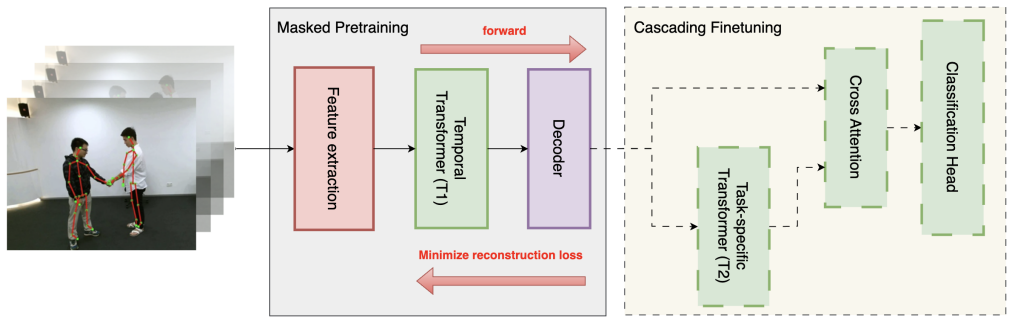
On its own terms, the paper's central claim is that joint-level masked pretraining—masking 30% of joints across all frames and reconstructing the masked coordinates with a lightweight linear decoder—gives a vanilla temporal transformer enough spatiotemporal structure that a subsequent cascading fine-tuning stage can compete with graph-convolutional baselines. The cascading stage passes the pretrained frame embeddings through a second task-specific transformer and fuses them with the original embeddings via cross-attention before frame-average pooling and classification. The decisive evidence is on NTU RGB+D 60: CascadeFormer 1.0 reaches 81.01% cross-subject and 88.17% cross-view, essentially
What carries the argument
The load-bearing mechanism is the two-stage cascade: a temporal transformer (T1) pretrained to reconstruct masked joint coordinates with a linear decoder, followed by a task-specific transformer (T2) that refines T1's frame embeddings; the refined and original embeddings are combined through cross-attention, average-pooled over frames, and classified. The three CascadeFormer variants share T1, T2, pretraining, and fine-tuning stages, differing only in how frame tokens are built—linear projection, a 1D convolution over joints, or a single spatial transformer over joint embeddings. What carries the argument is minimalism: no graph edges or skeleton topology appear anywhere, so competitive accu
Load-bearing premise
That the added second-stage transformer is what makes the fine-tuning stage work: the paper never compares against fine-tuning the same pretrained backbone with only a linear classifier head, so if that control matches the reported accuracy, the cascading novelty adds nothing.
What would settle it
Run the same 100-epoch masked pretraining on NTU RGB+D 60 cross-subject and fine-tune in two ways: with the cascading T2 transformer, and with only frame-average pooling plus a linear classifier. If the linear-head run reaches 81.01% or higher, the cascading stage is not the cause of the result. Separately, rerun Penn Action evaluation without removing occluded skeletons; if accuracy drops toward or below the 93.4% HDM-BG baseline, the comparison protocol changes the conclusion.
If this is right
- On NTU RGB+D 60, CascadeFormer 1.0 reaches 81.01% cross-subject and 88.17% cross-view, showing that spatial graphs are not required to stay competitive with graph-convolutional baselines on large-scale skeleton data.
- The same two-stage pipeline transfers across dataset formats and scales: 94.66% on Penn Action (2D, 13 joints), 91.16% on N-UCLA (3D, 20 joints), and strong results on NTU60 (3D, 25 joints).
- The pretraining-duration ablation ties downstream accuracy directly to masked pretraining: 76.38% after 1 epoch versus 81.01% after 100 epochs on NTU60 cross-subject.
- Joint-level random masking outperforms frame-level masking (94.66% vs 89.98%) and unmasked reconstruction (91.10%) on Penn Action, indicating that fine-grained spatial masking is the more effective pretraining objective.
- Among the three feature extractors, the simplest linear frame projection is best or near-best on all datasets, so added spatial modeling inside the encoder is not what drives performance.
Where Pith is reading between the lines
- If a future control run fine-tunes the same pretrained backbone with only a linear classifier head and matches the reported accuracy, the second transformer T2 would be shown to add little; the paper's reported gains do not settle that question directly.
- The Penn Action evaluation removes occluded skeletons before training and testing, a protocol change the cited baselines are not described as using; rerunning on the original unmodified set would test whether the 94.66% ranking holds.
- The cross-view gap on two-person actions (84.86% vs 88.92% for single-person actions) suggests that inter-person dynamics, not joint topology, is the next bottleneck; adding explicit relative-pose or interaction features between persons is a direct extension.
- Because the simplest encoder wins on most splits, the results imply that frame-level tokens plus masked joint reconstruction can absorb most of the spatial information in skeleton data, so graph or part-based encoders may be replaceable in other skeleton pipelines as well.
Editorial analysis
A structured set of objections, weighed in public.
Referee Report
Summary. The paper introduces CascadeFormer, a family of two-stage transformer models for skeleton-based action recognition. The first stage applies masked joint-level pretraining to a temporal transformer backbone (T1) with a linear reconstruction decoder. The second stage is a cascading fine-tuning component in which a task-specific transformer (T2) refines T1's frame embeddings, fuses them via cross-attention, and feeds the pooled result to a linear classifier. Three variants (1.0, 1.1, 1.2) differ only in the feature extraction module (linear projection, 1D convolution, and joint-level spatial transformer, respectively). The models are evaluated on Penn Action, N-UCLA, and NTU RGB+D 60 (cross-subject and cross-view), with reported accuracies of 94.66%, 91.16%, 81.01%, and 88.17% for the best variant per dataset. The paper also includes ablations on pretraining duration, masking strategy, input representation, decoder architecture, and backbone freezing, and it releases code and checkpoints.
Significance. If the two-stage cascading design is genuinely responsible for the reported results, the paper provides useful evidence that a vanilla temporal transformer, combined with masked pretraining and a second task-specific transformer, can match or approach graph-based models on standard skeleton benchmarks without explicit spatial graphs. The empirical study is broad, covering three datasets with different modalities, scales, and evaluation protocols, and the public release of code and checkpoints is a concrete reproducibility contribution. The loss functions and attention equations are standard and consistently written, and the reported numbers are externally measured benchmark accuracies, so there is no circularity in the central accuracy claims. However, the paper's stated core novelty—the cascading T2 stage—is never isolated by a control experiment, and the comparison protocol on Penn Action is not shown to be aligned with the cited baselines. These issues directly affect whether the paper's central claims are supported.
major comments (3)
- [Cascading Finetuning Component / Insights] The paper's central novelty is the cascading fine-tuning stage (T2 plus cross-attention fusion), and the Insights paragraph asserts that 'the effectiveness of the cascading fine-tuning strategy is consistent across model variants and datasets.' However, no experiment compares the full CascadeFormer pipeline against the standard alternative of fine-tuning the identical pretrained T1 with a linear classification head only. The ablations in Tables 7–8 and supplementary Tables 9–11 vary pretraining duration, masking strategy, input representation, decoder, and backbone freezing, but none isolate T2. Without this control, the reported accuracies in Table 1 could be entirely attributable to masked pretraining of T1 plus a linear head, making the cascade superfluous. This is load-bearing because if T2 provides no measurable gain, the paper's title and central claim collapse even though the accu
- [Data Preprocessing / Table 3] The Penn Action evaluation is reported as beating HDM-BG (93.4%) and AOG (85.5%), but the paper states in Data Preprocessing that occluded skeletons were removed using visibility flags. The cited baselines are not shown to use the same filtered protocol. If the removal changes the test set, the comparison in Table 3 is not apples-to-apples, and the 94.66% result may reflect a different (possibly easier) benchmark rather than a model advantage. The authors should either evaluate the baselines under the same filtered protocol, report accuracy on the standard unfiltered test split, or explicitly show that the filtering does not affect the ranking. Without this, the Penn Action comparison is not a controlled claim.
- [Performance Comparison / Tables 5-6] The text states that 'even without spatial graphs, our model competes with state-of-the-art graph convolutional approaches,' but the NTU RGB+D 60 comparison set contains only ST-LSTM (2016) and ST-GCN (2018). Modern graph-based methods such as CTR-GCN (cited in the paper's references but not compared) and many later GCNs achieve substantially higher accuracies on these splits. The claim of competing with state-of-the-art graph convolutional approaches is therefore unsupported by the presented comparison. Either the comparison table should be updated to include current GCN and transformer baselines, or the claim should be tempered to 'comparable to ST-GCN,' which is what the data actually show.
minor comments (5)
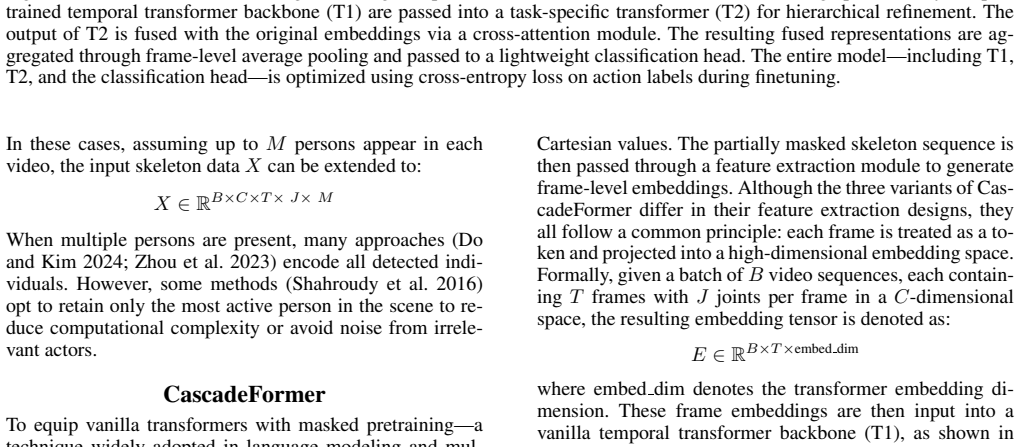
- [Equation (1)] The MSE loss is written as ||masked X - masked X'||^2 over the full tensors, although the text says the loss is computed only on masked joints. A masking operator or index set should be introduced to make the objective precise.
- [Training Setup] The architecture hyperparameters for T1 and T2 are not given: embedding dimension, number of layers, number of heads, and decoder dimension are all missing. The claim of reproducibility would be stronger if these were specified in the paper, even if code is available.
- [Data Preprocessing (N-UCLA)] The text says the dataset is 'virtually repeat[ed] multiple times' following SkateFormer, but the repetition multiplier is not stated. This is a deterministic preprocessing detail that should be reported.
- [Ablation Highlights / Table 7] The number of fine-tuning epochs is fixed at 100 for the pretraining-duration ablation, but the main training setup says the number of epochs varies across variants and datasets. The fine-tuning epoch count for each reported configuration should be stated in the table or text to allow replication.
- [Notation in Cross-Attention] In Equation (5), E_cross = Attention(E_pretrain, E_finetune, E_finetune) uses three arguments but the convention for Attention(Q,K,V) is not explicitly repeated. Clarify which argument is Q, K, and V, and whether E_pretrain here is the output of T1 before or after T2 processing.
Circularity Check
No circularity: accuracy results are external benchmark measurements, and the missing T2-only control is a support gap rather than a definitional reduction.
full rationale
The paper's central results are accuracies measured on external benchmarks (Penn Action, N-UCLA, NTU RGB+D 60), and no equation in the paper defines those results in terms of a fitted constant or normalizing trick. The masked-pretraining loss is MSE over masked joints and the fine-tuning loss is cross-entropy; these are standard objectives, not self-referential predictions. The paper's claim that the cascading fine-tuning strategy is 'effective' is an interpretation of the full-pipeline accuracy, not a quantity that equals its input by construction. The missing control experiment (linear head on the same pretrained backbone, without T2) is a genuine support gap and a limitation of the evidence, but it is not circularity: the full-pipeline accuracy is not logically forced by anything in the paper, and it could in principle have been worse than a linear-head baseline. The citation to OmniVec2 for hierarchical adaptation is inspirational and is not a self-citation; the reference list contains no overlapping authors with the present paper. The Penn Action occluded-skeleton preprocessing is a protocol concern for comparability, but again not a circular dependency. Therefore no circular step is present, and the appropriate score is 0.
Axiom & Free-Parameter Ledger
free parameters (7)
- masking_ratio =
0.30 (30% of joints masked, applied across all frames)
- pretraining_epochs =
100 epochs (default)
- fine-tuning learning rate =
1e-5 (Penn/N-UCLA), 3e-5 (NTU60 CS), 1e-4 (NTU60 CV)
- pretraining learning rate =
1e-4 for all datasets
- sampled frame length =
64 frames (N-UCLA and NTU60); per-batch padding on Penn Action
- N-UCLA virtual repetition multiplier =
not stated in text
- architecture hyperparameters (embed dim, depth, heads, decoder size) =
not stated in text
axioms (6)
- standard math Standard transformer attention, cross-attention, and MSE pretraining objectives behave as specified (Vaswani et al. 2023, He et al. 2021).
- domain assumption Raw joint coordinates, through the paper's three feature encoders, carry enough information to classify the target actions.
- domain assumption Masked reconstruction pretraining transfers to the downstream classification task at the finetuning stage.
- domain assumption Keeping only the most active person per NTU60 sequence preserves the label-relevant information.
- domain assumption Penn Action accuracies remain comparable to AOG and HDM-BG after removing occluded skeletons.
- ad hoc to paper The cascading T2 transformer improves classification over a plain linear head on the pretrained T1 embeddings.
Cite this review
Pith. "Pith review of CascadeFormer: A Family of Two-stage Cascading Transformers for Skeleton-based Human Action Recognition." pith.science (2026). https://pith.science/paper/WFLSQ2VL
@misc{pith2026250900692,
  author       = {Pith},
  title        = {Pith review of: CascadeFormer: A Family of Two-stage Cascading Transformers for Skeleton-based Human Action Recognition},
  year         = {2026},
  howpublished = {\url{https://pith.science/paper/WFLSQ2VL}},
  note         = {Machine review of arXiv:2509.00692}
}
read the original abstract
Skeleton-based human action recognition leverages sequences of human joint coordinates to identify actions performed in videos. Owing to the intrinsic spatiotemporal structure of skeleton data, Graph Convolutional Networks (GCNs) have been the dominant architecture in this field. However, recent advances in transformer models and masked pretraining frameworks open new avenues for representation learning. In this work, we propose CascadeFormer, a family of two-stage cascading transformers for skeleton-based human action recognition. Our framework consists of a masked pretraining stage to learn generalizable skeleton representations, followed by a cascading fine-tuning stage tailored for discriminative action classification. We evaluate CascadeFormer across three benchmark datasets (Penn Action N-UCLA, and NTU RGB+D 60), achieving competitive performance on all tasks. To promote reproducibility, we release our code and model checkpoints.
Figures


Reference graph
Works this paper leans on
-
[1]
, " * write output.state after.block = add.period write newline
ENTRY address archivePrefix author booktitle chapter edition editor eid eprint howpublished institution isbn journal key month note number organization pages publisher school series title type volume year label extra.label sort.label short.list INTEGERS output.state before.all mid.sentence after.sentence after.block FUNCTION init.state.consts #0 'before.a...
-
[2]
write newline
" write newline "" before.all 'output.state := FUNCTION n.dashify 't := "" t empty not t #1 #1 substring "-" = t #1 #2 substring "--" = not "--" * t #2 global.max substring 't := t #1 #1 substring "-" = "-" * t #2 global.max substring 't := while if t #1 #1 substring * t #2 global.max substring 't := if while FUNCTION word.in bbl.in capitalize " " * FUNCT...
-
[3]
Bertasius, G.; Wang, H.; and Torresani, L. 2021. Is Space-Time Attention All You Need for Video Understanding? arXiv:2102.05095
Pith/arXiv arXiv 2021
-
[4]
Cai, D.; Kang, Y.; Yao, A.; and Chen, Y. 2023. Ske2Grid: Skeleton-to-Grid Representation Learning for Action Recognition. arXiv:2308.07571
work page internal anchor Pith review Pith/arXiv arXiv 2023
-
[5]
Chen, Y.; Zhang, Z.; Yuan, C.; Li, B.; Deng, Y.; and Hu, W. 2021. Channel-wise Topology Refinement Graph Convolution for Skeleton-Based Action Recognition. arXiv:2107.12213
work page internal anchor Pith review Pith/arXiv arXiv 2021
-
[6]
Devlin, J.; Chang, M.-W.; Lee, K.; and Toutanova, K. 2019. BERT: Pre-training of Deep Bidirectional Transformers for Language Understanding. arXiv:1810.04805
Pith/arXiv arXiv 2019
-
[7]
Do, J.; and Kim, M. 2024. SkateFormer: Skeletal-Temporal Transformer for Human Action Recognition. arXiv:2403.09508
Pith/arXiv arXiv 2024
-
[8]
Dosovitskiy, A.; Beyer, L.; Kolesnikov, A.; Weissenborn, D.; Zhai, X.; Unterthiner, T.; Dehghani, M.; Minderer, M.; Heigold, G.; Gelly, S.; Uszkoreit, J.; and Houlsby, N. 2021. An Image is Worth 16x16 Words: Transformers for Image Recognition at Scale. arXiv:2010.11929
Pith/arXiv arXiv 2021
-
[9]
Duan, H.; Zhao, Y.; Chen, K.; Lin, D.; and Dai, B. 2022. Revisiting Skeleton-based Action Recognition. arXiv:2104.13586
work page internal anchor Pith review Pith/arXiv arXiv 2022
-
[10]
He, K.; Chen, X.; Xie, S.; Li, Y.; Dollár, P.; and Girshick, R. 2021. Masked Autoencoders Are Scalable Vision Learners. arXiv:2111.06377
Pith/arXiv arXiv 2021
-
[11]
Kim, S.; Ahn, D.; and Ko, B. C. 2023. Cross-Modal Learning with 3D Deformable Attention for Action Recognition. arXiv:2212.05638
work page internal anchor Pith review Pith/arXiv arXiv 2023
-
[12]
Lee, I.; Kim, D.; Kang, S.; and Lee, S. 2017. Ensemble Deep Learning for Skeleton-Based Action Recognition Using Temporal Sliding LSTM Networks. In 2017 IEEE International Conference on Computer Vision (ICCV), 1012--1020
work page 2017
-
[13]
Liu, H.; Li, C.; Wu, Q.; and Lee, Y. J. 2023. Visual Instruction Tuning. arXiv:2304.08485
Pith/arXiv arXiv 2023
-
[14]
Liu, J.; Shahroudy, A.; Xu, D.; and Wang, G. 2016. Spatio-Temporal LSTM with Trust Gates for 3D Human Action Recognition. arXiv:1607.07043
work page internal anchor Pith review Pith/arXiv arXiv 2016
-
[15]
Liu, M.; Liu, H.; and Chen, C. 2017. Enhanced Skeleton Visualization for View Invariant Human Action Recognition. Pattern Recognition, 68: 346--362
work page 2017
-
[16]
Loshchilov, I.; and Hutter, F. 2017. SGDR: Stochastic Gradient Descent with Warm Restarts. arXiv:1608.03983
Pith/arXiv arXiv 2017
-
[17]
Loshchilov, I.; and Hutter, F. 2019. Decoupled Weight Decay Regularization. arXiv:1711.05101
Pith/arXiv arXiv 2019
-
[18]
Nie, B. X.; Xiong, C.; and Zhu, S.-C. 2015. Joint action recognition and pose estimation from video. In 2015 IEEE Conference on Computer Vision and Pattern Recognition (CVPR), 1293--1301
work page 2015
-
[19]
Paszke, A.; Gross, S.; Massa, F.; Lerer, A.; Bradbury, J.; Chanan, G.; Killeen, T.; Lin, Z.; Gimelshein, N.; Antiga, L.; Desmaison, A.; Kopf, A.; Yang, E.; DeVito, Z.; Raison, M.; Tejani, A.; Chilamkurthy, S.; Steiner, B.; Fang, L.; Bai, J.; and Chintala, S. 2019. PyTorch: An Imperative Style, High-Performance Deep Learning Library. In Advances in Neural ...
work page 2019
-
[20]
Radford, A.; Kim, J. W.; Hallacy, C.; Ramesh, A.; Goh, G.; Agarwal, S.; Sastry, G.; Askell, A.; Mishkin, P.; Clark, J.; Krueger, G.; and Sutskever, I. 2021. Learning Transferable Visual Models From Natural Language Supervision. arXiv:2103.00020
Pith/arXiv arXiv 2021
-
[21]
Rao, Y.; Zhao, W.; Liu, B.; Lu, J.; Zhou, J.; and Hsieh, C.-J. 2021. DynamicViT: Efficient Vision Transformers with Dynamic Token Sparsification. arXiv:2106.02034
Pith/arXiv arXiv 2021
-
[22]
Ridnik, T.; Ben-Baruch, E.; Noy, A.; and Zelnik-Manor, L. 2021. ImageNet-21K Pretraining for the Masses. arXiv:2104.10972
Pith/arXiv arXiv 2021
-
[23]
Ruder, S. 2017. An overview of gradient descent optimization algorithms. arXiv:1609.04747
Pith/arXiv arXiv 2017
-
[24]
Shahroudy, A.; Liu, J.; Ng, T.-T.; and Wang, G. 2016. NTU RGB+D: A Large Scale Dataset for 3D Human Activity Analysis. arXiv:1604.02808
Pith/arXiv arXiv 2016
-
[25]
Shi, L.; Zhang, Y.; Cheng, J.; and Lu, H. 2019. Skeleton-Based Action Recognition with Directed Graph Neural Networks . In Proceedings of the IEEE Conference on Computer Vision and Pattern Recognition (CVPR), 7912--7921. Long Beach, CA
work page 2019
-
[26]
Srivastava, S.; and Sharma, G. 2023. OmniVec: Learning robust representations with cross modal sharing. arXiv:2311.05709
Pith/arXiv arXiv 2023
-
[27]
Srivastava, S.; and Sharma, G. 2024. OmniVec2 - A Novel Transformer Based Network for Large Scale Multimodal and Multitask Learning. In 2024 IEEE/CVF Conference on Computer Vision and Pattern Recognition (CVPR), 27402--27414
work page 2024
-
[28]
N.; Kaiser, L.; and Polosukhin, I
Vaswani, A.; Shazeer, N.; Parmar, N.; Uszkoreit, J.; Jones, L.; Gomez, A. N.; Kaiser, L.; and Polosukhin, I. 2023. Attention Is All You Need. arXiv:1706.03762
Pith/arXiv arXiv 2023
-
[29]
wang, J.; Nie, X.; Xia, Y.; Wu, Y.; and Zhu, S.-C. 2014. Cross-view Action Modeling, Learning and Recognition. arXiv:1405.2941
work page internal anchor Pith review Pith/arXiv arXiv 2014
-
[30]
Wang, Q.; Shi, S.; He, J.; Peng, J.; Liu, T.; and Weng, R. 2023. IIP-Transformer: Intra-Inter-Part Transformer for Skeleton-Based Action Recognition. In 2023 IEEE International Conference on Big Data (BigData), 936–945. IEEE
work page 2023
-
[31]
Yan, S.; Xiong, Y.; and Lin, D. 2018. Spatial Temporal Graph Convolutional Networks for Skeleton-Based Action Recognition. arXiv:1801.07455
Pith/arXiv arXiv 2018
-
[32]
Zhang, C.; Gupta, A.; and Zisserman, A. 2021. Temporal Query Networks for Fine-grained Video Understanding. arXiv:2104.09496
work page internal anchor Pith review Pith/arXiv arXiv 2021
-
[33]
Zhang, W.; Zhu, M.; and Derpanis, K. G. 2013. From Actemes to Action: A Strongly-Supervised Representation for Detailed Action Understanding. In 2013 IEEE International Conference on Computer Vision, 2248--2255
work page 2013
-
[34]
Zhao, R.; Xu, W.; Su, H.; and Ji, Q. 2019. Bayesian Hierarchical Dynamic Model for Human Action Recognition. In 2019 IEEE/CVF Conference on Computer Vision and Pattern Recognition (CVPR), 7725--7734
work page 2019
-
[35]
Zhou, Y.; Cheng, Z.-Q.; Li, C.; Fang, Y.; Geng, Y.; Xie, X.; and Keuper, M. 2023. Hypergraph Transformer for Skeleton-based Action Recognition. arXiv:2211.09590
Pith/arXiv arXiv 2023
This paper was first reviewed by deepseek-v4-flash on August 5, 2026.
discussion (0)
Sign in with ORCID, Apple, or X to comment. Anyone can read and Pith papers without signing in.