REVIEW 4 major objections 5 minor 41 references
DELTA: Variational Disentangled Learning for Privacy-Preserving Data Reprogramming
T0 review · 4 major / 5 minor · reviewed 2026-08-05 · deepseek-v4-flash
Pith's one-line read This paper claims that DELTA solves Privacy-Preserving Data Reprogramming by transforming raw features into explicit new features that raise target prediction by about 9.3% while cutting sensitive-attribute inference by about 35%.
desk verdict A useful problem formulation and a coherent two-phase design, but the privacy-guarantee language outruns the evidence—worth refereeing, not worth citing as-is. read the letter →
The pith
A machine-rendered reading of the paper's core claim, the machinery that carries it, and where it could break.
The reading
What carries the argument
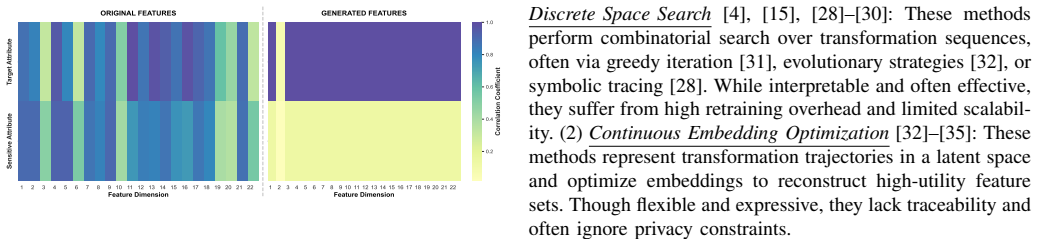
The load-bearing object is the disentangled variational latent space z = [zu ∥ zp] of a sequence-to-sequence VAE: zu is meant to capture target-predictive information, zp to capture sensitive-attribute information. During generation, only zu is fed to an attentive LSTM decoder, so generated feature sequences should inherit no privacy signal; adversarial heads and a causal regularization penalty (regressing zu on the privacy score and penalizing the coefficient) enforce that independence during training.
What would settle it
Train a stronger adversary—gradient-boosted trees or a neural network—on the features DELTA generates for each dataset, and also rerun DELTA with several fixed seeds for the random sensitive-attribute selection; if sensitive-attribute F1 approaches or exceeds the original-features level under any of these, the privacy claim fails. A more direct test: on the four datasets with randomly selected sensitive attributes, compare leakage across all sensible candidate attributes.
Extended reading notes
Core claim
DELTA's central claim is that explicit privacy-preserving feature transformation can be achieved by decoupling utility-driven search from privacy-enforced generation. Phase I collects a knowledge base of transformation paths serialized in Reverse Polish Notation and annotated with utility and privacy scores. Phase II encodes these paths into a variational latent space partitioned into utility and privacy components, decodes new transformations from the utility component alone, and applies adversarial and causal losses to make the utility component statistically independent of the sensitive attribute. Experiments on eight tabular datasets report an average 9.3% improvement in downstream F1 ov
Load-bearing premise
Privacy leakage is measured by how well one Random Forest classifier predicts the sensitive attribute from the generated features; if a different or stronger adversary can recover the sensitive attribute, or if the randomly chosen sensitive attributes in four datasets are not representative, the claimed privacy protection may not hold.
Editorial extensions
If this is right
- If DELTA's claims hold, feature engineering for tabular data can be made privacy-preserving without relying on opaque embeddings or noise injection, because the output is an explicit feature set.
- Regulated sectors like healthcare and finance could share derived features instead of raw data, aligning with requirements such as GDPR and HIPAA.
- The two-phase design means the expensive RL search can be done once per dataset, and the generative model can then propose new transformations; the paper reports sublinear runtime growth with dataset size.
- The HSIC-based disentanglement metric offers a measurable diagnostic that could become standard for verifying privacy-oriented feature generators.
- The ablation indicates that causal regularization is especially important on high-dimensional data, pointing to a design principle for future privacy-preserving generators.
Reading between the lines
- The privacy guarantee is defined operationally by a single Random Forest adversary; an immediate testable extension is to measure leakage against stronger adversaries (e.g., gradient boosting or neural networks) and across multiple fixed-seed sensitive-attribute choices.
- The RPN serialization and token vocabulary could be extended beyond arithmetic operators to grouping, binning, or domain-specific operators, potentially widening the method's applicability.
- The causal-regularization term penalizes only the linear regression coefficient of the privacy score on the utility embedding; a natural extension is to add nonlinear or distributional dependence penalties, such as HSIC between the utility embedding and the sensitive attribute directly.
- The paper's stated limitation on imbalanced attribute distributions could be addressed by reweighting or by evaluating DELTA on skewed sensitive attributes, which the current experiments do not report.
Editorial analysis
A structured set of objections, weighed in public.
Referee Report
Summary. The paper formulates Privacy-Preserving Data Reprogramming (PPDR) as transforming a raw feature set to maximize target-attribute prediction while minimizing sensitive-attribute inference (Eq. 1). DELTA is a two-phase framework: Phase I uses a multi-agent DQN with an information-bottleneck-style reward to collect feature-transformation sequences annotated with utility and privacy scores; Phase II trains a variational LSTM seq2seq encoder-decoder with a partitioned latent space (utility embedding zu and privacy embedding zp), linear utility/privacy evaluators, linear adversarial heads, a covariance-based disentanglement term, and a causal regularizer that penalizes the ordinary least-squares coefficient of zu regressed on the privacy score p. At generation time, the decoder is conditioned on the MAP utility embedding only. Experiments on eight tabular datasets report an average downstream F1 improvement of about 9.3% and a sensitive-attribute F1 reduction of about 35% relative to the original features, together with ablations and cross-model generalization results.
Significance. If the empirical claims were taken at face value, the paper would provide a useful, explicit feature-transformation method that improves downstream F1 while lowering sensitive-attribute predictability for a specific adversary. The two-phase design, the attempt to generate interpretable transformations rather than opaque embeddings, and the breadth of datasets and baselines are strengths. The ablation study is creditable. However, the paper overstates its contribution: it claims 'robust privacy guarantees' and causal disentanglement, but the optimization objective contains only linear/covariance constraints and a linear regression penalty, and the evaluation appears to use the same family of classifier (Random Forest) both to compute the privacy labels in Phase I and to measure leakage in the experiments. Thus the central privacy claim is not established as a general property, only as a reduction of one particular classifier's F1 on the tested datasets.
major comments (4)
- [§III.B.2, Eqs. (13)–(16), Lcausal, §III.B.3] The claim that the objective 'delivers robust privacy guarantees' and 'eliminate[s] direct linear causal effects' is not supported by the implemented losses. The constraints are: linear heads on zu/zp (Eqs. 13–14), linear adversarial heads (Eqs. 15–16), a covariance term between zu and zp, and Lcausal = ||((p−p̄)⊤(p−p̄))^{-1}(p−p̄)⊤(zu−z̄u)||_2. These are first-order/linear statistics: they do not bound P(s|zu), do not remove nonlinear dependence, and p is the scalar privacy score of a feature set, not the sensitive attribute s. Eq. (1) explicitly requires minimizing log P(s|T(x)), but Phase II never optimizes this quantity over s. Please remove the 'guarantee'/'eliminate' language or supply a formal statement connecting these penalties to a concrete privacy measure.
- [§IV.A.2 and Table II] The headline '~35% reduction in adversarial sensitive attribute leakage' is supported by the SF column, which appears to be generated with a single Random Forest adversary (the paper states in §IV.A.3 that Random Forests are used as the downstream model for all methods). Because the Phase I privacy score p is computed with the same kind of classifier and the generated features are tuned to lower exactly that score, the comparison is circular. A stronger adversary (tuned MLP, XGBoost, kernel SVM, or similar) may recover s from DELTA features at levels close to the original features. Please report AUC/accuracy for several adversary families with seeds and confidence intervals, and restrict the conclusion to the evaluated adversary if the result is model-specific. Note also that the Activity row in Table II shows SF slightly increasing (0.0414 vs. 0.0398 for ORI), so the average 35% figure
- [§III.B.2 'Adversarial Evaluators' and Eq. (21)] The adversarial heads in Eqs. (15)–(16) are described as producing estimates of p from zu and u from zp, while the disentanglement loss is described as 'maximiz[ing] the error' of these predictions; the overall objective (Eq. 21) is then minimized over all parameters. As written, a single joint minimization containing a negative cross-entropy term does not define a min-max game. Either the adversary should be updated to minimize its own loss (with gradient reversal or alternating optimization for the encoder), or the procedure must be stated explicitly. Without this clarification, the 'w/o Adv' ablation does not establish the effect of a genuine adversary; it may simply reflect that the objective discourages the adversarial head from being accurate.
- [§IV.A.1, Table I] For Lymphography, OpenML 618, AP Omentum Ovary, and Activity, the sensitive attribute is 'randomly selected' with no seed, no candidate set, and no reported selected attribute. Since every privacy number depends on this choice, the experiment is not reproducible and the selection could bias the findings. Additionally, Tables II and III report single numbers with no variance or significance tests; the average 9.3%/35% claims need confidence intervals or error bars to be interpretable.
minor comments (5)
- [§IV.A.3 and Table II] The baseline list uses 'ORG' for the original-data baseline, while Table II and the main text use 'ORI'. Please standardize the name.
- [§III.A.2, Eq. (2)] Eq. (2) is presented as an 'information bottleneck' reward, but it is simply the incremental downstream performance weighted by (1−β_IB). No mutual information term is defined. Please rename or clarify the connection to the information bottleneck principle.
- [§III.B.2, Lcausal] In the definition of Lcausal, the text reads '¯s and ¯zu'; the symbol s is not defined there and should likely be p̄. Please also specify whether p and zu are column or row vectors, since the inverse notation depends on that.
- [§VI] The conclusion states that effectiveness on highly imbalanced attribute distributions 'warrants further investigation.' Since sensitive attributes are often highly imbalanced, this limitation is directly relevant to the privacy evaluation and should be discussed earlier, not only as future work.
- [References] References [28] and [29] appear to be the same paper, as do [24] and [33]. Please consolidate or disambiguate.
Circularity Check
No circular reduction of the central claim; minor self-citation and training/evaluation metric overlap noted.
full rationale
The central claims are empirical: DELTA's utility improvement and privacy-leakage reduction are measured by training fresh Random Forests on the generated features (Table II), not by reading off the Phase II evaluator outputs. The Phase II losses (Eqs. 13-16, Lcausal, Eq. 21) are defined in the paper and trained on utility/privacy scores computed in Phase I, but no equation maps the fitted evaluators to the reported F1 scores; the final evaluation retrains classifiers on new transformations. Self-citations ([15], [16], [19], [24], among others) are methodological precedents for RL feature search and causal decorrelation; the loss formulas are explicit and the central disentanglement mechanism is not justified by a self-citation. The Section III.B.3 'privacy guarantees' language overstates what linear disentanglement/causal penalties can deliver, and the evaluation lacks a held-out protocol and random seed for the randomly selected sensitive attributes (Table I), but these are correctness/risk concerns, not circularity. One minor self-citation is present in the causal-motivation sentence ('motivated by [18], [19]'), where [19] is the authors' own paper, but it is not load-bearing because the causal loss is specified in full. Accordingly, score 2 reflects minor self-citation and metric alignment, not a reduction-by-construction.
Assumptions & free parameters
free parameters (5)
- lambda (privacy-utility weight in Eq. 1) =
not reported
- beta_IB =
not reported
- lambda_dis (disentanglement loss weight) =
not reported
- lambda_causal (causal regularization weight) =
not reported
- latent dimension d =
not reported
assumptions (4)
- domain assumption A lower F1-score of a single Random Forest sensitive-attribute predictor is a valid measure of privacy leakage and generalizes to any adversary.
- ad hoc to paper Penalizing the within-batch linear regression coefficient of zu on p removes causal influence of the sensitive attribute on the utility representation.
- domain assumption The variational seq2seq model, trained on Phase I utility-dominated transformation trajectories, can generate unseen high-utility and privacy-preserving feature transformations by decoding from the utility subspace.
- standard math Standard VAE reparameterization and Gaussian prior assumptions hold for the learned latent space.
Cite this review
Pith. "Pith review of DELTA: Variational Disentangled Learning for Privacy-Preserving Data Reprogramming." pith.science (2026). https://pith.science/paper/C7EAEXQQ
@misc{pith2026250900693,
  author       = {Pith},
  title        = {Pith review of: DELTA: Variational Disentangled Learning for Privacy-Preserving Data Reprogramming},
  year         = {2026},
  howpublished = {\url{https://pith.science/paper/C7EAEXQQ}},
  note         = {Machine review of arXiv:2509.00693}
}
read the original abstract
In real-world applications, domain data often contains identifiable or sensitive attributes, is subject to strict regulations (e.g., HIPAA, GDPR), and requires explicit data feature engineering for interpretability and transparency. Existing feature engineering primarily focuses on advancing downstream task performance, often risking privacy leakage. We generalize this learning task under such new requirements as Privacy-Preserving Data Reprogramming (PPDR): given a dataset, transforming features to maximize target attribute prediction accuracy while minimizing sensitive attribute prediction accuracy. PPDR poses challenges for existing systems: 1) generating high-utility feature transformations without being overwhelmed by a large search space, and 2) disentangling and eliminating sensitive information from utility-oriented features to reduce privacy inferability. To tackle these challenges, we propose DELTA, a two-phase variational disentangled generative learning framework. Phase I uses policy-guided reinforcement learning to discover feature transformations with downstream task utility, without any regard to privacy inferability. Phase II employs a variational LSTM seq2seq encoder-decoder with a utility-privacy disentangled latent space design and adversarial-causal disentanglement regularization to suppress privacy signals during feature generation. Experiments on eight datasets show DELTA improves predictive performance by ~9.3% and reduces privacy leakage by ~35%, demonstrating robust, privacy-aware data transformation.
Figures


Figures from the paper (2 more)


Reference graph
Works this paper leans on
-
[1]
Beyond the hipaa privacy rule: enhancing privacy, improving health through research,
L. O. Gostin, L. A. Levit, and S. J. Nass, “Beyond the hipaa privacy rule: enhancing privacy, improving health through research,” 2009
work page 2009
-
[2]
The effect of the gdpr on privacy policies: Recent progress and future promise,
R. N. Zaeem and K. S. Barber, “The effect of the gdpr on privacy policies: Recent progress and future promise,” ACM Transactions on Management Information Systems (TMIS), vol. 12, no. 1, pp. 1–20, 2020
work page 2020
-
[3]
Feature construction and selection using genetic programming and a genetic algorithm,
M. Smith and L. Bull, “Feature construction and selection using genetic programming and a genetic algorithm,” 04 2003
work page 2003
-
[4]
Cognito: Automated feature engineering for supervised learning,
U. Khurana, D. Turaga, H. Samulowitz, and S. Parthasrathy, “Cognito: Automated feature engineering for supervised learning,” in 2016 IEEE 16th International Conference on Data Mining Workshops (ICDMW) , 2016, pp. 1304–1307
work page 2016
-
[5]
Automatic data acquisition for deep learning,
J. Liu, F. Zhu, C. Chai, Y . Luo, and N. Tang, “Automatic data acquisition for deep learning,” Proc. VLDB Endow., vol. 14, no. 12, p. 2739–2742, Jul. 2021
work page 2021
-
[6]
W. Ying, C. Wei, N. Gong, X. Wang, H. Bai, A. V . Malarkkan, S. Dong, D. Wang, D. Zhang, and Y . Fu, “A survey on data-centric ai: Tabular learning from reinforcement learning and generative ai perspective,” arXiv preprint arXiv:2502.08828 , 2025
work page Pith review arXiv 2025
-
[7]
Automating feature subspace exploration via multi-agent reinforcement learning,
K. Liu, Y . Fu, P. Wang, L. Wu, R. Bo, and X. Li, “Automating feature subspace exploration via multi-agent reinforcement learning,” in Proceedings of the 25th ACM SIGKDD International Conference on Knowledge Discovery & Data Mining , ser. KDD ’19. New York, NY , USA: Association for Computing Machinery, 2019, p. 207–215
work page 2019
-
[8]
Automated feature selection: A reinforcement learning perspective,
K. Liu, Y . Fu, L. Wu, X. Li, C. Aggarwal, and H. Xiong, “Automated feature selection: A reinforcement learning perspective,” IEEE Transac- tions on Knowledge and Data Engineering , vol. 35, no. 3, pp. 2272– 2284, 2023
work page 2023
Show all 41 references
-
[9]
Automatic feature extraction in large fusion databases by using deep learning approach,
G. Farias, S. Dormido-Canto, J. Vega, G. Ratt ´a, H. Vargas, G. Her- mosilla, L. Alfaro, and A. Valencia, “Automatic feature extraction in large fusion databases by using deep learning approach,” Fusion Engineering and Design , vol. 112, pp. 979–983, 2016
2016
-
[10]
Censoring representations with an adver- sary,
H. Edwards and A. Storkey, “Censoring representations with an adver- sary,” arXiv preprint arXiv:1511.05897 , 2015
2015 arXiv
-
[11]
Learning adversarially fair and transferable representations,
D. Madras, E. Creager, T. Pitassi, and R. Zemel, “Learning adversarially fair and transferable representations,” in International Conference on Machine Learning. PMLR, 2018, pp. 3384–3393
2018
-
[12]
Data privacy and utility trade- off based on mutual information neural estimator,
Q. Wu, J. Tang, S. Dang, and G. Chen, “Data privacy and utility trade- off based on mutual information neural estimator,” Expert Systems with Applications, vol. 207, p. 118012, Nov. 2022
2022
-
[13]
Dp2-vae: Differentially private pre-trained variational autoencoders,
D. Jiang, G. Zhang, M. Karami, X. Chen, Y . Shao, and Y . Yu, “Dp2-vae: Differentially private pre-trained variational autoencoders,” 2022
2022
-
[14]
Feature selection as deep sequential generative learning,
W. Ying, D. Wang, H. Chen, and Y . Fu, “Feature selection as deep sequential generative learning,” ACM Trans. Knowl. Discov. Data , vol. 18, no. 9, Oct. 2024
2024
-
[15]
Group-wise reinforce- ment feature generation for optimal and explainable representation space reconstruction,
D. Wang, Y . Fu, K. Liu, X. Li, and Y . Solihin, “Group-wise reinforce- ment feature generation for optimal and explainable representation space reconstruction,” 2022
2022
-
[16]
Traceable automatic feature transformation via cascading actor- critic agents,
M. Xiao, D. Wang, M. Wu, Z. Qiao, P. Wang, K. Liu, Y . Zhou, and Y . Fu, “Traceable automatic feature transformation via cascading actor- critic agents,” 2022
2022
-
[17]
Reverse polish notation method,
P. V . Krtolica and P. S. S. and, “Reverse polish notation method,” International Journal of Computer Mathematics, vol. 81, no. 3, pp. 273– 284, 2004
2004
-
[18]
Fitness: A causal de-correlation approach for mitigating bias in machine learning software,
Y . Xiao, S. Wang, S. Liu, D. Xue, X. Zhan, and Y . Liu, “Fitness: A causal de-correlation approach for mitigating bias in machine learning software,” 2023
2023
-
[19]
Rethinking spatio-temporal anomaly detection: A vision for causality- driven cybersecurity,
A. V . Malarkkan, H. Bai, X. Wang, A. Kaushik, D. Wang, and Y . Fu, “Rethinking spatio-temporal anomaly detection: A vision for causality- driven cybersecurity,” arXiv preprint arXiv:2507.08177 , 2025
2025 arXiv
-
[20]
Fairness in decision-making — the causal explanation formula,
J. Zhang and E. Bareinboim, “Fairness in decision-making — the causal explanation formula,” in Proceedings of the Thirty-Second AAAI Conference on Artificial Intelligence and Thirtieth Innovative Applications of Artificial Intelligence Conference and Eighth AAAI Symposium on E...
2018
-
[21]
F. Horn, R. Pack, and M. Rieger, The autofeat Python Library for Automated Feature Engineering and Selection . Springer International Publishing, 2020, p. 111–120. [Online]. Available: http://dx.doi.org/10. 1007/978-3-030-43823-4 10
2020
-
[22]
Neural feature search: A neural architecture for automated feature engineering,
X. Chen, B. Qiao, W. Zhang, W. Wu, M. Chintalapati, D. Zhang, Q. Lin, C. Luo, X. Li, H. Zhang, Y . Xu, Y . Dang, K. Sui, and X. Zhang, “Neural feature search: A neural architecture for automated feature engineering,” in 2019 IEEE International Conference on Data Mining, ICDM 2...
2019
-
[23]
Feature engineering for predictive modeling using reinforcement learning,
U. Khurana, H. Samulowitz, and D. S. Turaga, “Feature engineering for predictive modeling using reinforcement learning,” in Proceedings of the Thirty-Second AAAI Conference on Artificial Intelligence, (AAAI-18), the 30th innovative Applications of Artificial Intelligence (IAAI...
2018
-
[24]
Reinforcement- enhanced autoregressive feature transformation: Gradient-steered search in continuous space for postfix expressions,
D. Wang, M. Xiao, M. Wu, Y . Zhou, Y . Fu et al. , “Reinforcement- enhanced autoregressive feature transformation: Gradient-steered search in continuous space for postfix expressions,” Advances in Neural Infor- mation Processing Systems , vol. 36, 2024
2024
-
[25]
Analyze gauss: optimal bounds for privacy-preserving principal component analysis,
C. Dwork, K. Talwar, A. Thakurta, and L. Zhang, “Analyze gauss: optimal bounds for privacy-preserving principal component analysis,” in Symposium on Theory of Computing, STOC 2014, New York, NY, USA, May 31 - June 03, 2014 , D. B. Shmoys, Ed. ACM, 2014, pp. 11–20. [Online]. Av...
2014
-
[26]
Differential privacy,
C. Dwork, “Differential privacy,” in Automata, Languages and Programming, 33rd International Colloquium, ICALP 2006, Venice, Italy, July 10-14, 2006, Proceedings, Part II , ser. Lecture Notes in Computer Science, M. Bugliesi, B. Preneel, V . Sassone, and I. Wegener, Eds., vol....
2006 doi
-
[27]
Random forests,
L. Breiman, “Random forests,” Machine learning , vol. 45, pp. 5–32, 2001
2001
-
[28]
Traceable automatic feature transformation via cascading actor-critic agents,
M. Xiao, D. Wang, M. Wu, Z. Qiao, P. Wang, K. Liu, Y . Zhou, and Y . Fu, “Traceable automatic feature transformation via cascading actor-critic agents,” 2022. [Online]. Available: https://arxiv.org/abs/2212.13402
2022 arXiv
-
[29]
Feature engineering for predictive modeling using reinforcement learning,
U. Khurana, H. Samulowitz, and D. Turaga, “Feature engineering for predictive modeling using reinforcement learning,” Proceedings of the AAAI Conference on Artificial Intelligence , vol. 32, no. 1, Apr
-
[30]
Traceable group-wise self-optimizing feature transformation learning: A dual optimization perspective,
M. Xiao, D. Wang, M. Wu, K. Liu, H. Xiong, Y . Zhou, and Y . Fu, “Traceable group-wise self-optimizing feature transformation learning: A dual optimization perspective,” 2023. [Online]. Available: https://arxiv.org/abs/2306.16893
2023 arXiv
-
[31]
Strengthening learning algorithms by feature discovery,
O. Dor and Y . Reich, “Strengthening learning algorithms by feature discovery,” Inf. Sci. , vol. 189, p. 176–190, Apr. 2012. [Online]. Available: https://doi.org/10.1016/j.ins.2011.11.039
2012 doi
-
[32]
Evolutionary large language model for automated feature transformation,
N. Gong, C. K. Reddy, W. Ying, H. Chen, and Y . Fu, “Evolutionary large language model for automated feature transformation,” 2024. [Online]. Available: https://arxiv.org/abs/2405.16203
2024 arXiv
-
[33]
Reinforcement-enhanced autoregressive feature transformation: Gradient-steered search in continuous space for postfix expressions,
D. Wang, M. Xiao, M. Wu, P. Wang, Y . Zhou, and Y . Fu, “Reinforcement-enhanced autoregressive feature transformation: Gradient-steered search in continuous space for postfix expressions,”
-
[34]
Self-optimizing feature generation via categorical hashing representation and hierarchical reinforcement crossing,
W. Ying, D. Wang, K. Liu, L. Sun, and Y . Fu, “Self-optimizing feature generation via categorical hashing representation and hierarchical reinforcement crossing,” in2023 IEEE International Conference on Data Mining (ICDM), 2023, pp. 748–757
2023
-
[35]
Distribution shift aware neural tabular learning,
W. Ying, N. Gong, D. Wang, X. Wang, A. V . Malarkkan, V . Gupta, C. K. Reddy, and Y . Fu, “Distribution shift aware neural tabular learning,” arXiv preprint arXiv:2508.19486 , 2025
2025 arXiv
-
[36]
Advanced conditional variational autoencoders (a-cvae): Towards interpreting open-domain conversation generation via disentangling latent feature representation,
Y . Wang, J. Liao, H. Yu, G. Wang, X. Zhang, and L. Liu, “Advanced conditional variational autoencoders (a-cvae): Towards interpreting open-domain conversation generation via disentangling latent feature representation,” 2022. [Online]. Available: https://arxiv.org/abs/2207. 12696
2022
-
[37]
Joint disentanglement of labels and their features with vae,
K. Zou, S. Faisan, F. Heitz, and S. Valette, “Joint disentanglement of labels and their features with vae,” in 2022 IEEE International Conference on Image Processing (ICIP) , 2022, pp. 1341–1345
2022
-
[38]
Disentangling high-level factors and their features with condi- tional vector quantized vaes,
——, “Disentangling high-level factors and their features with condi- tional vector quantized vaes,” Pattern Recognition Letters, vol. 172, pp. 172–180, 2023
2023
-
[39]
Disentangling disentanglement in variational autoencoders,
E. Mathieu, T. Rainforth, N. Siddharth, and Y . W. Teh, “Disentangling disentanglement in variational autoencoders,” 2019. [Online]. Available: https://arxiv.org/abs/1812.02833
2019 arXiv
-
[2018]
Available: https://ojs.aaai.org/index.php/AAAI/article/ view/11678
[Online]. Available: https://ojs.aaai.org/index.php/AAAI/article/ view/11678
-
[2023]
Available: https://arxiv.org/abs/2309.13618
[Online]. Available: https://arxiv.org/abs/2309.13618
Reviewed August 5, 2026 · model on record in the stance chip above.
Discussion (0). Continue with ORCID to comment.