REVIEW 4 major objections 5 minor 33 references
Why Pool When You Can Flow? Active Learning with GFlowNets
T0 review · 4 major / 5 minor · reviewed 2026-08-05 · deepseek-v4-flash
Pith's one-line read A GFlowNet trained to sample molecules in proportion to their BALD score can replace pool scanning in active learning, reaching over 90% of BALD's peak F1 with roughly one-seventh the surrogate evaluations.
desk verdict A plausible but thin application of GFlowNet-based active learning to JAK2; the mechanism is known and the empirical evidence is under-powered. read the letter →
The pith
A machine-rendered reading of the paper's core claim, the machinery that carries it, and where it could break.
The reading
What carries the argument
The load-bearing object is the GFlowNet: a generative model whose policy is trained, via a trajectory-balance objective, so that the probability of producing any object is proportional to a user-supplied reward. In BALD-GFlowNet, the reward is the surrogate classifier's BALD mutual information (estimated with Monte Carlo dropout), optionally multiplied by drug-likeness terms for chemical feasibility. Because the GFlowNet generates rather than selects, the acquisition step never needs to iterate over the unlabeled pool; the only per-cycle cost is training the policy and sampling a batch. The surrogate classifier is retrained each cycle on the newly labeled molecules, closing the active-learni
What would settle it
On a small pool where exhaustive BALD scoring is feasible, compute the rank correlation between the GFlowNet's sampling frequencies and the true BALD scores; if the correlation is near zero, the 'sampling proportional to reward' claim fails. Alternatively, compare the molecules generated by BALD-GFlowNet against the top-BALD molecules from the same pool and measure overlap; low overlap combined with lower classifier performance would indicate the generative approximation is not faithful.
Extended reading notes
Core claim
The central claim is that generative active learning is a viable replacement for pool-based acquisition: rather than exhaustively scoring an unlabeled library, a GFlowNet is trained to sample candidate molecules in proportion to their BALD mutual-information score, so the number of surrogate evaluations per acquisition cycle is constant. In the synthetic grid task, the learned policy converges to high-uncertainty regions and uses fewer oracle calls than exhaustive BALD scoring. In the JAK2 virtual screening case study, BALD-GFlowNet reaches a peak F1 of 0.30 in 1.74M surrogate evaluations, recovering over 90% of the BALD baseline's peak F1 (0.32 at 12.2M evaluations), with runtime independen
Load-bearing premise
The pipeline stands on the surrogate classifier's uncertainty estimates being a trustworthy guide to which molecules are worth labeling; if the MC-dropout BALD scores are miscalibrated, the GFlowNet will confidently generate molecules that are uncertain to the surrogate but uninformative for the true docking-score task.
Editorial extensions
If this is right
- BALD-GFlowNet cuts the surrogate-evaluation cost of active learning from O(pool size) to a constant per acquisition cycle, so the method scales to libraries where exhaustive scoring is infeasible.
- At comparable peak F1 (0.30 vs 0.32), the generative approach uses roughly 7x fewer surrogate evaluations than BALD before reaching its peak, with an extrapolated 2.5x wall-clock speedup at a 50-million-molecule pool.
- The generated molecules are more structurally diverse than pool-selected ones, which could improve coverage of chemical space in later iterations.
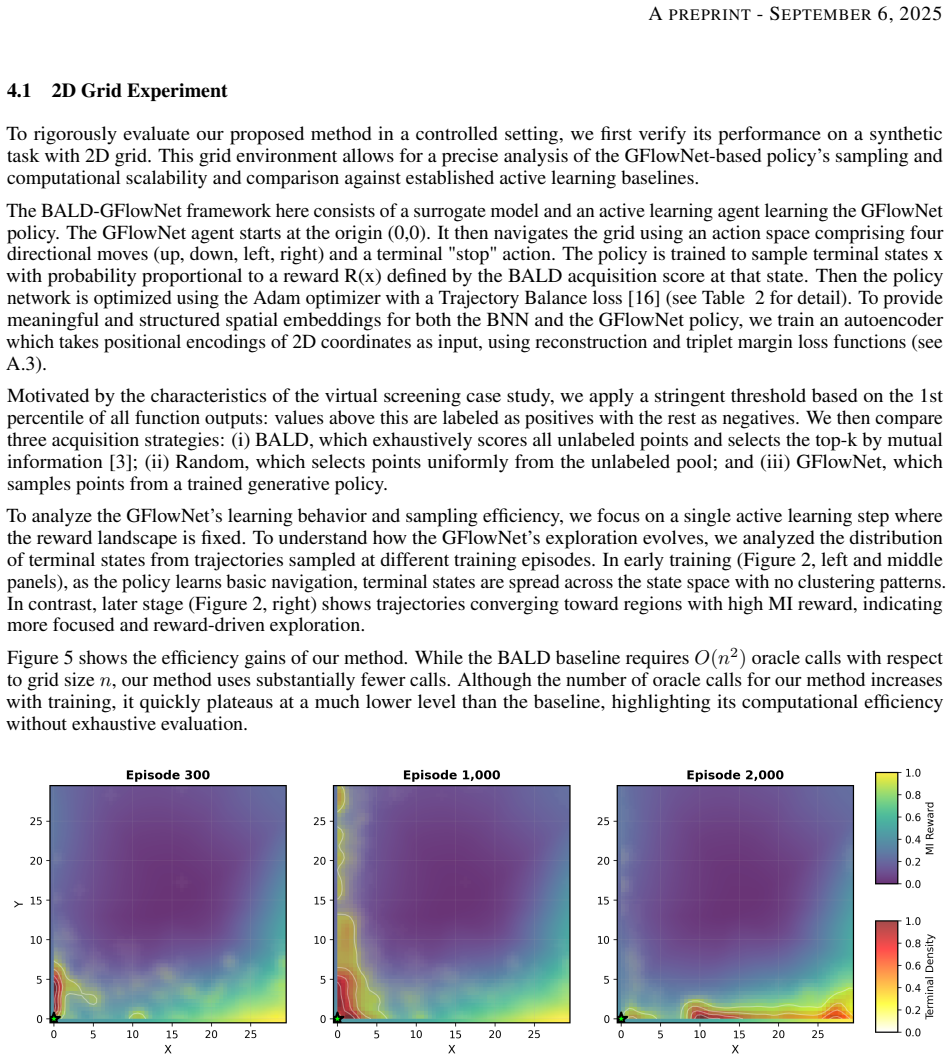
- The synthetic-grid results show the GFlowNet policy converges toward high-uncertainty regions as training progresses, confirming that the generative policy learns the reward landscape rather than memorizing a fixed pool.
Reading between the lines
- If the generative approach works for any acquisition score, then cheaper or more informative scores than BALD (e.g., expected error reduction) could be plugged into the same GFlowNet loop, provided they can be evaluated during generation.
- Because the GFlowNet is not constrained to an enumerated library, the method could in principle generate molecules that no existing database contains, extending active learning from selection to de-novo exploration.
- The practical crossover point between generative and pool-based acquisition depends on the cost of training the GFlowNet; for small pools, exhaustive scoring may still win, so the constant-cost advantage matters most at billion-scale libraries.
- A direct test of the method's fidelity would be to compare the GFlowNet's sampling distribution against the true BALD-ranking of a small pool; high agreement would confirm that generation is faithfully approximating the acquisition signal.
Editorial analysis
A structured set of objections, weighed in public.
Referee Report
Summary. The manuscript introduces BALD-GFlowNet, an active learning method in which a GFlowNet is trained to generate unlabeled examples with probability proportional to a BALD mutual-information reward, replacing pool-based acquisition scoring. The method is evaluated on a synthetic 2D grid and on a JAK2 virtual-screening classification task with QuickVina2 labels. The central reported results are: (i) on the grid, the GFlowNet policy converges toward high-MI regions with fewer surrogate evaluations than exhaustive BALD; (ii) in virtual screening, BALD-GFlowNet reaches peak F1=0.30 after 1.74M surrogate evaluations, versus BALD's 0.32 after 12.2M, and has pool-size-independent acquisition cost, extrapolated to a 2.5x wall-clock speedup at 50M molecules.
Significance. The proposal to amortize acquisition by generative sampling is well-motivated and timely for billion-scale virtual screening. If the main claims are confirmed, the method would significantly reduce the cost of uncertainty-based acquisition in large chemical libraries. The authors provide detailed hyperparameter tables, compute accounting, and an explicit limitations section, which is helpful. However, the current empirical support is thin: the MI component of the reward is not isolated by ablation, the headline F1 differences are within plausible noise, and the runtime speedup rests on a small-pool extrapolation. Thus the significance of the contribution is currently not established to the standard of a journal publication.
major comments (4)
- [§4.2, Eq. (1)] The reward is the product of MI and four drug-likeness terms, with no normalization described for TPSA, SAS, or Rings; these quantities can have scales far outside [0,1], so the product landscape may be dominated by drug-likeness rather than BALD uncertainty. The Limitations section itself acknowledges this imbalance, but no ablation is reported that removes MI from the reward or varies its weight. Without such an analysis, the claim that BALD-GFlowNet is an uncertainty-driven active learning method is unsupported: the observed F1=0.30 could be achieved by a drug-likeness-prior generator with no MI signal. Please add a reward ablation (e.g., MI-only, no-MI, normalized terms) and report the sampling distribution under each setting.
- [§4.2, Table 1 and Fig. 3a] The F1 comparison is based on single runs with no error bars. The reported values (0.30 vs 0.32 vs 0.28) have a spread of 0.02-0.04, which is small relative to typical run-to-run variance in molecular classification tasks. Additionally, the x-axis is cumulative surrogate evaluations, not the number of oracle-labeled molecules. Since both methods acquire 100 labels per iteration, BALD reaches its peak at iteration 7 (700 labels) while BALD-GFlowNet reaches its peak at iteration 14 (1400 labels). In terms of the actual oracle-labeling cost that motivates active learning, BALD-GFlowNet is less sample-efficient. Please report F1 versus labeled examples, include multiple seeds with confidence intervals, and state whether the 'queries' in Table 1 refer to surrogate evaluations or oracle labels.
- [§4.2, Fig. 3b] The claimed 2.5x runtime reduction at 50M molecules is an extrapolation. The blue circles are measured BALD runtimes on small pools, fitted by y=803.11x+789.80; the red line for BALD-GFlowNet is shown as constant but no empirical runtime points are given for the GFlowNet pipeline, nor is the cost per iteration (GFlowNet training plus surrogate scoring) reported. Since the crossover point depends on the ratio of these constants, the 2.5x figure is not established. Please report measured total wall-clock times for both methods over the actual pool sizes used, and if extrapolating, give a sensitivity analysis over GFlowNet training episodes and per-generation surrogate evaluation counts.
- [B.1 / Table 1] The term 'oracle calls' is used to mean surrogate-model evaluations (e.g., a grid state queried to compute MI), while the oracle in active learning is the ground-truth labeler (QuickVina2). This conflation obscures the comparison: the paper's efficiency argument is about computational cost of scoring the pool, not about label cost. Clarify the terminology throughout, and when comparing methods report both cumulative surrogate evaluations and cumulative oracle labels.
minor comments (5)
- [Abstract] Typo: 'billions samples' should be 'billions of samples'; also the running title has formatting artifacts ('A CTIVE', 'GF LOWNETS').
- [References] Reference [10] appears to be a paper on agricultural asset management, which seems irrelevant to the GFlowNet/MCMC discussion. Please check and replace with the intended citation.
- [Fig. 3a] Gaussian smoothing (σ=1.5) is applied to the F1 curves. Please show unsmoothed curves as well, since smoothing can shift apparent peak locations and iteration numbers.
- [Algorithm 1] The nested loops over t and 'episode' are not clearly defined: TrainGFNPolicy is called with BALD in each episode, but the pseudocode suggests T episodes per AL iteration. Clarify whether the GFlowNet is re-trained from scratch or fine-tuned each iteration, and specify the number of training steps per iteration.
- [Table 1] For Random, 'Queries at Peak' = 0 is misleading: random acquisition does not query the surrogate, but it does incur oracle-labeling cost. Report the number of oracle labels separately from surrogate evaluations.
Circularity Check
Synthetic-grid convergence is entailed by the GFlowNet training objective; the core virtual-screening F1 comparison is independent and non-circular.
-
self definitional
[Section 4.1 and Figure 2 caption; also Introduction contribution bullet 2]
"The policy is trained to sample terminal states x with probability proportional to a reward R(x) defined by the BALD acquisition score at that state. ... later training stages show convergence toward high-reward regions of the state space."
The GFlowNet is trained with the Trajectory Balance objective, which by construction makes the terminal-state distribution proportional to R(x). Since R(x) is the BALD mutual information at state x, the observed convergence to high-MI regions is a direct consequence of the training objective, not an independent empirical discovery. The paper's contribution bullet 'BALD-GFlowNet identifies high-uncertainty regions more efficiently than exhaustive search' therefore restates the reward definition and training loss. The efficiency comparison in terms of oracle calls is a separate algorithmic property, and the downstream JAK2 F1 evaluation is genuinely empirical, so the circularity is partial and confined to this sanity-check result.
full rationale
The main empirical claim of the paper is the JAK2 virtual-screening comparison: BALD-GFlowNet, BALD, and Random are compared on held-out F1 using an external docking oracle (QuickVina2) and a fixed test set. This evaluation is self-contained and does not reduce to the GFlowNet's training objective; whether high-BALD generated molecules improve an independent docking-score classifier is an empirical question. The scalability claim (O(1) acquisition cost independent of pool size) is a straightforward design property of not scanning the unlabeled pool, not a fitted prediction. The only circularity found is the synthetic-grid demonstration that the trained GFlowNet concentrates on high-MI regions; this is entailed by the trajectory-balance training objective with R(x)=MI(x). It is a sanity check of the training procedure rather than a first-principles result. The paper's Limitations section admits the unaddressed imbalance between MI and drug-likeness terms in Eq. 1; this is a correctness/robustness risk (the BALD signal is untested by ablation), but it is not circularity. Self-citations, notably [6] for the pretrained GFlowNet and RTB regularization, are used as engineering resources and do not constitute load-bearing circular arguments. Overall, the central F1 result has independent content, so the circularity score is low.
Assumptions & free parameters
free parameters (5)
- MI task slope =
1
- Beta =
96
- GFlowNet fine-tuning loss coefficients =
RTB loss 0.04, MLE coefficient 20
- Positive-class docking cutoff =
0.01 quantile of initial training scores
- Synthetic function noise =
sigma=0.1
assumptions (4)
- standard math Trajectory Balance loss converges to a policy sampling proportional to reward
- domain assumption MC dropout approximates posterior predictive distributions for BALD estimation
- domain assumption QuickVina2 docking scores are a valid oracle for binding affinity in JAK2
- domain assumption MoLFormer embeddings capture the chemical structure needed for the reward and classifier
Cite this review
Pith. "Pith review of Why Pool When You Can Flow? Active Learning with GFlowNets." pith.science (2026). https://pith.science/paper/PB6WPFOZ
@misc{pith2026250900704,
  author       = {Pith},
  title        = {Pith review of: Why Pool When You Can Flow? Active Learning with GFlowNets},
  year         = {2026},
  howpublished = {\url{https://pith.science/paper/PB6WPFOZ}},
  note         = {Machine review of arXiv:2509.00704}
}
read the original abstract
The scalability of pool-based active learning is limited by the computational cost of evaluating large unlabeled datasets, a challenge that is particularly acute in virtual screening for drug discovery. While active learning strategies such as Bayesian Active Learning by Disagreement (BALD) prioritize informative samples, it remains computationally intensive when scaled to libraries containing billions samples. In this work, we introduce BALD-GFlowNet, a generative active learning framework that circumvents this issue. Our method leverages Generative Flow Networks (GFlowNets) to directly sample objects in proportion to the BALD reward. By replacing traditional pool-based acquisition with generative sampling, BALD-GFlowNet achieves scalability that is independent of the size of the unlabeled pool. In our virtual screening experiment, we show that BALD-GFlowNet achieves a performance comparable to that of standard BALD baseline while generating more structurally diverse molecules, offering a promising direction for efficient and scalable molecular discovery.
Figures


Figures from the paper (2 more)


Reference graph
Works this paper leans on
-
[12]
Generative Active Learning for the Search of Small-molecule Protein Binders
Maksym Korablyov, Cheng-Hao Liu, Moksh Jain, Almer M van der Sloot, Eric Jolicoeur, Edward Ruediger, Andrei Cristian Nica, Emmanuel Bengio, Kostiantyn Lapchevskyi, Daniel St-Cyr, et al. Generative active learning for the search of small-molecule protein binders. arXiv preprint arXiv:2405.01616, 2024
work page Pith review arXiv 2024
-
[1]
Christoph Gorgulla, Andras Boeszoermenyi, Zi-Fu Wang, Patrick D. Fischer, Paul W. Coote, Krishna M. Padman- abha Das, Yehor S. Malets, Dmytro S. Radchenko, Yurii S. Moroz, David A. Scott, Konstantin Fackeldey, Moritz Hoffmann, Iryna Iavniuk, Gerhard Wagner, and Haribabu Arthanari. An open-source drug discovery platform enables ultra-large virtual screens....
work page 2020
-
[2]
Understanding active learning of molecular docking and its applications, 2024
Jeonghyeon Kim, Juno Nam, and Seongok Ryu. Understanding active learning of molecular docking and its applications, 2024
work page 2024
-
[3]
Bayesian active learning for classification and preference learning
Neil Houlsby, Ferenc Huszár, Zoubin Ghahramani, and Máté Lengyel. Bayesian active learning for classification and preference learning. arXiv preprint arXiv:1112.5745, 2011
arXiv 2011
-
[4]
Flow network based generative models for non-iterative diverse candidate generation
Emmanuel Bengio, Moksh Jain, Maksym Korablyov, Doina Precup, and Yoshua Bengio. Flow network based generative models for non-iterative diverse candidate generation. Advances in Neural Information Processing Systems, 34:27381–27394, 2021
2021
-
[5]
Gflownet foundations
Yoshua Bengio, Salem Lahlou, Tristan Deleu, Edward J Hu, Mo Tiwari, and Emmanuel Bengio. Gflownet foundations. Journal of Machine Learning Research, 24(210):1–55, 2023
2023
-
[6]
GFlowNet Pretraining with Inexpensive Rewards
Mohit Pandey, Gopeshh Subbaraj, and Emmanuel Bengio. Gflownet pretraining with inexpensive rewards. arXiv preprint arXiv:2409.09702, 2024
work page Pith review arXiv 2024
-
[7]
Jak2 mutants (eg, jak2v617f) and their importance as drug targets in myeloproliferative neoplasms
Karoline Gäbler, Iris Behrmann, and Claude Haan. Jak2 mutants (eg, jak2v617f) and their importance as drug targets in myeloproliferative neoplasms. Jak-Stat, 2(3):e25025, 2013
work page 2013
Show all 33 references
-
[8]
Zinc- a free database of commercially available compounds for virtual screening
John J Irwin and Brian K Shoichet. Zinc- a free database of commercially available compounds for virtual screening. Journal of chemical information and modeling, 45(1):177–182, 2005
2005
-
[9]
Biological sequence design with gflownets
Moksh Jain, Emmanuel Bengio, Alex Hernandez-Garcia, Jarrid Rector-Brooks, Bonaventure FP Dossou, Chanakya Ajit Ekbote, Jie Fu, Tianyu Zhang, Michael Kilgour, Dinghuai Zhang, et al. Biological sequence design with gflownets. In International Conference on Machine Learning, page...
2022
-
[10]
Amortization methods of fixed assets and their implications on the result of the exercise
Elena Claudia Sîrbulescu, Luminita Pirvulescu, Tiberiu Iancu, Simion Alda, and Remus Gherman. Amortization methods of fixed assets and their implications on the result of the exercise. Agricultural Management/Lucrari Stiintifice Seria I, Management Agricol, 23(2), 2021
2021
-
[11]
Batchgfn: Generative flow networks for batch active learning
Shreshth A Malik, Salem Lahlou, Andrew Jesson, Moksh Jain, Nikolay Malkin, Tristan Deleu, Yoshua Bengio, and Yarin Gal. Batchgfn: Generative flow networks for batch active learning. arXiv preprint arXiv:2306.15058, 2023
2023 arXiv
-
[13]
Estimation of synthetic accessibility score of drug-like molecules based on molecular complexity and fragment contributions
Peter Ertl and Ansgar Schuffenhauer. Estimation of synthetic accessibility score of drug-like molecules based on molecular complexity and fragment contributions. Journal of cheminformatics, 1:1–11, 2009
2009
-
[14]
Topological polar surface area: a useful descriptor in 2d-qsar
Sivaprakasam Prasanna and Robert J Doerksen. Topological polar surface area: a useful descriptor in 2d-qsar. Current medicinal chemistry, 16(1):21–41, 2009
2009
-
[15]
The application of in silico drug- likeness predictions in pharmaceutical research
Sheng Tian, Junmei Wang, Youyong Li, Dan Li, Lei Xu, and Tingjun Hou. The application of in silico drug- likeness predictions in pharmaceutical research. Advanced drug delivery reviews, 86:2–10, 2015
2015
-
[16]
Trajectory balance: Improved credit assignment in gflownets
Nikolay Malkin, Moksh Jain, Emmanuel Bengio, Chen Sun, and Yoshua Bengio. Trajectory balance: Improved credit assignment in gflownets. Advances in Neural Information Processing Systems, 35:5955–5967, 2022
2022
-
[17]
Attention is all you need
Ashish Vaswani, Noam Shazeer, Niki Parmar, Jakob Uszkoreit, Llion Jones, Aidan N Gomez, Łukasz Kaiser, and Illia Polosukhin. Attention is all you need. Advances in neural information processing systems, 30, 2017. 6 A PREPRINT - SEPTEMBER 6, 2025
2017
-
[18]
Deep learning using rectified linear units (relu)
Abien Fred Agarap. Deep learning using rectified linear units (relu). arXiv preprint arXiv:1803.08375, 2018
2018 arXiv
-
[19]
A joint reconstruction-triplet loss autoencoder approach towards unseen attack detection in iov networks
Julia Boone, Tolunay Seyfi, and Fatemeh Afghah. A joint reconstruction-triplet loss autoencoder approach towards unseen attack detection in iov networks. IEEE Internet of Things Journal, 2025
2025
-
[20]
Dropout as a bayesian approximation: Representing model uncertainty in deep learning
Y Gal and Z Ghahramani. Dropout as a bayesian approximation: Representing model uncertainty in deep learning. arxiv [stat. ml]. Retrieved fro http://arxiv. org/abs/1506.02142, 2015
2015 arXiv
-
[21]
Bayesian neural networks
T Charnock, L Perreault-Levasseur, and F Lanusse. Bayesian neural networks. arxiv e-prints, art. arXiv preprint arXiv:2006.01490, 10, 2020
2006 arXiv
-
[22]
Dropout: a simple way to prevent neural networks from overfitting
Nitish Srivastava, Geoffrey Hinton, Alex Krizhevsky, Ilya Sutskever, and Ruslan Salakhutdinov. Dropout: a simple way to prevent neural networks from overfitting. The journal of machine learning research, 15(1):1929–1958, 2014
1929
-
[23]
Empirical evaluation of rectified activations in convolutional network
Bing Xu, Naiyan Wang, Tianqi Chen, and Mu Li. Empirical evaluation of rectified activations in convolutional network. arXiv preprint arXiv:1505.00853, 2015
2015 arXiv
-
[24]
How does mixup help with robustness and generalization? arXiv preprint arXiv:2010.04819, 2020
Linjun Zhang, Zhun Deng, Kenji Kawaguchi, Amirata Ghorbani, and James Zou. How does mixup help with robustness and generalization? arXiv preprint arXiv:2010.04819, 2020
2010 arXiv
-
[25]
Large-scale chemical language representations capture molecular structure and properties
Jerret Ross, Brian Belgodere, Vijil Chenthamarakshan, Inkit Padhi, Youssef Mroueh, and Payel Das. Large-scale chemical language representations capture molecular structure and properties. Nature Machine Intelligence, 4(12):1256–1264, 2022
2022
-
[26]
Enamine real database: Making chemical diversity real
Alexander N Shivanyuk, Sergey V Ryabukhin, A Tolmachev, A V Bogolyubsky, DM Mykytenko, AA Chupryna, W Heilman, and AN Kostyuk. Enamine real database: Making chemical diversity real. Chemistry today, 25(6):58–59, 2007
2007
-
[27]
Deep docking: a deep learning platform for augmentation of structure based drug discovery
Francesco Gentile, Vibudh Agrawal, Michael Hsing, Anh-Tien Ton, Fuqiang Ban, Ulf Norinder, Martin E Gleave, and Artem Cherkasov. Deep docking: a deep learning platform for augmentation of structure based drug discovery. ACS central science, 6(6):939–949, 2020
2020
-
[28]
Fast, accurate, and reliable molecular docking with quickvina 2
Amr Alhossary, Stephanus Daniel Handoko, Yuguang Mu, and Chee-Keong Kwoh. Fast, accurate, and reliable molecular docking with quickvina 2. Bioinformatics, 31(13):2214–2216, 2015
2015
-
[29]
Drug discovery with dynamic goal-aware fragments
Seul Lee, Seanie Lee, Kenji Kawaguchi, and Sung Ju Hwang. Drug discovery with dynamic goal-aware fragments. arXiv preprint arXiv:2310.00841, 2023
2023 arXiv
-
[30]
Densely connected convolutional networks
Gao Huang, Zhuang Liu, and Kilian Q Weinberger. Densely connected convolutional networks. corr. arXiv preprint arXiv:1608.06993, 2016
2016 arXiv
-
[31]
Amortizing intractable inference in diffusion models for vision, language, and control
Siddarth Venkatraman, Moksh Jain, Luca Scimeca, Minsu Kim, Marcin Sendera, Mohsin Hasan, Luke Rowe, Sarthak Mittal, Pablo Lemos, Emmanuel Bengio, et al. Amortizing intractable inference in diffusion models for vision, language, and control. arXiv preprint arXiv:2405.20971, 2024
2024 arXiv
-
[32]
Adam: A method for stochastic optimization
Diederik P Kingma and Jimmy Ba. Adam: A method for stochastic optimization. arXiv preprint arXiv:1412.6980, 2014
2014 arXiv
-
[33]
Generalized cross entropy loss for training deep neural networks with noisy labels
Zhilu Zhang and Mert Sabuncu. Generalized cross entropy loss for training deep neural networks with noisy labels. Advances in neural information processing systems, 31, 2018. 7 A PREPRINT - SEPTEMBER 6, 2025 A Technical Appendices and Supplementary Material A.1 Synthetic Datas...
2018
Reviewed August 5, 2026 · model on record in the stance chip above.
Discussion (0). Sign in to comment.