REVIEW 3 major objections 5 minor 15 references
Moving a transmitter's antennas decorrelates the legitimate channel from eavesdroppers, letting a few elements match the spatial resolution of much larger fixed arrays.
Reviewed by Pith at T0; open to challenge. T0 means a machine referee read the full paper against a public rubric. the ladder, T0–T4 →
Movable antennas can be repositioned to reduce signal leakage to eavesdroppers and null jammers, and this paper reviews the opportunities, challenges, and open problems.
T0 review reviewed 2026-08-05 challenge →
load-bearing objection A competent magazine-style overview of MA-aided secure communications whose illustrative figures conflate aperture with mobility; useful for the taxonomy, not for the quantitative claims. the 3 major comments →
Movable Antenna-Enhanced Secure Communication: Opportunities, Challenges, and Solutions
The pith
A machine-rendered reading of the paper's core claim, the machinery that carries it, and where it could break.
The reading
Core claim
On the paper's own terms, the discovery is that the physical geometry of the array is itself a security resource. In an FPA system only the complex weights can be reconfigured, so when the legitimate user and an eavesdropper sit in nearby directions the beamformer must trade signal power for secrecy. An MA array breaks this trade-off: repositioning elements changes the array response vectors, so the legitimate and eavesdropping channels can be made nearly orthogonal, and the eavesdropping channels of multiple adversaries can be collected into a compact subspace that a single null suppresses. The paper reports two quantitative demonstrations: in a far-field scenario with one signal direction
What carries the argument
The load-bearing object is the joint optimization of the antenna position vector (APV) and the antenna weight vector (AWV): the positions define the array geometry and therefore the array's response (steering vector) in every direction, and the weights shape the beam given that geometry. Around this sit two correlation-control effects. First, repositioning decorrelates the legitimate receiver's steering vector from eavesdroppers' and jammers' steering vectors, making the desired and undesired responses nearly orthogonal. Second, for multiple eavesdroppers, the MA array can aggregate their steering vectors into a low-rank subspace, so one orthogonal beam suppresses them all. In the near field
Load-bearing premise
The claimed security gains require that the transmitter know, at least statistically, where the eavesdropper is, and that antennas can be repositioned quickly and accurately enough to exploit the spatial variation of the channel before it changes.
What would settle it
Replay the paper's Fig. 3 scenario—an 8-element array, one desired direction (90°) and three eavesdropping angles (80°, 100°, 150°)—with a physical or ray-traced channel, optimizing positions with the cited beam-nulling algorithm and comparing against an 8-element λ/2 ULA using zero-forcing. If the MA array does not hold full gain toward 90° while the FPA array loses roughly 58.5% of its gain, or if the near-field secrecy-rate gap over dense and sparse FPA does not come close to the reported 10.2–10.6 bps/Hz, the central advantage claim is not reproducible outside the simulation settings.
If this is right
- An MA transmitter can keep full signal power toward a legitimate receiver even when an eavesdropper sits in a nearly adjacent direction—a regime where the paper's 8-element FPA example forfeits about 58.5% of its array gain to zero-forcing.
- Secrecy improves with the size of the movement region: in the near-field simulation, enlarging the region from 10λ to 100λ narrows the main lobe and suppresses leakage, meaning aperture can be bought with a slide track rather than hundreds of static elements.
- The same geometry-reconfiguration principle applies on the receive side, where repositioning MAs attenuates jamming before signal processing, complementing transmit-side secrecy.
- MA-aided systems need far fewer RF chains than extremely large arrays: the paper contrasts 64 movable elements against a dense FPA array that would need roughly 4 × 10^4 antennas to cover the same aperture at half-wavelength spacing.
- Because eavesdropper CSI is the hard part, the paper shifts the practical agenda toward partial and statistical CSI, radar-assisted eavesdropper localization, and AI-based positioning that does not require instantaneous eavesdropper channels.
Where Pith is reading between the lines
- The paper leaves implicit that the value of antenna motion should scale with the spatial selectivity of the environment: in rich scattering where many paths already decorrelate channels, the incremental secrecy gain of moving antennas may shrink, whereas the mechanism is most potent when a few dominant paths make FPA channels highly correlated.
- The correlation-control principle generalizes beyond secrecy: forcing two channel responses apart by physical repositioning could equally serve covert communication, physical-layer key generation, or interference alignment.
- A natural testable extension is to benchmark MA against a sparse FPA array of identical aperture and total hardware cost, including actuators, energy, and movement latency, which the paper's secrecy-rate comparison leaves out of the accounting.
- If instantaneous eavesdropper CSI is unavailable, the paper's own channel-acquisition discussion points toward a sensing-coupled design—probing to localize eavesdroppers and nulling their directions—which could turn the strongest assumption into an engineered feature.
Editorial analysis
A structured set of objections, weighed in public.
Referee Report
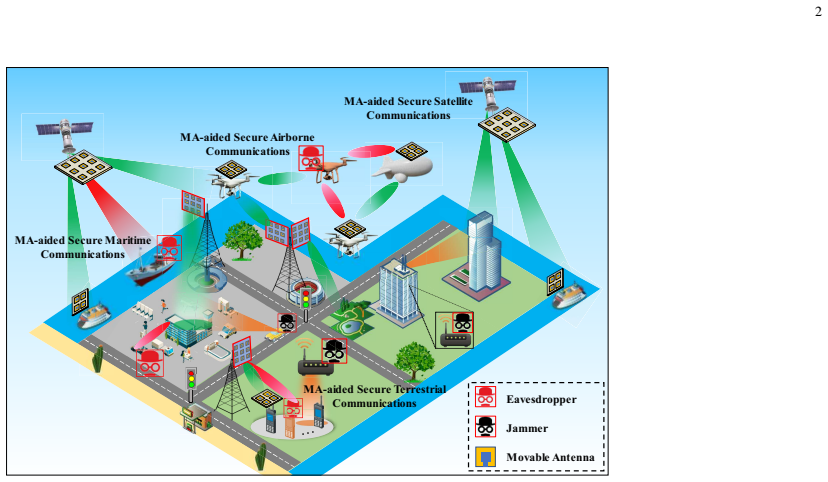
Summary. This magazine-style paper surveys movable antenna (MA) enhanced secure communications. It argues that by repositioning antennas, MA arrays can reshape array response vectors to reduce channel correlation between the legitimate receiver and eavesdroppers, improve correlation among multiple eavesdroppers, and achieve sharper near-field beam focusing, thereby improving secrecy rate and anti-jamming performance compared to fixed-position antenna (FPA) arrays. The paper presents application scenarios (terrestrial, airborne, satellite, SAGSIN), illustrates security gains via beam-pattern and secrecy-rate simulations (Figs. 3–5), and discusses hardware architectures, channel acquisition, position optimization, and future directions such as 6DMA, movable-element IRS, and extremely large-scale MA. The central claim is that MAs provide a hardware-efficient spatial DoF that can enhance physical-layer security beyond conventional FPA beamforming.
Significance. If the quantitative claims were properly substantiated, the paper would be a useful overview of an emerging topic: MA-based physical-layer security has attracted significant recent interest, and a structured survey of scenarios, challenges, and solutions is timely. The paper does provide a broad taxonomy of applications and implementation architectures, and it correctly identifies channel acquisition and position optimization as key bottlenecks. The qualitative direction is consistent with prior independent work (e.g., Refs. [4], [7], [8], [13]), and the paper does not claim new mathematical derivations. However, the illustrative evidence in Section II is weakened by methodological confounds and missing simulation details, as detailed below. The paper's value as a survey is real but its central performance claims, as presented, are not fully demonstrated; the core ideas are defensible but need clearer, fairer benchmarking to be persuasive.
major comments (3)
- [§II-A, Fig. 3] The comparison in Fig. 3 does not isolate the effect of antenna mobility. The MA array is optimized over a 1D region of length A = 10λ, whereas the FPA benchmark is an 8-element ULA with λ/2 spacing spanning only 3.5λ. In the far field, angular resolution and nulling capability are governed by aperture in wavelengths, so the sharper main lobe and deeper nulls of the MA pattern are expected even for a fixed array of the same aperture. To support the claim that MA movement itself provides the gain, the benchmark should be a fixed nonuniform array with the same maximum aperture (e.g., an 8-element array spanning 10λ, with optimized positions) or the MA movement region should be restricted to match the FPA aperture. Without this control, Figs. 3 and the associated '58.5% beamforming loss' conflate aperture gain with mobility gain.
- [§II-A, Fig. 5] The secrecy-rate comparison of Fig. 5 is not reproducible from the text. The dense FPA is described as an '8×8 UPA' with λ/2 spacing, and the sparse FPA as an '8×8 UPA' with spacing A/8, but the horizontal axis varies M (number of transmit antennas) from 16 to 140. An 8×8 UPA contains 64 elements; it is unclear how M values other than 64 are realized for these benchmarks. The text also omits the channel model, noise and path-loss parameters, eavesdropper/jammer geometry, and the optimization algorithm used for the MA positions. Without these details, the reported improvements of up to 10.2 bps/Hz (P_B = 20 dBm) and 10.6 bps/Hz (P_B = 30 dBm) cannot be checked, and this figure cannot serve as evidence for the central claim.
- [§II-A, Sec. I, Figs. 3–4] The paper frames the fundamental advantage of MAs as arising from 'joint optimization of the APV and the AWV' versus FPA systems where 'only the antenna/beamforming weights can be reconfigured.' This framing is misleading: for a fixed array, the antenna geometry is also a design variable that can be optimized at deployment. A one-time optimized nonuniform FPA with the same aperture and element count can, in principle, realize the same snapshot beam pattern as the MA array. What is genuinely unique to MAs is the ability to reconfigure positions in response to changing channels, yet Figs. 3 and 4 show only static snapshots and no comparison over time-varying channels or movement latency. The claimed 'fundamental gain' should be reframed as a reconfiguration gain, and the illustrative evidence should include scenarios where channel dynamics make reconfiguration valuable.
minor comments (5)
- [Fig. 4] The caption for Fig. 4 appears corrupted with non-ASCII symbols ('(a) ܣ= ߣ ...'), and the subfigures are not described in the main text with clear labels. The normalization of the heat-maps and the color scale are also undefined.
- [§II-A, Fig. 3] The text states that 'the FPA array experiences a loss of around 58.5% in beamforming gain over θ0,' but it is not clear whether this refers to normalized gain relative to the MA array, relative to the array gain limit, or some other baseline. Please specify the metric and provide the underlying beamforming weights or a pointer to the method.
- [§III-B] The discussion of channel acquisition would benefit from a more explicit statement of the assumptions on eavesdropper CSI. The text mentions 'statistical CSI' and 'radar-assisted detection,' but the conditions under which nulling and decorrelation gains remain achievable (e.g., partial CSI, angular uncertainty) are not formalized.
- [References] The reference list leans heavily on the authors' own prior work (e.g., [2], [3], [5], [10], [11], [14]). While this is not inappropriate for an overview, a few more independent references on fluid antennas / movable-antenna security would strengthen the bibliographic coverage.
- [§III-A] In the description of electronically driven movement, the phrase 'altered antenna positions without mechanical motion' is conceptually sound, but the phase-center shift is not the same as physical displacement; a brief clarification of the distinction would avoid confusion.
Circularity Check
No significant circularity: the paper is an overview that cites prior work (including the authors' own) rather than deriving new predictions from fitted inputs; self-citations are illustrative and independently corroborated.
full rationale
This is a magazine-level overview, not a derivation paper. It contains no fitted parameters that are later relabeled as predictions, no uniqueness theorem imported from the authors' prior work, and no equation in which an output is constructed to equal an input. The central claim that movable-antenna arrays can shape beams by jointly optimizing positions and weights is supported by the cited literature, including external works [4], [7], [13], [15]. The paper's reliance on the authors' own references ([2], [3], [5], [10], [11], [14]) is mostly bibliographic: [2] is cited for a beam-nulling algorithm and an FRI channel-estimation framework, [11] for FRI modeling, [10] for a cross-linked MA architecture, and [14] for an XL-MA extension. These citations do not function as an unverified premise that forces the article's conclusions; rather, they point to concrete algorithmic and architectural results that are stated as already-published. The skeptical concern that Fig. 3 compares an MA array of 10λ aperture with an FPA ULA of only 3.5λ aperture is a benchmark-fairness / external-validity issue, not a circularity: the paper does not define the MA gain as being independent of aperture, and it explicitly attributes sharper beams to larger movement regions. Similarly, the inconsistency in Fig. 5's 8×8 UPA vs. variable M affects reproducibility but does not reduce a prediction to an input. Overall, no step in the paper's reasoning is circular by construction, so score 2 reflects the presence of several minor self-citations while emphasizing that none is load-bearing.
Axiom & Free-Parameter Ledger
free parameters (3)
- Antenna moving region size A (for illustrative beam patterns) =
A = 10λ and A = 100λ in Fig. 4; A = 100λ in Fig. 5
- Number of transmit antennas M =
64 in Fig. 4; varied from 16 to 140 in Fig. 5
- Transmit power budget P_B =
20 dBm and 30 dBm in Fig. 5
axioms (4)
- domain assumption Antenna positions can be adjusted accurately and fast enough to exploit spatial channel variation.
- domain assumption The transmitter has at least statistical CSI of eavesdroppers and jammers.
- domain assumption The wireless channel is a deterministic function of antenna position, so that repositioning changes channel vectors predictably.
- standard math Secrecy capacity is the capacity difference between legitimate and eavesdropping links.
Cite this review
Pith. "Pith review of Movable Antenna-Enhanced Secure Communication: Opportunities, Challenges, and Solutions." pith.science (2026). https://pith.science/paper/IG7DYCRK
@misc{pith2026250900894,
  author       = {Pith},
  title        = {Pith review of: Movable Antenna-Enhanced Secure Communication: Opportunities, Challenges, and Solutions},
  year         = {2026},
  howpublished = {\url{https://pith.science/paper/IG7DYCRK}},
  note         = {Machine review of arXiv:2509.00894}
}
read the original abstract
The broadcast nature of wireless communication renders it inherently vulnerable to security threats such as jamming and eavesdropping. While traditional array beamforming techniques help to mitigate these threats, they usually incur high hardware and processing costs, particularly in large-scale arrays with fixed-position antennas (FPAs). In contrast, movable antenna (MA) arrays can fully exploit the channel variation in spatial regions by enabling flexible antenna movement, which has emerged as a promising technology for secure communications. This article provides a magazine-type overview of MA-aided secure communications. Specifically, we first illuminate the promising application scenarios for MA-enhanced secure communication systems. Then, we examine the security advantages of MAs over conventional FPA systems, fundamentally stemming from their ability to adjust channel correlations between legitimate users, eavesdroppers, and jammers. Furthermore, we discuss important technical challenges and their potential solutions related to MA hardware architecture, channel acquisition, and antenna position optimization to realize secure transmissions. Finally, several promising directions for MA-aided secure communications are presented to inspire future research.
Figures


Reference graph
Works this paper leans on
-
[1]
A survey on wireless security: Technical challenges, recent advances, and future trends,
Y . Zou, J. Zhu, X. Wang, and L. Hanzo, “A survey on wireless security: Technical challenges, recent advances, and future trends, ” Proc. IEEE , vol. 104, no. 9, pp. 1727–1765, Sep. 2016
work page 2016
-
[2]
A tutorial on movable antennas for wireless networks,
L. Zhu et al. , “A tutorial on movable antennas for wireless networks,” IEEE Commun. Surveys Tuts. , https://ieeexplore.ieee.org/abstract/document/10906511, accessed on 27 Feb. 2025, DOI: 10.1109/COMST.2025.3546373
-
[3]
Movable antennas for wireles s commu- nication: Opportunities and challenges,
L. Zhu, W. Ma, and R. Zhang, “Movable antennas for wireles s commu- nication: Opportunities and challenges,” IEEE Commun. Mag. , vol. 62, no. 6, pp. 114–120, Jun. 2024
2024
-
[4]
Secure wirele ss communication via movable-antenna array,
G. Hu, Q. Wu, K. Xu, J. Si, and N. Al-Dhahir, “Secure wirele ss communication via movable-antenna array,” IEEE Signal Process. Lett. , vol. 31, pp. 516–520, Jan. 2024
work page 2024
-
[5]
Movable-antenn a aided secure transmission for RIS-ISAC systems,
Y . Ma, K. Liu, Y . Liu, L. Zhu, and Z. Xiao, “Movable-antenn a aided secure transmission for RIS-ISAC systems,” IEEE Trans. Wireless Com- mun., https://ieeexplore.ieee.org/abstract/document/1103 3708, accessed on 12 Jun. 2025, DOI: 10.1109/TWC.2025.3577040
-
[6]
A survey on spac e-air- ground-sea integrated network security in 6G,
H. Guo, J. Li, J. Liu, N. Tian, and N. Kato, “A survey on spac e-air- ground-sea integrated network security in 6G,” IEEE Commun. Surveys Tuts., vol. 24, no. 1, pp. 53–87, 1st Quat. 2022
work page 2022
-
[7]
Ne ar- field communications: A tutorial review,
Y . Liu, Z. Wang, J. Xu, C. Ouyang, X. Mu, and R. Schober, “Ne ar- field communications: A tutorial review,” IEEE Open J. Commun. Soc., , vol. 4, pp. 1999–2049, Aug. 2023
work page 1999
-
[8]
New movable plate for efficient millimeter wave vertical on-chip antenna,
L. Marnat et al. , “New movable plate for efficient millimeter wave vertical on-chip antenna,” IEEE Trans. Antennas Propag. , vol. 61, no. 4, pp. 1608–1615, Apr. 2013
work page 2013
-
[9]
Using a moving antenna to improve GNSS/INS integration performance under low- dynamic scenarios,
X. Li, Y . Zhou, Z. Shen, B. Song, and S. Li, “Using a moving antenna to improve GNSS/INS integration performance under low- dynamic scenarios,” IEEE Trans. Intell. Transp. Syst. , vol. 23, no. 10, pp. 17 717–17 728, Oct. 2022
work page 2022
-
[10]
Multiuser Communications Aided by Cross-Linked Movable Antenna Array: Architecture and Optimization
L. Zhu, H. Sun, W. Ma, Z. Xiao, and R. Zhang, “Multiuser co mmu- nications aided by cross-linked movable antenna array: Arc hitecture and optimization,” arXiv:2505.03175, https://arxiv.org/abs/2505.03175, accessed on 6 May 2025
work page internal anchor Pith review Pith/arXiv arXiv 2025
-
[11]
Modeling and performance an alysis for movable antenna enabled wireless communications,
L. Zhu, W. Ma, and R. Zhang, “Modeling and performance an alysis for movable antenna enabled wireless communications,” IEEE Trans. Wireless Commun., vol. 23, no. 6, pp. 6234–6250, Jun. 2024
2024
-
[12]
Secure communi cation under channel uncertainty and adversarial attacks,
R. F. Schaefer, H. Boche, and H. V . Poor, “Secure communi cation under channel uncertainty and adversarial attacks,” Proc. IEEE, vol. 103, no. 10, pp. 1796–1813, Oct. 2015
work page 2015
-
[13]
X. Shao et al. , “A tutorial on six-dimensional movable antenna for 6G networks: Synergizing positionable and rotatable an tennas,” arXiv:2503.18240, https://arxiv.org/abs/2503.18240, accessed on 7 May 2025
Pith/arXiv arXiv 2025
-
[14]
Extremely Large-Scale Movable Antenna-Enabled Multiuser Communications: Modeling and Optimization
M. Fu, L. Zhu, and R. Zhang, “Extremely large-scale mova ble antenna-enabled multiuser communications: Modeling and o ptimiza- tion,” arXiv:2506.02735, https://arxiv.org/abs/2506.02735, accessed on 3 Jun. 2025
work page internal anchor Pith review Pith/arXiv arXiv 2025
-
[15]
Flexible-antenna s ys- tems: A pinching-antenna perspective,
Z. Ding, R. Schober, and H. V . Poor, “Flexible-antenna s ys- tems: A pinching-antenna perspective,” IEEE Trans. Commun. , https://ieeexplore.ieee.org/abstract/document/10945421, accessed on 28 Mar. 2025, DOI: 10.1109/TCOMM.2025.3555866
This paper was first reviewed by deepseek-v4-flash on August 5, 2026.
discussion (0)
Sign in with ORCID, Apple, or X to comment. Anyone can read and Pith papers without signing in.