REVIEW 4 major objections 6 minor 44 references
Anchor intervals give lung-sound detection direct event timing
Reviewed by Pith at T0; open to challenge. T0 means a machine referee read the full paper against a public rubric. the ladder, T0–T4 →
A GNN plus anchor-interval framework detects abnormal respiratory sound events, reaching F1 of 22.3 percent on SPRSound, with anchor scales tuned to the observed event durations.
T0 review reviewed 2026-08-05 challenge →
load-bearing objection Novel GNN+anchor framework for respiratory event detection, but the evaluation as written doesn't prove the headline improvement—the main baseline comparison is confounded and the anchor priors are fitted to the test set. the 4 major comments →
EZhouNet:A framework based on graph neural network and anchor interval for the respiratory sound event detection
The pith
A machine-rendered reading of the paper's core claim, the machinery that carries it, and where it could break.
The reading
Core claim
The paper's central claim is that separating sound-event detection into interval confidence, interval category, and interval-boundary regression over predefined anchor intervals lets a network learn event timing directly, rather than inferring boundaries from frame-level outputs. The anchor intervals are temporal windows at three fixed durations (0.5, 0.8, and 1.5 seconds normalized to clip length), each labeled by its best IoU with a ground-truth event; the network predicts an offset, a confidence, and a class per anchor and decodes refined intervals. The graph representation is the enabler of variable-length handling: every five spectrogram frames form one node, nodes are linked in a forwa
What carries the argument
Anchor interval refinement is the load-bearing mechanism: a fixed set of candidate intervals at three scales, with soft IoU-based labels for confidence, class, and target interval, lets the network regress start/end offsets instead of predicting event boundaries from scratch. The supporting machinery is the spectrogram-to-graph construction, in which each group of five spectrogram frames becomes a node, edges form a directed temporal chain, and GAT layers update node features while preserving variable-length structure.
Load-bearing premise
The framework depends on the three fixed anchor durations (0.5, 0.8, and 1.5 seconds) matching the durations of abnormal events in the target data; if a new dataset's events fall mostly outside these ranges, the offset regressor must compensate on its own.
What would settle it
Run the same framework on a dataset of respiratory recordings whose abnormal events are predominantly shorter than 0.3 s or longer than 2.5 s, with all other training details unchanged. If event-level F1 drops sharply relative to a version with anchor scales matched to those durations, the reliance on fixed anchor priors is confirmed.
If this is right
- Event-level respiratory sound detection can be trained end-to-end, since interval confidence, category, and localization are learned jointly from anchor labels.
- Variable-length recordings can be processed without fixed-length constraints, because the input graph naturally grows with the number of chunks.
- Adding respiratory position information improves recall of abnormal events, so location cues are worth including in clinical audio models.
- Five-frame grouping favors discontinuous sounds such as crackle; continuous sounds such as wheeze, rhonchi, and stridor need larger groups or longer context.
- The reported event F1 remains modest in absolute terms, indicating that anchor priors and frame grouping are not yet sufficient for clinical use alone.
Where Pith is reading between the lines
- Because the anchor scales are fixed to the duration distribution observed in SPRSound and HF Lung v1, the framework should transfer best to settings with similar event durations; new populations with systematically longer or shorter abnormal events would likely require re-tuning the scales.
- The same anchor-interval idea could be applied to other periodic or event-based bioacoustic tasks, such as cough or snore detection, where event durations are variable and frame-level post-processing is the norm.
- A testable extension is to replace fixed anchor scales with learned or adaptive anchors, such as a small set of learnable durations per clip, which would remove the manual prior without abandoning the regression formulation.
- The chain-graph connectivity limits long-range context; using higher-order edges or a second graph over longer spans might improve detection of sustained wheeze and rhonchi.
Editorial analysis
A structured set of objections, weighed in public.
Referee Report
Summary. The paper proposes EZhouNet, an end-to-end framework for abnormal respiratory sound event detection that combines multichannel spectrograms (Mel, Gamma, CQT), a graph construction module that converts spectrogram chunks into variable-length graph nodes, two GAT layers for node feature update, and an anchor-interval refinement module with three predefined duration scales. The anchor intervals are refined via GRU-based local feature extraction, soft offset regression over discrete bins, and separate confidence/classification heads. Experiments are reported on SPRSound 2024 and HF Lung V1, including a comparison against a CNN+VAD baseline [42], a node-level ablation for respiratory position information, and a discussion of limitations. The central claim is that the framework improves temporal localization and event-level detection of abnormal respiratory sounds while natively handling variable-length audio.
Significance. If the central claim were adequately supported, the paper would make a useful contribution by transferring anchor-based object detection ideas to respiratory sound event detection, avoiding frame-level post-processing, and proposing a graph-based representation that can in principle handle variable-length recordings. The availability of reference code is a positive feature, and the task itself is clinically relevant and relatively understudied. However, the reported empirical evidence is not yet sufficient to establish the claimed improvement: the comparison with [42] is not controlled, the anchor priors appear to be fitted to the evaluation datasets, key hyperparameters are missing, and no uncertainty estimates or significance tests are provided. These issues are fixable, but they are load-bearing for the paper's main conclusion.
major comments (4)
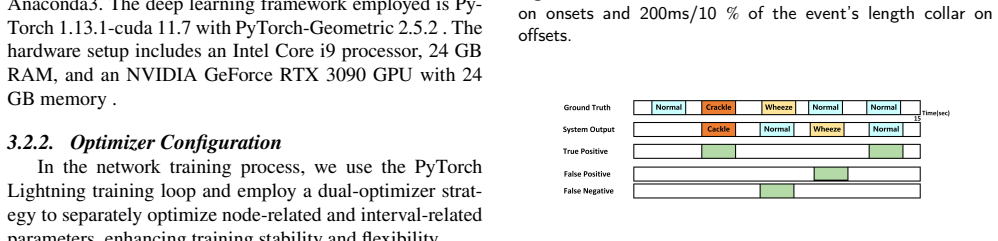
- [3.3.2, Table 3, Eq. (47)] The comparison with CNN+VAD [42] on SPRSound is not apples-to-apples. The text states that [42] also includes normal sounds in the detection process, while 'our experiments exclude them.' In the event-based metrics of Eq. (47), N is the number of reference events, and FP/FN are counted with respect to the label set. A system that never predicts 'normal' cannot be charged with deletions or insertions for normal events, whereas a baseline that must detect them is penalized for every normal-event error. The reported F1 gap (22.3 vs 6.81) and ER gap (1.08 vs 1.26) may therefore be a metric artifact, not an architectural improvement. To support the central claim, the baseline must be re-evaluated under the identical label protocol, or both systems must be reported under both protocols (including class-wise matched labels).
- [3.3.3, Eq. (25)-(26)] The anchor interval priors appear to be fitted to the evaluation datasets. The paper observes that event durations in SPRSound and HF Lung V1 fall at 0.5s, 0.75s, 1s, and 1.25s, and states that these 'align with the designed prior anchor intervals of 0.5s, 0.75s, and 1.5s' (Eq. (25)). Since the anchor durations and densities are chosen after inspecting the test duration distribution, the reported detection performance partly reflects this fitting. This weakens the generalization claim and makes the framework's interval-detection behavior dependent on the evaluation datasets. I recommend either evaluating on a held-out dataset with a different event-duration distribution, or performing a sensitivity analysis over anchor scales/configurations and reporting results for a prior chosen independently of the test data.
- [3.3.1-3.3.2, Eq. (31)-(32), Eq. (38)-(39), Eq. (46)] Several load-bearing experimental details are missing. The loss weights w_n_conf, w_n_cls, w_i_conf, w_i_cls, w_i_loc in Eq. (46) are never given numerical values. The IoU threshold theta_iou in Eq. (31)-(32) is defined but its value is never reported. The bin counts B_k and their ranges in Eq. (38)-(39) are also unspecified, and the temporal encoding scale gamma in Eq. (24) is only described as 'e.g. 0.05.' In addition, Tables 1-3 report single runs without standard deviations, confidence intervals, or number of seeds. Given the moderate F1 values and class imbalance, the reported differences (e.g., integrated vs separate head) cannot be assessed for statistical significance. These details are needed both for reproducibility and for interpreting the central empirical claim.
- [3.3.2, Tables 4-5] The ablation for respiratory position information is performed at the node level, not at the event level. The text claims that position information improves recall for all four abnormal classes, and indeed Table 5 shows recall increases for rhonchi, wheeze, stridor, and crackle. However, F1 for crackle decreases (0.7905 to 0.7804), and there are no confidence intervals or significance tests. More importantly, the central claim is about event-level detection (Table 3); a node-level ablation does not directly establish that position information improves the event-level detection of abnormal respiratory sounds. An event-level ablation with and without position information is needed.
minor comments (6)
- [3.3.2 (title)] Typo in section title: 'stduy' should be 'study.'
- [Eq. (9)] The argmax notation contains stray vertical bars ('|||{...}|||') and the tie-breaking rule could be stated more cleanly. Please clarify whether ties are resolved by the first-appearing class in chronological order.
- [Figures 1-3] The text refers to 'Fig. 2' when describing the network architecture, but the first mentioned figure is 'Fig. 1'; please check figure numbering. Also, Fig. 4 in the text corresponds to 'The convergence of interval classification losses' but is placed after the evaluation metrics section; renumbering may improve readability.
- [References] The reference list appears to be duplicated: the same entries [1]-[9] and then a second full 'References' list with the same numbered papers are printed. Please remove the duplicate block.
- [Table 3] For the HF Lung V1 row, no baseline value is reported. The table should clearly state 'not comparable / not reported' rather than a dash, to avoid implying an empty or zero baseline.
- [3.4] The discussion admits that variable-length audio could not be batched in practice due to the PyTorch Lightning collate_fn, and training used sequential loading. This is an honest limitation, but it should also be noted in Section 1 and the abstract contribution statement, since 'handling variable-length audio' is presented as a native capability.
Circularity Check
No significant circularity: the interval predictions are anchor-plus-learned-offset outputs, not predetermined by the anchor priors, and no load-bearing self-citation is present.
full rationale
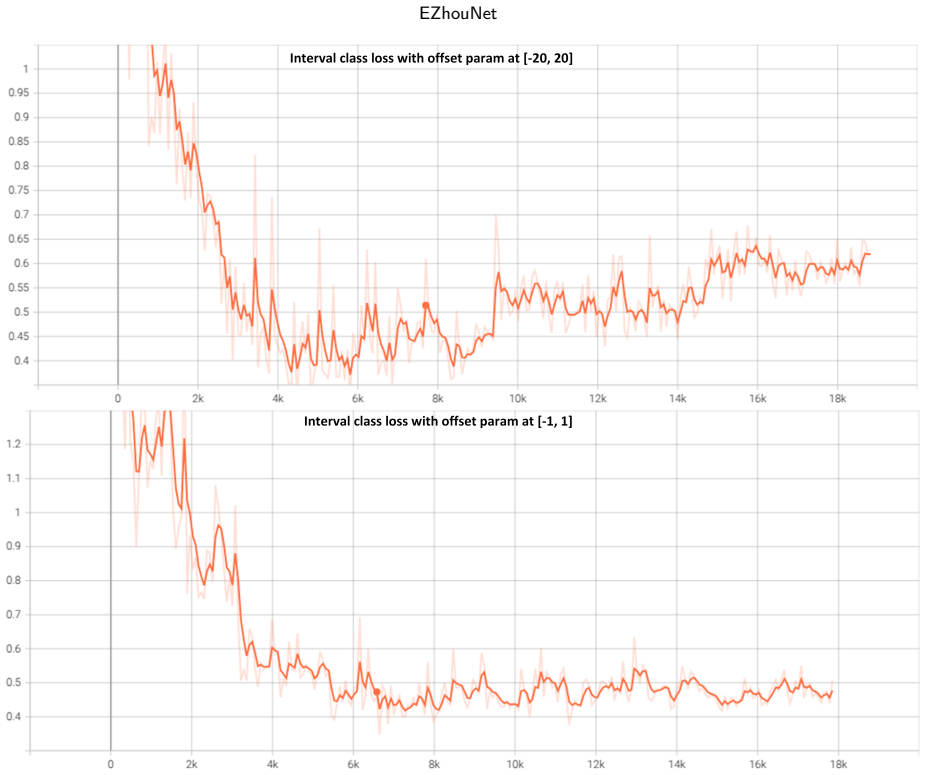
The paper's central derivation is an end-to-end architecture: multichannel spectrogram -> graph construction -> GAT node updates -> anchor-interval refinement. The final interval predictions are computed in Eq. (40) as anchor + learned offsets, where the offsets come from a trained MLP/GRU head over discrete bins (Eqs. 33-39). The anchor scales in Eq. (25) are manually specified hyperparameters, and the statement in Sec. 3.3.3 that observed event durations 'align with the designed prior anchor intervals' is a post-hoc hyperparameter justification, not an equation-level reduction: the offsets are learned and, for the best configuration in Table 1, can range over [-20,20], so the anchor prior does not by itself determine the output intervals. No load-bearing self-citation appears: [40], [42], and [43] are external datasets/baselines, and the paper invokes no uniqueness theorem or prior work by the same authors to force its design. The limitations acknowledged in Sec. 3.4 (fixed anchor sizes; inability to batch variable-length audio in the current implementation) are practical weaknesses and do not constitute circular derivation. The Table 3 comparison with [42] is confounded by a different label protocol (normal events included vs. excluded), but that is an evaluation-validity concern, not circularity. Under the required standard of exhibiting a specific reduction where a fitted parameter is renamed as a prediction or an equation reduces to its own input, no circular step can be identified.
Axiom & Free-Parameter Ledger
free parameters (7)
- anchor scale durations d =
[0.5, 0.8, 1.5] s
- anchor density weights w_k and base centers N0 =
[0.75, 2.0, 0.75], N0=20
- frames per node (group size) =
5 frames (~80 ms)
- offset bin count B_k and ranges =
swept ranges like [-0.5, 0.5] to [-20, 20]
- loss weights w_n_conf, w_n_cls, w_i_conf, w_i_cls, w_i_loc =
not reported
- IoU threshold theta_iou =
not reported
- Gaussian scaling gamma =
0.05
axioms (5)
- standard math FFT, Mel, gammatone and CQT filterbank definitions
- domain assumption Each 5-frame chunk maps to a graph node that preserves event boundary information
- ad hoc to paper Fixed 3-scale anchor intervals cover the event durations of interest
- domain assumption Event-based F1 with 200 ms onset and offset collar is the appropriate evaluation
- ad hoc to paper Soft confidence labels improve training stability
Cite this review
Pith. "Pith review of EZhouNet:A framework based on graph neural network and anchor interval for the respiratory sound event detection." pith.science (2026). https://pith.science/paper/ALUZ4TGO
@misc{pith2026250901153,
  author       = {Pith},
  title        = {Pith review of: EZhouNet:A framework based on graph neural network and anchor interval for the respiratory sound event detection},
  year         = {2026},
  howpublished = {\url{https://pith.science/paper/ALUZ4TGO}},
  note         = {Machine review of arXiv:2509.01153}
}
read the original abstract
Auscultation is a key method for early diagnosis of respiratory and pulmonary diseases, relying on skilled healthcare professionals. However, the process is often subjective, with variability between experts. As a result, numerous deep learning-based automatic classification methods have emerged, most of which focus on respiratory sound classification. In contrast, research on respiratory sound event detection remains limited. Existing sound event detection methods typically rely on frame-level predictions followed by post-processing to generate event-level outputs, making interval boundaries challenging to learn directly. Furthermore, many approaches can only handle fixed-length audio, limiting their applicability to variable-length respiratory sounds. Additionally, the impact of respiratory sound location information on detection performance has not been extensively explored. To address these issues, we propose a graph neural network-based framework with anchor intervals, capable of handling variable-length audio and providing more precise temporal localization for abnormal respiratory sound events. Our method improves both the flexibility and applicability of respiratory sound detection. Experiments on the SPRSound 2024 and HF Lung V1 datasets demonstrate the effectiveness of the proposed approach, and incorporating respiratory position information enhances the discrimination between abnormal sounds. The reference implementation is available at https://github.com/chumingqian/EzhouNet.
Figures




Reference graph
Works this paper leans on
-
[1]
World health statistics 2022: monitoring health for the sdgs, sustainable development goals,
W. H. Organizationet al., “World health statistics 2022: monitoring health for the sdgs, sustainable development goals,” 2022
work page 2022
-
[2]
Projections of global mortality and burden of disease from 2002 to 2030,
C. D. Mathers and D. Loncar, “Projections of global mortality and burden of disease from 2002 to 2030,”PLoS medicine, vol. 3, no. 11, p. e442, 2006
work page 2002
-
[3]
Whoglobalprogressreportontuberculosiselimination,
E.Harding,“Whoglobalprogressreportontuberculosiselimination,” The Lancet Respiratory Medicine, vol. 8, no. 1, p. 19, 2020
work page 2020
-
[4]
The global impact of respiratory disease–second edition. sheffield, european respiratory society,
F. of International Respiratory Societies, “The global impact of respiratory disease–second edition. sheffield, european respiratory society,” 2017
work page 2017
-
[5]
Fundamentals of lung auscultation,
A. Bohadana, G. Izbicki, and S. S. Kraman, “Fundamentals of lung auscultation,” New England Journal of Medicine, vol. 370, no. 8, pp. 744–751, 2014
work page 2014
-
[6]
New parameters for respiratory sound classification,
M. Bahoura and C. Pelletier, “New parameters for respiratory sound classification,” inCCECE 2003-Canadian Conference on Electrical and Computer Engineering. Toward a Caring and Humane Technol- ogy (Cat. No. 03CH37436), vol. 3, pp. 1457–1460, IEEE, 2003
work page 2003
-
[7]
J. Li, J. Yuan, H. Wang, S. Liu, Q. Guo, Y. Ma, Y. Li, L. Zhao, and G. Wang, “Lungattn: advanced lung sound classification using attention mechanism with dual tqwt and triple stft spectrogram,” Physiological Measurement, vol. 42, no. 10, p. 105006, 2021
work page 2021
-
[8]
S.B.Shuvo,S.N.Ali,S.I.Swapnil,T.Hasan,andM.I.H.Bhuiyan, “A lightweight cnn model for detecting respiratory diseases from lung auscultation sounds using emd-cwt-based hybrid scalogram,” IEEE Journal of Biomedical and Health Informatics, vol. 25, no. 7, pp. 2595–2603, 2020
work page 2020
-
[9]
Classificationofauscultation sounds into objective spirometry findings using mvmd and 3d cnn,
S.Gupta,M.Agrawal,andD.Deepak,“Classificationofauscultation sounds into objective spirometry findings using mvmd and 3d cnn,” in2022 National Conference on Communications (NCC), pp. 42–47, IEEE, 2022
work page 2022
-
[10]
L. Xu, J. Cheng, J. Liu, H. Kuang, F. Wu, and J. Wang, “Arsc-net: Adventitious respiratory sound classification network using parallel paths with channel-spatial attention,” in2021 IEEE International Conference on Bioinformatics and Biomedicine (BIBM), pp. 1125– 1130, IEEE, 2021
work page 2021
-
[11]
Lung sounds classifica- tion using convolutional neural networks,
D. Bardou, K. Zhang, and S. M. Ahmad, “Lung sounds classifica- tion using convolutional neural networks,”Artificial intelligence in medicine, vol. 88, pp. 58–69, 2018
work page 2018
-
[12]
Triple-classification of respiratory sounds using optimized s-transform and deep residual networks,
H. Chen, X. Yuan, Z. Pei, M. Li, and J. Li, “Triple-classification of respiratory sounds using optimized s-transform and deep residual networks,”IEEE Access, vol. 7, pp. 32845–32852, 2019
work page 2019
-
[13]
K. Minami, H. Lu, H. Kim, S. Mabu, Y. Hirano, and S. Kido, “Auto- matic classification of large-scale respiratory sound dataset based on convolutionalneuralnetwork,”in 201919thInternationalConference on Control, Automation and Systems (ICCAS), pp. 804–807, IEEE, 2019
work page 2019
-
[14]
Y. Ma, X. Xu, Q. Yu, Y. Zhang, Y. Li, J. Zhao, and G. Wang, “Lung- brn: A smart digital stethoscope for detecting respiratory disease using bi-resnet deep learning algorithm,” in2019 IEEE Biomedical Circuits and Systems Conference (BioCAS), pp. 1–4, IEEE, 2019
work page 2019
-
[15]
S.Gupta,M.Agrawal,andD.Deepak,“Gammatonegrambasedtriple classificationoflungsoundsusingdeepconvolutionalneuralnetwork with transfer learning,”Biomedical Signal Processing and Control, vol. 70, p. 102947, 2021
work page 2021
-
[16]
Feature extraction of lung sounds based on bispectrum analysis,
S. Li and Y. Liu, “Feature extraction of lung sounds based on bispectrum analysis,” in 2010 Third International Symposium on Information Processing, pp. 393–397, IEEE, 2010
work page 2010
-
[17]
I. Sen, M. Saraclar, and Y. P. Kahya, “A comparison of svm and gmm-based classifier configurations for diagnostic classification of pulmonary sounds,”IEEE Transactions on Biomedical Engineering, vol. 62, no. 7, pp. 1768–1776, 2015
work page 2015
-
[18]
F. Cinyol, U. Baysal, D. Köksal, E. Babaoğlu, and S. S. Ulaşlı, “Incorporating support vector machine to the classification of respi- ratory sounds by convolutional neural network,”Biomedical Signal Processing and Control, vol. 79, p. 104093, 2023
work page 2023
-
[19]
S. A. Shehab, K. K. Mohammed, A. Darwish, and A. E. Hassanien, “Deep learning and feature fusion-based lung sound recognition model to diagnoses the respiratory diseases,”Soft Computing, pp. 1– 17, 2024. Chu Yun et al.:Preprint submitted to Elsevier Page 18 of 19 EZhouNet
work page 2024
-
[20]
E. K. Topuz and Y. Kaya, “Super-cough: A super learner-based ensemble machine learning method for detecting disease on cough acousticsignals,” BiomedicalSignalProcessingandControl ,vol.93, p. 106165, 2024
work page 2024
-
[21]
Patch-level contrastive embedding learning for respiratory sound classification,
W. Song and J. Han, “Patch-level contrastive embedding learning for respiratory sound classification,”Biomedical Signal Processing and Control, vol. 80, p. 104338, 2023
work page 2023
-
[22]
Contrastive embeddind learning method for respiratory sound classification,
W. Song, J. Han, and H. Song, “Contrastive embeddind learning method for respiratory sound classification,” inICASSP 2021-2021 IEEE International Conference on Acoustics, Speech and Signal Processing (ICASSP), pp. 1275–1279, IEEE, 2021
work page 2021
-
[23]
S. Bae, J. Kim, W. Cho, H. Baek, S. Son, B. Lee, C. Ha, K. Tae, S. Kim, and S. Yun, “Patch-mix contrastive learning with audio spectrogram transformer on respiratory sound classification,” 2023
work page 2023
-
[24]
Pretraining respiratory sound repre- sentations using metadata and contrastive learning,
I. Moummad and N. Farrugia, “Pretraining respiratory sound repre- sentations using metadata and contrastive learning,” in2023 IEEE Workshop on Applications of Signal Processing to Audio and Acous- tics (WASPAA), pp. 1–5, IEEE, 2023
work page 2023
-
[25]
Audioevent- relational graph representation learning for acoustic scene classifica- tion,
Y.Hou,S.Song,C.Yu,W.Wang,andD.Botteldooren,“Audioevent- relational graph representation learning for acoustic scene classifica- tion,”IEEE signal processing letters, 2023
work page 2023
-
[26]
Graph-based audio classifica- tion using pre-trained models and graph neural networks,
A. E. Castro-Ospina, M. A. Solarte-Sanchez, L. S. Vega-Escobar, C. Isaza, and J. D. Martínez-Vargas, “Graph-based audio classifica- tion using pre-trained models and graph neural networks,”Sensors, vol. 24, no. 7, p. 2106, 2024
work page 2024
-
[27]
Y. Jiang, D. Guo, L. Wang, H. Zhang, H. Dong, Y. Qiu, and H. Zou, “Soundeventdetectionintrafficscenesbasedongraphconvolutional network to obtain multi-modal information,”Complex & Intelligent Systems, pp. 1–16, 2024
work page 2024
-
[28]
Sound event detection utilizing graph laplacianregularizationwitheventco-occurrence,
K. Imoto and S. Kyochi, “Sound event detection utilizing graph laplacianregularizationwitheventco-occurrence,” IEICETRANSAC- TIONS on Information and Systems, vol. 103, no. 9, pp. 1971–1977, 2020
work page 1971
-
[29]
Musicy- olo: A vision-based framework for automatic singing transcription,
X. Wang, B. Tian, W. Yang, W. Xu, and W. Cheng, “Musicy- olo: A vision-based framework for automatic singing transcription,” IEEE/ACM Transactions on Audio, Speech, and Language Process- ing, vol. 31, pp. 229–241, 2022
work page 2022
-
[30]
X. Wang, W. Xu, W. Yang, and W. Cheng, “Musicyolo: A sight- singingonset/offsetdetectionframeworkbasedonobjectdetectionin- steadofspectrumframes,”in ICASSP2022-2022IEEEInternational Conference on Acoustics, Speech and Signal Processing (ICASSP), pp. 396–400, IEEE, 2022
work page 2022
-
[31]
You only hear once: a yolo-like algorithm for audio segmentation and sound event detec- tion,
S. Venkatesh, D. Moffat, and E. R. Miranda, “You only hear once: a yolo-like algorithm for audio segmentation and sound event detec- tion,”Applied Sciences, vol. 12, no. 7, p. 3293, 2022
work page 2022
-
[32]
R-crnn: Region-based convolutional recurrent neural network for audio event detection,
C.-C. Kao, W. Wang, M. Sun, and C. Wang, “R-crnn: Region-based convolutional recurrent neural network for audio event detection,” in Proc. Interspeech 2018, pp. 1358–1362, 2018
work page 2018
-
[33]
Sound event detection transformer: An event-based end-to-end model for sound event detection,
Z.Ye,X.Wang,H.Liu,Y.Qian,R.Tao,L.Yan,andK.Ouchi,“Sound event detection transformer: An event-based end-to-end model for sound event detection,”arXiv preprint arXiv:2110.02011, 2021
Pith/arXiv arXiv 2021
-
[34]
Metrics for polyphonic sound event detection,
A. Mesaros, T. Heittola, and T. Virtanen, “Metrics for polyphonic sound event detection,”Applied Sciences, vol. 6, no. 6, p. 162, 2016
2016
-
[35]
Improvingsoundeventdetectionmetrics:insights from dcase 2020,
G. Ferroni, N. Turpault, J. Azcarreta, F. Tuveri, R. Serizel, Ç. Bilen, andS.Krstulović,“Improvingsoundeventdetectionmetrics:insights from dcase 2020,” inICASSP 2021-2021 IEEE international confer- ence on acoustics, speech and signal processing (ICASSP), pp. 631– 635, IEEE, 2021
work page 2020
-
[36]
A framework for the robust evaluation of sound event detection,
Ç. Bilen, G. Ferroni, F. Tuveri, J. Azcarreta, and S. Krstulović, “A framework for the robust evaluation of sound event detection,” in ICASSP 2020-2020 IEEE International Conference on Acoustics, Speech and Signal Processing (ICASSP), pp. 61–65, IEEE, 2020
work page 2020
-
[37]
Graph-based semi- supervised one class support vector machine for detecting abnor- mal lung sounds,
R. Lang, R. Lu, C. Zhao, H. Qin, and G. Liu, “Graph-based semi- supervised one class support vector machine for detecting abnor- mal lung sounds,”Applied Mathematics and Computation, vol. 364, p. 124487, 2020
work page 2020
-
[38]
Analysisofunlabeledlungsound samples using semi-supervised convolutional neural networks,
R.Lang,Y.Fan,G.Liu,andG.Liu,“Analysisofunlabeledlungsound samples using semi-supervised convolutional neural networks,”Ap- plied Mathematics and Computation, vol. 411, p. 126511, 2021
work page 2021
-
[39]
Convolutional neural network for breathing phase detection in lung sounds,
C. Jácome, J. Ravn, E. Holsbø, J. C. Aviles-Solis, H. Melbye, and L. Ailo Bongo, “Convolutional neural network for breathing phase detection in lung sounds,”Sensors, vol. 19, no. 8, p. 1798, 2019
work page 2019
-
[40]
F.-S. Hsu, S.-R. Huang, C.-W. Huang, C.-J. Huang, Y.-R. Cheng, C.-C. Chen, J. Hsiao, C.-W. Chen, L.-C. Chen, Y.-C. Lai,et al., “Benchmarking of eight recurrent neural network variants for breath phase and adventitious sound detection on a self-developed open- access lung sound database—hf_lung_v1,”PLoS One, vol. 16, no. 7, p. e0254134, 2021
work page 2021
-
[41]
F.-S. Hsu, S.-R. Huang, C.-F. Su, C.-W. Huang, Y.-R. Cheng, C.-C. Chen, C.-Y. Wu, C.-W. Chen, Y.-C. Lai, T.-W. Cheng,et al., “A dual- purpose deep learning model for auscultated lung and tracheal sound analysis based on mixed set training,”Biomedical Signal Processing and Control, vol. 86, p. 105222, 2023
work page 2023
-
[42]
C.-Y. Yeh, S.-A. Chiu, X.-Y. Deng, and W.-C. Fang, “A novel ai- inspired method and system implementation for detecting and clas- sifyingpediatricrespiratorysoundevents,”in 2024IEEEBiomedical Circuits and Systems Conference (BioCAS), pp. 1–5, IEEE, 2024
work page 2024
-
[43]
Meta: Data compression and event detection grand challenge 2024 with sprsound dataset,
Q. Zhang, C. Chen, S. Yuan, J. Zhang, J. Yuan, H. Huang, Y. Zhang, R. Pan, X. Jiang, J. Zhao,et al., “Meta: Data compression and event detection grand challenge 2024 with sprsound dataset,”IEEE Data Descriptions, 2024
work page 2024
-
[44]
P.K.ChaudharyandR.B.Pachori,“Automaticdiagnosisofglaucoma using two-dimensional fourier-bessel series expansion based empiri- cal wavelet transform,”Biomedical Signal Processing and Control, vol. 64, p. 102237, 2021. Chu Yun et al.:Preprint submitted to Elsevier Page 19 of 19
work page 2021
This paper was first reviewed by deepseek-v4-flash on August 5, 2026.
discussion (0)
Sign in with ORCID, Apple, or X to comment. Anyone can read and Pith papers without signing in.