REVIEW 4 major objections 6 minor 31 references
Jointly fine-tuning one model on Classical and Modern Chinese information extraction tasks causes measurable negative interference; Tea-MoELORA counters it with separate task and era routing over low-rank experts.
Reviewed by Pith at T0; open to challenge. T0 means a machine referee read the full paper against a public rubric. the ladder, T0–T4 →
Tea-MOELORA uses separate task and era gates over LoRA experts to jointly train relation and event extraction across classical and modern Chinese, improving F1 over joint LoRA and existing LoRA-MoE baselines on most datasets.
T0 review reviewed 2026-08-05 challenge →
load-bearing objection A useful era-aware LoRA-MoE idea, but the abstract's claim of uniform superiority is contradicted by its own Table 2 on DUIE. the 4 major comments →
Joint Information Extraction Across Classical and Modern Chinese with Tea-MOELoRA
The pith
A machine-rendered reading of the paper's core claim, the machinery that carries it, and where it could break.
The reading
Core claim
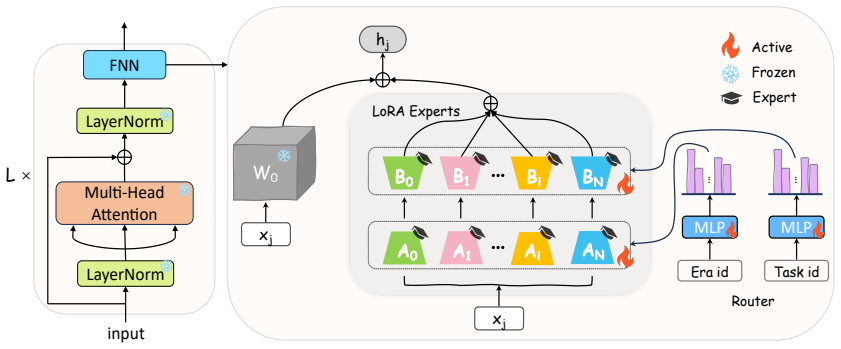
The paper's central claim is that negative transfer in cross-era, multi-task Chinese information extraction can be mitigated by routing low-rank experts along two separate dimensions instead of one. Tea-MoELORA equips each LoRA expert with its own A and B matrices and computes two softmax gates: an era gate driven by a learnable era embedding and a task gate driven by a learnable task embedding. The era weight multiplies the A-side projection and the task weight multiplies the B-side projection, so the final update is a product of both routing signals. Experiments on CHED, CHisRE, ACE2005, and DUIE show that this two-gate design beats jointly trained LoRA on all four datasets, beats the MoEL
What carries the argument
The load-bearing mechanism is the task-era-aware router defined in Equation (10): for each expert i, the contribution is (w_t^i · λ · B_i)(A_i · Dropout(x) · w_e^i), where w_e is a softmax routing weight from era embeddings and w_t is a softmax routing weight from task embeddings. This factorizes routing into two orthogonal gates, letting the model allocate experts separately for diachronic linguistic properties and for task semantics. The paper also compares merging strategies and finds that keeping two separate gating mechanisms preserves features from both categories better than feeding a concatenated signal into a single router.
Load-bearing premise
The load-bearing premise is that task and era are independent, separable routing signals: era weights multiply the A-side projection and task weights multiply the B-side projection, and the binary Classical/Modern label captures all temporal variation. If the correct expert mixture depends on a task-era interaction, such as Classical event extraction needing different experts than Classical relation extraction, the two-gate factorization caps performance.
What would settle it
Train a matched LoRA-MoE model with a single joint router fed the concatenated task and era embeddings; if its average F1 equals or exceeds the two separate gates on CHED, CHisRE, ACE2005, and DUIE, the claimed advantage of factorization collapses. A sharper check: fix task labels and shuffle era labels on Classical examples; if performance does not drop, era routing is not doing causal work.
If this is right
- A single jointly trained checkpoint can cover both Classical and Modern Chinese information extraction without the usual multi-task penalty, reducing the need for era-specific deployed models.
- Small datasets benefit most: the largest joint-LoRA drops are on CHisRE and ACE2005, so expert routing matters most where training data is scarce.
- Both routing signals earn their place: the ablation shows that removing either the era ID or the task ID reduces performance and makes expert usage smoother and less specialized.
- Task granularity matters: assigning four distinct task IDs beats assigning just two coarse task IDs, indicating that schema differences between datasets are as important as coarse task type.
Where Pith is reading between the lines
- If the separability assumption holds beyond Chinese, the same two-gate factorization can be applied to other diachronic or register-split settings, such as historical versus contemporary English or legal versus social-media text, where a categorical domain label already exists.
- A natural extension the paper leaves open is continuous time: replacing the binary Classical/Modern label with document dates could reveal whether the era dimension is genuinely continuous and whether the coarse label hides within-era variation.
- The case study suggests the practical benefit may be as much about suppressing hallucinated extractions — spurious relation tuples and merged event arguments — as about average F1; a dedicated hallucination or tuple-validity metric would quantify this.
- The four-task-ID result implies the router treats each dataset's schema as its own task, so adding new IE datasets likely means adding task IDs rather than retraining all experts from scratch.
Editorial analysis
A structured set of objections, weighed in public.
Referee Report
Summary. The paper proposes Tea-MoELORA, a parameter-efficient multi-task fine-tuning framework that combines LoRA with a Mixture-of-Experts design for Chinese information extraction spanning Classical and Modern Chinese. Multiple low-rank LoRA experts are combined by a task-era-aware router that uses separate task and era embeddings to produce gating weights. The method is evaluated on four datasets (CHED, CHisRE, ACE2005, DUIE) and compared with in-context learning, single-task LoRA, joint LoRA, MoELORA, and an adapted TeamLoRA baseline. The central claim, stated in the abstract and Section 4.2, is that Tea-MoELORA outperforms both single-task and joint LoRA baselines across both Classical and Modern Chinese datasets.
Significance. If the empirical claims were fully supported, this would be a useful contribution to multi-task information extraction for Chinese, particularly in showing that era-aware expert routing can mitigate negative transfer across historical and modern text. The paper is not circular: the router is trained on task and era labels, and performance is measured against external baselines on standard datasets. The focus on Classical Chinese IE is timely and the ablation structure is sensible. However, the current evidence does not back the headline claim of uniform superiority, and the lack of statistical reliability and missing experimental details limit the paper's immediate impact. No code, configuration files, or significance tests are provided, so the contribution is currently an interesting but not fully verified empirical design.
major comments (4)
- [Abstract and Section 4.2, Table 2] The abstract and Section 4.2 claim that Tea-MoELORA 'outperforms both single-task and joint LoRA baselines' and gives 'substantial improvements across both Classical and Modern Chinese datasets.' This is contradicted by the DUIE row in Table 2: Tea-MoELORA obtains F1=78.13, while LLaMA-3.1-8B single-task LoRA obtains F1=78.45 and MoELORA obtains F1=79.46. Thus the method is not uniformly better than single-task LoRA, and on the single Modern Chinese relation-extraction benchmark it is also worse than both MoE baselines. The conclusion is defensible only if restricted to joint LoRA (LoRA Mix) or to Classical Chinese datasets; the paper must be reworded and re-analyzed accordingly.
- [Section 4.1, Table 2] The base model for Tea-MoELORA is not specified. Section 4.1 states that the two LLMs (LLaMA-3.1-8B-Instruction and GLM-4-9b-chat) are fine-tuned for the LoRA Single and LoRA Mix baselines, but Table 2 lists exactly one 'Ours' row. It is impossible to tell whether Tea-MoELORA was run on LLaMA, GLM, or both. If it was run only on LLaMA, the comparison against GLM baselines is not apples-to-apples; if it was run on both, the missing row conceals backbone variance. This must be clarified, and ideally results for both backbones should be reported.
- [Section 4.2, Tables 2-3] No error bars, multiple-run variance, or significance tests are reported. Several of the claimed advantages are small relative to the likely run-to-run variation: for CHisRE, Ours F1=69.21 vs GLM-4-9b Single F1=67.21; for DUIE, Ours F1=78.13 vs MoELORA F1=79.46, i.e., Tea-MoELORA is numerically worse. Without repeated seeds and a significance test, the phrase 'substantial improvements' in Section 4.2 is not supportable. This is a load-bearing issue because the main contribution is an empirical performance claim.
- [Section 3.3, Equations (10)-(12); Section 4.5, Figure 2] The router factorization in Eq. (10) assumes that era information modulates the A-side projection and task information modulates the B-side projection independently. The paper reports in Section 4.5 that this separate-gate design outperforms concatenating both signals into a single router, but the evidence is presented only as a bar chart (Figure 2) with no numeric values and no significance testing. Given that the factorization is a core design decision, the comparison needs quantitative support. In addition, key hyperparameters such as the number of experts N, LoRA rank r, and the dimensions d_t and d_e of the task and era embeddings are not reported anywhere, so the reader cannot assess the router capacity or reproduce the method.
minor comments (6)
- [Section 4.2, Table 2] The event-extraction column headers are typeset as 'Trir-I Tri-C Tri-I Tri-C Arg-I Arg-C'; these should be 'Trig-I Trig-C Arg-I Arg-C' or similar. The current labels are confusing and make the table hard to read.
- [Section 4.3, Table 3] In the 'W/o Task id' row, the ACE2005 'Arg-I' entry appears as '65.84 .66.67', which looks like a formatting error. Please correct the decimal formatting.
- [Throughout] The method name is inconsistent: the title and most of the paper use 'Tea-MoELORA', while the abstract uses 'Tea-MoELoRA'. Similarly, 'MoELORA' is sometimes written 'MoELoRA'. Please standardize.
- [Section 4.1, Datasets paragraph] The construction of the DUIE training/test split is under-specified: 'we randomly sample 10% of the original training and development sets' does not state how the test set is derived, what random seed is used, or whether the sampled development set is disjoint from the training sample. This is needed for reproducibility.
- [Section 3.2] The sentence 'Our experiments confirm this limitation...' states a result before the experiments are described. It would be clearer to reference Table 2 or move this claim to the results section.
- [References] The HydraLoRA citation in Section 2.2 has no year in the text ('Tian et al. proposed'), and the reference entry lacks a year. Please add the missing publication information.
Circularity Check
No significant circularity: Tea-MoELORA's router is trained end-to-end and evaluated on external benchmarks; self-citations are non-load-bearing.
full rationale
The paper's derivation chain is empirical: it defines a task/era-aware router in Eqs. (10)–(12), trains LoRA experts jointly, and evaluates F1 on CHED, CHisRE, ACE2005, and DUIE against LoRA, LoRA-Mix, MoELORA, and TeamLoRA baselines. Nothing in this chain equates a fitted parameter with the predicted outcome; the router weights are learned from disclosed task/era labels and are not derived from the target IE labels. The self-citations (CHisRE dataset, cross-era segmentation work, and related Chinese IE work) provide datasets, motivation, or background, but the central claim—that the proposed router improves multi-task IE—is supported by the reported comparisons and ablations, not by those citations. The reported DUIE result being lower than a baseline is a consistency/correctness concern, not circularity. No uniqueness theorem, no ansatz justified only by the authors' prior work, and no renamed known result is load-bearing.
Axiom & Free-Parameter Ledger
free parameters (4)
- Number of LoRA experts N
- LoRA rank r
- LoRA scaling factor lambda
- Task embedding dimension d_t and era embedding dimension d_e
axioms (4)
- domain assumption A frozen pretrained LLM with LoRA adapters is sufficient to capture task and era knowledge
- standard math The low-rank decomposition in LoRA captures meaningful task-specific updates
- standard math Softmax-gated linear combinations of expert outputs are differentiable and trainable
- ad hoc to paper A binary era label (classical vs modern) plus a task ID fully describe the temporal and task context
Cite this review
Pith. "Pith review of Joint Information Extraction Across Classical and Modern Chinese with Tea-MOELoRA." pith.science (2026). https://pith.science/paper/TOFLJBIQ
@misc{pith2026250901158,
  author       = {Pith},
  title        = {Pith review of: Joint Information Extraction Across Classical and Modern Chinese with Tea-MOELoRA},
  year         = {2026},
  howpublished = {\url{https://pith.science/paper/TOFLJBIQ}},
  note         = {Machine review of arXiv:2509.01158}
}
read the original abstract
Chinese information extraction (IE) involves multiple tasks across diverse temporal domains, including Classical and Modern documents. Fine-tuning a single model on heterogeneous tasks and across different eras may lead to interference and reduced performance. Therefore, in this paper, we propose Tea-MOELoRA, a parameter-efficient multi-task framework that combines LoRA with a Mixture-of-Experts (MoE) design. Multiple low-rank LoRA experts specialize in different IE tasks and eras, while a task-era-aware router mechanism dynamically allocates expert contributions. Experiments show that Tea-MOELoRA outperforms both single-task and joint LoRA baselines, demonstrating its ability to leverage task and temporal knowledge effectively.
Figures


Reference graph
Works this paper leans on
-
[1]
Xiaoyi Bao, Jinghang Gu, Zhongqing Wang, Minjie Qiang, and Chu-Ren Huang. 2024. https://doi.org/10.18653/v1/2024.findings-emnlp.58 Employing glyphic information for C hinese event extraction with vision-language model . In Findings of the Association for Computational Linguistics: EMNLP 2024, pages 1068--1080, Miami, Florida, USA. Association for Computat...
-
[2]
Wei Congcong, Feng Zhenbing, Huang Shutan, Li Wei, and Shao Yanqiu. 2023. https://aclanthology.org/2023.ccl-1.74/ Ched: A cross-historical dataset with a logical event schema for classical chinese event detection . In Proceedings of the 22nd Chinese National Conference on Computational Linguistics, page 875–888, Harbin, China. Chinese Information Processi...
work page 2023
-
[3]
DeepSeek-AI, Daya Guo, Dejian Yang, Haowei Zhang, Junxiao Song, Ruoyu Zhang, Runxin Xu, Qihao Zhu, Shirong Ma, Peiyi Wang, Xiao Bi, Xiaokang Zhang, Xingkai Yu, Yu Wu, Z. F. Wu, Zhibin Gou, Zhihong Shao, Zhuoshu Li, Ziyi Gao, and 181 others. 2025. https://doi.org/10.48550/arXiv.2501.12948 Deepseek-r1: Incentivizing reasoning capability in llms via reinforc...
-
[4]
Shihan Dou, Enyu Zhou, Yan Liu, Songyang Gao, Wei Shen, Limao Xiong, Yuhao Zhou, Xiao Wang, Zhiheng Xi, Xiaoran Fan, Shiliang Pu, Jiang Zhu, Rui Zheng, Tao Gui, Qi Zhang, and Xuanjing Huang. 2024. https://doi.org/10.18653/v1/2024.acl-long.106 Loramoe: Alleviating world knowledge forgetting in large language models via moe-style plugin . In Proceedings of ...
-
[5]
Hao Fei, Shengqiong Wu, Jingye Li, Bobo Li, Fei Li, Libo Qin, Meishan Zhang, Min Zhang, and Tat-Seng Chua. 2022. Lasuie: unifying information extraction with latent adaptive structure-aware generative language model. In Proceedings of the 36th International Conference on Neural Information Processing Systems, NIPS ’22, page 15460–15475, Red Hook, NY, USA....
work page 2022
-
[6]
Wenfeng Feng, Chuzhan Hao, Yuewei Zhang, Yu Han, and Hao Wang. 2024. https://aclanthology.org/2024.lrec-main.994/ Mixture-of-loras: An efficient multitask tuning method for large language models . In Proceedings of the 2024 Joint International Conference on Computational Linguistics, Language Resources and Evaluation (LREC-COLING 2024), page 11371–11380, ...
work page 2024
-
[7]
Honghao Gui, Jintian Zhang, Hongbin Ye, and Ningyu Zhang. 2023. http://arxiv.org/abs/2305.11527 Instructie: A chinese instruction-based information extraction dataset . (arXiv:2305.11527). ArXiv:2305.11527 [cs]
Pith/arXiv arXiv 2023
-
[8]
Yucan Guo, Zixuan Li, Xiaolong Jin, Yantao Liu, Yutao Zeng, Wenxuan Liu, Xiang Li, Pan Yang, Long Bai, Jiafeng Guo, and Xueqi Cheng. 2023. https://doi.org/10.48550/arXiv.2311.02962 Retrieval-augmented code generation for universal information extraction . (arXiv:2311.02962). ArXiv:2311.02962 [cs]
-
[9]
Hu, Yelong Shen, Phillip Wallis, Zeyuan Allen-Zhu, Yuanzhi Li, Shean Wang, Lu Wang, and Weizhu Chen
Edward J. Hu, Yelong Shen, Phillip Wallis, Zeyuan Allen-Zhu, Yuanzhi Li, Shean Wang, Lu Wang, and Weizhu Chen. 2021. http://arxiv.org/abs/2106.09685 Lora: Low-rank adaptation of large language models . (arXiv:2106.09685). ArXiv:2106.09685 [cs]
Pith/arXiv arXiv 2021
-
[10]
Chengsong Huang, Qian Liu, Bill Yuchen Lin, Tianyu Pang, Chao Du, and Min Lin. 2024. https://doi.org/10.48550/arXiv.2307.13269 Lorahub: Efficient cross-task generalization via dynamic lora composition . (arXiv:2307.13269). ArXiv:2307.13269 [cs]
-
[11]
Robert A. Jacobs, Michael I. Jordan, Steven J. Nowlan, and Geoffrey E. Hinton. 1991. https://doi.org/10.1162/neco.1991.3.1.79 Adaptive mixtures of local experts . Neural Computation, 3(1):79--87
-
[12]
Shuangjie Li, Wei He, Yabing Shi, Wenbin Jiang, Haijin Liang, Ye Jiang, Yang Zhang, Yajuan Lyu, and Yong Zhu. 2019. https://doi.org/10.1007/978-3-030-32236-6_72 Duie: A large-scale chinese dataset for information extraction . In Natural Language Processing and Chinese Computing, page 791–800, Cham. Springer International Publishing
-
[13]
Tianwei Lin, Jiang Liu, Wenqiao Zhang, Yang Dai, Haoyuan Li, Zhelun Yu, Wanggui He, Juncheng Li, Jiannan Guo, Hao Jiang, Siliang Tang, and Yueting Zhuang. 2025. https://aclanthology.org/2025.acl-long.669/ T eam L o RA : Boosting low-rank adaptation with expert collaboration and competition . In Proceedings of the 63rd Annual Meeting of the Association for...
work page 2025
-
[14]
Qidong Liu, Xian Wu, Xiangyu Zhao, Yuanshao Zhu, Derong Xu, Feng Tian, and Yefeng Zheng. 2024. https://doi.org/10.1145/3626772.3657722 When moe meets llms: Parameter efficient fine-tuning for multi-task medical applications . In Proceedings of the 47th International ACM SIGIR Conference on Research and Development in Information Retrieval, SIGIR ’24, page...
arXiv 2024
-
[15]
Yaojie Lu, Qing Liu, Dai Dai, Xinyan Xiao, Hongyu Lin, Xianpei Han, Le Sun, and Hua Wu. 2022. https://doi.org/10.18653/v1/2022.acl-long.395 Unified structure generation for universal information extraction . In Proceedings of the 60th Annual Meeting of the Association for Computational Linguistics (Volume 1: Long Papers), page 5755–5772, Dublin, Ireland. ...
-
[16]
Xuemei Tang, Zekun Deng, Qi Su, Hao Yang, and Jun Wang. 2024. https://aclanthology.org/2024.lrec-main.283/ Chisiec: An information extraction corpus for ancient chinese history . In Proceedings of the 2024 Joint International Conference on Computational Linguistics, Language Resources and Evaluation (LREC-COLING 2024), page 3192–3202, Torino, Italia. ELRA...
work page 2024
-
[17]
Xuemei Tang and Qi Su. 2022. https://doi.org/10.18653/v1/2022.acl-long.540 That slepen al the nyght with open ye! cross-era sequence segmentation with switch-memory . In Proceedings of the 60th Annual Meeting of the Association for Computational Linguistics (Volume 1: Long Papers), page 7830–7840, Dublin, Ireland. Association for Computational Linguistics
- [18]
-
[19]
Hydralora: An asymmetric lora architecture for efficient fine-tuning
Chunlin Tian, Zhan Shi, Zhijiang Guo, Li Li, and Chengzhong Xu. Hydralora: An asymmetric lora architecture for efficient fine-tuning
-
[20]
Christopher Walker, Stephanie Strassel, Julie Medero, and Kazuaki Maeda. 2006. Ace 2005 multilingual training corpus. (No Title)
work page 2006
-
[21]
Xiao Wang, Weikang Zhou, Can Zu, Han Xia, Tianze Chen, Yuansen Zhang, Rui Zheng, Junjie Ye, Qi Zhang, Tao Gui, Jihua Kang, Jingsheng Yang, Siyuan Li, and Chunsai Du. 2023. http://arxiv.org/abs/2304.08085 Instructuie: Multi-task instruction tuning for unified information extraction . (arXiv:2304.08085). ArXiv:2304.08085 [cs]
Pith/arXiv arXiv 2023
-
[22]
Xiang Wei, Xingyu Cui, Ning Cheng, Xiaobin Wang, Xin Zhang, Shen Huang, Pengjun Xie, Jinan Xu, Yufeng Chen, Meishan Zhang, Yong Jiang, and Wenjuan Han. 2024. https://doi.org/10.48550/arXiv.2302.10205 Chatie: Zero-shot information extraction via chatting with chatgpt . (arXiv:2302.10205). ArXiv:2302.10205 [cs]
- [23]
-
[24]
Xun Wu, Shaohan Huang, and Furu Wei. 2024. https://doi.org/10.48550/arXiv.2404.13628 Mixture of lora experts . (arXiv:2404.13628). ArXiv:2404.13628 [cs]
-
[25]
Jingwei Xu, Junyu Lai, and Yunpeng Huang. 2024. https://doi.org/10.48550/arXiv.2405.13053 Meteora: Multiple-tasks embedded lora for large language models . (arXiv:2405.13053). ArXiv:2405.13053 [cs]
-
[26]
Ziyu Zhao, Leilei Gan, Guoyin Wang, Wangchunshu Zhou, Hongxia Yang, Kun Kuang, and Fei Wu. 2024. https://doi.org/10.48550/arXiv.2402.09997 Loraretriever: Input-aware lora retrieval and composition for mixed tasks in the wild . (arXiv:2402.09997). ArXiv:2402.09997 [cs]
-
[27]
Lin Zhisheng, Fu Han, Liu Chenghao, Li Zhuo, and Sun Jianling. 2024. https://doi.org/10.18653/v1/2024.findings-acl.410 Pemt: Multi-task correlation guided mixture-of-experts enables parameter-efficient transfer learning . page 6869–6883
-
[28]
Yiyun Zhou, Chang Yao, and Jingyuan Chen. 2025. https://aclanthology.org/2025.findings-acl.726/ C o LA : Collaborative low-rank adaptation . In Findings of the Association for Computational Linguistics: ACL 2025, pages 14115--14130, Vienna, Austria. Association for Computational Linguistics
work page 2025
-
[29]
Yuhang Zhou, Zeping Li, Siyu Tian, Yuchen Ni, Sen Liu, Guangnan Ye, and Hongfeng Chai. 2024. https://doi.org/10.48550/arXiv.2404.04949 Silversight: A multi-task chinese financial large language model based on adaptive semantic space learning . (arXiv:2404.04949). ArXiv:2404.04949 [cs]
work page internal anchor Pith review Pith/arXiv arXiv doi:10.48550/arxiv.2404.04949 2024
-
[30]
online" 'onlinestring :=
ENTRY address archivePrefix author booktitle chapter edition editor eid eprint eprinttype howpublished institution journal key month note number organization pages publisher school series title type volume year doi pubmed url lastchecked label extra.label sort.label short.list INTEGERS output.state before.all mid.sentence after.sentence after.block STRING...
-
[31]
write newline
" write newline "" before.all 'output.state := FUNCTION n.dashify 't := "" t empty not t #1 #1 substring "-" = t #1 #2 substring "--" = not "--" * t #2 global.max substring 't := t #1 #1 substring "-" = "-" * t #2 global.max substring 't := while if t #1 #1 substring * t #2 global.max substring 't := if while FUNCTION word.in bbl.in capitalize " " * FUNCT...
This paper was first reviewed by deepseek-v4-flash on August 5, 2026.
discussion (0)
Sign in with ORCID, Apple, or X to comment. Anyone can read and Pith papers without signing in.