REVIEW 4 major objections 5 minor 25 references
VGTeam reports that an API-only multi-agent chat tower turns text prompts into slideshow storytelling videos, with a 98.4 percent reported success rate and $0.103 average cost per video.
Reviewed by Pith at T0; open to challenge. T0 means a machine referee read the full paper against a public rubric. the ladder, T0–T4 →
VGTeam uses communicating LLM agents plus commercial APIs to turn a text prompt into a slideshow video for about $0.10 per clip, with a self-reported 75.7% quality rate.
T0 review reviewed 2026-08-05 challenge →
load-bearing objection A cheap slideshow-video pipeline that works, but the headline success rate counts inappropriate outputs as successes; the system itself is a modest extension of known multi-agent patterns. the 4 major comments →
Communicative Agents for Slideshow Storytelling Video Generation based on LLMs
The pith
A machine-rendered reading of the paper's core claim, the machinery that carries it, and where it could break.
The reading
Core claim
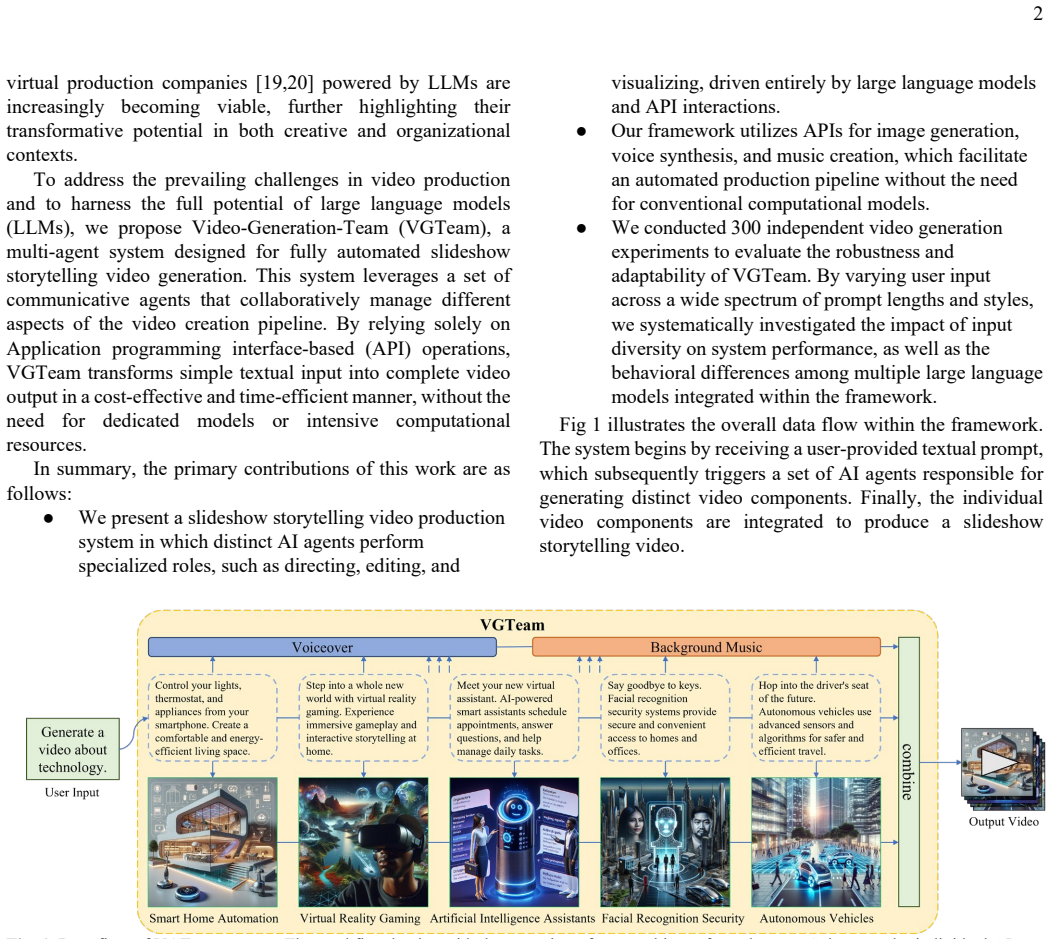
The paper's claim is that a fully agentic, API-only pipeline can reliably produce slideshow storytelling videos from a single text prompt, and that doing so is cheap. Four role-specialized LLM agents—director, editor, painter, and composer—talk in a waterfall-inspired chat tower; the director coordinates, the editor writes captions shared by painter and composer, the memory stream preserves decisions, and an iterative approval loop has the director reject and ask for revisions until outputs pass. The experiments ran 100 prompts through each of three LLMs and report 1.7 percent hard failures, 22.7 percent inappropriate content, 75.7 percent properly generated videos, and a 98.4 percent succes
What carries the argument
The Chat Tower: a sequential, waterfall-inspired agent communication structure. The director agent is the only interface to the user and the quality gatekeeper; editor, painter, and composer produce captions, image prompts, and music prompts; the memory stream persists context across iterations; and iterative approval turns the director into a feedback loop. The tower's shared editor output is what keeps visual, auditory, and narrative elements aligned, and this structure is what lets the system rely on external APIs instead of trained video models.
Load-bearing premise
The load-bearing assumption is that the director's iterative self-approval and the authors' appropriateness labels reliably measure video quality; in the reported data, the 98.4 percent figure counts as successful the 22.7 percent of videos the authors themselves called inappropriate.
What would settle it
Run the pipeline described in the paper on a fresh set of prompts, have blind annotators classify each output as appropriate, inappropriate, or invalid, and reconcile API invoices against the stated cost. If the blind appropriate rate is materially below 75.7 percent or the realized per-video cost is materially above $0.103, the headline claims collapse.
If this is right
- A slideshow video pipeline can be composed from LLM and multimedia APIs alone, so per-video marginal cost collapses to API fees.
- All agent decisions are logged, so human oversight can intervene at any point rather than only at the final video.
- Model choice is a real design variable: verbose LLMs suit script-heavy tasks, while more concise LLMs show wider runtime variance.
- Longer prompts reduce failure risk; shorter prompts make runtime more predictable but are more likely to fail.
- The same chat-tower pattern can be reused for other multi-component generation tasks where coordination, not pixel-level synthesis, is the bottleneck.
Where Pith is reading between the lines
- If the architecture generalizes, text-to-video for slideshow formats may not need diffusion video models at all; still-image APIs plus an LLM coordinator could become the cheaper default for narration-driven content.
- The reported link between long prompts and stability suggests a cheap improvement the paper does not implement: an automatic prompt-expansion step before the director, which could lower failure rates while preserving runtime predictability.
- The same chat-tower structure could serve as a testbed for agent quality-control research: comparing the director's acceptance rate against human judgments would quantify how much self-review inflates success metrics.
Editorial analysis
A structured set of objections, weighed in public.
Referee Report
Summary. The paper proposes VGTeam, a multi-agent LLM system for slideshow storytelling video generation. A director, editor, painter, and composer agents interact inside a Chat Tower, with a memory stream and iterative director approval, then invoke text-to-image, text-to-audio, and text-to-music APIs to assemble a final video. The authors report experiments across 300 runs using three LLMs (DeepSeek-V3, ERNIE 4.5-Turbo, Qwen3-235B), YouTube-8M-derived prompts, and two prompt-length conditions. The central claims are an average cost of $0.103 per video and a 98.4% success rate, with 75.7% of videos 'properly generated.' The paper also analyzes token length, loop count, and communication time as a function of prompt type and LLM choice.
Significance. If the empirical claims held, the work would demonstrate a practically useful, API-only alternative to compute-heavy text-to-video models, with a plausible path to democratized video production. The system-level contribution is clear: decomposing generation into agent roles and using third-party APIs is a reasonable engineering approach. The paper also has strengths worth noting: it reports 300 experiments, makes the generated videos available in a public repository, and logs agent interactions for traceability. However, the current evaluation does not establish the headline success rate or the quality rate, and the absence of baselines or ablations leaves the central architectural contribution untested. The system is potentially significant, but the evidence as presented is conditional.
major comments (4)
- [Abstract and Section III.A] The headline 'successful generation rate of 98.4%' is computed while treating the 22.7% of outputs labeled 'inappropriate content' as successes; only 75.7% were 'properly generated.' The conclusion section repeats the 98.4% figure without the 75.7% qualification. This is not an internal arithmetic error, but the abstract's central quantitative claim is misleading: it reports a pipeline-completion rate as a quality success rate. Please report the 75.7% 'properly generated' rate as the headline quality figure, or define both rates explicitly and lead with the quality rate.
- [Section III.A] The substantive quality claim (75.7% appropriate) rests entirely on binary 'appropriate/inappropriate' labels, but no rubric, annotator instructions, inter-rater agreement, or example labels are given. The paragraph notes that such content is 'often identifiable by built-in content moderation mechanisms in the APIs,' but those mechanisms are not described, and it is unclear whether the labels came from them, from the director's internal approval loop (Section II-B-c), or from the authors. Without a validated measurement protocol, the quality rate is not established. Add an evaluation protocol, an independent human-judgment sample, and agreement statistics.
- [Sections II and III] The paper attributes the system's performance to the multi-agent Chat Tower design, but no baseline or ablation is reported. A single-agent LLM prompted to produce the same script, image prompts, and music prompts, or a non-communicative pipeline using the same APIs, would isolate the contribution of agent communication and the iterative approval mechanism. Since the architectural claim is a core contribution, this absence is load-bearing. Please add at least one comparison baseline or ablation.
- [Section III.B and Fig. 7] The claim that 'all observed failures occurred in trials with short prompt inputs' is based on 5 invalid outputs out of 300 (1.7%); with such a small numerator, the conclusion that prompt length affects stability is not statistically supported. Additionally, the reported cost of $0.103/video is a single average with no distribution, time-based variation, or relation to the 300 experimental runs described in the paper. Since cost is a headline contribution, report per-run cost variation and the calculation method in more detail.
minor comments (5)
- [Section III.B] The model name is inconsistent: 'Qwen3-235B' appears in the setup, 'Qwen2-35B' appears in Fig. 8's caption text, and 'Qwen3-235b' appears in the body and Fig. 8. Please standardize.
- [Section III.A] The paper states a 1.7% failure rate, which corresponds to 5.1 trials out of 300. Please report exact counts (e.g., 5 invalid, 68 inappropriate, 227 appropriate) rather than percentages only.
- [Figures 7 and 8] The label 'communicate time' should be 'communication time.' The x-axis description is vague ('total runtime segmented into intervals'); specify the interval width and units in the captions.
- [Section III.A and Table 1] Only 10 of 300 input prompts are shown. For reproducibility, include the full prompt set or an explicit statement about where it is archived, in addition to the generated videos.
- [Data Availability] The repository link provides generated videos, but the paper does not state whether the experimental logs, quality labels, and per-run cost data are also available. Please include these if possible.
Circularity Check
No circularity: all headline figures are direct empirical measurements; the gap between 98.4% success and 75.7% proper generation is a reporting-definition issue, not a derivation from inputs.
full rationale
The paper reports a multi-agent video-generation system and evaluates it over 300 runs. It contains no equations, no fitted parameters, and no prediction derived from an input that is itself defined by the output. The central quantitative claims are direct measurements: the $0.103/video cost is total API cost divided by number of videos, and the 98.4% success rate is a direct tally of the 75.7% appropriate plus 22.7% inappropriate outputs, with 1.7% invalid outputs. Thus the headline 'success' rate is by construction a non-invalid rate rather than a quality rate; this is a construct-validity or reporting concern, not circularity, because the number is measured rather than derived from a fitting procedure. The director's iterative approval loop is an internal system component, not an evaluator whose judgments are used to compute the reported rates, and it is not cited as external evidence. No load-bearing claim rests on self-citation: the cited prior work (ChatDev, CAMEL, YouTube-8M, etc.) is external and used as design inspiration or as an input source, with no authors overlapping the present paper's authors. The Discussion acknowledges limitations such as LLM unpredictability and static imagery, but these are not assertions of circularity. Since no specific circular reduction can be quoted, the appropriate score is 0.
Axiom & Free-Parameter Ledger
axioms (3)
- domain assumption Third-party APIs (ERNIE-iRAG, TEXT2AUDIO, TEXT-to-MUSIC, LLM providers) remain available and behave consistently enough for the pipeline.
- domain assumption LLM agents follow their role prompts and produce parseable outputs most of the time.
- ad hoc to paper The quality labels ('appropriate', 'inappropriate') are meaningful and consistently applied.
Cite this review
Pith. "Pith review of Communicative Agents for Slideshow Storytelling Video Generation based on LLMs." pith.science (2026). https://pith.science/paper/ISNESDRY
@misc{pith2026250901277,
  author       = {Pith},
  title        = {Pith review of: Communicative Agents for Slideshow Storytelling Video Generation based on LLMs},
  year         = {2026},
  howpublished = {\url{https://pith.science/paper/ISNESDRY}},
  note         = {Machine review of arXiv:2509.01277}
}
abstract
With the rapid advancement of artificial intelligence (AI), the proliferation of AI-generated content (AIGC) tasks has significantly accelerated developments in text-to-video generation. As a result, the field of video production is undergoing a transformative shift. However, conventional text-to-video models are typically constrained by high computational costs. In this study, we propose Video-Generation-Team (VGTeam), a novel slide show video generation system designed to redefine the video creation pipeline through the integration of large language models (LLMs). VGTeam is composed of a suite of communicative agents, each responsible for a distinct aspect of video generation, such as scriptwriting, scene creation, and audio design. These agents operate collaboratively within a chat tower workflow, transforming user-provided textual prompts into coherent, slide-style narrative videos. By emulating the sequential stages of traditional video production, VGTeam achieves remarkable improvements in both efficiency and scalability, while substantially reducing computational overhead. On average, the system generates videos at a cost of only $0.103, with a successful generation rate of 98.4%. Importantly, this framework maintains a high degree of creative fidelity and customization. The implications of VGTeam are far-reaching. It democratizes video production by enabling broader access to high-quality content creation without the need for extensive resources. Furthermore, it highlights the transformative potential of language models in creative domains and positions VGTeam as a pioneering system for next-generation content creation.
Figures

Reference graph
Works this paper leans on
-
[1]
J. C. Foust, E. J. Fink, and L. S. Gross, Video Production: Disciplines and Techniques. London, England: Taylor and Francis, 2017
work page 2017
-
[2]
Make-A-Video: Text-to-video generation without text- video data,
U. Singer et al., “Make-A-Video: Text-to-video generation without text- video data,” Sep. 2022, arXiv:2209.14792. doi: 10.48550/arxiv.2209.14792
-
[3]
ModelScope Text-to-Video Technical Report
J. Wang, H. Yuan, D. Chen, Y. Zhang, X. Wang, and S. Zhang, “ModelScope Text-to-Video Technical Report.” arXiv:2308.06571. Accessed on: Mar. 25, 2024. [Online]. Available: https://arxiv.org/pdf/2308.06571.pdf
Pith/arXiv arXiv 2024
-
[4]
CogVideo: Large- scale pretraining for text-to-video generation via transformers,
W. Hong, M. Ding, W. Zheng, X. Liu, and J. Tang, “CogVideo: Large- scale pretraining for text-to-video generation via transformers,” May 2022, arXiv:2205.15868. doi: 10.48550/arxiv.2205.15868
-
[5]
Tune-A-Video: One-shot tuning of image diffusion models for text-to-video generation,
J. Z. Wu et al., “Tune-A-Video: One-shot tuning of image diffusion models for text-to-video generation,” Proc. IEEE/CVF Int. Conf. Comput. Vis. (ICCV), 2023, pp. 7623-7633. arXiv (Cornell University), Dec. 2022, doi: 10.48550/arxiv.2212.11565
-
[6]
Tell me what happened: Unifying text-guided video completion via multimodal masked video generation,
T. J. Fu, et al., “Tell me what happened: Unifying text-guided video completion via multimodal masked video generation,” Proc. IEEE/CVF Conference on Computer Vision and Pattern Recognition, 2023, pp. 10681–10692
work page 2023
-
[7]
VideoGen: A reference-guided latent diffusion approach for high definition text-to-video generation,
X. Li et al., “VideoGen: A reference-guided latent diffusion approach for high definition text-to-video generation,” arXiv (Cornell University), Sep. 2023, arXiv:2309.00398, doi:10.48550/arxiv.2309.00398
-
[8]
Training language models to follow instructions with human feedback,
L. Ouyang et al., “Training language models to follow instructions with human feedback,” Adv. Neural Inf. Process. Syst., vol. 35, pp. 27730– 27744, 2022
work page 2022
-
[9]
Free-Bloom: Zero-shot text-to-video generator with LLM director and LDM animator,
H. Huang, Y. Feng, C. Shi, L. Xu, J. Yu, and S. Yang, “Free-Bloom: Zero-shot text-to-video generator with LLM director and LDM animator,” arXiv (Cornell University), Sep. 2023, arXiv:2309.14494. doi:10.48550/arxiv.2309.14494
-
[10]
Dysen-VDM: Empowering Dynamics-aware Text-to-Video Diffusion with LLMs
H. Fei et al., “Empowering dynamics-aware text-to-video diffusion with large language models.” arXiv, arXiv:2308.13812, 2023
work page internal anchor Pith review Pith/arXiv arXiv 2023
-
[11]
P. P. Ray, “ChatGPT: A comprehensive review on background, applications, key challenges, bias, ethics, limitations and future scope,” Internet Things Cyber-Phys. Syst., vol. 3, pp. 121–154, 2023. doi:10.1016/j.iotcps.2023.04.003
-
[12]
ChatEval: Towards Better LLM-based Evaluators through Multi-Agent Debate,
C.-M. Chan et al., “ChatEval: Towards Better LLM-based Evaluators through Multi-Agent Debate,” arXiv.org, Aug. 14, 2023. arXiv:abs/2308.07201
Pith/arXiv arXiv 2023
-
[13]
AutoGen: Enabling next-gen LLM applications via multi- agent conversation,
Q. Wu et al., “AutoGen: Enabling next-gen LLM applications via multi- agent conversation,” arXiv.org, Oct. 03, 2023. arXiv:2308.08155
Pith/arXiv arXiv 2023
-
[14]
Building cooperative embodied agents modularly with Large Language Models,
H. Zhang et al., “Building cooperative embodied agents modularly with Large Language Models,” arXiv.org, Jul. 05, 2023. arXiv:2307.02485
Pith/arXiv arXiv 2023
-
[15]
Self-Adaptive Large Language Model (LLM)-Based Multiagent Systems
N. Nascimento, P. Alencar, and D. Cowan, “Self-adaptive Large Language Model (LLM)-based multiagent systems,” arXiv (Cornell University), Jul. 2023, arXiv:2307.06187, doi: 10.48550/arxiv.2307.06187
work page internal anchor Pith review Pith/arXiv arXiv doi:10.48550/arxiv.2307.06187 2023
-
[16]
Y. Li, Y. Zhang, and L. Sun, “MetaAgents: Simulating interactions of human behaviors for LLM-based task-oriented coordination via collaborative generative agents,” arXiv.org, Oct. 10, 2023. arXiv:2310.06500
Pith/arXiv arXiv 2023
-
[17]
CAMEL: Communicative Agents for “Mind
G. Li, A. Kader, H. Itani, D. Khizbullin, and B. Ghanem, “CAMEL: Communicative Agents for “Mind” Exploration of Large Scale Language Model Society,” Mar. 2023, arXiv:2303.17760, doi:10.48550/arxiv.2303.17760
-
[18]
Generative agents: Interactive simulacra of human behavior,
J. S. Park, J. C. O’Brien, C. J. Cai, M. R. Morris, P. Liang, and M. S. Bernstein, “Generative agents: Interactive simulacra of human behavior,” arXiv (Cornell University), Apr. 2023, arXiv:2304.03442, doi: 10.48550/arxiv.2304.03442
-
[19]
Communicative agents for software development,
C. Qian et al., “Communicative agents for software development,” arXiv.org, Jul. 18, 2023. arXiv:2307.07924
Pith/arXiv arXiv 2023
-
[20]
GameGPT: Multi- agent Collaborative Framework for Game Development,
D. Chen, H. Wang, Y. Huo, Y. Li, and H. Zhang, “GameGPT: Multi- agent Collaborative Framework for Game Development,” 2023. arXiv:2310.08067
Pith/arXiv arXiv 2023
-
[21]
Large language models and the perils of their hallucinations,
R. Azamfirei et al., “Large language models and the perils of their hallucinations,” Crit. Care, vol. 27, no. 1, p. 120, 2023. doi:10.1186/s13054-023-04393-x
-
[22]
Youtube-8m: A large-scale video classification benchmark[J]
Abu-El-Haija S, Kothari N, Lee J, et al. Youtube-8m: A large-scale video classification benchmark[J]. arXiv preprint arXiv:1609.08675,
-
[23]
Bhardwaj S, Srinivasan M, Khapra M M. Efficient video classification using fewer frames[C]//Proceedings of the IEEE/CVF Conference on Computer Vision and Pattern Recognition. 2019: 354-363
work page 2019
-
[24]
A survey on video content rating: taxonomy, challenges and open issues[J]
Khaksar Pour A, Chaw Seng W, Palaiahnakote S, et al. A survey on video content rating: taxonomy, challenges and open issues[J]. Multimedia Tools and Applications, 2021, 80: 24121-24145.doi: 10.1007/s11042-021-10838-8
-
[2016]
doi:10.48550/arXiv.1609.08675
This paper was first reviewed by deepseek-v4-flash on August 5, 2026.
discussion (0)
Sign in with ORCID, Apple, or X to comment. Anyone can read and Pith papers without signing in.