REVIEW 4 major objections 4 minor 27 references
T5 model replaces phoneme lookup for Japanese speech synthesis, matching traditional G2P quality.
Reviewed by Pith at T0; open to challenge. T0 means a machine referee read the full paper against a public rubric. the ladder, T0–T4 →
A T5 model predicts SSL-derived discrete speech tokens directly from mixed-script Japanese text, letting a FastSpeech 2 synthesizer produce speech without a grapheme-to-phoneme module.
T0 review reviewed 2026-08-05 challenge →
load-bearing objection A plausible G2P-free TTS route with an important evaluation gap: the de-duplication of pseudo-labels undermines the duration-cue story, and the 'matches G2P' claim is stronger than the numbers. the 4 major comments →
MixedG2P-T5: G2P-free Speech Synthesis for Mixed-script texts using Speech Self-Supervised Learning and Language Model
The pith
A machine-rendered reading of the paper's core claim, the machinery that carries it, and where it could break.
The reading
Core claim
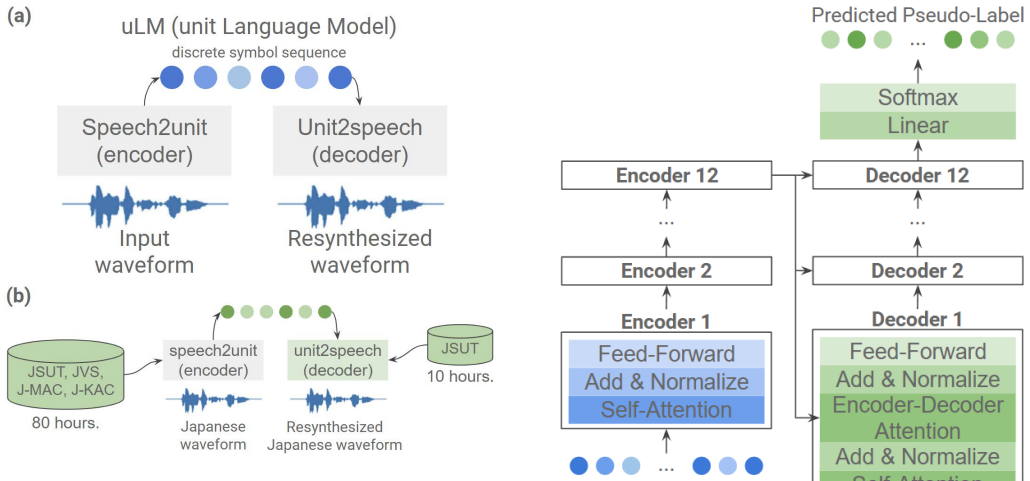
The central claim is that a text-to-token predictor trained on SSL-derived pseudo-labels can substitute for G2P conversion without losing the linguistic and paralinguistic information needed for natural synthesis. In practice, the predictor is a T5 (12+12 layers) fine-tuned on Japanese TTS corpora to map raw sentences to sequences of 500 ContentVec/k-means units; those units, with repeated symbols removed, are fed to a speaker-conditioned FastSpeech 2 trained to reconstruct mel-spectrograms. The paper's evidence is comparative: the proposed pipeline's synthesized speech matches the OpenJTalk-based G2P baseline on UTMOS, WARP-Q, and SDR, while the oracle (labels from the true audio) and the p
What carries the argument
The load-bearing object is the pseudo-language label: a phoneme-like discrete token obtained by k-means quantizing ContentVec SSL embeddings of speech into 500 units. These labels are meant to carry both linguistic content and paralinguistic cues (accent, intonation, speaker traits) that a conventional G2P output would not. The T5 encoder-decoder serves as the text-to-label transducer, and FastSpeech 2 is the spectral predictor that turns predicted labels into mel-spectrograms, with duration, pitch, energy, and speaker embedding as conditioning features; repeated-symbol removal in labels provides the shorter, non-repetitive sequences the synthesizer consumes.
Load-bearing premise
The claim rests on the 500-unit, de-duplicated token stream retaining enough duration, accent, and prosodic detail for FastSpeech 2 to synthesize naturally; the G2P baseline feeds those cues in explicitly, so if de-duplication discards timing information the token stream cannot be a full substitute.
What would settle it
Retrain the pipeline without removing repeated symbols and compare FastSpeech 2's predicted durations against TextGrid durations on a held-out JVS subset. If keeping repetitions yields substantially lower duration error or higher UTMOS, the de-duplication step is destroying the timing information the token stream is supposed to carry, and the claim that text-predicted labels match G2P's explicit inputs fails.
If this is right
- Building a TTS voice for a language needs no hand-written pronunciation rules, accent dictionaries, or morphological analyzers: the SSL encoder supplies supervision directly from raw audio.
- The token-based intermediate representation carries accent and prosody implicitly, so the synthesized speech can retain paralinguistic characteristics without an explicit accent-estimation module.
- Scaling to large audiobook or web corpora becomes feasible because text–audio pairs suffice for training, and only tokenization of the output units requires a language-specific choice.
- The same SSL-token pipeline can in principle be reused for other languages by swapping the text tokenizer (e.g., to byte-level tokenizers), although the paper only demonstrates Japanese.
- If the text-prediction step is nearly lossless, as the oracle-vs-proposed gap suggests, future quality gains should come from the spectral predictor rather than the G2P-replacement module.
Where Pith is reading between the lines
- The de-duplication of repeated tokens is the riskiest preprocessing choice: repetitions directly encode duration, so removing them may erase timing information that FastSpeech 2 then has to guess; a natural extension is to compare systems with and without de-duplication on duration prediction error.
- Because Chinese shares kanji with Japanese but has different phonology and no kana to disambiguate, the same T5 text-to-token idea could be tested on Chinese or on Japanese sentences with unusual name readings—the hardest cases for G2P-free mapping.
- The near-equality of oracle and proposed metrics suggests the bottleneck is SSL-token-to-speech reconstruction, not the text-to-token step; investing in a better spectral predictor or a higher-rate token codebook may improve the whole pipeline more than improving the T5.
- A multilingual version using mT5 or ByT5 tokenization, as the paper itself suggests, would test whether the approach's claimed scalability holds without Japanese-specific preprocessing.
Editorial analysis
A structured set of objections, weighed in public.
Referee Report
Summary. The paper proposes replacing the conventional G2P module in Japanese TTS with a T5-based predictor that maps mixed kanji/kana text directly to 'pseudo-language labels', defined as discrete tokens obtained from a ContentVec/k-means SSL pipeline. A FastSpeech 2 synthesizer is then trained on these labels. The authors compare three pipelines on 100 JVS utterances: a G2P baseline using OpenJTalk/TextGrid accent and duration features, an oracle using SSL tokens extracted from audio, and the proposed text-predicted token pipeline. Reported metrics include UER/CER for intelligibility, UTMOS for naturalness, and WARP-Q/SDR for acoustic quality. The paper concludes that the proposed method performs comparably to the G2P baseline.
Significance. If substantiated, the approach would be a valuable step toward G2P-free TTS for mixed-script languages, reducing reliance on pronunciation and accent dictionaries and enabling use of unlabeled speech. The inclusion of an oracle condition is a good experimental design choice that partially separates predictor error from synthesizer error. However, the evidence presented does not yet support the equivalence claim: intelligibility is materially worse (CER 21.28% vs 18.24%), naturalness is slightly lower, and the only direct label-level metric is a self-consistency measure. The paper also contains an internal contradiction about repeated-symbol removal and duration cues. With additional significance testing, prosodic fidelity checks, and clarification of the preprocessing, the central claim could be made defensible.
major comments (4)
- [Section IV (Preprocessing and duration cues)] The text states that 'a preprocessing step was applied to remove repeated symbols from the pseudo-language label sequences' and immediately adds that 'these repetitions can be used as cues to predict duration.' These statements are mutually inconsistent for the trained predictor: if repeated symbols are removed from the training targets, the T5 never learns to emit repetitions, so no repetition-based duration cue reaches FastSpeech 2. The G2P baseline receives duration and accent explicitly from TextGrid/accent dictionaries, whereas the proposed pipeline must recover these from token identity and FastSpeech 2's duration/pitch predictors. No accent-specific metric, minimal-pair test, or F0/duration analysis is reported, so the Section VI claim that the system retains 'natural linguistic and paralinguistic features, such as accents and intonations' is unsupported. Please clarify which prep
- [Section V, Table 2 (Statistical support for the central claim)] The abstract's 'matches the performance' and the conclusion's 'comparable performance' are stronger than the evidence. On only 100 test utterances, the proposed CER is 21.28% versus 18.24% for the baseline (a 16.7% relative increase), and UTMOS is 2.54 versus 2.59; no confidence intervals or significance tests are reported. Moreover, the oracle—which should be an upper bound—is not uniformly better than the proposed method: it has lower UTMOS (2.49 vs 2.54) despite a slightly lower CER (20.63 vs 21.28). This inversion suggests high variance or an uncontrolled confound (e.g., de-duplication affecting the oracle and proposed pipelines differently). Please report paired significance tests, effect sizes, and an explanation of the oracle/proposed inversion.
- [Section V.A (Evaluation of the pseudo-language labels)] The only direct evaluation of the pseudo-language labels, the reported UER (7.47%), compares T5 outputs to labels produced by the same ContentVec/k-means pipeline used to create the training targets. This is largely a self-consistency measure and does not establish that the labels encode phonemes, accents, or durations. The external metrics (Whisper CER, UTMOS, WARP-Q, SDR) evaluate the full synthesis pipeline, so they cannot attribute degradations to the label predictor versus the spectral predictor. To support the claim that SSL-derived tokens substitute for G2P output, please report an external measure of pseudo-label quality (e.g., phone error rate against a phonemic transcription, or accent/duration prediction accuracy) that is independent of the SSL pipeline.
- [Section VI (Acknowledged limitations)] The conclusion acknowledges that 'it is also necessary to individually assess the contributions of each input factor (e.g., duration, pitch) fed into FastSpeech 2' and that 'a broader and more diverse test dataset would allow for a more comprehensive and generalized analysis.' These admissions align with the concerns above, but they are listed as future work rather than as caveats on the current central claim. The claim of 'comparable performance' should be qualified to reflect that only global quality metrics were measured and that prosodic and duration fidelity were not directly validated.
minor comments (4)
- [Section IV / Table 1] The experimental setup is severely underspecified: T5 fine-tuning steps, batch size, learning rate; k-means training details; FastSpeech 2 configuration; vocoder choice; and the train/dev/test split are not given. This makes the results difficult to reproduce and the 100-utterance evaluation impossible to contextualize. Please add a reproducibility section or appendix.
- [Section V.A / Table 2] UER is not precisely defined, the phrase 'prior experiments' is vague, and Table 2's UER row has entries only under 'Proposed' with no baseline or oracle comparison. Clarify how UER is computed and why no comparison is reported.
- [Whole paper] Formatting inconsistencies: 'W ARP-Q' should be 'WARP-Q' in Table 2 and Section V.C; 'Fastspeech 2' should be 'FastSpeech 2' in the references; reference [22] for Whisper lacks publication venue and year formatting; and the conclusion's 'four currently used features' is ambiguous—specify the exact feature set used for each pipeline.
- [Section III] The claim that prior T5-based G2P work is 'constrained to alphabetic scripts' is correct, but the statement that they assume 'a clear one-to-one correspondence between characters and phonemes' is not accurate for typical sequence-to-sequence G2P models and should be rephrased to avoid overgeneralization.
Circularity Check
No significant circularity: predictions are evaluated on held-out data and external metrics; the internal duration-cue contradiction is a correctness issue, not circularity.
full rationale
The claimed derivation chain is not circular. The T5 pseudo-language label predictor is trained on text–discrete-token pairs derived from a speech SSL model and is evaluated on 100 held-out JVS utterances; UER measures how well the predictor reproduces those externally derived tokens, which is the standard supervised prediction error, not a fitted value renamed as a prediction. The central 'matches G2P' claim is supported by external benchmarks (Whisper CER, UTMOS, WARP-Q, SDR) comparing baseline, oracle, and proposed pipelines, so it does not reduce to the training objective. The load-bearing components (ContentVec, k-means, T5, FastSpeech 2, GSLM) are external published systems, and no uniqueness theorem or ansatz is imported from the authors' prior work. There is an internal inconsistency that should be flagged as a correctness/argumentation risk but not as circularity: Section IV states 'a preprocessing step was applied to remove repeated symbols from the pseudo-language label sequences' and then says 'these repetitions can be used as cues to predict duration.' If repetitions are removed from the training targets, the T5 cannot output them, so the duration-cue mechanism is void by the paper's own construction; indeed the conclusion admits that accentual information still needs to be integrated. This contradicts one explanatory rationale but does not make the evaluation equivalent to its inputs. No circular step meets the standard of Eq. X = Eq. Y by construction or fitted-input-called-prediction.
Axiom & Free-Parameter Ledger
free parameters (3)
- k-means vocabulary size =
500
- T5 encoder/decoder layers =
12
- repeated-symbol removal =
true
axioms (4)
- domain assumption ContentVec SSL representations and k-means quantization retain sufficient linguistic and paralinguistic information for speech synthesis.
- domain assumption T5 pretraining on large multilingual text transfers usefully to predicting arbitrary discrete speech tokens for Japanese mixed-script input.
- domain assumption Objective metrics (Whisper CER, UTMOS, WARP-Q, SDR) are valid proxies for human intelligibility, naturalness, and acoustic quality.
- domain assumption The OpenJTalk/Mecab/Marine G2P baseline is a fair and correctly implemented comparison.
invented entities (1)
-
pseudo-language labels
no independent evidence
Cite this review
Pith. "Pith review of MixedG2P-T5: G2P-free Speech Synthesis for Mixed-script texts using Speech Self-Supervised Learning and Language Model." pith.science (2026). https://pith.science/paper/6666RP62
@misc{pith2026250901391,
  author       = {Pith},
  title        = {Pith review of: MixedG2P-T5: G2P-free Speech Synthesis for Mixed-script texts using Speech Self-Supervised Learning and Language Model},
  year         = {2026},
  howpublished = {\url{https://pith.science/paper/6666RP62}},
  note         = {Machine review of arXiv:2509.01391}
}
read the original abstract
This study presents a novel approach to voice synthesis that can substitute the traditional grapheme-to-phoneme (G2P) conversion by using a deep learning-based model that generates discrete tokens directly from speech. Utilizing a pre-trained voice SSL model, we train a T5 encoder to produce pseudo-language labels from mixed-script texts (e.g., containing Kanji and Kana). This method eliminates the need for manual phonetic transcription, reducing costs and enhancing scalability, especially for large non-transcribed audio datasets. Our model matches the performance of conventional G2P-based text-to-speech systems and is capable of synthesizing speech that retains natural linguistic and paralinguistic features, such as accents and intonations.
Figures

Reference graph
Works this paper leans on
-
[1]
A Brief Overview of Unsupervised Neural Speech Representation Learning
L. Borgholt, J. D. Havtorn, J. Edin, L. Maaløe, and C. Igel, “A brief overview of unsupervised neural speech representation learning,” CoRR, vol. abs/2203.01829,
work page internal anchor Pith review Pith/arXiv arXiv
-
[2]
Natural TTS synthesis by conditioning Wavenet on mel-spectrogram predictions,
J. Shen, R. Pang, R. J. Weiss, et al. , “Natural TTS synthesis by conditioning Wavenet on mel-spectrogram predictions,” in 2018 IEEE International Conference on Acoustics, Speech and Signal Processing , 2018, pp. 4779–4783
work page 2018
-
[3]
Conditional variational autoencoder with adversarial learning for end-to-end text-to-speech,
J. Kim, J. Kong, and J. Son, “Conditional variational autoencoder with adversarial learning for end-to-end text-to-speech,” in Proceedings of the 38th Interna- tional Conference on Machine Learning , vol. 139, 2021, pp. 5530–5540
work page 2021
-
[4]
On generative spoken language modeling from raw audio,
K. Lakhotia, E. Kharitonov, W.-N. Hsu, et al. , “On generative spoken language modeling from raw audio,” Transactions of the Association for Computational Lin- guistics, vol. 9, pp. 1336–1354, 2021
work page 2021
-
[5]
Wav2vec 2.0: A framework for self-supervised learning of speech representations,
A. Baevski, Y . Zhou, A. Mohamed, and M. Auli, “Wav2vec 2.0: A framework for self-supervised learning of speech representations,” in Advances in Neural Infor- mation Processing Systems , vol. 33, 2020, pp. 12 449– 12 460
work page 2020
-
[6]
HuBERT: Self- supervised speech representation learning by masked prediction of hidden units,
W.-N. Hsu, B. Bolte, Y .-H. H. Tsai, K. Lakhotia, R. Salakhutdinov, and A. Mohamed, “HuBERT: Self- supervised speech representation learning by masked prediction of hidden units,” IEEE/ACM Transactions on Audio, Speech, and Language Processing , vol. 29, pp. 3451–3460, 2021
work page 2021
-
[7]
A Unified Accent Estimation Method Based on Multi-Task Learn- ing for Japanese Text-to-Speech,
B. Park, R. Yamamoto, and K. Tachibana, “A Unified Accent Estimation Method Based on Multi-Task Learn- ing for Japanese Text-to-Speech,” in Proc. Interspeech 2022, 2022, pp. 1931–1935
work page 2022
-
[8]
Reazonspeech: A free and massive corpus for Japanese ASR,
Y . Yue, M. Daijiro, and F. Seiji, “Reazonspeech: A free and massive corpus for Japanese ASR,” in Proceedings of Annual Meeting of the Association for NLP , 2023, 1134–1139
work page 2023
-
[9]
Exploring the limits of transfer learning with a unified text-to- text transformer,
C. Raffel, N. M. Shazeer, A. Roberts, et al., “Exploring the limits of transfer learning with a unified text-to- text transformer,” J. Mach. Learn. Res. , vol. 21, 140:1– 140:67, 2019
work page 2019
-
[10]
JSUT corpus: Free large-scale Japanese speech corpus for end- to-end speech synthesis,
R. Sonobe, S. Takamichi, and H. Saruwatari, “JSUT corpus: Free large-scale Japanese speech corpus for end- to-end speech synthesis,” CoRR, vol. abs/1711.00354,
-
[11]
JVS corpus: Free Japanese multi- speaker voice corpus,
S. Takamichi, K. Mitsui, Y . Saito, T. Koriyama, N. Tanji, and H. Saruwatari, “JVS corpus: Free Japanese multi- speaker voice corpus,” CoRR, vol. abs/1908.06248,
Pith/arXiv arXiv 1908
-
[12]
Audio- book speech synthesis conditioned by cross-sentence context-aware word embeddings,
W. Nakata, T. Koriyama, S. Takamichi, et al. , “Audio- book speech synthesis conditioned by cross-sentence context-aware word embeddings,” in Proc. The 11th ISCA SSW , 2021
work page 2021
-
[13]
J-MAC: Japanese multi-speaker audiobook corpus for speech synthesis,
S. Takamichi, N. Wataru, T. Naoko, and S. Hiroshi, “J-MAC: Japanese multi-speaker audiobook corpus for speech synthesis,” in Interspeech 2022 , ISCA, 2022, pp. 2358–2362
work page 2022
-
[14]
JSSS: free japanese speech corpus for summarization and simplification,
S. Takamichi, M. Komachi, N. Tanji, and H. Saruwatari, “JSSS: free japanese speech corpus for summarization and simplification,” CoRR, vol. abs/2010.01793, 2020. arXiv: 2010.01793
Pith/arXiv arXiv 2010
-
[15]
T5g2p: Us- ing text-to-text transfer transformer for grapheme-to- phoneme conversion,
M. ˇRez´aˇckov´a, J. ˇSvec, and D. Tihelka, “T5g2p: Us- ing text-to-text transfer transformer for grapheme-to- phoneme conversion,” in Interspeech 2021, 2021, pp. 6– 10
work page 2021
-
[16]
SpeechT5: Unified- modal encoder-decoder pre-training for spoken language processing,
J. Ao, R. Wang, L. Zhou, et al. , “SpeechT5: Unified- modal encoder-decoder pre-training for spoken language processing,” in Proceedings of the 60th Annual Meeting of the Association for Computational Linguistics , vol. 1, Dublin, Ireland, May 2022, pp. 5723–5738
work page 2022
-
[17]
Neural ma- chine translation for multilingual grapheme-to-phoneme conversion,
A. Sokolov, T. Rohlin, and A. Rastrow, “Neural ma- chine translation for multilingual grapheme-to-phoneme conversion,” in Interspeech 2019, 2019, pp. 2065–2069
work page 2019
-
[18]
K. Vesik, M. Abdul-Mageed, and M. Silfverberg, “One model to pronounce them all: Multilingual grapheme- to-phoneme conversion with a transformer ensemble,” in Proceedings of the 17th SIGMORPHON Workshop on Computational Research in Phonetics, Phonology, and Morphology , Jul. 2020, pp. 146–152
work page 2020
-
[19]
Byt5 model for mas- sively multilingual grapheme-to-phoneme conversion,
J. Zhu, C. Zhang, and D. Jurgens, “Byt5 model for mas- sively multilingual grapheme-to-phoneme conversion,” in Interspeech 2022, 2022, pp. 446–450
work page 2022
-
[20]
ContentVec: An improved self-supervised speech representation by dis- entangling speakers,
K. Qian, Y . Zhang, H. Gao, et al. , “ContentVec: An improved self-supervised speech representation by dis- entangling speakers,” in Proceedings of the 39th In- ternational Conference on Machine Learning , 2022, pp. 18 003–18 017. 5
work page 2022
-
[21]
Fastspeech 2: Fast and high-quality end-to-end text to speech,
Y . Ren, C. Hu, X. Tan, et al. , “Fastspeech 2: Fast and high-quality end-to-end text to speech,” ArXiv, vol. abs/2006.04558, 2020
Pith/arXiv arXiv 2006
-
[22]
A. Radford, K. Jong Wook, X. Tao, B. Greg, M. Chris- tine, and S. Ilya, Robust speech recognition via large- scale weak supervision. https://cdn.openai.com/papers/ whisper.pdf, 2022
work page 2022
-
[23]
UTMOS: UTokyo-SaruLab system for VoiceMOS challenge 2022,
T. Saeki, D. Xin, W. Nakata, T. Koriyama, S. Takamichi, and H. Saruwatari, “UTMOS: UTokyo-SaruLab system for VoiceMOS challenge 2022,” in Interspeech 2022 , ISCA, 2022, pp. 4521–4525
work page 2022
-
[24]
Speech quality assessment with W ARP-Q: From sim- ilarity to subsequence dynamic time warp cost,
W. A. Jassim, J. Skoglund, M. Chinen, and A. Hines, “Speech quality assessment with W ARP-Q: From sim- ilarity to subsequence dynamic time warp cost,” IET Signal Processing, vol. 16, no. 9, 1050––1070, 2022
work page 2022
-
[25]
A. Rix, J. Beerends, M. Hollier, and A. Hekstra, “Per- ceptual evaluation of speech quality (PESQ)-a new method for speech quality assessment of telephone networks and codecs,” in 2001 IEEE International Con- ference on Acoustics, Speech, and Signal Processing , vol. 2, 2001, 749–752 vol.2
work page 2001
-
[26]
mT5: A mas- sively multilingual pre-trained text-to-text transformer,
X. Linting, C. Noah, R. Adam, et al. , “mT5: A mas- sively multilingual pre-trained text-to-text transformer,” in Proceedings of the 2021 Conference of the North American Chapter of the Association for Computational Linguistics, 2021, pp. 5206–5210
work page 2021
-
[27]
ByT5: Towards a token-free future with pre-trained byte-to-byte models,
X. Linting, B. Aditya, C. Noah, et al., “ByT5: Towards a token-free future with pre-trained byte-to-byte models,” in TACL 2022, 2021, pp. 5206–5210. 6
work page 2022
This paper was first reviewed by deepseek-v4-flash on August 5, 2026.
discussion (0)
Sign in with ORCID, Apple, or X to comment. Anyone can read and Pith papers without signing in.