REVIEW 4 major objections 6 minor 60 references
The paper introduces Neural Scene Designer (NSD), a diffusion-based framework that edits or inpaints a specified image region so the new content matches both the user's text description and the surrounding scene's style, reporting state-of-
Reviewed by Pith at T0; open to challenge. T0 means a machine referee read the full paper against a public rubric. the ladder, T0–T4 →
NSD uses a contrastively learned style embedding from the input image itself, fed through a second cross-attention branch, to make diffusion-based inpainting results match the surrounding scene's style.
T0 review reviewed 2026-08-05 challenge →
load-bearing objection Solid systems paper for style-consistent inpainting with a useful benchmark and dataset, but the SOTA claim needs variance reporting and a less-aligned metric before I'd fully trust the numbers. the 4 major comments →
Neural Scene Designer: Self-Styled Semantic Image Manipulation
The pith
A machine-rendered reading of the paper's core claim, the machinery that carries it, and where it could break.
The reading
Core claim
The paper's central claim is that semantic control and stylistic consistency are complementary, not competing, objectives in local image manipulation, provided the model separates them. NSD uses two parallel cross-attention mechanisms: one conditions the diffusion U-Net on CLIP text embeddings for semantic intent, the other on a style embedding extracted from the unmasked scene. That style embedding is produced by the Progressive Self-style Representational Learning (PSRL) module, trained on the premise that non-overlapping crops of the same image share a style while crops from different images do not. This gives instance-level, semantic-free supervision via a contrastive loss. The paper rep
What carries the argument
The central mechanism is the Progressive Self-style Representational Learning (PSRL) module paired with dual parallel cross-attention. PSRL first pre-trains a VGG-based encoder by matching second-order statistics (mean and variance) of random crops from the same image, then refines it with a contrastive loss that pulls crops of the same image together and pushes crops of a different image apart. The resulting style embedding is injected as key and value into a dedicated cross-attention layer, while text embeddings go through a parallel layer; their outputs are summed (z = z_sem + λ·z_sty, with λ=1). A reference network that mirrors the U-Net but omits text cross-attention concatenates the no
Load-bearing premise
The whole style module rests on the premise that every region of one image shares a single style and any two different images have different styles; if an image mixes several styles, the learned embedding will be an average that matches no local style.
What would settle it
Take an image with two visibly different styles in different zones (for example, a minimalist white half and an industrial dark half), mask an object inside one zone, and run NSD with a neutral prompt. If the generated patch's style distance to its immediate local zone is larger than its style distance to the image-wide average, the core consistency assumption fails; the paper's own limitation section predicts such an 'average' style for mixed-aesthetic images. A small benchmark of mixed-style images with per-zone style labels would settle this.
If this is right
- Text-guided inpainting can carry explicit style conditioning without retraining the base diffusion model, so users can replace an object while keeping the room's palette and texture.
- Because PSRL needs no manual style labels, the same recipe can be applied to new domains simply by collecting unlabeled images and cropping them.
- The new S3IMIndoorData benchmark provides a standardized way to measure style consistency in indoor scene manipulation, using CSD, HPS, and IR alongside semantic and quality metrics.
- The dual-attention ablation suggests that mixing style features into the text-conditioning manifold degrades fidelity, making separate conditioning pathways a design principle for future style-aware editors.
- Gains concentrate on style metrics while background PSNR is preserved, indicating style consistency need not trade off against content retention.
Where Pith is reading between the lines
- An extension the paper leaves implicit is region-aware style extraction: instead of one global embedding per image, the model could learn which local style zone a mask falls into and condition on that zone, directly addressing the mixed-aesthetic images the limitations section flags.
- The contrastive premise that different images have distinct styles may hurt when the dataset contains repeated styles across images; one could test whether clustering-aware or harder negative mining improves the embedding.
- Since CSD, HPS, and IR are themselves learned or feature-based models, measured style gains may partly reflect alignment with those models' biases; a perceptual study using mixed-style stimuli would test the practical claim more directly.
- Patch size and crop count are fixed (128×128, N=10) without a sweep; larger patches would capture more layout but more semantics, smaller patches more texture, leaving a testable hyperparameter space.
Editorial analysis
A structured set of objections, weighed in public.
Referee Report
Summary. The paper introduces the task of Self-Styled Semantic Image Manipulation (S3IM), in which a specified image region is edited or inpainted so that the generated content is both semantically aligned with a text prompt and stylistically consistent with the unmasked context. To this end, the authors propose Neural Scene Designer (NSD), built on Stable Diffusion with two parallel cross-attention mechanisms that separately inject text and style embeddings, plus a reference network that preserves the unmasked regions. Style embeddings are produced by a Progressive Self-style Representational Learning (PSRL) module, trained with second-order statistics followed by a contrastive objective that treats patches from the same image as positives and patches from different images as negatives. The paper also contributes a benchmark with three evaluation settings, style-related metrics (CSD, HPS, IR), a new indoor dataset (S3IMIndoorData), ablations, and a user study. The authors report state-of-the-art results across all metrics in Tables I-III.
Significance. The paper addresses a real gap: text-guided inpainting methods often ignore stylistic consistency, and the proposed framework is a reasonable architectural response. The PSRL idea of learning instance-level, semantic-independent style representations from within-image patch consistency is interesting and the contrastive formulation is clearly described. The new benchmark and indoor dataset are potentially useful community resources, and the paper ships a claim of code/model/dataset release. The method is not internally circular in the sense that the final edited images are generated by a diffusion model rather than directly optimized against the test metric. However, the central empirical claim - state-of-the-art performance across all metrics - rests on single-run point estimates with small margins, and the primary style metric overlaps in spirit with the objective used to train the style representation. The user study is reported only at the level of aggregate preference bars. If the reported advantages survive independent and statistically grounded evaluation, the contribution would be solid. As presented, the evidence is not yet sufficient to support the SOTA claim.
major comments (4)
- [Sec. V-B, Tables I-III] Every quantitative comparison is a single point estimate with no standard deviation, no number of inference seeds, and no significance test. Several gaps are tiny: Table I reports CSD 49.18 vs 48.54, HPS 27.25 vs 26.76, IR 12.06 vs 11.98, CLIP Sim 26.63 vs 26.63, AS 6.55 vs 6.54, and PSNR 21.57 vs 21.55. Since diffusion sampling is stochastic and the baselines use official checkpoints, these margins may be within run-to-run noise. Please report mean plus/minus standard deviation over at least three to five seeds for all methods and provide a statistical test or confidence intervals, especially for the style and semantic metrics that drive the SOTA claim.
- [Sec. IV-C and Sec. III-B, Eqs. (9)-(10)] The primary style metric, CSD, measures feature similarity between the generated patch and its context. PSRL is trained with a contrastive loss that explicitly maximizes similarity between patches from the same image and minimizes similarity between patches from different images (Eq. 9) and uses the resulting representation for style injection. There is a meaningful risk that the reported CSD gains partly reflect alignment between the PSRL-trained representation and the style-similarity criterion encoded in CSD, rather than an independent perceptual improvement. The paper should validate the style-consistency claim with an independent style metric that does not share this training objective, and/or with a more rigorous human evaluation (see next comment).
- [Sec. V-D, Figs. 7-8] The user study is the most direct evidence for the claimed style consistency, but the description is minimal: 25 users, 50 sets, three criteria, and aggregate preference bars. There is no information about the number of images per condition, the presentation or interface, whether users were shown all models side by side, inter-rater agreement, or any statistical significance measure. Given the small automatic-metric margins, the user study is load-bearing and needs a full protocol description plus error bars or a paired significance test across users.
- [Sec. III-B, Assumption Validation; Sec. VI] PSRL is built on the premise that different regions within one scene share a consistent style and regions across scenes do not. The validation is a single qualitative dimensionality-reduction figure (Fig. 4), and Sec. VI itself concedes that mixed-aesthetic images lead to an 'average' style. Since this premise is load-bearing for the style representation, the paper should quantify how often the assumption holds in the evaluation datasets (e.g., intra- vs inter-image patch feature distances), and should provide failure examples or a measure of the fraction of benchmark samples for which the global-style assumption is violated. This would clarify the scope of the claimed improvement.
minor comments (6)
- [Sec. II-B] Typo: 'PowerPoint' should be 'PowerPaint' in the text discussing [60].
- [References] References [35] and [36] are identical (both cite InstantStyle-Plus); one should be removed or corrected to the intended different work.
- [Fig. 4] The dimensionality-reduction visualization does not state which reduction method is used (e.g., PCA, t-SNE, UMAP) or how many images or patches are shown. This makes the assumption validation difficult to assess.
- [Sec. III-B, Eq. (8)] The notation in Eq. (8) is confusing: the superscripted indices on the feature set should be defined consistently with Eq. (9), and the roles of i and j should be stated explicitly (e.g., two non-overlapping region indices within the same image).
- [Sec. V-A and Sec. IV-B] The paper states S3IMIndoorData contains about 40,000 training and 4,000 test samples, but later says 35,000 interior-design images were scraped. Clarify how the 40k training samples arise (e.g., augmentation, additional sources) and how the test set is constructed.
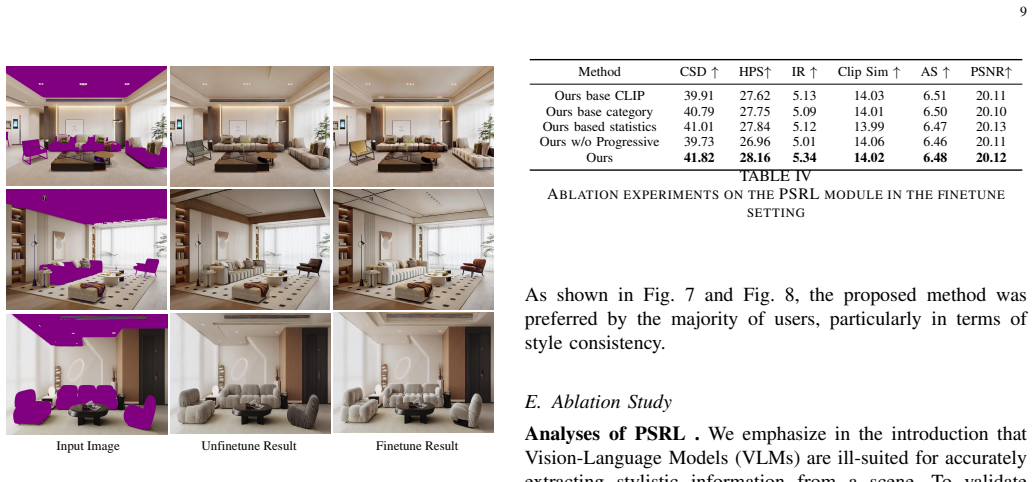
- [Table IV] The row labeled 'Ours base category' is referred to in the text as 'Ours w/ Category Style'; use consistent naming for clarity.
Circularity Check
No significant circularity: NSD's style encoder is trained with its own contrastive objective and evaluated with external metrics; reported limitations are scope conditions, not circular steps.
full rationale
The central derivation is self-contained. PSRL (Eqs. 7-10) trains a VGG-based encoder plus learnable projector with second-order statistics and an InfoNCE-style contrastive loss operating on same-image patches as positives and cross-image patches as negatives. This is a genuine representation-learning objective; it is not fitted to any evaluation metric. The style metric CSD is an external measure (Somepalli et al. [31]) computed on generated versus context patches, and the paper does not claim CSD uses PSRL's encoder. HPS and IR are external reward models. The generation model is trained with the standard diffusion noise-prediction loss (Eq. 4), not with a loss that directly minimizes CSD or maximizes HPS/IR. Therefore the state-of-the-art table entries are empirical outcomes rather than consequences of the training definition. The apparent match between PSRL's objective and CSD's notion of style is conceptual transfer, not by-construction equivalence. The only self-citations ([5], [8], [20]) are background references on contrastive learning and object composition and are not load-bearing for the core claim. The Sec. VI limitation about mixed-aesthetic images producing an 'average' style is an acknowledged boundary condition of the same-image-style assumption, not a circular step. Concerns that reported margins are small and lack significance testing are statistical-evidence concerns, not circularity, and do not raise the circularity score.
Axiom & Free-Parameter Ledger
free parameters (4)
- lambda =
1
- tau =
0.07
- patch size =
128x128
- N patches =
10
axioms (5)
- domain assumption Regions within the same scene share a consistent style; regions in different images display distinct styles.
- domain assumption Second-order statistics (mean and variance) of VGG features are sufficient to initialize a style representation.
- domain assumption A pre-trained VGG network can extract foundational style features that are useful for instance-level contrastive learning.
- domain assumption Frozen Stable Diffusion with added zero-convolution branches preserves generative quality while learning style.
- domain assumption CSD, HPS, and ImageReward are valid proxies for style consistency.
Cite this review
Pith. "Pith review of Neural Scene Designer: Self-Styled Semantic Image Manipulation." pith.science (2026). https://pith.science/paper/LZ7Z2PP4
@misc{pith2026250901405,
  author       = {Pith},
  title        = {Pith review of: Neural Scene Designer: Self-Styled Semantic Image Manipulation},
  year         = {2026},
  howpublished = {\url{https://pith.science/paper/LZ7Z2PP4}},
  note         = {Machine review of arXiv:2509.01405}
}
read the original abstract
Maintaining stylistic consistency is crucial for the cohesion and aesthetic appeal of images, a fundamental requirement in effective image editing and inpainting. However, existing methods primarily focus on the semantic control of generated content, often neglecting the critical task of preserving this consistency. In this work, we introduce the Neural Scene Designer (NSD), a novel framework that enables photo-realistic manipulation of user-specified scene regions while ensuring both semantic alignment with user intent and stylistic consistency with the surrounding environment. NSD leverages an advanced diffusion model, incorporating two parallel cross-attention mechanisms that separately process text and style information to achieve the dual objectives of semantic control and style consistency. To capture fine-grained style representations, we propose the Progressive Self-style Representational Learning (PSRL) module. This module is predicated on the intuitive premise that different regions within a single image share a consistent style, whereas regions from different images exhibit distinct styles. The PSRL module employs a style contrastive loss that encourages high similarity between representations from the same image while enforcing dissimilarity between those from different images. Furthermore, to address the lack of standardized evaluation protocols for this task, we establish a comprehensive benchmark. This benchmark includes competing algorithms, dedicated style-related metrics, and diverse datasets and settings to facilitate fair comparisons. Extensive experiments conducted on our benchmark demonstrate the effectiveness of the proposed framework.
Figures




Reference graph
Works this paper leans on
-
[1]
Region filling and object removal by exemplar-based image inpaint- ing
Criminisi Antonio, P ´erez Patrick, and Toyama Kentaro. Region filling and object removal by exemplar-based image inpaint- ing. IEEE Transactions on image processing , 13(9):1200–1212, 2004
work page 2004
-
[2]
Omri Avrahami, Ohad Fried, and Dani Lischinski. Blended latent diffusion. ACM transactions on graphics (TOG) , 42(4): 1–11, 2023. 11
work page 2023
-
[3]
Artistic style transfer with internal-external learning and contrastive learning
Haibo Chen, Zhizhong Wang, Huiming Zhang, Zhiwen Zuo, Ailin Li, Wei Xing, Dongming Lu, et al. Artistic style transfer with internal-external learning and contrastive learning. Advances in Neural Information Processing Systems , 34:26561– 26573, 2021
work page 2021
-
[4]
A simple framework for contrastive learning of visual representations
Ting Chen, Simon Kornblith, Mohammad Norouzi, and Geof- frey Hinton. A simple framework for contrastive learning of visual representations. In International conference on machine learning, pages 1597–1607. PMLR, 2020
work page 2020
-
[5]
Learning adaptive spatial coherent correlations for speech-preserving facial expression manipulation
Tianshui Chen, Jianman Lin, Zhijing Yang, Chunmei Qing, and Liang Lin. Learning adaptive spatial coherent correlations for speech-preserving facial expression manipulation. In Proceed- ings of the IEEE/CVF Conference on Computer Vision and Pattern Recognition, pages 7267–7276, 2024
work page 2024
-
[6]
Heterogeneous semantic transfer for multi- label recognition with partial labels
Tianshui Chen, Tao Pu, Lingbo Liu, Yukai Shi, Zhijing Yang, and Liang Lin. Heterogeneous semantic transfer for multi- label recognition with partial labels. International Journal of Computer Vision, 132:6091–6106, 2024
work page 2024
-
[7]
Dynamic correlation learning and regularization for multi-label confidence calibration
Tianshui Chen, Weihang Wang, Tao Pu, Jinghui Qin, Zhijing Yang, Jie Liu, and Liang Lin. Dynamic correlation learning and regularization for multi-label confidence calibration. IEEE Transactions on Image Processing , 2024
work page 2024
-
[8]
Tianshui Chen, Jianman Lin, Zhijing Yang, Chumei Qing, Yukai Shi, and Liang Lin. Contrastive decoupled representation learn- ing and regularization for speech-preserving facial expression manipulation. International Journal of Computer Vision , pages 1–17, 2025
work page 2025
-
[9]
Jiwoo Chung, Sangeek Hyun, and Jae-Pil Heo. Style injection in diffusion: A training-free approach for adapting large-scale diffusion models for style transfer. In Proceedings of the IEEE/CVF conference on computer vision and pattern recog- nition, pages 8795–8805, 2024
work page 2024
-
[10]
Latentpaint: Image inpainting in latent space with diffusion models
Ciprian Corneanu, Raghudeep Gadde, and Aleix M Martinez. Latentpaint: Image inpainting in latent space with diffusion models. In Proceedings of the IEEE/CVF Winter Conference on Applications of Computer Vision , pages 4334–4343, 2024
work page 2024
-
[11]
Context adaptive network for image inpainting
Ye Deng, Siqi Hui, Sanping Zhou, Wenli Huang, and Jinjun Wang. Context adaptive network for image inpainting. IEEE Transactions on Image Processing , 2023
work page 2023
-
[12]
Causal deciphering and inpainting in spatio- temporal dynamics via diffusion model
Yifan Duan, Jian Zhao, pengcheng, Junyuan Mao, Hao Wu, Jingyu Xu, Shilong Wang, Caoyuan Ma, Kai Wang, Kun Wang, and Xuelong Li. Causal deciphering and inpainting in spatio- temporal dynamics via diffusion model. In Advances in Neural Information Processing Systems, pages 107604–107632. Curran Associates, Inc., 2024
work page 2024
-
[13]
Image style transfer using convolutional neural networks
Leon A Gatys, Alexander S Ecker, and Matthias Bethge. Image style transfer using convolutional neural networks. In Proceed- ings of the IEEE conference on computer vision and pattern recognition, pages 2414–2423, 2016
work page 2016
-
[14]
Momentum contrast for unsupervised visual repre- sentation learning
Kaiming He, Haoqi Fan, Yuxin Wu, Saining Xie, and Ross Girshick. Momentum contrast for unsupervised visual repre- sentation learning. In Proceedings of the IEEE/CVF conference on computer vision and pattern recognition , pages 9729–9738, 2020
work page 2020
-
[15]
Classifier-free diffusion guid- ance
Jonathan Ho and Tim Salimans. Classifier-free diffusion guid- ance. arXiv preprint arXiv:2207.12598 , 2022
Pith/arXiv arXiv 2022
-
[16]
Brushnet: A plug-and-play image inpainting model with decomposed dual-branch diffusion, 2024
Xuan Ju, Xian Liu, Xintao Wang, Yuxuan Bian, Ying Shan, and Qiang Xu. Brushnet: A plug-and-play image inpainting model with decomposed dual-branch diffusion, 2024
work page 2024
-
[17]
Masked vision and language modeling for multi-modal representation learning
Gukyeong Kwon, Zhaowei Cai, Avinash Ravichandran, Erhan Bas, Rahul Bhotika, and Stefano Soatto. Masked vision and language modeling for multi-modal representation learning. arXiv preprint arXiv:2208.02131 , 2022
Pith/arXiv arXiv 2022
-
[18]
Prior guided gan based semantic inpainting
Avisek Lahiri, Arnav Kumar Jain, Sanskar Agrawal, Pabitra Mi- tra, and Prabir Kumar Biswas. Prior guided gan based semantic inpainting. In Proceedings of the IEEE/CVF conference on computer vision and pattern recognition , pages 13696–13705, 2020
work page 2020
-
[19]
Yuanman Li, Liangpei Hu, Li Dong, Haiwei Wu, Jinyu Tian, Jiantao Zhou, and Xia Li. Transformer-based image inpaint- ing detection via label decoupling and constrained adversarial training. IEEE Transactions on Circuits and Systems for Video Technology, 2023
work page 2023
-
[20]
Geometry-Editable and Appearance-Preserving Object Compositon
Jianman Lin, Haojie Li, Chunmei Qing, Zhijing Yang, Liang Lin, and Tianshui Chen. Geometry-editable and appearance-preserving object compositon. arXiv preprint arXiv:2505.20914, 2025
work page internal anchor Pith review Pith/arXiv arXiv 2025
-
[21]
Stylecrafter: Enhancing stylized text-to-video generation with style adapter
Gongye Liu, Menghan Xia, Yong Zhang, Haoxin Chen, Jinbo Xing, Xintao Wang, Yujiu Yang, and Ying Shan. Stylecrafter: Enhancing stylized text-to-video generation with style adapter. arXiv preprint arXiv:2312.00330 , 2023
Pith/arXiv arXiv 2023
-
[22]
Pd-gan: Probabilistic diverse gan for image inpainting
Hongyu Liu, Ziyu Wan, Wei Huang, Yibing Song, Xintong Han, and Jing Liao. Pd-gan: Probabilistic diverse gan for image inpainting. In Proceedings of the IEEE/CVF conference on computer vision and pattern recognition , pages 9371–9381, 2021
work page 2021
-
[23]
Repaint: Inpainting using denoising diffusion probabilistic models
Andreas Lugmayr, Martin Danelljan, Andres Romero, Fisher Yu, Radu Timofte, and Luc Van Gool. Repaint: Inpainting using denoising diffusion probabilistic models. In Proceedings of the IEEE/CVF conference on computer vision and pattern recognition, pages 11461–11471, 2022
2022
-
[24]
Hd-painter: high-resolution and prompt-faithful text-guided image inpainting with diffusion models
Hayk Manukyan, Andranik Sargsyan, Barsegh Atanyan, Zhangyang Wang, Shant Navasardyan, and Humphrey Shi. Hd-painter: high-resolution and prompt-faithful text-guided image inpainting with diffusion models. arXiv preprint arXiv:2312.14091, 2023
Pith/arXiv arXiv 2023
-
[25]
Improved denoising diffusion probabilistic models
Alexander Quinn Nichol and Prafulla Dhariwal. Improved denoising diffusion probabilistic models. In International con- ference on machine learning , pages 8162–8171. PMLR, 2021
work page 2021
-
[26]
Context encoders: Feature learning by inpainting
Deepak Pathak, Philipp Krahenbuhl, Jeff Donahue, Trevor Dar- rell, and Alexei A Efros. Context encoders: Feature learning by inpainting. In Proceedings of the IEEE conference on computer vision and pattern recognition , pages 2536–2544, 2016
work page 2016
-
[27]
Image inpainting with local and global refinement
Weize Quan, Ruisong Zhang, Yong Zhang, Zhifeng Li, Jue Wang, and Dong-Ming Yan. Image inpainting with local and global refinement. IEEE Transactions on Image Processing , 31: 2405–2420, 2022
work page 2022
-
[28]
Learning transferable visual models from natural language supervision
Alec Radford, Jong Wook Kim, Chris Hallacy, Aditya Ramesh, Gabriel Goh, Jack Agarwal, et al. Learning transferable visual models from natural language supervision. In International conference on machine learning , pages 8748–8763. PMLR, 2021
work page 2021
-
[29]
High-resolution image synthesis with latent diffusion models
Robin Rombach, Andreas Blattmann, Dominik Lorenz, Patrick Esser, and Bj ¨orn Ommer. High-resolution image synthesis with latent diffusion models. In Proceedings of the IEEE/CVF conference on computer vision and pattern recognition , pages 10684–10695, 2022
work page 2022
-
[30]
Laion- 5b: An open large-scale dataset for training next generation image-text models
Christoph Schuhmann, Romain Beaumont, Richard Vencu, Cade Gordon, Ross Wightman, Mitchell Cherti, et al. Laion- 5b: An open large-scale dataset for training next generation image-text models. Advances in Neural Information Processing Systems, 35:25278–25294, 2022
work page 2022
-
[31]
Measuring style similarity in diffusion models
Gowthami Somepalli, Anubhav Gupta, Kamal Gupta, Shramay Palta, Micah Goldblum, Jonas Geiping, Abhinav Shrivastava, and Tom Goldstein. Measuring style similarity in diffusion models. arXiv preprint arXiv:2404.01292 , 2024
Pith/arXiv arXiv 2024
-
[32]
Denoising diffusion implicit models
Jiaming Song, Chenlin Meng, and Stefano Ermon. Denoising diffusion implicit models. arXiv preprint arXiv:2010.02502 , 2020
Pith/arXiv arXiv 2010
-
[33]
Resolution-robust large mask inpainting with fourier convolu- tions
Roman Suvorov, Elizaveta Logacheva, Anton Mashikhin, Anas- tasia Remizova, Arsenii Ashukha, Aleksei Silvestrov, Naejin Kong, Harshith Goka, Kiwoong Park, and Victor Lempitsky. Resolution-robust large mask inpainting with fourier convolu- tions. In Proceedings of the IEEE/CVF winter conference on applications of computer vision , pages 2149–2159, 2022
work page 2022
-
[34]
Attention is all you need
A Vaswani. Attention is all you need. Advances in Neural Information Processing Systems , 2017
2017
-
[36]
Instantstyle-plus: Style transfer with content-preserving in text-to-image generation
Haofan Wang, Peng Xing, Renyuan Huang, Hao Ai, Qixun Wang, and Xu Bai. Instantstyle-plus: Style transfer with content-preserving in text-to-image generation. arXiv preprint arXiv:2407.00788, 2024
Pith/arXiv arXiv 2024
-
[37]
Dynamic selection network for image inpainting
Ning Wang, Yipeng Zhang, and Lefei Zhang. Dynamic selection network for image inpainting. IEEE Transactions on Image Processing, 30:1784–1798, 2021
work page 2021
-
[38]
Imagen editor and editbench: Advancing and evaluating text-guided image inpainting
Su Wang, Chitwan Saharia, Ceslee Montgomery, Jordi Pont- Tuset, Shai Noy, Stefano Pellegrini, Yasumasa Onoe, Sarah Laszlo, David J Fleet, Radu Soricut, et al. Imagen editor and editbench: Advancing and evaluating text-guided image inpainting. In Proceedings of the IEEE/CVF conference on computer vision and pattern recognition , pages 18359–18369, 2023
work page 2023
-
[39]
Cap-vstnet: content affinity preserved versatile style transfer
Linfeng Wen, Chengying Gao, and Changqing Zou. Cap-vstnet: content affinity preserved versatile style transfer. In Proceedings of the IEEE/CVF Conference on Computer Vision and Pattern Recognition, pages 18300–18309, 2023
work page 2023
-
[40]
Godiva: Generating open-domain videos from natural descriptions
Chenfei Wu, Lun Huang, Qianxi Zhang, Binyang Li, Lei Ji, Fan Yang, Guillermo Sapiro, and Nan Duan. Godiva: Generating open-domain videos from natural descriptions. arXiv preprint arXiv:2104.14806, 2021
Pith/arXiv arXiv 2021
-
[41]
Xiaoshi Wu, Yiming Hao, Keqiang Sun, Yixiong Chen, Feng Zhu, Rui Zhao, and Hongsheng Li. Human preference score v2: A solid benchmark for evaluating human preferences of text-to- image synthesis. arXiv preprint arXiv:2306.09341 , 2023
Pith/arXiv arXiv 2023
-
[42]
Ccpl: Contrastive coherence preserving loss for versatile style transfer
Zijie Wu, Zhen Zhu, Junping Du, and Xiang Bai. Ccpl: Contrastive coherence preserving loss for versatile style transfer. In European Conference on Computer Vision , pages 189–206. Springer, 2022
work page 2022
-
[43]
Smartbrush: Text and shape guided object inpainting with diffusion model
Shaoan Xie, Zhifei Zhang, Zhe Lin, Tobias Hinz, and Kun Zhang. Smartbrush: Text and shape guided object inpainting with diffusion model. In Proceedings of the IEEE/CVF Con- ference on Computer Vision and Pattern Recognition , pages 22428–22437, 2023
work page 2023
-
[44]
Imagereward: Learning and evaluating human preferences for text-to-image generation
Jiazheng Xu, Xiao Liu, Yuchen Wu, Yuxuan Tong, Qinkai Li, Ming Ding, Jie Tang, and Yuxiao Dong. Imagereward: Learning and evaluating human preferences for text-to-image generation. Advances in Neural Information Processing Systems , 36, 2024
work page 2024
-
[45]
Zhihua Xu, Tianshui Chen, Zhijing Yang, Chunmei Qing, Yukai Shi, and Liang Lin. Self-supervised emotion representation disentanglement for speech-preserving facial expression manip- ulation. In ACM Multimedia 2024 , 2024
work page 2024
-
[46]
Zhihua Xu, Tianshui Chen, Zhijing Yang, Siyuan Peng, Keze Wang, and Liang Lin. Exploiting temporal audio-visual corre- lation embedding for audio-driven one-shot talking head anima- tion. IEEE Transactions on Multimedia , 2025
work page 2025
-
[47]
Emogen: Emo- tional image content generation with text-to-image diffusion models
Jingyuan Yang, Jiawei Feng, and Hui Huang. Emogen: Emo- tional image content generation with text-to-image diffusion models. In Proceedings of the IEEE/CVF Conference on Computer Vision and Pattern Recognition , pages 6358–6368, 2024
work page 2024
-
[48]
Uni-paint: A unified framework for multimodal image inpainting with pretrained diffusion model
Shiyuan Yang, Xiaodong Chen, and Jing Liao. Uni-paint: A unified framework for multimodal image inpainting with pretrained diffusion model. In Proceedings of the 31st ACM International Conference on Multimedia , pages 3190–3199, 2023
work page 2023
-
[49]
Ip- adapter: Text compatible image prompt adapter for text-to- image diffusion models
Hu Ye, Jun Zhang, Sibo Liu, Xiao Han, and Wei Yang. Ip- adapter: Text compatible image prompt adapter for text-to- image diffusion models. arXiv preprint arXiv:2308.06721 , 2023
Pith/arXiv arXiv 2023
-
[50]
Generative image inpainting with contextual attention
Jiahui Yu, Zhe Lin, Jimei Yang, Xiaohui Shen, Xin Lu, and Thomas S Huang. Generative image inpainting with contextual attention. In Proceedings of the IEEE conference on computer vision and pattern recognition , pages 5505–5514, 2018
work page 2018
-
[51]
Inpaint anything: Segment anything meets image inpainting
Tao Yu, Runseng Feng, Ruoyu Feng, Jinming Liu, Xin Jin, Wen- jun Zeng, and Zhibo Chen. Inpaint anything: Segment anything meets image inpainting. arXiv preprint arXiv:2304.06790, 2023
Pith/arXiv arXiv 2023
-
[52]
High- fidelity image inpainting with gan inversion
Yongsheng Yu, Libo Zhang, Heng Fan, and Tiejian Luo. High- fidelity image inpainting with gan inversion. In European Conference on Computer Vision , pages 242–258. Springer, 2022
work page 2022
-
[53]
Mmgin- painting: Multi-modality guided image inpainting based on diffusion models
Cong Zhang, Wenxia Yang, Xin Li, and Huan Han. Mmgin- painting: Multi-modality guided image inpainting based on diffusion models. IEEE Transactions on Multimedia , 2024
work page 2024
-
[54]
Adding conditional control to text-to-image diffusion models
Lvmin Zhang, Anyi Rao, and Maneesh Agrawala. Adding conditional control to text-to-image diffusion models. In Proceedings of the IEEE/CVF International Conference on Computer Vision, pages 3836–3847, 2023
work page 2023
-
[55]
De-gan: Domain embedded gan for high quality face image inpainting
Xian Zhang, Xin Wang, Canghong Shi, Zhe Yan, Xiaojie Li, Bin Kong, Siwei Lyu, Bin Zhu, Jiancheng Lv, Youbing Yin, et al. De-gan: Domain embedded gan for high quality face image inpainting. Pattern Recognition, 124:108415, 2022
work page 2022
-
[56]
Domain enhanced arbitrary image style transfer via contrastive learning
Yuxin Zhang, Fan Tang, Weiming Dong, Haibin Huang, Chongyang Ma, Tong-Yee Lee, and Changsheng Xu. Domain enhanced arbitrary image style transfer via contrastive learning. In ACM SIGGRAPH 2022 conference proceedings , pages 1–8, 2022
work page 2022
-
[57]
Large scale image comple- tion via co-modulated generative adversarial networks
Shengyu Zhao, Jonathan Cui, Yilun Sheng, Yue Dong, Xiao Liang, Eric I Chang, and Yan Xu. Large scale image comple- tion via co-modulated generative adversarial networks. arXiv preprint arXiv:2103.10428, 2021
Pith/arXiv arXiv 2021
-
[58]
Cm-gan: Image inpainting with cascaded modulation gan and object-aware training
Haitian Zheng, Zhe Lin, Jingwan Lu, Scott Cohen, Eli Shecht- man, Connelly Barnes, Jianming Zhang, Ning Xu, Sohrab Amirghodsi, and Jiebo Luo. Cm-gan: Image inpainting with cascaded modulation gan and object-aware training. arXiv preprint arXiv:2203.11947, 2022
Pith/arXiv arXiv 2022
-
[59]
Image inpainting by end-to-end cascaded refinement with mask awareness
Manyu Zhu, Dongliang He, Xin Li, Chao Li, Fu Li, Xiao Liu, Errui Ding, and Zhaoxiang Zhang. Image inpainting by end-to-end cascaded refinement with mask awareness. IEEE Transactions on Image Processing , 30:4855–4866, 2021
work page 2021
-
[60]
Junhao Zhuang, Yanhong Zeng, Wenran Liu, Chun Yuan, and Kai Chen. A task is worth one word: Learning with task prompts for high-quality versatile image inpainting, 2023. Jianman Lin received a B.Sc. degree from Guang- dong University of Technology, Guangzhou, China, in 2024. He is currently pursuing a Master’s degree in Electronic Information at South Chi...
work page 2023
-
[2014]
He is a Fellow of IEEE, IAPR, and IET
This paper was first reviewed by deepseek-v4-flash on August 5, 2026.
discussion (0)
Sign in with ORCID, Apple, or X to comment. Anyone can read and Pith papers without signing in.