REVIEW 3 major objections 4 minor 36 references
Analyzing Reluctance to Ask for Help When Cooperating With Robots: Insights to Integrate Artificial Agents in HRC
T0 review · 3 major / 4 minor · reviewed 2026-08-05 · deepseek-v4-flash
Pith's one-line read Users in a human-robot assembly task delayed asking a remote helper for an average of 2.1 minutes after recognizing a problem, and interviews indicate they would ask a non-judgmental robot sooner.
desk verdict Worth a referee: a real behavioral measurement of help-seeking delay in HRC, wrapped in an overreaching robot-preference narrative. read the letter →
The pith
A machine-rendered reading of the paper's core claim, the machinery that carries it, and where it could break.
The reading
What carries the argument
The instrument that carries the argument is a four-level behavioral coding scheme applied to video recordings: Flow, then Level 1 (social cues of uncertainty), Level 2 (visible attempts to resolve the problem), and Level 3 (verbal help request). This scheme turns the invisible moment of 'needing help' into a time-stamped event, letting the authors compute the delay between need onset and request. The second mechanism is the semi-structured interview and affinity-diagram analysis, which connects those delays to participants' feelings about human versus robot assistance, and produces the design guidelines.
What would settle it
Run the same assembly task with a real proactive robot assistant implementing the paper's design guidelines and measure the delay from help need to request; if the delay does not drop below 2.1 minutes, or if users report the robot feels intrusive or untrustworthy, the central claim fails.
Extended reading notes
Core claim
On the paper's own terms, the central discovery is that reluctance to ask for help is measurable and consequential in human-robot collaboration, and that users' stated preferences point toward proactive, non-judgmental robot assistance as a remedy. In a controlled HRC assembly task with intentional ambiguities, participants showed signs of needing help for a mean of 7.5 minutes per task and took a mean of 2.1 minutes after recognizing a problem before saying 'NEED HELP'; 70% displayed visible frustration or stress during this period. Interview data then supplied the mechanism: 12 of 20 participants reported barriers to asking humans, citing fear of bothering or being judged, whereas 20 of 20
Load-bearing premise
The load-bearing premise is that participants' interview-stated willingness to ask a robot for help predicts what they would actually do with a real assistive robot, since the study only provided a remote human assistant.
Editorial extensions
If this is right
- Designers of assistive robots should treat the time between need and request as a primary performance metric, not just task completion time.
- A robot that offers help without stopping its own work, signaled by a light, may reduce users' feeling that they are bothering it and encourage earlier requests.
- Robot assistants should default to hints and spatial guidance rather than full solutions, because participants wanted to retain autonomy.
- Privacy transparency—no recording, no performance tracking, a visible active-state indicator—may be a precondition for trust in proactive assistance.
- Because users preferred asking a robot sooner, proactive assistance may be accepted even if on-demand remains preferred for human helpers.
Reading between the lines
- If the 2.1-minute delay reflects a general human cost of help-seeking, then any assistive agent—human or artificial—should be evaluated on how much it shortens that delay, not only on task success.
- The same non-judgmental preference may generalize beyond factories to remote work, education, and health coaching, where asking a human feels socially risky; this is an untested extrapolation.
- A real robot implementation could reveal backlash: users who imagine asking sooner may, in practice, find proactive prompts annoying or intrusive, especially experts; the paper's own data on prompt-assistance discomfort hints at this.
- The hidden-piece and grayscale-instruction task is a reusable elicitation method for help-seeking studies, since it reliably creates stuck states without artificially forcing requests.
Editorial analysis
A structured set of objections, weighed in public.
Referee Report
Summary. The paper reports a single-condition user study (N=20) in which participants assembled a 3D puzzle alongside a UR5 robot and could request help from a remote human assistant by saying 'NEED HELP.' The task was intentionally made difficult by hiding a required piece and presenting grayscale instructions. Video annotations were used to classify time spent in four help-need levels, yielding a mean delay of 2.1 minutes between apparent need onset and help request and an average of 28.1% of task time spent in help-need states. Semi-structured interviews explored participants' feelings about human assistance and their attitudes toward hypothetical robot assistance, including on-demand and proactive forms. From these data, the paper proposes design guidelines for assistive robots and concludes that users prefer proactive, non-judgmental robotic assistance.
Significance. The study addresses an important and understudied issue in HRC: the reluctance of human workers to ask for help. The direct behavioral measurement of delay-to-ask (2.1 minutes) is a potentially useful empirical contribution, and the qualitative material gives a rich picture of the social and emotional barriers to help-seeking. However, the paper's central conclusion about robot-assistance preferences is based on imagined scenarios rather than interaction with a real robot, and the reported statistics contain internal inconsistencies. The contribution is best characterized as a preliminary, qualitative/descriptive study. Its value depends on correcting the quantitative reporting and re-scoping the claims from established behavior to stated attitudes.
major comments (3)
- [Section VIII / Abstract / Section V-A] The conclusion that users 'prefer proactive, non-judgmental robotic assistance' is not supported by the data. Section III.B describes a single-condition study in which assistance was provided exclusively by a remote human and only after the participant verbally requested it; no robot-assistance condition and no proactive/unsolicited-assistance condition were run. All robot-related results in Section V and Figs. 4-5 come from post-task interviews about hypothetical scenarios, as Section VII concedes ('it is limited to human assistance'). Self-reported willingness to ask a robot for help is not evidence of actual behavior with a real robot. Please re-scope the abstract, Section V, Section VI, and Section VIII to 'self-reported attitudes toward imagined robot assistance' or add a real robot-assistance condition.
- [Table I / Section IV-A] The reported standard deviations and 95% confidence intervals are mutually inconsistent. For Level 3 time, M=0.9, SD=4.8, CI=[0.3,1.6] is impossible for n=20: the CI half-width of 0.65 implies SD approximately 1.4, not 4.8. For Total time, M=7.5, SD=2.5, CI=[4.4,10.2] implies SD approximately 6.2, not 2.5. Similarly, '12.2% (SD=0.01) CI 95%[8.7, 15.6]' in Section IV-A is implausible, as are several other rows. Since the paper's central quantitative findings (2.1-min delay, 28% time in need) rest on these values, the numerical magnitudes and uncertainties are not trustworthy as reported. In addition, the video coding of help-need levels is central to the delay measurement, yet no inter-rater reliability statistic is reported for the two investigators who performed the labeling. Please correct the table and report reliability.
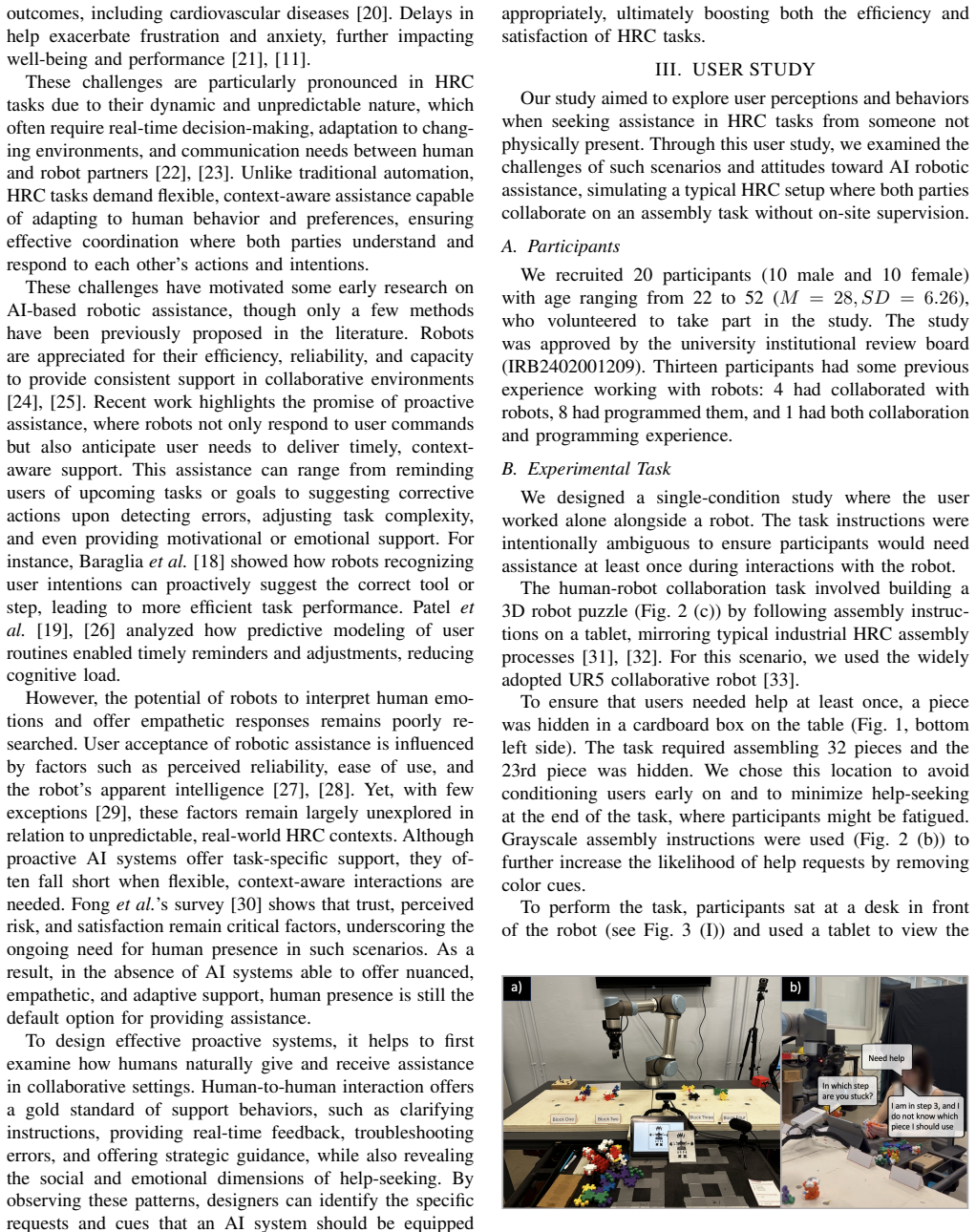
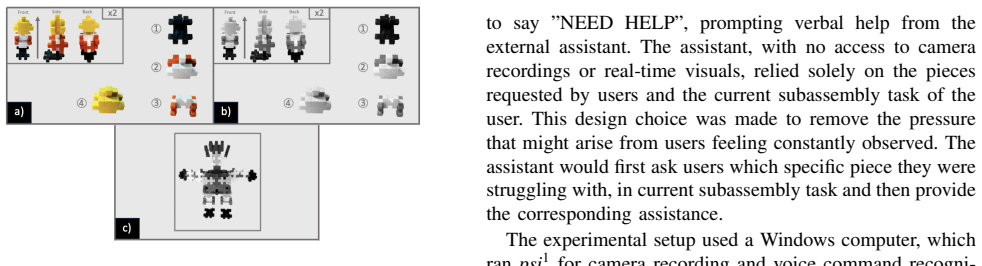
- [Section III.B / Section IV / Section VI] The abstract and several passages speak of analyzing the 'impact' of on-demand versus unsolicited assistance and of human versus artificial assistants, but the study has no control or comparison condition. Participants always had access to a remote human on-demand; there was no no-assistance condition and no proactive/unsolicited condition. Therefore statements about 'impact on task performance' and the design guidelines in Section VI are not established by the data. The paper should describe the findings as descriptive/preliminary or introduce the missing comparison conditions. The deliberate creation of help-need situations (hidden piece, grayscale instructions) also deserves a more prominent caveat: the measured delay and frustration occur in an artificially induced need context, and the representativeness of that context for real HRC tasks is an assumption rather than a demonstrated
minor comments (4)
- [Section V-A] The numbers are not fully consistent: the text says 'twenty participants feeling comfortable seeking help from a robot' and 'seventeen participants reported no such issues with robot assistance.' Clarify whether these are different subquestions and report the exact wording used in the interview.
- [Section III-D] The description of the coding levels says 'Levels 1 through 3 indicate increasing assistance needs,' but the first level is called 'Flow' in Table I. Clarify the naming (Flow vs. Level 1) so the table and definitions align.
- [Section IV-A] The sentence 'Notably, 17 users were stuck at some point ... for around one minute, and 9 of them for more than 2 minutes' would benefit from defining the threshold for 'stuck' and from reporting the durations as ranges rather than approximate summaries.
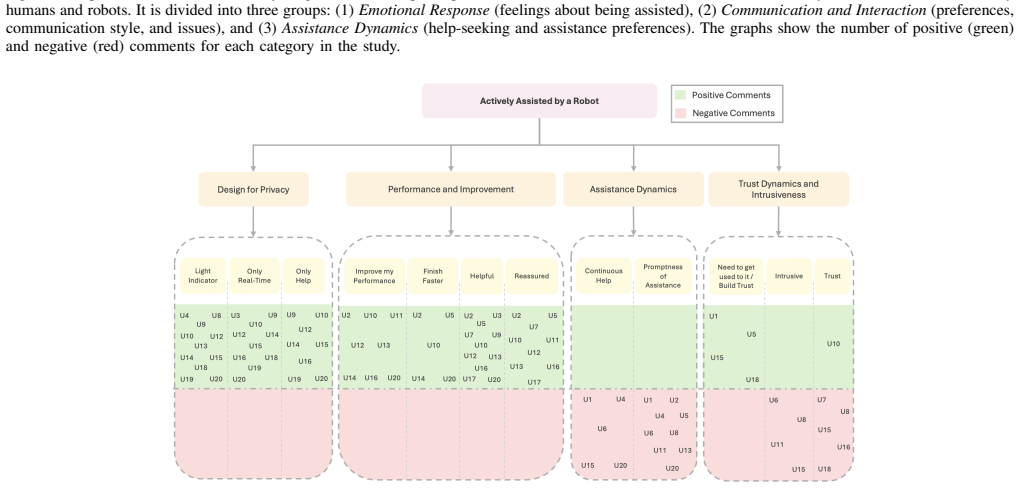
- [General] The figures in Section IV-B present the affinity diagram results with green/red categories; if the paper is read in grayscale, the distinction should be indicated by shape or hatching in addition to color.
Circularity Check
No circular derivation: quantitative behavior and interview self-reports carry the claims; no fitted input is renamed as a prediction and no load-bearing self-citation is used.
full rationale
No circularity found. The quantitative reluctance result (Section IV-A: mean 2.1-minute delay between need onset and request; 28% of task time in help-need states) comes from video coding of behavior in a task where the hidden-piece and grayscale manipulations were intended to create help-need situations (Section III-B). The manipulation makes help needs likely, but it does not by construction determine the delay length, the request rate, or the observed stress behaviors; these are empirical findings. The robot-preference claims (Section V-A and Figs. 4-5) come from semi-structured interview self-reports about imagined robot assistance, not from fitting a parameter to the outcome being predicted; they are hypothetical-preference data, which raises external-validity concerns rather than circularity. The paper itself acknowledges this boundary in Section VII: "it is limited to human assistance." No load-bearing self-citations appear: the cited prior work (e.g., Baraglia et al. [18], Patel et al. [19]) is external and is used for context, not to derive the paper's claims. No uniqueness theorem is imported from the authors' own prior work, and no ansatz is smuggled in via self-citation. The design guidelines in Section VI are presented as a synthesis of participant suggestions and observed patterns; restating one's own empirical observations as guidelines is inductive synthesis, not circular derivation. The apparent statistical inconsistencies in Table I are a data-quality/correctness concern, not a circularity concern. Therefore the derivation chain is self-contained: the conclusions are supported by behavioral measurement and participant reports rather than by reusing the conclusions as inputs.
Assumptions & free parameters
assumptions (3)
- domain assumption Participant self-reports about hypothetical robot assistance predict real help-seeking behavior with robots.
- domain assumption The assistance-level coding scheme (Flow, Levels 1-3) reliably distinguishes genuine need for help from normal task pauses.
- ad hoc to paper The deliberately induced help-need scenario (hidden piece, grayscale instructions) reflects authentic help needs in real HRC tasks.
Cite this review
Pith. "Pith review of Analyzing Reluctance to Ask for Help When Cooperating With Robots: Insights to Integrate Artificial Agents in HRC." pith.science (2026). https://pith.science/paper/R2XG25DA
@misc{pith2026250901450,
  author       = {Pith},
  title        = {Pith review of: Analyzing Reluctance to Ask for Help When Cooperating With Robots: Insights to Integrate Artificial Agents in HRC},
  year         = {2026},
  howpublished = {\url{https://pith.science/paper/R2XG25DA}},
  note         = {Machine review of arXiv:2509.01450}
}
read the original abstract
As robot technology advances, collaboration between humans and robots will become more prevalent in industrial tasks. When humans run into issues in such scenarios, a likely future involves relying on artificial agents or robots for aid. This study identifies key aspects for the design of future user-assisting agents. We analyze quantitative and qualitative data from a user study examining the impact of on-demand assistance received from a remote human in a human-robot collaboration (HRC) assembly task. We study scenarios in which users require help and we assess their experiences in requesting and receiving assistance. Additionally, we investigate participants' perceptions of future non-human assisting agents and whether assistance should be on-demand or unsolicited. Through a user study, we analyze the impact that such design decisions (human or artificial assistant, on-demand or unsolicited help) can have on elicited emotional responses, productivity, and preferences of humans engaged in HRC tasks.
Figures
Figures from the paper (2 more)

Reference graph
Works this paper leans on
-
[1]
The AI revolution is coming to robots: how will it change them?
E. Gibney, “The AI revolution is coming to robots: how will it change them?” Nature, vol. 630, no. 8015, pp. 22–24, 2024
work page 2024
-
[2]
J. Jeon and S. Lee, “Can learners benefit from chatbots instead of humans? a systematic review of human-chatbot comparison research in language education,” Education and Information Technologies , pp. 1–32, 2024
work page 2024
-
[3]
A. Angelidis, E. Solis, F. Lautenbach, W. van der Does, and P. Putman, “I’m going to fail! acute cognitive performance anxiety increases threat-interference and impairs wm performance,” PloS one , vol. 14, no. 2, p. e0210824, 2019
work page 2019
-
[4]
H. M. Van Praag, “Can stress cause depression?” The World Journal of Biological Psychiatry , vol. 6, no. sup2, pp. 5–22, 2005
work page 2005
-
[5]
Association of stress and functional gastrointestinal disorders in high school graduates,
C. Duan, C. Chen, Z. Ouyang, C. Duan, S. Zhang, H. Shang, L. Zhang, X. Xiang, J. Song, K. Zou et al., “Association of stress and functional gastrointestinal disorders in high school graduates,” Journal of Affective Disorders , vol. 292, pp. 305–310, 2021
work page 2021
-
[6]
S. Thomas, E. Tewell, and G. Willson, “Where students start and what they do when they get stuck: A qualitative inquiry into aca- demic information-seeking and help-seeking practices,” The Journal of Academic Librarianship , vol. 43, no. 3, pp. 224–231, 2017
work page 2017
-
[7]
An exploratory study of employee silence: Issues that employees don’t communicate upward and why,
F. J. Milliken, E. W. Morrison, and P. F. Hewlin, “An exploratory study of employee silence: Issues that employees don’t communicate upward and why,” Journal of management studies , vol. 40, no. 6, pp. 1453–1476, 2003
work page 2003
-
[8]
Performance productivity and quality of frontline employees in service organizations,
J. Singh, “Performance productivity and quality of frontline employees in service organizations,” Journal of marketing, vol. 64, no. 2, pp. 15– 34, 2000
work page 2000
Show all 36 references
-
[9]
Work, stress, and well-being,
F. Landy, J. C. Quick, and S. Kasl, “Work, stress, and well-being,” International Journal of Stress Management , vol. 1, pp. 33–73, 1994
1994
-
[10]
Decision factors for remote work adoption: advantages, disadvantages, driving forces and challenges,
R. Ferreira, R. Pereira, I. S. Bianchi, and M. M. da Silva, “Decision factors for remote work adoption: advantages, disadvantages, driving forces and challenges,” Journal of Open Innovation: Technology, Market, and Complexity , vol. 7, no. 1, p. 70, 2021
2021
-
[11]
T. D. Golden, J. F. Veiga, and R. N. Dino, “The impact of professional isolation on teleworker job performance and turnover intentions: does time spent teleworking, interacting face-to-face, or having access to communication-enhancing technology matter?” Journal of applied psy...
2008
-
[12]
“why didn’t you just ask?
V . K. Bohns and F. J. Flynn, ““why didn’t you just ask?” underestimat- ing the discomfort of help-seeking,” Journal of Experimental social psychology, vol. 46, no. 2, pp. 402–409, 2010
2010
-
[13]
When the going gets tough, do the tough ask for help? help seeking and power motivation in organizations,
F. Lee, “When the going gets tough, do the tough ask for help? help seeking and power motivation in organizations,” Organizational behavior and human decision processes , vol. 72, no. 3, pp. 336–363, 1997
1997
-
[14]
A cognitive load theory approach to defining and measuring task complexity through element interactivity,
O. Chen, F. Paas, and J. Sweller, “A cognitive load theory approach to defining and measuring task complexity through element interactivity,” Educational Psychology Review , vol. 35, no. 2, p. 63, 2023
2023
-
[15]
Understanding mental fatigue and its detection: a comparative analysis of assessments and tools,
K. Kunasegaran, A. M. H. Ismail, S. Ramasamy, J. V . Gnanou, B. A. Caszo, and P. L. Chen, “Understanding mental fatigue and its detection: a comparative analysis of assessments and tools,” PeerJ, vol. 11, p. e15744, 2023
2023
-
[16]
Mental fatigue: costs and benefits,
M. A. Boksem and M. Tops, “Mental fatigue: costs and benefits,” Brain research reviews, vol. 59, no. 1, pp. 125–139, 2008
2008
-
[17]
Beyond text: ChatGPT as an emotional resilience support tool for gen z–a sequential ex- planatory design exploration,
K. Kavitha, V . Joshith, and S. Sharma, “Beyond text: ChatGPT as an emotional resilience support tool for gen z–a sequential ex- planatory design exploration,” E-Learning and Digital Media , p. 20427530241259099, 2024
2024
-
[18]
Efficient human-robot collaboration: when should a robot take initiative?
J. Baraglia, M. Cakmak, Y . Nagai, R. P. Rao, and M. Asada, “Efficient human-robot collaboration: when should a robot take initiative?” The International Journal of Robotics Research , vol. 36, no. 5-7, pp. 563– 579, 2017
2017
-
[19]
Proactive robot assistance via spatio- temporal object modeling,
M. Patel and S. Chernova, “Proactive robot assistance via spatio- temporal object modeling,” arXiv preprint arXiv:2211.15501 , 2022
2022 arXiv
-
[20]
Stress and cardiovascular disease,
B. Rishab Revankar, K. R. Reddy, and K. M. Chinnaiyan, “Stress and cardiovascular disease,” in Cardiovascular Risk Assessment in Primary Prevention. Springer, 2022, pp. 413–428
2022
-
[21]
The effects of task difficulty and multitasking on performance,
R. F. Adler and R. Benbunan-Fich, “The effects of task difficulty and multitasking on performance,” Interacting with Computers , vol. 27, no. 4, pp. 430–439, 2015
2015
-
[22]
Human–robot interaction: a survey,
M. A. Goodrich, A. C. Schultz et al. , “Human–robot interaction: a survey,” Foundations and Trends® in Human–Computer Interaction , vol. 1, no. 3, pp. 203–275, 2008
2008
-
[23]
Collaboration in human-robot teams,
G. Hoffman and C. Breazeal, “Collaboration in human-robot teams,” in AIAA 1st intelligent systems technical conference , 2004, p. 6434
2004
-
[24]
Chi, Artificially Intelligent (AI) Social Robots in Service Delivery
H. Chi, Artificially Intelligent (AI) Social Robots in Service Delivery . Washington State University, 2021
2021
-
[25]
Nonverbal signaling for non- humanoid robots during human-robot collaboration,
E. Cha, M. Matari ´c, and T. Fong, “Nonverbal signaling for non- humanoid robots during human-robot collaboration,” in 2016 11th ACM/IEEE International Conference on Human-Robot Interaction (HRI). IEEE, 2016, pp. 601–602
2016
-
[26]
Predicting routine object us- age for proactive robot assistance,
M. Patel, A. Prakash, and S. Chernova, “Predicting routine object us- age for proactive robot assistance,” arXiv preprint arXiv:2309.06252 , 2023
2023 arXiv
-
[27]
User acceptance of information technology: Toward a unified view,
V . Venkatesh, M. G. Morris, G. B. Davis, and F. D. Davis, “User acceptance of information technology: Toward a unified view,” MIS quarterly, pp. 425–478, 2003
2003
-
[28]
Perceived trust in artificial intelligence technologies: A preliminary study,
O. V . Bitkina, H. Jeong, B. C. Lee, J. Park, J. Park, and H. K. Kim, “Perceived trust in artificial intelligence technologies: A preliminary study,” Human Factors and Ergonomics in Manufacturing & Service Industries, vol. 30, no. 4, pp. 282–290, 2020
2020
-
[29]
The emergence of service robots at restau- rants: Integrating trust, perceived risk, and satisfaction,
K. H. Seo and J. H. Lee, “The emergence of service robots at restau- rants: Integrating trust, perceived risk, and satisfaction,” Sustainability, vol. 13, no. 8, p. 4431, 2021
2021
-
[30]
A survey of socially interactive robots,
T. Fong, I. Nourbakhsh, and K. Dautenhahn, “A survey of socially interactive robots,” Robotics and autonomous systems , vol. 42, no. 3- 4, pp. 143–166, 2003
2003
-
[31]
Comparative analysis of mental workload in adaptive human-robot collaboration during assembly tasks,
C. Caiazzo, M. Savkovic, M. Pusica, and N. Nikolic, “Comparative analysis of mental workload in adaptive human-robot collaboration during assembly tasks,” in Proceedings of the European Safety and Reliability Conference (ESREL) , 2024. [Online]. Available: https://esrel2024.co...
2024
-
[32]
Empowering assembly lines with human– robot collaboration for enhanced productivity and safety,
M. Radi and M. A. Matar, “Empowering assembly lines with human– robot collaboration for enhanced productivity and safety,” in AI in Business: Opportunities and Limitations: Volume 2 . Springer, 2024, pp. 91–101
2024
-
[33]
Histodepth-novel depth per- ception for safe collaborative robots,
C. Buerkle, F. Oboril, and K.-U. Scholl, “Histodepth-novel depth per- ception for safe collaborative robots,” in 2023 IEEE/RSJ International Conference on Intelligent Robots and Systems (IROS) . IEEE, 2023, pp. 9677–9684
2023
-
[34]
Czikszentmihalyi, Flow: The psychology of optimal experience
M. Czikszentmihalyi, Flow: The psychology of optimal experience . New York: Harper & Row, 1990
1990
-
[35]
Performance assessment of self-care skills,
J. Rogers, “Performance assessment of self-care skills,” Rehabilitation Psychology, 1989
1989
-
[36]
Using affinity diagrams to evaluate interactive prototypes,
A. Lucero, “Using affinity diagrams to evaluate interactive prototypes,” in IFIP Conference on Human-Computer Interaction. Springer, 2015, pp. 231–248
2015
Reviewed August 5, 2026 · model on record in the stance chip above.
Discussion (0). Sign in to comment.