REVIEW 4 major objections 5 minor 2 cited by
Q-Sched: Pushing the Boundaries of Few-Step Diffusion Models with Quantization-Aware Scheduling
T0 review · 4 major / 5 minor · reviewed 2026-08-05 · deepseek-v4-flash
Pith's one-line read Q-Sched claims that a quantized few-step diffusion model can match or beat full-precision image quality by tuning only two scalar coefficients in the sampling schedule, achieving a 4× model-size reduction without retraining weights.
desk verdict A simple, reference-free scheduler tweak that gives real gains for 4-bit few-step diffusion, but the paper overstates the guarantee and skimps on reproducibility details. read the letter →
The pith
A machine-rendered reading of the paper's core claim, the machinery that carries it, and where it could break.
The reading
What carries the argument
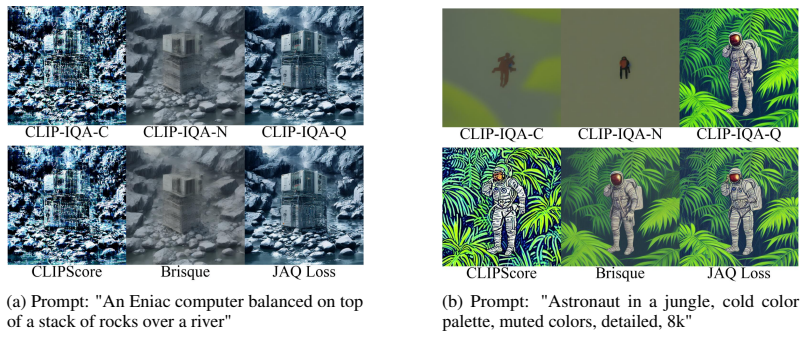
The central object is the modified TCD Strategic Stochastic Sampling update with two learnable scalar preconditioning coefficients, cx and c_epsilon (Eq. 11). The coefficients reweight the two inputs the sampler receives from the previous step—the partially denoised latent xt and the quantized noise prediction E^Q_theta—effectively steering the sampling trajectory away from artifacts induced by quantization and by the few-step distillation itself. The selection mechanism is the JAQ loss, a linear combination of a text-image compatibility metric and a no-reference image quality metric, which serves as a calibration objective that needs no full-precision model or reference images; in practice
What would settle it
Run the same grid search on a 4-step LCM at W3A8 or on a 1-step model and check whether any (cx,c_epsilon) yields FID at or below the full-precision few-step model; if the best pair cannot beat naive quantization, the two-scalar correction is not generally sufficient. Alternatively, compute the optimal coefficients separately on COCO-30k prompts and MJHQ prompts for the same backbone and compare: a large shift in the optimum indicates the correction is prompt-distribution-specific rather than a property of the quantized sampler.
Extended reading notes
Core claim
The central claim is that compressing the denoising backbone of a few-step diffusion model to W4A8 and then re-tuning the sampler's two scalar coefficients restores, and in some configurations exceeds, full-precision generation quality. The two coefficients enter the TCD strategic stochastic sampling update: cx scales the previous latent xt and c_epsilon scales the quantized noise estimate E^Q_theta, so the corrected step is xs = (alpha_s/alpha_s')[(alpha_s'/alpha_t) cx xt - sigma_t c_epsilon E^Q_theta + sigma_s' c_epsilon E^Q_theta] + sqrt(1 - alpha_s^2/alpha_s'^2) z. The coefficients are found by grid search minimizing JAQ(x) = TC(x) + k·IQ(x), a reference-free sum of a text-image compatib
Load-bearing premise
One pair of scalar coefficients, applied to the previous latent and the quantized noise prediction, can correct the quantization-induced trajectory shift well enough for every model, bit-width, step count, and prompt distribution the method is used on.
Editorial extensions
If this is right
- W4A8 quantized few-step models can replace FP16 ones in deployment, cutting backbone memory by 4× while keeping or improving FID, so text-to-image models become practical on consumer GPUs.
- Post-training quantization of diffusion models no longer needs a large calibration set of full-precision outputs: five to twenty prompts and a reference-free loss suffice.
- Quantization and few-step distillation can be combined as complementary compression strategies rather than treated as competing ones.
- The scheduler-level correction is backbone-agnostic, applying to both U-Net and DiT architectures via the same two-scalar recipe.
- The JAQ loss offers a reusable reference-free objective for tuning generative model hyperparameters beyond scheduling, wherever ground truth images are unavailable.
Reading between the lines
- Because the correction is only two global scalars, there is likely headroom to generalize it to per-timestep or per-block coefficients for harder regimes (W3A8, W4A4, 1-step models), where a single pair may not absorb the accumulated error.
- The success of trajectory-level correction suggests that quantization error in few-step diffusion behaves less like additive noise and more like a smooth re-parametrization of the ODE path; if so, the same idea could transfer to other latent-space perturbations such as LoRA merges or activation sparsity.
- The reported W8A8 case on SDXL-Turbo where Q-Sched's FID trailed the baselines hints that the two-scalar correction helps most when quantization actually shifts the trajectory; at higher precision the added degrees of freedom may overfit the small calibration set.
- A direct test would be to measure how much the optimal (cx, c_epsilon) moves when the prompt distribution changes; if the optimum is prompt-specific, the method needs a per-domain calibration step in practice.
Editorial analysis
A structured set of objections, weighed in public.
Referee Report
Summary. The paper proposes Q-Sched, a post-training quantization method for few-step text-to-image diffusion models. Instead of modifying the network weights, Q-Sched adjusts the sampling trajectory by introducing two scalar pre-conditioning coefficients, c_x and c_epsilon, into the TCD-style scheduler (Eq. 11). These coefficients are selected by grid search to minimize a reference-free JAQ loss (Eq. 12), which combines a text-image compatibility term and an image quality term. The method is evaluated on LCM and PCM models with a Stable Diffusion v1.5 backbone (Table 1), on a 2-step PCM with SDXL (Table 2a), and on SDXL-Turbo and FLUX.1[schnell] at multiple bit-widths (Table 2b), with FID, CLIPScore, and large-scale human preference annotations. The authors claim that Q-Sched achieves full-precision accuracy with a 4x reduction in model size and that quantization and few-step distillation are complementary.
Significance. If the empirical claims hold, Q-Sched is an attractive and modular idea: it requires no full-precision calibration, uses only a handful of prompts, and can be applied on top of existing quantization methods. The paper includes a broad set of experiments, including LCM, PCM, SDXL-Turbo, and FLUX.1, and a large-scale user study with more than 80,000 annotations, which is a substantial strength. The central FID-based claims are generally supported by the tables in the lower-bit (W4A8) regimes. However, the paper overgeneralizes in places: the abstract and several statements are contradicted by the W8A8 result in Table 2b, and the theoretical appendix claiming a 'strict guarantee' is mathematically unsound. The absence of error bars, learned coefficient values, grid-search ranges, and the calibration prompt list further limits the reproducibility and strength of the empirical conclusions.
major comments (4)
- [Abstract / Table 2b] The abstract states unconditionally that Q-Sched 'achieves full-precision accuracy with a 4x reduction in model size.' However, Table 2b reports SDXL-Turbo W8A8 with Q-Sched FID 26.34, which is worse than Naive W8A8 (25.49), MixDQ W8A8 (25.16), and FP16 (25.48). In this setting, the proposed scheduler is worse than doing nothing. The main text later says 'advantages are most pronounced in lower-bit regimes,' but the abstract and the sentence 'W4A8 and W8A8 ... yet our method improves over baseline' do not carry this scope. Please restrict the claims to the tested W4A8 regime, or provide a clear explanation and a mechanism that avoids this failure.
- [Section 3 / Appendix H] The central assertion that two scalar coefficients are sufficient is not established. Appendix H's 'strict guarantee' is invalid: Eq. (33) writes E[||Δx0||] as a sum of terms E[||ΔEθ(s)||], but the norm of a sum is not the sum of norms without independence or orthogonality assumptions that are not stated. Moreover, Q-Sched uses global scalars c_x and c_epsilon, while Appendix H analyzes per-step coefficients k_t and m_t; the existence argument for per-step coefficients does not apply to the actual parametrization. The W8A8 result in Table 2b is a concrete counterexample. I recommend either proving a scoped guarantee for the actual two-scalar form, removing Appendix H entirely, or clearly labeling the two-scalar sufficiency as an empirical observation limited to the tested settings.
- [Section 4 / Eq. (12)] For LCM and PCM, the JAQ loss uses TC(x) = CLIPScore(x), and the same metric is then reported as an evaluation metric in Table 1. This creates a mild self-selection loop: CLIPScore improvements in Table 1 are not independent evidence of better text alignment. The FID results are still meaningful because FID is not part of the objective, but the text-alignment claims should be re-validated with a held-out metric or human preference data that was not used in the selection.
- [Appendix B / Reproducibility] Appendix B states 'we do not report error bars at this time.' The paper also does not report the optimized values of c_x and c_epsilon, the grid-search ranges, or the calibration prompt list, despite stating that the calibration set is 'hand-curated.' Several headline improvements are small in absolute FID terms (e.g., Table 1 PCM 2-step: 22.24 vs. 23.33), so without variance estimates it is hard to judge which comparisons are significant. Please add error bars or per-run results, report the selected coefficients and search ranges, and release the calibration prompts.
minor comments (5)
- [Section 4 (Results)] The text says Q-Sched 'outperforms PTQD noise schedules in 4/6 consistency model variants.' Inspection of Table 1 shows it outperforms PTQD in 5 of 6 variants (all except PCM at 8 steps). Please correct this count.
- [Table 2 caption] The caption says 'W4A8 and W8A8 are a 4x and 8x model size reduction ... yet our method improves over baseline.' This is not true for the W8A8 column, where Q-Sched is worse than both Naive and MixDQ. Please specify that the improvement statement applies to W4A8.
- [References] Reference [30] is a duplicate of reference [29] (Latent Consistency Models). Please merge or remove the duplicate.
- [Appendix H.2] The notation in Appendix H.2 defines α_t = 1 − β_t and σ_t = Π α_i, which is nonstandard and appears inconsistent with the use of α_s and α_s' in Eq. (9) as cumulative schedule quantities. Please clarify the noise schedule notation.
- [Figure 5b] The ablation on pre-conditioning coefficients reports PickScore, HPSV2, and JAQ Loss, but not FID. Since the paper's central claims are FID-based, reporting FID for this ablation would strengthen the analysis.
Circularity Check
Not circular overall: main FID claims are independent of the JAQ objective; two minor evaluation self-references (CLIPScore as both objective and metric, and JAQ-Loss row in the ablation) are non-load-bearing.
-
fitted input called prediction
[Section 3 'JAQ: A Joint Alignment Quality Loss Function' and Section 4 Table 1]
"To learn our preconditioning coefficients, cx, cϵ, we apply grid search and evaluate each coefficient combination with respect to the JAQ loss. ... JAQ(x) = TC(x) + k · IQ(x). ... The FID and CLIPScore are calculated with respect to the COCO-30k dataset."
In the CLIP-based variant, TC(x)=CLIPScore(x), so the two scalar coefficients are selected by maximizing CLIPScore on the calibration prompts. The paper then reports CLIPScore in Tables 1 and 2 as an evaluation result. That text-alignment evaluation is not independent: the reported CLIPScore is the same objective used for selection, so improvements on this axis are partly an artifact of the grid search. This does not affect the central FID claims because FID is not part of JAQ; indeed the W8A8 case (Q-Sched 26.34 vs Naive 25.49 on SDXL-Turbo) shows JAQ optimization does not force FID gains.
-
fitted input called prediction
[Section 4, Figure 5b ablation (Pre-Conditioning Coefficients)]
"As shown in Figure 5b, jointly optimizing both cϵ and cx consistently yields the best results across all three metrics: PickScore, HPSv2, and JAQ Loss."
The coefficients are selected by grid search on the JAQ loss, so the JAQ-Loss column in this ablation is the optimization objective, not an independent outcome. Reporting it as supporting evidence for joint optimization is therefore self-referential. The conclusion is not load-bearing because PickScore and HPSv2 are external to the selection objective and agree with the same conclusion.
full rationale
The main derivation is not circular. Q-Sched fits two scalar scheduler coefficients by grid search on the JAQ loss, but the headline results are measured with FID on COCO-30k/MJHQ, and FID is not a component of JAQ. Calibration prompts (hand-curated or from sDCI) are disjoint from the evaluation sets, and the method does not use full-precision inference for calibration. There are no load-bearing self-citations: the cited schedulers, PTQD, and other prior works are external. The two flagged items are evaluation-metric self-references: CLIPScore appears both in the CLIP-based JAQ objective and in the reported tables, and the ablation's JAQ-Loss row uses the selection objective as an outcome metric. Neither is load-bearing because the central FID and user-study claims are not optimized with respect to the same metrics. The user study uses actual human annotations, independent of HPSV2 used in the preference-based JAQ variant. Appendix H's 'strict guarantee' is mathematically unsupported (E[||Δx0||] is not linear in the coefficients, and the zero-error minimum is unattainable with fixed quantization error), but this is a correctness defect, not a circularity. Likewise, the W8A8 FID regression on SDXL-Turbo (26.34 vs Naive 25.49) contradicts the unqualified abstract claim but demonstrates that JAQ selection does not force FID outcomes, i.e., the FID evaluation is not circular. Overall the method is self-contained against external FID and human-preference benchmarks, so the circularity score is low.
Assumptions & free parameters
free parameters (3)
- cx (sample-side preconditioning coefficient) =
not reported
- c_epsilon (model-side preconditioning coefficient) =
not reported
- k (JAQ loss trade-off) =
2
assumptions (4)
- domain assumption TCD strategic stochastic sampling formula (Eq. 9) correctly describes the few-step diffusion process for LCM/PCM variants.
- domain assumption A single pair of scalar coefficients applied uniformly at every denoising step can correct the trajectory shift caused by quantization.
- domain assumption CLIPScore and CLIP-IQA (or AQ-MAP and HPSV2) are valid proxies for the image quality and text alignment of quantized outputs.
- domain assumption Hand-curated 5-20 prompt calibration sets are representative enough to select coefficients that generalize to COCO-30k and MJHQ-30k.
Cite this review
Pith. "Pith review of Q-Sched: Pushing the Boundaries of Few-Step Diffusion Models with Quantization-Aware Scheduling." pith.science (2026). https://pith.science/paper/QEYLI6V6
@misc{pith2026250901624,
  author       = {Pith},
  title        = {Pith review of: Q-Sched: Pushing the Boundaries of Few-Step Diffusion Models with Quantization-Aware Scheduling},
  year         = {2026},
  howpublished = {\url{https://pith.science/paper/QEYLI6V6}},
  note         = {Machine review of arXiv:2509.01624}
}
read the original abstract
Text-to-image diffusion models are computationally intensive, often requiring dozens of forward passes through large transformer backbones. For instance, Stable Diffusion XL generates high-quality images with 50 evaluations of a 2.6B-parameter model, an expensive process even for a single batch. Few-step diffusion models reduce this cost to 2-8 denoising steps but still depend on large, uncompressed U-Net or diffusion transformer backbones, which are often too costly for full-precision inference without datacenter GPUs. These requirements also limit existing post-training quantization methods that rely on full-precision calibration. We introduce Q-Sched, a new paradigm for post-training quantization that modifies the diffusion model scheduler rather than model weights. By adjusting the few-step sampling trajectory, Q-Sched achieves full-precision accuracy with a 4x reduction in model size. To learn quantization-aware pre-conditioning coefficients, we propose the JAQ loss, which combines text-image compatibility with an image quality metric for fine-grained optimization. JAQ is reference-free and requires only a handful of calibration prompts, avoiding full-precision inference during calibration. Q-Sched delivers substantial gains: a 15.5% FID improvement over the FP16 4-step Latent Consistency Model and a 16.6% improvement over the FP16 8-step Phased Consistency Model, showing that quantization and few-step distillation are complementary for high-fidelity generation. A large-scale user study with more than 80,000 annotations further confirms Q-Sched's effectiveness on both FLUX.1[schnell] and SDXL-Turbo.
Figures


Figures from the paper (7 more)




Forward citations
Cited by 2 Pith papers
-
Quantizing Recursive Reasoning Models
Per-tensor 4-bit quantization of weight-tied recursive reasoners induces accumulating activation bias that kills accuracy; per-block scaling (MXInt4) restores it.
-
Holding the FP8 Quality Ceiling at 8-Bit Weights and Activations: INT8 and GGUF Post-Training Quantization of Ideogram 4.0 for Consumer GPUs
INT8 W8A8 post-training quantization of Ideogram 4.0 preserves FP8 quality on a 200-prompt benchmark while outperforming NF4 on CLIP score and offering a favorable quality-memory trade-off via GGUF Q4_K.
Reference graph
Works this paper leans on
-
[1]
Rapidata: An api that provides fast access to large-scale human evaluations, 2025. URL https://www.rapidata.ai/. Accessed: 2025-05-16
work page 2025
-
[2]
Segdiff: Image segmentation with diffusion probabilistic models
Tomer Amit, Eliya Nachmani, Tal Shaharbany, and Lior Wolf. Segdiff: Image segmentation with diffusion probabilistic models. arXiv preprint arXiv:2112.00390, 2021
arXiv 2021
-
[3]
Protein structure and sequence generation with equivariant denoising diffusion probabilistic models
Namrata Anand and Tudor Achim. Protein structure and sequence generation with equivariant denoising diffusion probabilistic models. arXiv preprint arXiv:2205.15019, 2022
arXiv 2022
-
[4]
Structured denoising diffusion models in discrete state-spaces
Jacob Austin, Daniel D Johnson, Jonathan Ho, Daniel Tarlow, and Rianne van den Berg. Structured denoising diffusion models in discrete state-spaces. Advances in Neural Information Processing Systems, 34:17981–17993, 2021
work page 2021
-
[5]
Blended diffusion for text-driven editing of natural images
Omri Avrahami, Dani Lischinski, and Ohad Fried. Blended diffusion for text-driven editing of natural images. In Proceedings of the IEEE/CVF Conference on Computer Vision and Pattern Recognition, pages 18208–18218, 2022
work page 2022
-
[6]
Label-efficient semantic segmentation with diffusion models
Dmitry Baranchuk, Ivan Rubachev, Andrey V oynov, Valentin Khrulkov, and Artem Babenko. Label-efficient semantic segmentation with diffusion models. arXiv preprint arXiv:2112.03126, 2021
arXiv 2021
-
[7]
Black Forest Labs. Flux.1-schnell. https://huggingface.co/black-forest-labs/FLUX. 1-schnell, 2024. Accessed: 2025-05-14
work page 2024
-
[8]
Denoising pretraining for semantic segmentation
Emmanuel Asiedu Brempong, Simon Kornblith, Ting Chen, Niki Parmar, Matthias Minderer, and Mohammad Norouzi. Denoising pretraining for semantic segmentation. In Proceedings of the IEEE/CVF Conference on Computer Vision and Pattern Recognition, pages 4175–4186, 2022
work page 2022
Show all 55 references
-
[9]
High-frequency space diffusion models for accelerated mri
Chentao Cao, Zhuo-Xu Cui, Shaonan Liu, Dong Liang, and Yanjie Zhu. High-frequency space diffusion models for accelerated mri. arXiv preprint arXiv:2208.05481, 2022
2022 arXiv
-
[10]
Q-dit: Accurate post-training quantization for diffusion transformers
Lei Chen, Yuan Meng, Chen Tang, Xinzhu Ma, Jingyan Jiang, Xin Wang, Zhi Wang, and Wenwu Zhu. Q-dit: Accurate post-training quantization for diffusion transformers. arXiv preprint arXiv:2406.17343, 2024
2024 arXiv
-
[11]
Structural pruning for diffusion models
Gongfan Fang, Xinyin Ma, and Xinchao Wang. Structural pruning for diffusion models. Advances in neural information processing systems, 36, 2024
2024
-
[12]
Squant: On-the-fly data-free quantization via diagonal hessian approximation
Cong Guo, Yuxian Qiu, Jingwen Leng, Xiaotian Gao, Chen Zhang, Yunxin Liu, Fan Yang, Yuhao Zhu, and Minyi Guo. Squant: On-the-fly data-free quantization via diagonal hessian approximation. arXiv preprint arXiv:2202.07471, 2022
2022 arXiv
-
[13]
Ptqd: Accurate post-training quantization for diffusion models
Yefei He, Luping Liu, Jing Liu, Weijia Wu, Hong Zhou, and Bohan Zhuang. Ptqd: Accurate post-training quantization for diffusion models. Advances in Neural Information Processing Systems, 36, 2024
2024
-
[14]
Clipscore: A reference-free evaluation metric for image captioning
Jack Hessel, Ari Holtzman, Maxwell Forbes, Ronan Le Bras, and Yejin Choi. Clipscore: A reference-free evaluation metric for image captioning. arXiv preprint arXiv:2104.08718, 2021
2021 arXiv
-
[15]
Gans trained by a two time-scale update rule converge to a local nash equilibrium
Martin Heusel, Hubert Ramsauer, Thomas Unterthiner, Bernhard Nessler, and Sepp Hochreiter. Gans trained by a two time-scale update rule converge to a local nash equilibrium. Advances in neural information processing systems, 30, 2017
2017
-
[16]
Denoising diffusion probabilistic models
Jonathan Ho, Ajay Jain, and Pieter Abbeel. Denoising diffusion probabilistic models. Advances in neural information processing systems, 33:6840–6851, 2020
2020
-
[17]
Cascaded diffusion models for high fidelity image generation
Jonathan Ho, Chitwan Saharia, William Chan, David J Fleet, Mohammad Norouzi, and Tim Salimans. Cascaded diffusion models for high fidelity image generation. J. Mach. Learn. Res., 23(47):1–33, 2022. 11
2022
-
[18]
Knowledge diffusion for distillation
Tao Huang, Yuan Zhang, Mingkai Zheng, Shan You, Fei Wang, Chen Qian, and Chang Xu. Knowledge diffusion for distillation. Advances in Neural Information Processing Systems, 36, 2024
2024
-
[19]
Rethinking fid: Towards a better evaluation metric for image generation
Sadeep Jayasumana, Srikumar Ramalingam, Andreas Veit, Daniel Glasner, Ayan Chakrabarti, and Sanjiv Kumar. Rethinking fid: Towards a better evaluation metric for image generation. In Proceedings of the IEEE/CVF Conference on Computer Vision and Pattern Recognition, pages 9307–9...
2024
-
[20]
Elucidating the design space of diffusion-based generative models
Tero Karras, Miika Aittala, Timo Aila, and Samuli Laine. Elucidating the design space of diffusion-based generative models. arXiv preprint arXiv:2206.00364, 2022
2022 arXiv
-
[21]
Q-refine: A perceptual quality refiner for ai-generated image
Chunyi Li, Haoning Wu, Zicheng Zhang, Hongkun Hao, Kaiwei Zhang, Lei Bai, Xiaohong Liu, Xiongkuo Min, Weisi Lin, and Guangtao Zhai. Q-refine: A perceptual quality refiner for ai-generated image. In 2024 IEEE International Conference on Multimedia and Expo (ICME), pages 1–6. IEEE, 2024
2024
-
[22]
Playground v2.5: Three insights towards enhancing aesthetic quality in text-to-image generation, 2024
Daiqing Li, Aleks Kamko, Ehsan Akhgari, Ali Sabet, Linmiao Xu, and Suhail Doshi. Playground v2.5: Three insights towards enhancing aesthetic quality in text-to-image generation, 2024
2024
-
[23]
Svdquant: Absorbing outliers by low-rank component for 4-bit diffusion models
Muyang Li, Yujun Lin, Zhekai Zhang, Tianle Cai, Junxian Guo, Xiuyu Li, Enze Xie, Chenlin Meng, Jun-Yan Zhu, and Song Han. Svdquant: Absorbing outliers by low-rank component for 4-bit diffusion models. In The Thirteenth International Conference on Learning Representations, 2025
2025
-
[24]
Diffusion-lm improves controllable text generation
Xiang Li, John Thickstun, Ishaan Gulrajani, Percy S Liang, and Tatsunori B Hashimoto. Diffusion-lm improves controllable text generation. Advances in Neural Information Processing Systems, 35:4328–4343, 2022
2022
-
[25]
Q-diffusion: Quantizing diffusion models
Xiuyu Li, Long Lian, Yijiang Liu, Huanrui Yang, Zhen Dong, Daniel Kang, Shanghang Zhang, and Kurt Keutzer. Q-diffusion: Quantizing diffusion models. arXiv preprint arXiv:2302.04304, 2023
2023 arXiv
-
[26]
Q-dm: An efficient low-bit quantized diffusion model
Yanjing Li, Sheng Xu, Xianbin Cao, Xiao Sun, and Baochang Zhang. Q-dm: An efficient low-bit quantized diffusion model. Advances in Neural Information Processing Systems, 36, 2024
2024
-
[27]
Microsoft coco: Common objects in context
Tsung-Yi Lin, Michael Maire, Serge Belongie, James Hays, Pietro Perona, Deva Ramanan, Piotr Dollár, and C Lawrence Zitnick. Microsoft coco: Common objects in context. In Computer Vision–ECCV 2014: 13th European Conference, Zurich, Switzerland, September 6-12, 2014, Proceedings...
2014
-
[28]
Instaflow: One step is enough for high-quality diffusion-based text-to-image generation
Xingchao Liu, Xiwen Zhang, Jianzhu Ma, Jian Peng, et al. Instaflow: One step is enough for high-quality diffusion-based text-to-image generation. In The Twelfth International Conference on Learning Representations, 2023
2023
-
[30]
Latent consistency models: Synthesizing high-resolution images with few-step inference
Simian Luo, Yiqin Tan, Longbo Huang, Jian Li, and Hang Zhao. Latent consistency models: Synthesizing high-resolution images with few-step inference. arXiv preprint arXiv:2310.04378, 2023
2023 arXiv
-
[31]
Sdedit: Guided image synthesis and editing with stochastic differential equations
Chenlin Meng, Yutong He, Yang Song, Jiaming Song, Jiajun Wu, Jun-Yan Zhu, and Stefano Ermon. Sdedit: Guided image synthesis and editing with stochastic differential equations. In International Conference on Learning Representations, 2021
2021
-
[32]
No-reference image quality assessment in the spatial domain
Anish Mittal, Anush Krishna Moorthy, and Alan Conrad Bovik. No-reference image quality assessment in the spatial domain. IEEE Transactions on image processing, 21(12):4695–4708, 2012
2012
-
[33]
Scalable diffusion models with transformers
William Peebles and Saining Xie. Scalable diffusion models with transformers. In Proceedings of the IEEE/CVF international conference on computer vision, pages 4195–4205, 2023. 12
2023
-
[34]
Sdxl: Improving latent diffusion models for high-resolution image synthesis
Dustin Podell, Zion English, Kyle Lacey, Andreas Blattmann, Tim Dockhorn, Jonas Müller, Joe Penna, and Robin Rombach. Sdxl: Improving latent diffusion models for high-resolution image synthesis. arXiv preprint arXiv:2307.01952, 2023
2023 arXiv
-
[35]
Hierarchical text-conditional image generation with clip latents
Aditya Ramesh, Prafulla Dhariwal, Alex Nichol, Casey Chu, and Mark Chen. Hierarchical text-conditional image generation with clip latents. arXiv preprint arXiv:2204.06125, 2022
2022 arXiv
-
[36]
High- resolution image synthesis with latent diffusion models
Robin Rombach, Andreas Blattmann, Dominik Lorenz, Patrick Esser, and Björn Ommer. High- resolution image synthesis with latent diffusion models. In Proceedings of the IEEE/CVF Conference on Computer Vision and Pattern Recognition, pages 10684–10695, 2022
2022
-
[37]
U-net: Convolutional networks for biomedical image segmentation
Olaf Ronneberger, Philipp Fischer, and Thomas Brox. U-net: Convolutional networks for biomedical image segmentation. In Medical image computing and computer-assisted intervention–MICCAI 2015: 18th international conference, Munich, Germany, October 5-9, 2015, proceedings, part ...
2015
-
[38]
Adversarial diffusion distillation
Axel Sauer, Dominik Lorenz, Andreas Blattmann, and Robin Rombach. Adversarial diffusion distillation. In European Conference on Computer Vision, pages 87–103. Springer, 2024
2024
-
[39]
Post-training quantization on diffusion models
Yuzhang Shang, Zhihang Yuan, Bin Xie, Bingzhe Wu, and Yan Yan. Post-training quantization on diffusion models. arXiv preprint arXiv:2211.15736, 2022
2022 arXiv
-
[40]
Temporal dynamic quantization for diffusion models
Junhyuk So, Jungwon Lee, Daehyun Ahn, Hyungjun Kim, and Eunhyeok Park. Temporal dynamic quantization for diffusion models. Advances in Neural Information Processing Systems, 36, 2024
2024
-
[41]
Denoising diffusion implicit models
Jiaming Song, Chenlin Meng, and Stefano Ermon. Denoising diffusion implicit models. arXiv preprint arXiv:2010.02502, 2020
2010 arXiv
-
[42]
Kingma, Abhishek Kumar, Stefano Ermon, and Ben Poole
Yang Song, Jascha Sohl-Dickstein, Diederik P. Kingma, Abhishek Kumar, Stefano Ermon, and Ben Poole. Score-based generative modeling through stochastic differential equations, 2021
2021
-
[43]
Consistency models
Yang Song, Prafulla Dhariwal, Mark Chen, and Ilya Sutskever. Consistency models. arXiv preprint arXiv:2303.01469, 2023
2023 arXiv
-
[44]
Towards accurate data-free quantization for diffusion models
Changyuan Wang, Ziwei Wang, Xiuwei Xu, Yansong Tang, Jie Zhou, and Jiwen Lu. Towards accurate data-free quantization for diffusion models. arXiv preprint arXiv:2305.18723, 2(5), 2023
2023 arXiv
-
[45]
Phased consistency model
Fu-Yun Wang, Zhaoyang Huang, Alexander William Bergman, Dazhong Shen, Peng Gao, Michael Lingelbach, Keqiang Sun, Weikang Bian, Guanglu Song, Yu Liu, et al. Phased consistency model. arXiv preprint arXiv:2405.18407, 2024
2024 arXiv
-
[46]
Quest: Low-bit diffusion model quantization via efficient selective finetuning
Haoxuan Wang, Yuzhang Shang, Zhihang Yuan, Junyi Wu, and Yan Yan. Quest: Low-bit diffusion model quantization via efficient selective finetuning. arXiv preprint arXiv:2402.03666, 2024
2024 arXiv
-
[47]
Exploring clip for assessing the look and feel of images
Jianyi Wang, Kelvin CK Chan, and Chen Change Loy. Exploring clip for assessing the look and feel of images. In Proceedings of the AAAI Conference on Artificial Intelligence, volume 37, pages 2555–2563, 2023
2023
-
[48]
Image quality assessment: from error visibility to structural similarity
Zhou Wang, Alan C Bovik, Hamid R Sheikh, and Eero P Simoncelli. Image quality assessment: from error visibility to structural similarity. IEEE transactions on image processing, 13(4): 600–612, 2004
2004
-
[49]
Human preference score v2: A solid benchmark for evaluating human preferences of text-to-image synthesis
Xiaoshi Wu, Yiming Hao, Keqiang Sun, Yixiong Chen, Feng Zhu, Rui Zhao, and Hongsheng Li. Human preference score v2: A solid benchmark for evaluating human preferences of text-to-image synthesis. CoRR, 2023
2023
-
[50]
Diffusion probabilistic modeling for video generation
Ruihan Yang, Prakhar Srivastava, and Stephan Mandt. Diffusion probabilistic modeling for video generation. arXiv preprint arXiv:2203.09481, 2022
2022 arXiv
-
[51]
Cogvideox: Text-to-video diffusion models with an expert transformer
Zhuoyi Yang, Jiayan Teng, Wendi Zheng, Ming Ding, Shiyu Huang, Jiazheng Xu, Yuanming Yang, Wenyi Hong, Xiaohan Zhang, Guanyu Feng, et al. Cogvideox: Text-to-video diffusion models with an expert transformer. arXiv preprint arXiv:2408.06072, 2024. 13
2024 arXiv
-
[52]
One-step diffusion with distribution matching distillation
Tianwei Yin, Michaël Gharbi, Richard Zhang, Eli Shechtman, Fredo Durand, William T Freeman, and Taesung Park. One-step diffusion with distribution matching distillation. arXiv preprint arXiv:2311.18828, 2023
2023 arXiv
-
[53]
Mixdq: Memory-efficient few-step text-to-image diffusion models with metric-decoupled mixed precision quantization
Tianchen Zhao, Xuefei Ning, Tongcheng Fang, Enshu Liu, Guyue Huang, Zinan Lin, Shengen Yan, Guohao Dai, and Yu Wang. Mixdq: Memory-efficient few-step text-to-image diffusion models with metric-decoupled mixed precision quantization. In European Conference on Computer Vision, p...
2024
-
[54]
Which image is of higher quality and more aesthetically pleasing?
Jianbin Zheng, Minghui Hu, Zhongyi Fan, Chaoyue Wang, Changxing Ding, Dacheng Tao, and Tat-Jen Cham. Trajectory consistency distillation. arXiv preprint arXiv:2402.19159, 2024. 14 A Details on User Preference Assessment We design our evaluation setup following the user prefere...
2024 arXiv
-
[55]
The quantized model’s distribution shift can be modeled through a linear correction term
-
[56]
Why is Q-Sched able to learn a better noise schedule when it is also a linear correction?
The uncorrelated quantization noise is normally distributed. While these assumptions are similar to prior work on diffusion models, they are likely to break down on the few-step diffusions where the denoising process is distilled from many steps and is not expected to be linea...
Reviewed August 5, 2026 · model on record in the stance chip above.
Discussion (0). Sign in to comment.